From Surf Wiki (app.surf) — the open knowledge base
2013 Shahbag protests
Protest in Shahbag, Bangladesh;2013

Protest in Shahbag, Bangladesh;2013
| Field | Value |
|---|---|
| title | 2013 Shahbag protests |
| partof | Trial for Bangladesh genocide from Bangladesh Liberation War |
| image | Shahbag Projonmo Square Uprising Demanding Death Penalty of the War Criminals of 1971 in Bangladesh 32.jpg |
| image_size | 285px |
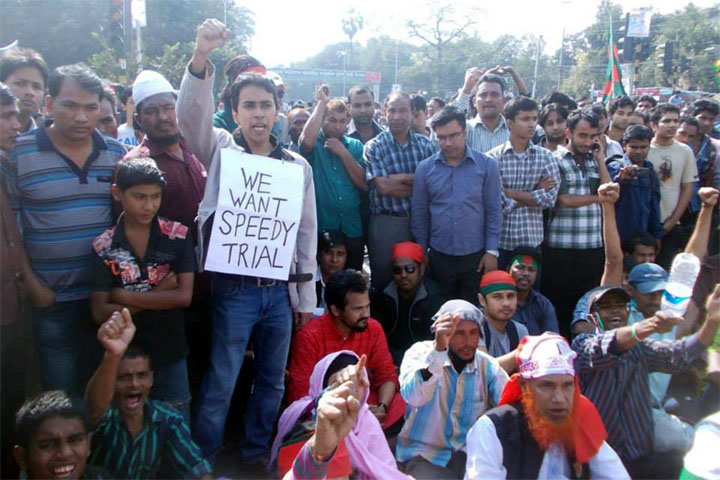
| caption | Demonstrators in Shahbag in February 2013 |
| date | 5 February 2013 – 6 March 2013 |
| place | Bangladesh (began at Shahbagh Square, Dhaka) |
| coordinates | |
| goals | * Capital punishment for those convicted of war crimes during the Bangladesh Liberation War by the ICT |
| * Ban of Jamaat-e-Islami from politics<ref name | "thedailystar1" |
| * Boycott of Jamaat institutions<ref name | vow/ |
| methods | * Civil resistance |
| result | * Government passed a new act to swiftly execute the verdict of war criminals, |
| * 5 Jamaat and 1 BNP leader were executed,<ref name | aljazeera.mollah |
| * Emerging of Hifazat-e-Islam Bangladesh<ref name | "hefajat's_rise_aljazeera" |
| * Bangladesh Supreme Court postponed the registration of the Bangladesh Jamaat-e-Islami political party making them unfit to contest the general elections<ref name | "aljazeera.com" |
| leadfigures1 | * Imran H Sarkar |
| leadfigures2 | * Shah Ahmad Shafi |
| side1 | Directly |
| side2 | Directly |
- Ban of Jamaat-e-Islami from politics
- Boycott of Jamaat institutions
- Demonstrations
- Online activism
- 5 Jamaat and 1 BNP leader were executed,
- Emerging of Hifazat-e-Islam Bangladesh
- Bangladesh Supreme Court postponed the registration of the Bangladesh Jamaat-e-Islami political party making them unfit to contest the general elections
- Bangladesh Jamaat-e-Islami went underground
- Lucky Akter
- Nasiruddin Yousuff
- Muhammed Zafar Iqbal
- Junaid Babunagari
- Mahmudur Rahman
- Bangladesh Online Activist Network
- Leftist progressive Student Alliance
- Bangladesh Students Union
- Socialist Students' Front
- Revolutionary Students Unity of Bangladesh
- Awami League
- Bangladesh Chhatra League
- Bangladesh Awami Jubo League
- Sammilito Sangskritik Jote Indirectly
- Grand Alliance (Bangladesh)
- Communist Party of Bangladesh
- Bangladesh Jamaat-e-Islami
- Bangladesh Islami Chhatra Shibir
- Hefazat-e-Islam Bangladesh Indirectly
- Bangladesh Nationalist Party
- Jatiya Party (Ershad)
- 18 Party Alliance The Shahbag protests were widespread demonstrations held in Bangladesh in 2013. On 5 February 2013, protests ignited in Shahbagh, Bangladesh, fuelled by the call for the execution of the convicted war criminal Abdul Quader Mollah. Previously sentenced to life imprisonment, Mollah was convicted on five of six counts of war crimes by the International Crimes Tribunal of Bangladesh. Mollah supported West Pakistan during the 1971 Bangladesh Liberation War and played a crucial role in the murder of numerous Bengali nationalists and intellectuals. The demonstrations also sought the government's ban on Jamaat-e-Islami, from participating in politics, including elections, and a boycott of institutions supporting or affiliated with the group.
Protesters perceived Mollah's initial sentence of life imprisonment as unduly lenient, leading bloggers and online activists to mobilize additional protests at Shahbagh, resulting in heightened participation in the demonstrations. Jamaat orchestrated several counter-protests challenging the tribunal's validity and the protest movement, advocating for the release of those accused and convicted.
On 15 February, blogger and activist Ahmed Rajib Haider was killed outside his house, by members of an Islamist conservative terrorist group, Ansarullah Bangla Team, affiliated with the student wing of Jamaat-e-Islami, leading to widespread condemnation and outrage during the heightened time. On 27 February of the same year, the war tribunal convicted Delwar Hossain Sayeedi, a prominent fundamental-Islamist, of war crimes against humanity and subsequently sentenced him to death; the sentence was later commuted to life imprisonment.
Historical context
From March to December 1971, East Pakistan engaged in a nine-month conflict against West Pakistan. The Indian Army, having provided guerrilla training to the Mukti Bahini, entered the war on 3 December 1971, supporting East Pakistan's liberation. The armed conflict culminated on 16 December 1971, with the surrender of the Pakistani Armed Forces to the joint force of Bangladesh and India in East Pakistan. This surrender marked the formation of the People's Republic of Bangladesh as an independent and sovereign nation.
According to the famous Blood telegram from the United States consulate in Dhaka (formerly known as 'Dacca') to the State Department, many atrocities had been committed by the Pakistan Army and its supporter Razakars and Al-Badar militia. Time reported a high-ranking US official as saying, "It is the most incredible, calculated killing since the days of the Nazis in Poland." Estimates are that one to three million people were killed, nearly a quarter of a million women were raped and more than ten million people fled to India to escape persecution.
A paramilitary force known as the Razakars was created by the May 1971 Razakar Ordinance promulgated by Tikka Khan, the governor of East Pakistan. The ordinance stipulated the creation of a volunteer force, trained and equipped by the provincial government.
The majority of East Pakistanis supported the call to create a free and independent Bangladesh during the Liberation War. However, Pakistani supporters and members of Islamic political parties, particularly Jamaat-e-islami and its east Pakistan student wing Islami Chatra Sangha (ICS, ), the Muslim League, the Pakistan Democratic Party (PDP) Council and Nezam-e-Islami, collaborated with the Pakistani army to resist the formation of an independent Bangladesh. The students belonging to Islami Chatra Sangha were known as the Al-Badr force; people belonging to Jamaat-e-Islami Pakistan, Muslim League, Nizam-e-Islami and similar groups were called Al-Shams, and the Urdu-speaking people (generally known as Bihari) were known as Al-Mujahid.
After independence
In November 1973 Sheikh Mujibur Rahman issued a general pardon for the war criminals during the liberation war. Under Ershad Jamaat-e-Islami participated in 1986 election. In the 1991 election, which was the first free and fair election after independence, Jamaat got 18 seats out of 300 and gained 12.2% of vote.
In 1992, the distinguished Bangladeshi writer and political activist, Jahanara Imam, led the war-crime tribunal committee, Ekattorer Ghatak Dalal Nirmul Committee, advocating for the prosecution of Ghulam Azam, the leader of Jamaat-e-Islami and a convicted war criminal. On 26 March 1992, the committee organized mock trials in Dhaka, known as Gono Adalat (The People's Court), symbolically 'sentencing' individuals they accused of being war criminals.
In the 2001 general election, Bangladesh Nationalist party in coalition with Jamaat-e-Islami won the election. From 2001 to 2003, the leader of Jamat-e-Islami Motiur Rahman Nizami served as the Minister of Agriculture, then as the Minister of Industry from 2003 to 2006, and general the secretary Ali Ahsan Mohammad Mojaheed served the Ministry of Social Welfare between 2001 and 2006.
International Crimes Tribunal (ICT) of 2010
Since 2000, there has been growing demands in Bangladesh for justice related to war crimes committed during the 1971 struggle; the issue was central to the 2008 general election. | access-date = 19 September 2010 | archive-url = https://web.archive.org/web/20140704223548/http://www.thaindian.com/newsportal/uncategorized/dhaka-body-lists-war-criminals-of-1971_10034353.html | archive-date = 4 July 2014 | url-status = dead}} | access-date = 19 September 2010 | archive-date = 11 May 2012 | archive-url = https://web.archive.org/web/20120511195609/http://www.thedailystar.net/magazine/2008/07/02/ca.htm | url-status = live
The Grand Alliance won the election (held on 29 December 2008) with a two-thirds majority, based in part on its promise to prosecute alleged war criminals.{{Cite news | access-date = 19 September 2010 | archive-date = 4 March 2015 | archive-url = https://web.archive.org/web/20150304223758/http://bdnews24.com/bangladesh/election-2008/2008/12/30/a-historic-landslide-for-hasina | url-status = live | access-date = 19 September 2010 | archive-date = 5 March 2016 | archive-url = https://web.archive.org/web/20160305090123/http://www.cnn.com/2008/WORLD/asiapcf/12/30/bangladesh.elections/ | url-status = live On 29 January 2009 the new Parliament unanimously passed a resolution to prosecute war criminals. The government intended to use the 1973 law: the International Crimes (Tribunals) Act. The government worked to amend the law, updating it and incorporating in it other nations' experience.{{Cite news | access-date = 13 November 2015 | archive-date = 4 March 2016 | archive-url = https://web.archive.org/web/20160304112147/http://archive.thedailystar.net/newDesign/news-details.php?nid=96243 | url-status = live
On 25 March 2010, the Awami-led government announced the formation of a three-member tribunal, a seven-member investigation agency, and a twelve-member prosecution team to conduct the trials under the ICT Act 1973. The panel of three judges included Fazle Kabir and Zahir Ahmed, with Mohammed Nizamul Huq as chairman. Abdul Matin, Abdur Rahim, Kutubur Rahman, Shamsul Arefin, Mir Shahidul Islam, Nurul Islam and M. Abdur Razzak Khan were appointed to assist the state prosecutors. Golam Arif Tipu was named Chief Prosecutor. Others prosecutors were Syed Rezaur Rahman, Golam Hasnayen, Rana Das Gupta, Zahirul Huq, Nurul Islam Sujan, Syed Haider Ali, Khandaker Abdul Mannan, Mosharraf Hossain Kajal, Zead Al Malum, Sanjida Khanom, and Sultan Mahmud Semon.
{{anchor|Verdicts from Tribunal}}Verdicts
A formal charge was filed by the prosecution against Abdul Quader Mollah on 18 December 2011. He was charged with:
- The Pallab murder
- Killing pro-liberation poet Meherunnesa, her mother and two brothers
- The Khandoker Abu Taleb killing
- The Ghatar Char and Bhawal Khan Bari killings
- The Alubdi mass killing (344 people)
- The rape and murder of Hazrat Ali and his family
On 5 February 2013, the ICT found Mollah guilty of crimes against humanity. The day before the verdict was announced, Bangladesh Jamaat-e-Islami announced a nationwide dawn-to-dusk general strike for 5 February in protest of their leader's conviction.
{{anchor|Demands of the protests}}Protesters' demands
Over several days, protesters increased their demands, asking for:
- Death penalty for Mollah
- Death sentences for those convicted of war crimes by the International War Crimes Tribunal
- A ban of Jamaat from Bangladeshi politics
- A boycott of Jamaat institutions
{{anchor|Development of protest}}Development
{{anchor|Protests start}}Origins
Protest began right after the verdict was announced. Student organizations started the protest immediately after the Judgement in the Shahbagh square. On 7 February, demonstrations began at 8 am. Thousands of people gathered with banners, posters, Bangladeshi flags and placards in Shahbagh with their demands. On Friday afternoon, a mass rally was held at Shahbagh with an estimated attendance of more than 100,000.
On 12 February, protesters observed three minutes of silence at 4 pm at Shahbagh and all across Bangladesh. In Dhaka, traffic was stopped as thousands of people took to the streets, formed human chains and stood in silence. A Bangladesh Premier League game at the Sher-e-Bangla National Stadium halted for three minutes, as players and supporters observed the silence. Parliamentarians and the police also joined the protest. Bengali singer Kabir Suman wrote a song entitled "Tin Minit" ("Three Minutes") in honour of the silent protest.
Further developments
On 21 February, International Mother Language Day, the number of protesters reached a new high. Its leadership declared 26 March 2013, the Independence Day of Bangladesh, as the deadline for the government to ban Jamaat-e-Islami from politics.[[File:Shahbag Projonmo Square Uprising Demanding Death Penalty of the War Criminals of 1971 in Bangladesh 09.jpg|thumb|240px|alt=Protesters at night, chanting and holding torches|Protesters at [[Shahbag Square|Shahbagh Square]]]]Seven protesters began a fast until death on 26 March at 10:30 pm in front of the National Museum, protesting "inadequate government action" to ban Jamaat in response to the Shahbagh protesters' ultimatum. The protesters said at a press briefing that they would send an open letter to Prime Minister Hasina during the 100th hour of their protests. More than 100 organizations expressed solidarity with the hunger strikers.
Sentencing of Delwar Hossain Sayeedi
On 28 February the International Crimes Tribunal sentenced Delwar Hossain Sayeedi, Nayeb-e-Ameer (vice-president) of Jamaat-e-Islami, to death for convictions on 8 out of 20 charges of war crimes and crimes against humanity committed during the 1971 Bangladesh Liberation War.
{{anchor|Counter protests}}Counter-demonstrations
Jamaat followers were enraged by the decision, claiming that the case against Sayeedi was politically motivated. His lawyer, Abdur Razzaq, accused authorities of preventing a key witness from testifying and intentionally slanting the process. "This is a perverse judgment. It is inconceivable that a court of law awarded him a conviction. This prosecution was for a political purpose", Razzaq said. an additional eight hundred were injured.
Clashes between police and Jamaat-e-Islami workers continued on 1 March, spreading to the northern districts of Gaibandha and Chapai Nawabganj. Opposition leader Khaleda Zia criticised government and called for a demonstration in the capital, Dhaka. Security measures were increased to prevent the situation from escalating. The death toll rose to forty-four (including six policemen). Former prime minister and BNP member Khaleda Zia declared a nationwide dawn-to-dusk strike for 5 March, and called for countrywide rallies on 2 March to protest what she called government corruption, misrule, oppression, and "mass killings".
Violent conflict continued on 2 March, with another four deaths and hundreds of injuries. In Chittagong district police opened fire on Jamaat-e-Islami protesters, leading to three deaths. In Nilphamari, a young person died in a clash between protesters and police.
On 3 March, violence continued as the Jamaat-organised strike began. In Bogra Jamaat supporters attacked police outposts with sticks and homemade bombs, leading to at least eight deaths. In Godagari two deaths were reported in a similar incident, More than 40 temples and many statues were destroyed and scores of houses set ablaze, leaving hundreds of people homeless throughout the country.
Amnesty International has urged the Bangladeshi government to provide better protection for minority Hindus. Abbas Faiz, the organization's Bangladesh researcher, has noted that the attacks on the Hindu community were a shocking development in the recent history of Bangladesh.
Reactions
{{anchor|Domestic responses}}Domestic response

The Shahbagh protests has attracted people from all walks of life. The Shahbagh intersection at the centre of the protests has been referred to as "Generation Circle" ( Projônmo Chôttor) or "Shahbagh Square", in a nod to the events which unfolded in Tahrir Square, Cairo. The protest spread from Shahbagh to other parts of the country, with sit-ins and demonstrations in Chittagong, Rajshahi, Khulna, Sylhet, Barisal, Mymensingh, Rajbari, Rangpur, Comilla, Bogra, Narayanganj, Sunamganj, Noakhali and Narsingdi.
{{anchor|Political party response to protests}}Political response
State Minister for Law, Quamrul Islam, said that the verdict against Abdul Quader Mollah could have been different if people had taken to the streets sooner. The government is planning to file appeals with the Supreme Court contesting the sentence for Mollah. On 11 February the Cabinet approved proposed amendments to the International Crimes (Tribunals) Act 1973, introducing a provision for plaintiffs to appeal verdicts handed down by the tribunal. This amendment, if passed, would enable the state to appeal Mollah's life sentence.
Jamaat-e-Islami, which was already staging protests against the impending trial of its leaders, called for a general strike. Jamaat continues to demand that the international war crimes tribunal be stopped and its party leaders freed. Jamaat supporters had staged nationwide demonstrations with increasing frequency from November 2012 to February 2013, demanding the release of its leaders. Actions included firing gunshots, smashing and setting fire to vehicles and detonating homemade bombs. Violence was targeted at police stationed in the capital, Dhaka, and major cities such as Rajshahi, Cox's Bazar, Chittagong, Rangpur, Dinajpur and Khulna. Several Jamaat-Shibir political activists were arrested during the strikes and confrontations with police.
{{anchor|Reactions of Bangladeshis living abroad}}Reaction from Bangladeshis abroad
Bangladeshis abroad have expressed solidarity with the protests through social media websites Facebook and Twitter. Demonstrations of solidarity have also taken place in Australia, Malaysia, Germany, and the United States.
Bangladeshis in New York City joined in a symbolic protest on 9 February at Diversity Plaza in Jackson Heights. A mass sit-in was organised by the Bangladeshi community in Sydney on 10 February at the International Mother Language Monument in Sydney Ashfield Park. At a rally at the Angel Statue in Melbourne, demonstrators signed a petition to Bangladeshi Prime Minister Sheikh Hasina demanding death for war criminals.[[File:Candle light vigil Shahbag - Stuttgart.jpg|thumb|473x473px|alt=Semicircle of demonstrators holding candlelight vigil|Shahbagh protest supporters in [[Stuttgart]]]]On 10 February, Bangladeshi students gathered at Rutgers University in New Jersey to express solidarity with the Shahbagh protests. Bangladeshi students at the University of Delaware and nearby residents demonstrated their solidarity with the Shahbagh movement on 15 February at a busy intersection in Newark, Delaware. A candlelight vigil was held that evening for Rajib, a blogger and human rights activist who was killed several hours before the demonstration.
In London, protesters at Altab Ali Park in solidarity for Shahbagh were attacked by Jamaat-e-Islami supporters. Protests are held at the park every week by both sides.
International response
On 18 February British Foreign Office minister Sayeeda Warsi hailed the Shahbagh Square protests, describing them as peaceful, productive and non-violent. An article in the Fletcher Forum of World Affairs by Suzannah Linton on 27 February expressed concern about "bloodlust in Bangladesh" and called on the international community to steer the process towards international standards.
Media coverage

International media outlets such as BBC, CNN, Al Jazeera English, The New York Times, and The Independent have published numerous reports and articles on the protests, with BBC Bangla closely monitoring and documenting the events. Additionally, Reuters photographer Andrew Biraj published live photographs from the massive Shahbagh demonstrations.
Social media played a crucial role in disseminating news globally about events at Shahbagh. A Facebook event was created, calling for a protest at Shahbagh, resulting in the formation of the viral human chain on 5 February 2013. Facebook served as one of the primary sources of information about the Shahbagh protests among its activists. Bangladeshis utilized the X (formally Twitter) hashtag #shahbag to provide live updates on the movement.
Outcome
The demonstration exerted pressure on the government, prompting amendments to the International Crimes Tribunal Act to facilitate the swift execution of war criminals upon conviction. In response to widespread protests, Jute and Textiles Minister Abdul Latif Siddiqui announced on 12 February that a bill is in the drafting stage to prohibit Jamaat-e-Islami from participating in Bangladeshi politics.
On 17 September 2013, the Bangladesh Supreme Court found Abdul Quader Mollah guilty of several counts of premeditated murder and war crimes which were committed during the 1971 Bangladesh Liberation War and ordered his execution. He was subsequently executed on 12 December 2013.
Controversies surrounding the protests
- During the movement, protesters used various slogans. These included "Ekta ekta Shibir dhor, dhoira dhoira jobai kor." ("Catch Shibir activists one by one, and slaughter them."), "Rajakarer chamra, kutta diya kamra." ("Make dogs chew on the skin of razakars."), among others, which were accused of promoting violence. Threats were directed against academic Piash Karim for his stance against the tribunals, while boycotts and death threats were declared against Asif Nazrul, Farhad Mazhar and Motiur Rahman Chowdhury.
- The Awami League fully supported the prosecution of the individuals who were responsible for the genocide and war crimes committed during the 1971 War of Liberation. Since the beginning of the war tribunal proceedings held by the International Crimes Tribunal, which consisted of a three-member judge, a seven-member investigation agency, and a twelve-member prosecution team, 83 individuals have been prosecuted, with 52 receiving the death penalty. Many critics argue that the movement was partially orchestrated by the government to garner public support for the prosecution of the right-wing Jamaat-e-Islami leaders, thereby consolidating power 42 years after the war.
- On 25 October 2014, a Shahbagh movement's leader named Mahmudul Haque Munshi attempted to hurl a shoe at the vehicle carrying the coffin of Golam Azam after his funeral. Shahbagh protesters called for boycotting institutions run by Jamaat-e-Islam political leaders such as Islami Bank and Retina Coaching Centre. The Bangladesh Chhatra League was accused of coercing students from various residential halls of the University of Dhaka to join the rallies. Mass protests were held, urging the boycott of certain right-wing media outlets critical of the war tribunals, which included Diganta Television, Daily Naya Diganta, Amar Desh, and The Daily Sangram,
- Shahbagh is home to many important, national and largest hospitals in Dhaka City, including BIRDEM General Hospital, Ibrahim Medical College. The prolonged blockade of this crucial and sensitive road by protesters for over a month was accused of causing substantial suffering for patients.
Timeline

- 5 February - Abdul Quader Molla is sentenced to life imprisonment. Initial gathering of protesters in Shahbagh Square (also known as Shahbagh Circle).
- 6–7 February - Protests intensify, crowds grow bigger, other cities and towns pick up protest. Bangladeshi diaspora and student communities abroad also begin to express solidarity with the protest.
- 8 February - Hundreds of thousands attend afternoon rallies in Shahbagh and nationwide. Dr Muhammed Zafar Iqbal and others address the crowds.
- 9–10 February - Protest continues countrywide.
- 12 February - A 3 minute silence is observed in Shahbagh and all across the country. Shibir attempts to disrupt with a mid-day rally which quickly turns violent as they use guns and bombs against police.
- 15 February - Protester and blogger Ahmed Rajib Haider is killed. Haider had actively participated in the protest from the beginning and had written several blogs against Jamaat-e-Islami activities.
- 16 February - Thousands of people from all professions gather at Shahbagh wearing black badges to show their respect on the death of Ahmed Rajib Haider. By touching the coffin, protesters swear not to return home leaving their demands unfulfilled.
- 17 February - Various schools in Dhaka hoist the national flag and sing the national anthem to express solidarity with Shahbagh protesters. The Shahbagh activists announce a "grand rally" to be held on 21 February and reiterate their demand of death penalty for war criminals.
- 18 February - The Shahbagh protests continues for the 14th day. Khelafat Andolon and Islami Oikya Jote demand the death penalty for top bloggers (Omi Rahman Pial, Ibrahim Khalil, Arif Jebtik and Asif Mohiuddin) of the ongoing Shahbagh movement.
- 19 February - British foreign office minister Baroness Sayeeda Warsi praises the Shahbagh Square protest, describing it as peaceful and productive. Shahbagh protesters vow to spread their movement to the grassroots level by making 'Gonojagoron Mancha' (mass-upsurge stage) like Shahbagh square at every corner of the country.
- 20 February - Alleged "smear campaign" against Shahbagh activists, branding them as anti-Islamic and anti-social elements by appealing to the religious sentiments of the people and at the same time trying to brand Haider as an atheist to justify his murder.
- 21 February - After the movement ran for two weeks, with huge participation from masses of people, in the grand rally at Shahbagh held on 21 February 2013 in the afternoon, Dr. Imran H Sarker presents six demands before the people. An intelligence agency releases a message to the news media and law enforcement agencies which states that some "anti-state elements" will try to carry out destructive activities including suicide bomb attacks on places like Shahbagh, Shaheed Minar and Baitul Mukarram. Law enforcement agencies arrest several Jamaat-e-Islami leaders and Shibir political activists carrying explosives and planning to attack Shaheed Minar.
- 22 February - Shahbagh Ganajagaran Mancha calls for nationwide protest just 1 day after calling off their demonstration at Shahbagh. This happens after Jamaat political and radical Islamists went on a rampage in Dhaka city, clashing with police and attacking them with bombs and stones. Jamaat Islamists destroy the Sylhet Central Shaheed Minar setting on fire the national flag of Bangladesh and flowers.
- 6 March - The Shahbagh protests has completed in one month. What started from the bloggers and online activists, has turned into a mass uprising, spread across the country to people from all walks of life, and among the expatriate Bangladeshis.
Post-July Revolution
In March 2025, an organisation called the Anti-Shahbagi Alliance staged a protest in Shahbag by bathing a cow named 'Shahbagi' and arranging mass-iftar to symbolize their opposition to the 2013 Shahbag protests.{{cite news|title=শাহবাগে গরু এনে গোসল করানো হচ্ছে, নাম 'শাহবাগী'
On March 13, 2025, Mahfuj Alam, Adviser for Information and Broadcasting, urged an end to the indiscriminate labeling of individuals as ‘Shahbagi’ out of political vendetta. He emphasized ideological struggle over exclusion, and called for unity in post-uprising Bangladesh.{{cite news|title=হরেদরে সবাইকে শাহবাগী বলা বন্ধ করতে হবে: মাহফুজ আলম
Shadik Kayem, central publication secretary of Islami Chhatra Shibir, accused the Shahbag protesters of legitimizing a fascist regime through the rise of mob culture, extrajudicial killings and enforced disappearances. S. M. Farhad, president of the Dhaka University unit of Islami Chhatra Shibir, stated that all massacres from the Liberation War to Shahbag must be properly adjudicated, and that any process marred by scandals, abductions, mob violence or undue influence would constitute a "judicial killing."
{{anchor|Photo gallery}}Photos
|File:Shahbag_Projonmo_Square_Uprising_Demanding_Death_Penalty_of_the_War_Criminals_of_1971_in_Bangladesh_25.jpg|alt1=Protesters at night, with torches|Protesters in Shahbag |File:Shahbag_Projonmo_Square_Uprising_Demanding_Capital_Punishment_of_the_War_Criminals_of_1971_in_Bangladesh.jpg|alt2=Seated protesters, holding placards|Placards with demands |File:Shahbag Circle (Projanmo Chattar), Dhaka, Bangladesh 2013-02-14 Nasir Khan.jpg|alt3=Aerial photo of large, nighttime demonstration|Candlelight vigil |File:Shahbag Projonmo Square Uprising Demanding Death Penalty of the War Criminals of 1971 in Bangladesh 13.jpg|alt4=Displaying shoes gor war criminals|Displaying shoes for war criminals
|File:Queen's University, ON, Canada students assemblage.jpg|alt1=Students holding placards in front of "Queen's University" sign|Students at Queen's University, Kingston, Ontario, Canada |File:Association of Bangladesh Students and Scholars @ Texas Tech University showing solidarity with Shahbag protesters.jpg|alt2=Students holding placards in front of "Texas Tech University" sign|Students at Texas Tech University, Lubbock, Texas, United States |File:Bangladesh club 1nz.jpg|alt3=Bangladeshis of all ages holding signs in front of a tree|Bangladeshis in New Zealand |File:Protest in Taiwan.jpg|alt4=Bangladeshis of all ages holding signs in a Park in Taiwan|Bangladeshis in Taipei, Taiwan |File:Helsinki shahbag movement3.jpg|alt5=People holding signs on steps of large building|Demonstrators in Helsinki, Finland
Please understand, Wikipedia is not a photo album. Adding a lot of photos reduces the article content value. It is better if you focus on adding info and reference on this article. If you want to discuss more, express it on Talk page. --
References
References
- (9 February 2013). "Shahbagh grand rally demands ban on Jamaat". The Daily Star.
- (12 December 2013). "Bangladesh executes opposition leader". Al Jazeera.
- [http://www.jagranjosh.com/current-affairs/jamaateislami-leader-muhammad-kamaruzzaman-hanged-by-bangladesh-for-1971-war-crimes-1428930815-1 Jamaat-e-Islami leader Muhammad Kamaruzzaman hanged by Bangladesh for 1971 war crimes] {{Webarchive. link. (2022-01-29 . ''Jagran Josh''. 13 April 2015.)
- (22 November 2015). "Bangladesh executes 2 opposition leaders for war crimes". Hindustan Times.
- [https://thediplomat.com/2016/05/bangladesh-hangs-another-islamist-leader/ Bangladesh Hangs Another Islamist Leader] {{Webarchive. link. (2022-01-29 . ''The Diplomat''. 15 May 2016.)
- [http://www.ibtimes.co.uk/bangladesh-executes-islamist-tycoon-mir-quasem-ali-1971-war-crimes-1579575 Bangladesh executes Islamist tycoon Mir Quasem Ali for 1971 war crimes] {{Webarchive. link. (2022-01-29 International Business Times. 4 September 2016)
- (1 August 2013). "Bangladesh court declares Jamaat illegal". Al Jazeera.
- (5 January 2014). "Zafar Iqbal slams media". The Daily Star.
- "The International Crimes (Tribunals) Act, 1973". bdlaws.minlaw.gov.bd.
- Rabbi, Saimul Islam. (16 February 2013). "Bangladesh 1971: War Crimes, Genocide and Crimes against Humanity". BD News 24.
- (6 February 2013). "Protesters demand death for Bangladesh war crimes Islamist". [[Reuters]].
- Rahman, Mashiur. (28 February 2013). "Analysis: Calls grow for banning Jamaat-e-Islami in BD". The Express Tribune.
- (6 February 2013). "Outraged".
- Sarkar, Ashutosh. (7 February 2013). "Verdict surprises some top jurists". The Daily Star.
- (19 February 2013). "Bangladesh's rising voices". [[Al Jazeera English.
- (7 February 2013). "Outrage explodes over verdict". The Daily Star.
- (15 March 2013). "Blogger Rajib's 'killers' linked to al-Qaeda: DB". Transcom Group.
- (15 February 2013). "Shahbagh protest to go relentless". bdnews24.com.
- (2 March 2013). "Shibir man behind blogger killing". The Daily Star.
- (31 March 1971). "Army Terror Campaign Continues in Dacca; Evidence Military Faces Some Difficulties Elsewhere". U.S. Consulate (Dacca) Cable, Sitrep.
- "Document 125".
- "Document 126".
- "Document 127".
- (2 August 1971). "Pakistan: The Ravaging of Golden Bengal".
- "3 MILLION Slaughtered Sheik MUJIB Charges 'Greatest Massacre'," ''The Portsmouth Herald,'' page 6, '17 January 1972, Portsmouth, New Hampshire
- Dummett, Mark. (30 June 2008). "Bangladesh war crimes stir tension". BBC News.
- (2 August 1971). "The East Pakistan Razakars Ordinance, 1971". The Dacca Gazette Extraordinary.
- Das, Tapos Kanti. (11 May 2013). "Jamaat played proactive role in 1971 genocide: ICT-2". The New Age.
- Khan, Mushtaq H.. (2002). "The Making of History: Essays Presented to Irfan Habib". Anthem Press.
- [http://archive.ipu.org/parline-e/reports/2023_B.htm Electoral system] {{Webarchive. link. (2017-10-17 Inter-Parliamentary Union)
- "Return of that famous letter". The Daily Star.
- "Jahanara Imam's death anniversary today". The New Age.
- (5 October 2001). "Zia wins power in Bangladesh". CNN.
- "End of Nizami". The Daily Star.
- (18 November 2015). "Like father, like son". The Daily Star.
- [http://icsforum.org/mediarchive/2008/12/31/no-against-war-criminals-won/ "No against war criminals won"] {{Webarchive. link. (2014-04-13 , ''The Daily Prothom Alo'', 31 December 2008, collected from [http://icsforum.org/mediarchive/ ICSF Media Archive] {{Webarchive). link. (2013-02-08)
- Julhas Alam, "[https://www.theguardian.com/world/feedarticle/10005738 Bangladesh wrestles with trials from '71 war] {{Webarchive. link. (2015-03-06 ", ''The Guardian'', 21 December 2011)
- (30 January 2009). "JS passes proposal to try war criminals". The Daily Star.
- "Bangladesh Genocide Archive". genocidebangladesh.org.
- (26 March 2009). "War criminal trial under int'l crime act". The Daily Star.
- "Opinion of the Law Commission on the technical aspects of the International Crimes (Tribunals) Act, 1973 (Act No. XIX of 1973)".
- (26 March 2010). "Stage set for war trial". The Daily Star.
- (3 May 2012). "Prosecutor begins statement against SQ Chy". Bdnews24.
- (26 March 2010). "We will wait, watch: Jamaat on war crimes trial". Thaindian News.
- (25 March 2010). "War Crimes Tribunal constituted, prosecutors, investigation agency named". UNBconnect.
- (6 February 2013). "Summary of verdict in Quader Mollah case". The Daily Star.
- (5 February 2013). "Bangladesh jails Islamic party leader for life". [[The Guardian]].
- (5 February 2013). "66 held during violence-marred Jamaat strike". [[bdnews24.com.
- Habib, Haroon. (16 February 2013). "At Shahbagh, Bangladesh's fourth awakening". [[The Hindu]].
- (8 February 2013). "Huge Bangladesh rally seeks death penalty for War Crimes". BBC News.
- Alam, Julhas. (8 February 2013). "Hundreds of thousands rally in Bangladesh to demand executions of 1971 war crimes suspects". [[Toronto Star]].
- (8 February 2013). "Protesters continue to demand death penalty for Bangladesh war criminal Abdul Quader Mollah". [[newstrackindia]].
- (8 February 2013). "Teeming thousands chant 'Hang them all'". [[Bdnews24.com]].
- Alam, Julhas. (8 February 2013). "Bangladesh Protest Calls for Death for War Crimes". [[ABC News (United States).
- (9 February 2013). "Nationwide protests in B'desh; death for war criminals demanded". [[zeenews]].
- (8 February 2013). "Cry for Jamaat ban". [[Bdnews24.com]].
- (9 February 2013). "Vow to boycott Jamaat institutions". The Daily Star.
- (6 February 2013). link
- (6 February 2013). "Protest gets social media boost". [[bdnews24.com.
- "Bangladesh falls silent for execution of war criminals".
- (12 February 2013). "A silence stronger than words". The Daily Star.
- Suman, Kabir. "Tin Minit (Three Minutes)". kabirsumanonline.com.
- (13 February 2013). link
- (22 February 2013). "Act before March 26". The Daily Star.
- (28 March 2013). "Shaheed Rumi Squad begins fast-unto-death for ban on Jamaat". The Daily Star.
- (30 March 2013). "Rumi Squad urges students to hold token hunger strike". The New Age.
- (30 March 2013). "Rumi Squad continues fast unto death". The Daily Star.
- (27 February 2013). "Sayedee verdict Thursday". The Daily Star.
- (1 March 2013). "Gallows for Sayedee". The Daily Star.
- Julfikar Ali Manik. (1 March 2013). "Death Toll From Bangladesh Unrest Reaches 44". The New York Times.
- (1 March 2013). "Clashes Kill 35 in Bangladesh After Islamist Sentenced to Hang". Bloomberg Business.
- (1 March 2013). "Bangladesh war crimes verdict sparks more violence". BBC News.
- Naim-Ul-Karim. (2 March 2013). "4 dead, hundreds injured as riots continue in Bangladesh".
- (3 March 2013). "Bangladesh deaths rise as Jamaat protest strike begins". BBC News.
- (28 February 2013). "Jamaat men attack Hindus in Noakhali". bdnews24.
- (4 March 2013). "Stop violence against Hindus: Bangladeshi daily". Zee News.
- Habib, Haroon. (1 March 2013). "44 killed in Bangladesh violence". The Hindu.
- (5 March 2013). "Bangladesh: Khaleda Zia condemns attacks on Hindus, demands probe". The Times of India.
- (6 March 2013). "Bangladesh: Wave of violent attacks against Hindu minority". Amnesty International.
- (7 March 2013). "Amnesty calls for protecting Hindus".
- (7 February 2013). "Protests rage for third day over Bangladeshi war crimes Islamist". Reuters.
- Preetha, Sushmita S. (7 February 2013). "Thousands join Shahbagh sit-in".
- Ahmed, Anis. (6 February 2013). "Protesters demand death for Bangladesh war crimes Islamist". Reuters.
- (7 February 2013). "People burst into protests". The New Age.
- [http://news.priyo.com/2013/02/06/verdict-could-be-dif-67138.html "Verdict could be different if people took to streets earlier: Quamrul"] {{Webarchive. link. (10 February 2013 , News)
- Sarkar, Ashutosh. (9 February 2013). "Govt, defence ready to file appeals". The Daily Star.
- (12 February 2013). "Provision for appeal endorsed: Cabinet okays change to war crimes trial act". The Daily Star.
- (8 February 2013). "Jamaat calls hartal in Ctg for tomorrow". The Daily Star.
- Farid, Ahmed. (16 February 2013). "Bangladesh war crimes verdict protests turn deadly". CNN.
- (28 January 2013). "Jamaat, Shibir attack policemen across country". bdnews24.com.
- (6 February 2013). "Jamaat, Shibir attack police in Khulna". bdnews24.com.
- (7 February 2013). "Jamaat, Shibir men torch 2 vehicles in Ctg". The Daily Star.
- (29 January 2013). "Jamaat-Shibir men go on rampage". The New Age.
- (28 January 2013). "Jamaat-Shibir let loose terror in several districts". The Independent.
- (5 February 2013). "Three shot dead in Ctg during Jamaat-Shibir hartal". The Independent.
- "40 injured in police and Jamaat-Shibir clash in Rangpur". Bangladesh Sangbad Snagstha(BSS).
- "Jamaat turns violent, clash with cops across country; 168 injured". UNBconnect.
- (11 November 2012). "Jamaat, Shibir clash with police across country". The New Age.
- (14 February 2013). "Jamaat rampage continues". The Daily Star.
- Haque, Enamul. (18 February 2013). "Sydney students are with Shahbag". The Daily Star.
- "timesworld24.com-last updated news::কাদের মোল্লার ফাঁসি : আন্দোলন মালয়েশিয়াতেও".
- (16 February 2013). "Cologne joins Shahbag in solidarity". bdnews24.com.
- "Bangladesh Photo Gallery: Latest Pictures, Best News Photos, Images about on Bangladesh". Firstpost.
- (11 February 2013). "Expats express solidarity with Shahbagh protestors". Bangladesh Sangbad Sangstha (BSS).
- (11 February 2013). "Bangladeshis in Melbourne express solidarity with Shahbag protests". The New Age.
- "Shahbagh protester killed". bdnews24.com.
- Cohen, Nick. (17 February 2013). "The agonies of Bangladesh come to London". The Guardian.
- (20 February 2013). "UK minister praises Shahbagh protests". The Independent.
- (18 February 2013). "UK Minister hails Shahbagh demo". bdnews24.com.
- (27 February 2013). "Bloodlust in Bangladesh: A Search for Justice Gone Wrong". The Fletcher Forum of World Affairs.
- Philip Hensher. (19 February 2013). "The war Bangladesh can never forget". The Independent.
- (7 February 2013). "Thousands in Bangladesh war crimes protest". Al Jazeera English.
- Sabbir. Mir. (9 February 2013). link. BBC Bangla
- (7 February 2013). link. BBC Bangla
- Ahmed, Anis. (8 February 2013). "Bangladeshi war crimes protesters turn anger towards feuding politicians". Reuters.
- (10 February 2013). "Shahbagh 'battle' now on cyber space". [[bdnews24.com]].
- Anam, Tahmima. (13 February 2013). "Shahbag protesters versus the Butcher of Mirpur". [[The Guardian]].
- (11 February 2013). "Defiant crowd battles propaganda war". bdnews24.
- Prokopp, Christian. (9 February 2013). "Shahbag online". [[The Daily Ittefaq]].
- Prokopp, Christian. (15 February 2013). "Shahbag outcry". [[The Daily Ittefaq]].
- Alam, Shafiq. (12 February 2013). "Bangladesh approves law to swiftly execute war criminals".
- (12 February 2013). "Bill to ban Jamaat on way".
- "Criminal Appeal(A) 24/2013".
- (8 November 2019). "The Orwellian dystopia in Bangladesh". southasinjournal.
- (16 February 2013). "A CALL TO RISE". The Daily Star.
- Talukder Shaheb. (14 July 2013). "Debunking the Propaganda: Allama Shafi 'viral' video".
- (8 March 2013). banglanews24. link
- (21 February 2013). bdnews24.com. link
- (18 March 2013). "The trees and forests of projonmno chottor". The Daily Star.
- "Give space to opposing voices". Prothom Alo.
- "History as Ethical Remembrance: Dhaka University, Shaheed Minar and CP Gang's 'Bessha' Banner Part: I and II {{!}} Rahnuma Ahmed".
- (2013-12-27). "Asif Nazrul warned to shun talk-show or be killed". New Age.
- (2011-05-19). "Bangladesh: Unique Opportunity for Justice for 1971 Atrocities {{!}} Human Rights Watch".
- (18 August 2018). "Eight years of war crimes trials". Dhaka Tribune.
- "Bangladesh hangs Jamaat-e-Islami leader for war crimes".
- (25 October 2014). "Shoes hurled at hearse carrying Ghulam Azam's body". bdnews24.com.
- (26 October 2014). "Return of the shoe". The Daily Star.
- (18 March 2013). "Rajshahi AL leader in Dhaka hospital". bdnews24.com.
- (9 February 2013). "The oath". The Daily Star.
- (7 May 2013). "Diganta, Islamic TV off air". The Daily Star.
- "Sahbag Google maps".
- (18 March 2013). [[Prothom Alo]]. link
- (12 February 2013). "4011 3-minute silence observed". banglanews24.com.
- (11 February 2013). "Nation observes 3-minute silence Tuesday". banglanews24.com.
- (13 February 2013). "Shibir unleashes quick terror". The Daily Star.
- Hasan, Rashidul. (13 February 2013). "Anarchy, not rally". The Daily Star.
- (17 February 2013). "Bangladesh war crimes trial: Blogger killed, violence escalates". The First Post.
- (16 February 2013). "Shahbagh protesters vow to avenge blogger's killing". The Hindu.
- (17 February 2013). "Grief turns into strength". The Daily Star.
- (17 February 2013). "Shahbagh protests: National flag hoisted, national anthem sung in city schools". The Independent.
- (18 February 2013). "Shahbagh campaigners announce new plan, to stage mass rally on Feb 21". The Independent.
- (18 February 2013). "Shahbagh mass rally Feb 21". bdnews24.
- (19 February 2013). "Shahbagh vigil calls for fighting Jamaat unitedly". The Independent.
- (19 February 2013). "Islamic groups demand death penalty to Shahbagh bloggers". The Independent.
- (20 February 2013). "Shahbagh activists to take movement to grassroots level". The Independent.
- (20 February 2013). "Out with a new trick?". The Daily Star.
- (21 February 2013). "Massive sabotage feared this month". bdnews24.
- (22 February 2013). "Jamaat activists go berserk in capital". bdnews24.
- (22 February 2013). "Four killed, over 250 hurt in violent clashes". The Independent.
- (22 February 2013). "Jamaat activists' attack Sylhet Shaheed Minar". bdnews24.
- (6 March 2013). "Shahbagh movement completes one month". bdnews24.com.
- (12 March 2025). ""শাহবাগী রাজাকার, এই মুহূর্তে বাংলা ছাড়"". Bangla Edition.
- (12 March 2025). "'হাসিনাকে গডমাদার অব ফ্যাসিজম' হিসেবে তৈরি করেছে শাহবাগীরা". Dhaka Post.
- (13 March 2025). "রাজনৈতিক প্রতিহিংসা থেকে হরে-দরে সবাইকে 'শাহবাগী' বলা বন্ধ করতে হবে: মাহফুজ আলম". Prothom Alo.
- (6 August 2025). "শাহবাগীরা বিগত সময়ে ফ্যাসিবাদের বৈধতা দিয়েছে: সাদিক কায়েম". Jagonews24.
- (6 August 2025). "মুক্তিযুদ্ধ থেকে শাহবাগী ফ্যাসিবাদ, প্রতিটি গণহত্যার যথাযথ বিচার হতে হবে". Dhaka Post.
- (6 August 2025). "শাহবাগীরা মব জাস্টিসের প্রবর্তক: ঢাবি শিবির সভাপতি". Insaf24.
This article was imported from Wikipedia and is available under the Creative Commons Attribution-ShareAlike 4.0 License. Content has been adapted to SurfDoc format. Original contributors can be found on the article history page.
Ask Mako anything about 2013 Shahbag protests — get instant answers, deeper analysis, and related topics.
Research with MakoFree with your Surf account
Create a free account to save articles, ask Mako questions, and organize your research.
Sign up freeThis content may have been generated or modified by AI. CloudSurf Software LLC is not responsible for the accuracy, completeness, or reliability of AI-generated content. Always verify important information from primary sources.
Report