From Surf Wiki (app.surf) — the open knowledge base
2007 in spaceflight
none
none
| Field | Value |
|---|---|
| year | 2007 |
| image | ISRO-SCRE-1-Spacecraft-1.jpg |
| caption | SRE-1, the first Indian recovered spacecraft, on public display at Thiruvananthapuram |
| first | 10 January |
| last | 25 December |
| total | 68 |
| success | 63 |
| failed | 3 |
| partial | 2 |
| catalogued | 65 |
| maidens | Atlas V 421 |
| Long March 3B/E | |
| Proton-M Enhanced | |
| PSLV-CA | |
| Shavit-2 | |
| Zenit-2M | |
| retired | H-IIA 2022 |
| orbital | 5 |
| totalcrew | 27 |
| firstsat | |
| firsttrav |
Long March 3B/E Proton-M Enhanced PSLV-CA Shavit-2 Zenit-2M
The year 2007 contained several significant events in spaceflight, including a Chinese ASAT test, the launches of the US Phoenix and Dawn missions to study Mars and Asteroid belt respectively, Japan's Kaguya Lunar orbiter, and the first Chinese Lunar probe, Chang'e 1.
The internationally accepted definition of a spaceflight is any flight which crosses the Kármán line, 100 kilometres above sea level. The first recorded spaceflight launch of the year occurred on 10 January, when a PSLV, launched from the Satish Dhawan Space Centre, placed four spacecraft into low Earth orbit. One of these spacecraft was SRE-1, which returned to Earth twelve days later, in the first Indian attempt to recover a satellite after re-entry.
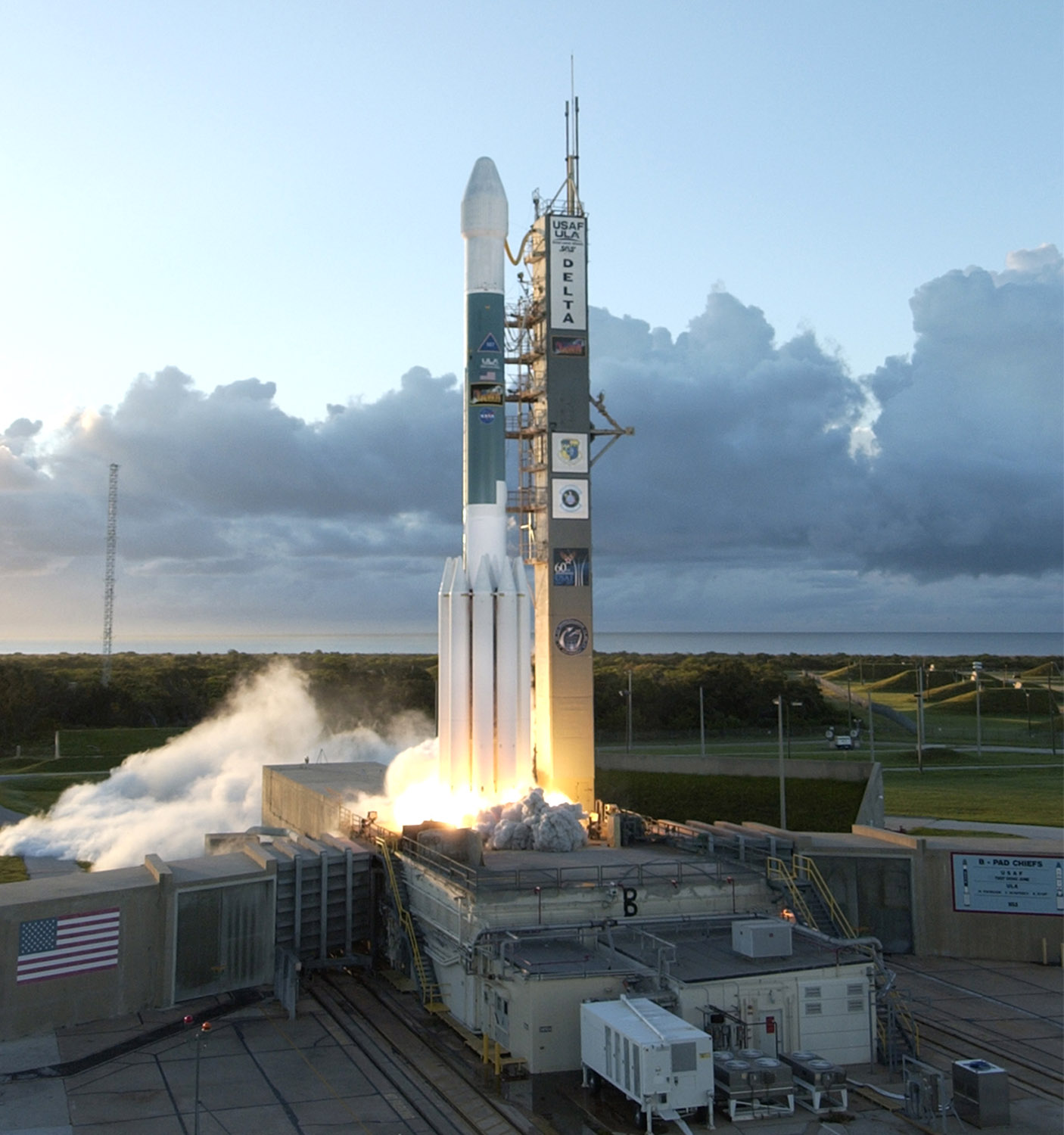
Several carrier rockets made their maiden flights in 2007; the PSLV-CA, Long March 3B/E, Shavit-2, Zenit-2M, Proton-M Enhanced. These were all modernised or upgraded versions of existing systems. The RS-24 missile also conducted its first launch, and the Atlas V made its first flight in the 421 configuration. The first Colombian and Mauritian satellites, Libertad 1 and Rascom-QAF 1 respectively, were launched in 2007, although a helium leak reduced Rascom's operational lifetime by thirteen years.
Space exploration
Several spacecraft were launched to explore the Moon. Japan's Kaguya orbiter, along with the smaller Okina and Ouna relay spacecraft, was launched on 14 September. The spacecraft entered Selenocentric orbit on 3 October. China launched its first Lunar probe, Chang'e 1, on 24 October, with the spacecraft entering Selenocentric orbit on 5 November. In 2009, two satellites launched into highly elliptical Earth orbits in 2007 as part of the THEMIS mission were also sent to the Moon. They are expected to arrive in October 2010.
In August, the NASA Phoenix spacecraft was launched towards Mars, followed by the Dawn mission to the Asteroid belt in September. Cassini continued to make flybys of the moons of Saturn, mostly focussing on Titan. In November, Rosetta flew past Earth, where it was mistaken for an asteroid, and given the provisional designation 2007 VN84.
Crewed spaceflight
Five crewed flights were launched in 2007, two by Russia and three by the United States. Russia flew two Soyuz missions to the International Space Station for crew rotation. Soyuz TMA-10, launched on 7 April, carried the Expedition 15 crew to the Station. Space tourist Charles Simonyi was also launched on this flight, and landed aboard Soyuz TMA-9 a few days later. When TMA-10 returned to Earth in October, it made the first of two consecutive ballistic re-entries of Soyuz spacecraft, due to problems with separation bolts. Soyuz TMA-11, launched on 10 October, carried the Expedition 16 crew, and the first Malaysian in space, Sheikh Muszaphar Shukor, who was selected for flight under the Angkasawan programme. He landed aboard Soyuz TMA-10. When TMA-11 landed in 2008, it also made a ballistic descent.

2007 also saw the continued assembly of the International Space Station, by US Space Shuttle flights. On 8 June made the first Shuttle launch of the year, STS-117, with seven astronauts, and the S3/4 truss segment of the ISS. It was the first Shuttle to launch from Complex 39A at the Kennedy Space Center since STS-107 in 2003. Launch had previously been delayed from February due to Hail damage to the External Tank, which required a rollback to repair in the Vehicle Assembly Building. In August, launched on its first mission since 2002, STS-118. This carried the S5 truss segment, and marked the final flight of the Spacehab module, which was used to carry supplies. NASA's first Educator Astronaut, Barbara Morgan flew aboard STS-118. Morgan had previously been a backup for Christa McAuliffe, who was killed in the Challenger accident in 1986. STS-120, launched on 23 October using , carried the Harmony node, the first pressurised ISS component to be launched since Pirs in September 2001. Attempts to launch Atlantis in December on STS-122 were scrubbed, and the launch was delayed to 2008 after ECO sensors in the External Tank failed.
Launch failures
Three orbital launch attempts in 2007, involving a Zenit, a Falcon 1, and a Proton failed, and two others, an Atlas V and a GSLV, resulted in partial failures. On 30 January, a Sea Launch Zenit-3SL exploded on the Ocean Odyssey launch platform, seconds after ignition. The failure destroyed the NSS-8 satellite, and caused considerable damage to the Odyssey platform. It was later determined that the failure had been caused by debris in the turbopump. As a result of downtime to conduct repairs, and bad sea conditions at the end of the year, Sea Launch did not conduct another launch until 2008.
On 21 March, SpaceX launched the second Falcon 1. Due to the failure of the maiden flight, the launch was conducted as a demonstration flight without a functional payload. The launch failed to reach orbit due to a chain of events, starting with an error in setting the fuel mix ratio, which resulted in first stage underperformance, and the rocket being too low at the time of first stage separation. Additional atmospheric drag at this altitude caused recontact between the stages, setting up a fuel slosh in the second stage. This resulted in the premature cutoff of the second stage, and the rocket failed to reach orbit. This was the last launch of the Falcon 1 with the ablatively cooled Merlin-1A engine, which was replaced with the regeneratively cooled Merlin-1C for subsequent flights, starting in August 2008. As several test objectives were completed, SpaceX claimed that the launch was a success overall, and declared the Falcon 1 operational.
The Atlas family ended a run of eighty consecutive successful launches over fourteen years, after a partial failure of an Atlas V launched on 15 June. A faulty valve caused a fuel leak in the Centaur upper stage, resulting in a premature cutoff at the end of its second burn. This resulted in the USA-194 satellites being delivered into a lower orbit than planned. The spacecraft were able to correct the orbit using their manoeuvring engines.
The fifth GSLV was launched on 2 September, with the INSAT-4CR satellite. This was the first GSLV launch since the failure in July 2006. The rocket underperformed, and placed the satellite into an orbit with a lower apogee and greater inclination than planned. This required the spacecraft to use fuel reserved for stationkeeping to raise itself to the correct orbit, at the expense of its operational lifetime.
On 5 September, a Proton-M with a Briz-M upper stage failed to place the JCSAT-11 into orbit, after the second stage of the carrier rocket failed to separate from the first. It was later established that damaged cabling had been the cause of the malfunction.
Summary of launches

In total, sixty eight orbital launches were made in 2007, with sixty five reaching orbit, and three outright failures. This was an increase of two orbital launch attempts on 2006, with one more launch reaching orbit. The final launch of the year was conducted on 25 December, by a Proton-M with three GLONASS navigation satellites for the Russian government.
Suborbital spaceflight in 2007 saw a number of sounding rocket and missile launches. On 11 January, the Chinese People's Liberation Army used a Dong-Feng 21 derived anti-satellite weapon to destroy Feng Yun 1C, a retired weather satellite. Russia also began testing the RS-24 Yars missile
China conducted ten orbital launches in 2007, using the Long March family of rockets, whilst Europe conducted five using the Ariane 5. India made three orbital launch attempts, using PSLV-C, PSLV-CA and GSLV rockets, with the GSLV launch resulting in a partial failure. Israel conducted a single successful launch using the first Shavit-2 rocket. Japan successfully launched two H-IIA rockets. Russia and the former Soviet Union conducted twenty six launches, including one failure, but not including the international Sea Launch programme, whose single launch attempt failed. Nineteen launches were conducted by the United States, which had originally announced plans to launch many more, however technical issues with the Atlas V, Delta IV and Falcon 1, caused a number of delays. Two of six planned Space Shuttle launches were also delayed to 2008, STS-123 due to knock-on delays from STS-117, and STS-122 due to problems with engine cutoff sensors.
Launches
January
|- |d-date = 14 February 2024 |d-time = 10:18 |d-date = 22 January |d-time = 04:16 |d-date = 16 January 2023 |d-date = 1 August |d-time=19:26 |d-time = T-0
February
|- Operational USAArtemis P1 (2009—) Selenocentric (planned) USAArtemis P2 (2009—) Selenocentric (planned) |d-date = 13 April 2014 Technology |d-date = 12 November 2013 |d-time = 02:31
March
|-
|d-date = 25 October 2013{{cite web |url=https://www.n2yo.com/satellite/?s=30772 |title=OE (ASTRO) |work=N2YO.com |date=25 October 2013 |access-date=23 November 2022}} |d-date = 12 November 2022{{cite web |url=https://www.n2yo.com/satellite/?s=30777 |title=CFESAT |work=N2YO.com |date=12 November 2022 |access-date=23 November 2022}} Plasma |d-date = 21 January 2023{{cite web |url=https://www.n2yo.com/satellite/?s=30776 |title=FALCONSAT 3 |work=N2YO.com |date=21 January 2023 |access-date=1 February 2023}} Technology |d-date = 17 August 2023 |d-date = 21 April 2023 Technology |d-date = 8 November 2023
|d-date = 21 March
April
|- |d-date=21 October |d-time=10:36 Operational |d-date = 13 February 2024 |d-date = 19 July 2022 |d-date = 4 November 2015
May
|- |FRAAriane 5ECA |d-date=25 September |d-time=19:48 Now: Graveyard
June
|- |d-date=22 August |d-time=21:00 |d-date=22 June |d-time=19:49:38 Operational Operational
July
|-
August
|- Technology |d-date=22 January 2008 |d-time=19:52 |d-date=25 May 2008 |d-time=23:38 |d-date=21 August |d-time=16:32 |d-span=2 |d-span=inherit |FRAAriane 5ECA
September
|- Partial spacecraft failure Operational |d-time=~+135 seconds |d-date=12 February 2009 |d-time=08:46 |d-date=26 September |d-date=Unknown Then: Ceres orbit Then: Vesta orbit
October
|- |FRAAriane 5GS |d-date=19 April 2008 |d-date=5 January 2019 |d-time=07:58 |d-date=7 November |d-time=18:01 |d-date=1 March 2009 |d-time=08:13
November
|- Stopped transmitting in September 2008 |FRAAriane 5ECA
December
|- |FRAAriane 5GS Operational |d-date=15 February 2008 |d-time=10:29 |}
Suborbital launches
January
|- |d-date = 11 January |d-date = 16 January |d-date = 19 January |d-date = 19 January |d-date = 19 January |d-date = 19 January |d-date = 27 January |d-date = 27 January |d-date = 30 January
February
|- |d-date = 7 February |d-date = 12 February |d-date = 14 February |d-date = 14 February |d-date = 14 February |d-date = 14 February |d-date = 25 February |d-date = 28 February
March
|- |d-date = 1 March
|d-date = 6 March |d-date = 21 March
|d-date = 30 March
April
|- |d-date = 6 April |d-date=12 April |d-date=26 April |d-date=26 April |d-date=28 April |d-date=28 April |d-date=28 April |d-date=28 April |d-date=28 April RocketFoto Astrax |d-date=28 April
May
|- |d-date=15 May |d-date=15 May |d-date=25 May |d-date=29 May
June
|- |d-date=15 June |d-date=15 June |d-date=15 June |d-date=20 June |d-date=20 June |d-date=21 June |d-date=21 June |d-date=23 June |d-date=23 June |d-date=28 June
July
|- |d-date=19 July
August
|- |d-date=3 August |d-date=3 August |d-date=6 August |d-date=7 August |d-date=13 August |d-date=23 August |d-time=09:01
September
|- |d-date=2 September |d-date=6 September |d-time=21:19 |d-date = 13 September |d-date=28 September |d-date=28 September
October
|- |d-date=5 October |d-date = 29 October |d-date=30 October |d-time=04:26:17
November
|- |d-date=6 November
December
|- |d-date=8 December |d-date=10 December |d-date=10 December |d-date=17 December |d-date=17 December |d-date=17 December |d-date=17 December |d-date=25 December |d-date=25 December
|}
Deep Space Rendezvous
| Date (GMT) | Spacecraft | Event | Remarks |
|---|---|---|---|
| 13 January | Cassini | 23rd flyby of Titan | Closest approach: 950 km |
| 29 January | Cassini | 24th flyby of Titan | Closest approach: 2775 km |
| 22 February | Cassini | 25th flyby of Titan | Closest approach: 953 km |
| 25 February | Rosetta | Flyby of Mars | Gravity assist |
| 28 February | New Horizons | Flyby of Jupiter | Gravity assist |
| 10 March | Cassini | 26th flyby of Titan | Closest approach: 956 km |
| 26 March | Cassini | 27th flyby of Titan | Closest approach: 953 km |
| 10 April | Cassini | 28th flyby of Titan | Closest approach: 951 km |
| 26 April | Cassini | 29th flyby of Titan | Closest approach: 951 km |
| 12 May | Cassini | 30th flyby of Titan | Closest approach: 950 km |
| 28 May | Cassini | 31stflyby of Titan | Closest approach: 2425 km |
| 5 June | MESSENGER | 2nd flyby of Venus | Gravity assist; Closest approach: 338 km |
| 13 June | Cassini | 32nd flyby of Titan | Closest approach: 950 km |
| 29 June | Cassini | 33rd flyby of Titan | Closest approach: 1942 km |
| 19 July | Cassini | 34thflyby of Titan | Closest approach: 1302 km |
| 30 August | Cassini | Flyby of Rhea | Closest approach: 5100 km |
| 31 August | Cassini | 35th flyby of Titan | Closest approach: 3227 km |
| 10 September | Cassini | Flyby of Iapetus | Closest approach: 1000 km |
| 2 October | Cassini | 36th flyby of Titan | Closest approach: 950 km |
| 3 October | Kaguya | Selenocentric orbit injection | |
| 5 November | Chang'e 1 | Selenocentric orbit injection | |
| 13 November | Rosetta | 2nd flyby of the Earth | Mistaken for asteroid, given the designation 2007 VN84 |
| 19 November | Cassini | 37th flyby of Titan | Closest approach: 950 km |
| 5 December | Cassini | 38th flyby of Titan | Closest approach: 1300 km |
| 20 December | Cassini | 39th flyby of Titan | Closest approach: 953 km |
| 31 December | Deep Impact (EPOXI) | Flyby of Earth | Closest approach: 15566 km |
:Distant, non-targeted flybys of Dione, Enceladus, Mimas, Tethys and Titan by Cassini occurred throughout the year.
EVAs
| Start date/time | Duration | End time | Spacecraft | Crew | Function | Remarks |
|---|---|---|---|---|---|---|
| 31 January | ||||||
| 15:14 | 7 hours | |||||
| 55 minutes | 23:09 | Expedition 14 | ||||
| ISS Quest | USAMichael Lopez-Alegria | |||||
| USASunita Williams | Reconfigured Destiny cooling system, connected SSPTS, secured P6 starboard radiator, disconnected EAS. | |||||
| 4 February | ||||||
| 13:38 | 7 hours | |||||
| 11 minutes | 20:49 | Expedition 14 | ||||
| ISS Quest | USAMichael Lopez-Alegria | |||||
| USASunita Williams | Completed Destiny cooling system reconfiguration and EAS disconnection, photographed P6 inboard solar array, continued SSPTS installation. | |||||
| 8 February | ||||||
| 13:26 | 6 hours | |||||
| 40 minutes | 20:06 | Expedition 14 | ||||
| ISS Quest | USAMichael Lopez-Alegria | |||||
| USASunita Williams | Removed and jettisoned P3 thermal covers, install P3 attachment point, remove P5 launch restraints, continued SSPTS installation. | |||||
| 22 February | ||||||
| 10:27 | 6 hours | |||||
| 18 minutes | 16:45 | Expedition 14 | ||||
| ISS Pirs | RUSMikhail Tyurin | |||||
| USAMichael Lopez-Alegria | Retracted an antenna at the aft port of the Zvezda, photographed a satellite navigation antenna, and replaced a Russian materials experiment, inspected and photographed an antenna for the ATV, photographed a German robotics experiment, and inspected, remated, and photographed hardware connectors. | |||||
| 30 May | ||||||
| 19:05 | 5 hours | |||||
| 25 minutes | 31 May | |||||
| 00:30 | Expedition 15 | |||||
| ISS Pirs | RUSFyodor Yurchikhin | |||||
| RUSOleg Kotov | Installed Service Module Debris Protection (SMDP) panels and rerouted a Global Positioning System antenna cable. | |||||
| 6 June | ||||||
| 14:23 | 5 hours | |||||
| 37 minutes | 20:00 | Expedition 15 | ||||
| ISS Pirs | RUSFyodor Yurchikhin | |||||
| RUSOleg Kotov | Installed a section of Ethernet cable on the Zarya module, installed additional Service Module Debris Protection (SMDP) panels on Zvezda, and deployed a Russian scientific experiment. | |||||
| 11 June | ||||||
| 20:02 | 6 hours | |||||
| 15 minutes | 12 June | |||||
| 02:17 | STS-117 | |||||
| ISS Quest | USAJames F. Reilly | |||||
| USAJohn D. Olivas | Began the S3/S4 Truss installation. | |||||
| 13 June | ||||||
| 18:28 | 7 hours | |||||
| 16 minutes | 14 June | |||||
| 01:44 | STS-117 | |||||
| ISS Quest | USAPatrick G. Forrester | |||||
| USASteven Swanson | Assisted in retraction of the solar panels on the P6 Truss. Completed the S3/S4 truss installation. Partial failure due to the S3/S4 SARJ motor control circuits being wired in reverse, so some launch restraints were left in place to prevent the possibility of undesired rotation. | |||||
| 15 June | ||||||
| 17:24 | 7 hours | |||||
| 58 minutes | 16 June | |||||
| 01:22 | STS-117 | |||||
| ISS Quest | USAJames F. Reilly | |||||
| USAJohn D. Olivas | Repaired the Orbital Maneuvering System (OMS) pod thermal blanket, finished the P6 solar array retraction, and installed a hydrogen ventilation valve onto Destiny. | |||||
| 17 June | ||||||
| 16:25 | 6 hours | |||||
| 29 minutes | 22:54 | STS-117 | ||||
| ISS Quest | USAPatrick G. Forrester | |||||
| USASteven Swanson | Retrieved a television camera and its support structure from an ESP attached to Quest, and installed it on the S3 truss, verified the Drive Lock Assembly (DLA) 2 configuration, and removed the last six SARJ launch restraints. Installed a computer network cable on Unity, opened the hydrogen vent valve on Destiny, and tethered two orbital debris shield panels on Zvezda. | |||||
| 23 July | ||||||
| 10:25 | 7 hours | |||||
| 41 minutes | 18:06 | Expedition 15 | ||||
| ISS Quest | USAClayton Anderson | |||||
| RUSFyodor Yurchikhin | Replaced components for the Mobile Transporter's redundant power system, jettisoned an ammonia tank and flight support equipment, and cleaned the Common Berthing Mechanism (CBM) on the nadir port of Unity. | author=Spaceflightnow.com | ||||
| 11 August | ||||||
| 16:28 | 6 hours | |||||
| 17 minutes | 23:45 | STS-118 | ||||
| ISS Quest | USARichard Mastracchio | |||||
| CANDafydd Williams | Attached the Starboard 5 (S5) segment of the station's truss, and retracted the forward heat-rejecting radiator from the station's Port 6 (P6) truss. | |||||
| 13 August | ||||||
| 15:32 | 6 hours | |||||
| 28 minutes | 22:00 | STS-118 | ||||
| ISS Quest | USARichard Mastracchio | |||||
| CANDafydd Williams | Removed the new Control Moment Gyroscope (CMG) from the shuttle's payload bay and installed it onto the Z1 truss. Installed the failed CMG onto an External Stowage Platform (ESP-2). | |||||
| 15 August | ||||||
| 14:38 | 5 hours | |||||
| 28 minutes | 20:05 | STS-118 | ||||
| ISS Quest | USARichard Mastracchio | |||||
| USAClayton Anderson | Relocated two CETA carts around the Mobile Transporter and an antenna base from the P6 truss to P1, and installed a new transponder and signal processor for an S-band communications upgrade. | Mastracchio noted a hole on the thumb of his left glove and returned to the airlock as a precautionary measure. | ||||
| 18 August | ||||||
| 14:17 | 5 hours | |||||
| 2 minutes | 19:02 | STS-118 | ||||
| ISS Quest | CANDafydd Williams | |||||
| USAClayton Anderson | Retrieved Materials International Space Station Experiment (MISSE) containers 3 and 4, installed the Orbiter Boom Sensor System (OBSS) Boom Stand, installed an External Wireless Instrumentation System (EWIS) antenna, and secured Z1 gimbal locks. | |||||
| 26 October | ||||||
| 10:02 | 6 hours | |||||
| 14 minutes | 16:16 | STS-120 | ||||
| ISS Quest | USAScott E. Parazynski | |||||
| USADouglas H. Wheelock | Installed the new Harmony module in its temporary location, retrieved the S-Band Antenna Support Assembly, and prepared for the relocation of the P6 truss by disconnecting fluid lines on the P6/Z1 truss segments. | |||||
| 28 October | ||||||
| 09:32 | 6 hours | |||||
| 33 minutes | 16:05 | STS-120 | ||||
| ISS Quest | USAScott E. Parazysnki | |||||
| USADaniel M. Tani | Disconnected the Z1-to-P6 umbilicals, detached P6 from Z1, configured the S1 radiator, installed handrails onto Harmony, and inspected the S4 starboard Solar Alpha Rotary Joint (SARJ). | |||||
| 30 October | ||||||
| 08:45 | 7 hours | |||||
| 8 minutes | 15:53 | STS-120 | ||||
| ISS Quest | USAScott E. Parazysnki | |||||
| USADouglas H. Wheelock | Attached P6 to P5, installed P6/P5 umbilical connections, reconfigured S1 following its redeployment, and inspected the port SARJ. | |||||
| 3 November | ||||||
| 10:03 | 7 hours | |||||
| 19 minutes | 17:22 | STS-120 | ||||
| ISS Quest | USAScott E. Parazysnki | |||||
| USADouglas H. Wheelock | Inspection and repair of the P6 solar array. | |||||
| 9 November | ||||||
| 09:54 | 6 hours | |||||
| 55 minutes | 16:49 | Expedition 16 | ||||
| ISS Quest | USAPeggy Whitson | |||||
| RUSYuri Malenchenko | Disconnected and stored the Station-to-Shuttle Power Transfer System cables, stored the PMA-2 umbilical, and stowed a Harmony node avionics umbilical into a temporary position. | |||||
| 20 November | ||||||
| 10:10 | 7 hours | |||||
| 16 minutes | 17:26 | Expedition 16 | ||||
| ISS Quest | USAPeggy Whitson | |||||
| USADaniel M. Tani | External configuration of PMA-2 and Harmony: Fluid, electrical, and data lines attached, avionics lines hooked up, heater cables attached, and relocated a fluid tray. | |||||
| 24 November | ||||||
| 09:50 | 7 hours | |||||
| 4 minutes | 16:54 | Expedition 16 | ||||
| ISS Quest | USAPeggy Whitson | |||||
| USADaniel M. Tani | Completion of fluid, electrical, and data line hookups for PMA-2 and Harmony. Loop B Fluid Tray connected to the port side of the Destiny laboratory. Inspected and photographed the starboard Solar Alpha Rotary Joint (SARJ) to assist with troubleshooting on the ground. | |||||
| 18 December | ||||||
| 09:50 | 6 hours | |||||
| 56 minutes | 16:46 | Expedition 16 | ||||
| ISS Quest | USAPeggy Whitson | |||||
| USADaniel M. Tani | Inspected the S4 starboard Solar Alpha Rotary Joint (SARJ), and a Beta Gimbal Assembly (BGA). | 100th EVA in support of the ISS. | ||||
| Whitson became the female astronaut with the most EVAs and the most time spent in EVA. |
Orbital launch statistics
By country
For the purposes of this section, the yearly tally of orbital launches by country assigns each flight to the country of origin of the rocket, not to the launch services provider or the spaceport. | [ {"value":220, "color":"#a52a2a", "label": "Russia: 22 (32.35%)"}, {"value":190, "color":"#484785", "label": "United States: 19 (27.94%)"}, {"value":100, "color":"#ff0000", "label": "China: 10 (14.70%)"}, {"value":60, "color":"#318ce7", "label": "France: 6 (8.82%)"}, {"value":50, "color":"#ffd700", "label": "Ukraine: 5 (7.35%)"}, {"value":30, "color":"#ff9933", "label": "India: 3 (4.41%)"}, {"value":20, "color":"#ffffff", "label": "Japan: 2 (2.94%)"}, {"value":10, "color":"#008080", "label": "Israel: 1 (1.47%)"}, ]
| Country | Launches | Successes | Failures | Partial | |||||||||||||||||||||||||||||||||||||
|---|---|---|---|---|---|---|---|---|---|---|---|---|---|---|---|---|---|---|---|---|---|---|---|---|---|---|---|---|---|---|---|---|---|---|---|---|---|---|---|---|---|
| failures | style="text-align:left;" | style="text-align:left;" | style="text-align:left;" | style="text-align:left;" | style="text-align:left;" | style="text-align:left;" | style="text-align:left;" | style="text-align:left;" | World | ||||||||||||||||||||||||||||||||
| 10 | 10 | 0 | 0 | ||||||||||||||||||||||||||||||||||||||
| 6 | 6 | 0 | 0 | ||||||||||||||||||||||||||||||||||||||
| 3 | 2 | 0 | 1 | ||||||||||||||||||||||||||||||||||||||
| 1 | 1 | 0 | 0 | ||||||||||||||||||||||||||||||||||||||
| 2 | 2 | 0 | 0 | ||||||||||||||||||||||||||||||||||||||
| 22 | 21 | 1 | 0 | ||||||||||||||||||||||||||||||||||||||
| 5 | 4 | 1 | 0 | ||||||||||||||||||||||||||||||||||||||
| 19 | 17 | 1 | 1 |
By rocket
By family
| Family | Country | Launches | Successes | Failures | Partial failures | Remarks |
|---|---|---|---|---|---|---|
| Ariane | 6 | 6 | 0 | 0 | ||
| Atlas | 4 | 3 | 0 | 1 | ||
| Delta | 9 | 9 | 0 | 0 | ||
| Falcon | 1 | 0 | 1 | 0 | ||
| GSLV | 1 | 0 | 0 | 1 | ||
| H-II | 2 | 2 | 0 | 0 | ||
| Long March | 10 | 10 | 0 | 0 | ||
| Minotaur | 1 | 1 | 0 | 0 | ||
| Pegasus | 1 | 1 | 0 | 0 | ||
| PSLV | 2 | 2 | 0 | 0 | ||
| R-7 | 12 | 12 | 0 | 0 | ||
| R-14 | 3 | 3 | 0 | 0 | ||
| R-36 | 3 | 3 | 0 | 0 | ||
| Shavit 2 | 1 | 1 | 0 | 0 | ||
| Space Shuttle | 3 | 3 | 0 | 0 | ||
| Universal Rocket | 7 | 6 | 1 | 0 | ||
| Zenit | 2 | 1 | 1 | 0 |
By type
| Rocket | Country | Family | Launches | Successes | Failures | Partial failures | Remarks |
|---|---|---|---|---|---|---|---|
| Ariane 5 | Ariane | 6 | 6 | 0 | 0 | ||
| Atlas V | Atlas | 4 | 3 | 0 | 1 | ||
| Delta II | Delta | 8 | 8 | 0 | 0 | ||
| Delta IV | Delta | 1 | 1 | 0 | 0 | ||
| Dnepr | R-36 | 3 | 3 | 0 | 0 | ||
| Falcon 1 | Falcon | 1 | 0 | 1 | 0 | ||
| GSLV | GSLV | 1 | 0 | 0 | 1 | ||
| H-IIA | H-II | 2 | 2 | 0 | 0 | ||
| Kosmos | R-12/R-14 | 3 | 3 | 0 | 0 | ||
| Long March 2 | Long March | 2 | 2 | 0 | 0 | ||
| Long March 3 | Long March | 6 | 6 | 0 | 0 | ||
| Long March 4 | Long March | 2 | 2 | 0 | 0 | ||
| Minotaur I | Minotaur | 1 | 1 | 0 | 0 | ||
| Molniya | R-7 | 1 | 1 | 0 | 0 | ||
| Pegasus | Pegasus | 1 | 1 | 0 | 0 | ||
| Proton | Universal Rocket | 7 | 6 | 1 | 0 | ||
| PSLV | PSLV | 2 | 2 | 0 | 0 | ||
| Shavit | Shavit | 1 | 1 | 0 | 0 | ||
| Soyuz | R-7 | 11 | 11 | 0 | 0 | ||
| Space Shuttle | Space Shuttle | 3 | 3 | 0 | 0 | ||
| Zenit | Zenit | 2 | 1 | 1 | 0 |
By configuration
| Rocket | Country | Type | Launches | Successes | Failures | Partial failures | Remarks |
|---|---|---|---|---|---|---|---|
| Ariane 5 ECA | Ariane 5 | 4 | 4 | 0 | 0 | ||
| Ariane 5 GS | Ariane 5 | 2 | 2 | 0 | 0 | ||
| Atlas V 401 | Atlas V | 3 | 2 | 0 | 1 | ||
| Atlas V 421 | Atlas V | 1 | 1 | 0 | 0 | Maiden flight | |
| Delta II 7420 | Delta II | 2 | 2 | 0 | 0 | ||
| Delta II 7920 | Delta II | 1 | 1 | 0 | 0 | ||
| Delta II 7925 | Delta II | 4 | 4 | 0 | 0 | ||
| Delta II 7925H | Delta II | 1 | 1 | 0 | 0 | Final flight | |
| Delta IV Heavy | Delta IV | 1 | 1 | 0 | 0 | ||
| Dnepr | Dnepr | 3 | 3 | 0 | 0 | ||
| Falcon 1 | Falcon 1 | 1 | 0 | 1 | 0 | ||
| GSLV Mk I | GSLV | 1 | 0 | 0 | 1 | Final flight | |
| H-IIA 2022 | H-IIA | 1 | 1 | 0 | 0 | ||
| H-IIA 2024 | H-IIA | 1 | 1 | 0 | 0 | ||
| Kosmos-3M | Kosmos | 3 | 3 | 0 | 0 | ||
| Long March 2C | Long March 2 | 1 | 1 | 0 | 0 | ||
| Long March 2D | Long March 2 | 1 | 1 | 0 | 0 | ||
| Long March 3A | Long March 3 | 4 | 4 | 0 | 0 | ||
| Long March 3B | Long March 3 | 1 | 1 | 0 | 0 | ||
| Long March 3B/E | Long March 3 | 1 | 1 | 0 | 0 | ||
| Long March 4B | Long March 4 | 1 | 1 | 0 | 0 | ||
| Long March 4C | Long March 4 | 1 | 1 | 0 | 0 | ||
| Minotaur I | Minotaur I | 1 | 1 | 0 | 0 | ||
| Molniya-M / 2BL | Molniya | 1 | 1 | 0 | 0 | ||
| Pegasus-XL | Pegasus | 1 | 1 | 0 | 0 | ||
| Proton-K / DM-2 | Proton | 1 | 1 | 0 | 0 | ||
| Proton-M / DM-2 | Proton | 1 | 1 | 0 | 0 | Maiden flight | |
| Proton-M / Briz-M | Proton | 5 | 4 | 1 | 0 | ||
| PSLV-G | PSLV | 1 | 1 | 0 | 0 | ||
| PSLV-CA | PSLV | 1 | 1 | 0 | 0 | Maiden flight | |
| Shavit-2 | Shavit | 1 | 1 | 0 | 0 | Maiden flight | |
| Soyuz-FG | Soyuz | 2 | 2 | 0 | 0 | ||
| Soyuz-FG / Fregat | Soyuz | 3 | 3 | 0 | 0 | ||
| Soyuz-U | Soyuz | 6 | 6 | 0 | 0 | ||
| Space Shuttle | Space Shuttle | 3 | 3 | 0 | 0 | ||
| Zenit-2M | Zenit | 1 | 1 | 0 | 0 | Maiden flight | |
| Zenit-3SL | Zenit | 1 | 0 | 1 | 0 |
By launch site
| Site | Country | Launches | Successes | Failures | Partial failures | Remarks | Total | 68 | 63 | 3 | 2 |
|---|---|---|---|---|---|---|---|---|---|---|---|
| Baikonur | 20 | 19 | 1 | 0 | |||||||
| Cape Canaveral | 10 | 9 | 0 | 1 | |||||||
| Dombarovsky | 1 | 1 | 0 | 0 | |||||||
| Jiuquan | 1 | 1 | 0 | 0 | |||||||
| Kennedy | 3 | 3 | 0 | 0 | |||||||
| Kourou | 6 | 6 | 0 | 0 | |||||||
| Kwajalein | 1 | 0 | 1 | 0 | |||||||
| MARS | 1 | 1 | 0 | 0 | |||||||
| Ocean Odyssey | UN International | 1 | 0 | 1 | 0 | Damaged by explosion | |||||
| Palmachim | 1 | 1 | 0 | 0 | |||||||
| Plesetsk | 5 | 5 | 0 | 0 | |||||||
| Satish Dhawan | 3 | 2 | 0 | 1 | |||||||
| Taiyuan | 3 | 3 | 0 | 0 | |||||||
| Tanegashima | 2 | 2 | 0 | 0 | |||||||
| Vandenberg | 4 | 4 | 0 | 0 | One launch used Stargazer aircraft | ||||||
| Xichang | 6 | 6 | 0 | 0 |
By orbit
(transfer) : Inclined GSO : High Earth : Heliocentric
| Orbital regime | Launches | Successes | Failures | Accidentally | ||||||
|---|---|---|---|---|---|---|---|---|---|---|
| achieved | Remarks | Total | 68 | 65 | 3 | 0 | ||||
| Transatmospheric | 0 | 0 | 0 | 0 | ||||||
| Low Earth | 37 | 36 | 1 | 0 | 9 to ISS | |||||
| Medium Earth / Molniya | 7 | 7 | 0 | 0 | ||||||
| Geosynchronous / GTO | 19 | 17 | 2 | 0 | ||||||
| High Earth / Lunar transfer | 3 | 3 | 0 | 0 | ||||||
| Heliocentric / Planetary transfer | 2 | 2 | 0 | 0 |
References
Footnotes
References
- Rohit, T. K.. (10 January 2007). "All 4 PSLV-C7 satellites launched into orbit". Rediff.
- (22 January 2007). "Space Capsule Successfully Recovered". ISRO.
- (16 January 2023). "PEHUENSAT 1". N2YO.com.
- (14 March 2007). "Sea Launch Explosion Due To Engine Failure". Space-Travel.com.
- McDowell, Dr. Jonathan. (25 February 2007). "Issue 577". Jonathan's Space Report.
- (29 August 2010). "Japan's lone radar intelligence orbiter breaks down". The Daily Yomiuri.
- McDowell, Dr. Jonathan. (16 March 2007). "Issue 578". Jonathan's Space Report.
- (17 August 2023). "MIDSTAR 1". N2YO.com.
- (21 April 2023). "OE (NEXTSAT)". N2YO.com.
- (8 November 2023). "STPSAT 1". N2YO.com.
- McDowell, Dr. Jonathan. (23 April 2007). "Issue 579". Jonathan's Space Report.
- "CubeSat Community Website – Satellite Status (Dnepr Launch 2)".
- "CubeSats". NASA.
- (19 July 2022). "AAM/PSLV". N2YO.com.
- McDowell, Dr. Jonathan. (16 May 2007). "Issue 580". Jonathan's Space Report.
- (4 November 2015). "NFIRE". N2YO.com.
- Onuah, Felix. (12 November 2008). "Nigerian satellite battery dead, not lost in space". Reuters.
- Dr. Jonathan McDowell. (23 June 2007). "Issue 581". Jonathan's Space Report.
- Barbosa, Rui C.. (25 May 2007). "China launch Yaogan-II satellite – 100th success". NASA Spaceflight.com.
- "About COSMO-Skymed". Italian Space Agency.
- (11 June 2007). "Israel successfully launches Ofek 7 satellite". Israel Ministry of Foreign Affairs.
- "Atlas V (401)". Gunter's Space Page.
- Dr. Jonathan McDowell. (7 July 2007). "Issue 582". Jonathan's Space Report.
- "DirecTV-10 Mission Overview". Khrunichev.
- Dr. Jonathan McDowell. (4 August 2007). "Issue 583". Jonathan's Space Report.
- Dr. Jonathan McDowell. (19 August 2007). "Issue 584". Jonathan's Space Report.
- Clark, Stephen. (2 September 2007). "India's large satellite launcher returns to flight". Spaceflight Now.
- Ram, Arun. (15 December 2007). "Isro satellite 'disappears', loses five years of life". DNA-India.
- Clark, Stephen. (11 October 2007). "Damaged cable blamed for downing Proton rocket". Spaceflight Now.
- (25 September 2007). "YES2 student payload released from Foton-M3". European Space Agency.
- Dr. Jonathan McDowell. (14 October 2007). "Issue 586". Jonathan's Space Report.
- Dr. Jonathan McDowell. (30 October 2007). "Issue 587". Jonathan's Space Report.
- "COSMOS 2430 - NORAD 32268".
- Guodong, Du. (1 March 2009). "China's lunar probe Chang'e-1 impacts moon". Xinhua.
- McDowell, Dr. Jonathan. (19 September 2007). "Issue 588". Jonathan's Space Report.
- Shalal-Esa, Andrea. (24 November 2008). "U.S. missile-warning satellite fails". Reuters.
- Bergin, Chris. (14 November 2007). "Ariane 5 ECA launches with Skynet 5B and Star One C1". NASASpaceflight.com.
- Dr. Jonathan McDowell. (21 December 2007). "Issue 589". Jonathan's Space Report.
- (29 December 2007). "RASCOM-QAF1's Launch Early Operation Procedures have been stopped". Thales Alenia Space.
- Dr. Jonathan McDowell. (16 January 2008). "Issue 590". Jonathan's Space Report.
- Covault, Craig. (17 January 2007). "Chinese Test Anti-Satellite Weapon". Aviation Week.
- McDowell, Dr. Jonathan. (2 February 2007). "Issue 576". Jonathan's Space Report.
- Lynch Rocket Group. (8 March 2007). "ROPA". Dartmouth College.
- (25 May 2007). "Missile Defence Test A "No Test"". MDA.
- Dr. Jonathan McDowell. (19 September 2007). "Issue 585". Jonathan's Space Report.
- (2012). "Suborbital and low-thermospheric experiments using sounding rockets in Taiwan". Acta Astronautica.
- (17 December 2007). "Japan/U.S. Missile Defense Flight Test Successful". Missile Defense Agency.
- Lakdawalla, Emily. (14 September 2007). "Kaguya Rockets Toward the Moon". The Planetary Society.
- NASA. (2007). "Station Crew Members Wind Up Successful Spacewalk". NASA.
- NASA. (2007). "Crew Completes Scheduled Spacewalk Tasks, and More". NASA.
- NASA. (2007). "Spacewalkers Successfully Wrap Up Record Series". NASA.
- NASA. (2007). "Spacewalkers Successfully Retract Progress Antenna". NASA.
- NASA. (2007). "Spacewalk Complete, Debris Panels Installed". NASA.
- NASA. (2007). "Cosmonauts Wrap Up Debris-Panel Spacewalk". NASA.
- NASA. (2007). "STS-117 MCC Status Report No. 07". NASA.
- NASA. (2007). "STS-117 MCC Status Report #11". NASA.
- Chris Bergin. (2007). "Success filled day for STS-117's EVA-3". NASA SpaceFlight.com.
- NASA. (2007). "STS-117 MCC Status Report #19". NASA.
- NASA. "Station Crew Winds Up Ammonia Reservoir Jettison Spacewalk". NASA.
- NASA. (2007). "STS-118 MCC Status Report No. 07". NASA.
- NASA. (2007). "STS-118 MCC Status Report No. 11". NASA.
- NASA. (2007). "STS-118 MCC Status Report No. 15". NASA.
- NASA. (2007). "STS-118 MCC Status Report No. 21". NASA.
- NASA. (2007). "STS-120 MCC Status Report No. 8". NASA.
- NASA. (2007). "STS-120 MCC Status Report No. 12". NASA.
- NASA. (2007). "STS-120 MCC Status Report No. 16". NASA.
- NASA. (2007). "STS-120 MCC Status Report No. 24". NASA.
- NASA. (2008). "Expedition 16 EVA Mission Status Briefing Materials". NASA.
- NASA. (2007). "ISS On-Orbit Status 11/09/07". NASA.
- NASA. (2007). "ISS On-Orbit Status 11/20/07". NASA.
- NASA. (2007). "ISS On-Orbit Status 11/24/07". NASA.
- (18 December 2007). "Astronauts Take Spacewalk to Inspect Defective Solar Wing Mechanisms". Fox News.
- NASA. (2007). "ISS On-Orbit Status 12/18/07". NASA.
- NASA. (2007). "Spacewalkers Find No Solar Wing Smoking Gun". NASA.
- Tariq Malik. (2007). "Space Station Commander Breaks Spacewalking Record". Space.com.
This article was imported from Wikipedia and is available under the Creative Commons Attribution-ShareAlike 4.0 License. Content has been adapted to SurfDoc format. Original contributors can be found on the article history page.
Ask Mako anything about 2007 in spaceflight — get instant answers, deeper analysis, and related topics.
Research with MakoFree with your Surf account
Create a free account to save articles, ask Mako questions, and organize your research.
Sign up freeThis content may have been generated or modified by AI. CloudSurf Software LLC is not responsible for the accuracy, completeness, or reliability of AI-generated content. Always verify important information from primary sources.
Report