From Surf Wiki (app.surf) — the open knowledge base
2005 United Kingdom general election in Scotland
none
none
| Field | Value |
|---|---|
| election_name | 2005 United Kingdom general election in Scotland |
| country | Scotland |
| type | parliamentary |
| ongoing | no |
| previous_election | 2001 United Kingdom general election in Scotland |
| previous_year | 2001 |
| previous_mps | List of MPs elected in the United Kingdom general election, 2001 |
| next_election | 2010 United Kingdom general election in Scotland |
| next_year | 2010 |
| seats_for_election | All 59 Scottish seats to the House of Commons |
| elected_mps | List of MPs for constituencies in Scotland 2005–10 |
| election_date | |
| turnout | 60.6%, 2.4% |
| 1blank | UK seats |
| image1 | |
| leader1 | Tony Blair |
| leader_since1 | 21 July 1994 |
| party1 | Labour Party (UK) |
| last_election1 | 56 seats |
| seats_before1 | 46 |
| seats1 | 41 |
| seat_change1 | 5* |
| 1data1 | 355 |
| popular_vote1 | 922,402 |
| percentage1 | 39.5% |
| swing1 | 4.5% |
| image2 | |
| leader2 | Charles Kennedy |
| leader_since2 | 19 August 1999 |
| party2 | Liberal Democrats (UK) |
| last_election2 | 10 seats |
| seats_before2 | 9 |
| seats2 | 11 |
| seat_change2 | 2* |
| 1data2 | 62 |
| popular_vote2 | 528,076 |
| percentage2 | 22.6% |
| swing2 | 6.3% |
| image4 | |
| leader4 | Alex Salmond |
| leader_since4 | 3 September 2004 |
| party4 | Scottish National Party |
| popular_vote4 | 412,267 |
| percentage4 | 17.7% |
| swing4 | 2.4% |
| last_election4 | 5 seats |
| seats_before4 | 4 |
| seats4 | 6 |
| seat_change4 | 2* |
| 1data4 | 6 |
| image5 | |
| leader5 | Michael Howard |
| leader_since5 | 6 November 2003 |
| party5 | Conservative Party (UK) |
| popular_vote5 | 369,388 |
| percentage5 | 15.8% |
| swing5 | 0.2% |
| last_election5 | 1 seat |
| seats_before5 | 0 |
| seats5 | 1 |
| seat_change5 | 1* |
| 1data5 | 198 |
| map_image | File:2005 UK General election in Scotland.svg |
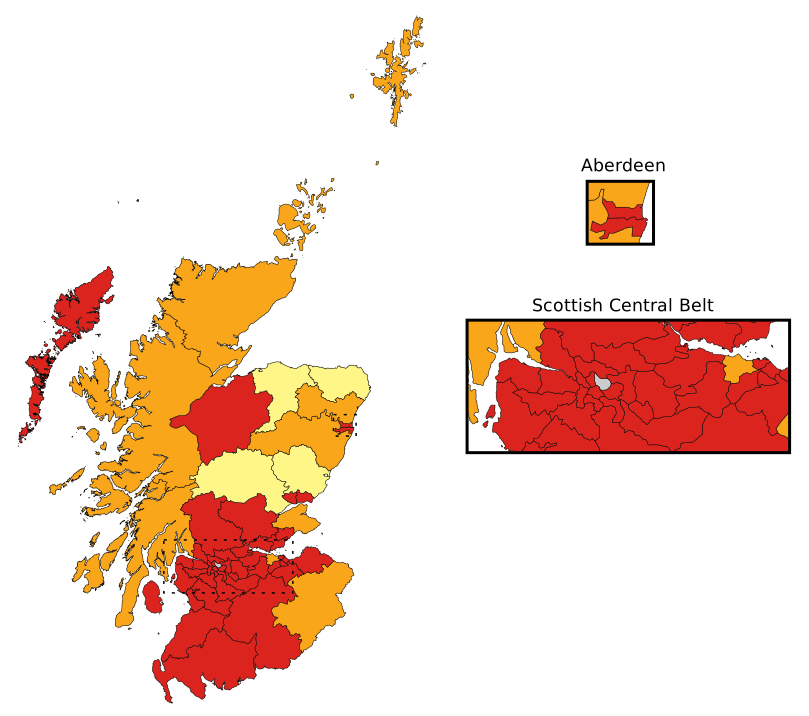
| map_caption | Coloured according to the winning party's vote share in each constituency |
Main article: 2005 United Kingdom general election
/ *Indicates boundary changeso this is a nominal figure
- Figure does include the Speaker, Michael Martin*
A general election was held in the United Kingdom on 5 May 2005 and all 59 seats in Scotland were contested. This was the first election to occur under the new boundaries which reduced the number of Scottish seats from 72 to 59. Previously, Scotland had a greater number of MPs per person than the rest of the UK to compensate for its distinct political nature and distance from Westminster. With the introduction of the Scottish Parliament, Scottish constituencies were brought into line with those found in the rest of the UK, so that they had similar electorates.
Changes
Several years after the Scottish Parliament had been established by the Scotland Act 1998, the target electorate (population) size of Westminster Parliamentary seats in Scotland was adjusted to bring it in line with England's constituencies. Before this reform, Scotland had a smaller target electoral size per constituency resulting in more seats per head of population, which had been intended to compensate Scotland for its status as a nation, its lower population density (which causes larger constituencies geographically), its distance from the Parliament in Westminster and finally, because prior to 1999 Scottish law had been wholly determined by the UK Parliament in Westminster. These problems were perceived to have been addressed with the establishment of the devolved Scottish Parliament in May 1999.
The Boundary Commission for Scotland therefore produced a plan in 2003 in which there would be 59 constituencies, reduced from 72. In 2004, Parliament passed the Scottish Parliament (Constituencies) Act 2004 which instituted these changes and broke the link between UK and Scottish Parliamentary constituencies.
Three constituencies were left unchanged; the island seats of Orkney and Shetland, the Western Isles, though the latter changed its official name to the Gaelic "Na h-Eileanan an Iar", and Eastwood, which changed its name to "East Renfrewshire". Several other new constituency names were also implemented; in all these cases the new seats had altered boundaries.
Predictions
Although it was impossible to guarantee a wholly accurate prediction of the strength of the parties within the 59 Scottish seats, estimates had been made prior to the poll on 5 May on the basis of a ward-by-ward breakdown of local council election results. An agreed set used by all media reports and most political commentators suggested that had the new boundaries been in effect for the 2001 general election, Labour would have won forty-six seats, the Liberal Democrats nine, the Scottish National Party four, and the Conservatives none. This would have represented a loss of ten seats for Labour and one each for the Liberal Democrats, Scottish National Party and the Conservatives. The arithmetic was however complicated by the fact that the boundary revision had produced some seats that were notionally highly marginal.
The results of the 2005 general election showed some of the highest changes of the share of the vote for particular parties occurring in Scottish seats, leading some commentators to speculate that either the notional results were in error and/or they were unable to take into account factors such as tactical voting and people voting differently between general and local elections.
Results
Labour won 41 seats, the Liberal Democrats 11, the Scottish National Party six, and in Dumfriesshire, Clydesdale and Tweeddale the Conservatives won their only Scottish seat. Compared to the actual general election results of 2001, this meant a loss of fourteen seats for Labour, a gain of one seat for the Scottish National Party and the Liberal Democrats, and no change for the Conservatives.
Results in Scotland for Labour were also down, though less so than in England. Labour lost approximately 4% of the vote in East Scotland and approximately 6% of the vote in West Scotland. Labour's vote declined the most in the Edinburgh area and in the north of Scotland (where Labour lost all of its rural seats).
The Conservative vote declined marginally in both East and West Scotland, but the Conservatives nevertheless did win a seat in the South (Dumfriesshire, Clydesdale and Tweeddale), so maintaining their sole Scottish seat in the House of Commons. Having once been the largest party in Scotland (most recently in 1959), the 2001 and 2005 general elections had done very little to reverse the downward trend that culminated in the loss of all eleven Conservative seats in Scotland in 1997.
The Liberal Democrats made gains against Labour in both regions of Scotland and picked up a modest number of seats. On average, their vote rose approximately 5% across Scotland, though again this translated into few gains as the Liberal Democrat vote was not particularly concentrated.
The SNP's vote declined slightly across Scotland, but they won one rural and one urban seat from Labour.
The Socialist Labour Party achieved its highest ever result in one constituency, gaining 14.5% of the votes cast in Glasgow North East, but it failed to win the seat.
Results table
| Party | Seats | Aggregate votes | Total | Gains | Losses | Net +/- | Of all (%) | Total | Of all (%) | Difference | Total |
|---|---|---|---|---|---|---|---|---|---|---|---|
| 41 | 0 | 5 | 5 | 69.5 | 922,402 | 39.5 | 4.5 | ||||
| 11 | 2 | 0 | 2 | 18.6 | 528,076 | 22.6 | 6.3 | ||||
| 6 | 2 | 0 | 2 | 10.2 | 412,267 | 17.7 | 2.4 | ||||
| 1 | 1 | 0 | 1 | 1.7 | 369,388 | 15.8 | 0.2 | ||||
| 0 | 0 | 0 | 0.0 | 43,514 | 1.9 | 1.2 | |||||
| 0 | 0 | 0 | 0.0 | 25,760 | 1.1 | 1.1 | |||||
| 0 | 0 | 0 | 0.0 | 8,859 | 0.4 | 0.3 | |||||
| 0 | 0 | 0 | 0.0 | 6,696 | 0.3 | 0.2 | |||||
| 0 | 0 | 0 | 0.0 | 4,004 | 0.2 | New | |||||
| 0 | 0 | 0 | 0.0 | 1,591 | 0.1 | 0.1 | |||||
| 0 | 0 | 0 | 0.0 | 1,266 | 0.1 | ||||||
| 0 | 0 | 0 | 0.0 | 1,017 | 0.0 | New | |||||
| 0 | 0 | 0 | 0.0 | 916 | 0.0 | ||||||
| Others | 0 | 0 | 0 | 0.0 | 8,131 | 0.3 | 0.1 | ||||
| 59 | 13 | 2,333,887 | 60.6 | 2.4 |
File:ScotlandParliamentaryConstituency2010Results.svg|2005 map of Scottish Constituencies - Results
Votes and seats summary
References
References
- (2015-05-16). "Profile: Jim Murphy, Scottish Labour leader". BBC News.
- (23 May 2005). "Election 2005 | Results | Scotland". BBC News.
- "General Election results, 7 June 2001".
This article was imported from Wikipedia and is available under the Creative Commons Attribution-ShareAlike 4.0 License. Content has been adapted to SurfDoc format. Original contributors can be found on the article history page.
Ask Mako anything about 2005 United Kingdom general election in Scotland — get instant answers, deeper analysis, and related topics.
Research with MakoFree with your Surf account
Create a free account to save articles, ask Mako questions, and organize your research.
Sign up freeThis content may have been generated or modified by AI. CloudSurf Software LLC is not responsible for the accuracy, completeness, or reliability of AI-generated content. Always verify important information from primary sources.
Report