From Surf Wiki (app.surf) — the open knowledge base
2001 South African census
none

none
| Field | Value |
|---|---|
| name | 2001 National Census |
| previous_year | 1996 |
| next_census | South African National Census of 2011 |
| logo | ZA Census 2001 Logo.png |
| logo_size | 250px |
| country | Republic of South Africa |
| previous_census | South African National Census of 1996 |
| date | |
| next_year | 2011 |
| authority | Statistics South Africa |
| population | |
| percent_change | 9.92% |
| region_type | province |
| most_populous | KwaZulu-Natal |
| least_populous | Northern Cape |
The National Census of 2001 was the 2nd comprehensive national census of the Republic of South Africa, or Post-Apartheid South Africa. It undertook to enumerate every person present in South Africa on the census night between 9–10 October 2001 at a cost of .
It was organised and planned by Statistics South Africa in terms of the Statistics Act from the beginning of 1999, under the commission of the Statistician-General Pali Lehohla. The enumeration primarily took place from 10 to 31 October 2001 and the results were published in 2003.
Pre-enumeration
This was the first South African census to use a Geographic Information System to determine the Enumeration Areas. Traditionally, the areas were created using analogue and sketch maps. This geographic database was created out of several data sets acquired from government departments and private sector companies. It included topographic maps, cadastral data, administrative boundaries, aerial photography, satellite imagery and videography. Each area was classified according to its location as one of four types:
- Formal urban area
- Informal urban area
- Rural area (commercial farms)
- Tribal (traditional) area
The country was divided into approximately 80,000 manageable "pockets of land" with an average of 150 living spaces in each Enumeration Area. The intention was that each area could be handled by a single enumerator, to allow every household in the country to be visited within the timeframe provided.
The census questionnaire was developed and tested on a computer-based census administration system at the end of 2000. The main pilot for the census was conducted in February and March 2001, all aspects of enumeration were tested. It resulted in many revisions of both processes and management methods. The 1996 census questionnaire was used as a basis, with some key differences in labour related questions. Three questionnaires were printed:
- The household questionnaire (A) could collect information for ten people in workers' hostels, student hostels, residential hotels or private residencies.
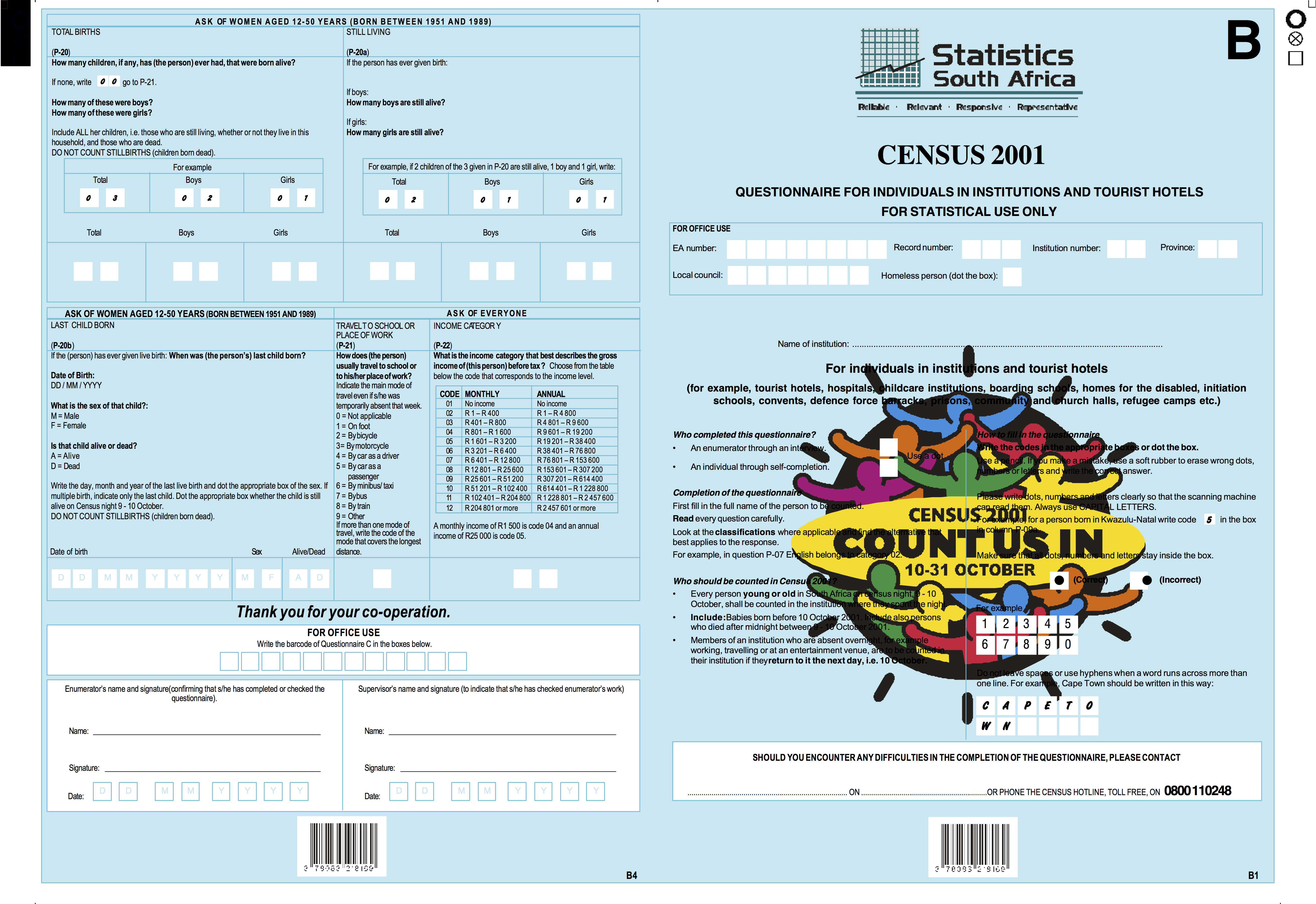
- The individual in an institution questionnaire (B) was an individual form for a person in institutions or tourist hotels, additionally it was used for the homeless.
- The institution questionnaire (C) was for the institution as a whole to provide a list of all the residents on census night, against which completed B questionnaires could be checked.
Data Processing
As the 2001 Census was paper-based, an enormous amount of data needed to be converted to a digital format. The task of data processing consists of primarily four parts: data capture, post-data capture, coding and product generation.
Over 1000 temporary staff members were employed by Statistics South Africa to assist in the process. These employees worked in shifts, 7 days a week for almost 18 months. In total, 10 249 185 questionnaires were received which resulted in the generation of over 117 million images once scanned.
Post-enumeration Survey (PES)
Results
The census population results revealed people live in a 1,219,090 sqkm area, that is 36.8 PD/sqkm.
Demographics
| Rank | Race | 1996 Census | 2001 Census | Change | Percent | |||
|---|---|---|---|---|---|---|---|---|
| change | Total population | 9.92% | ||||||
| 1 | Black African | 12.89% | ||||||
| 2 | White | 3.23% | ||||||
| 3 | Coloured | 10.38% | ||||||
| 4 | Asian or Indian | 6.47% |
| Rank | First language | 1996 Census | 2001 Census | Change | Percent |
|---|---|---|---|---|---|
| change | |||||
| 1 | IsiZulu | 14.86% | |||
| 2 | IsiXhosa | 9.42% | |||
| 3 | Afrikaans | 2.91% | |||
| 4 | Sepedi | 12.98% | |||
| 5 | Setswana | 10.75% | |||
| 6 | English | 6.05% | |||
| 7 | Sesotho | 13.54% | |||
| 8 | Xitsonga | 12.60% | |||
| 9 | SiSwati | 16.42% | |||
| 10 | Tshivenda | 15.31% | |||
| 11 | IsiNdebele | 19.23% | |||
| 12 | Other | 4.93% |
| Rank | Gender | 1996 Census | 2001 Census | Change | Percent |
|---|---|---|---|---|---|
| change | |||||
| 1 | Female | 10.45% | |||
| 2 | Male | 9.34% |
| Rank | Province | 1996 Census | 2001 Census | Change | Percent | |||
|---|---|---|---|---|---|---|---|---|
| change | Total population | 9.92% | ||||||
| 1 | KwaZulu-Natal | 11.31% | ||||||
| 2 | Gauteng | 18.40% | ||||||
| 3 | Eastern Cape | 2.11% | ||||||
| 4 | Limpopo | 6.75% | ||||||
| 5 | Western Cape | 13.38% | ||||||
| 6 | North West | 8.96% | ||||||
| 7 | Mpumalanga | 10.88% | ||||||
| 8 | Free State | 2.74% | ||||||
| 9 | Northern Cape | 2.16% |
References
References
- (2007). "Using the 2001 Census: Approaches to analysing data". Statistics South Africa and the Human Sciences Research Council.
- (2003). "Census 2001: Metadata". Statistics South Africa.
- (2003). "How the count was done". Statistics South Africa.
- (2003). "Census in brief". Statistics South Africa.
- (2003). "How the count was done". Statistics South Africa.
- "Comparing Census 1996 with Census 2001: An operational perspective". Southern African Journal of Demography.
- (2003). "Census in brief". Statistics South Africa.
- (2004). "Primary tables South Africa: Census '96 and 2001 compared". Statistics South Africa.
- (2004). "Primary tables South Africa: Census '96 and 2001 compared". Statistics South Africa.
- (2004). "Primary tables South Africa: Census '96 and 2001 compared". Statistics South Africa.
- (2004). "Primary tables South Africa: Census '96 and 2001 compared". Statistics South Africa.
This article was imported from Wikipedia and is available under the Creative Commons Attribution-ShareAlike 4.0 License. Content has been adapted to SurfDoc format. Original contributors can be found on the article history page.
Ask Mako anything about 2001 South African census — get instant answers, deeper analysis, and related topics.
Research with MakoFree with your Surf account
Create a free account to save articles, ask Mako questions, and organize your research.
Sign up freeThis content may have been generated or modified by AI. CloudSurf Software LLC is not responsible for the accuracy, completeness, or reliability of AI-generated content. Always verify important information from primary sources.
Report