From Surf Wiki (app.surf) — the open knowledge base
2000 class railcar
Railcars of suburban Adelaide
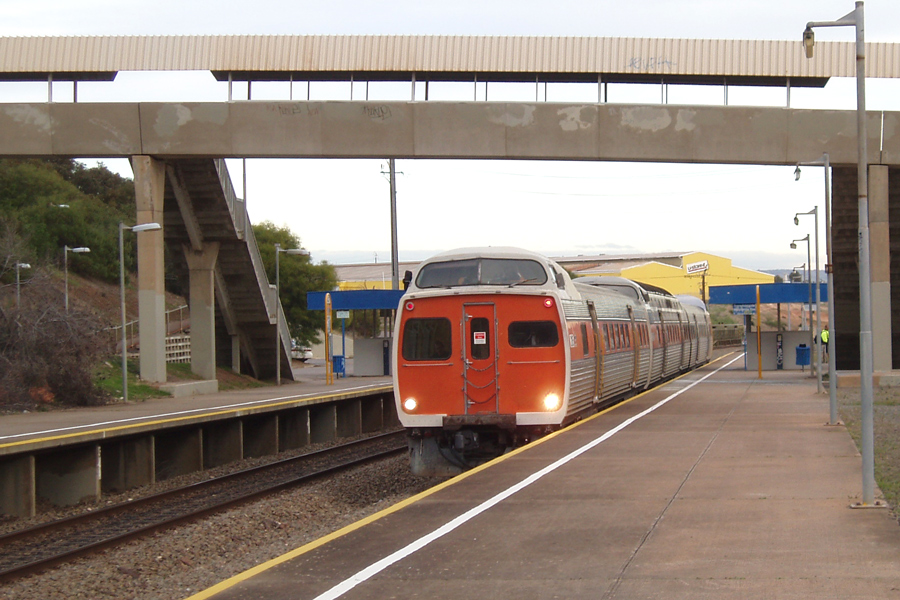
Railcars of suburban Adelaide
| Field | Value | |||
|---|---|---|---|---|
| name | 2000 and 2100 class railcars | |||
| image | AdelaideRail 4.jpg | |||
| caption | Adelaide Metro liveried 2011 & 2106 at Gawler station in June 2005 | |||
| manufacturer | Comeng | |||
| factory | Granville, New South Wales | |||
| yearconstruction | 1978–1980 | |||
| yearservice | February 1980 | |||
| yearretired | August 2015 | |||
| yearscrapped | June 2016 | |||
| numberbuilt | 30 | |||
| numberpreserved | 6 | |||
| numberscrapped | 24 | |||
| successor | 4000 class | |||
| formation | 2–4 carriages | |||
| fleetnumbers | 2001–2012, 2101–2118 | |||
| capacity | {{plainlist | |||
| operator | {{plainlist | |||
| depots | Dry Creek | |||
| carlength | 24.8 m | |||
| width | 3.19 m | |||
| height | 4.27 m | |||
| maxspeed | {{plainlist | |||
| * {{convert | 130 | km/h | abbr | on}} (design) |
| * {{convert | 90 | km/h | abbr | on}} (service) |
| weight | {{plainlist | |||
| * 2000: {{convert | 65 | t | abbr | on}} |
| * 2100: {{convert | 42 | t | abbr | on}} |
| engine | {{plainlist | |||
| poweroutput | {{plainlist | |||
| * As built: 2 × {{convert | 377 | kW | abbr | on}} |
| * After repowering: 2 × {{convert | 390 | kW | abbr | on}} |
| transmission | Voith T420r Diesel Hydraulic | |||
| aux | Rolls-Royce SF65CT | |||
| uicclass | B′B′ | |||
| gauge |
- 70 (2000)
- 100 (2100)
- State Transport Authority
- TransAdelaide
- Adelaide Metro
- 130 km/h (design)
- 90 km/h (service)
- 2000: 65 t
- 2100: 42 t
- As built: 2 × MAN D3650s
- After repowering: 2 × Cummins KTA 19Rs
- As built: 2 × 377 kW
- After repowering: 2 × 390 kW
The 2000 class and 2100 class were diesel multiple units that operated on the Adelaide rail network between 1980 and 2015. They were built by Comeng in Granville, New South Wales in 1979–1980. As of 2024, six railcars have been preserved while the rest have been scrapped.
History
The 2000 and 2100 class were self-propelled diesel railcars operated by the State Transport Authority and its successors on the Adelaide rail network. The body shell design was based on the Budd SPV-2000, Metroliner and Amfleet cars, but the 2000 class railcars have a slightly different curve to the Amfleet cars.
Twelve 2000 powercars and eighteen 2100 class trailer cars were built. The bodyshells were built by Comeng in Granville. Two (2001 and 2101) were completed at Granville while the remainder were railed to Adelaide via Lithgow and Broken Hill to comply with a contractual requirement to maximise local content, the fit out being conducted by Comeng's Aresco subsidiary at Dry Creek. The first delivery took place in late October 1979 and entered service on 22 February 1980. Delivery of the trains continued until August 1981.
They were nicknamed Jumbos owing to the raised driving cab, similar to the distinctive hump of the Boeing 747 jumbo jet. This raised cab was designed to meet Australian Federated Union of Locomotive Employees demands for a full-width driver's cab whilst allowing inter-carriage doors to be fitted.
The powercars were originally powered by V12 turbocharged MAN D3650 engines that were replaced by two turbocharged 6 cylinder Cummins engines under the floor driving a Voith hydraulic transmission in the late 1980s. They usually operated in 2-car (power-trailer) or 3-car (trailer-power-trailer) configurations. It was originally intended that they primarily operate express services on the Gawler and Noarlunga Centre lines with the existing Redhens operating the all stops services, but they quickly ended up operating services across the network.
Six were stored for a number of years, being returned to traffic in 2007. One was sent to Bombardier Transportation's Dandenong factory in 2006 to assess the feasibility of a life extension program, but it was deemed not worthwhile. They did on occasions venture beyond the Adelaide metropolitan area, operating special services to Tanunda and Nuriootpa on the Barossa Valley line, however these excursions ended in April 2003.
From 23 February 2014, these railcars were no longer permitted to operate on the Belair, Tonsley (now Flinders) and Seaford lines due to low clearances as a result of the electrification of these lines, being restricted to the Gawler Central, Grange and Outer Harbor lines. Withdrawals commenced in late 2014. By 2015 only 11 cars were still in service and only operated peak hour express services and special event extra services such as Adelaide Oval event trains on the Gawler Central line and occasionally on the Outer Harbor line. The remaining fleet members was retired in August 2015 after running services between Gawler Central and Adelaide and were stored at the Dry Creek Railcar depot for 10 months before removal.
Preservation
Four have been preserved, however as of 2025, none are operating:
- 2006 and 2112 were preserved and gifted to National Railway Museum, Port Adelaide via rail
- 2010 and 2109 were delivered to SteamRanger Heritage Railway via road.
2009 and 2104 were donated to the South Australian Metropolitan Fire Service for use in training exercises.
References
References
- McNicol, Steve. (2016). "Jumbos: The early days". Railmac Publications.
- New Generation of Trains on the way ''[[Among Ourselves]]'' issue 193 June 1978 pages 12/13
- New Metropolitan Rollingstock ''[[The Recorder (periodical). The Recorder]]'' October 1978 pages3-5
- "Here & There" ''[[Australian Railway History. Australian Railway Historical Society Bulletin]]'' issue 507 January 1980 page 4
- "Here & There" ''Australian Railway Historical Society Bulletin'' issue 511 May 1980 page 27
- "2000 Class Railcars" ''Australian Railway Historical Society Bulletin'' issue 605 Match 1988 pages 50-69
- "The Adelaide 2000 class Railcars" ''[[Railway Digest]]'' December 2005 pages 32/33
- Dunn, John. (2013). "Comeng: A History of Commonwealth Engineering Volume 4: 1977–1985". Rosenberg Publishing.
- 2000 series ''The Recorder'' September 1986 page 184
- Repowered Jumbos ''[[Transit Australia]]'' June 1989 page 132
- "TransAdelaide Update" ''[[Catch Point (periodical). Catch Point]]'' issue 173 May 2006 page 5
- "Gawler Line Timetable Changes" ''Catch Point'' issue 187 September 2008 page 17
- McNicol, Steve. (2017). "Jumbos: Workhorses to the end". Railmac Publications.
- "Broad Gauge - Northern Lines" ''Catch Point'' issue 113 May 1996 page 22
- "TransAdelaide Barossa Services" ''Catch Point'' issue 117 January 1997 page 8
- [http://www.natrailmuseum.org.au/assets/pdfdocs/corporate/a2.4-a2.5_annual-report_2015-2016.pdf Annual Report for year ended 30 June 2016]{{Dead link. (July 2021)
- "SA Jumbos Preserved" ''Railway Digest'' January 2016 page 57
- The rest were sent by road and scrapped in June 2016 at [[Sims Metal Management. link. (3 October 2020 ''[[ABC News (Australia)). ABC News]]'' 1 June 2016
- "Jumbo Railcars Say Farewell" ''Catch Point'' issue 234 July 2016 pages 10-13
This article was imported from Wikipedia and is available under the Creative Commons Attribution-ShareAlike 4.0 License. Content has been adapted to SurfDoc format. Original contributors can be found on the article history page.
Ask Mako anything about 2000 class railcar — get instant answers, deeper analysis, and related topics.
Research with MakoFree with your Surf account
Create a free account to save articles, ask Mako questions, and organize your research.
Sign up freeThis content may have been generated or modified by AI. CloudSurf Software LLC is not responsible for the accuracy, completeness, or reliability of AI-generated content. Always verify important information from primary sources.
Report