From Surf Wiki (app.surf) — the open knowledge base
1989 California medfly attack
Bioterrorism incident in California, United States

Bioterrorism incident in California, United States
| Field | Value |
|---|---|
| title | 1989 California medfly attack |
| image | Fly October 2008-4.jpg |
| caption | A female Mediterranean fruit fly (Ceratitis capitata) |
| location | Southern California (Los Angeles area) |
| target | California Agriculture/Malathion spraying program |
| date | July 1989–November 1990 |
| type | Ecotage, Agro-terrorism, Ecoterrorism |
| fatalities | 0 |
| injuries | 0 |
| weapons | Medflies |
| perpetrator | Unknown |
| motive | Unknown |
In 1989, a sudden invasion of Mediterranean fruit flies (Ceratitis capitata, "medflies") appeared in the US state of California and began devastating crops. Scientists were puzzled and said that the sudden appearance of the insects "defies logic", and some speculated "biological terrorists" were responsible. Analysis suggested that an outside hand played a role in the dense infestation.
A person or group calling itself "The Breeders" took responsibility for the bioterrorist attack, as financial retaliation for the environmental damage caused by the state's Malathion aerial spraying; the group's members were never identified. Subsequently, three months after "The Breeders" announced the medfly release, the state ended its decade-long Malathion program and sought alternate ways to handle destructive insects.
Background
Largely because of its sunny Mediterranean climate and widespread irrigation, California is the world's fifth largest supplier of food and agriculture commodities.{{Cite web
Medflies breed rapidly and eat fruit with a voracious appetite. Notably, they represent a risk to 22 crops in California, including apples, apricots, avocados, bell peppers, cherries, dates, figs, grapes, grapefruits, kiwis, limes, mandarin oranges, nectarines, olives, oranges, peaches, pears, persimmons, plums, prunes and tomatoes.
Medfly infestations are not without precedent, both in California and elsewhere in North America. Between 1975 and 1993 the state of California spent more than $170 million on medfly eradication programs meant to contain 12 different infestations. In 1996 the state began utilizing sterile medflies in its eradication program and between 1996 and 2007 the state experienced five infestations. A major 1981 medfly infestation cost California $40 million by itself. Medflies were found in traps as late as 2007 in Solano County, California. The first medflies in Florida turned up in 1929 and they have been a constant threat to the citrus crop there ever since. Medfly sightings occurred in Florida in 1997 and 2010.
Attack
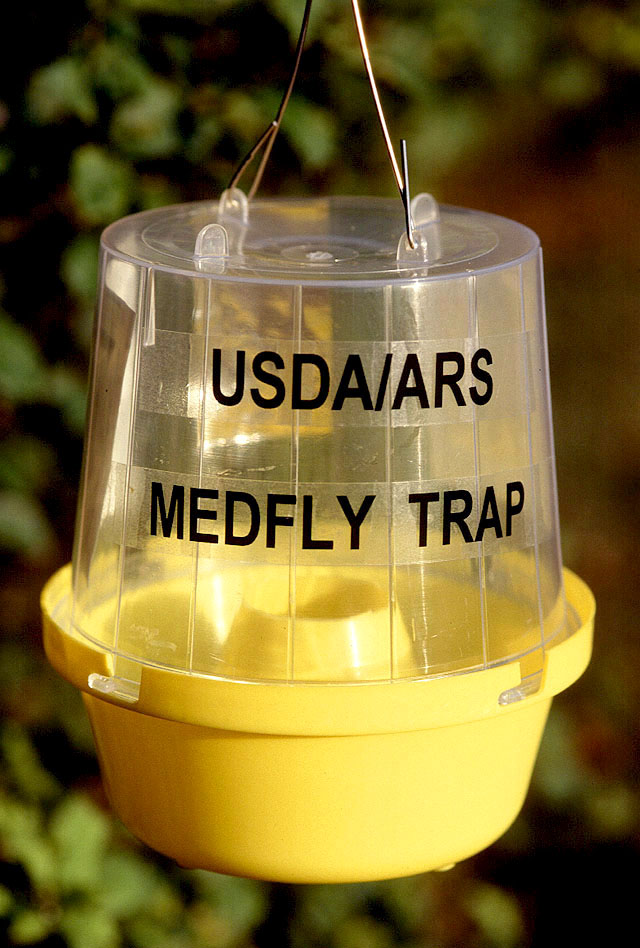
Beginning in 1975, when medflies were first seen in the area, California deployed small McPhail traps to attract and capture the medflies to help measure the estimated population. In 1989, as many flies were captured as had been captured in the previous fifteen years combined. The greatest concentration of medflies were found in Orange County and within a triangle linking the eastern edge of the Los Angeles Basin with San Bernardino and Riverside County.
On December 8, 1989, the state retreated from its position that the 12 outbreaks since August each represented "isolated infestations" that could be easily eradicated after a panel of scientific advisers suggested it was not possible. It was instead ordered that, rather than 1–2 aerial sprayings of the infected communities, more than a dozen sprayings would be necessary over a period of months. In addition, Malathion was no longer used alone, but mixed in a 4:1 ratio with Nu-Lure0 bait to attract insects to the area.
The period of infestation stretched from July 1989 through November 1990. In the years since medflies were discovered in California, an average of $26 million was spent annually to control them; but 1989's attack was estimated to have cost $60 million in eradication efforts, making 1989 the second-most expensive year in the state's program. It is not clear whether the $60 million was the total cost, or only represented California's half of a possible $120 million cost, as half the costs were borne by the federal Department of Agriculture.
Claim of responsibility
In December 1989, a two-page letter addressing Los Angeles Mayor Tom Bradley was sent to the Los Angeles Times and Fresno Bee ostensibly from an "ecoterrorist organization" calling itself "The Breeders". The Breeders claimed that it was responsible for the summer release of the medflies as retaliation for the environmental damage caused by the Malathion aerial spraying by the state. It also threatened to expand its medfly infestation into the San Joaquin Valley. The letters claimed that officials would have noticed an uptick in medfly numbers around March 1989. Initially, the letter was dismissed as "some crank trying to get a lot of publicity", but there was evidence the group played a role in the infestation. Certain characteristics of the 1989 medfly infestation led investigators to the conclusion that someone was responsible for deliberately releasing medflies. The dense medfly population coupled with the low number of medfly larvae found in the infested areas left entomologists baffled as to how the infestation could be completely natural. The writer of the letter, and any members of the alleged group, were never identified.
Response
The FBI became involved in the investigation and the letters were turned over to the Los Angeles Police Department's Criminal Conspiracy Section. During the course of the investigation, the United States Department of Agriculture attempted to contact The Breeders through a classified ad placed in the Los Angeles Times. The ad stated: "Breeders if you're for real send one of your little friends. We want to talk. Call John at USDA."
In response to the threat, California State Senator Ruben S. Ayala introduced the bill SB1754 in the Senate Agriculture and Water Resources Committee to make it a felony for any person to import Mediterranean fruit flies into the state, rather than the misdemeanor it already was. The bill included prison sentences ranging from 16 months to three years, and fines up to $10,000. Senator Ayala's proposal became law June 22, 1990, and added Section 6306 to the Food and Agriculture Code.
In the year following the attack, there were seizures of postal shipments which sought to intercept medfly larvae. In addition, 61,731 passengers and 2,430 cargo shipments were searched entering through airports, but no larvae were discovered. There were five "intensive searches" of cargo and baggage as it arrived at Los Angeles Airport and San Francisco Airport that tested positive for medfly larvae. After its repeated sprayings failed to eradicate the medfly threat, California halted its Malathion aerial spraying program in March 1990, three months after the threat from The Breeders was received. The state instead opted to try the voluntary introduction of millions of radiation-sterilized medflies to interrupt the reproductive cycle and control the population.
Later, South Dakota reported that a similar attack with a corn or soybean pest could devastate their agriculture industry. In May 2001, Mark Urlaub, the Department of Agriculture's biosecurity program director, announced that investigators were "taking another look at" the 1989 attack.
References
References
- Johnson, John. "[https://www.latimes.com/archives/la-xpm-1989-12-30-mn-1024-story.html Invasion by Medfly Defies Logic, Scientists Say Infestation: Experts discover peculiar patterns in the spread of the stubborn fruit fly]", ''[[Los Angeles Times]]'', December 30, 1989, accessed February 21, 2012.
- 0071452826).
- Pratt, Robert J. "[https://apps.dtic.mil/sti/pdfs/ADA415732.pdf Invasive Species - A Threat to the Homeland?]", USAWC Strategy Research Project, ''[[U.S. Army War College]]'', April 7, 2003, accessed February 21, 2012. {{Dead link. (November 2021)
- (1989-12-03). "Mystery Letter Puts Odd Twist on Medfly Crisis".
- (September 1996). "The Incipient Mediterranean Fruit Fly Population in California: Implications for Invasion Biology". Ecology.
- [[Root-Bernstein, Robert S.]] "[https://www.theatlantic.com/past/docs/issues/91may/rootbernstein.htm Infectious Terrorism]", ''[[The Atlantic]]'', May 1991, accessed February 19, 2012.
- (July 1995). "Embargo on California produce would cause revenue, job loss". California Agriculture.
- Wheeler, Mark. "[https://www.discovermagazine.com/planet-earth/fly-wars Fly Wars] {{Webarchive. link. (June 2, 2021 ", ''Discovery Magazine'', February 1993, accessed May 31, 2021.)
- (2008). "Use of Genetically Engineered Fruit Fly and Pink Bollworm in APHIS Plant Pest Control Programs".
- The 1981 infestation turned into a political crisis and led to the beginning of the state's aerial spraying program in July of that year.Anderson, Ian. "Medfly fighters win their battle the hard way", ([https://books.google.com/books?id=VBWAYqkejC4C&dq=medflies+1981&pg=PA815 Google Books link]), ''[[New Scientist]]'', Vol. 95, No. 1324, p. 815, ISSN 0262-4079.
- Brazil, Eric. "The political stakes in the Medfly infestation", ''California Journal'', April 1981, pp. 137-39.
- (2007-09-23). "Medfly puts Solano in spotlight".
- (2016-03-04). "Medfly Scare Yet Another Challenge For Citrus Industry, Very Much Alive In Lake - tribunedigital-orlandosentinel".
- (2010-06-18). "Medflies found in Boca Raton - Sun Sentinel".
- Chavez, Stephanie and Simon, Richard. "[https://www.latimes.com/archives/la-xpm-1989-12-08-mn-342-story.html State Launches New Offensive Against Medfly]", ''Los Angeles Times'', December 8, 1989, accessed February 21, 2012.
- Chavez, Stephanie and Simon, Richard. "[https://www.latimes.com/archives/la-xpm-1989-12-08-mn-298-story.html Months-Long Spraying of Medfly Is Ordered Infestation: Officials admit underestimating the outbreak. Meantime, the malathion opposition grows.]", ''Los Angeles Times'', December 8, 1989, accessed February 21, 2012.
- Leyva, J. "[http://www.cdpr.ca.gov/docs/emon/pubs/ehapreps/mallett.htm Removal of Malathion Residues from Lettuce for Medfly Eradication Projects] {{Webarchive. link. (2016-03-04 " (Memorandum), ''[[California Department of Pesticide Regulation]]'', August 16, 1995, accessed February 19, 2012.)
- (1992). "The Mediterranean fruit fly in California: taking stock". California Agriculture.
- (October 1992). "Geographic populations of the medfly may be differentiated by mitochondrial DNA variation". Experientia.
- "[http://www.paloaltohistory.com/palo-alto-medfly-invasion.php Palo Alto Pests: The 1981 Medfly Invasion] {{webarchive. link. (April 22, 2012 ", ''paloaltohistory.com'', accessed February 23, 2012.)
- (1995). "Medfly problem simmers". California Agriculture.
- Chavez, Stephanie and Simon, Richard. "[https://www.latimes.com/archives/la-xpm-1989-12-03-me-267-story.html Mystery Letter Puts Odd Twist on Medfly Crisis]", ''Los Angeles Times'', December 3, 1989, accessed February 21, 2012.
- "Medfly letter puts blame on mystery group, ''[[San Jose Mercury News]]'', December 5, 1989.
- Bonfante, Jordan. "[https://web.archive.org/web/20080724201507/http://www.time.com/time/magazine/article/0,9171,969129,00.html Medfly Madness]", ''[[Time Magazine]]'', January 8, 1990, accessed December 25, 2008.
- [[Fresno Bee]], "Medfly threat prompts new bill Ayala proposes law after group vows to unleash flies", ([http://nl.newsbank.com/nl-search/we/Archives?p_product=FB&p_theme=fb&p_action=search&p_maxdocs=200&p_topdoc=1&p_text_direct-0=0EAE8415C5E23A39&p_field_direct-0=document_id&p_perpage=10&p_sort=YMD_date:D&s_trackval=GooglePM login required]), ''[[Fresno Bee]]'', January 18, 1990, accessed February, 23, 2012.
- 1410100235).
- Published on December 2, 1989, Daily News of Los Angeles (CA) GROUP CLAIMS RESPONSIBILITY FOR MEDFLY WOES
- Times, Richard Simon Richard Simon is a former staff writer for the Los Angeles. (1989-12-03). "Mystery Letter Puts Odd Twist on Medfly Crisis".
- 0262582392).
- (2016-03-04). "'Peculiar Things Happening' In Southern California Medfly Infestation - tribunedigital-orlandosentinel".
- "[http://cns.miis.edu/cbw/agchron.htm Chronology of CBW Incidents Targeting Agriculture 1915-2008] {{Webarchive. link. (2012-05-31 ", James Martin Center for Nonproliferation Studies, Monterey Institute of International Studies, ''[[Middlebury College]]'', March 2009, accessed February 19, 2012.)
- [[Drogin, Bob]]. "[https://www.latimes.com/archives/la-xpm-2009-jun-10-na-spy-highschool10-story.html High school mixes algebra, homeland security]", ''Los Angeles Times'', June 10, 2009, accessed February 21, 2012.
- "Panel OKS Bill Making Medfly Import Felony", ([http://nl.newsbank.com/nl-search/we/Archives?p_product=FB&p_theme=fb&p_action=search&p_maxdocs=200&p_topdoc=1&p_text_direct-0=0EAE842F7145EC98&p_field_direct-0=document_id&p_perpage=10&p_sort=YMD_date:D&s_trackval=GooglePM login required]), ''[[Fresno Bee]]'', March 7, 1990, accessed February 23, 2012.
- "3 Pest Bills Pass AG Committee", ([http://nl.newsbank.com/nl-search/we/Archives?p_product=FB&p_theme=fb&p_action=search&p_maxdocs=200&p_topdoc=1&p_text_direct-0=0EAE84516A9C7C13&p_field_direct-0=document_id&p_perpage=10&p_sort=YMD_date:D&s_trackval=GooglePM login required]), ''Fresno Bee'', May 15, 1990, accessed February 23, 2012.
- John Burton. (1990). "New Statutes Affecting the Criminal Law; 1990 General and Extraordinary Sessions of the California State Legislature". Report of the Assembly Committee on Public Safety.
- link. (2013-04-12 ", Section 6301-6306, ''aroundthecapitol.com'', accessed February 23, 2012.)
- Dunn, Ashley. "[https://www.latimes.com/archives/la-xpm-1990-05-16-mn-303-story.html State Gambles That Sterile Flies Can Do the Job: Medfly: Agriculture officials are about to attempt a tactical shift in the battle, replacing the aerial spraying of malathion]", ''Los Angeles Times'', May 16, 1990, accessed February 23, 2012.
- [http://www.southdakota.us/doa/das/Newsletter%20Spring2003.pdf The threat of agricultural terrorism] {{Webarchive. link. (2007-09-28 South Dakota Department of Agriculture)
- Caruba, Alan. "[http://www.conservativemonitor.com/news/2001022.shtml A New Terrorism Comes of Age]", ''Conservative Monitor'', May 2001, accessed February 23, 2012. {{Webarchive. link. (May 17, 2008)
This article was imported from Wikipedia and is available under the Creative Commons Attribution-ShareAlike 4.0 License. Content has been adapted to SurfDoc format. Original contributors can be found on the article history page.
Ask Mako anything about 1989 California medfly attack — get instant answers, deeper analysis, and related topics.
Research with MakoFree with your Surf account
Create a free account to save articles, ask Mako questions, and organize your research.
Sign up freeThis content may have been generated or modified by AI. CloudSurf Software LLC is not responsible for the accuracy, completeness, or reliability of AI-generated content. Always verify important information from primary sources.
Report