From Surf Wiki (app.surf) — the open knowledge base
1975 Portuguese Constituent Assembly election
none
none
| Field | Value | |
|---|---|---|
| election_name | 1975 Portuguese Constituent Assembly election | |
| country | Portugal | |
| type | parliamentary | |
| ongoing | no | |
| previous_election | 1973 Portuguese legislative election | |
| previous_year | 1973 | |
| next_election | 1976 Portuguese legislative election | |
| next_year | 1976 | |
| seats_for_election | All 250 seats in the Constituent Assembly of Portugal | |
| elected_members | elected members | |
| majority_seats | 126 | |
| registered | 6,231,372 | |
| turnout | 5,711,829 (91.7%) | |
| election_date | 25 April 1975 | |
| image1 | ||
| leader1 | Mário Soares | |
| party1 | Socialist Party (Portugal) | |
| leader_since1 | 19 April 1973 | |
| leaders_seat1 | Lisbon | |
| seats1 | 116 | |
| popular_vote1 | 2,162,972 | |
| percentage1 | 37.9% | |
| image2 | ||
| leader2 | Francisco Sá Carneiro | |
| party2 | PPD | |
| colour2 | FFA500 | |
| leader_since2 | 6 May 1974 | |
| leaders_seat2 | Porto | |
| seats2 | 81 | |
| popular_vote2 | 1,507,282 | |
| percentage2 | 26.4% | |
| image3 | ||
| colour3 | DA251E | |
| leader3 | Álvaro Cunhal | |
| party3 | PCP | |
| leader_since3 | 31 March 1961 | |
| leaders_seat3 | Lisbon | |
| seats3 | 30 | |
| popular_vote3 | 711,935 | |
| percentage3 | 12.5% | |
| image4 | ||
| colour4 | 0093DD | |
| leader4 | Diogo Freitas do Amaral | |
| party4 | CDS | |
| leader_since4 | 19 July 1974 | |
| leaders_seat4 | Lisbon | |
| seats4 | 16 | |
| popular_vote4 | 434,879 | |
| percentage4 | 7.6% | |
| image5 | ||
| colour5 | 8b0000 | |
| leader5 | Francisco Pereira de Moura | |
| party5 | MDP/CDE | |
| leader_since5 | September 1969 | |
| leaders_seat5 | Lisbon | |
| seats5 | 5 | |
| popular_vote5 | 236,318 | |
| percentage5 | 4.1% | |
| image6 | [[File:União Democrática Popular logo, 1975.svg | 85px]] |
| colour6 | ||
| leader6 | João Pulido Valente | |
| party6 | UDP | |
| leader_since6 | 9 March 1975 | |
| leaders_seat6 | Lisbon | |
| seats6 | 1 | |
| popular_vote6 | 44,877 | |
| percentage6 | 0.8% | |
| <!-- Map --> | map | {{Switcher |
| [[File:1975 Portuguese Constituent Assembly election - Results.svg|230px]] | Vote winner strength by district | [[File:Eleições para a Constituinte de 1975.svg|234px]] | Results by constituency
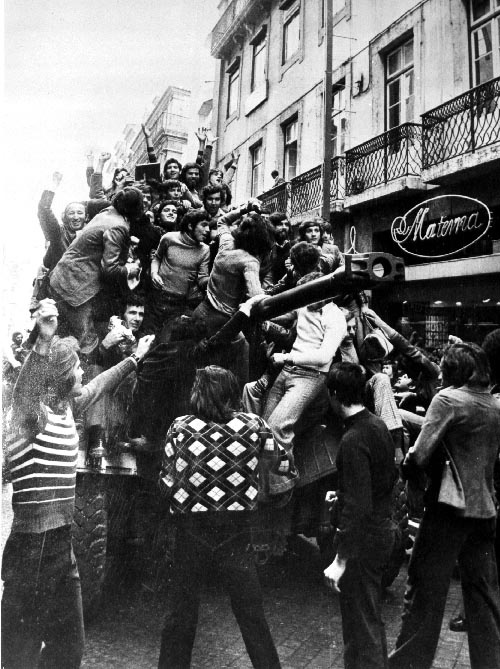
Constituent Assembly elections were carried out in Portugal on 25 April 1975, exactly one year after the Carnation Revolution. The election elected all 250 members of the Portuguese Constituent Assembly.
It was the first free election held in Portugal since 1925, and only the seventh free election in all of Portuguese history. It was also the first under universal suffrage since 1894. Turnout was a record 91.66 percent, which remains (as of 2025) the highest ever in any Portuguese democratic elections (general, regional, local or European).
The main aim of the election was the election of a Constituent Assembly, in order to write a new constitution to replace the Estado Novo regime's authoritarian Constitution of 1933 and so this freely-elected parliament had a single-year mandate and no government was based on parliamentary support; the country continued to be governed by a military-civilian provisional administration during the deliberations of the Constituent Assembly.
With very few opinion polls during the campaign, the real trend of the electorate was unknown, but incumbent Prime Minister Vasco Gonçalves was confident in a victory of the most leftwing forces in Portugal, forecasting that the Portuguese Democratic Movement (MDP/CDE) would win the election, followed by the Communists (PCP) and then the Socialist Party (PS). In the end, this forecast was totally wrong.
The election was won by the Socialist Party with almost 38 percent of the votes and 116 seats. The Social Democratic Party (then known as the Democratic People's Party, PPD) was the second-most voted party, 26.4 percent and 81 seats, defending a project that it would soon abandon, social democratic centrism, the Portuguese "Social-Democracy", and becoming the major right-wing party in the country a few years after. The size of the results of the PPD were a big surprise, taking into account that they won double the votes of the Communists.
The new parliament had a large majority of parties defending socialist or "democratic socialist" ideas and the Constitution, approved one year after, reflected such influence. The Portuguese Communist Party achieved a surprisingly low total, just 12 percent, considering the overwhelming support in the south of the country and the radical turn to the left of the revolutionary process after the failed fascist coup, one month before.
With the PPD's shift away from the left and towards the right coming after this election, the only right-of-centre party elected was the CDS, which received 7.6 percent of the vote and 16 seats. The other big surprise were the very weak results of MDP/CDE, which polled just at 4 percent and elected 5 members to the Assembly.
The results map showed a strong North-South division, with the more rightwing forces, PPD and CDS, dominating the North and Center regions, mainly in rural areas, and the PCP dominating the South, especially the Alentejo region. The PS dominated the big urban areas around Lisbon, Porto, Coimbra and Setúbal.
Background
Main article: Portuguese transition to democracy
The previous parliamentary elections were held on October 28, 1973, still under the authoritarian rule of the Estado Novo (New State), founded by António de Oliveira Salazar, who died in 1970. The People's National Action (ANP), the single party of the then President of the Council of Ministers, Marcelo Caetano, had won the all 150 deputies of the National Assembly in the 1973 election, with a participation rate of 66.5% of registered. The election was boycotted by Opposition forces due to complaints about democratic legitimacy and oppression.
1974 revolution
Main article: Carnation Revolution
On April 25, 1974, the Carnation Revolution, initiated by the captains of the Armed Forces Movement (MFA), ended the authoritarian regime established in 1932 by António de Oliveira Salazar. After the revolutionary forces proclaimed victory, the National Salvation Junta, presided by General António de Spínola, took over the position of Head of State and Government.
With political parties once again legal, the Socialist Party (PS) leader, Mário Soares, and the Portuguese Communist Party (PCP) Secretary General, Álvaro Cunhal, returned to Portugal less than a week later. In addition, the members of the "liberal wing" of the ANP, favorable to a democratization of the "Estado Novo" before its fall, founded the Democratic People's Party (PPD) which claimed to be social democratic.
At the end of three weeks, Spínola took the oath as President of the Republic, and nominated Adelino da Palma Carlos Prime Minister as the head of the 1st provisional government in which civil and military members plus independent, socialists, social democrats and communists also took part.
As early as July 18, Vasco Gonçalves, a military man seen as very close to the Communist Party, replaced Palma Carlos as head of the government. After this, the first party that didn't claim to be from the left or the center-left appeared, the Democratic and Social Center (CDS), which claimed to be an advocate of Christian democracy and liberalism.
Barely two and a half months later, after failing to carry out a counter-revolution, Spínola resigned as President of the Republic and was replaced by General Francisco da Costa Gomes, his deputy in the National Salvation Junta. On March 19, 1975, President Costa Gomes officially called an election to elect members to write a new Constitution.
Electoral system
The electoral system adopted, set by the electoral law approved on November 15, 1974, establishes the election of members of parliament by proportional representation according to the D'Hondt method, known to benefit the parties that come first.
The law fixes the number of one deputy per 25,000 inhabitants and one more per fraction of 12,500. Deputies were elected in twenty-three constituencies, namely the eighteen metropolitan districts, Horta, Ponta Delgada, Angra do Heroísmo, Funchal, Mozambique, Macau, and the rest of the world.
In application of these provisions, 250 seats were to be filled.
For these elections, the MPs distributed by districts were the following:
| District | Number of MPs | Map |
|---|---|---|
| Lisbon | 55 | |
| Porto | 36 | |
| Setúbal | 16 | |
| Braga | 15 | |
| Aveiro | 14 | |
| Santarém | 13 | |
| Coimbra | 12 | |
| Leiria | 11 | |
| Viseu | 10 | |
| Faro | 9 | |
| Castelo Branco | 7 | |
| Beja, Funchal, Guarda, Viana do Castelo and Vila Real | 6 | |
| Évora | 5 | |
| Bragança and Portalegre | 4 | |
| Ponta Delgada | 3 | |
| Angra do Heroísmo | 2 | |
| Emigration, Horta, Macau and Mozambique | 1 |
Parties
The table below lists the major parties that contested the elections:
| Name | Ideology | Political position | Leader |
|---|---|---|---|
| Socialist Party (Portugal)}};" | PS | Socialist Party | |
| Partido Socialista | Social democracy | ||
| Social Democratic Party (Portugal)}};" | PPD | Democratic People's Party | |
| Partido Popular Democrático | Liberalism | ||
| PCP | Portuguese Communist Party | ||
| Partido Comunista Português | Communism | ||
| CDS – People's Party}};" | CDS | Democratic and Social Center | |
| Centro Democrático e Social | Christian democracy | ||
| Democratic Electoral Commission}};" | MDP/CDE | Portuguese Democratic Movement | |
| Movimento Democrático Português | Left-wing nationalism | ||
| Democratic socialism | |||
| Left Bloc (Portugal)}};" | UDP | Popular Democratic Union | |
| União Democrática Popular | Marxism | ||
| Socialism | |||
| Association for the Defense of Macau Interests}};" | ADIM | Association for the Defense of Macau Interests | |
| Associação para a Defesa dos Interesses de Macau | Conservatism | ||
| Macau interests |
Campaign period
Party slogans
| Party or alliance | Original slogan | English translation | Refs | |
|---|---|---|---|---|
| Socialist Party (Portugal)}}" | PS | « A verdadeira escolha » | "The real choice" | |
| Social Democratic Party (Portugal)}}" | PPD | « Tu decides votando » | "You decide by voting" | |
| Portuguese Communist Party}}" | PCP | « Dá mais força à Liberdade » | "Empower Freedom" | |
| CDS – People's Party}}" | CDS | « O voto certo » | "The right vote" | |
| MDP | « O voto do povo » | "The people's vote" | ||
| Left Bloc (Portugal)}}" | UDP | « Em frente com a UDP » | "Moving forward with UDP" |
Candidates' debates
On the election night broadcast on RTP1, a debate took place, moderated by Joaquim Letria, on the electoral results revealed so far, with the participation of the leaders of the four main parties at the time: Mário Soares (Socialist Party), Joaquim Magalhães Mota replacing Francisco Sá Carneiro (Social Democratic Party), Álvaro Cunhal (Portuguese Communist Party), and Francisco Pereira de Moura (MDP/CDE). The questions to the guests were asked by a panel of commentators made up of journalists Manuel Beça Múrias, Dinis Abreu, José Júdice, Castro Mendes and José Carlos Vasconcelos.
| 1975 Portuguese Constituent Assembly election | Date | Organisers | Moderator(s) | Present Absent invitee Non-invitee | PS | PPD | PCP | MDP/CDE | Refs | Socialist Party (Portugal)}};" | Social Democratic Party (Portugal)}};" | Portuguese Communist Party}};" | |||||
|---|---|---|---|---|---|---|---|---|---|---|---|---|---|---|---|---|---|
| 26 Apr | RTP1 | Joaquim Letria | Soares | Mota | Cunhal | Moura | date=26 April 1975 | url=https://arquivos.rtp.pt/conteudos/analise-das-eleicoes-para-a-assembleia-constituinte/ | title=Análise das eleições para a Assembleia Constituinte | language=pt | work=RTP Arquivos | access-date=5 February 2022}} |
Opinion polling
| Polling firm/Link | Date Released | PS | [[File:Primeiro Símbolo do PSD.png | 29px | link=Social Democratic Party (Portugal) | PPD]] | [[File:Portuguese Communist Party Hammer and Sickle.png | 25px | link=Portuguese Communist Party | PCP]] | [[File:CDS-PP (1982-1994).png | 25px | link=CDS – People's Party | CDS]] | [[File:Símbolo do MDP-CDE.png | 23px | link=Portuguese Democratic Movement | MDP]] | O | Lead |
|---|---|---|---|---|---|---|---|---|---|---|---|---|---|---|---|---|---|---|---|---|
| 1975 Constituent election | 25 Apr 1975 | 37.9 | ||||||||||||||||||
| 26.4 | ||||||||||||||||||||
| 12.5 | ||||||||||||||||||||
| 7.6 | ||||||||||||||||||||
| 4.1 | ||||||||||||||||||||
| 11.5 | ||||||||||||||||||||
| Socialist Party (Portugal)}}; color:white;" | 11.5 | |||||||||||||||||||
| IPOPE | Mar 1975 | 47 | 21 | 17 | 2 | 4 | 9 | 26 | ||||||||||||
| Vida Mundial | 27 Feb 1975 | 49 | 27 | 14 | 6 | 4 | 22 | |||||||||||||
| CUF | Dec 1974 | 35.1 | 27.0 | 10.8 | 2.7 | 24.4 | 8.1 |
Results
National summary
Distribution by constituency
|- class="unsortable" !rowspan=2|Constituency!!%!!S!!%!!S!!%!!S!!%!!S!!%!!S!!%!!S!!%!!S !rowspan=2|Total S |- class="unsortable" style="text-align:center;" !colspan=2 | PS !colspan=2 | PPD !colspan=2 | PCP !colspan=2 | CDS !colspan=2 | MDP/CDE !colspan=2 | UDP !colspan=2 | ADIM |-
| 23.0 |
|---|
| 2 |
| 2.4 |
| - |
| 6.1 |
| - |
| 1.1 |
| - |
| 2 |
| - |
| 31.8 |
| 5 |
| 7 |
| 3.2 |
| - |
| 11.1 |
| 2 |
| 3.9 |
| - |
| 14 |
| - |
| 35.6 |
| 3 |
| 5.3 |
| - |
| 3 |
| 2.2 |
| - |
| 5.5 |
| - |
| 1.4 |
| - |
| 6 |
| - |
| 27.4 |
| 5 |
| 7 |
| 3.7 |
| - |
| 18.0 |
| 3 |
| 2.9 |
| - |
| - |
| - |
| 15 |
| - |
| 24.7 |
| 1 |
| 3 |
| 2.7 |
| - |
| 13.5 |
| - |
| 3.7 |
| - |
| - |
| - |
| 4 |
| - |
| 5 |
| 24.3 |
| 2 |
| 5.6 |
| - |
| 6.4 |
| - |
| 3.9 |
| - |
| 0.8 |
| - |
| 7 |
| - |
| 7 |
| 27.2 |
| 4 |
| 5.7 |
| 1 |
| 4.6 |
| - |
| 4.4 |
| - |
| 12 |
| - |
| 3 |
| 6.9 |
| - |
| 37.1 |
| 2 |
| 2.8 |
| - |
| 7.8 |
| - |
| 0.9 |
| - |
| 5 |
| - |
| 6 |
| 13.9 |
| 1 |
| 12.3 |
| 1 |
| 3.4 |
| - |
| 9.5 |
| 1 |
| 1.1 |
| - |
| 9 |
| - |
| 19.6 |
| 1 |
| 5 |
| 1.7 |
| - |
| 10.0 |
| - |
| 1.3 |
| - |
| 6 |
| - |
| 28.2 |
| 2 |
| 3 |
| 2.9 |
| - |
| 19.5 |
| 1 |
| 3.6 |
| - |
| 6 |
| - |
| 23.0 |
| - |
| 1 |
| 2.4 |
| - |
| 3.1 |
| - |
| 1 |
| - |
| 33.2 |
| 5 |
| 5 |
| 6.4 |
| - |
| 6.8 |
| 1 |
| 3.4 |
| - |
| 1.1 |
| - |
| 11 |
| - |
| 29 |
| 15.0 |
| 9 |
| 18.9 |
| 11 |
| 4.8 |
| 3 |
| 4.1 |
| 2 |
| 1.7 |
| 1 |
| 55 |
| - |
| 1 |
| 1 |
| - |
| 1 |
| 1 |
| - |
| 30.4 |
| 1 |
| 2 |
| 1.5 |
| - |
| 3.1 |
| - |
| 2.7 |
| - |
| 3 |
| - |
| 3 |
| 9.9 |
| - |
| 17.5 |
| 1 |
| 4.0 |
| - |
| 4.5 |
| - |
| 1.2 |
| - |
| 4 |
| - |
| 18 |
| 29.4 |
| 12 |
| 6.7 |
| 2 |
| 8.9 |
| 3 |
| 2.6 |
| 1 |
| 0.6 |
| - |
| 36 |
| - |
| 8 |
| 18.8 |
| 3 |
| 15.1 |
| 2 |
| 4.3 |
| - |
| 4.1 |
| - |
| 1.0 |
| - |
| 13 |
| - |
| 7 |
| 5.7 |
| 1 |
| 37.8 |
| 7 |
| 1.6 |
| - |
| 6.0 |
| 1 |
| 1.3 |
| - |
| 16 |
| - |
| 24.5 |
| 2 |
| 3 |
| 3.8 |
| - |
| 14.5 |
| 1 |
| 7.1 |
| - |
| 6 |
| - |
| 27.1 |
| 2 |
| 4 |
| 2.9 |
| - |
| 7.2 |
| - |
| 2.3 |
| - |
| 6 |
| - |
| 21.5 |
| 2 |
| 6 |
| 2.3 |
| - |
| 17.2 |
| 2 |
| 4.0 |
| - |
| 10 |
| - |
| 34.4 |
| - |
| 1 |
| 4.6 |
| - |
| 11.0 |
| - |
| 1 |
| - |
| - class="unsortable" style="background:#E9E9E9" |
| 116 |
| 26.4 |
| 81 |
| 12.5 |
| 30 |
| 7.6 |
| 16 |
| 4.1 |
| 5 |
| 0.8 |
| 1 |
| 0.0 |
| 1 |
| 250 |
| - |
| } |
Maps
Legislativas portuguesas de 1975 (Mapa).png|Most voted political force by municipality.
Notes
References
References
- (29 September 2019). "Todos queriam votar nas eleições de 1975". Correio da Manhã.
- (2015). "A primeira campanha eleitoral em democracia". RTP.
- "25 de Abril de 1974". [[Rádio e Televisão de Portugal.
- "As primeiras eleições livres". [[Correio da Manhã (Portugal).
- [http://www.cne.pt/sites/default/files/dl/ac_1975_data_eleicao.pdf Official call of 1975 Constituent Assembly election]
- [http://www.cne.pt/sites/default/files/dl/legis_dl_621_c_74.pdf Electoral Law of 1974]
- "Mapa com o número de deputados da Eleição para a Assembleia Constituinte de 25 de Abril de 1975". CNE - Comissão Nacional de Eleições - Mapa com o número de deputados da Eleição para a Assembleia Constituinte de 25 de Abril de 1975.
- "PS – 1975". EPHEMERA.
- "ELEIÇÕES LEGISLATIVAS DE 1983 – PSD". EPHEMERA.
- "Comunicação Política em eleições legislativas em Portugal: uma análise a partir dos cartazes eleitorais (1975-2009)". Francisco Teixeira.
- "Comunicação Política em eleições legislativas em Portugal: uma análise a partir dos cartazes eleitorais (1975-2009)". Francisco Teixeira.
- "MDP – CDE – 1975". EPHEMERA.
- "UDP – 1975". EPHEMERA.
- (26 April 1975). "Análise das eleições para a Assembleia Constituinte". RTP Arquivos.
This article was imported from Wikipedia and is available under the Creative Commons Attribution-ShareAlike 4.0 License. Content has been adapted to SurfDoc format. Original contributors can be found on the article history page.
Ask Mako anything about 1975 Portuguese Constituent Assembly election — get instant answers, deeper analysis, and related topics.
Research with MakoFree with your Surf account
Create a free account to save articles, ask Mako questions, and organize your research.
Sign up freeThis content may have been generated or modified by AI. CloudSurf Software LLC is not responsible for the accuracy, completeness, or reliability of AI-generated content. Always verify important information from primary sources.
Report