From Surf Wiki (app.surf) — the open knowledge base
1914 Belgian general election
none
none
| Field | Value |
|---|---|
| country | Belgium |
| type | parliamentary |
| previous_election | 1912 Belgian general election |
| previous_year | 1912 |
| next_election | 1919 Belgian general election |
| next_year | 1919 |
| seats_for_election | 88 of the 186 seats in the Chamber of Representatives |
| election_date | 24 May 1914 |
| image_size | 130x130px |
| image1 | DeBroqueville.jpg |
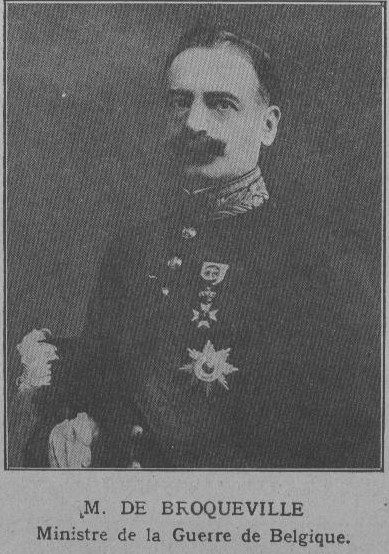
| leader1 | Charles de Broqueville |
| party1 | Catholic Party (Belgium) |
| seats1 | 41 |
| popular_vote1 | 570,806 |
| percentage1 | 42.77% |
| image2 | 3x4.svg |
| leader2 | Laurent Vandersmissen |
| party2 | Belgian Labour Party |
| seats2 | 26 |
| popular_vote2 | 404,701 |
| percentage2 | 30.32% |
| image3 | 3x4.svg |
| party3 | Liberal Party (Belgium) |
| seats3 | 20 |
| popular_vote3 | 326,922 |
| percentage3 | 24.50% |
| title | Government |
| posttitle | Government after election |
| before_election | De Broqueville I |
| before_party | Catholic Party (Belgium) |
| after_election | De Broqueville I |
| after_party | Catholic Party (Belgium) |
Partial general elections were held in Belgium on 24 May 1914.{{Cite book The result was a victory for the Catholic Party, which won 41 of the 88 seats up for election in the Chamber of Representatives.
The Catholics had formed the government continuously since 1884; the incumbent de Broqueville government was in office since 1911.
Under the alternating system, elections were only held in four out of the nine provinces: Hainaut, Limburg, Liège and East Flanders. This was the last time this system was applied, as the next elections in 1919 saw the introduction of full four-year terms.
The elections occurred shortly before the outbreak of World War I. The newly elected legislature met for just one day in a special session: on 4 August 1914, when King Albert I addressed the United Chambers of Parliament upon the German invasion of Belgium. The parliament met again after the war in November 1918.
Results
Seats up for election
Seats in the provinces of Antwerp, Brabant, Luxembourg, Namur and West Flanders were not up for election.
| Province | Arrondissement(s) | Chamber | Total | 88 |
|---|---|---|---|---|
| Limburg | Hasselt | 3 | ||
| Tongeren-Maaseik | 4 | |||
| East Flanders | Aalst | 5 | ||
| Oudenaarde | 3 | |||
| Gent-Eeklo | 12 | |||
| Dendermonde | 4 | |||
| Sint-Niklaas | 4 | |||
| Hainaut | Tournai-Ath | 6 | ||
| Charleroi | 11 | |||
| Thuin | 3 | |||
| Mons | 7 | |||
| Soignies | 4 | |||
| Liège | Huy-Waremme | 4 | ||
| Liège | 13 | |||
| Verviers | 5 |
Elected members
Apart from the re-elected members, the following six members were newly elected:
- Paul Van Hoegaerden-Braconier (liberal), elected in Liège to replace Charles Van Marcke de Lummen (liberal), who did not seek re-election.
- Alfred Journez (liberal), elected in Liège to replace Ferdinand Fléchet (liberal), who was not a candidate for health reasons.
- Paul-Emile Janson (liberal), elected in Tournai to replace Albert Asou (liberal), who did not seek re-election to the Chamber.
- Paul Neven (liberal), elected in Tongeren-Maaseik to replace Auguste Van Ormelingen (catholic).
- Clément Peten (liberal), elected in Hasselt to replace Albert de Menten de Horne (catholic).
- Joseph Wauters (socialist), elected in Huy-Waremme to replace Jules Giroul (liberal).
References
References
- Nohlen & Stöver, p308
- [http://www.ibzdgip.fgov.be/result/nl/result_vt.php?date=1914-05-24&vt=CK&ko_type=KO_PR Belgian Elections]
This article was imported from Wikipedia and is available under the Creative Commons Attribution-ShareAlike 4.0 License. Content has been adapted to SurfDoc format. Original contributors can be found on the article history page.
Ask Mako anything about 1914 Belgian general election — get instant answers, deeper analysis, and related topics.
Research with MakoFree with your Surf account
Create a free account to save articles, ask Mako questions, and organize your research.
Sign up freeThis content may have been generated or modified by AI. CloudSurf Software LLC is not responsible for the accuracy, completeness, or reliability of AI-generated content. Always verify important information from primary sources.
Report