From Surf Wiki (app.surf) — the open knowledge base
1912 racial conflict in Forsyth County, Georgia
Racially motivated violence and subsequent racial cleansing in Forysth County in 1912

Racially motivated violence and subsequent racial cleansing in Forysth County in 1912

In Forsyth County, Georgia, in September 1912, two separate alleged attacks on white women in the Cumming area resulted in black men being accused as suspects. First, a white woman reportedly awoke to find a black man in her bedroom. Days later, a white teenage girl was beaten and raped, later dying of her injuries.
Following the first alleged assault, a black preacher who made disparaging remarks about the victim was harshly beaten. Local law enforcement locked the preacher inside the courthouse overnight to protect him from the mob waiting outside. Other black men, arrested in connection with the alleged assault, were moved to Atlanta for their safety. A grand jury dropped the case months later.
Following the second assault, a 16-year-old black boy was linked to the attack by a pocket mirror sold to him at a local store. He confessed, under duress, and implicated accomplices. Rob Edwards was one of the men arrested and held in the small jail in Cumming. He was taken from the jail by a white mob and shot and beaten to death, and his body was hanged from a telephone pole. The 16-year-old and a 17-year-old black boy were later convicted by an all-white jury after the older boy's sister testified against both them and sentenced to death by hanging. The sentences were carried out weeks later in what became a public execution. Immediately prior to his execution, the younger black boy made a voluntary confession of his guilt. However, his older codefendant maintained his innocence.
In the following months, a group of men called "Night Riders" terrorized black citizens, warning them to leave in 24 hours or be killed. Those who resisted were subjected to further harassment, including shots fired into their homes, or livestock killed. An estimated 98% of the black residents of Forsyth County left.
Background
After the American Civil War, black enslaved persons in the South were emancipated and granted citizenship and the franchise through constitutional amendments. But by the turn of the 20th century, all Southern states disfranchised blacks by passing constitutions and other laws to impede voter registration and voting. Georgia Democrats passed such a law in 1908, resulting in the disfranchisement of blacks in the state. In addition, the white-dominated Southern legislatures passed laws imposing racial segregation in public facilities, and Jim Crow customs ruled. Most rural blacks worked as sharecroppers on white-owned land, and were seldom able to get free from poverty.
The 1906 Atlanta race riot was waged by whites against blacks, and reflected tensions in a city that was rapidly changing. Dr. Ansel Strickland, a doctor in Cumming, Georgia, wrote a firsthand account saying that "hundreds of Black were killed" by whites in the Atlanta riot. The rate of lynchings of blacks by whites in Georgia and the South had been high since the late 19th century, and accounts of lynchings were regularly published in the local papers, often maintaining that the blacks were responsible, guilty either of a crime or poor attitude. Lynchings were a means by whites to enforce white supremacy in social affairs, and ensure that blacks stayed in line.
The presence of mixed race individuals suggests that the official ban against interracial relationships was not absolute, including historical accounts of light-skinned slaves being fathered by white owners. At the time of the 1910 census, Georgia's Forsyth County was recorded as having more than 10,000 whites, 858 blacks and 440 mulattoes (mixed race).
Ellen Grice incident
_Edit_Share_Print_Download.jpg)
On the night of September 5, 1912, a white woman named Ellen Grice alleged that a black man entered her bedroom. Awakened by him, she screamed, which caused him to flee. Within days, Forsyth County Sheriff William Reid detained Toney Howell as a suspect, along with alleged accomplices Johnny Bates, Fate Chester, Isaiah Pirkle, and Joe Rogers. The five black men were placed in the small Forsyth County jail located near the Cumming town square.
Assault on Grant Smith
After the news came out about the attack on Grice, Grant Smith, a black preacher at a local Cumming church, was heard to suggest that the victim was a "sorry white woman". No one was ever arrested or tried for the assault on Smith.
Whites patrol streets

Based on rumors that blacks at a nearby church barbecue threatened to dynamite the town, armed white men patrolled Cumming to prevent such action. Fearing a race riot, Governor Joseph Mackey Brown declared martial law
Later that day, Sheriff Reid sent Howell, his four alleged accomplices, and Smith to the Cobb County jail in nearby Marietta for their safety. Smith, who was not under arrest, was released there. Fearing that a mob from Cumming was en route, Governor Brown arranged for the five prisoners to be moved again for their protection, this time to the Fulton County jail in Atlanta. No mob formed in Marietta.
Toney Howell charges
Police said that Toney Howell had confessed to the assault on Ellen Grice. Charged with assault with intent to rape,
Mae Crow assault
On September 8, 1912, Mae Crow,{{efn|Contemporary newspaper reports gave her name as May Crow; She was lying face down in a pool of blood and her throat had been slashed; she was still alive and breathing shallowly. Crow later died of her injuries.
Arrest of Ernest Knox
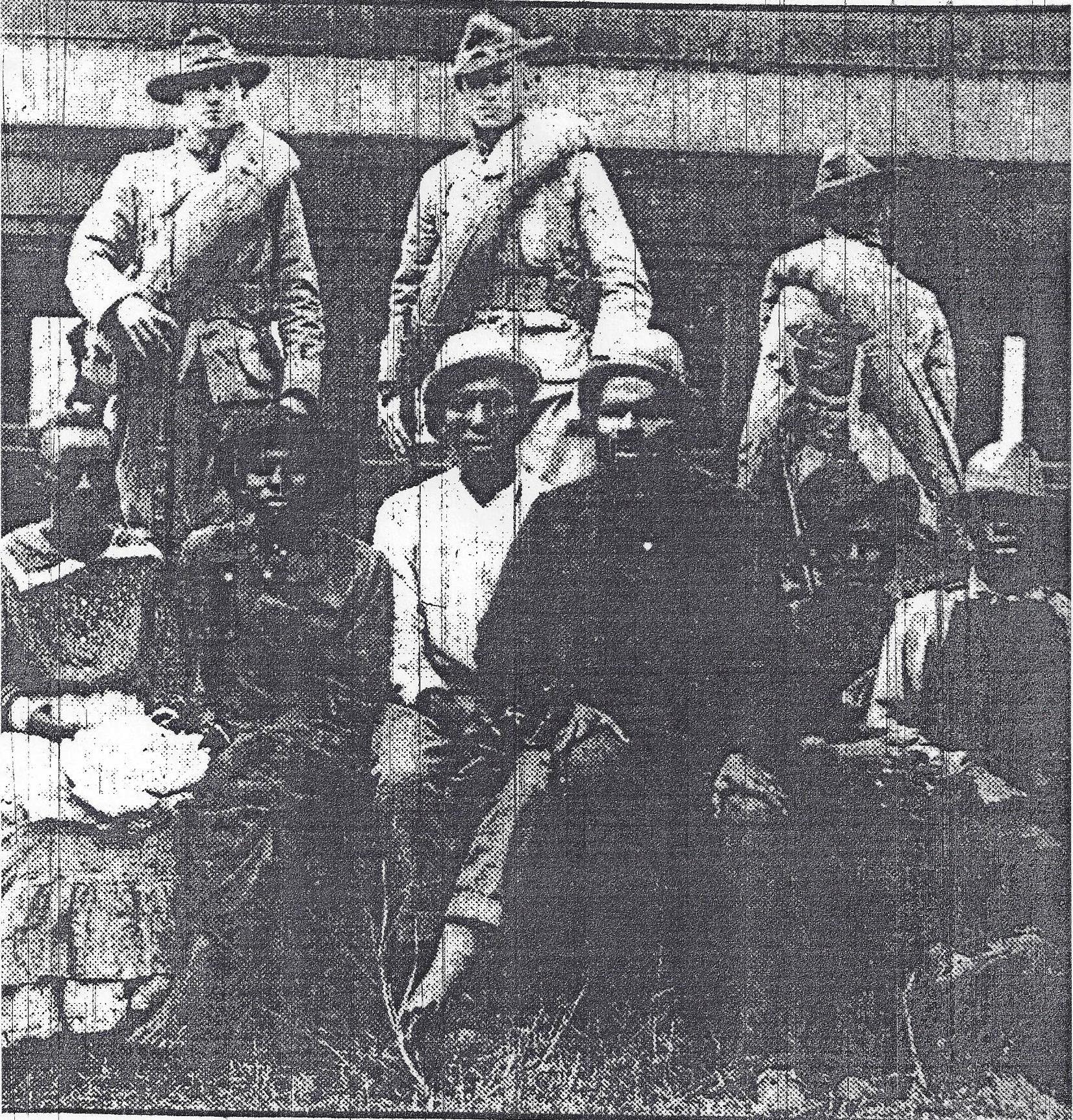
At the scene where the girl was found, searchers found a small pocket mirror that was said to belong to Ernest Knox,{{efn|Contemporary newspaper reports initially gave his name as Ernest Cox. Police arrested him at home, taking him to the Hall County jail in Gainesville to avoid the recent turmoil of Cumming. On the way, Knox confessed to having attacked Crow, after being subjected to a "form of torture known as mock lynching."
Knox was said to have struck Crow from behind and dragged her down a gully in the woods.
When word spread of the attack on Crow, a white lynch mob began to form that afternoon at the Gainesville jail. That night, police officers took Knox by car to Atlanta to prevent a lynching.
Rob Edwards lynched
Rob Edwards was arrested the next day as a suspect in Crow's attack and was taken to the county jail in Cumming. The Atlanta Georgian reported that "the corpse was mangled into something hardly resembling a human form."
Trial
Trussie Daniel and her brother Oscar Daniel were also arrested as suspects, and their neighbor Ed Collins was held as a witness. For the trial, held in early October in Cumming, the governor again declared martial law.
The following day, October 4, both teenagers were sentenced to death by hanging, scheduled for October 25. State law prohibited public hangings. The scheduled execution was to be viewed only by the victim's family, a minister, and law officers. Gallows were built off the square in Cumming. A fence erected around the gallows was burned down the night before the execution. A crowd estimated at between 5,000 and 8,000 gathered to watch what became a public hanging of the two youths. The total county population was around 12,000 at the time.
Prior to mounting the scaffold, Daniel maintained his innocence, but Knox confessed.
Aftermath: racial expulsion

After the trial and executions, bands of white men known as Night Riders, from Cherokee County and other nearby counties, threatened and intimidated black inhabitants. These families either fled or were killed and their properties were stolen from them. Those that left fled to Hall County and Gwinnett County. In 1910, more than 1,000 black people lived in the county, which had more than 10,000 white residents. Within the next four months following the events of September 1912, an estimated 98% of the black residents living in the county left due to Night Rider threats, or were murdered.
Some property owners were able to sell, likely at a loss. The renters and sharecroppers left to seek safer places. Those who had to abandon property, and failed to continue paying property tax, eventually lost their lands, and whites took it over. Many black properties ended up in white hands without a sale and without a legal transfer of title. Much of this land was in the village of Oscarville, Georgia. Eventually, the village was submerged under the waters of Lake Lanier.
Night Riders next moved on to Dawson County and Hall County where they attempted to do the same. Reportedly, a few white residents tried to stop the Night Riders, but were unsuccessful. They were finally stopped when the Hall County sheriff arrested 11 of the Night Riders.
This anti-black campaign was widespread across Appalachian Georgia, with Forsyth being the third county to expel its black population after Towns and Union, whilst whites soon afterwards expelled blacks from the surrounding counties of Fannin, Gilmer and Dawson.
Representation in other media
The racial expulsion, or ethnic cleansing, of Forsyth County was among the events explored in Banished: American Ethnic Cleansings, aired on PBS in 2015 in its Independent Lens series.
The 2016 non-fiction book by author Patrick Phillips, Blood at the Root: A Racial Cleansing In America, examines the 1912 events in Forsyth County along with later events including the 1987 Forsyth County protests. Phillips said in an interview with Terry Gross that he first heard of the racial cleansing when he moved to the county with his parents at age seven.
In 2020, soil from the site where Rob Edwards was lynched was donated to The Legacy Museum in Montgomery, Alabama, for display with soil from other lynching sites across the United States.
In January 2021, a historical marker documenting the lynching of Rob Edwards was unveiled in downtown Cumming.
Notes
References
References
- "Ernest Knox, GA, 1912 October 25".
- (September 7, 1912). "Appeal for Troops as Lynchers Gather". [[The Atlanta Georgian]].
- (September 8, 1912). "Militia Prevents Clash of Racist Cummings". [[Ledger-Enquirer]].
- "The Assault, Rape and Murder of Mae Crow". County Coordinator of Forsyth County.
- (September 8, 1912). "Two Companies of Militia Prevent a Serious Race Riot". [[The Telegraph (Macon, Georgia).
- (September 11, 1912). "Bloodhounds on Trial of Cumming Firebug; Race War Threatens". [[The Atlanta Georgian]].
- (9 September 1912). "State Troopers Rescue Negroes at Cumming, GA". [[The Atlanta Constitution]].
- Christensen, Mike. (June 28, 1987). "Tale of white Forsyth not fully factual". [[The Atlanta Journal-Constitution]].
- Christensen, Mike. (June 28, 1987). "Forsyth (cont'd)". [[The Atlanta Journal-Constitution]].
- (September 9, 1912). "Young Lady was in Woods, but Found". [[The Valdosta Daily Times]].
- (September 9, 1912). "Girl, 18, Throat Cut, Found Unconscious in Woods Near Cumming". [[The Atlanta Georgian]].
- (September 10, 1912). "Negro is Rushed in Fast Machine to Fulton Tower". [[The Atlanta Constitution]].
- (September 10, 1912). "Second Outrage Shocks Cumming". [[The Telegraph (Macon, Georgia).
- (October 4, 1912). "Troops on Guard as Two Rapists are Convicted". [[The Atlanta Constitution]].
- (September 11, 1912). "Terror in Cumming; Race Riot Feared". [[The Atlanta Georgian]].
- (September 10, 1912). "Mob Batters Down Jail Door at Cumming and Hangs Girl's Assailant". [[The Atlanta Georgian]].
- (October 3, 1912). "Troops Guard Negroes' Trial at Cumming". [[The Atlanta Georgian]].
- (October 3, 1912). "List of Chosen Jurors". [[The Atlanta Georgian]].
- Bramblett, Annette. (2002-10-01). "Forsyth County: History Stories, The Making of America Series". Arcadia Publishing.
- Jaspin, Elliot. (2007-03-05). "Buried in the Bitter Waters: The Hidden History of Racial Cleansing in America". Basic Books.
- Loewen, James W.; ''Sundown Towns: A Hidden Dimension of American Racism'', p. 179 {{ISBN. 9781565848870
- [https://archive.today/20130415144348/http://www.pbs.org/independentlens/banished/film.html ''Banished: American Ethnic Cleansings''] (2015), Independent Lens, PBS
- (September 2016). "Blood at the Root: A Racial Cleansing in America". W. W. Norton & Company.
- (September 15, 2016). "The 'Racial Cleansing' That Drove 1,100 Black Residents Out Of Forsyth County, Ga.". NPR.
- Cep, Casey. (July 11, 2020). "'Do You Think You're Not Involved?' The Racial Reckoning of 'Blood at the Root'".
- (January 25, 2021). "Historical marker documenting 1912 lynching unveiled in downtown Cumming".
This article was imported from Wikipedia and is available under the Creative Commons Attribution-ShareAlike 4.0 License. Content has been adapted to SurfDoc format. Original contributors can be found on the article history page.
Ask Mako anything about 1912 racial conflict in Forsyth County, Georgia — get instant answers, deeper analysis, and related topics.
Research with MakoFree with your Surf account
Create a free account to save articles, ask Mako questions, and organize your research.
Sign up freeThis content may have been generated or modified by AI. CloudSurf Software LLC is not responsible for the accuracy, completeness, or reliability of AI-generated content. Always verify important information from primary sources.
Report