From Surf Wiki (app.surf) — the open knowledge base
1912 Belgian general election
none
none
| Field | Value |
|---|---|
| country | Belgium |
| type | parliamentary |
| previous_election | 1910 Belgian general election |
| previous_year | 1910 |
| next_election | 1914 Belgian general election |
| next_year | 1914 |
| seats_for_election | All 186 seats in the Chamber of Representatives |
| 93 of 120 seats in the Senate | |
| election_date | 2 June 1912 |
| image_size | 130x130px |
| image1 | DeBroqueville.jpg |
| leader1 | Charles de Broqueville |
| party1 | Catholic Party (Belgium) |
| seats1 | 101 |
| popular_vote1 | 1,337,315 |
| percentage1 | 51.01% |
| image2 | 3x4.svg |
| leader2 | N/A |
| party2 | Liberal–Socialist |
| seats2 | 45 |
| popular_vote2 | 710,459 |
| percentage2 | 27.10% |
| color2 | 800080 |
| image3 | 3x4.svg |
| party3 | Liberal Party (Belgium) |
| seats3 | 21 |
| popular_vote3 | 291,084 |
| percentage3 | 11.10% |
| image4 | 3x4.svg |
| leader4 | Laurent Vandersmissen |
| party4 | Belgian Labour Party |
| seats4 | 18 |
| popular_vote4 | 243,338 |
| percentage4 | 9.28% |
| party5 | Christene Volkspartij |
| seats5 | 1 |
| popular_vote5 | 19,317 |
| percentage5 | 0.74% |
| title | Government |
| posttitle | Government after election |
| before_election | De Broqueville I |
| before_party | Catholic Party (Belgium) |
| after_election | De Broqueville I |
| after_party | Catholic Party (Belgium) |
93 of 120 seats in the Senate
Full general elections were held in Belgium on 2 June 1912.{{Cite book
Background
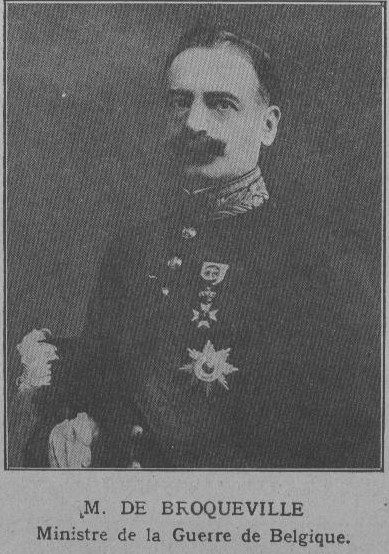
Catholics had formed the government continuously since 1884. Minister Schollaert had drafted a controversial education law, because of which he was forced to resign in June 1911. He was succeeded by a government led by Charles de Broqueville. The education law was intended to financially equalise public and private education, which was opposed by liberals and socialists as it benefited private (Catholic) schools. Both opposition parties, united against Catholics, were expected to win the elections. King Albert I was preparing to switch to a progressive government headed by liberal Paul Hymans. However, the elections unexpectedly increased the majority of the Catholic Party, which won 101 of the 186 seats in the Chamber of Representatives and 54 of the 93 seats in the Senate. Consequently, the incumbent Catholic government headed by Charles de Broqueville continued after the elections.
Electoral system
These elections were the first full general elections since 27 May 1900, when a proportional system using the D'Hondt method was introduced. Since 1893, there was universal suffrage with plural voting. Hence, there were more votes than the 1,745,666 who could vote in these Chamber elections (out of a population of 7,571,387 in the country).
Following the population census, the number of seats in the Chamber of Representatives increased from 166 to 186. The number of directly elected seats in the Senate (half the number of Chamber seats) consequently increased from 83 to 93; the number of provincial senators remained at 27.
Results
Chamber of Representatives
Senate
Constituencies
The distribution of seats among the electoral districts was as follows. Several arrondissements got one or more additional seats, following the population census. With Neufchâteau-Virton receiving an extra seat, every electoral district now had at minimum, three seats in the Chamber.
| Province | Arrondissement(s) | Chamber | Change | Senate | Change | Total | 186 | +20 | 120 | +10 |
|---|---|---|---|---|---|---|---|---|---|---|
| Antwerp | Antwerp | 15 | +2 | 7 | +1 | |||||
| Mechelen | 5 | +1 | 5 | +1 | ||||||
| Turnhout | 4 | +1 | ||||||||
| Elected by the provincial council | 3 | – | ||||||||
| Limburg | Hasselt | 3 | – | 4 | +1 | |||||
| Tongeren-Maaseik | 4 | +1 | ||||||||
| Elected by the provincial council | 2 | – | ||||||||
| East Flanders | Aalst | 5 | – | 4 | – | |||||
| Oudenaarde | 3 | – | ||||||||
| Gent-Eeklo | 12 | +1 | 6 | +1 | ||||||
| Dendermonde | 4 | +1 | 4 | – | ||||||
| Sint-Niklaas | 4 | – | ||||||||
| Elected by the provincial council | 4 | – | ||||||||
| West Flanders | Bruges | 4 | – | 2 | – | |||||
| Roeselare-Tielt | 5 | +1 | 3 | +1 | ||||||
| Kortrijk | 5 | – | 4 | – | ||||||
| Ypres | 3 | – | ||||||||
| Veurne-Diksmuide-Ostend | 5 | +1 | 2 | – | ||||||
| Elected by the provincial council | 3 | – | ||||||||
| Brabant | Leuven | 7 | +1 | 3 | – | |||||
| Brussels | 26 | +5 | 13 | +2 | ||||||
| Nivelles | 4 | – | 2 | – | ||||||
| Elected by the provincial council | 4 | – | ||||||||
| Hainaut | Tournai-Ath | 6 | – | 3 | – | |||||
| Charleroi | 11 | +2 | 7 | +1 | ||||||
| Thuin | 3 | – | ||||||||
| Mons | 7 | +1 | 5 | – | ||||||
| Soignies | 4 | – | ||||||||
| Elected by the provincial council | 4 | – | ||||||||
| Liège | Huy-Waremme | 4 | – | 2 | – | |||||
| Liège | 13 | +1 | 7 | +1 | ||||||
| Verviers | 5 | – | 2 | – | ||||||
| Elected by the provincial council | 3 | – | ||||||||
| Luxembourg | Arlon-Marche-Bastogne | 3 | – | 3 | – | |||||
| Neufchâteau-Virton | 3 | +1 | ||||||||
| Elected by the provincial council | 2 | – | ||||||||
| Namur | Namur | 5 | – | 5 | +1 | |||||
| Dinant-Philippeville | 4 | – | ||||||||
| Elected by the provincial council | 2 | – |
References
References
- Nohlen & Stöver, pp308-310
- "Verkiezingsdatabase".
- "Verkiezingsdatabase".
- [http://www.dekamer.be/digidoc/DPS/K3055/K30550008/K30550008.PDF List of members of the Chamber of Representatives (1912)]
This article was imported from Wikipedia and is available under the Creative Commons Attribution-ShareAlike 4.0 License. Content has been adapted to SurfDoc format. Original contributors can be found on the article history page.
Ask Mako anything about 1912 Belgian general election — get instant answers, deeper analysis, and related topics.
Research with MakoFree with your Surf account
Create a free account to save articles, ask Mako questions, and organize your research.
Sign up freeThis content may have been generated or modified by AI. CloudSurf Software LLC is not responsible for the accuracy, completeness, or reliability of AI-generated content. Always verify important information from primary sources.
Report