From Surf Wiki (app.surf) — the open knowledge base
190th Street station
New York City Subway station in Manhattan
New York City Subway station in Manhattan
| Field | Value | ||
|---|---|---|---|
| name | 190 Street | ||
| former | 190th Street–Overlook Terrace | ||
| image | IND 190th Street Southbound Platform.jpg | ||
| image_caption | Southbound platform | ||
| address | West 190th Street & Fort Washington Avenue | ||
| New York, New York | |||
| borough | Manhattan | ||
| locale | Washington Heights, Hudson Heights | ||
| coordinates | |||
| division | IND | ||
| line | IND Eighth Avenue Line | ||
| service | Eighth far north | ||
| other | NYCT Bus: | ||
| platforms | 2 side platforms | ||
| tracks | 2 | ||
| structure | Underground | ||
| depth | 140 ft | ||
| opened | |||
| other_exits | east side of Fort Washington Avenue, west side of Bennett Avenue | ||
| accessible | mf | ||
| services | {{Adjacent stations | system=New York City Subway | |
| line | Eighth far north | left=Dyckman Street | right=181st Street}} |
| footnotes | |||
| embedded | {{Infobox NRHP | ||
| embed | yes | ||
| name | 190th Street Subway Station (IND) | ||
| (190th Street-Overlook Terrace Subway Station) | |||
| image | 190th Street subway station from Corbin Circle.jpg | ||
| image_size | 300px | ||
| caption | Ft. Washington Ave. entrance building (2014) | ||
| added | March 30, 2005 | ||
| mpsub | New York City Subway System MPS | ||
| refnum | 05000225 | ||
| route_map | {{NYCS 2-tracked side platform station | inline=y | |
| deg | 330 | ||
| 1 | Dyckman Street | ||
| 2 | 181st Street | ||
| code | IND Eighth Avenue Line |
New York, New York (190th Street-Overlook Terrace Subway Station)
The 190th Street station (originally 190th Street–Overlook Terrace) is a station on the IND Eighth Avenue Line of the New York City Subway, served by the A train at all times. It is located on Fort Washington Avenue in the Hudson Heights section of Manhattan's Washington Heights neighborhood, near the avenue's intersection with Cabrini Boulevard at Margaret Corbin Circle, about three blocks north of 190th Street.
The 190th Street station opened in 1932 and has two tracks and two side platforms. It is close to Fort Tryon Park with the Cloisters medieval art museum, and the Mother Cabrini Shrine. An additional exit through the side of the hill leads to Bennett Avenue and provides access to the Broadway Valley area of Washington Heights. The station is listed on the National Register of Historic Places.
History
Construction and opening
New York City mayor John Francis Hylan's original plans for the Independent Subway System (IND), proposed in 1922, included building over 100 mi of new lines and taking over nearly 100 mi of existing lines. The lines were designed to compete with the existing underground, surface, and elevated lines operated by the Interborough Rapid Transit Company (IRT) and BMT. On December 9, 1924, the New York City Board of Transportation (BOT) gave preliminary approval for the construction of the IND Eighth Avenue Line. This line consisted of a corridor connecting Inwood, Manhattan, to Downtown Brooklyn, running largely under Eighth Avenue but also paralleling Greenwich Avenue and Sixth Avenue in Lower Manhattan. The BOT announced a list of stations on the new line in February 1928, with a station at 190th Street.
The BOT began constructing the 190th Street station in 1928. Squire J. Vickers, the chief architect of the Dual System, helped design the 190th Street station. He was responsible for most stations on the Independent Subway System (IND), and being a painter, he did tile work for the station. Robert Ridgway was hired as the chief engineer. The finishes at the five stations between 175th and 207th Street, including the 190th Street station, were 18 percent completed by May 1930. By that August, the BOT reported that the Eighth Avenue Line was nearly completed and that the stations from 116th to 207th Street were 99.9 percent completed. The entire line was completed by September 1931, except for the installation of turnstiles.
A preview event for the new subway was hosted on September 8, 1932, two days before the official opening. The 190th Street station opened on September 10, 1932, as part of the city-operated IND's initial segment, the Eighth Avenue Line between Chambers Street and 207th Street. Construction of the whole line cost $191.2 million. Service at this station was provided with express service from its onset. While the IRT Broadway–Seventh Avenue Line already provided service to Washington Heights, the new subway via Fort Washington Avenue made subway service more readily accessible. Its opening resulted in the development of residential apartment buildings south of the station.
Operation
On December 28, 1950, the Board of Transportation issued a report concerning the construction of bomb shelters in the subway system. Five deep stations in Washington Heights, including the 190th Street station, were considered to be ideal for being used as bomb-proof shelters. The program was expected to cost $104 million (equivalent to $ billion in ). These shelters were expected to provide limited protection against conventional bombs, while providing protection against shock waves and air blast, as well as from the heat and radiation from an atomic bomb. To become suitable as shelters, the stations would require water-supply facilities, first-aid rooms, and additional bathrooms. However, the program, which required federal funding, was never completed.
In 1951, researchers from New York University concluded that in the event of a nuclear attack, the 190th Street station would provide adequate shelter from fallout. This was ascertained after the researchers conducted tests on cosmic rays inside deep subway stations in the area.
The 190th Street station is mostly unchanged from its original design. On March 30, 2005, the 190th Street station was listed on the National Register of Historic Places (NRHP). The station was considered historically and architecturally significant as an early IND station that retained many of its original features. In 2023, the MTA began planning to renovate the and 190th Street stations for a combined $100 million; the work would involve "historically sensitive" repairs, as both stations are on the NRHP. The project was to be funded by congestion pricing in New York City, but the renovation was postponed in June 2024 after the implementation of congestion pricing was delayed.
Elevator modifications
From 1932 until 1957, pedestrians had to pay a fare to use the elevators. Though the elevators were intended for subway riders, local residents paid the subway fare to avoid climbing about eight stories up Fort Washington Hill. Bills were proposed in the New York State Legislature to put the elevators out of fare control, but these failed in committee. On September 5, 1957, the New York City Transit Authority (NYCTA) began allowing free public access to the elevators at the 181st and 190th Street stations. The NYCTA agreed once Joseph Zaretzki, the local State Senator, requested the change.
Several of the elevators in the station are staffed by elevator attendants, who are also employed at four other deep-level stations in Washington Heights. The elevator attendants are intended to reassure passengers, as the elevators are the only entrance to the platforms, and passengers often wait for the elevators with an attendant. The attendants at the five stations are primarily maintenance and cleaning workers who suffered injuries that made it hard for them to continue doing their original jobs. In July 2003, to reduce costs, the Metropolitan Transportation Authority (MTA) announced that as part of its 2004 budget it would eliminate 22 elevator operator positions at the 190th Street station and four others in Washington Heights, leaving one full-time operator per station. The agency had intended to remove all the attendants at these stops, but kept one in each station after many riders protested. In addition, the MTA began operating all elevators at all times; prior to the change, each elevator only operated if it was staffed by an elevator operator. The change took effect on January 20, 2004, and was expected to save $1.15 million a year.
In November 2007, the MTA proposed savings cuts to help reduce the agency's deficit. As part of the plan, all elevator operators at 190th Street, along with those in four other stations in Washington Heights, would have been cut. MTA employees had joined riders in worrying about an increase in crime as a result of the cuts after an elevator operator at 181st Street on the Broadway–Seventh Avenue Line helped save a stabbed passenger. The move was intended to save $1.7 million a year. However, on December 7, 2007, the MTA announced that it would not remove the remaining elevator operators at these stations, due to pushback from elected officials and residents from the area. In October 2018, the MTA once again proposed removing the elevator operators at the five stations, but this was reversed after dissent from the Transport Workers' Union. The MTA again suggested reassigning elevator operators to station-cleaner positions in June 2023, prompting local politicians to sue to prevent the operators' reassignments.
This station's elevators were closed for elevator replacement on August 29, 2020, but the station remained open via the exit to Bennett Avenue. The elevators were scheduled to reopen in September 2021. Some of the elevators reopened on November 30, 2021; the reopening was pushed back due to unexpected structural issues. In July 2025, the MTA announced that it would install elevators at 12 stations, including mezzanine-to-platform elevators at the 190th Street station, as part of its 2025–2029 capital program. The elevators would make the station fully compliant with the Americans with Disabilities Act of 1990.
Station layout
| Side platform |
|---|
The station has two tracks and two side platforms. It is the third-to-last station on the IND Eighth Avenue Line proceeding northbound. The station's platforms are 660 ft long, a typical length of station platforms built by the Independent Subway System, and the station itself is 50 ft wide. The platform level contains a double-barrel-vaulted ceiling supported by an arcade in the center. The ceiling is relatively low, in contrast to other nearby deep-level stations such as 181st Street or 168th Street stations on the IRT Broadway–Seventh Avenue Line, where the vaults are larger.
The outer walls of the platform level consist of tiled alcoves, slightly recessed within concrete arches. The station's tiles are colored maroon. This was part of a color-coded tile system used throughout the IND. The tile colors were designed to facilitate navigation for travelers going away from Lower Manhattan. As such, the maroon tiles used at the 190th Street station are also used at 168th Street, the first express station to the south, as well as at other stations on the Eighth Avenue Line north of 168th Street. Maroon-and-black plaques with white sans-serif lettering reading "190-OVERLOOK TER." are located on the walls nearest the stairways to the mezzanine. Smaller maroon, black, and white mosaics with the number "190" are located within some of the alcoves. Within the alcoves that do not contain the "190" mosaic, there are black tiles with white numerals reading "190". The remaining tiling in the alcoves is white. A ramp leads from the northbound platform to an exit passageway leading to Bennett Avenue.
A small concrete-floored mezzanine is located above the platforms toward the northern end of the station. The portion of the mezzanine above the platforms has metal railings on its northern and southern sides, from which the platforms can be seen. The rest of the mezzanine has white tiled walls. Two stairs descend from the mezzanine to each platform. There is also a station-agent booth on the northern wall.
Located 140 ft below ground level, it is one of the deepest stations in the entire system by distance to ground level; it is even deeper than the 34th Street–Hudson Yards station, the deepest station in the system by elevation below sea level. Although this is an extremely deep station, the Bennett Avenue entrance is at a lower elevation than the mezzanine, so the exit passageway slopes down. Additionally, Dyckman Street, the next station north, is only one level below the surface, in contrast to the 190th Street station.
Entrances and exits
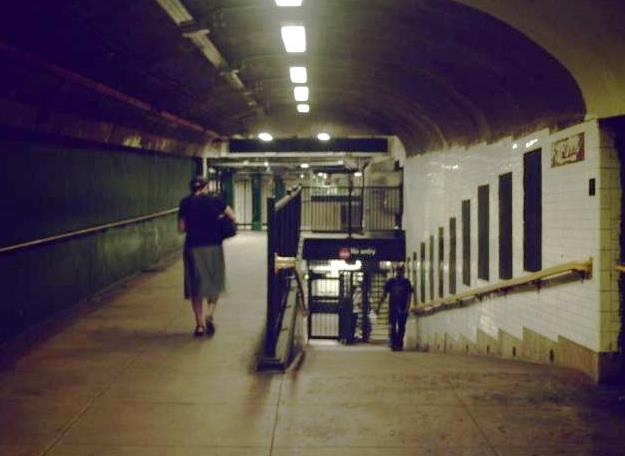
Contrary to the station's name, there are no exits to either 190th Street or Overlook Terrace. However, the station has entrances both to Hudson Heights, on top of the ridge, and to Bennett Avenue in the valley of Washington Heights, on the bottom.
A tunnel leading eastward from the station provides access to Bennett Avenue, midblock between Broadway and 192nd Street, Passengers used to be able to enter the station from the ramp, which is evidenced by tiled mosaics.
The entrance at the top of the ridge is a head house located at the end of Fort Washington Avenue, at Margaret Corbin Circle. The station was built while the Cloisters in Fort Tryon Park were under construction, making it possible for the head house to have a stone facade to harmonize it with the entrance to the Cloisters several hundred feet north of the station's entrance. The head house is a single-story rectangular stone building with a black hip roof. The longer sides are on the western and eastern elevations, and each contain three bays. The northern elevation contains three small arches, of which the center arch contained a doorway into the head house. The southern elevation is abutted by stone stairs leading down to the station's elevators and a play area within Fort Tryon Park. A lamppost and a steel sign with the word "SUBWAY" is located on the sidewalk of Fort Washington Avenue at the top of these stairs.
Elevators
The station maintains three elevators from the mezzanine in one tower at its eastern end, and has done so since its opening. The elevators lead upward to the basement of the Fort Washington Avenue head house. The head house basement contains brick walls and a concrete floor and ceiling, and formerly contained a token booth. The elevators were formerly only open during the daytime, and required the payment of a fare to use since the fare control for both street entrances to the station was originally located just inside the street doors. Since 1957, the elevators have been available for use by pedestrians going between Bennett Avenue and Fort Washington Avenue without paying a fare; a similar situation exists at 181st Street, the next station downtown, as well as at 191st Street on the IRT Broadway–Seventh Avenue Line. The elevators to the mezzanine still utilize elevator operators, one of the few stations in the system to do so.
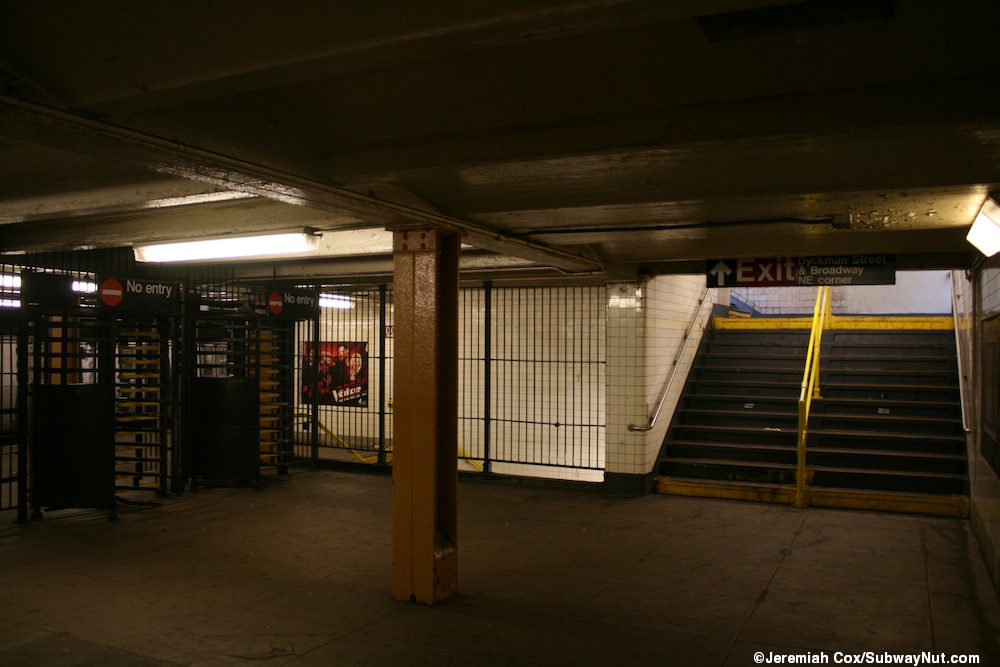
The station is not compliant with the Americans with Disabilities Act of 1990, because it cannot be used by passengers with wheelchairs since access from the fare control area to the platforms is only possible via stairways. Additionally, the elevators as well as the free out-of-system traverse between Fort Washington and Bennett Avenues are not ADA-compliant for wheelchair users either (unlike at 181st Street), since the entrance to the former is only accessible by several flights of stairs, and another smaller staircase exists between the end of the passageway and the Bennett Avenue exit. There is a staircase available in case of an emergency.
File:IND 190 A st jeh.JPG|Fort Washington Avenue entrance File:190th Street subway station Fort Washington Avenue entrance.jpg|Stairs to Fort Washington Avenue entrance File:190th Street subway station Bennett Avenue entrance.jpg|Bennett Avenue entrance
Notes
References
References
- (September 10, 1932). "List of the 28 Stations on the New 8th Av. Line". [[The New York Times]].
- {{Cite archive
- (August 4, 1923). "Two Subway Routes Adopted by City". The New York Times.
- (March 12, 1924). "Plans Now Ready to Start Subways". The New York Times.
- (December 10, 1924). "Hylan Subway Plan Links Four Boroughs at $450,000,000 Cost". The New York Times.
- {{Cite Routes Not Taken
- (5 Feb 1928). "Express and Local Stations For New Eighth Avenue Line". New York Herald Tribune.
- (1930-05-26). "Progress is Rapid on 8th Av. Subway; Board's Engineers Report Spurt in Building Is Likely to Open the Line in July, 1930". The New York Times.
- (1930-08-24). "Eighth Av. Subway Nearly Completed; Basic Construction Work From Chambers to 207th St. Done Except on Few Short Stretches". The New York Times.
- O'Brien, John C.. (9 Sep 1931). "8th Ave. Line Being Rushed For Use Jan. 1: Turnstile Installation on Subway Begins Monday; Other Equipment Ready for Start of Train Service City Has Yet to Find Operating Company Transit Official on Trip, 207th to Canal Street, Inspects Finished Tube". New York Herald Tribune.
- (September 9, 1932). "Sightseers Invade New Subway When Barricade Is lifted". The New York Times.
- (September 9, 1932). "8th Av. Subway Gets First 5c. by Woman's Error: She Peers Into a Station, Hears Train, Pays for Ride, but Is Day Too Early Preparing for Tomorrow's Rush on 8th Ave. Subway". New York Herald Tribune.
- (September 10, 1932). "Gay Midnight Crowd Rides First Trains In The New Subway: Throngs at Station an Hour Before Time, Rush Turnstiles When Chains are Dropped". [[The New York Times]].
- Sebring, Lewis B.. (10 Sep 1932). "Midnight Jam Opens City's New Subway: Turnstiles Click Into Action at 12:01 A. M. as Throngs Battle for Places in 'First' Trains Boy, 7, Leads Rush At 42d St. Station City at Last Hails 8th Ave. Line After 7-Year Wait; Cars Bigger, Clean Transit Commissioner Officially Opening New Subway at Midnight". New York Herald Tribune.
- Duffus, R. L.. (September 9, 1932). "New Line First Unit In City-Wide System". The New York Times.
- Ronan, Thomas P.. (December 29, 1950). "Subway Shelters to Cost $104,000,000 Proposed for City". The New York Times.
- Lister, Walter Jr.. (29 Dec 1950). "Subway Bomb Shelters Outlined, City Seeks U.S. Aid on Financing: Bingham Plans Sleeping Quarters for 101,500, Standing Room for a Million More". New York Herald Tribune.
- O'Flaherty, Mary. (January 5, 1957). "Stein's Plan For Subway Cash. Would Utilize Extensions For Shelters, Let U.S. Pay". [[New York Daily News]].
- (December 16, 1951). "190th St. Station Held Bomb-Proof". The New York Times.
- Nessen, Stephen. (March 19, 2024). "MTA will spend $100M to revitalize 2 grimy, historic NYC subway stations".
- Kumamoto, Ian. (March 19, 2024). "These two old subway stations are getting a $100 million refresh".
- Nessen, Stephen. (June 27, 2024). "Dreary Chambers Street subway station will remain decrepit due to congestion pricing pause".
- Collins, Keith. (2024-07-11). "See How Your Subway Service May Suffer Without Congestion Pricing". The New York Times.
- Grynbaum, Michael M.. (April 28, 2011). "The Subway's Elevator Operators, a Reassuring Amenity of Another Era". The New York Times.
- Brachfeld, Ben. (July 13, 2023). "Espaillat, TWU sue MTA over plan to stop staffing uptown subway elevators".
- Waller, Nikki. (November 23, 2003). "Why They Take the A Train (and the 1/9) – Neighborhood Report: Washington Heights". The New York Times.
- Piazza, Jo. (December 7, 2003). "M.T.A. Urged Not to Cut Elevator Jobs At 5 Stations". The New York Times.
- Sanchez, Ray. (8 Dec 2003). "Deep Fears In Heights". Newsday.
- Luo, Michael. (2003-12-16). "Likely M.T.A Budget Cuts 22 Subway Elevator Operators' Jobs". The New York Times.
- Sangha, Soni. (21 Jan 2004). "Riders fear elevator cutbacks Operators not standing by". New York Daily News.
- Neuman, William. (November 30, 2007). "M.T.A. Savings Proposal May Mean Service Cuts". The New York Times.
- (1 Dec 2007). "Subway Elevator Cuts a Downer, Say Riders". New York Daily News.
- Sangha, Soni. (January 21, 2004). "Riders fear elevator cutbacks. Operators not standing by.". [[New York Daily News]].
- (December 8, 2007). "Changing Course, M.T.A. Will Keep Elevator Operators On". The New York Times.
- Krisel, Brendan. (October 31, 2018). "Uptown Subway Stations Won't Lose Elevator Operators, Union Says".
- Mocker, Greg. (June 16, 2023). "Transit union and MTA debate future of elevator operators at Uptown subway stations".
- Simko-Bednarski, Evan. (June 15, 2023). "MTA reassigning elevator operators deepest NYC subway stations".
- Saltonstall, Gus. (July 13, 2023). "MTA Elevator Job Cuts Endanger Wash Heights Straphangers: Pol's Suit".
- "Replacing the Elevators at Uptown A and 1 Stations". Metropolitan Transportation Authority.
- (December 18, 2018). "5 subway stations will get replacement elevators".
- (December 18, 2018). "Five Subway Stations in Upper Manhattan to Receive New Elevators". Metropolitan Transportation Authority.
- "MTA completes elevator replacements in upper Manhattan. For Railroad Career Professionals".
- Simko-Bednarski, Evan. (July 22, 2025). "MTA plans to add elevators at 12 more NYC subway stations".
- Russo-Lennon, Barbara. (July 22, 2025). "12 additional NYC subway stations to get accessibility upgrades under MTA’s capital plan".
- {{NYCS const. trackref. trackbook3
- {{NYCS const. timetable. a
- (August 22, 1932). "Tile Colors a Guide in the New Subway; Decoration Scheme Changes at Each Express Stop to Tell Riders Where They Are". The New York Times.
- Carlson, Jen. (February 18, 2016). "Map: These Color Tiles In The Subway System Used To Mean Something".
- Gleason, Will. (February 18, 2016). "The hidden meaning behind the New York subway's colored tiles".
- Young, Michelle. (June 26, 2013). "The Deepest and Highest Subway Stations in NYC: 191st St, 190th Street, Smith & 9th". Untapped Cities.
- Flegenheimer, Matt. (May 29, 2014). "With New Slant on Subway Elevators, Expect Delays". The New York Times.
- Castillo, Wilfredo. (December 29, 2012). "Stairs down".
- Weinberg, Brian. (May 14, 2009). "190 St station entrance @ Bennett Ave & W 193 St. Looking west up the tunnel towards the platforms.".
- Cox, Jeremiah. (March 7, 2013). "The area behind the high exit turnstiles from the uptown platform (the underpass is how silly passengers wanting to go one stop can enter the station)".
- (2015). "MTA Neighborhood Maps: Washington Heights". Metropolitan Transportation Authority.
- Rosenfeld, Robbie. (August 13, 2015). "Uptown ramp".
- David-Paul, David. (June 12, 2009). "Downtown sign pointed customers to directly enter 207th Street bound platform without using mezzanine area. Ramp is now exit-only.".
- Husband, Timothy. (2013). "Creating the Cloisters". Metropolitan Museum of Art.
- (August 7, 1939). "Free Elevators in Subway Fought". The New York Times.
- (September 6, 1957). "2 IND Elevators Open to Free Use". The New York Times.
- Kurtz, Josh. (August 12, 1991). "Washington Heights Journal; A Subway Passageway Just for the Courageous". The New York Times.
- Grynbaum, Michael M.. (April 28, 2011). "The Subway's Elevator Operators, a Reassuring Amenity of Another Era". The New York Times.
- "Accessible Stations in the MTA Network". Metropolitan Transportation Authority.
- Rosenfeld, Robbie. (August 13, 2015). "Emergency Stairs".
This article was imported from Wikipedia and is available under the Creative Commons Attribution-ShareAlike 4.0 License. Content has been adapted to SurfDoc format. Original contributors can be found on the article history page.
Ask Mako anything about 190th Street station — get instant answers, deeper analysis, and related topics.
Research with MakoFree with your Surf account
Create a free account to save articles, ask Mako questions, and organize your research.
Sign up freeThis content may have been generated or modified by AI. CloudSurf Software LLC is not responsible for the accuracy, completeness, or reliability of AI-generated content. Always verify important information from primary sources.
Report