From Surf Wiki (app.surf) — the open knowledge base
1. FC Lok Stendal
German football club
German football club
| Field | Value | |||||
|---|---|---|---|---|---|---|
| clubname | 1. FC Lok Stendal | |||||
| image | 1 FC Lok Stendal.png | |||||
| upright | 0.7 | |||||
| alt | logo | |||||
| fullname | 1. FC Lok Stendal e. V. | |||||
| founded | 1945 | |||||
| ground | Stadion am Hölzchen | |||||
| capacity | 6,000 | |||||
| manager | Sven Körner | |||||
| league | Oberliga Nordost-Nord | |||||
| season | 2018–19 | |||||
| position | 12th | |||||
| pattern_la1 | _black_stripes | pattern_b1=_blackstripes | pattern_ra1=_black_stripes | |||
| leftarm1 | ff0000 | body1=ff0000 | rightarm1=ff0000 | shorts1=000000 | socks1=ff0000 | |
| pattern_la2 | pattern_b2= | pattern_ra2= | ||||
| leftarm2 | ffffff | body2=ffffff | rightarm2=ffffff | shorts2=ffffff | socks2=ffffff |
1. FC Lok Stendal is a German association football club that plays in Stendal, Saxony-Anhalt.
History
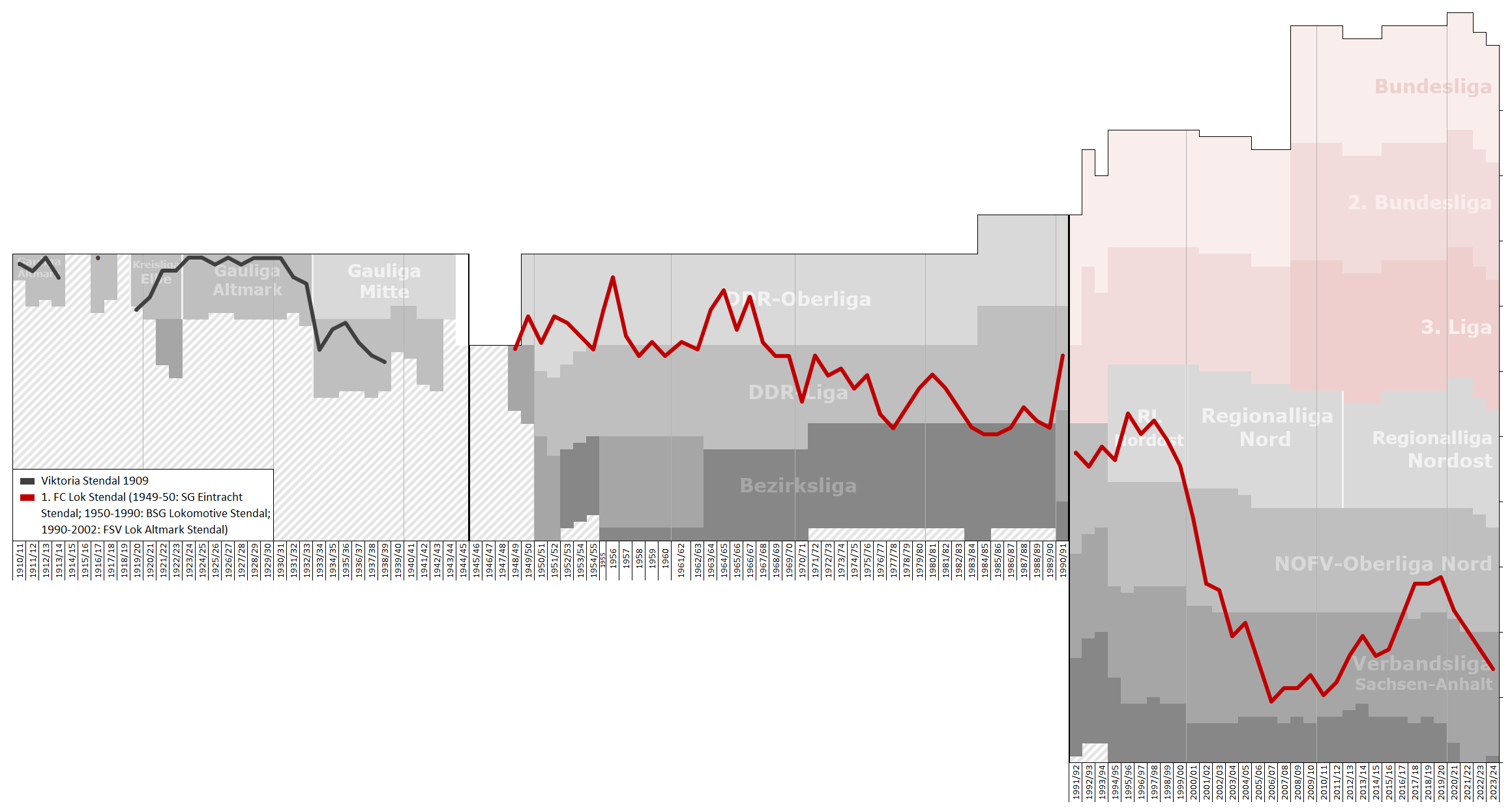
Founded in 1909, FC Viktoria Stendal was dissolved in the aftermath of World War II and re-established in Soviet occupation zone of Germany in 1945 as SG Stendal-Nord. The club underwent a number of changes in quick succession. It was renamed Blau-Weiss Stendal in 1948 and then SG Eintracht Stendal in April 1949. By year's end Eintract was merged with two railway sides – BSG Reichsbahn Stendal and BSG RAW Stendal – to emerge briefly in December as SG Hans Wendler Stendal. The practise of honouring industry in the worker's state through the renaming of football clubs was common in East Germany. Hans Wendler was an engineer who developed a method for using dust from the country's plentiful supplies of low grade brown coal to fuel older locomotives and so was briefly honoured by having one of the railway-sponsored football sides named after him. The team was finally dubbed BSG Lokomotive Stendal in 1950.
Lok spent most of the 1950s and 1960s in the top flight DDR-Oberliga. However, they were a perennial lower-table side and their best ever result at that level was a fourth-place finish. They fell to the second-tier DDR-Liga in 1968 to play out the 1970s and early 1980s. Most of the rest of the 1980s was spent in third and fourth division level competition.
With German reunification in 1990 the club changed its name to FSV Lok Altmark Stendal and after a year in the transitional league, Lok Altmark was seeded to the third tier NOFV-Oberliga Mitte and, from 1994 to 2000, the Regionalliga Nordost. The team enjoyed a successful run in the 1995 German Cup, advancing as far as the quarter finals where there were put out on penalty kicks by Bundesliga side Bayer Leverkusen.
With the new millennium the club slipped to the NOFV-Oberliga Nord (VI) and by 2002 they were bankrupt and adrift. A union with the small local club 1. FC Stendal earned them a new start in the Verbandsliga Sachsen-Anhalt (VI since 2008, previously V) where they play today.
Honours
The club's honours:
- Olympia-Pokal (de)
- Runners-up: 1964
- Saxony-Anhalt Cup
- Winners: 1992, 1995, 1996
- Runners-up: 1998, 2003, 2025
References
References
- "Geschichteg: Von der SG Nord zur BSG Lokomotive". 1. FC Lok Stendal.
- [http://www.f-archiv.de/ Das deutsche Fußball-Archiv] {{in lang. de Historical German domestic league tables
- [http://www.fussball.de/mannschaft/1-fc-lok-stendal-1fc-lok-stendal-ev-sachsen-anhalt/-/saison/1415/team-id/011MICMSCK000000VTVG0001VTR8C1K7#!/section/teamFixturesMatchdayLeagueTable 1. FC Lok Stendal at Fussball.de] {{in lang. de Tables and results of all German football leagues
This article was imported from Wikipedia and is available under the Creative Commons Attribution-ShareAlike 4.0 License. Content has been adapted to SurfDoc format. Original contributors can be found on the article history page.
Ask Mako anything about 1. FC Lok Stendal — get instant answers, deeper analysis, and related topics.
Research with MakoFree with your Surf account
Create a free account to save articles, ask Mako questions, and organize your research.
Sign up freeThis content may have been generated or modified by AI. CloudSurf Software LLC is not responsible for the accuracy, completeness, or reliability of AI-generated content. Always verify important information from primary sources.
Report