From Surf Wiki (app.surf) — the open knowledge base
Yōkai
Supernatural beings from Japanese folklore

Supernatural beings from Japanese folklore
are a class of supernatural entities and spirits in Japanese folklore. Yōkai are a vast range of beings, including shapeshifters, ghosts, demons, and tricksters. They can be mischievous, helpful, or malevolent, often appearing as animal-like figures, possessed objects, or humanoids. They embody the mysterious and uncanny aspects of nature and human emotions.
ja are also referred to as , or . Some academics and Shinto practitioners acknowledge similarities within the seeming dichotomy between the natures of yōkai and most kami, which are generally regarded as relatively beneficent in comparison, and class the two as ultimately the same type of spirits of nature or of a mythological realm. |author-link1 = Michael Foster (folklorist) |publication-place = Oakland, California |access-date = 14 September 2024 Their behavior can range from malevolent or mischievous to benevolent to humans.
ja often have animal-like features (such as the ja, depicted as appearing similar to a turtle, and the ja, commonly depicted with wings), but may also appear humanoid in appearance, such as the ja (口裂け女). Some ja resemble inanimate objects (such as the ja), while others have no discernible shape. ja are typically described as having spiritual or supernatural abilities, with shapeshifting being the most common trait associated with them. ja that shapeshift are known as or .
Japanese folklorists and historians explain ja as personifications of "supernatural or unaccountable phenomena to their informants". In the Edo period (1603 to 1868), many artists, such as Toriyama Sekien (1712-1788), invented new ja by taking inspiration from folktales or purely from their own imagination. Today, several such ja (such as the ja) are mistakenly thought to originate in more traditional folklore.
The kanji representation of the word ja comprises two characters that both mean "suspicious, doubtful", and while the Japanese name is simply the Japanese transliteration or pronunciation of the Chinese term yāoguài (which designates similarly strange creatures), some Japanese commentators argue that the word yōkai has taken on many different meanings in Japanese culture, including referring to a large number of uniquely Japanese creatures.
Concept
The concept of ja varies greatly throughout Japanese culture and historical periods; typically, the older the time period, the higher the number of phenomena deemed to be supernatural and the result of ja. According to Japanese ideas of animism, spirit-like entities were believed to reside in all things, including natural phenomena and objects. Such spirits possessed emotions and personalities: peaceful spirits were known as ja, who brought good fortune; violent spirits, known as ja, brought ill fortune, such as illness and natural disasters. Neither type of spirit was considered to be ja.
One's ancestors and particularly respected departed elders could also be deemed to be ja, accruing status as protective spirits who brought fortune to those who worshiped them. Animals, objects and natural features or phenomena were also venerated as ja or propitiated as ja depending on the area.
Rituals for converting ja into ja were performed, aiming to quell malevolent spirits, prevent misfortune and alleviate the fear arising from phenomena and events that otherwise had no explanation. The ritual for converting ja into ja was known as the . ja rituals for ja that failed to achieve deification as benevolent spirits, whether through a lack of sufficient veneration or through losing worshippers and thus their divinity, became ja.
Over time, phenomena and events thought to be supernatural became fewer and fewer, with the depictions of ja in picture scrolls and paintings beginning to standardize, evolving more into caricatures than fearsome spiritual entities. Elements of the tales and legends surrounding ja began to be depicted in public entertainment, beginning as early as the Middle Ages in Japan. During and following the Edo period, the mythology and lore of ja became more defined and formalized.
File:Katsushika_Hokusai_-The_Lantern_Ghost%2C_Iwa-_Google_Art_Project.jpg|ja by Katsushika Hokusai File:Kuniyoshi Kidomaru.jpg|ja by Utagawa Kuniyoshi File:Suushi Nekomata.jpg|ja from the Hyakkai Zukan by Sawaki Suushi File:Yoshitoshi_The_Ground_Spider.jpg|ja from the by Tsukioka Yoshitoshi File:Gamayoukai.JPG|ja from the ja Volume 2, special issue ja Tamababaki File:SekienNarigama.jpg|ja from the Gazu Hyakki Tsurezure Bukuro by Sekien Toriyama File:Kawanabe Kyōsai - Theatre Curtain of the Shintomi-za, with an Impromptu Sketch Monsters.jpg|Theatre Curtain with Yokai by Kawanabe Kyōsai (1880)
Types
The folklorist Tsutomu Ema studied the literature and paintings depicting ja and , dividing them into categories as presented in the ja and the ja:
- Categories based on a ja's "true form":
- Human
- Animal
- Plant
- Object
- Natural phenomenon
- Categories depending on the source of mutation:
- Mutation related to this world
- Spiritual or mentally related mutation
- Reincarnation or afterworld related mutation
- Material related mutation
- Categories based on external appearance:
- Human
- Animal
- Plant
- Artifact
- Structure or building
- Natural object or phenomenon
- Miscellaneous or appearance compounding more than one category
In other folklorist categorizations, ja are classified, similarly to the nymphs of Greek mythology, by their location or the phenomena associated with their manifestation. ja are indexed in the book as follows:
- ja (動物の怪; animals, either real or imaginary)
- ja (木の怪; trees)
- ja (道の怪; paths)
- ja (水の怪; water)
- ja (音の怪; sound)
- ja (海の怪; the sea)
- ja (山の怪; mountains)
- ja (雪の怪; snow)
History
Ancient history
- 772 CE: in the ja, there is the statement "Shinto purification is performed because ja appear very often in the imperial court", using the word ja to not refer to any one phenomenon in particular, but to strange phenomena in general.
- Middle of the Heian period (794–1185/1192): In The Pillow Book by Sei Shōnagon, there is the statement "there are tenacious ja", as well as a statement by Murasaki Shikibu that "the ja have become quite dreadful", which are the first appearances of the word ja.
- 1370: In the ja, in the fifth volume, there is the statement, "Sagami no Nyudo was not at all frightened by ja."

The ancient times were a period abundant in literature and folktales mentioning and explaining ja. Literature such as the ja, the ja, and various ja expositioned on legends from the ancient past, and mentions of ja, ja, among other kinds of mysterious phenomena can already be seen in them. In the Heian period, collections of stories about ja and other supernatural phenomena were published in multiple volumes, starting with publications such as the ja and the ja, and in these publications, mentions of phenomena such as ja can be seen.
The ja that appear in this literature were passed on to later generations. Despite the literature mentioning and explaining these ja, they were never given any visual depictions. In Buddhist paintings such as the Hell Scroll (Nara National Museum), which came from the later Heian period, there are visual expressions of the idea of ja, but actual visual depictions would only come later in the Middle Ages, from the Kamakura period and beyond.
Yamata no Orochi was originally a local god but turned into a ja who was slain by Susanoo. Yasaburo was originally a bandit whose vengeful spirit (ja) turned into a poisonous snake upon death and plagued the water in a paddy, but eventually became deified as the "wisdom god of the well". ja and ja are sometimes treated as gods in one area and ja in other areas. From these examples, it can be seen that among Japanese gods, there are some beings that can go from god to ja and vice versa.
Post-classical history
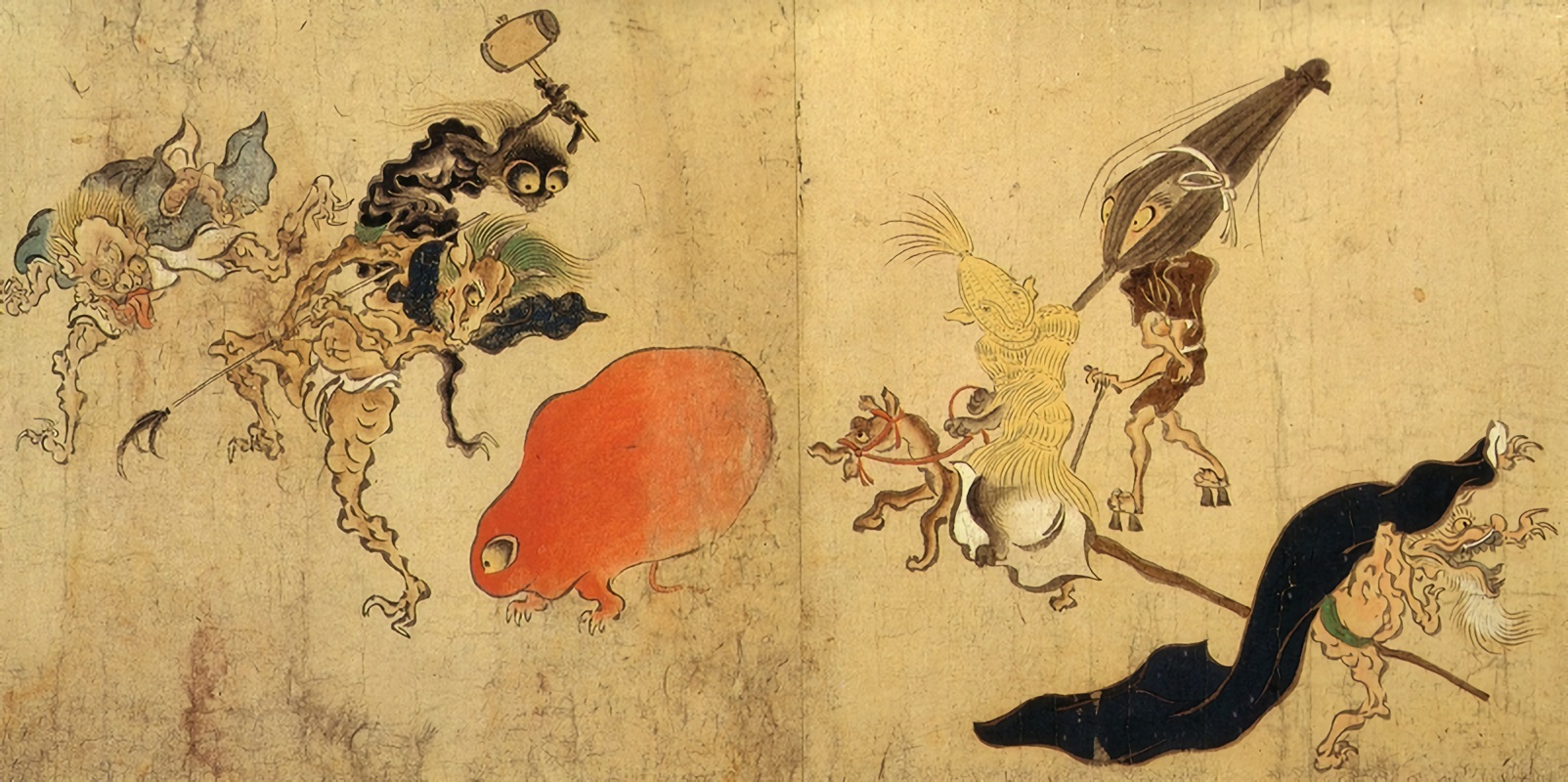
Medieval Japan was a time period where publications such as ja, ja, and other visual depictions of ja started to appear. While there were religious publications such as the , others, such as the ja, were intended more for entertainment, starting the trend where ja became more and more seen as subjects of entertainment. For examples, tales of ja extermination could be said to be a result of emphasizing the superior status of human society over ja. Publications included:
- The ja (about an ja), the ja (about a ja), the (concerning serpent/dragon-folk oppressed by a giant centipede yōkai), the (about ja), and the ja (about a giant snake). These ja were about ja that come from even older times.
- The ja, in which Sugawara no Michizane was a lightning god who took on the form of an ja, and despite attacking people after doing this, he was still deified as a god in the end.
- The ja, the ja, (both about Tamamo-no-Mae), and the ja (about a monkey). These ja told of ja mutations of animals.
- The ja, which told tales of thrown away none-too-precious objects that come to have a spirit residing in them planning evil deeds against humans, and ultimately get exorcised and sent to peace.
- The ja, depicting many different kinds of ja all marching together In this way, ja that were mentioned only in writing were given a visual appearance in the Middle Ages. In the ja, familiar tales such as Urashima Tarō and Issun-bōshi also appeared.
The next major change in ja came after the period of warring states, in the Edo period.
Modern history
Edo period
- 1677: Publication of the ja, a collection of tales of various monsters.
- 1706: Publication of the ja. In volumes such as ja (volume 1) and ja (volume 4), collections of tales that seem to come from China were adapted into a Japanese setting.
- 1712: Publication of the ja by Terajima Ryōan, a collection of tales based on the Chinese zh.
- 1716: In the specialized dictionary , there is an entry on ja, which stated, "Among the commoners in my society, there are many kinds of ja (mysterious phenomena), often mispronounced by commoners as ja Types include the cry of weasels, the howling of foxes, the bustling of mice, the rising of the chicken, the cry of the birds, the pooping of the birds on clothing, and sounds similar to voices that come from cauldrons and bottles. These types of things appear in the ja, methods of exorcising them can be seen, so it should serve as a basis."
- 1788: Publication of the ja by Masayoshi Kitao. This was a ja diagram book of ja, but it was prefaced with the statement "it can be said that the so-called ja in our society is a representation of our feelings that arise from fear", and already in this era, while ja were being researched, it indicated that there were people who questioned whether ja really existed or not.
It was in this era that the technology of the printing press and publication was first started to be widely used, that a publishing culture developed, and was frequently a subject of ja and other publications.
As a result, ja shops that handled such books spread and became widely used, making the general public's impression of each ja fixed, spreading throughout Japan. For example, before the Edo period, there were plenty of interpretations about what the ja were that were classified as ja, but because of books and publishing, the notion of ja became anchored to what is now the modern notion of ja.
Also, including other kinds of publications, other than ja born from folk legend, there were also many invented ja that were created through puns or word plays; the ja by Toriyama Sekien is one example. When the ja became popular in the Edo period, it is thought that one reason for the appearance of new ja was a demand for entertaining ghost stories about ja no one has ever heard of before, resulting in some that were simply made up for the purpose of telling an entertaining story. The ja and the ja are known examples of these.
They are also frequently depicted in ukiyo-e, and there are artists that have drawn famous ja like Utagawa Kuniyoshi, Yoshitoshi, Kawanabe Kyōsai, and Hokusai, and there are also ja books made by artists of the Kanō school.
In this period, toys and games like ja and ja, frequently used ja as characters. Thus, with the development of a publishing culture, ja depictions that were treasured in temples and shrines were able to become something more familiar to people, and it is thought that this is the reason that even though ja were originally things to be feared, they have then become characters that people feel close to.
Meiji and Taishō periods

- 1891: Publication of the ja by Shibue Tamotsu. It introduced folktales from Europe, such as the Grimm Tales.
- 1896: Publication of the ja by Inoue Enryō
- 1900: Performance of the kabuki play ja at the Kabuki-za in January. It was a performance in which appeared numerous ja such as the ja, skeletons, ja, ja, among others. Onoe Kikugorō V played the role of many of these, such as the ja.
- 1914: Publication of the ja by Mitsutaro Shirai. Shirai expositioned on plant ja from the point of view of a plant pathologist and herbalist.
With the Meiji Restoration, Western ideas and translated western publications began to make an impact, and western tales were particularly sought after. Things like ja, , and ja were talked about, and ja were even depicted in classical ja. Although the ja were misunderstood as a kind of Japanese ja or ja, they actually became well known among the populace through a ja called ja by San'yūtei Enchō, which were adoptions of European tales such as the Grimm fairy tale "Godfather Death" and the Italian opera Crispino e la comare (1850). Also, in 1908, Kyōka Izumi and jointedly translated Gerhart Hauptmann's play The Sunken Bell. Later works of Kyōka such as were influenced by The Sunken Bell, and so it can be seen that folktales that come from the West became adapted into Japanese tales of ja.
Shōwa period
Since ja have been introduced in various kinds of media, they have become well known among people from all walks of life. The ja from before the war, the manga industry, ja shops that continued to exist until around the 1970s, and television all contributed to the public knowledge and familiarity with ja. ja play a role in attracting tourism revitalizing local mecca regions such as Tōno in Iwate Prefecture (where stories in Kunio Yanagita's ja were collected) or Tottori Prefecture (Shigeru Mizuki's birthplace).
In this way, ja are spoken about in legends in various forms, but traditional oral storytelling by the elders and the older people is rare, and regionally unique situations and background in oral storytelling are not easily conveyed. For example, the classical ja represented by ja can only be felt as something realistic by living close to nature, such as with ja (Japanese raccoon dogs), foxes and weasels. Furthermore, in the suburbs, and other regions, even when living in a primary-sector environment, there are tools that are no longer seen, such as the inkstone, the ja (a large cooking pot), or the ja (a bucket used for getting water from a well), and there exist ja that are reminiscent of old lifestyles such as the ja and the .
As a result, even for those born in the first decade of the Shōwa period (1925–1935), except for some who were evacuated to the countryside, they would feel that those things that become ja are "not familiar" and "not very understandable". For example, in classical ja, even though people understand the words and what they refer to, they are not able to imagine it as something that could be realistic. Thus, the modernization of society has had a negative effect on the place of ja in classical Japanese culture.
On the other hand, the ja introduced through mass media are not limited to only those that come from classical sources like folklore, and just as in the Edo period, new fictional ja continue to be invented, such as scary school stories and other urban legends like ja and ja, giving birth to new ja. From 1975 onwards, starting with the popularity of ja, these urban legends began to be referred to in mass media as "modern ja". This terminology was also used in recent publications dealing with urban legends, and the researcher on ja, , used this especially frequently.
During the 1970s, many books were published that introduced ja through encyclopedias, illustrated reference books, and dictionaries as a part of children's horror books, but along with the ja that come from classics like folklore, ja, and essays, it has been pointed out by modern research that there are some mixed in that do not come from classics, but were newly created. Some well-known examples of these are the ja and the ja. For example, Arifumi Sato is known to be a creator of modern ja, and Shigeru Mizuki, a manga artist of ja, in writings concerning research about ja, pointed out that newly created ja do exist, and Mizuki himself, through ja, created about 30 new ja.
There has been much criticism that this mixing of classical ja with newly created ja is making light of tradition and legends. However, since there have already been those from the Edo period like Sekien Toriyama who created many new ja, there is also the opinion that it is unreasonable to criticize modern creations without doing the same for classical creations too. Furthermore, there is a favorable view that says that introducing various ja characters through these books nurtured creativity and emotional development of young readers of the time.
Comparison with yaoguai
Both the Chinese yaoguai () and Japanese yōkai include strange, supernatural beings with shapeshifting tendencies. In the Chinese version, the emphasis is often on the first character, 妖 (, ), which connotes bewilderment, enchantment, or supernatural affliction — for example, their ability to take on human form in order to seduce and to enthrall human beings. In Japanese yōkai, the emphasis appears to be on the 怪 (, ), referring to their monstrous and aberrant nature and anatomy. Depictions of Japanese yōkai in popular culture often include elements of the cute, the comical, the goofy, and the bizarre.
Some creatures appear as both Chinese yaoguai and Japanese yōkai, such as the scaly "water tiger" 水虎 (, ), the wilderness demons 魑魅魍魎 (, ), and the nine-tailed foxes 九尾狐 (, ; also called 九尾の狐 () in Japanese).
Some yōkai, such as the nekomata (cat yōkai) and tanuki (raccoon yōkai), resemble Chinese yaoguai, which encompass any number of shapeshifting animals and plants who have learnt to cultivate human form and other supernatural arts. For example, the nekomata resembles the Chinese (仙狸, ; Japanese: ).
Yet others are uniquely Japanese, such as the kappa, ambivalent and occasionally cute, the haradashi, with its belly on its face, and the mumashika, a comical-looking yokai with a horse head and a deer body.
In popular culture
ja are often referred to as Japanese spirits or East Asian ghosts, like the ja legend or the story of the "Slit-mouthed girl", both of which hail from Japanese legend. The term ja can also be interpreted as something strange or unusual.
Lafcadio Hearn's collection of Japanese ghost stories entitled Kwaidan: Stories and Studies of Strange Things includes stories of yūrei and yōkai such as Yuki-onna, and is one of the first Western publications of its kind.
Yōkai remain prevalent in modern works of fiction. Shigeru Mizuki, the manga creator of such series as GeGeGe no Kitaro and Kappa no Sanpei, keeps yōkai in the popular imagination. Other popular works focusing on yōkai include the Nurarihyon no Mago series, Yu Yu Hakusho, Inuyasha: A Feudal Fairy Tale, Yo-kai Watch and the 1960s Yokai Monsters film series, which was loosely remade in 2005 as Takashi Miike's The Great Yokai War and more recently Yukinobu Tatsu's Dandadan and the video games Genshin Impact and Phasmophobia.
References
Notes
Citations
Works cited
References
- NHK Publishing. (24 May 2016)
- (21 January 2025). "Yokai: Discover the History of Japan's Legendary Monsters".
- "Toriyama Sekien". The Obakemono Project.
- Minzokugaku kenkyujo . (1956). "Sōgō nihon minzoku goi". Heibonsha.
- "Konjaku monogatarishū".
- Tachikawa, Kiyoshi. (1987). "Hyakumonogatari kaidanshū". Kokusho Kankokai.
- (1716). "Sesetsu kojien 3".
- Kabat, Adam. (February 1999). "Edo bakemono zōshi". [[Shogakukan]].
- Yumoto, Kōichi. (2008). "DISCOVER yōkai: nihon yōkai daihyakka". Kodansha.
- Yamaguchi, Bintarō. (2007). "Hontō ni iru nihon no 'gendai yōkai' zukan". Kasakura.
- "DISCOVER妖怪 日本妖怪大百科".
- To gakkai [Academy of Outrageous Book]. (2007). "Tondemo hon no sekai". Rakkosha.
- Yōkaiō (Yamaguchi Bintarō) Group. (2003). "Shōwa no kodomo: Natsukashi no yōkai zukan". Art Book hon no mori.
- Mizuki, Shigeru. (1974). "Yōkai nandemo nyūmon". Shogakukan.
- "Japanese Yokai Meaning & List with Pictures of these Demons".
- "Haradashi – Yokai.com".
- "Mumashika – Yokai.com".
- (2007). "Saikaku to Ukiyoe zōshi kenkyū: dai-2-gō furoku. Kaiibutsu sashie taizen". Kasama shoin.
- (2008). "Yōkaigahon kyōka hyakumonogatari". Kokusho Kankokai.
This article was imported from Wikipedia and is available under the Creative Commons Attribution-ShareAlike 4.0 License. Content has been adapted to SurfDoc format. Original contributors can be found on the article history page.
Ask Mako anything about Yōkai — get instant answers, deeper analysis, and related topics.
Research with MakoFree with your Surf account
Create a free account to save articles, ask Mako questions, and organize your research.
Sign up freeThis content may have been generated or modified by AI. CloudSurf Software LLC is not responsible for the accuracy, completeness, or reliability of AI-generated content. Always verify important information from primary sources.
Report