From Surf Wiki (app.surf) — the open knowledge base
Yacón syrup
Syrup made from the root of the yacón plant
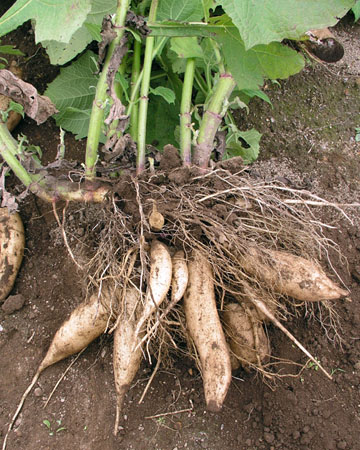
Syrup made from the root of the yacón plant
Yacón syrup is a sweetening agent extracted from the tuberous roots of the yacón plant (Smallanthus sonchifolius) indigenous to the Andes mountains.
It was used by the Incas. In Peru, people eat yacón because of its nutritional properties—few calories and low sugar levels. In Bolivia, yacón roots are eaten by people with diabetes or other digestive and renal disorders. In Brazil, the dried leaves are used to make yacón tea, said to be antidiabetic.
The syrup contains up to 50% of fructooligosaccharides (FOS). The consumption of FOS does not increase blood glucose; however, the root contains free fructose at about 35%.
The ratio of FOS and free sugars in the root is dependent on growing techniques, time of harvest, and storage condition. Plant & Food Research (formally known as Crop & Food Research) New Zealand published a study on maximizing FOS production in yacon after trials in New Zealand.
Sydney University's Glycemic Index Research Service (SUGiR) conducted a glycemic index study on a New Zealand-made yacon concentrate syrup, the result shows the GI value of the syrup is 40 ± 4, it is categorized as a low GI food.
It is usually made with an evaporator, like the ones used to make maple syrup. It has a taste similar to molasses or caramelized sugar. In a study by Yoshida et al. (2002), an enzyme solution of yacón was determined to be a better antioxidant than enzyme solutions of potato, mushroom, eggplant and edible burdock.
In a study by Genta et al., it was shown that a daily intake of yacón syrup produced a significant decrease in body weight, waist circumference and body mass index when given to obese pre-menopausal women.
References
References
- Manrique, I.. (2005). "Yacon syrup: Principles and processing". Series: Conservación y Uso de la Biodiversidad de Raíces y Tubérculos Andinos: Una Década de Investigación Para el Desarrollo (1993-2003)..
- (February 2001). "Hypoglycemic effect of the water extract of ''Smallantus sonchifolius'' (yacon) leaves in normal and diabetic rats". Journal of Ethnopharmacology.
- Lachman, J.. (2003). "Yacon [Smallanthus sonchifolia (Poepp. et Endl.) H. Robinson] chemical composition and use – a review". Plant, Soil and Environment.
- Douglas, J. A., Scheffer, J. J. C., Sims, I. M., & Triggs, C. M. (2002). Maximising fructo-oligosaccharide production in yacon. In ''Proceedings of the Agronomy Society of New Zealand'' (Vol. 32, pp. 49-55).
- (2019-11-03). "A Sustainable Wholesome Foodstuff; Health Effects and Potential Dietotherapy Applications of Yacon". Nutrients.
- Engelhart, Terces. (2007). "I Am Grateful: Recipes and Lifestyle of Cafe Gratitude". North Atlantic Books.
- Lachman, J.. (2003). "Yacon [Smallanthus sonchifolia (Poepp. et Endl.) H. Robinson] chemical composition and use – a review". Plant, Soil and Environment.
- Genta, Susana. (2009). "Yacon syrup: beneficial effects on obesity and insulin resistance in humans". Clinical Nutrition.
This article was imported from Wikipedia and is available under the Creative Commons Attribution-ShareAlike 4.0 License. Content has been adapted to SurfDoc format. Original contributors can be found on the article history page.
Ask Mako anything about Yacón syrup — get instant answers, deeper analysis, and related topics.
Research with MakoFree with your Surf account
Create a free account to save articles, ask Mako questions, and organize your research.
Sign up freeThis content may have been generated or modified by AI. CloudSurf Software LLC is not responsible for the accuracy, completeness, or reliability of AI-generated content. Always verify important information from primary sources.
Report