From Surf Wiki (app.surf) — the open knowledge base
Work–family conflict
Type of conflict
Type of conflict
Work–family conflict is a concept in psychology, industrial and organizational psychology, and occupational health psychology that studies how competing demands between work and family responsibilities create tension and measurably impact mental health, productivity, and family dynamics. The concept emerged as industrialization shifted paid work out of the household, reshaping expectations at the work-life interface. Work–family conflict has been associated with increased occupational burnout, job stress, poorer health, and diminished organizational commitment and job performance.
Origins and theory
Scholars began examining work–family conflict in the late 19th century as industrialization moved income-generating labor from the home to factories, altering the relationship between work and family life. Boundary theory frames social life as two interdependent domains, work and family, with distinct roles and responsibilities. Because the domains influence one another, individuals must transition between expectations at work and roles within the family. Border theory builds on boundary theory by considering how each domain influences the other and by identifying strategies people use to manage the borders between them. Some individuals separate the domains and move back and forth between them, while others integrate them to pursue balance.
Forms of conflict
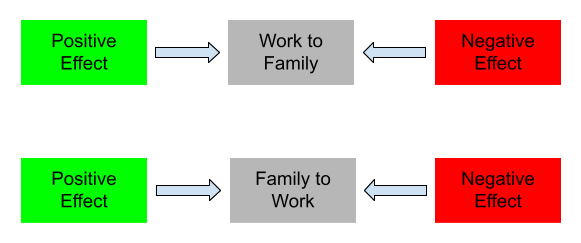
Work–family conflict runs in two directions: work-to-family conflict and family-to-work conflict. Work-to-family conflict arises when job demands such as long or inflexible hours, heavy workloads, interpersonal friction, travel, or unsupportive supervision disrupt responsibilities at home, for example causing a parent to miss after-school pick-up. Family-to-work conflict occurs when caregiving duties, family strain, or limited support at home interfere with job performance, including situations where employees must leave work to care for a sick relative. Each direction can be time-based when schedules collide, strain-based when stress spills over, or behavior-based when the conduct required in one role clashes with the other.
Although work interface with family (WIF) and family interface with work (FIW) are strongly correlated, more attention has been directed toward WIF. Research linked to Arlie Russell Hochschild's concept of the "ideal worker" depicts the inelastic nature of work roles and responsibilities. The expectations employers hold of an ideal worker assume that family responsibilities are handled elsewhere, leaving employees unencumbered at work. Although most families in the United States are dual earning, the image of the ideal worker persists and reinforces work–family conflict.
Workaholism
Workaholism correlates strongly with work-to-family conflict because prioritizing work commitments crowds out family time. Scholars describe workaholism as a substantial investment in work that can manifest in multiple directions and facets. Job flexibility and satisfaction influence how strain transfers between work and home, while excessive work hours often displace intimate relationships and social connections. Workaholics devote extensive time to work-related activities and may sacrifice family, social, and recreational life, contributing to marital strain and isolation.
Employers have become more aware of these pressures and have implemented family-responsive human resource practices that promote work-family balance to reduce stress in both environments.
Organizational responses
Researchers compare high-pressure corporate roles to elite athletics, noting that sustained exertion without recovery produces chronic stress, burnout, and fatigue. Employers counter these risks by encouraging short recovery breaks and providing facilities such as corporate gyms, which can improve cognition, energy, focus, and emotional intelligence.
Organizations seek an advantage by branding themselves as work-life balance supportive, a stance linked to higher retention, morale, performance, and organizational identification. Family-friendly policies covering paid parental leave, sick leave, health insurance, and subsidized or on-site child care are associated with lower work-family conflict.
Advances in communication technology allow employees on tight schedules to stay connected with family members, and organizations increasingly use remote work programs and expanded flextime to provide that flexibility.
Role of gender
Gendered expectations, especially the "ideal worker" norm that prizes constant availability, shape how organizations evaluate employees with caregiving duties. Managers who subscribe to this standard often read visible work-family juggling as lack of commitment, which reduces promotion prospects.
Women experience that bias acutely because they continue to shoulder substantial unpaid care work. German dual-earner households with children under thirteen reported that mothers provided nearly triple the child care of fathers in 2018, while studies find women have less control over their schedules, heightening work–family conflict. Managers may therefore rate women who balance care and employment as less committed, while men reporting lower conflict are seen as especially dedicated.
Studies of fathers find that those with limited caregiving experience often underestimate household demands, whereas men whose spouses take on most domestic labor remain more visible at work and frequently shape workplace policy.
The motherhood penalty captures the cumulative outcome: working mothers face documented gaps in pay, perceived competence, and access to benefits and continue to receive lower performance evaluations than non-mothers, reinforcing discrimination in pay, hiring, and daily treatment.
References
Sources
- Bakker, A., Demerouti, E. & Burke, R. (January 2009). Workaholism and Relationship Quality: A Spillover-Crossover Perspective. Journal of Occupational Health Psychology, 14, 23–33
- Frone, M. R., Yardley, J. K., & Markel, K. S. (1997). Developing and testing an integrative model of the work–family interface. Journal of Vocational Behavior, 50, 145–167.
- Greenhaus, J. H., & Beutell, N. J. (1985). Sources of conflict between work and family roles. Academy of Management Review, 10, 76–88.
- Kossek, E. E., & Ozeki, C. (1998). Work–family conflict, policies, and the job–life satisfaction relationship: A review and directions for organizational behavior–human resources research. Journal of Applied Psychology, 83, 139–149.
- Kossek, E., Noe, R. & DeMarr, B. (April 1999). Work-family synthesis: Individual and organizational determinants.International Journal of Conflict Management, 10, 102–129.
- Krouse, S. S., & Afifi, T. D. (2007). Family-to-work spillover stress: Coping communicatively in the workplace. The Journal of Family Communication, 7, 85–122.
- Lambert, S. J. (1990). Processes linking work and family: A critical review and research agenda. Human Relations, 43, 239–257.
- MacDermind, S. M., Seery, B. L., & Weiss, H. H. (2002). An emotional examination of the work-family interface. In N. Schmitt (Series Ed.) & R. G. Lord, R. J. Klimoski & R. K. Kanfer (Vol. Eds.), The organizational frontier series: Vol. 16. Emotions in the workplace: Understanding the structure and role of emotions in organizational behavior (pp. 402–427). San Francisco: Jossey-Bass.
- Temple, H. & Gillespie, B. (February 2009). Taking charge of work and life. ABA Journal, 95, 31–32.
References
- Greenhaus, J. H., & Beutell, N. J. (1985). Sources and conflict between work and family roles. Academy of Management Review, 10(1), 76-88.
- Lavassani & Movahedi, Kayvan Miri & Bahar. (2014). "DEVELOPMENTS IN THEORIES AND MEASURES OF WORK-FAMILY RELATIONSHIPS: FROM CONFLICT TO BALANCE". Contemporary Research on Organization Management and Administration.
- Amstad, F. T., Meier, L. L., Fasel, U., Elfering, A., & Semmer, N. K. (2011). A meta-analysis of work–family conflict and various outcomes with a special emphasis on cross-domain versus matching-domain relations. Journal of Occupational Health Psychology, 16(2), 151-169. {{doi. 10.1037/a0022170
- Greenhaus, J. H., & Powell, G. N. (2006). When work and family are allies: A theory of work-family enrichment. Academy of Management Review, 25, 178–199.
- Hochschild, Arlie Russell. 1997. The Time Bind: When Work Becomes Home and Home Becomes Work. New York: Metropolitan Books.
- Harpaz, Itzhak. (March 2003). "Workaholism: Its Definition and Nature". Human Relations.
- (2001-01-01). "The Making of a Corporate Athlete". Harvard Business Review.
- (2010). "Representations of work-life balance support". Human Relations.
- Waldfogel, J. (2001). International Policies Toward Parental Leave and Child Care. Caring for Infants and Toddlers, 99–110.
- Temple, H.. (February 2009). "Taking charge of work and life". ABA Journal.
- Pitt-Catsouphes, Marcie; Casy, Judi; Shulkin, Sandee; Weber, Julie; Curlew, Mary. (2009). Telework and Telecommuting: Policy Briefing Series. Boston: Sloan Work and Family Research Network. [https://workfamily.sas.upenn.edu/sites/workfamily.sas.upenn.edu/files/imported/pdfs/policy_makers3.pdf]
- Estes, S. B., & Glass, J. L. (1997). The Family Responsive Workplace. Annual Review of Sociology, 289–310.
- King, E. (2008). The effect of bias and unrealistic on the advancement of working mothers: Disentangling legitimate concerns from inaccurate stereotypes as predictors of advancement in academe. Human Relations, 61, 1677–1711. {{doi. 10.1177/0018726708098082
- (2009). "Bosses' perception of family-work conflict and women's promotability: Glad ceiling effects". Academy of Management Journal.
- Arntz, Melanie. (November 2020). "Working from Home and COVID-19: The Chances and Risks for Gender Gaps". Intereconomics.
- (2017). "In search of family-friendly careers? Professional strategies, work conditions and gender differences in work–family conflict". Community, Work & Family.
- (December 2002). "Gender Differences in the Importance of Work and Family Roles: Implications for Work–Family Conflict". Sex Roles.
- (October 2012). "A two-study examination of work–family conflict, production deviance and gender". Journal of Vocational Behavior.
- (September 2014). "Gender role beliefs and fathers' work-family conflict". Emerald Publishing.
- Williams, J. (2000). Unbending gender: Why family and work conflict and what to do about it. New York, NY: Oxford University Press
- Anderson, Deborah. (2003). "The Motherhood Wage Penalty Revisited: Experience, Heterogeneity, Work effort and Work-Schedule Flexibility". Industrial and Labor Relations Review.
- Correll, S.. (2007). "Getting a job: Is there a motherhood penalty?". American Journal of Sociology.
- Budig, Michelle. (2001). "The Wage Penalty for Motherhood". American Sociological Review.
This article was imported from Wikipedia and is available under the Creative Commons Attribution-ShareAlike 4.0 License. Content has been adapted to SurfDoc format. Original contributors can be found on the article history page.
Ask Mako anything about Work–family conflict — get instant answers, deeper analysis, and related topics.
Research with MakoFree with your Surf account
Create a free account to save articles, ask Mako questions, and organize your research.
Sign up freeThis content may have been generated or modified by AI. CloudSurf Software LLC is not responsible for the accuracy, completeness, or reliability of AI-generated content. Always verify important information from primary sources.
Report