From Surf Wiki (app.surf) — the open knowledge base
Weill–Marchesani syndrome
Rare generic disorder
Rare generic disorder
| Field | Value |
|---|---|
| name | Weill–Marchesani syndrome |
| synonyms | Spherophakia-brachymorphia syndrome, congenital mesodermal dystrophy, GEMSS syndrome |
| image | Marchesani2.gif |
| alt | Image of a six-year-old female with Weill-Marchesani syndrome. |
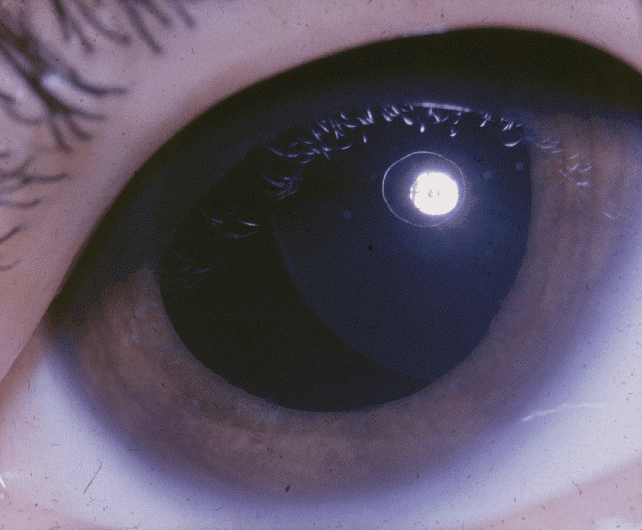
| caption | A six-year-old girl with Weill-Marchesani syndrome, which has caused a dislocated lens. |
| field | Ophthalmology, rheumatology, medical genetics |
Weill–Marchesani syndrome is a rare genetic disorder characterized by short stature; an unusually short, broad head (brachycephaly) and other facial abnormalities; hand defects, including unusually short fingers (brachydactyly); and distinctive eye (ocular) abnormalities. It was named after ophthalmologists Georges Weill (1866–1952) and Oswald Marchesani (1900–1952) who first described it in 1932 and 1939, respectively.
The eye manifestations typically include unusually small, round lenses of the eyes (microspherophakia), which may be prone to dislocating (ectopia lentis), as well as other ocular defects. Due to such abnormalities, affected individuals may have varying degrees of visual impairment, ranging from nearsightedness myopia to blindness. Weill–Marchesani syndrome may have autosomal recessive inheritance involving the ADAMTS10 gene, or autosomal dominant inheritance involving the FBN1 gene. In some cases there is no association with either of these genes.
Diagnosis
Diagnosis is made when several characteristic clinical signs are observed. There is no single test to confirm the presence of Weill–Marchesani syndrome. Exploring family history or examining other family members may prove helpful in confirming this diagnosis.
Treatment
Eye surgery has been documented to help those with ocular diseases, such as some forms of glaucoma.
Prognosis
However, long term medical management of glaucoma has not proven to be successful for patients with Weill–Marchesani syndrome. Physical therapy and orthopedic treatments are generally prescribed for problems stemming from mobility from this connective tissue disorder. However, this disorder has no cure, and generally, treatments are given to improve quality of life.
References
References
- "Weill-Marchesani syndrome: MedlinePlus Genetics".
- (2005). "Surgical treatment of advanced chronic angle closure glaucoma in Weill-Marchesani syndrome". J Pediatr Ophthalmol Strabismus.
- Anderson, Charles. (2002). "NORD Guide to Rare Disorders". Lippincott Williams & Wilkins.
This article was imported from Wikipedia and is available under the Creative Commons Attribution-ShareAlike 4.0 License. Content has been adapted to SurfDoc format. Original contributors can be found on the article history page.
Ask Mako anything about Weill–Marchesani syndrome — get instant answers, deeper analysis, and related topics.
Research with MakoFree with your Surf account
Create a free account to save articles, ask Mako questions, and organize your research.
Sign up freeThis content may have been generated or modified by AI. CloudSurf Software LLC is not responsible for the accuracy, completeness, or reliability of AI-generated content. Always verify important information from primary sources.
Report