From Surf Wiki (app.surf) — the open knowledge base
Washington & Jefferson College
Private college in Washington, Pennsylvania, US
Private college in Washington, Pennsylvania, US
| Field | Value |
|---|---|
| name | Washington & Jefferson College |
| image | Washington and Jefferson College seal.svg |
| image_upright | 0.6 |
| motto | Juncta Juvant |
| mottoeng | "Together We Thrive" |
| established | |
| type | Private liberal arts college |
| academic_affiliations | Annapolis Group |
| PCLA | |
| endowment | $122.9 million (2020) |
| undergrad | 1,149 (fall 2022) |
| president | Elizabeth MacLeod Walls |
| city | Washington, Pennsylvania |
| country | U.S. |
| coordinates | |
| campus | Small town |
| 60 acres (0.2 km2) | |
| former_names | Jefferson College (1802–1865) |
| Washington College (1806–1865) | |
| colors | Red and black |
| sports_nickname | Presidents |
| athletics_affiliations | |
| free | Whichi Coax |
| free_label | Cheer |
| website | |
| logo | Washington and Jefferson College logo 2021.png |
PCLA 60 acres (0.2 km2) Washington College (1806–1865)
Washington & Jefferson College (W&J College or W&J) is a private liberal arts college in Washington, Pennsylvania, United States. It traces its origin to three Presbyterian missionaries of the 1780s, John McMillan, Thaddeus Dod, and Joseph Smith, whose early schools evolved into two rival institutions: Washington College in Washington, and Jefferson College in Canonsburg, Pennsylvania. The two colleges merged in 1865 to form Washington & Jefferson College.
The 60 acre Washington & Jefferson College campus has more than 40 buildings, with the oldest dating to 1793. The college enrolled over 1,100 students as of fall 2022. It has a longstanding tradition of literary societies, dating back before the union of the two colleges. Nearly all of the college's students live on campus, and roughly one-third are members of fraternities or sororities. The W&J athletic program competes in NCAA Division III.
History
Main article: History of Washington & Jefferson College
Early history and the academies

Washington & Jefferson College traces its origin to three log cabin colleges established by three frontier clergymen in the 1780s: John McMillan, Thaddeus Dod, and Joseph Smith. John McMillan, the most prominent of the three founders because of his strong personality and longevity, came to the area in 1775 and built his log cabin college in 1780 near his church in Chartiers.
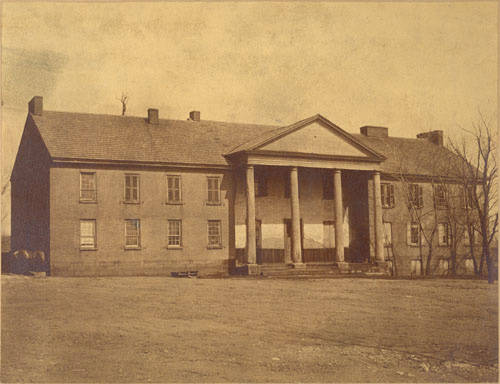
Washington Academy was chartered by the Pennsylvania General Assembly on September 24, 1787. The first members of the board of trustees included Reverends Dod and Smith. After a difficult search for a headmaster, in which the trustees consulted Benjamin Franklin, the trustees unanimously selected Thaddeus Dod, considered to be the best scholar in western Pennsylvania. Amid financial difficulties and unrest from the Whiskey Rebellion, the academy held no classes from 1791 to 1796. In 1792, the academy secured four lots at Wheeling and Lincoln street from William Hoge and began construction on the stone Academy Building. During the Whiskey Rebellion, portions of David Bradford's militia camped on a hillside that would later become home to the unified Washington & Jefferson College.
In October 1792, after a year's delay from its official incorporation resulting from "trouble with Indians," McMillan was chosen as the headmaster and Canonsburg was chosen as the location for the "Canonsburg Academy." At a subsequent unknown date, McMillan transferred his students from the log cabin to Canonsburg Academy. Canonsburg Academy was chartered by the General Assembly on March 11, 1794, thus placing it firmly ahead of its sister school, Washington Academy, which was without a faculty, students, or facilities. On January 15, 1802, with McMillan as president of the board, the General Assembly finally granted a charter for "a college at Canonsburgh."
Jefferson College and Washington College

In 1802, Canonsburg Academy was reconstituted as Jefferson College, with John McMillan serving as the first President of the board of trustees. In 1806, Matthew Brown petitioned the Pennsylvania General Assembly to grant Washington Academy a charter, allowing it to be re-christened as Washington College. At various times over the next 60 years, the various parties within the two colleges pursued unification with each other, but the question of where the unified college would be located thwarted those efforts. In the ensuing years, both colleges began to undertake risky financial moves, especially over-selling scholarships. Desperate for funds, Washington College accepted an offer from the Synod of Wheeling to take control of the college, a move that was supposed to stabilize the finances for a period of time. However, Washington College then undertook another series of risky financial moves that crippled its finances.
Unification of the colleges

Following the Civil War, both colleges were short on students and on funds, causing them to join as Washington & Jefferson College in 1865. The charter provided for the college to operate at both Canonsburg and Washington, a position that caused significant difficulty for the administration trying to rescue the college amid ill feelings over the unification. Edwards immediately encountered significant challenges, including the difficulties of administering a college across two campuses, as well as old prejudices and hard feelings among those still loyal to either Jefferson College or Washington College. Leadership of the college during this time fell to Samuel J. Wilson, a local pastor, and James I. Brownson, who had earlier been interim president of Washington College. By 1871, the United States Supreme Court upheld the consolidation, allowing the newly configured college to proceed.
History since unification
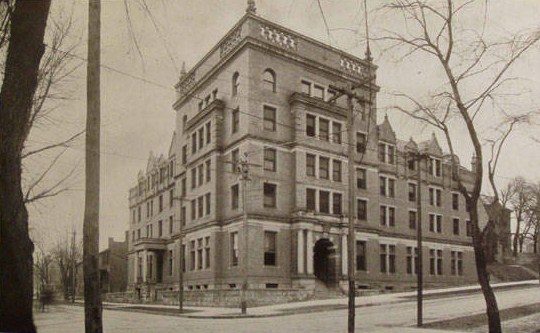
George P. Hays, who had assumed the presidency amid the court battle and the unification controversy, led the newly unified college until 1881. His successor, James D. Moffat, led the college through a period of growth where the college constructed the Old Gym, Hays Hall, Thompson Memorial Library, and Thistle Physics Building, as well as purchasing the land known as the "old fair ground," now used for Cameron Stadium. Towards the end of his term, Moffat personally paid for the 1912 renovations of McMillan Hall. In 1914, Frederick W. Hinitt was elected president. His tenure was dominated by the United States' entry into World War I, with an enrollment drop of 50%.
William E. Slemmons, a college trustee and adjunct professor, succeeded Hinitt and served as interim president from May 1918 to June 1919. After the war ended in 1919, Samuel Charles Black took over and helped to stabilize the enrollment. His successor, Simon Strousse Baker, was well liked by the college's trustees and by "many a townsman", but the student body felt that Baker was "autocratic" and held an "unfriendly attitude toward the student body as individuals." Baker defended himself, saying that the perceived ill-will towards students was unintentional and a misunderstanding.

Baker's successor, Ralph Cooper Hutchison, was much more popular with the student body. In an effort to strengthen the college's science department, Hutchison extended and expanded the southern portion of the campus, adding the Lazear Chemistry Hall and purchasing McIlvane Hall. When World War II broke out, the campus was opened to the Army Administration School, where hundreds of soldiers received their "training in classifications." Hutchison resigned in 1945 to take the presidency of his alma mater, Lafayette College. In 1950, Boyd Crumrine Patterson assumed the presidency and oversaw curriculum revisions and the construction of a number of buildings, including the Henry Memorial Center, 10 Greek housing units in the center of campus, the U. Grant Miller Library, the Student Center, the Commons, and two new dormitories. His fundraising abilities grew the college's endowment expanded from $2.3 million to nearly $11 million. Patterson retired in 1970, the same year that the trustees authorized the admission of women as undergraduate students. The college also adopted a new academic calendar to include intersession and expanded its academic programs to include the Entrepreneurial Studies Program, the Freshman Forum, and several cooperative international education programs. Student enrollment grew from 830 in 1970 to 1,100 in 1998. Burnett retired as president in 1998.
Under Burnett's successor, Brian C. Mitchell, who served as president from 1998 to 2004, the college experienced a growth in construction and an effort to improve relations with the neighboring communities. In 2004, Tori Haring-Smith became the first woman to serve as president of Washington & Jefferson, undertaking an effort to improve the science curriculum and to construct the Swanson Science Center. After 13 years of service, Haring-Smith retired from her position on June 30, 2017. John C. Knapp was named Haring-Smith's successor on April 21, 2017, and became the college's 13th president on August 1, 2017. On February 27, 2024, the college announced the selection of Elizabeth MacLeod Walls as the 14th president. MacLeod Walls and began her tenure on June 30, 2024.
Campus

The campus of Washington & Jefferson College is located in the city of Washington and the East Washington Borough, small-town communities about 30 mi south of Pittsburgh. The 60 acre campus is home to more than 40 academic, administrative, recreational, and residential buildings. Portions of the campus extend into the East Washington Historic District. Four historic gates mark four traditional entrances to campus at East Maiden Street, Wheeling Street, South College Street, and Beau Street. In 1947, the Pennsylvania Historical and Museum Commission installed a historical marker noting the historic importance of the college.
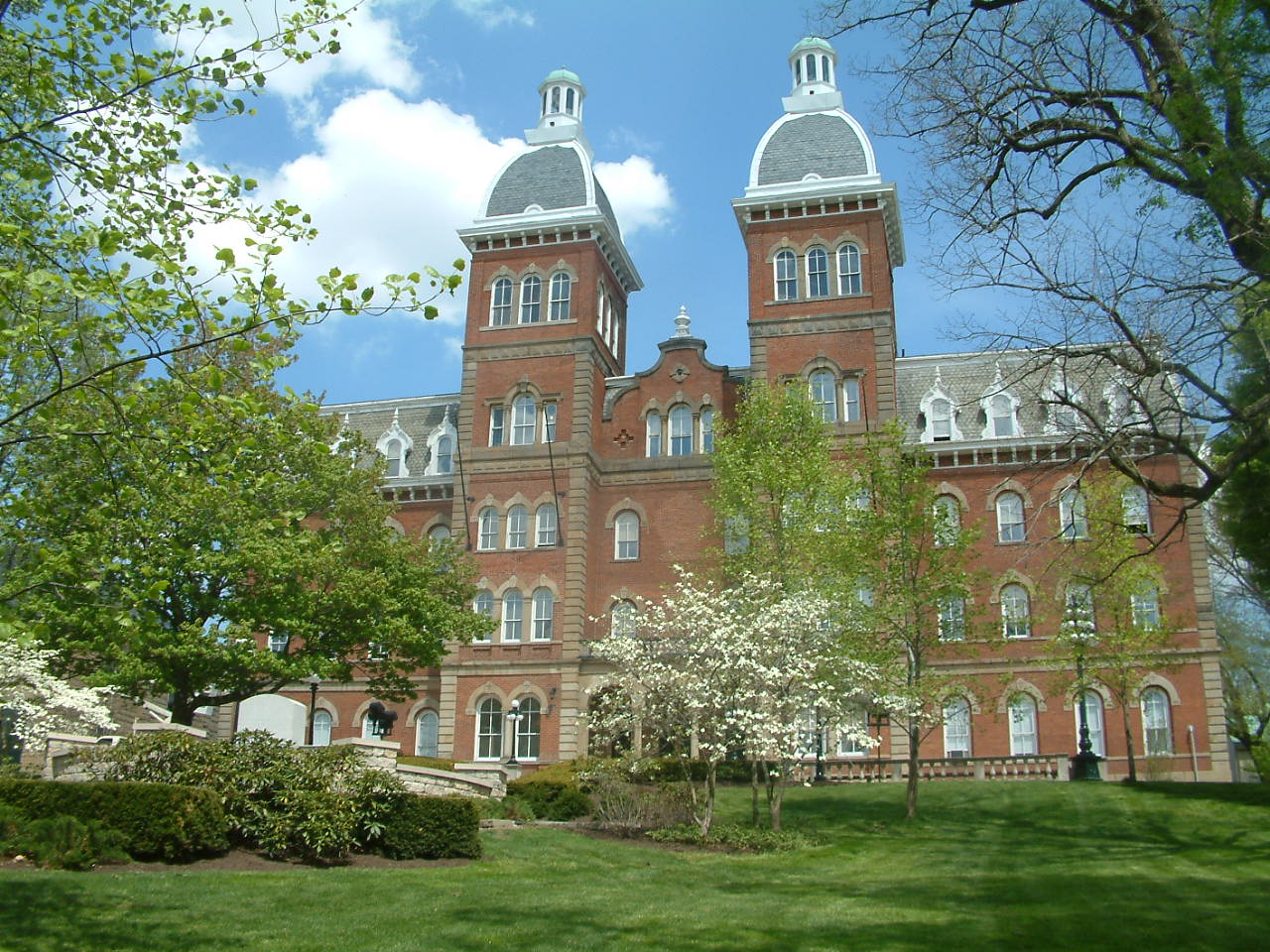
The oldest surviving building is McMillan Hall, which dates to 1793 and is the oldest college building west of the Allegheny Mountains. The main academic building is Old Main, which is topped with two prominent towers. The Old Gym houses a modern exercise facility. McIlvaine Hall, which was originally home to a female seminary, was demolished in 2008 and replaced by the Swanson Science Center. Davis Memorial Hall was once a dormitory and private house. The Swanson Science Center and the Dieter-Porter Life Sciences Building all cater to the scientific curriculum. The Burnett Center and its sister building, the Technology Center, were built in the late 1990s and early 2000s.
The first dormitory on campus was Hays Hall. Wade House, Carriage House, and Whitworth House are Victorian homes housing older students. The recently constructed Chestnut Street Housing complex provides housing for the college's Greek organizations. The Presidents' Row is a cluster of ten buildings in the center of campus, several of which are dedicated to theme housing. Two sister dormitories, New Residence Hall and Bica-Ross Hall, feature suite-style living arrangements. Mellon Hall houses female freshman, and Upperclass Hall houses male freshmen. Other dormitories include Alexander Hall, Cooper Hall (formerly Beau Hall), Marshall Hall, Penn House, and the currently unused North Hall. The college administration utilizes several buildings, including the Admissions House, the Alumni House, and the President's House, which are all modified Victorian homes. The Hub, the Commons, and the Rossin Campus Center provide recreational and dining facilities for students. The athletic and intramural teams utilize Cameron Stadium for football and track. The Henry Memorial Center is used for basketball, wrestling, swimming, and volleyball. Other athletic facilities include Brooks Park, Ross Memorial Park and Alexandre Stadium, and the Janet L. Swanson Tennis Courts.
Washington & Jefferson is the setting for the Netflix programs The Chair and Mindhunter.
Academics
As a liberal arts college, Washington & Jefferson College focuses exclusively on undergraduate education. The college's teaching environment reflects the liberal arts tradition of small group instruction by maintaining an average class size of 17 and a student/faculty ratio of 12:1. 85% of faculty have terminal degrees and no classes are taught by teaching assistants.
The college has a focus on preparing students for graduate school and professional programs. Across all disciplines, 85% to 90% of students who apply to such programs receive offers of admission. Among students who apply to medical school or related health graduate programs, 90% of students gain admission. Approximately 11% of all current W&J alumni are physicians and engineers, making the college third in the nation per capita for producing doctors and scientific researchers. Among students who apply to law school, approximately 90% of students gain admission.
The college recently added The English Language Institute which is a pre-academic program designed to equip multi-lingual learners with the English and academic skills to be prepared for undergraduate study.
Admission and rankings
(among 40% of FTFs) (among 10% of FTFs) Admission to Washington & Jefferson College is classified as "inclusive" by the Carnegie Classification of Institutions of Higher Education.
In 2023, the college received 3,218 applications. It extended offers of admission to 2,624 applicants, or 82%. 314 accepted students chose to enroll, a yield rate of 12%. Of the 40% of incoming students in 2023 who submitted SAT scores, the interquartile range was 1030–1250; of the 10% of incoming students in 2023 who submitted ACT scores, the average composite score was 26. Of all matriculating students, the average high school GPA was 3.5. In 2009, the college developed an SAT-optional admissions program.
In the 2025 U.S. News & World Report college rankings, Washington & Jefferson is ranked 90th (tied) of 211 liberal arts colleges nationwide. In Forbes' List of America's Best Colleges for 2010, the college was ranked #100 out of the nation's institutions of higher education. The Washington Monthly ranked the college #132 among all American liberal arts colleges in terms of social mobility, research, and community service. The rankings listed the college as #30 in the nation in terms of Federal Work-Study Program money spent of community service.
As president of the college, Tori Haring-Smith specifically criticized the U.S. News & World Report rankings system, noting that the "financial resources" portion of the rankings formula favors colleges that have higher tuition, even without providing any educational benefits, saying that this has harmed the college's ranking because it charged $5,000 to $7,000 less in tuition that its peer institutions. She also questioned the "peer assessment" portion of the rankings and suggested that college presidents are rarely aware of educational improvements in their peer institutions; she noted that Washington & Jefferson College's ranking has remained the same for a number of years, even while the college made significant improvements in terms of its acceptance rates and overall selectivity, the addition of academic programs, and the construction of additional buildings. She signed the "Presidents Letter," a nationwide movement asking fellow college presidents to decline participation in the U.S. News & World Report reputation survey, a subjective evaluation where college administrators score their competition.
Curriculum
The curriculum is centered on the traditional liberal arts education and pre-professional classes. All first-semester freshmen must complete a "First Year Seminar" class, which introduces new students to a variety of lectures, concerts, plays, and trips to museums or galleries based on a different course theme selected each year. In addition to completing an academic major, students must satisfy the college-wide general education requirements, which include classes in the arts, humanities, natural sciences and mathematics, foreign languages, cultural diversity, and academic skills classes including writing, oral communication, quantitative reasoning. Additionally, all students must complete a physical education requirement, amounting to one full semester class, making W&J one of the few liberal arts colleges without a physical education major to have such a requirement. The college maintains a number of combined degree programs, allowing students to attend graduate or professional school in lieu of senior year.
The college follows a standard academic calendar with the option to partake in summer classes and/or May Term. During the Intersession term, students have the choice of studying abroad, completing an external internship, or taking a specially designed Intersession course. Past Intersession courses have included "Emerging Diseases: Global and Local" in the biology department, "Corporate Failures, Frauds, and Scandals" in the business department, and "Vampires and Other Bloodsuckers" in the English department, "Holocaust Survivor Narratives" in the German department, and "Alternative Radio" in the communications department. At various times, the faculty organizes an "Integrated Semester," where professors organize regular departmental courses, specialized projects, and public events dealing with a common interdisciplinary theme. While W&J has not had a Reserve Officers' Training Corps (ROTC) program since 1991, the college has a relationship with the University of Pittsburgh's Army and Air Force ROTC programs, allowing W&J students to prepare for an active or reserve commission following graduation. In the 2010–2011 school year, 58% of W&J students studied abroad.
Student body
| Undergraduate | Pennsylvania | U.S. Census | African American | Asian American | White American | Hispanic American | Native American | International student | Unknown/unspecified |
|---|---|---|---|---|---|---|---|---|---|
| 2.84% | 11.20% | 12.1% | |||||||
| 1.19% | 2.46% | 4.3% | |||||||
| 81.97% | 86.83% | 65.8% | |||||||
| 1.32% | 4.19% | 14.5% | |||||||
| 0.46% | 0.54% | 0.9% | |||||||
| 2.05% | N/A | N/A | |||||||
| 10.17% | N/A | N/A |
As of fall 2021, the student body totaled 1,156 undergraduate students.{{cite web| title = U.S. News Best Colleges| publisher = Washington & Jefferson College| date = May 25, 2010| url = http://www.usnews.com/best-colleges/washington--jefferson-college-3389
The male to female ratio is 54% to 46%. Like the population of Pennsylvania and the United States as a whole, the largest ethnic group at the college is White American, making up about 82% of the student population. Roughly 10% of the student population does not specify their ethnicity. Other ethnicities, including African American, Asian American, Native American, and Hispanic Americans collectively comprise about 6% of the student body. International students make up 2.05% of the student body.
In 2006, Men's Fitness named W&J the "14th Fittest College in America," a ranking that weighed the college's fitness offerings and the student body's culture of fitness and behavior. In 2009, the college was named to the President's Higher Education Community Service Honor Roll, in recognition of the student body's commitment to community service. The college's spends 22% of its Federal Work-Study Program funds on community service projects.
The college has joined the YES Prep School IMPACT Partnership Program to provide support to low-income students from the YES Prep Public Schools.
Student life
Student housing
The college offers "Theme Community Living," where students with common interests live in a single living unit. Past themes have included the "Intensive Study," the "Service Leadership Community," the "International House," "Music House," the "WashPA Radio Theme Community" for students who participate in the WNJR college radio station, and the "Pet House". Students proposing a theme community must develop an educational plan centered on the theme. The college does not typically allow students to live in off-campus housing.
Clubs

Students may organize new clubs by presenting a constitution and a list of members to the college administration and the student government for approval. This approval process does not authorize any club to act on behalf of the college, nor does approval indicate any the college's agreement with the club's purpose.
The college recognizes over 70 student clubs on campus. A number of student clubs are dedicated to encouraging interest in a specific academic discipline, including the "W&J Denominators" mathematics club, the Society of Physics Students, and the Pre-Health Professions Society. Many other clubs encourage interests in various academic and non-academic activities, including the Green Club (the college's environmental club), the Outdoors Club, and others which are mainly inactive like the Bottega Art Club, the Franklin Literary Society, and the Chess Club.
Student media
Student media offerings at Washington & Jefferson College include a college newspaper, a college radio station, a yearbook, and a student-edited literary journal. All students, regardless of academic major, are eligible to contribute to these media organizations.
Founded in 1909, the Red & Black student newspaper has a weekly circulation of 1,250 copies. The Red & Black features local and national news, student opinion, and college athletics coverage.
The college radio station, WNJR broadcasts on the FM broadcast band. Student on-air personalities produce radio programs including music, news, talk, and sports. It serves the Pittsburgh Designated Market Area, reaching north to the northern Pittsburgh suburbs, east to Monessen, south to Waynesburg and west to the West Virginia Panhandle.
The Wooden Tooth Review is a student-edited literary journal, featuring short fiction and poetry submitted by members of the student body. The editorial board is organized as a recognized student club, with a faculty advisor. The journal was founded in 1999, with V. Penelope Pelizzon, Coordinator of Creative Writing, serving as the first faculty advisor. The college's yearbook, Pandora, is produced annually by a student staff.
Literary societies
Main article: Literary societies at Washington & Jefferson College

The history of literary societies at Washington & Jefferson College dates back to the 1797, when the Franklin Literary Society and the Philo Literary Society were founded at Canonsburg Academy. Two other literary societies were founded at Washington College, the Union Literary Society in 1809 and the Washington Literary Society in 1814. These four college literary societies had intense rivalries with each other, competing in "contests", which pitted select society members against another in "compositions, speaking select orations and debating", with the trustees selecting the victor. In the years after the union of the two colleges, these four literary societies merged with the Franklin Literary Society, which survives today.
Art scene
Washington & Jefferson College is home to a vibrant student art and musical scene. The artistic center of campus is the Olin Fine Arts Center, with an art gallery and a 486-seat auditorium. The Department of Music offers majors and minors in music. The Department of Theatre and Communications offers a major and minor in theatre. Current musical organizations include the W&J Wind Ensemble, the W&J Jazz Ensemble, the W&J Choir and the Camerata Singers. Former musical organizations include the Banjo, Mandolin & Guitar Club and the College Band. Every year since 2003, the Theatre and Communication Department has produced the Winter Tales series, an annual production of one-act plays written by members of the W&J community, students, alumni, faculty, administration, and staff, and produced by the W&J Student Theater Company.
In addition to student-produced art and music, the college provides a number of opportunities to view art and music from the larger art community. The college holds a collection of paintings by distinguished regional artist Malcolm Parcell, which are displayed in several locations on campus. The most prominent location is the Malcolm Parcell Room in The Commons, which is part of the student dining area. The W&J Arts Series is an annual collection of musicians, singers, and other artistic performers appearing at the Olin Fine Arts Center. Past shows have included Di Wu, Habib Koité, Chris Potter, The Aquila Theatre Company presenting The Invisible Man, Eroica Trio, Oni Buchanan, Tommy Sands, Cavani String Quartet, Sergio and Odar Assad, and Sandip Burman. In 1999, billionaire W&J alum and well-known opera philanthropist Alberto Vilar sponsored the Vilar Distinguished Artist Series. In 2003, amid Vilar's falling fortunes, the series went on a hiatus, and Vilar's 2005 indictment for financial fraud ended the series. In Fall 2003, the W&J Arts Series, the college's other art series, was expanded to partially compensate.
Greek life
Main article: Greek organizations at Washington & Jefferson College

43% of women and 40% of men of the student body participating in Greek life. The Princeton Review named Washington & Jefferson College 12th on their 2010 list of "Major Frat and Sorority Scene" in the United States. As of 2022, there were four fraternities and four sororities. All Greek organizations occupy college-owned houses on Chestnut Street.
Two national fraternities were founded at Jefferson College, Phi Gamma Delta in 1848 and Phi Kappa Psi in 1852. A third fraternity was founded at Jefferson College, Kappa Phi Lambda, but it dissolved after a decade of existence amid a dispute between chapters. In 1874, a fourth fraternity was founded at W&J, the short-lived Phi Delta Kappa. The new fraternity grew to several chapters before falling apart in 1880.
Athletics
Intercollegiate
Main article: Washington & Jefferson Presidents
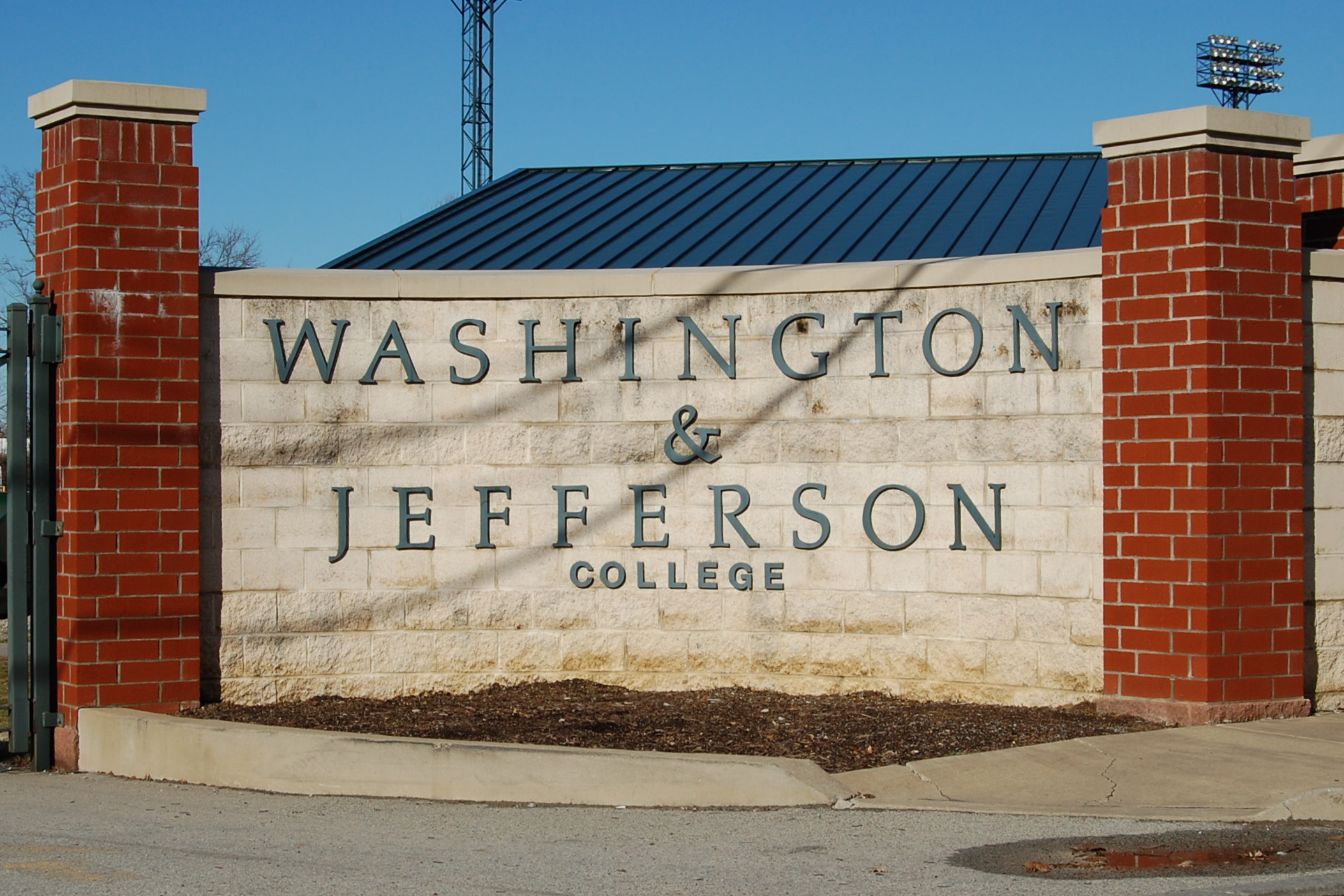
W&J competes in 26 varsity sports at the National Collegiate Athletic Association (NCAA) Division III level. As of the 2009–10 academic year, the Presidents have won more than 108 Presidents' Athletic Conference (PAC) championships, 40 students were selected as conference Most Valuable Player, more than 300 athletes were awarded First Team All-Conference recognition, 75 received All-American honors, and 25 achieved Academic All-American status. During the 2005–2006 season, 34 percent of the student body played varsity-level athletics.
The football team has been very successful, winning 18 out of the last 21 PAC Championships and advancing to the NCAA Division III playoffs 17 times. W&J played to a 0–0 tie in the 1922 Rose Bowl against the California Golden Bears and were named to a share of the national championship by the Boand System. In 1923, John Heisman coached the W&J football team. The men's ice hockey team won the 2008 College Hockey Mid America Conference championship, a Division I regional league of the American Collegiate Hockey Association. W&J also fields teams in field hockey, men's wrestling, baseball, softball, and women's volleyball, as well as men's and women's cross country running, soccer, tennis, water polo, basketball, swimming and diving, golf, lacrosse, and track & field. Men's volleyball and women's wrestling will be added in the 2026–27 school year.
Intramural
The intramural sports program is one of the most consistently popular activities at Washington & Jefferson College, providing non-varsity and recreational athletic activities for all students, faculty, and staff of the college. In 2002, 60% of students participated in intramural sports. In 2006, more than 40% of the student body participated in intramural athletics. In 2007, the intramural activities included 3-on-3 basketball, billiards, bowling, flag football, kickball, tennis, ultimate frisbee, volleyball, wallyball, ping pong, and Texas hold 'em. Intramural champions win a T-shirt celebrating their victory.
While the varsity athletics program was struggling during the 1930s, intramural participation topped 84% of the student population. During that time, the management of intramural activities was transferred to the athletic department, allowing the intramural program to use the college's varsity facilities. In the 1930s and 1940s, groups of students competed for the "Big Cup," a trophy given to the most outstanding team, as judged by a cross-sport point system.
Traditions
Main article: Traditions of Washington & Jefferson College

One of the oldest traditions at Washington & Jefferson College was the "Freshman Rules," a system of rules and restrictions on freshmen. During the 1870s and 1880s, the students engaged in organized athletic competitions, pitting the freshman versus sophomore classes in the "Olympic Games" that involved elaborate opening ceremonies and the smoking of a "Pipe of Peace." Another form of physical contest between the freshman and sophomore classes were the annual "color rush," where the teams fought over control over strips of fabric, the "pole rush," where the teams battled to raise a flag up a flagpole, and the "cane rush" where the teams fought over control over a ceremonial cane. These contests generally devolved into outright gang violence.
The college cheer, Whichi Coax, is so pervasive in college history and culture that in addition to being shouted during academic ceremonies and football games, it is also used as a salutation in correspondence between alumni. The college's fight song, "Good Ole W&J" is sung to the tune of "99 Bottles of Beer" and makes fun of a number of rival colleges, including the University of Pittsburgh, but was modified sometime before 1958 to laud Washington Female Seminary.
Symbols of the college
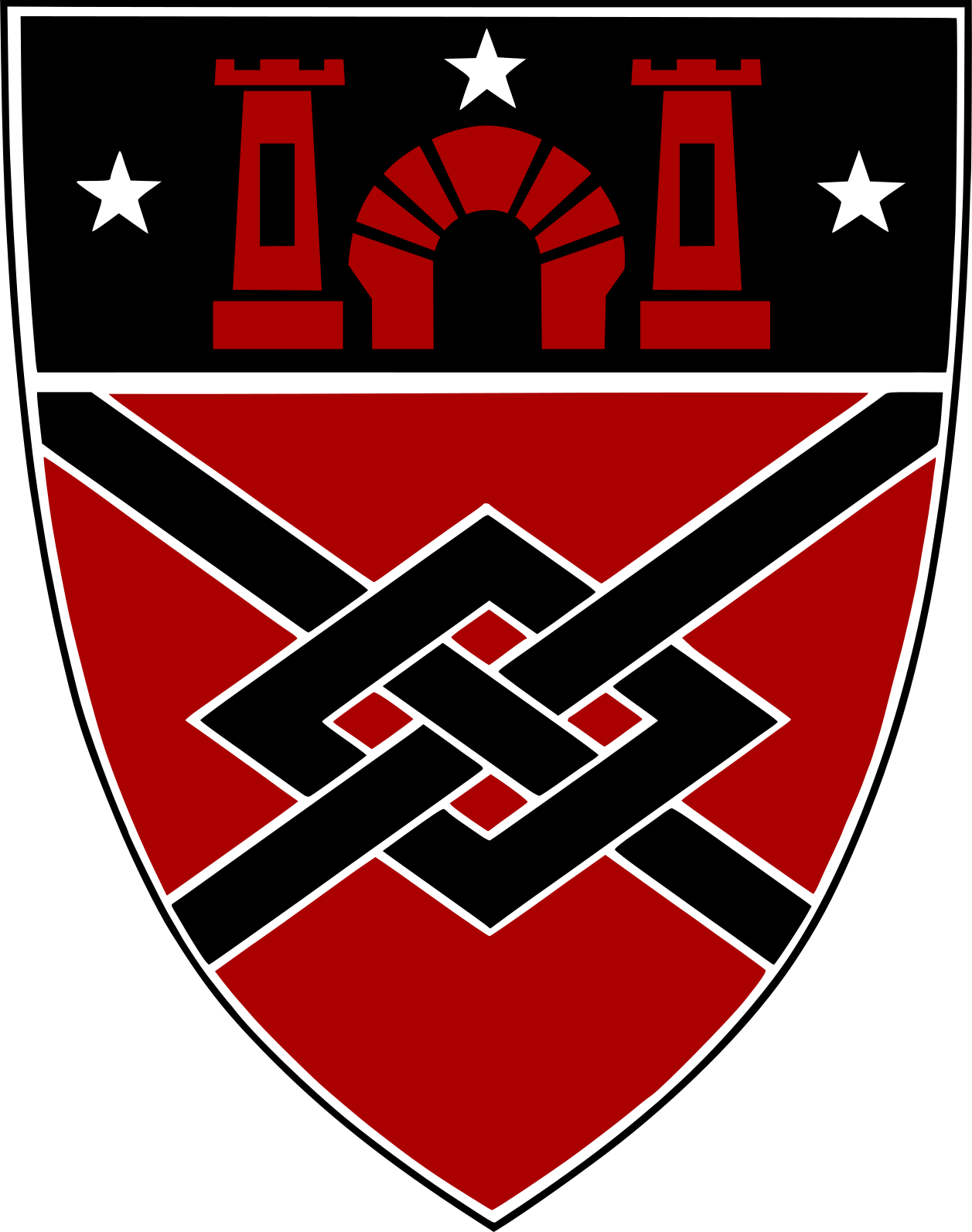
The college's coat of arms features a two-part shield based on the coats of arms of the Jefferson and Washington families. The top portion, showing two towers, representing Washington College and Jefferson College, and three stars, representing the McMillan, Dod, and Smith log cabins. The coat of arms may appear with a banner underneath showing the college motto. The design was adopted in 1902 in celebration of Jefferson College's centennial. It was designed by Rev. Harry B. King, class of 1891. Upon its adoption, it was described as "a happy combination, and makes a very neat appearance when worn as a pin or button."
The college seal displays two brick towers, with one labeled "1802," representing Jefferson College, and the other labeled "1806," representing Washington College.
The college's current logo features a stylized version of the two towers of Old Main, symbolizing the 1865 unification of Washington College and Jefferson College. The logo may be displayed in several versions: with the entire name of the college, the shortened form of "W&J", or without any text. Prior to the adoption of this logo, the college's graphic identity consisted of a variety of conflicting logos and type styles.
Relations with the city of Washington
Main article: City of Washington–Washington & Jefferson College relations
Relations between the city of Washington, Pennsylvania and Washington & Jefferson College span over two centuries, dating to the founding of both the city and the college in the 1780s. The relationship between the town and college was strong enough that the citizens of Washington offered a $50,000 donation in 1869 to the college in a successful attempt to lure the trustees to select Washington over nearby Canonsburg as the consolidated location of the college. Preservationists unsuccessfully attempted to pass laws prohibiting the college from demolishing certain buildings that were listed on the East Washington Historic District. Local preservationists also unsuccessfully tried to block the demolition of Hays Hall, which had been condemned. In the 1990s, the city of Washington made several unsuccessful attempts to challenge the college's tax-exempt status. In 1993, Washington appealed the Washington County Board of Assessment's determination that the college was exempt from the city's property tax. That case went to the Pennsylvania Supreme Court, which ruled in favor of the college. Separately, the city of Washington passed an ordinance that levied a municipal "service fee" against the college students, which was ruled to be illegal and was struck down. In the late 1990s, the college and town created the Blueprint for Collaboration, a plan with detailed goals and benchmarks for the future to help the college and the city work together on economic development, environmental protection, and historic preservation.
Notable alumni
Main article: List of Washington & Jefferson College alumni

As of 2009, Washington & Jefferson College had about 12,000 living alumni. Before the union of the two colleges, Washington College graduated 872 men and Jefferson College graduated 1,936 men. These alumni include Henry A. Wise, Governor of Virginia, and James G. Blaine, who served in Congress as Speaker of the House, U.S. Senator from Maine, two-time United States Secretary of State and the Republican nominee for the 1884 presidential election. As a U.S. Congressman, Clarence Long was a key figure in directing funds to Operation Cyclone, the CIA's effort to arm the mujahideen in the Soviet–Afghan War. James A. Beaver served as Governor of Pennsylvania and as acting president of the Pennsylvania State University; he is the namesake of Beaver Stadium. Blake Ragsdale Van Leer, was the fifth president of Georgia Tech and first president to allow women to enroll there. He also had a prominent military career. William Holmes McGuffey authored the McGuffey Readers, which are among the most popular and influential books in history. Thaddeus Dod's student, Jacob Lindley, was the first president of Ohio University. Astronaut and test pilot Joseph A. Walker became the first person to enter space twice. Other graduates have gone on to success in professional athletics, including Buddy Jeannette, a member of the Basketball Hall of Fame, and Pete Henry, a member of both the College and Pro Football Hall of Fame. Roger Goodell has served as the Commissioner of the NFL since 2006.
Among graduates who entered the medical field, Jonathan Letterman is recognized as the "Father of Battlefield Medicine." Successful graduates in the business realm include Richard Clark, President and CEO of Merck, John S. Reed, the former chairman of Citigroup and the New York Stock Exchange.
References
References
- (February 19, 2021). "U.S. and Canadian Institutions Listed by Fiscal Year 2020 Endowment Market Value and Change in Endowment Market Value from FY19 to FY20". National Association of College and University Business Officers and [[TIAA]].
- "U.S. News 2024 National Liberal Arts College Rankings". U.S. News & World Report.
- The three men, all graduates from the College of New Jersey (now [[Princeton University]]), came to present-day [[Washington County, Pennsylvania
- Coleman 1956 pp. 21–44
- Coleman 1956 pp. 45–58
- Coleman 1956 p. 59
- Coleman 1956 pp. 102–107
- In 1817, a disagreement over a perceived agreement for unification erupted into "The College War" and threatened the existence of both colleges.Coleman 1956 pp. 68–73
- Thanks to the leadership of Matthew Brown, Jefferson College was in a stronger position to weather the financial storm for a longer period.Coleman 1956 pp. 78–85
- Coleman 1956 pp. 130–131
- Coleman 1956 pp. 133–142
- Coleman 1956 pp. 143–149
- (September 4, 2003). "Jonathan Edwards (1866–1869)". Washington & Jefferson College.
- Edwards resigned in 1869, as the two-campus arrangement was declared a failure and all operations were consolidated in Washington. Before the merger could be completed, Canonsburg residents and Jefferson College partisans filed a lawsuit, known as the ''[[Pennsylvania College Cases]]'', sought to overturn the consolidation plan.Coleman 1956 pp. 155–156
- (September 4, 2003). "James I. Brownson (Pro Tem. 1870)". Washington & Jefferson College.
- (September 4, 2003). "Samuel J. Wilson (Pro Tem. 1869)". Washington & Jefferson College.
- (September 4, 2003). "George P. Hays (1870–1881)". Washington & Jefferson College.
- (September 4, 2003). "James D. Moffat (1881–1915)". Washington & Jefferson College.
- "McMillan Hall". Washington & Jefferson College.
- (September 4, 2003). "Frederick W. Hinitt (Pro Tem. 1915–1918)". Washington & Jefferson College.
- (September 4, 2003). "William E. Slemmons (Pro Tem. 1918–1919)". Washington & Jefferson College.
- (September 4, 2003). "Samuel Charles Black (1919–1921)". Washington & Jefferson College.
- (April 11, 1932). "W. & J.'s Hutchison".
- (September 4, 2003). "Ralph Cooper Hutchison (1931–1945)". Washington & Jefferson College.
- "Old Gym". Washington & Jefferson College.
- (September 4, 2003). "James Herbert Case, Jr. (1946–1949)". Washington & Jefferson College.
- (September 4, 2003). "Boyd Crumrine Patterson (1950–1970)". Washington & Jefferson College.
- (July 16, 1988). "Boyd C. Patterson, college President, 86". The New York Times.
- (September 4, 2003). "Howard Jerome Burnett (1970–1998)". Washington & Jefferson College.
- (September 4, 2003). "Brian C. Mitchell (1998–2004)". Washington & Jefferson College.
- (October 31, 2008). "Science Initiative Details". Washington & Jefferson College.
- (2004). "Congratulations and Welcome to President Haring-Smith". Washington & Jefferson College.
- (2017). "Dr. John C. Knapp Named 13th President of Washington & Jefferson College". Washington & Jefferson College.
- "Washington & Jefferson College names next president".
- Miller, Barbara S.. (April 1, 2010). "Universities, colleges gear up for census". [[Observer Reporter]].
- "Maiden, Wheeling, College, and Beau St. entrances". [[Council of Independent Colleges]].
- "Washington and Jefferson College – PHMC Historical Markers". Pennsylvania Historical & Museum Commission.
- "McMillan Hall". Washington & Jefferson College.
- "Old Main". Washington & Jefferson College.
- "Old Gym". Washington & Jefferson College.
- "McIlvaine Memorial Hall". [[Council of Independent Colleges]].
- Ramirez, Chris. (May 9, 2010). "Enrollment inspires expansion at Washington & Jefferson". [[Pittsburgh Tribune-Review]].
- "Davis Memorial Hall". [[Council of Independent Colleges]].
- "W&J:Howard J Burnett Center". Washington & Jefferson College.
- "W&J: Information Technology Leadership". Washington & Jefferson College.
- "Hays Hall". Washington & Jefferson College.
- "Victorian houses (Admissions House and President's House)". [[Council of Independent Colleges]].
- "W&J: Chestnut Street Housing". Washington & Jefferson College.
- "W&J: President's Row". Washington & Jefferson College.
- "W&J: New Residence Hall". Washington & Jefferson College.
- "W&J: Bica Ross Hall". Washington & Jefferson College.
- "W&J: Mellon Hall". Washington & Jefferson College.
- "W&J: Upperclass Hall". Washington & Jefferson College.
- npgadmin. (2021-04-01). "Introducing Cooper Hall".
- "W&J: Alexander Hall". Washington & Jefferson College.
- "W&J: Beau Hall". Washington & Jefferson College.
- "W&J: Residence Halls". Washington & Jefferson College.
- (May 2016). "W&J: North Hall". Washington & Jefferson College.
- "W&J: Library FAQ". Washington & Jefferson College.
- "Thompson Hall". [[Council of Independent Colleges]].
- (May 2016). "W&J: The Hub". Washington & Jefferson College.
- (May 2016). "W&J: Rossin Campus Center". Washington & Jefferson College.
- "W&J: Cameron Stadium". Washington & Jefferson College.
- "W&J: Henry Memorial Center". Washington & Jefferson College.
- "W&J: Brooks Park". Washington & Jefferson College.
- "Ross Memorial Park/Alexandre Stadium". Washington & Jefferson College.
- "Where Was 'The Chair' Filmed?". newsweek.com.
- (June 11, 2010). "Statement of Accreditation Status – Washington & Jefferson College". [[Middle States Commission on Higher Education]].
- (November 2012). "Staff Handbook". Washington & Jefferson College.
- "W&J: College Facts". Washington & Jefferson College.
- "About our graduates". Washington & Jefferson College – Office of Career Services.
- "W&J Science @ a Glance". Washington & Jefferson College.
- Trifaro, Emily. (Spring 2008). "The Science Initiative: Investing in the Future". Washington & Jefferson College.
- Haring-Smith, Tori. (Winter 2010). "President's Message". Washington & Jefferson College.
- "Pre-law general information". PRE-LAW COMMITTEE, Washington & Jefferson College.
- "2023-2024 Common Data Set". Washington & Jefferson College Office of Institutional Effectiveness.
- Goodman, Dawn. (September 26, 2009). "SAT or ACT scores now not problem at W&J". [[Observer-Reporter]].
- "W&J: Score Optional Policy". Washington & Jefferson College.
- (2010). "Overview : Washington and Jefferson College". [[U.S. News & World Report]].
- "#100 Washington and Jefferson College". [[Forbes Magazine's List of America's Best Colleges]].
- (2009). "College Guide: 2009 Liberal Arts". [[The Washington Monthly]].
- Jaschik, Scott. (January 17, 2008). "Potemkin Rankings". [[Inside Higher Ed]].
- Morse, Bob. (January 17, 2008). "About That Article on Washington and Jefferson College...". [[U.S. News & World Report]].
- (May 10, 2007). "Presidents Letter". [[Education Conservancy]].
- "Washington & Jefferson College – Washington, Pennsylvania". [[Carnegie Foundation for the Advancement of Teaching]].
- (2008). "Washington & Jefferson College 2008–2010 Catalog". Washington & Jefferson College.
- (September 1, 2010). "College-Wide Requirements". Washington & Jefferson College.
- "MayTerm".
- "Intersession 2008". Washington & Jefferson College.
- "W&J: Integrated Semester". Washington & Jefferson College.
- (November 13, 2012). "W&J Ranks High in Percentage of Students Who Study Abroad". Washington & Jefferson College.
- (2005). "Pennsylvania Population Estimates 2005". [[United States Census]].
- Hanford, Emily. "The YES Prep Story". [[American Radio Works]].
- "General Student Body Information: Washington & Jefferson College". [[U.S. News & World Report]].
- "Washington & Jefferson College: Student Body". [[The Princeton Review]].
- (November 2012). "W&J Recognized as One of the Fittest Colleges In America". Washington & Jefferson College.
- Millado, Nate. "Fittest Colleges in America". [[Men's Fitness]].
- "REPORT CARD: Washington & Jefferson College". [[Men's Fitness]].
- (2009). "Honor Roll". [[Learn and Serve America]].
- (March 2, 2010). "Washington & Jefferson College Named to Presidential Honor Roll". Washington & Jefferson College.
- Crompton, Janice. (March 4, 2010). "Washington & Jefferson joins program to educate underprivileged students". [[Pittsburgh Post-Gazette]].
- "W&J: Theme Community Living". Washington & Jefferson College.
- "W&J: Theme Communities". Washington & Jefferson College.
- Taylor, Lynda Guydon. (November 13, 2005). "Home Showcase: In tune with being together – W&J offers living quarters to like-minded music lovers". [[Pittsburgh Post-Gazette]].
- (October 2009). "College Policy on Campus Organizations". Washington & Jefferson College.
- "W&J: Clubs and Organizations". Washington & Jefferson College.
- (September 23, 2019). "Religious Life".
- "W&J: Student Media". Washington & Jefferson College.
- "W&J: Red & Black". Washington & Jefferson College.
- "W&J: WNJR". Washington & Jefferson College.
- "A recent history of radio at W&J". Washington & Jefferson College.
- "WNJR Washington, PA: Full-service FM, Channel 219 (91.7 MHz)". FCCData.org.
- "The Wooden Tooth Review Submission Deadline is Dec. 19". Washington & Jefferson College.
- "Wooden Tooth Review".
- Pelizzon, V. Penelope. "V. Penelope Pelizzon, Associate Professor, Department of English". [[University of Connecticut]].
- "W&J: Pandora". Washington & Jefferson College.
- McClelland, W.C.. (1903). "The Centennial Celebration of the Chartering of Jefferson College in 1802". George H. Buchanan and Company.
- Rhees, William Jones. (1859). "Manual of public libraries, institutions and societies in the United States and British provinces of North America". J. B. Lippincott & Company.
- (Spring 2006). "Organizations at W&J – Franklin Literary Society". Washington & Jefferson College.
- "W&J: Olin Art Gallery". Washington & Jefferson College.
- "W&J: Art". Washington & Jefferson College.
- "W&J: Department of Music". Washington & Jefferson College.
- "W&J: Theatre". Washington & Jefferson College.
- "Music Department Concerts". Washington & Jefferson College.
- "College Band (1961)". Washington & Jefferson College.
- "Banjo, Mandolin & Guitar Club". U. Grant Miller Library.
- "W&J: Past Productions". [[Olin Fine Arts Center]].
- (May 2016). "W&J Student Theatre presents...Winter Tales VI". Washington & Jefferson College.
- (2008). "Washington & Jefferson College 2008–2010 Catalog". Washington & Jefferson College.
- (May 2016). "Rossin Campus Center". Washington & Jefferson College.
- "W&J Arts Series Information". Washington & Jefferson College.
- "W&J Arts Series Events". Washington & Jefferson College.
- (Spring 2006). "2006–2007 Arts Series Announced". Washington & Jefferson College.
- (Winter 2002). "2002–2003 Vilar Distinguished Artist Series and 2002–2003 W&J Arts Series". Washington & Jefferson College.
- (Spring 2007). "2007–08 Arts Series Announced". Washington & Jefferson College.
- (Spring 2004). "Arts Series Announced for 2004–2005". Washington & Jefferson College.
- Druckenbrod, Andrew. (May 6, 2003). "Review: Bavarian Radio Symphony Orchestra". Pittsburgh Post-Gazette.
- Kanny, Mark. (December 3, 2001). "Review: Russian conductor makes energetic local debut at college". [[Pittsburgh Tribune Review]].
- Zlatos, Bill. (September 2017). "W&J alum accused in $5M scam". Pittsburgh Tribune Review.
- Druckenbrod, Andrew. (July 31, 2003). "W&J College to re-evaluate Vilar Distinguished Artist Series". Pittsburgh Post-Gazette.
- Schackner, Bill. (June 5, 2005). "Philanthropy carries a whiff of scandal". Pittsburgh Post-Gazette.
- (Summer 2003). "Vilar Distinguished Artist Series On Hiatus". Washington & Jefferson College.
- (2012). "Washington and Jefferson College Student Life". [[U.S. News & World Report]].
- (2010). "Social Scene: Major Frat and Sorority Scene". [[The Princeton Review]].
- "Fraternity & Sorority Life - Washington & Jefferson College".
- (May 2016). "Washington & Jefferson College Student Handbook". Washington & Jefferson College.
- "W&J: Chestnut Street Housing". Washington & Jefferson College.
- William Raimond Baird. (June 10, 2021). "Baird's Manual of American College Fraternities". G. Banta Company.
- (1920). "Baird's Manual of American College Fraternities". G. Banta Company.
- (June 10, 2021). "Baird's Manual of American College Fraternities". G. Banta Company.
- (1920). "Baird's Manual of American College Fraternities". G. Banta Company.
- "W&J: Athletics". Washington & Jefferson College.
- Adamski, Chris. (March 2, 2008). "Washington Sunday: W&J gets revenge, wins league championship". PG Publishing Co., Inc..
- "W&J: Intramural Sports". Washington & Jefferson College.
- (Fall 2008). "Professors Who Inspire". Washington & Jefferson College.
- (Fall–Winter 2002). "Tradition Meets Ambition". Washington & Jefferson College.
- (2007). "Intramural Activities". Washington & Jefferson College.
- Scarborough, David Knowles. (1979). "Intercollegiate Athletics at Washington and Jefferson College: the Building of a Tradition". [[University of Pittsburgh]].
- Scarborough, David Knowles. (1979). "Intercollegiate Athletics at Washington and Jefferson College: the Building of a Tradition". [[University of Pittsburgh]].
- Haring-Smith, Tori. (September 3, 2007). "2007 Convocation Address". Washington & Jefferson College.
- Haring-Smith, Tori. (August 21, 2005). "Matriculation of the Class of 2009". Washington & Jefferson College.
- DeFrancesco, Joyce. (Spring 2006). "Rich in History, Ripe With Promise – Miscellaneous W&J Traditions". Washington & Jefferson College.
- (1903). "The Centennial celebration of the chartering of Jefferson College in 1802". George H. Buchanan and Company.
- (Spring 2006). "Symbols of Jay". Washington & Jefferson College.
- "W&J Graphic Standards Guide – Seal". Washington & Jefferson College.
- "W&J: W&J Graphics Standards Guide – Logos and Typefaces". Washington & Jefferson College.
- "History of the City". [[Washington, Pennsylvania.
- Taylor, Davison. (March 31, 1991). "W&J's Building Plans Putting Residents on Guard". [[The Pittsburgh Press]].
- Templeton, David. (July 24, 1994). "W&J President Answers Critics of Expansion". [[Pittsburgh Post-Gazette]].
- Robertson, Bob. (August 21, 1994). "E. Washington Demolition Delayed". [[Pittsburgh Post-Gazette]].
- Robertson, Bob. (July 3, 1994). "Council Reconsiders W&J Demolition Permit". [[Pittsburgh Post-Gazette]].
- {{cite court. (November 20, 1997). link
- Marino, Gigi. (September 2004). "What a Ride It Will Be". Bucknell University.
- {{Cite court. (June 15, 1995)
- (November 22, 2002). "College and Community Present Cooperative Plan". Washington and Jefferson College.
- (June 26, 2003). "Blueprint for Collaboration Applauded". Washington and Jefferson College.
- "W&J: College Facts". Washington & Jefferson College.
- "Washington College 1806–1865". Washington & Jefferson College.
- "Jefferson College 1802–1865". Washington & Jefferson College.
- Perrin, William Henry. (1888). "Kentucky: A History of the State". F. A. Battey.
- "Long, Clarence Dickinson, (1908–1994)". United States Congress.
- Musselman, Ron. (September 16, 2008). "Why is it called Beaver Stadium?". [[Pittsburgh Post-Gazette]].
- "Georgia Tech Library".
- Eaton, Samuel John Mills. (1902). "Biographical and Historical Catalogue of Washington and Jefferson College". G.H. Buchanan and Company.
- Beard, Richard. (1874). "Brief Biographical Sketches of Some of the Early Ministers of the Cumberland Presbyterian Church: Second series". Cumberland Presbyterian Board of Publication.
- (September 17, 2009). "NASA – Joseph A. Walker". [[NASA]].
- (2007). "Harry E. "Buddy" Jeannette". Naismith Memorial Basketball Hall of Fame.
- {{College Football HoF
- "Wilbur (Pete) Henry". Pro Football Hall of Fame.
- "W&J: Roger S. Goodell". Washington & Jefferson College.
- "W&J: Richard T. Clark". Washington & Jefferson College.
- "W&J: John Reed". Washington & Jefferson College.
This article was imported from Wikipedia and is available under the Creative Commons Attribution-ShareAlike 4.0 License. Content has been adapted to SurfDoc format. Original contributors can be found on the article history page.
Ask Mako anything about Washington & Jefferson College — get instant answers, deeper analysis, and related topics.
Research with MakoFree with your Surf account
Create a free account to save articles, ask Mako questions, and organize your research.
Sign up freeThis content may have been generated or modified by AI. CloudSurf Software LLC is not responsible for the accuracy, completeness, or reliability of AI-generated content. Always verify important information from primary sources.
Report