From Surf Wiki (app.surf) — the open knowledge base
Waikīkī
Neighborhood of Honolulu, Hawaii, United States

Neighborhood of Honolulu, Hawaii, United States
| Field | Value |
|---|---|
| name | Waikīkī |
| official_name | Waikīkī |
| settlement_type | Neighborhood of Honolulu |
| image_skyline | Waikiki, Honolulu Panorama (16191692896).jpg |
| imagesize | 300px |
| image_caption | Aerial view of Waikiki |
| coordinates | |
| subdivision_type | Country |
| subdivision_name | United States |
| subdivision_type1 | State |
| subdivision_name1 | Hawaii |
| subdivision_type2 | County |
| subdivision_name2 | Honolulu County |
| subdivision_type3 | City |
| subdivision_name3 | Honolulu |
| area_total_sq_mi | 3.4 |
| elevation_footnotes | |
| postal_code_type | ZIP Code |
| postal_code | 96815 |
| area_code | 808 |
Waikīkī (; ) is a Honolulu neighborhood and the eponymous Waikīkī beach on its south shore, on the island of Oahu in the U.S. state of Hawaii. (Despite situational use of the spelling "Waikiki", typically in materials aimed at tourists, the spelling "Waikīkī" is official and common.)
Waikīkī Beach is one of six beaches in the district, along with Queen's Beach, Kuhio Beach, Gray's Beach, Fort DeRussy Beach, and Kahanamoku Beach. The sandy beach is almost entirely man-made.{{cite news | url=https://www.huffpost.com/entry/saving-waikiki-beach-erosion_n_6835424|title=Waikiki Beach Is Totally Man-Made (And Disappearing). Can Hawaii Save It?|access-date=March 28, 2020|author=Sophie Cocke|work=Huffington Post|date=March 9, 2015
Waikīkī (Hawaii) is home to public places including Kapiolani Park, Fort DeRussy, Kahanamoku Lagoon, Kūhiō Beach Park, and Ala Wai Harbor. Waikīkī was the first capital of the Kingdom of Hawaii from 1795 to 1796.
Etymology
The Hawaiian language name Waikīkī means "spouting fresh water", for springs and streams that fed wetlands that once separated Waikīkī from the interior.
History
After the founding of the Kingdom of Hawaii, Waikīkī was its first capital, 1795–1796.
In the 1800s, the area was a retreat for Hawaiian royalty, who enjoyed surfing there on early forms of longboards.
A few small hotels opened in the 1880s. In 1893, Greek-American George Lycurgus leased the guest house of Allen Herbert and renamed it the "Sans Souci" (French for "without worries" or “carefree”) creating one of the first beach resorts. Later that year Robert Louis Stevenson stayed at the resort; subsequently it became a popular destination for mainland tourists. The area at coordinates is still called "Sans Souci Beach".
20th century
In the early 1900s, Waikīkī was home to many wetlands, which were claimed to harbor disease-carrying mosquitoes. To get rid of the mosquitoes, developers created the Ala Wai canal. The canal, originally known as the Waikīkī Drainage Canal, was created by a Hawaiian dredging company run by Walter F. Dillingham. The project took about seven years, 1921–1928.
Duke Kahanamoku became a well-known surfer in Waikīkī. Throughout his life and after competing in the Olympics, many people around the world wanted to learn to surf. Duke's influence made Waikīkī beach a surfing hotspot. "Dukes", a club in Waikīkī named for Kahanamoku, helped Don Ho produce music and hosted the longest-running show in Waikīkī.
The first high-rise hotels on Waikīkī were built in 1955, including the Waikiki Biltmore and Sheraton Princess Kaiulani Hotel. Development boomed due to demand, and the area became filled with large resort hotels, such as the Hilton Hawaiian Village, Halekulani, the Hyatt Regency Waikiki, Marriott Waikiki, Sheraton Waikiki. These complemented historic hotels dating back to the early 20th century such as the Moana Surfrider Hotel and the Royal Hawaiian Hotel.
Changes in the shoreline
Waikīkī developed erosion problems starting in the late 1800s, as hotels and homes were built too close to the natural shoreline, while seawalls and other structures blocked the natural ebb and flow of sand along the beach.
In the 1920s and 1930s, sand was imported from Manhattan Beach, California, via ship and barge.
Before 1950, Waikīkī beaches were continuous. Then seawalls and groins began to appear. These helped build sand at one beach, but typically appropriated sand from others. They became separated into sections, some with sandy beach and others without. By 1950, more than 80 structures, including seawalls, groins, piers, and storm drains, occupied the Waikīkī shoreline.
Following World War II, Waikīkī beach restoration efforts have occurred every few years. Sand was imported to this artificial beach from the 1920s to the 1970s, once by boat and barge from Southern California. 1,730 ft of shoreline was replenished at a cost of $2.4 million following chronic erosion of more than a foot a year.
Importing stopped in the 1970s. In March 1971, the Corps of Engineers Pacific Ocean Division, created a Draft Environmental Statement for the Kuhio Beach Sector of Waikīkī, which aimed to improve the overall quality and size of the fading and narrowing shoreline.
21st century
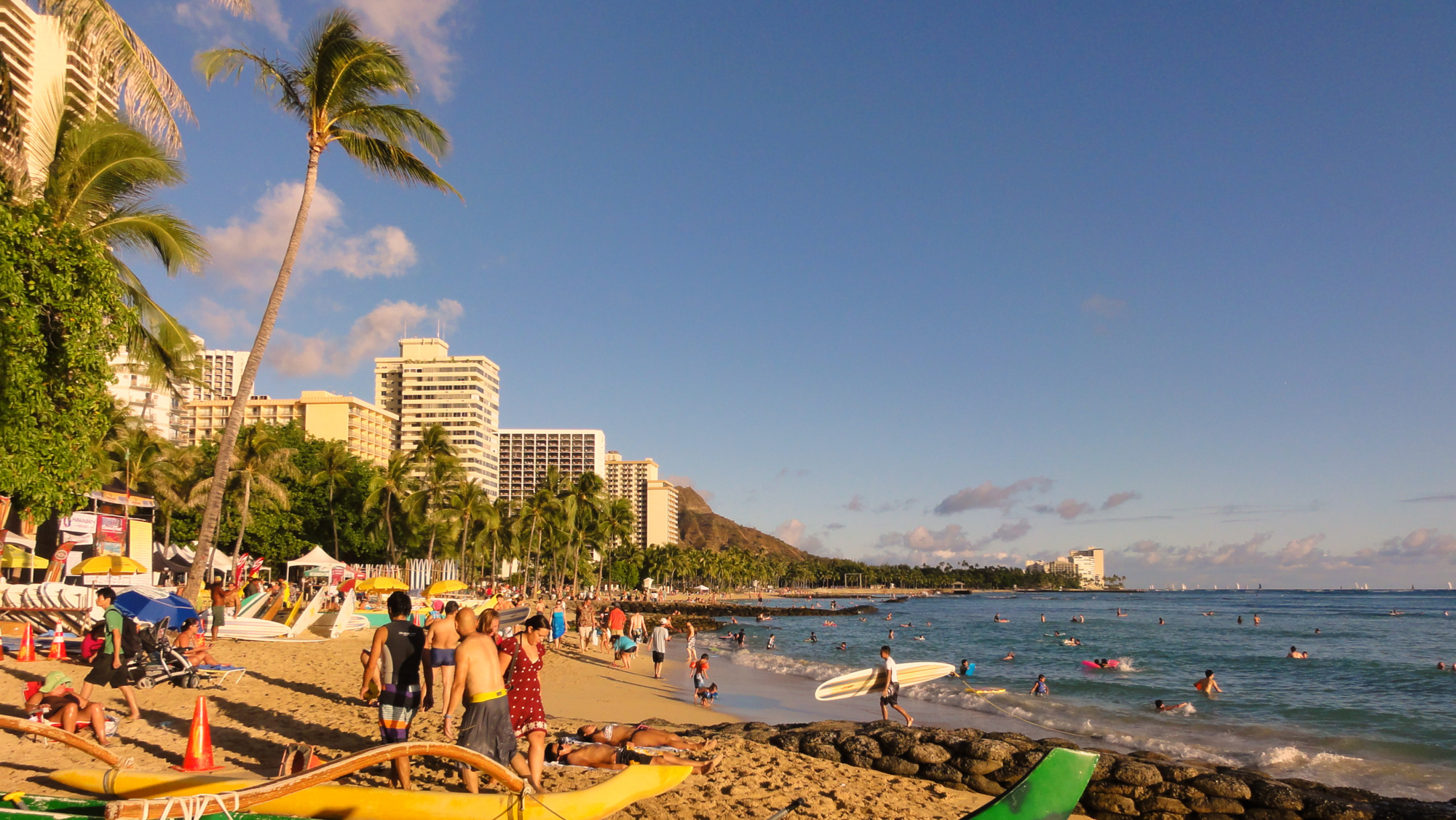
From October 29 through November 4, 2000, the first FINA World Open Water Swimming Championships were held in the waters off Waikīkī Beach.
A partial restoration was completed in the spring of 2012. The project imported sand from nearby shoals and widened the 1700 ft beach by about 37 ft between the Royal Hawaiian Hotel concrete groin and the Kūhiō Beach crib wall. The project temporarily restored the beach to its 1985 shoreline. Two aging sandbag groin structures were also removed that year.
In 2017, beach erosion worsened with high-energy king tides and elevated sea levels. Honolulu's mayor stated: "I'm not a scientist, but I'll get a jackhammer in there and remove all the concrete that's there creating this backwash and sucking out more sand, plus it's just downright dangerous."[[File:Waikiki view from Diamond Head.JPG|thumb|right|Waikīkī beach as seen from Diamond Head]]
The beach hosts many events, including surf competitions, outdoor performances, hula dancing, and outrigger canoe races. The many amenities, shops, and hotels enable Waikīkī to generate approximately 42 percent of Hawaiʻi's visitor revenue.
Geography
The neighborhood extends from the Ala Wai Canal (a channel dug to drain wetlands) on the west and north, to Diamond Head (Lēahi, tuna brow) on the east. Waikīkī Beach is noted for its views of the Diamond Head tuff cone, its usually warm and cloud-free climate, and its surf break. The Waikīkī skyline is filled with high-rises and resort hotels.
Beaches
Waikīkī Beach
Before 1950, the beach in the Waikīkī neighborhood was continuous and known as Waikīkī Beach. Seawalls and other developments have since separated the coast into eight distinct beaches. Since 1951, nearly 80,000 m3 of sand have been added to restore the beach in the region, but it is believed that little of the added sand remains. As of 2020 the family of beaches in the region are still referred to as "Waikīkī Beach", but most venues and addresses will use the name of a specific subsidiary beach.
From Waikīkī Beach the sunset in the sea is visible from mid-September to late March. Half of the beach is marked off for surfers. For some distance into the ocean the water is quite shallow, with numerous rocks on the bottom. The waves can have some force, particularly on windy days. The surf is known for its long rolling break, making it ideal for long boarding, tandem surfing, and beginners.
Subsidiary beaches
Thoroughfares
Waikīkī's main thoroughfare is Kalākaua Avenue, named after King Kalākaua, which houses most of the high-end hotels (Royal Hawaiian, Sheraton, Hyatt, Marriott, Moana Surfrider Hotel), most of the luxury designer brand stores (Apple Store, Chanel, Louis Vuitton, Prada, Burberry, Dior, Tiffany & Co., Fendi, Harry Winston, Saint Laurent, Gucci, and Hermès), department store (Macy's), and popular surf clothing brand stores (Quiksilver, Billabong, Volcom). Waikīkī's other main thoroughfare, Kūhiō Avenue, named after Prince Kūhiō, is better known for its restaurants, cafes and grocers, along with its clubs, nightlife and prostitution.
Public art
In 1990, the 9 ft bronze statue of Duke Kahanamoku by Gordon Fisher was installed at Waikīkī Beach, accompanied by a bronze replica of his surfboard, honorary spears, and commemorative bronze plaques. It serves as a culture and tourist locale with thousands of annual visitors and numerous cultural events. Seven years later, Billy Fields created The Stones of Life (in Hawaiian: Nā Pōhaku Ola O Kapaemahu A Me Kapuni), a sculpture incorporating ancient basaltic stones, was installed nearby and is considered a local monument. A bronze sculpture in Kapiolani Park of Mahatma Gandhi by Stephen Lowe entitled "A Fistful of Salt" was a gift in 1990 from the Gandhi Memorial International Foundation and the Jhamandas Watumull Fund.
At Kūhiō Beach and Queens Beach, three public artworks were installed in the early 2000s. The bronze statue of Prince Jonah Kuhio by Sean Browne and the children's story sculpture Makua and Kila by Holly Young were installed in 2001. Robert Pashby's Surfer on a Wave was installed at Queens Beach in 2003.

Beach issues
Erosion


Waikīkī beach has had repeated problems with erosion, leading to the construction of groins and beach replenishment projects. Imported sand came from California, local beaches such as Pāpōhaku Beach on Moloka‘i, and a sandbar from Oʻahu's Northern side near Kahuku. Officials look for ways to sustain the existing sand by eliminating loss due to tidal flow.
Erosion claims about 1 ft of beach per year. Local sources are sought for sand to replenish the beach.
Water quality
Waikīkī Beach had repeated contamination problems due to sewage spills in 2017.
Homelessness
Many homeless people settle around the beach because of the public shower and sanitary facilities available there. The Honolulu Police Department has increased patrolling in and around Waikīkī Beach with assistance from other city agencies and local businesses to prevent homeless people from making camp in this area.
Education
Hawaii state Department of Education operates conventional public schools throughout Hawaii. Thomas Jefferson Elementary School is located in Waikīkī proper, while Waikīkī Elementary School is located nearby, at the makai (seaward) edge of the Kapahulu neighborhood.
The Hawaii State Public Library System operates the Waikīkī Public Library.
Twin towns – sister cities
Waikīkī is twinned with:
- AUS Freshwater, New South Wales, Australia
- Oklahoma USA Bixby, Oklahoma, United States
- NZL Rotorua, New Zealand
Gallery
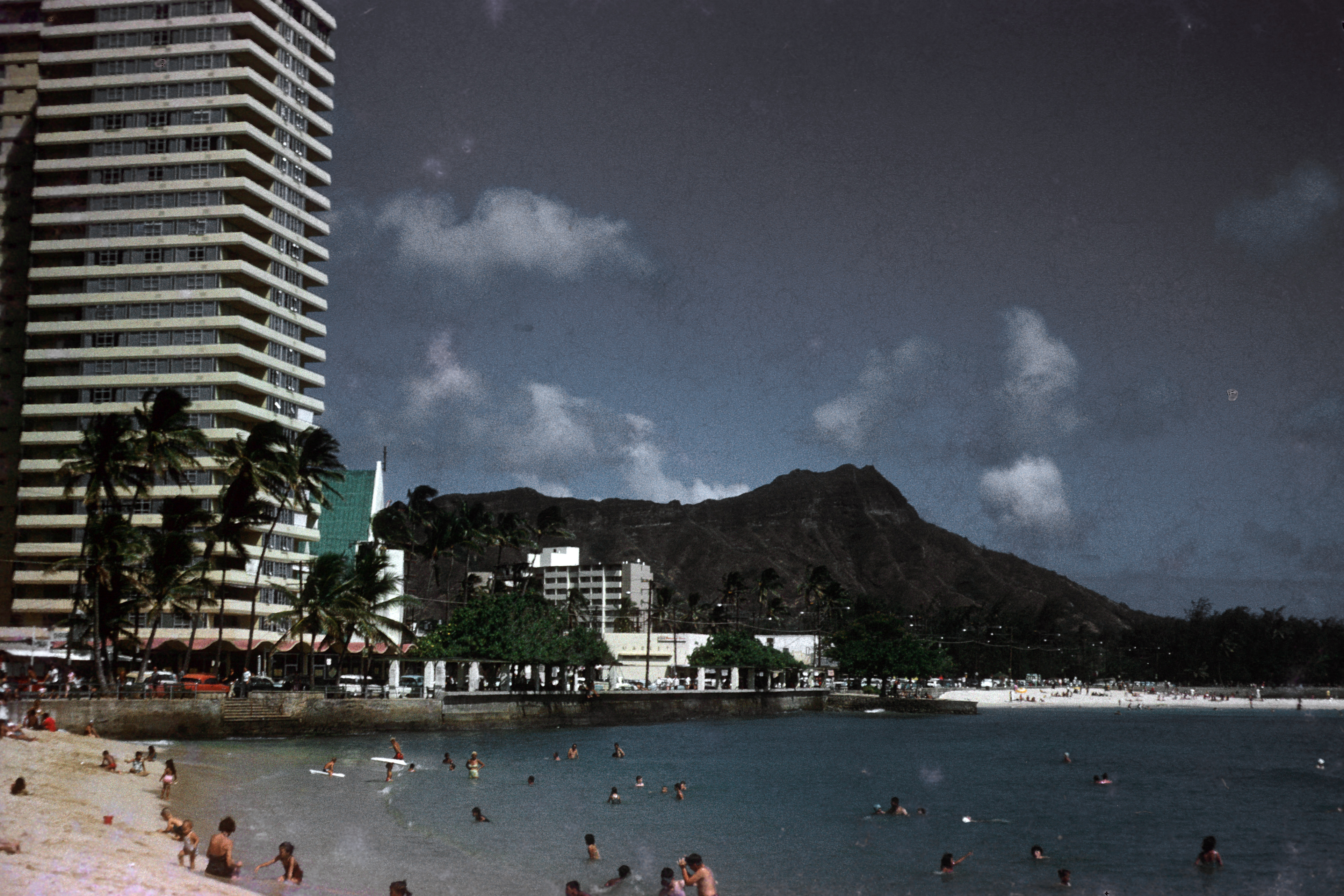
File:Surfboards in Waikiki.JPG|Surfboards in Waikīkī File:Waikiki Diamond Head CC.jpg|Waikiki Beach facing Diamond Head, 1958 File:Waikiki Beach View.JPG|Waikīkī Beach view File:Aerial view of Waikiki Beach and Honolulu, Hawaii, Highsmith.jpg|Aerial view of Waikīkī Beach and Honolulu File:Rainbow Tower Waikiki (16178632002).jpg|Aerial view of Duke Kahanamoku Lagoon File:Prince Kuhio statue in Waikiki.jpg|Statue of Prince Kūhiō in Waikīkī File:Zebra Shark at Waikiki Aquarium.jpg|A zebra shark swimming at Waikiki Aquarium File:Waikiki Beach (51872593291).jpg|A view of the sunset File:Waikiki As Seen From Departing Aircraft.jpg|View from aircraft departing Daniel K. Inouye International Airport
Notes
References
References
- {{cite EPD. 18
- {{cite LPD. 3
- "Waikiki Hawaii Travel Guide & Information {{!}} Go Hawaii".
- "Hawaiʻi Board on Geographic Names".
- {{Hawaiian Dictionaries. waikiki. HASH835ff9bba55d4820b22304
- "Longboards used by royalty". Hawaii-post.com.
- Chapin, Helen G.. (1981). "The Queen's "Greek Artillery Fire": Greek Royalists in the Hawaiian Revolution and Counterrevolution". Hawaiian Journal of History.
- (August 15, 2012). "Sans Souci Beach Park". [[Honolulu County, Hawaii.
- Wright, Katie. (2005). "Duke Kahanamoku: Cultural Icon". Center for Pacific Island Studies, University of Hawaii at Manoa.
- "Don Ho". TIM.
- Beckerson, Bonnie. (2001). "City of Manhattan Beach History".
- Cave, James. (2015-03-09). "Waikiki Beach Is Totally Man-Made (And Disappearing). Can Hawaii Save It?". Huffington Post.
- Bailey, Chris. (February 20, 2009). "Where's the beach? Seeking the origins of Waikīkī sand.".
- [http://www.fina.org/project/docs/histoFina/HistoFINA_X.pdf HistoFINA, volume 10] {{webarchive. link. (2015-09-08 ; published by FINA; published=2009-07-01, retrieved=2012-03-03 (FINA's self-history, 2009 edition; volume 10 deals with Open Water Swimming).)
- Kubota, Gary T.. (June 30, 2010). "Beach to be rebuilt with recovered sand - Hawaii News". Staradvertiser.com.
- Cocke, Sophie. (9 March 2015). "Waikiki Beach Is Totally Man-Made (And Disappearing). Can Hawaii Save It?". Huffington Post.
- (11 June 2016). "The influence of seasonal patterns on a beach nourishment project in a complex reef environment". Coastal Engineering.
- Inefuku, Terri. (2017-08-22). "Severe erosion sparks safety concerns, unusual prevention measures along Waikīkī beach". [[KHON-TV]].
- FOX, CATHERINE TOTH. (2018-02-12). "Our Waikiki: King Tides, Beach Erosion and Water Pollution—Can Waikiki Be Saved?".
- "Waikiki Historic Trail - Map". Hawaii Tourism Authority.
- Young, Peter T. (May 11, 2012). "Ho'okuleana: Waikīkī – Before the Ala Wai".
- Ejiri, Masakazu. (1996). "The Development of Waikiki, 1900–1949: The Formative Period of an American Resort Paradise". [[University of Hawaiʻi at Mānoa]].
- "Queens - Surfing in Oahu, United States of America - WannaSurf, surf spots atlas, surfing photos, maps, GPS location". wannasurf.com.
- "Canoes - Surfing in Oahu, United States of America - WannaSurf, surf spots atlas, surfing photos, maps, GPS location". wannasurf.com.
- Gonser, James. (January 26, 2004). "City to beautify Kuhio Avenue". The Honolulu Advertiser.
- Schaefers, Allison. (August 31, 2003). "Prostitution shifts from Waikiki". The Honolulu Advertiser.
- "The statue of Duke Kahanamoku". Surfer Today.
- "The Stones of Life - Na Pohaku Ola Kapaemahu A Kapuni". Mayors Office of Culture and Art.
- Wu, Nina. (2024-07-20). "Mahatma Gandhi sculpture restored in Waikiki". Honolulu Star-Advertiser.
- (3 November 2017). "City crew restores Prince Kuhio statue after vandalism". The Star Advertiser.
- "The most famous surfer statues in the world". Surfer Today.
- Dowd, Eddie. (2024-04-02). "Disappearing Waikiki beach prompts sand replenishment project — and calls for better fix".
- (July 5, 2003). "Where's Waikiki's sand?". [[Turner Broadcasting System]].
- Huff, Daryl. (October 23, 2023). "Land board blocks effort to move sand from ancient West Oahu beach to Waikiki".
- Hanna, Jason. (August 25, 2015). "Hawaii's Waikiki beaches shut after sewage spill". CNN.
- Jerome, Sara. "Investigation Of Waikiki Beach Sewage Spill Closes".
- (2008-01-30). "Massive Discharge of Untreated Sewage into the Ala Wai Canal (Oahu, Hawaii): A Threat to Waikiki's Waters?". Redorbit.
- Schaefers, Allison. (2019-03-29). "Homelessness is No. 1 public safety issue in Waikiki, Honolulu police chief says".
- "[http://www.k12.hi.us/~waikiki/schoolinfo.htm School Information] {{Webarchive. link. (October 5, 2006 ." ''Waikiki Elementary School''. Retrieved on May 22, 2009.)
- (May 22, 2009). "Waikiki Public Library". [[Hawaii State Public Library System]].
- (30 September 2006). ["Waikiki : A History of Forgetting and Remembering"]({{google books). University of Hawaii Press.
- (25 March 1971). ["Waikiki Beach erosion control improvements, Kuhio sector : environmental impact statement"]({{google books).
- (2 February 2018). "Our Waikīkī: King Tides, Beach Erosion and Water Pollution—Can Waikīkī Be Saved?".
This article was imported from Wikipedia and is available under the Creative Commons Attribution-ShareAlike 4.0 License. Content has been adapted to SurfDoc format. Original contributors can be found on the article history page.
Ask Mako anything about Waikīkī — get instant answers, deeper analysis, and related topics.
Research with MakoFree with your Surf account
Create a free account to save articles, ask Mako questions, and organize your research.
Sign up freeThis content may have been generated or modified by AI. CloudSurf Software LLC is not responsible for the accuracy, completeness, or reliability of AI-generated content. Always verify important information from primary sources.
Report