From Surf Wiki (app.surf) — the open knowledge base
Vampire: The Eternal Struggle
Multiplayer collectible card game
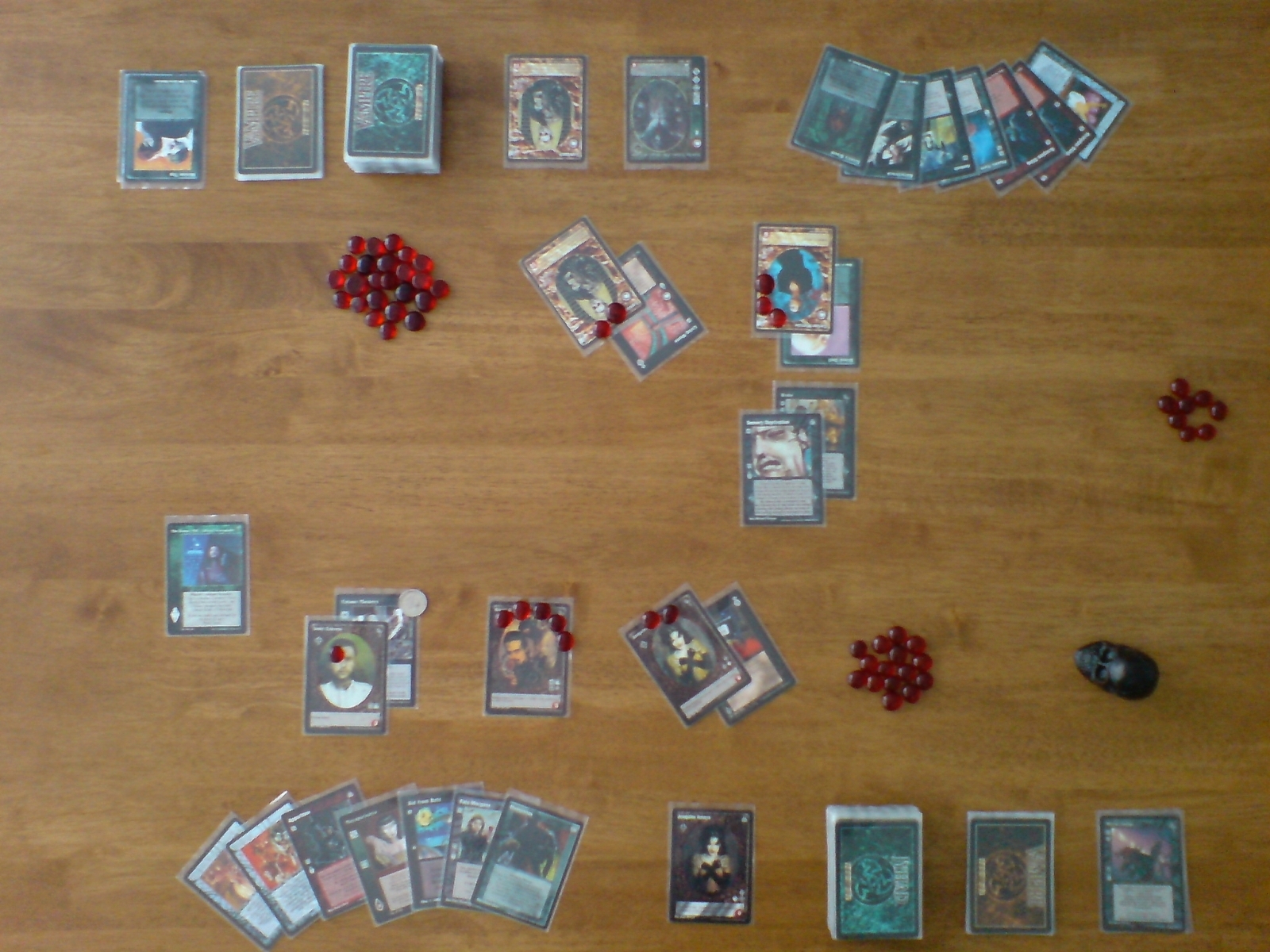
Multiplayer collectible card game
| Field | Value | ||||
|---|---|---|---|---|---|
| subject_name | Vampire: The Eternal Struggle | ||||
| (previously Jyhad) | |||||
| italic title | yes | ||||
| image_link | [[File:Vampire TES Library cardback.png | 90px | Vampire: The Eternal Struggle library card back]] [[File:Vtes Tanlarge.gif | 90px | Vampire: The Eternal Struggle crypt card back]] |
| image_caption | ''Vampire: The Eternal Struggle'''s library and crypt card back designs | ||||
| designer | Richard Garfield | ||||
| publisher | White Wolf Publishing | ||||
| players | 2–5 | ||||
| ages | 13+ | ||||
| setup_time | ~ 5 minutes | ||||
| playing_time | ~ 1–2 hours | ||||
| random_chance | Some | ||||
| skills | Strategy | ||||
| deck-building | |||||
| bluffing |
(previously Jyhad) deck-building bluffing Vampire: The Eternal Struggle (published as Jyhad in the first or "Limited" edition and often abbreviated as V:TES) is a multiplayer collectible card game published by Wizards of the Coast (1994-1996), then White Wolf Publishing (1996-2010) and after several years of hiatus, by Black Chantry Productions (2018-present). It is set in the World of Darkness{{Citation
Publication history
The game was designed in 1994 by Richard Garfield and initially published by Wizards of the Coast and was the third CCG ever created, after Magic: The Gathering and Spellfire.{{Citation
The release first release consisted of 438 cards sold in 76-card starter decks and 19-card booster packs. In 1995 the game was renamed from Jyhad to Vampire: The Eternal Struggle to increase its appeal and distance itself from the Islamic term jihad.
White Wolf published The Eternal Struggle: A Strategy Guide to the Jyhad in 1995, and Wizards published a player's guide Darkness Unveiled in August 1996. After the 1996 Sabbat expansion, Wizards of the Coast abandoned the game, and in 2000 White Wolf took over development.
White Wolf announced that Vampire: The Eternal Struggle would cease production on September 10, 2010.
Several fan-designed sets have appeared over the years, under the player community organization brand of Elder Kindred Network .
On April 24, 2018, Black Chantry Productions, a fan-run organization, announced the company had obtained the license to produce Vampire: The Eternal Struggle and return the game to print. They produced new sets of physical cards, along with expansions that were made available for free as PDFs. In 2020 they released the 5th Edition of the game, and used crowdfunding platform for some products.
Setting
The game is set in the World of Darkness, drawing mainly from the Vampire: The Masquerade role-playing game. After the events of Gehenna ended the official World of Darkness storyline, V:TES is considered a sort of alternative reality of the setting, as it continues though White Wolf publishes no further official products for the roleplaying game.
In V:TES, each player takes on the role of a Methuselah, an ancient and manipulative vampire, who is not itself present in the struggle, but acts from afar. Each Methuselah will try to eliminate all others by nullifying their influence and power. To that end, the Methuselahs will control and manipulate a number of minions (mostly younger vampires) to attack and destroy the other Methuselahs' resources.
Gameplay
Overview
The game can be played by any number of two or more players but is ideally played by a group of four or five players. Group play with more than six players is rare, as an individual's turn can easily take two to three minutes, causing a slow game. Two-player games (and to some extent three-player games) also suffer from lack of opportunity for the kind of inter-player alliances and treachery that are a large part of the game.
As in most other collectible card games, each player designs his or her own deck before play begins. Each deck is built with two components:
- "Crypt" - amber-backed cards representing vampires (and in some cases mortal allies) that the player may control during the game.
- "Library" - green-backed cards generally representing assets or actions to be taken during the game.. Most cards in the library can only be used in conjunction with vampires once they have been brought out from the crypt.
Each player starts the game with 30 "pool", which represents the player's influence. If a player's pool is reduced to 0, the player is "ousted" and eliminated from the game. The object for each player is to oust their "prey" (the player seated on their left) while defending themselves from their "predator" (the player seated on their right). Each time a player is ousted, their predator gains a victory point and 6 pool, with a bonus victory point for being the last surviving player in the game; when all but one of the players have been eliminated, the player with the most victory points wins.
On a player's turn, they direct their minions to perform a number of actions and attacks, which other players' minions may intercept or interrupt. A player must spend their own pool in order to bring vampires out from their crypt or sometimes to play cards from their hand (as indicated on the card). Therefore, players continually have to make decisions based on how much they want to invest into assets in play and how much to retain to stay alive, especially against other players capable of sudden dangerous "bleeds" (direct attacks on the player's pool).
Gameplay offers many options for alliance or betrayal. Due to the fact that being ousted nets the predator 6 pool, and thus makes him stronger and more dangerous to the next prey, it is not uncommon for players to suddenly start helping a player in a weak situation, or gang up on a player who seems to be getting too strong. This makes forming and shifting alliances part and parcel of the game. Short-term deals and trade-offs (with very fluid terms) are typical, and bluffing is also often used.
Game time varies greatly depending on the number of players and the style of decks played. Games can take anywhere from half an hour to three or more hours (for a 5-player game). In tournament play and in some informal games, a time limit may be imposed, after which all remaining players receive half a victory point in addition to any they may have already received. The standard time limit for a tournament game is 2 hours.
Playing styles
There are many ways to win in V:TES, though they all depend on eventually wearing down your prey's pool. Some of the most common styles, as described in the official player's guide are:
- Bleed / Stealth Bleed - this deck concentrates on causing as much pool loss as possible, either over the course of multiple turns, or suddenly during a moment of weakness. It usually has some way of ensuring that bleeds are more likely to slip past the defenses, the classical way of which would be playing "stealth" cards.
- Combat / Rush - this type of deck is based on attacking opponents' vampires, rendering them incapable of acting or destroying them outright. After the defense has been whittled away, it then starts bleeding normally. It also defends itself by attacking individual vampires (mainly of its own predator) that pose a threat.
- Political - this deck is geared to take advantage of the political system built into the game. It concentrates on having as many votes (usually via powerful vampires) on the table as possible. It is then able to call and pass its own political actions, which typically include those directly damaging its own prey.
- Build - this deck attempts to survive during the early game while it builds up to later control the table via these accumulated assets, be they vampires, large amounts of reserve pool, votes, or other cards. It is usually combined with another style.
- Intercept / Wall - This deck, often combined with the "Combat" or the "Build" style, tries to intercept the vampires of the prey when they act (and then likely attempts destroying them). Alternatively, it may be a defensive deck slowly building its strength for the late game, using its intercepting abilities to stop itself from being ousted in the meantime.
- Toolbox - this style attempts to be able to do as much as possible of all the styles. It is often a "Build"-style deck at the same time.
All the above deck types have various weaknesses, the most glaring being that a deck should theoretically be able to do everything well enough to take advantage of evolving game situations, and to counter other styles it may come up against. However, if it uses this "Toolbox" approach too strongly, it may spread itself too thin and end up being incapable of following through.
Distinct nature
V:TES is a game of negotiation, skill, and deck-building. What sets V:TES apart from most other collectible card games is the strong group play element. In general a player will concentrate on the player to his immediate left, his prey, and a player who succeeds in ousting his prey receives a strong boost by gaining 6 additional pool. This boost of resources might possibly enable him to eventually "sweep the table" (gaining momentum with every kill) and oust every other player. Thus there is a tendency for players to help weaker ones to frustrate the stronger players' dominance. This ensures that most players stay in the game longer, instead of the playing field being reduced quickly to those with the best cards and the greatest skill.
These conditions create a game where players are almost always interacting with the other players for both short- and long-term goals instead of simply waiting for their turns. Deals and alliances, both for a moment or for the whole game, can play a big role. A type of card called "political action" cards are designed with this in mind. When a player plays one, a referendum is called in which each player can cast votes, either by using votes granted from cards in play (typically from vampires with a "title" such as a Prince or Bishop) or by playing cards from hand, and the results of the referendum can affect all the players - though which players benefit and which players get hurt are all up to how the votes are cast.
Sets and expansions
White Wolf releases V:TES cards in base sets, expansion sets, and mini-expansion sets. The main difference between these are the size of the set and the number of reprints.
- Base sets contain booster packs as well as a number of pre-constructed starter decks (ranging from 3 to 6). The starter decks contain 89 cards (with 77 library and 12 crypt cards) as well as a rule booklet. The booster packs contain 11 cards (in newer sets, often with 7 common, 3 vampire, and 1 rare card, but refer to the table below). The base set should provide a new player with a number of cards to be able to build a wide variety of decks. A base set usually contains a high percentage of reprinted cards from earlier expansions.
- Expansion sets contain booster packs and may contain a number of pre-constructed starter decks. The distribution of cards in boosters and starters is similar to a base set but features a particular theme. New players are usually not able to build a large number of different decks with only cards from this expansion's boosters due to the lack of basic cards provided either in a starter deck or base set. The number of reprints is low and usually restricted to the pre-constructed starter decks.
- Mini-Expansion sets contain only booster packs, and the number of cards are restricted to 60 new cards (20 rare, 20 uncommon, and 20 common cards). All expansion sets from the Dark Sovereigns expansion onward are identified by an expansion symbol printed in the upper right corner of cards. In newsgroups and on web pages, character codes are used to identify each set, usually an abbreviation of the expansion's name.
| Expansion Name | Type | Symbol | Code | Release Date | Total cardsThe total cards include the cards from booster and starter, the number in brackets only include those from the booster packs. | New cardsThe new cards include cards from booster and starter packs. | Booster distribution | ||||||||||
|---|---|---|---|---|---|---|---|---|---|---|---|---|---|---|---|---|---|
| Jyhad | Base | (none) | Jyhad | August 16, 1994 | 437 | 437 | 11C, 4V, 3U, 1R | ||||||||||
| Vampire: The Eternal Struggle | Base | (none) | V:TES | September 15, 1995 | 436 | 6 | 11C, 4V, 3U, 1R | ||||||||||
| Dark Sovereigns | Expansion | Gothic window | DS | December 15, 1995 | (173) | 173 | 8C, 4V, 3U | ||||||||||
| title=On deck: Ancient Hearts | last=Hannes | first=Jeff | issue=17 | magazine=Inquest | page=42 | date=September 1996}} | Expansion | Eye of Horus | AH | May 29, 1996 | title = Ancient Hearts | page = 71 | newspaper = The Duelist | date = September 1996 | issue =#12}} | 179 | 6C, 4V, 2U/R |
| title=The Sabbat hits the street | last=Clarke Wilkes | first=Jennifer | magazine=The Duelist | issue=14 | publisher=Wizards of the Coast | pages=69–73 | date=December 1996}} | Expansion | Calligraphy S | Sabbat | October 28, 1996 | (410) | 340 | 16C, 5V, 5U, 2R | |||
| Sabbat War | Base | Inverted spiked ankh | SW | October 31, 2000 | 437 (300) | 77 | 5C, 3V, 2U, 1R or | ||||||||||
| 4C, 3V, 3U, 1RFirst printing had 5C, 3V, 2U, 1R; which was subsequently changed for second and subsequent print runs into 4C, 3V, 3U, 1R. | |||||||||||||||||
| Final Nights | Expansion | Broken ankh | FN | June 11, 2001 | 386 (162) | 170 | 7C, 3V, 1R | ||||||||||
| title=These vamps don't suck | last=Ricardi | first=Bill | issue=80 | magazine=InQuest Gamer | page=26 | publisher=Wizard Entertainment | date=December 2001}} | Expansion | Ankh on red blood spatter | BL | December 3, 2001 | (196) | 196 | 7C, 3V, 1R | |||
| title=Year of the damned | issue=79 | magazine=InQuest Gamer | page=24 | publisher=Wizard Entertainment | date=November 2001}} | Base | Ankh | CE | August 19, 2002 | 547 (385) | 115 | 5C, 3V, 2U, 1R | |||||
| Anarchs | Expansion | Combined CE/SW Ankhs | Anarchs | May 19, 2003 | 260 (132) | 128 | 7C, 3V, 1R | ||||||||||
| Black Hand | Expansion | Handprint | BH | November 17, 2003 | 286 (136) | 145 | 7C, 3V, 1R | ||||||||||
| Gehenna | Expansion | Stylised Clock | Gehenna | May 17, 2004 | (150) | 150 | 7C, 3V, 1R | ||||||||||
| Tenth Anniversary | Special | Foil "10" | Tenth | December 13, 2004 | 190 | 10 | -- | ||||||||||
| Kindred Most Wanted | Expansion | Gun | KMW | February 21, 2005 | 314 (150) | 162 | 7C, 3V, 1R | ||||||||||
| Legacies of Blood | Expansion | Split ankh (black) | LoB | November 14, 2005 | 461 (300) | 236 | 7C, 3V, 1R | ||||||||||
| Nights of Reckoning | Mini expansion | Plus with circle | NoR | April 10, 2006 | (60+17)Each Nights of Reckoning booster had one rules card. There are 5 different rules printed on 17 different rules cards. These cards, although printed with a different layout and mostly abbreviated card text, are legal in both constructed and limited tournaments. | 60 | 6C, 3V, 1R, 1X | ||||||||||
| Third Edition | Base | Tri-snake biohazard | Third | September 4, 2006 | 537 (390) | 160 | 5C, 3V, 2U, 1R | ||||||||||
| Sword of Caine | Mini expansion | Bundle of swords | SoC | March 19, 2007 | (60) | 60 | 7C, 3V, 1R | ||||||||||
| Lords of the Night | Expansion | Crown | LotN | September 26, 2007 | 295 (150) | 175 | 7C, 3V, 1R | ||||||||||
| Blood Shadowed Court | Special | Silver Ankh | BSC | April 16, 2008 | 100 | 0 | -- | ||||||||||
| Twilight Rebellion | Mini expansion | Tri-snake on Red Star | TR | May 28, 2008 | (60) | 60 | 7C, 3V, 1R | ||||||||||
| Keepers of Tradition | Base | Castle tower | KoT | November 19, 2008 | 457 (398) | 176 | 5C, 3V, 2U, 1R | ||||||||||
| Ebony Kingdom | Mini expansion | Split ankh (white) | EK | May 27, 2009 | (62) | 60 | 4C, 3V, 1R, 3C | ||||||||||
| Heirs to the Blood | Expansion | Three blood drops | HttB | February 3, 2010 | TBA (168) | 168 | 7C, 3V, 1R | ||||||||||
| Danse Macabre | Mini expansion (PDF) | Fanged Skull | DM | October 5, 2013 | 34 | 34 | -- | ||||||||||
| The Unaligned | Mini expansion (PDF) | Broken Column | TA | October 4, 2014 | 72 | 72 | -- | ||||||||||
| Storyline Rewards | Mini expansion (PDF) | (none) | SR | February 21, 2015 | 13 | 13 | -- | ||||||||||
| Anarchs Unbound | Mini expansion (PDF) | Burning ankh | AU | January 17, 2016 | 42 | 42 | -- | ||||||||||
| Lost Kindred | Mini expansion | Bleeding eye | LK | June 10, 2018 | 41 | 41 | -- | ||||||||||
| Sabbath Preconstructed | Expansion | Small Ankh | SP | February 16, 2019 | 125 | 8 | Set of four decks. | ||||||||||
| Fifth Edition | Base set | Small Ankh | V5 | November 30, 2020 | 495 | 49 | Box set of five decks, with rulebook, pool counters, and Edge token. | ||||||||||
| Kickstarter | Mini expansion | -- | KSU | Sep 2021 | -- | -- | Four card bundles: Anarchs Unbound, Danse Macabre, The Unaligned 1 and The Unaligned 2. |
Reception
In a review in issue #10 of Pyramid magazine, Scott Haring stated that while Magic: The Gathering created the collectible card game market, Vampire: The Eternal Struggle established it as a "legitimate game category". He also stated that the game had "pretty good" art, but that the numerous icons would take time to learn.
Ken Carpenter reviewed Jyhad in White Wolf Inphobia #50 (Dec., 1994), rating it a 4.5 out of 5 and stated that "One of the most appealing points of Jyhad is its lack of 'irresistible force meets immovable object' situations. The rules and cards are so straightforward that these situations do not arise. Play is simple, though made up of many steps and decisions (I'd hate to see a flow chart of the game)."
Vampire: The Eternal Struggle was a very popular card game in the 1990s, outselling most other collectible card games on the market at the time, although behind Magic: The Gathering in sales. A common criticism reported from players was its slow play speed. An article in the first issue of InQuest stated that the game is "complicated and takes a while to play" but can be "fiendishly rewarding".
Steve Faragher of Arcane magazine gave the game a score of 7/10, calling it the most "intriguingly political" card game he had played, and praising its storytelling atmosphere. He appreciated the higher play speed that came with the Vampire: The Eternal Struggle re-launch's revised rules, although fellow Arcane staff member Jon Moore still found the game slow to play.
Martin Klimes reviewed the Ancient Hearts expansion for Arcane magazine, rating it an 8 out of 10 overall. Klimes comments that "There is now pretty much always a good attack you can choose, and almost always a choice of defenses against it. Ancient Hearts will add significant interest to your games, which is all you can ask of any expansion."
Jennifer Clarke Wilkes reviewed the Sabbat expansion in the December 1996 issue of The Duelist, stating that as an expansion set it is "remarkably helpful" but that it "falls a little short of its goal" as a standalone set. Andy Butcher reviewed The Sabbat for Arcane magazine, rating it an 8 out of 10 overall, and stated that "The Sabbat is a welcome addition to Vampire: The Eternal Struggle. There's something just a little more satisfying about pitting the Sabbat against the Camarilla, and many of the new cards capture the atmosphere of White Wolf's Vampire: The Masquerade roleplaying game (on which Vampire: The Eternal Struggle is based) perfectly. V:TES was already a dark, brooding game with a lot of vicious backstabbing and nasty politics - with The Sabbat it's even darker."
Awards
In 2004, Inquest Gamer Magazine picked Vampire: The Eternal Struggle as the all-time best multiplayer collectible card games.
In 2006, Inquest Gamer Fan Awards called the Third Edition expansion the "Best CCG Expansion".
Reviews
- Rollespilsmagasinet Fønix (Danish) (Issue 5 - November/December 1994)
- Review in Shadis
''V:TES'' Online
From December 2005 to the end of 2007 an online implementation of Vampire: The Eternal Struggle named "Vampire: The Eternal Struggle Online" was available. It was developed and maintained by CCG Workshop. Players could create decks and compete online for a monthly fee. White Wolf Publishing had allowed CCG Workshop to release the Camarilla, Anarchs, Final Nights, Legacies of Blood, Black Hand and Kindred Most Wanted sets for online play.
References
- Andrew Greenberg, Richard Garfield & Daniel Greenberg, Eternal Struggle: A Player's Guide to Jyhad (White Wolf Game Studio, 1994, )
References
- (2006). "Trading Card Games For Dummies". [[John Wiley & Sons]].
- (1995). "Product news".
- Savage, R. Hyrum. (2007). "[[Hobby Games: The 100 Best]]". [[Green Ronin Publishing]].
- ''[http://www.vtesinla.org/articleGarfield.htm Garfield Reminisces on the Jyhad] {{Webarchive. link. (December 16, 2007 '' (interview with [[Richard Garfield]], by Robert Goudie, July 2001. Retrieved January 10, 2008.))
- ''[https://web.archive.org/web/20120305095740/http://www.vtesinla.org/articleAdkisonInterview.asp Ancient Influence - Peter Adkison Comments on the Early Days of Jyhad/V:TES]'' (interview with Wizards of the Coast Founder and former CEO [[Peter Adkison]], by Robert Goudie, February 2004. Retrieved March 26, 2010.){{Dead link. (April 2017)
- (May 1995). "News & Notes".
- Butcher, Andy. (June 1996). "Games Reviews".
- link. (September 19, 2010)
- Anderson, Joshua. (2018-12-05). "Vampire: The Eternal Struggle Lives On After Death".
- (2018-04-24). "Vampire: The Eternal Struggle returns to print".
- Writer, Alex Meehan Former Senior Staff. (2020-06-10). "Rebooted Vampire: The Masquerade card game Eternal Struggle delayed to autumn".
- Ashcroft, Barry. (2020-07-28). "Vampire: The Masquerade Rivals - Card Game Coming To Kickstarter August 4th".
- Haring, Scott. (November-December 1994). "Pyramid Pick: Jyhad".
- ''Vampire: The Eternal Struggle Player's Guide'' - Goudie, Robert; Peal, Ben & Swainbank, Ben; [[White Wolf Publishing]], 2005
- Beaulieu, Stephen. (February 1997). "Intercept: Beyond the Basics". The Duelist.
- Hannes, Jeff. (September 1996). "On deck: Ancient Hearts".
- (September 1996). "Ancient Hearts". The Duelist.
- Clarke Wilkes, Jennifer. (December 1996). "The Sabbat hits the street". [[Wizards of the Coast]].
- Ricardi, Bill. (December 2001). "These vamps don't suck". [[Wizard Entertainment]].
- (November 2001). "Year of the damned". [[Wizard Entertainment]].
- "V:TES Third Edition".
- (August 2018). "V:TES Ebony Kingdom Booster Pack Sorting". [[White Wolf Publishing]].
- (August 2018). "White Wolf's announcement on the publication delay".
- (October 5, 2013). "Danse Macabre".
- (September 27, 2014). "The Unaligned".
- (February 20, 2015). "Storyline Rewards".
- (January 17, 2016). "Anarchs Unbound".
- (May 5, 2018). "Lost Kindred".
- "Fifth Edition".
- Carpenter, Ken. (December 1994). "Feature Review: Jyhad".
- Sumner, Mark C.. (February 1996). "To dice or not to dice: Everyway and Dragon Dice come up with completely different answers.".
- Faragher, Steve. (December 1995). "Games Reviews".
- Klimes, Martin. (August 1996). "Games Reviews".
- Butcher, Andy. (January 1997). "Games Reviews". [[Arcane (magazine).
- "Inquest Gamer picks ''Vampire: The Eternal Struggle'' as all-time best multiplayer CCG".
- link. (September 30, 2007 (from the [[White Wolf Publishing]] website))
- "Jyhad {{!".
This article was imported from Wikipedia and is available under the Creative Commons Attribution-ShareAlike 4.0 License. Content has been adapted to SurfDoc format. Original contributors can be found on the article history page.
Ask Mako anything about Vampire: The Eternal Struggle — get instant answers, deeper analysis, and related topics.
Research with MakoFree with your Surf account
Create a free account to save articles, ask Mako questions, and organize your research.
Sign up freeThis content may have been generated or modified by AI. CloudSurf Software LLC is not responsible for the accuracy, completeness, or reliability of AI-generated content. Always verify important information from primary sources.
Report