From Surf Wiki (app.surf) — the open knowledge base
Sturmscharführer
Rank in Nazi German military
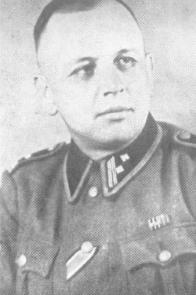
Rank in Nazi German military
| Field | Value | |
|---|---|---|
| name | Sturmscharführer | |
| image | [[File:SS-Sturmscharführer.svg | 150px]] |
| caption | Gorget patch | |
| image2 | [File:SS-Sturmscharführer h.svg | |
| caption2 | Shoulder and camo insignia | |
| country | Nazi Germany | |
| service branch | Flag of the Schutzstaffel.svg [Schutzstaffel | |
| abbreviation | Stuscha | |
| formation | 1934 | |
| abolished | 1945 | |
| higher rank | Untersturmführer | |
| lower rank | Hauptscharführer | |
| equivalents | Stabsfeldwebel |
NOTOC | Non-NATO rank =
SS-Sturmscharführer (; ) was a Nazi rank of the Waffen-SS that existed between 1934 and 1945. The rank was the most senior enlisted rank in the Waffen-SS, the equivalent of a regimental sergeant major, in other military organizations.
Rank usage
Sturmscharführer as a proper rank was unique to the Waffen-SS and was not used in the Allgemeine-SS (general-SS), where the highest enlisted rank was Hauptscharführer. Members of the Sicherheitspolizei (SiPo), when wearing the rank insignia of Sturmscharführer with police collar piping, did so when holding the equivalent police rank of Meister or the investigator's title of Kriminalsekretär. Administratively, such secret police members were not even required to be members of the SS (although many were) and thus the insignia was sometimes worn by non-SS members. Due to SS rank parity regulations, by 1943 most police members were required to hold SS rank, and those with police equivalent rank to Sturmscharführer were often administratively enlisted into the Waffen-SS in order to be ranked as a Sturmscharführer.
History
The rank of Sturmscharführer was first created in June 1934, after the Night of the Long Knives. Due to a reorganization of the SS, Sturmscharführer was created as the most senior enlisted rank of the SS-Verfügungstruppe (SS-VT), replacing the older Sturmabteilung (SA) title of Haupttruppführer.
By 1941, the Waffen-SS had become the successor organization to the SS-VT and Sturmscharführer was established as the most senior enlisted rank. A Sturmscharführer was typically assigned as the head sergeant of an entire regiment or, in some cases, an infantry division.
Insignia
Sturmscharführer was not the same as Stabsscharführer, which was a positional title given to the head SS non-commissioned officer of a company. The rank of Sturmscharführer was also not a prerequisite for promotion to Untersturmführer and was generally considered as a rank for "career" enlisted SS soldiers, rather than a rank on the path to becoming an officer.
The insignia for Sturmscharführer was two silver pips and two silver stripes worn on a collar patch along with the shoulder boards of a Wehrmacht Stabsfeldwebel. As was the case with Waffen-SS enlisted insignia, the collar patch of a Sturmscharführer was edged with black-and-silver twist cord until 1940 when the edging was dropped; like all non-commissioned officers the collar was bordered with 9mm silver-grey braid.
Insignia Waffen-SS
File:SS-Sturmscharführer h.svg |Shoulder strap (insignia) File:SS-Sturmscharführer.svg |Gorget patches File:StFw Stuscha OR8 cam slv 1945.svg |SS smock insignia
| Junior rank | |
|---|---|
| SS-Hauptscharführer | SS rank |
| SS-Sturmscharführer | Senior rank |
| SS-Untersturmführer |
Notes
Bibliography
This article was imported from Wikipedia and is available under the Creative Commons Attribution-ShareAlike 4.0 License. Content has been adapted to SurfDoc format. Original contributors can be found on the article history page.
Ask Mako anything about Sturmscharführer — get instant answers, deeper analysis, and related topics.
Research with MakoFree with your Surf account
Create a free account to save articles, ask Mako questions, and organize your research.
Sign up freeThis content may have been generated or modified by AI. CloudSurf Software LLC is not responsible for the accuracy, completeness, or reliability of AI-generated content. Always verify important information from primary sources.
Report