From Surf Wiki (app.surf) — the open knowledge base
SpVgg Greuther Fürth
German association football club
German association football club
| Field | Value |
|---|---|
| clubname | SpVgg Greuther Fürth |
| fullname | Spielvereinigung Greuther Fürth e. V. |
| image | SpVgg Greuther Fürth logo (2017).svg |
| upright | 0.8 |
| current | 2025–26 SpVgg Greuther Fürth season |
| nickname | Kleeblätter (Shamrocks) |
| founded | as SpVgg Fürth |
| ground | Sportpark Ronhof |
| capacity | 16,626 |
| chairman | Fred Höfler |
| chrtitle | President |
| mgrtitle | Head coach |
| manager | Heiko Vogel |
| league | |
| season | |
| position | |
| website | |
| pattern_la1 | _furth2526h |
| pattern_b1 | _furth2526h |
| pattern_ra1 | _furth2526h |
| pattern_sh1 | _furth2526h |
| leftarm1 | FFFFFF |
| body1 | FFFFFF |
| rightarm1 | FFFFFF |
| shorts1 | FFFFFF |
| socks1 | FFFFFF |
| pattern_la2 | _furth2526a |
| pattern_b2 | _furth2526a |
| pattern_ra2 | _furth2526a |
| pattern_sh2 | _furth2526a |
| leftarm2 | 009a44 |
| body2 | 009a44 |
| rightarm2 | 009a44 |
| shorts2 | 009a44 |
| socks2 | 009a44 |
Spielvereinigung Greuther Fürth (), commonly known as Greuther Fürth () or by their historical name, SpVgg Fürth, is a German football club based in Fürth, Bavaria. They play in the 2. Bundesliga, the second tier of the German football league system, following relegation from the Bundesliga in the 2021–22 season.
Founded in 1903, the most successful era for Greuther Fürth came in the pre-Bundesliga era in the 1910s and 1920s, when the club won three German championships, in 1914, 1926, and 1929 respectively, and finished as runners-up in 1920. In the 2012–13 season, the club played in the Bundesliga for the first time, having won promotion from the 2. Bundesliga; they were relegated back to the 2. Bundesliga at the end of the season. On 23 May 2021, they were promoted back to the Bundesliga for the second time. Upon placing 18th in the Bundesliga table in the 2021–22 season, they were relegated back to 2. Bundesliga.
History
Spielvereinigung Fürth
The origins of SpVgg Fürth are in the establishment on 23 September 1903 of a football department within the gymnastics club Turnverein 1860 Fürth. The footballers went their own way as an independent club in November 1906, after they did not get enough support from TV Fürth. The team played in the Ostkreisliga and took divisional titles there in 1912, 1913 and 1914 before moving on to participate in the Süddeutsche (South German) regional playoffs for the national championship round. Right from the beginning, there was a great rivalry between the SpVgg Fürth and the 1. FC Nürnberg, predicated on the historical rivalry between the two neighbouring cities. The club grew rapidly, and by 1914, it had 3,000 members and was the largest sports club in Germany. When the club built their own stadium, Sportpark Ronhof, in 1910, it was the biggest stadium in Germany at the time.
National champions
Fürth won their first national title, the 1914 German football championship, under English coach William Townley with left winger Julius Hirsch, who had joined the team the prior season. They faced VfB Leipzig – the defending champions with three titles to their credit – in the final held on 31 May in Magdeburg. A 154-minute-long thriller, the longest completed game in German football history (the 1922 Final was abandoned after 189 minutes due to darkness), ended with Fürth scoring a golden goal to secure the title.
The team had a solid run of successes through the 1920s and into the early 1930s, beginning with an appearance in the national final in 1920 against 1. FC Nürnberg, which was the dominant side of the decade. The rivalry between the two clubs was such that a star player with SpVgg was forced to leave after he married a woman from the city of Nuremberg. In 1924, for the first and only time, the Germany national side was made up exclusively of players from just two sides – Fürth and 1. FC Nürnberg – and players of the two teams slept in separate rail coaches.
SpVgg showed regularly on the national stage, advancing to the semi-finals in 1923 and 1931. They claimed two more championships – in 1926 and 1929 – with both of those victories coming at the expense of Hertha BSC. Through this period, the club played five finals in the Süddeutscher Pokal (en:South German Cup), coming away as cup winners on four occasions. On 27 August 1929, the association was joined by FC Schneidig Fürth.
German football was re-organized in 1933 under the Third Reich into 16 top flight Gauligen. Fürth became part of the Gauliga Bayern, but their success over the next dozen seasons was limited to a division title there in 1935, alongside regular appearances in competition for the Tschammerpokal, predecessor to today's DFB-Pokal (German Cup).
Postwar play
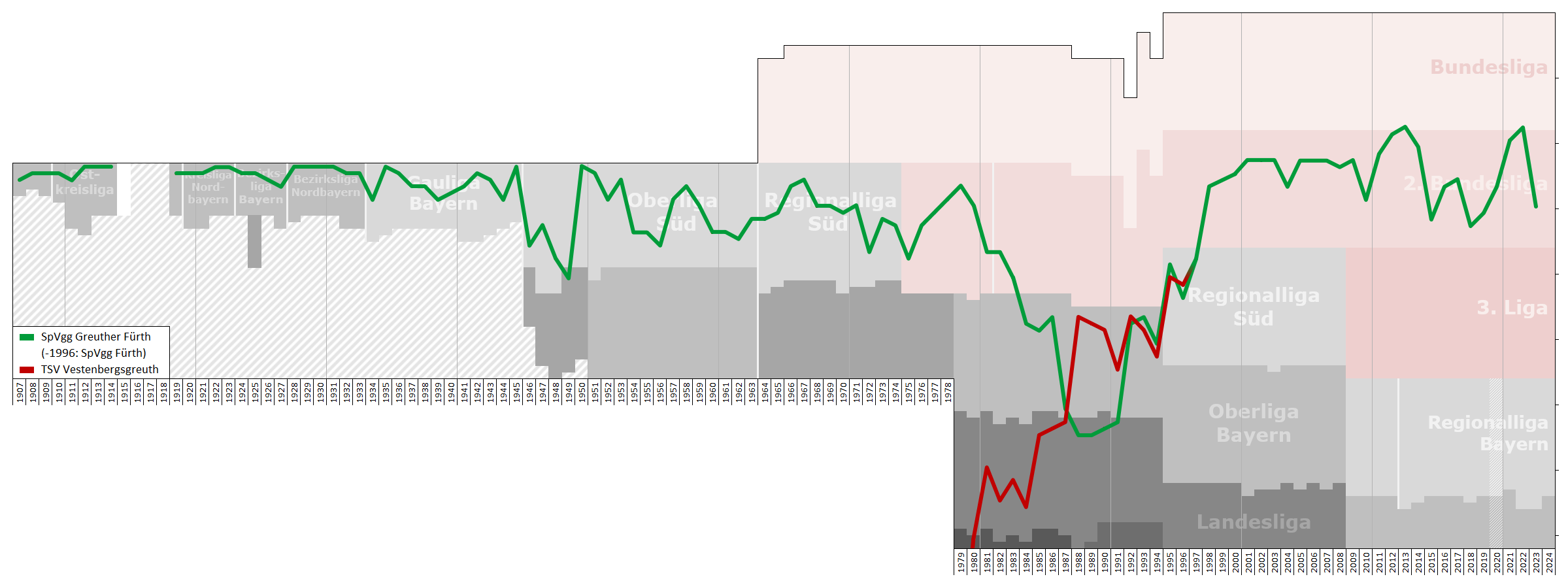
After the war, the team struggled through three seasons in the Oberliga Süd (I) before slipping to the Landesliga Bayern (II). SpVgg quickly recovered itself and returned to Oberliga play the next season. They won the title there in 1950 and went on to the national playoffs, advancing as far as the semi-finals before being eliminated 1–4 by VfB Stuttgart. In 1954, two players from the SpVgg, Karl Mai and Herbert Erhardt, were members of the "Miracle of Bern" team that won Germany's first World Cup.
Fürth remained a first division side until the formation of the Bundesliga in 1963. The club did not qualify as one of the sixteen teams that made up the new unified national first division and they found themselves playing second division football in the Regionalliga Süd, where they were generally a mid-table side whose best finish was third-place result in 1967. The club played in the 2. Bundesliga from its inception in 1974 until 1983 with their best performance a fourth-place result in 1978–79. They slipped to playing in the tier III Bayernliga, with a short three-year spell in the fourth division Landesliga Bayern-Mitte in the late 1980s. At this time, the club started to have large financial problems. In 1990, Fürth celebrated a 3–1 victory in the opening round of the DFB-Pokal play over first division side Borussia Dortmund before going out 0–1 to 1. FC Saarbrücken in the second round. They returned to the Bayernliga (III) in 1991 and the Regionalliga Süd (III) in 1994. But still, the club's financial issues became bigger, and they were forced to sell their ground to the local businessman Conny Brandstätter. As the financial problems continued to grow, the president of SpVgg, Edgar Burkhart, arranged a deal with Helmut Hack, president of TSV Vestenbergsgreuth, to let TSV join the SpVgg and changing the name of the Spielvereinigung to the name SpVgg Greuther Fürth, which is still in use. The SpVgg so had the chance to get back in both financial and on-pitch success, while TSV could grow bigger in the city of Fürth than it would have been possible in the village of Vestenbergsgreuth.
TSV Vestenbergsgreuth
Main article: TSV Vestenbergsgreuth
Meanwhile, the small village team of TSV Vestenbergsgreuth was established 1 February 1974 and debuted as a fourth division side. They advanced into the Amateur Oberliga Bayern (III) in 1987, just as SpVgg Fürth was descending to play in the division the more junior club had just escaped. TSV took part in the national amateur playoff round in 1988 and 1995. Their best performance came in the 1995 DFB-Pokal when they upset Bayern Munich 1–0, and then beat FC 08 Homburg 5–1, before being eliminated in the third round of the competition by VfL Wolfsburg on penalty kicks.
SpVgg Greuther Fürth
At the time when Vestenbergsgreuth's football branch was incorporated in 1996, in which TSV's football players came over to Fürth, both clubs were playing at about the same level in Regionalliga Süd (III). The SpVgg was runner-up behind long-term rival 1. FC Nürnberg in the division the next year, and so earned promotion back to the 2. Bundesliga after 18 years, and played in the second tier at the first time since 1979. At this time, the Sportpark Ronhof, now called Playmobil Arena, faced the first major redevelopment since the post-war years and the construction of the old main stand in 1950. They built new stands on three of the four sides of the pitch, a roofed seating stand on the opposite side of the main stand, an uncovered terrace in the north end, and an uncovered mixed standing and seating area in the south of the stadium, as well as installing floodlights in the Ronhof the first time ever. With the modernized stadium and a clever transfer strategy, they have consistently finished in the top half of the 18-team table in the 2000s, despite having one of the lowest budgets most of the time. On 1 July 2003, the club added former workers' club Tuspo Fürth to its tradition through a merger. In 2008, the stadium faced another redevelopment, as the standing terrace in the north got a roof, and a VIP building was installed near to the old main stand. With this work, the main stand became the last piece of the stadium that has not been redeveloped. In that time, Fürth has come close to renewing its ancient rivalry with Nürnberg at the Bundesliga level, narrowly missing promotion in each of the first two seasons of the 2010s. On 23 April 2012, Fürth finally gained promotion to the Bundesliga in the 2011–12 season, eventually winning the 2. Bundesliga under manager Mike Büskens. With promotion, the 1998-built south stand was demolished, and a new one was installed, gaining a capacity increase from 14,500 to 18,000, as well as providing a roof on the south for the first time.
However, Fürth had a difficult first season in the Bundesliga as the club amassed only four victories in the 34-game campaign, one of them at the ground of their rivals 1. FC Nürnberg, when the de facto relegated side won 1–0, giving the fans of the Kleeblatt a peaceful feeling about the relegation. The club also set an infamous record by becoming the first club in Bundesliga history to not win a single home game during the regular season. The club finished last in the league with 21 points and was relegated back to the 2. Bundesliga.
The following season, despite not aiming for promotion, the club was a strong contender for a direct return to the Bundesliga. A third place in the final standings qualified the team for the promotion play-offs, where it faced Hamburger SV. After a 0–0 draw in Hamburg, the club missed out on promotion on the away goal rule when the return leg ended 1–1. In the following seasons, they struggled to be as strong as they were before the Bundesliga promotion. They nearly got relegated to the 3. Liga in the 2014–15 season, when only a narrow win against later promoted club SV Darmstadt 98 on matchday 33, and other teams not winning on matchday 34, kept them in the league. In the same season, on early matchday 2, they gained a historic 5–1 home victory in the Frankenderby, their highest-ever home win in a derby. In the following two years, the Spielvereinigung finished mid-table, with not having either fear of getting relegated or gaining promotion. This period of their newer history is characterized by the relegation of FCN in 2014, and both rivals playing each year since then. In the 2016–17 season, the Kleeblatt won both derbies of the regular season for the first time since the 1970s, and finished above Nuremberg for the first time since the 1950s. In early 2016, the 1950-built main stand was demolished, and the construction of a new main stand started. Before the 2017–18 season, the construction of the new main stand was finished. With a 3–1 victory over Fortuna Düsseldorf on 17 September 2017, the club became leader of the all-time league table of the 2. Bundesliga.
By finishing second in the 2020–21 season, Greuther Fürth gained promotion to the Bundesliga for the second time in the club's history. Under manager Stefan Leitl, the team secured promotion on the last matchday of the season with a 3–2 victory over Fortuna Düsseldorf.
SpVgg Greuther Fürth II
Main article: SpVgg Greuther Fürth II
Fürth also fields a reserve side which has played in the Oberliga Bayern (IV) since the 2001–02 season and finished second there in 2006–07. which lead to promotion to Regionalliga Süd.
Rivals
Main article: Bavarian football derbies
- FC Nürnberg is by far Furth’s biggest rival, going back to the early days of German football when, at times, those two clubs dominated the national championship. Matches between both teams also called as "Frankenderby". Minor rivals include Bayern Munich. Both competed against each other again in the 2012–13 Bundesliga season and the 2014–15 2. Bundesliga season.
Honours
League
- German championship
- 2. Bundesliga
- Champions: 2011–12
- Landesliga Bayern-Mitte (IV)
- Champions: 1990–91
Cup
- German Indoor Cup
- Winner: 2000
Regional
- Southern German championship
- Champions: 1914, 1923, 1931
- Ostkreis-Liga (I)
- Champions: 1912, 1913, 1914, 1917
- Kreisliga Nordbayern (I)
- Champions: 1922, 1923
- Bezirksliga Nordbayern (I)
- Champions: 1927–28, 1929–30, 1930–31
- Gauliga Bayern (I)
- Champions: 1934–35
- Oberliga Süd (I)
- Champions: 1949–50
- Southern German Cup
- Winner: 1918, 1923, 1925, 1926, 1927 (record)
- Mittelfranken Cup (Tiers III–VII)
- Winner: 1990, 1991, 1996, 1997
- Runners-up: 1989
Invitational
- Tournoi de Pentecôte de Paris
- Winner: 1925
Youth team
- Bavarian Under 19 championship
- Champions: 2003
- Bavarian Under 17 championship
- Champions: 2001, 2008
- Bavarian Under 15 championship
- Champions: 2004
Recent coaches
List of club's coach since 1974:
| Name | From | Until |
|---|---|---|
| Germany Alfred Hoffmann | 1 July 1974 | 30 June 1975 |
| Germany Hans Cieslarczyk | 1 July 1975 | 30 June 1977 |
| Germany Hannes Baldauf | 1 July 1977 | 30 June 1980 |
| Germany Dieter Schulte | 1 July 1980 | 28 February 1981 |
| Germany Heinz Lucas | 1 March 1981 | 30 June 1981 |
| Germany Hans-Dieter Roos | 1 July 1981 | 15 November 1981 |
| Germany Lothar Kleim | 23 November 1981 | 30 June 1982 |
| Germany Franz Brungs | 1 July 1982 | 30 June 1983 |
| Germany Günter Gerling | 1 July 1983 | 30 June 1986 |
| Germany Lothar Kleim | 1 July 1986 | 28 February 1987 |
| Germany Paul Hesselbach | 1 March 1987 | 30 June 1989 |
| Germany Günter Gerling | 1 July 1989 | 9 April 1995 |
| Germany Bertram Beierlorzer | 10 April 1995 | 30 June 1996 |
| Germany Armin Veh | 1 July 1996 | 30 June 1997 |
| Germany Benno Möhlmann | 15 October 1997 | 21 October 2000 |
| Germany Paul Hesselbach | 22 October 2000 | 19 November 2000 |
| Germany Uwe Erkenbrecher | 20 November 2000 | 30 August 2001 |
| Name | From | Until |
|---|---|---|
| Germany Paul Hesselbach (interim) | 1 September 2001 | 29 October 2001 |
| Germany Eugen Hach | 30 October 2001 | 5 November 2003 |
| Germany Werner Dreßel (interim) | 6 November 2003 | 29 December 2003 |
| Germany Thomas Kost | 30 December 2003 | 16 February 2004 |
| Germany Benno Möhlmann | 18 February 2004 | 30 June 2007 |
| Germany Bruno Labbadia | 1 July 2007 | 30 June 2008 |
| Germany Benno Möhlmann | 1 July 2008 | 20 December 2009 |
| Germany Mike Büskens | 27 December 2009 | 20 February 2013 |
| Germany Ludwig Preis (interim) | 21 February 2013 | 11 March 2013 |
| Germany Frank Kramer | 12 March 2013 | 23 February 2015 |
| Germany Mike Büskens | 23 February 2015 | 28 May 2015 |
| Germany Stefan Ruthenbeck | 12 June 2015 | 21 November 2016 |
| Hungary Janos Radoki | 21 November 2016 | 28 August 2017 |
| Germany Mirko Dickhaut (interim) | 28 August 2017 | 9 September 2017 |
| Croatia Damir Burić | 9 September 2017 | 4 February 2019 |
| Germany Stefan Leitl | 5 February 2019 | 30 June 2022 |
| Switzerland Marc Schneider | 1 July 2022 | 15 October 2022 |
| Germany Alexander Zorniger | 23 October 2022 | 22 October 2024 |
| Germany Leonhard Haas | 22 October 2024 | 12 November 2024 |
| Germany Jan Siewert | 12 November 2024 | 5 May 2025 |
| Germany Thomas Kleine (interim) | ||
| Montenegro Milorad Peković (interim) | 5 May 2025 | 30 June 2025 |
| Germany Thomas Kleine | 1 July 2025 | 1 December 2025 |
| Germany Heiko Vogel | 1 December 2025 |
Recent seasons
The recent season-by-season performance of the club:
SpVgg Greuther Fürth
| Season | Division | Tier | Position |
|---|---|---|---|
| 1999–2000 | 2. Bundesliga | II | 7th |
| 2000–01 | 2. Bundesliga | 5th | |
| 2001–02 | 2. Bundesliga | 5th | |
| 2002–03 | 2. Bundesliga | 5th | |
| 2003–04 | 2. Bundesliga | 9th | |
| 2004–05 | 2. Bundesliga | 5th | |
| 2005–06 | 2. Bundesliga | 5th | |
| 2006–07 | 2. Bundesliga | 5th | |
| 2007–08 | 2. Bundesliga | 6th | |
| 2008–09 | 2. Bundesliga | 5th | |
| 2009–10 | 2. Bundesliga | 11th | |
| 2010–11 | 2. Bundesliga | 4th | |
| 2011–12 | 2. Bundesliga | 1st ↑ | |
| 2012–13 | Bundesliga | I | 18th ↓ |
| 2013–14 | 2. Bundesliga | II | 3rd |
| 2014–15 | 2. Bundesliga | 14th | |
| 2015–16 | 2. Bundesliga | 9th | |
| 2016–17 | 2. Bundesliga | 8th | |
| 2017–18 | 2. Bundesliga | 15th | |
| 2018–19 | 2. Bundesliga | 13th | |
| 2019–20 | 2. Bundesliga | 9th | |
| 2020–21 | 2. Bundesliga | 2nd ↑ | |
| 2021–22 | Bundesliga | I | 18th ↓ |
| 2022–23 | 2. Bundesliga | II | 12th |
| 2023–24 | 2. Bundesliga | 8th | |
| 2024–25 | 2. Bundesliga | 13th | |
| 2025–26 | 2. Bundesliga |
SpVgg Greuther Fürth II
| Season | Division | Tier | Position |
|---|---|---|---|
| 1999–2000 | Bezirksoberliga Mittelfranken | VI | 1st ↑ |
| 2000–01 | Landesliga Bayern-Mitte | V | 1st ↑ |
| 2001–02 | Bayernliga | IV | 5th |
| 2002–03 | Bayernliga | 9th | |
| 2003–04 | Bayernliga | 4th | |
| 2004–05 | Bayernliga | 12th | |
| 2005–06 | Bayernliga | 4th | |
| 2006–07 | Bayernliga | 2nd | |
| 2007–08 | Bayernliga | 2nd ↑ | |
| 2008–09 | Regionalliga Süd | IV | 11th |
| 2009–10 | Regionalliga Süd | 11th | |
| 2010–11 | Regionalliga Süd | 4th | |
| 2011–12 | Regionalliga Süd | 6th | |
| 2012–13 | Regionalliga Bayern | 12th | |
| 2013–14 | Regionalliga Bayern | 9th | |
| 2014–15 | Regionalliga Bayern | 14th | |
| 2015–16 | Regionalliga Bayern | 9th | |
| 2016–17 | Regionalliga Bayern | 16th | |
| 2017–18 | Regionalliga Bayern | 13th | |
| 2018–19 | Regionalliga Bayern | 14th | |
| 2019–20 | Regionalliga Bayern | tbd |
- With the introduction of the Bezirksoberligas in 1988 as the new fifth tier, below the Landesligas, all leagues below dropped one tier. With the introduction of the Regionalligas in 1994 and the 3. Liga in 2008 as the new third tier, below the 2. Bundesliga, all leagues below dropped one tier. With the establishment of the Regionalliga Bayern as the new fourth tier in Bavaria in 2012 the Bayernliga was split into a northern and a southern division, the number of Landesligas expanded from three to five and the Bezirksoberligas abolished. All leagues from the Bezirksligas onwards were elevated one tier.
;Key
| ↑ Promoted | ↓ Relegated |
|---|
Players
Current squad
Out on loan
Notable former players
- Karl Mai, earned 21 caps for Germany and played in the 1954 World Cup
- Herbert Erhardt earned 50 caps for Germany and played in the World Cups 1954, 1958 and 1962
- Julius Hirsch, earned 7 caps for Germany and played in the 1912 Summer Olympics; killed during the Holocaust
- Heiko Westermann, German international player
- Roberto Hilbert, German international player
- Rachid Azzouzi, played for Morocco in the World Cups 1994 and 1998
- Gerald Asamoah, German international player
- Nicolai Müller, German international player
- Abdul Rahman Baba, Ghana international player
- Stephan Schröck, captain of the Philippines national team
- Anton Stach, German international player
- David Raum, German international player
- Jamie Leweling, German international Player
Famous coaches
William Townley, had three turns as coach of SpVgg Fürth in 1911–1913, 1926–1927, and 1930–1932 and led the club to two championships.
Notable fans
In September 2012, former United States Secretary of State Henry Kissinger, whose family fled Nazi Germany in 1938, attended a SpVgg match against Schalke 04. He had promised to attend a game at the Ronhof stadium if the team were promoted to the top-flight Bundesliga. As a child, Kissinger had tried to watch games there, despite it being against his parents' wishes. Kissinger was an honorary member of SpVgg, and for decades he kept himself informed about match results and held contact to the club. During his time serving in the White House in the 1970s, he reportedly asked his staff to have the team's weekend result ready for him on Monday mornings. He visited his hometown and the club several times and attended a Bundesliga match in 2012 during the team's first season in the Bundesliga.
References
References
- "Sportpark Ronhof {{!}} Thomas Sommer".
- (20 August 2012). "Greuter Fürth set to begin first-division debut". Deutsche Welle.
- "Bochum und Fürth steigen auf – Kiel gegen Köln – BTSV abgestiegen".
- Grüne, Hardy. (2001). "Vereinslexikon". AGON Sportverlag.
- Burt, Mathew. (2023-09-12). "Rivals: 1. FC Nürnberg v SpVgg Greuther Fürth".
- "''Soccer Under the Swastika; Stories of Survival and Resistance During the Holocaust''".
- (6 May 2019). "Remembering the cream of Jewish footballing talent killed in the Holocaust".
- (30 May 2014). "100 Jahre Meister: Das längste Spiel". weltfussball.de.
- (15 May 2013). "Runs, records and retirement". FIFA.
- (20 September 2017). "Ewige Tabelle". weltfussball.de.
- (23 May 2021). "Greuther Fürth: Welcome back to the Bundesliga!". bundesliga.com.
- "Die Geschichte des Frankenderbys".
- García, Javier. (2009). "International Tournaments (Paris) 1904–1935: Tournoi de Pentecôte de Paris". [[Rec.Sport.Soccer Statistics Foundation]].
- "SpVgg Greuther Fürth " Trainer von A-Z". Weltfussball.de.
- "Historical German domestic league tables". Das deutsche Fußball-Archiv.
- "Ergebnisse". Fussball.de.
- "2020 ". SpVgg Greuther Fürth.
- Mayer-Lodge, Christopher. (2 January 2013). "Fürth's most famous ambassador". [[Bundesliga]] official site.
This article was imported from Wikipedia and is available under the Creative Commons Attribution-ShareAlike 4.0 License. Content has been adapted to SurfDoc format. Original contributors can be found on the article history page.
Ask Mako anything about SpVgg Greuther Fürth — get instant answers, deeper analysis, and related topics.
Research with MakoFree with your Surf account
Create a free account to save articles, ask Mako questions, and organize your research.
Sign up freeThis content may have been generated or modified by AI. CloudSurf Software LLC is not responsible for the accuracy, completeness, or reliability of AI-generated content. Always verify important information from primary sources.
Report