From Surf Wiki (app.surf) — the open knowledge base
Slovak Republic (1939–1945)
1939–1945 client state of Nazi Germany
.png)
1939–1945 client state of Nazi Germany
| Field | Value | ||||
|---|---|---|---|---|---|
| conventional_long_name | Slovak State | ||||
| (March 1939 – July 1939) | |||||
| Slovenský štátSlovak Republic | |||||
| (July 1939 – April 1945) | |||||
| Slovenská republika | |||||
| status | Client state of Nazi Germany and member of the Axis | ||||
| p1 | Second Czechoslovak Republic | ||||
| flag_p1 | Flag of Czechoslovakia.svg | ||||
| p2 | Autonomous Land of Slovakia1939: | ||||
| Autonomous Land of Slovakia | |||||
| flag_p2 | Flag of Slovakia (1939–1945).svg | ||||
| s1 | Third Czechoslovak Republic | ||||
| flag_s1 | Flag of Czechoslovakia.svg | ||||
| image_flag | Flag of Slovakia (1939–1945).svg | ||||
| flag | Flag of Slovakia | ||||
| image_coat | Coat of Arms of the Slovak State (1939-1945).svg | ||||
| coa_size | 70px | ||||
| symbol | Coat of arms of Slovakia | ||||
| other_symbol | |||||
| other_symbol_type | National seal | ||||
| national_motto | Verní sebe, svorne napred! | ||||
| () | |||||
| national_anthem | Hej, Slováci | ||||
| () | |||||
| [[File:Hey, Slavs 1930s instrumental.ogg | center]] | ||||
| image_map | Slovak Republic (1942).svg | ||||
| image_map_caption | The Slovak Republic in 1942 | ||||
| capital | Bratislava | ||||
| coordinates | |||||
| largest_city | capital | ||||
| official_languages | Slovak | ||||
| ethnic_groups | {{unbulleted list | ||||
| 85% Slovaks<ref>{{cite web | url | http://www.muzeumsnp.sk/historia/slovensko-v-rokoch-1938-1945/ | title=Slovensko v rokoch 1938 – 1945 | date=May 1, 2024 | website=Museum of the Slovak National Uprising}} |
| area_km2 | 38,055 | ||||
| population_estimate | 2,655,053 | ||||
| religion | Roman Catholicism (official religion) | ||||
| government_type | Clerical fascist one-party corporate state | ||||
| editor1-last | Badie | ||||
| editor1-first | Bertrand | ||||
| editor1-link | Bertrand Badie | ||||
| editor2-last | Berg-Schlosser | ||||
| editor2-first | Dirk | ||||
| editor2-link | Dirk Berg-Schlosser | ||||
| editor3-last | Morlino | ||||
| editor3-first | Leonardo | ||||
| editor3-link | Leonardo Morlino | ||||
| title | International Encyclopedia of Political Science | ||||
| date | 7 September 2011 | ||||
| url | https://books.google.com/books?id=Vn2iCQAAQBAJ | ||||
| publisher | SAGE Publications | ||||
| publication-date | 2011 | ||||
| isbn | 9781483305394 | ||||
| access-date | 9 September 2020 | ||||
| quote | ... fascist Italy ... developed a state structure known as the corporate state with the ruling party acting as a mediator between 'corporations' making up the body of the nation. Similar designs were quite popular elsewhere in the 1930s. The most prominent examples were Estado Novo in Portugal (1933–1974) and Brazil (1937–1945), the Austrian Standestaat (1934–1938), and authoritarian experiments in Estonia, Romania, and some other countries of East and East-Central Europe, | ||||
| legislature | National Assembly | ||||
| title_leader | President | ||||
| leader1 | Jozef Tiso | ||||
| year_leader1 | 1939–1945 | ||||
| title_deputy | Prime Minister | ||||
| deputy1 | Jozef Tiso | ||||
| year_deputy1 | 1939 | ||||
| deputy2 | Vojtech Tuka | ||||
| year_deputy2 | 1939–1944 | ||||
| deputy3 | Štefan Tiso | ||||
| year_deputy3 | 1944–1945 | ||||
| era | Interwar period • World War II | ||||
| event_start | Independence | ||||
| date_start | 14 March | ||||
| year_start | 1939 | ||||
| event1 | War with Hungary | ||||
| date_event1 | 23–31 March 1939 | ||||
| event2 | Constitution adopted | ||||
| date_event2 | 21 July 1939 | ||||
| event3 | Invasion of Poland | ||||
| date_event3 | 1–16 September 1939 | ||||
| event4 | Salzburg Conference | ||||
| date_event4 | 28 July 1940 | ||||
| event5 | Tripartite Pact | ||||
| date_event5 | 24 November 1940 | ||||
| event6 | Invasion of the USSR | ||||
| date_event6 | 22 June 1941 | ||||
| event7 | National Uprising | ||||
| date_event7 | 29 August 1944 | ||||
| event_end | Fall of Bratislava | ||||
| date_end | 4 April | ||||
| year_end | 1945 | ||||
| currency | Slovak koruna (Ks) | ||||
| date_format | d. m. yyyy | ||||
| drives_on | right | ||||
| today | Slovakia | ||||
| Poland | |||||
| demonym | Slovak |
(March 1939 – July 1939) Slovenský štátSlovak Republic (July 1939 – April 1945) Slovenská republika Autonomous Land of Slovakia
() () |85% Slovaks |128,000 Germans |89,000 Jews |65,000 Hungarians |30,000 Czechs | editor1-last = Badie | editor1-first = Bertrand | editor1-link = Bertrand Badie | editor2-last = Berg-Schlosser | editor2-first = Dirk | editor2-link = Dirk Berg-Schlosser | editor3-last = Morlino | editor3-first = Leonardo | editor3-link = Leonardo Morlino | publication-date = 2011 | access-date = 9 September 2020 under a totalitarian dictatorship Poland
Slovakia, officially the (First) Slovak Republic, and from 14 March until 21 July 1939 officially known as the Slovak State (), was a partially recognized clerical fascist client state of Nazi Germany which existed between 14 March 1939 and 4 April 1945 in Central Europe. The Slovak part of Czechoslovakia declared independence with German support one day before the German occupation of Bohemia and Moravia. It controlled most of the territory of present-day Slovakia, without its current southern parts, which were ceded by Czechoslovakia to Hungary in 1938. The puppet state was the first formally independent Slovak state in history. Bratislava was declared the capital city.
A one-party state governed by the far-right Hlinka's Slovak People's Party, the Slovak Republic is primarily known for its collaboration with Nazi Germany, which included sending troops to the invasion of Poland in September 1939 and the Soviet Union in 1941. In 1940, the country joined the Axis when its leaders signed the Tripartite Pact.
The local Jewish population (according to 1930 census Slovak part of Czechoslovakia had 136,737 Jewish inhabitants, before the loss of Slovak territory to Hungary) was heavily persecuted, with almost 69,000 Jews being murdered or deported (two-thirds of the 89,000 Slovak Jewish population). In 1942, the country deported 58,000 Jews to German-occupied Poland, paying Germany 500 Reichsmark for each deportee.
Internal opposition to the fascist government's policies culminated in the Slovak National Uprising in 1944, itself triggered by the Nazi German occupation of the country. Although the uprising was eventually suppressed, partisan resistance continued. The Slovak Republic was abolished after the Soviet liberation in 1945, and its territory was reintegrated into the recreated Third Czechoslovak Republic. The current Slovak Republic does not consider itself a successor state of the wartime Slovak Republic, instead a successor to the Czechoslovak Federal Republic. However, some nationalists celebrate 14 March as a day of independence.
Name
The official name of the country was the Slovak State () from 14 March to 21 July 1939 (until the adoption of the Constitution), and the Slovak Republic () from 21 July 1939 to its end in April 1945.
The country is often referred to historically as the First Slovak Republic () to distinguish it from the contemporary (Second) Slovak Republic, Slovakia, which is not considered its legal successor state. "Slovak State" was used colloquially, but "First Slovak Republic" was used even in encyclopedias written during the post-war Communist period. Other names were commonly used such as Tiso's Slovakia, Slovakia or Tiso regime.
Creation

After the Munich Agreement, Slovakia gained autonomy inside Czecho-Slovakia (as former Czechoslovakia had been renamed) and lost its southern territories to Hungary under the First Vienna Award.
As Hitler was preparing a mobilization into Czech territory and the creation of the Protectorate of Bohemia and Moravia, he had various plans for Slovakia. The Hungarians initially misinformed German officials that the Slovaks wanted to join Hungary. Germany decided to make Slovakia a separate puppet state under German influence and a potential strategic base for German attacks on Poland and other regions.
On 13 March 1939, Hitler invited Monsignor Jozef Tiso (the Slovak ex-prime minister who had been deposed by Czechoslovak troops several days earlier) to Berlin and urged him to proclaim Slovakia's independence. Hitler added that if Tiso had not consented, he would have allowed events in Slovakia to take place effectively, leaving it to the mercies of Hungary and Poland. During the meeting, Joachim von Ribbentrop passed on a report claiming that Hungarian troops were approaching the Slovak borders. Tiso refused to make such a decision himself, after which he was allowed by Hitler to organize a meeting of the Slovak parliament ("Diet of the Slovak Land"), which would approve Slovakia's independence.

On 14 March, the Slovak parliament convened and heard Tiso's report on his discussion with Hitler and a possible declaration of independence. Some of the deputies were skeptical of making such a move, among other reasons, because some worried that the Slovak state would be too small and with a strong Hungarian minority. The debate was quickly brought to a head when Franz Karmasin, leader of the German minority in Slovakia, said that any delay in declaring independence would result in Slovakia being divided between Hungary and Germany. Under these circumstances, Parliament unanimously voted to secede from Czecho-Slovakia, thus creating the first Slovak state in history. Jozef Tiso was appointed the first Prime Minister of the new republic. The next day, Tiso sent a telegram (composed the previous day in Berlin) announcing Slovakia's independence, asking the Reich to take over the protection of the newly minted state. The request was readily accepted.
Diplomatic recognition
Germany and Italy immediately recognized the emergent Slovak state a few weeks later. Britain and France refused to do so; in March 1939, both powers sent diplomatic notes to Berlin protesting developments in former Czechoslovakia as a breach of the Munich Agreement and pledged not to acknowledge the territorial changes. Similar notes – though without reference to Munich – were sent by the USSR and the USA. Some non-Axis states, like Switzerland, Poland, and the Vatican, recognized Slovakia in March and April 1939.
The Great Powers soon changed their position. In May, British diplomacy asked for (and received) a new exequatur for its former consul in Bratislava, which marked de facto recognition of Slovakia. France followed suit in July 1939. However, Czechoslovak legations kept operating in London and Paris. Some international organizations like the League of Nations or the International Labour Union still considered Czechoslovakia their member, but some – like the Universal Postal Union – admitted Slovakia.

Following the outbreak of the Second World War, the British and French consulates in Slovakia were closed, and the territory was declared under occupation. However, in September 1939, the USSR recognized Slovakia, admitted a Slovak representative, and closed the hitherto operational Czechoslovak legation in Moscow. Official Soviet-Slovak diplomatic relations were maintained until the outbreak of the German-Soviet war in 1941, when Slovakia joined the invasion on Germany's side, and the USSR recognized the Czechoslovak government-in-exile; Britain recognized it one year earlier.
In all, 27 states either de jure or de facto recognized Slovakia. They were either Axis countries (like Romania and Hungary) or Axis-dominated semi-independent states (like Vichy France, Manchukuo) or neutral countries like Lithuania, the Netherlands, and Sweden, as well as some beyond Europe (like Ecuador, Costa Rica, Liberia). In some cases, Czechoslovak legations were closed (e.g., in Switzerland), but some countries opted for a somewhat ambiguous stand. The states that maintained their independence ceased recognizing Slovakia in the late stages of World War II. However, some (e.g., Spain) permitted operations of semi-diplomatic representation until the late 1950s.
The United States never recognized Slovak independence. It remained consistent in their initial approach, as they never recognized the Munich Agreement, the extinction of Czechoslovakia, or any territorial changes made to Czechoslovak territory in the period 1938–1939.
International relations

From the beginning, the Slovak Republic was under the influence of Germany. The so-called "protection treaty" (Treaty on the protective relationship between Germany and the Slovak State), signed on 23 March 1939, partially subordinated its foreign, military, and economic policy to that of Germany. The German Wehrmacht established the so-called "Protective Zone" () in Western Slovakia in August 1939.
Following Slovak participation in the invasion of Poland in September 1939, border adjustments increased the Slovak Republic's geographical extent in the areas of Orava and Spiš, absorbing previously Polish-controlled territory.
In July 1940, at the Salzburg Conference, the Germans forced a reshuffle of the Slovak cabinet by threatening to withdraw their protection guarantees.
On 24 November 1940, Slovakia joined the Axis when its leaders signed the Tripartite Pact. Shortly after the signing of the Tripartite Pact, Slovakia, following the Hungarian lead, sent messages of "spiritual adherence" to Germany and Italy.
The Slovak-Soviet Treaty of Commerce and Navigation was signed at Moscow on 6 December 1940.
Slovakia declared war on the Soviet Union in 1941 and on 25 November 1941 signed anti-communist the Anti-Comintern Pact. The Slovak military participated in the war on the Eastern Front since Operation Barbarossa.
In 1942, Slovakia declared war on the United Kingdom and the United States.
The Croatian–Romanian–Slovak friendship proclamation was created in May 1942 to stop further Hungarian expansion. It can be compared to the Little Entente.
The state's most difficult foreign policy problem involved relations with Hungary, which had annexed one-third of Slovakia's territory by the First Vienna Award of 2 November 1938. Slovakia tried to achieve a revision of the Vienna Award, but Germany did not allow it. There were also constant quarrels concerning Hungary's treatment of Slovaks living in Hungary.
Characteristics

2.6 million people lived within the 1939 borders of the Slovak State, and 85 percent had declared Slovak nationality on the 1938 census. Minorities included Germans (4.8 percent), Czechs (2.9 percent), Rusyns (2.6 percent), Hungarians (2.1 percent), Jews (1.1 percent), and Romani people (0.9 percent). Seventy-five percent of Slovaks were Catholics. Most of the remainder belonged to the Lutheran and Greek Catholic churches. 50% of the population were employed in agriculture. The state was divided in six counties (župy), 58 districts (okresy) and 2659 municipalities. The capital, Bratislava, had over 140,000 inhabitants.
The state continued the legal system of Czechoslovakia, which was modified only gradually. According to the Constitution of 1939, the "President" (Jozef Tiso) was the head of the state, the "Assembly/Diet of the Slovak Republic" elected for five years, was the highest legislative body (no general elections took place, however), and the "State Council" performed the duties of a senate. The government, which had eight ministries, was the executive body.

The Slovak Republic was an authoritarian regime where German pressure resulted in the adoption of many elements of Nazism. Some historians characterized Tiso's regime as clerical fascism. The government issued many antisemitic laws prohibiting the remaining (after loss of territory to Hungary) 89000 Slovak Jews from participation in public life and actively supported their deportation to concentration camps erected by Germany on occupied Polish territory by paying 500 Reichsmark for each deported Slovak Jew to Nazi death camps.
The only political parties permitted were the dominant Hlinka's Slovak People's Party and two smaller openly fascist parties, these being the Hungarian National Party which represented the Hungarian minority and the German Party which represented the German minority. However, those two parties formed part of a coalition with the Hlinka's Slovak People's Party; for all intents and purposes, Slovakia was a one-party state.
The state advocated excluding women from the public sphere and politics. While promoting "natural" maternal duties of women, the regime aimed to restrict women's space to the privacy of family life. Slovakia's pro-natalist programs limited access to previously available birth-control methods and introduced harsher punishments for already criminalized abortions.
File:SK 100 korun slovenskych 1940.jpg|Slovak koruna, the official currency of Slovak Republic File:1-znamky slovensky stat 009.jpg|Stamp of Slovak Republic issued 14 March 1945 in the value 10 slovak koruna File:Temporary Slovak passport issued in 1940 to a Jewish refugee family.jpg|Temporary Slovak passport issued in 1940 to a Jewish refugee family File:Nový svet issue 38 cover.png|Cover of Slovak weekly magazine "New World", August 1940
SS plans for German minority

Although the official policy of the Nazi regime was in favor of an independent Slovak Republic dependent on Germany and opposed to any annexations of Slovak territory, Heinrich Himmler's SS considered ambitious population policy options concerning the German minority of Slovakia, which numbered circa 130,000 people.
In 1940, Günther Pancke, head of the SS RuSHA ("Race and Settlement Office"), undertook a study trip in Slovak lands where ethnic Germans were present and reported to Himmler that the Slovak Germans were in danger of disappearing. Pancke recommended that action should be taken to fuse the racially valuable part of the Slovaks into the German minority and remove the Romani and Jewish populations. He stated that this would be possible by "excluding" the Hungarian minority of the country and by settling some 100,000 ethnic German families in Slovakia. The racial core of this Germanization policy was to be gained from the Hlinka Guard, which was to be further integrated into the SS shortly.
Leaders and politicians
President
- Jozef Tiso (26 October 1939 – 4 April 1945)
Prime ministers
- Jozef Tiso (14 March 1939 – 26 October 1939)
- Vojtech Tuka (26 October 1939 – 5 September 1944)
- Štefan Tiso (5 September 1944 – 4 April 1945)
Commanders of German occupation forces
(after [[Slovak National Uprising]])
- Ogruf. Gottlob Christian Berger (29 August 1944 – 20 September 1944)
- Ogruf. Hermann Höfle (20 September 1944 – 3 April 1945)
Commanders of Soviet forces
(during Liberation of Czechoslovakia)
The Red Army entered Slovakia from multiple sides at once. The units of the 1st Ukrainian Front together with the members of the 1st Czechoslovak Army Corps crossed the Dukla Pass after Battle of the Dukla Pass on 6 October 1944. Units of the 2nd Ukrainian Front and the Romanian Army came from the South-East.
- G.A. Ivan Yefimovich Petrov (October 1944 – March 1945)
- G.A. Andrey Ivanovich Yeryomenko (April 1945 – July 1945)
Jozef Tiso
Main article: Jozef Tiso

Jozef Tiso began his career as a Catholic priest in Austro-Hungary. As such, he operated primarily in the Hungarian language. Yet, immediately after the break-up of the Austro-Hungarian Empire and the creation of Czechoslovakia, Tiso transformed himself into a Slovak nationalist and career politician.
After declaration of Slovak independence from Czecho-Slovak Republic, Tiso was initially Prime Minister from 14 March 1939 until 26 October 1939. Tiso not only supported Nazi Germany's invasion of Poland in September 1939, but also contributed Slovak troops, which the Germans rewarded by allowing Slovakia to annex 300 square miles of Polish territory.
On 1 October 1939, Tiso officially became chairman of the Slovak People's Party. On 26 October, he became President of the Slovak Republic, and appointed Vojtech Tuka as Prime Minister.

After 1942, President Tiso was also styled Vodca ("Leader"), an imitation of German Führer. Mainly as a Catholic priest, he was moral and natural authority for the majority of Slovaks.
Tiso collaborated with Germany in deportations of Jews, deporting many Slovak Jews to extermination and concentration camps in Germany and German-occupied Poland, while some Jews in Slovakia were murdered outright. Deportations were executed from 25 March 1942 until 20 October 1942.
.svg)
In August 1942, after the majority of Slovak Jews had been sent to German-occupied Poland and it became clear that the deportees were being systematically murdered, Tiso gave a speech in Holič in which he called for Slovaks to "cast off your parasite [the Jews]" and justified continuing deportations of Jews from Slovakia. On 30 August, Hitler commented "It is interesting how this little Catholic priest Tiso is sending us the Jews!". Vatican undersecretary Domenico Tardini complained: "Everyone understands that the Holy See cannot stop Hitler. But who can understand that it does not know how to rein in a priest?"
By the end of the Holocaust, more than two-thirds of the Jews living in Slovakia had been murdered.
Administrative divisions

The Slovak Republic was divided into 6 counties and 58 districts. The extant population records are from the same time:
- Bratislava county (Bratislavská župa), 3,667 km2, with 455,728 inhabitants, and 6 districts: Bratislava, Malacky, Modra, Senica, Skalica, and Trnava.
- Nitra county (Nitrianska župa), 3,546 km2, with 335,343 inhabitants, and 5 districts: Hlohovec, Nitra, Prievidza, Topoľčany, and Zlaté Moravce.
- Trenčín county (Trenčianska župa), 5,592 km2, with 516,698 inhabitants, and 12 districts: Bánovce nad Bebravou, Čadca, Ilava, Kysucké Nové Mesto, Myjava, Nové Mesto nad Váhom, Piešťany, Považská Bystrica, Púchov, Trenčín, Veľká Bytča, and Žilina.
- Tatra county (Tatranská župa), 9,222 km2, with 463,286 inhabitants, and 13 districts: Dolný Kubín, Gelnica, Kežmarok, Levoča, Liptovský Svätý Mikuláš, Námestovo, Poprad, Ružomberok, Spišská Nová Ves, Spišská Stará Ves, Stará Ľubovňa, Trstená, and Turčiansky Svätý Martin.
- Šariš-Zemplín county (Šarišsko-zemplínska župa), 7,390 km2, with 440,372 inhabitants, and 10 districts: Bardejov, Giraltovce, Humenné, Medzilaborce, Michalovce, Prešov, Sabinov, Stropkov, Trebišov, and Vranov nad Topľou.
- Hron county (Pohronská župa), 8,587 km2, with 443,626 inhabitants, and 12 districts: Banská Bystrica, Banská Štiavnica, Brezno nad Hronom, Dobšiná, Hnúšťa, Kremnica, Krupina, Lovinobaňa, Modrý Kameň, Nová Baňa, Revúca, and Zvolen.
Slovak military
Slovak Air Force
Main article: Slovak Air Force (1939–1945)
File:Slovak Air force roundels 1939.gif|World War II Slovak aircraft marking (1939–1941) File:Slovak Air force roundel 1939-1940.gif|World War II Slovak aircraft marking (1939–1941) File:Roundel of Slovakia (1938–1941).svg|World War II Slovak aircraft marking (1939–1941), Slovak aircraft carried both Slovak and German roundels during the Polish campaign File:Slovak and a German pilot stand next to an Avia B-534.jpg|Slovak and a German pilot stand next to an Avia B-534 of the Slovak Air Force at the end of the Polish campaign File:A crash landed Slovak Avia B-534.jpg|A crash landed Slovak Avia B-534. During the Polish campaign and the ‘Phoney War’ period, Slovak aircraft carried dual roundels File:Roundel of Slovakia (1941–1945).svg|World War II Slovak aircraft marking (1941–1945) File:Messerschmitt Bf 109E of the Slovak Air Force over Slovakia.jpg|Messerschmitt Bf 109E of the Slovak Air Force over Slovakia File:Three Avia B-534 flying in formation.jpg|Three Avia B-534 flying in formation File:Avia B-534 aircraft of the Slovak Air Force concealed on the Eastern Front.jpg|Slovak Pilot next to an Avia B-534 aircraft of the Slovak Air Force concealed on the Eastern Front File:Slovak Air Force pilots.jpg|Best aces of the Slovak Air Force, Ján Režňák (left) and Izidor Kovárik after being awarded the German Cross in gold, 1944
Slovak Ground Forces
Main article: Slovak Expeditionary Army Group
File:War_ensign_of_the_First_Slovak_Republic.svg|War flag of the Slovak Republic, used by military forces File:War Eagle of the Slovak Army (1939–1945).svg|War Eagle of the Slovak Army File:Infantry of The Slovak Army.jpg|Infantry of the Slovak Army File:LT-35 light tank of the Slovak Army.jpg|LT-35 light tank of the Slovak Army File:Machine gun team during manoeuvres in Crimea.jpg|Machine gun team during manoeuvres in Crimea, 1943 File:Slovak infantry in firing positions.jpg|Slovak infantry in firing positions, winter 1941 File:Slovak soldiers during the campaign against the Soviet Union.jpg|Slovak soldiers during the campaign against the Soviet Union File:Slovak advanced scouting units crossing the river Mius.jpg|Slovak advanced scouting units crossing the river Mius, Ukrainian SSR, Soviet Union File:Slovak soldiers in rye around Lypovets.jpg|Slovak soldiers in rye around Lypovets, Ukrainian SSR, Soviet Union File:Temporary Slovak military cemetery.jpg|Temporary Slovak military cemetery near Lypovets, Ukrainian SSR, Soviet Union
War with Hungary (1939)
Main article: Slovak–Hungarian War
On 23 March 1939, Hungary, having already occupied Carpatho-Ukraine, attacked from there, and the newly established Slovak Republic was forced to cede 1,697 km2 of territory with about 70,000 people to Hungary before the onset of World War II.
Slovak forces during the campaign against Poland (1939)
Main article: Slovak invasion of Poland, Invasion of Poland

Slovakia was the only Axis nation other than Germany to take part in the Invasion of Poland. With the impending invasion planned for September 1939, the Oberkommando der Wehrmacht (OKW) requested the assistance of Slovakia. Although the Slovak military was only six months old, it formed a small mobile combat group consisting of several infantry and artillery battalions. Two combat groups were created for the campaign in Poland alongside the Germans. The first group was a brigade-sized formation that consisted of six infantry battalions, two artillery battalions, and a company of combat engineers, all commanded by Antonín Pulanich. The second group was a mobile formation that consisted of two battalions of combined cavalry and motorcycle recon troops along with nine motorized artillery batteries, all commanded by Gustav Malár. The two groups reported to the headquarters of the 1st and 3rd Slovak Infantry Divisions. The two combat groups fought while pushing through the Nowy Sącz and Dukla Mountain Passes, advancing towards Dębica and Tarnów in the region of southern Poland.
Slovak forces during the campaign against the Soviet Union (1941–1944)
Main article: Eastern Front (World War II), Operation Barbarossa

The Slovak military participated in the war on the Eastern Front against the Soviet Union. The Slovak Expeditionary Army Group of about 45,000 entered the Soviet Union shortly after the German attack. This army lacked logistic and transportation support, so a much smaller unit, the Slovak Mobile Command (Pilfousek Brigade), was formed from units selected from this force; the rest of the Slovak army was relegated to rear-area security duty. The Slovak Mobile Command was attached to the German 17th Army (as was the Hungarian Carpathian Group also) and shortly thereafter given over to direct German command, the Slovaks lacking the command infrastructure to exercise effective operational control. This unit fought with the 17th Army through July 1941, including at the Battle of Uman.
At the beginning of August 1941, the Slovak Mobile Command was dissolved, and instead, two infantry divisions were formed from the Slovak Expeditionary Army Group. The Slovak 2nd Division was a security division, but the Slovak 1st Division was a front-line unit that fought in the campaigns of 1941 and 1942, reaching the Caucasus area with Army Group B. The Slovak 1st Division then shared the fate of the German southern forces, losing their heavy equipment in the Kuban bridgehead, then being badly mangled near Melitopol in southern Ukraine. In June 1944, the remnant of the division, no longer considered fit for combat due to low morale, was disarmed, and the personnel were assigned to construction work. This fate had already befallen the Slovak 2nd Division earlier for the same reason.
Hlinka Guard
Main article: Hlinka Guard

The Hlinka Guard was a paramilitary organization of the Hlinka's Slovak People's Party. It was created in 1938, and it was built according to the Nazi model. Even though there was an attempt to establish it as an organization with compulsory membership for all adult citizens (except Jews) in 1939, this idea was soon changed, and membership in the Guard was voluntary.
The Hlinka Guard was Slovakia's state police and most willingly helped Hitler with his plans. It operated against Jews, Czechs, Hungarians, the Left, and the opposition. By a decree issued on 29 October 1938, the Hlinka Guard was designated as the only body authorized to give its members paramilitary training, and it was this decree that established its formal status in the country. Hlinka guardsmen wore black uniforms and a cap shaped like a boat, with a woolen pompom on top, and they used the raised-arm salute. The official salute was "Na stráž!" ("On guard!"). Throughout its existence, the Hlinka Guard competed with the Hlinka party for primacy in ruling the country.
In 1941 Hlinka Guard shock troops were trained in SS camps in Germany, and the SS attached an adviser to the guard. At this point many of the guardsmen who were of middle-class origin quit, and thenceforth the organization consisted of peasants and unskilled laborers, together with various doubtful elements. A social message was an integral part of the radical nationalism that it sought to impart.
A small group called Náš Boj (Our Struggle), which operated under SS auspices, was the most radical element in the guard.
After the anti-Nazi Slovak National Uprising was crushed in August 1944, the SS took over and shaped the Hlinka Guard to suit its purposes. Special units of the guard (Hlinka Guard Emergency Divisions – POHG) were employed against partisans and Jews.
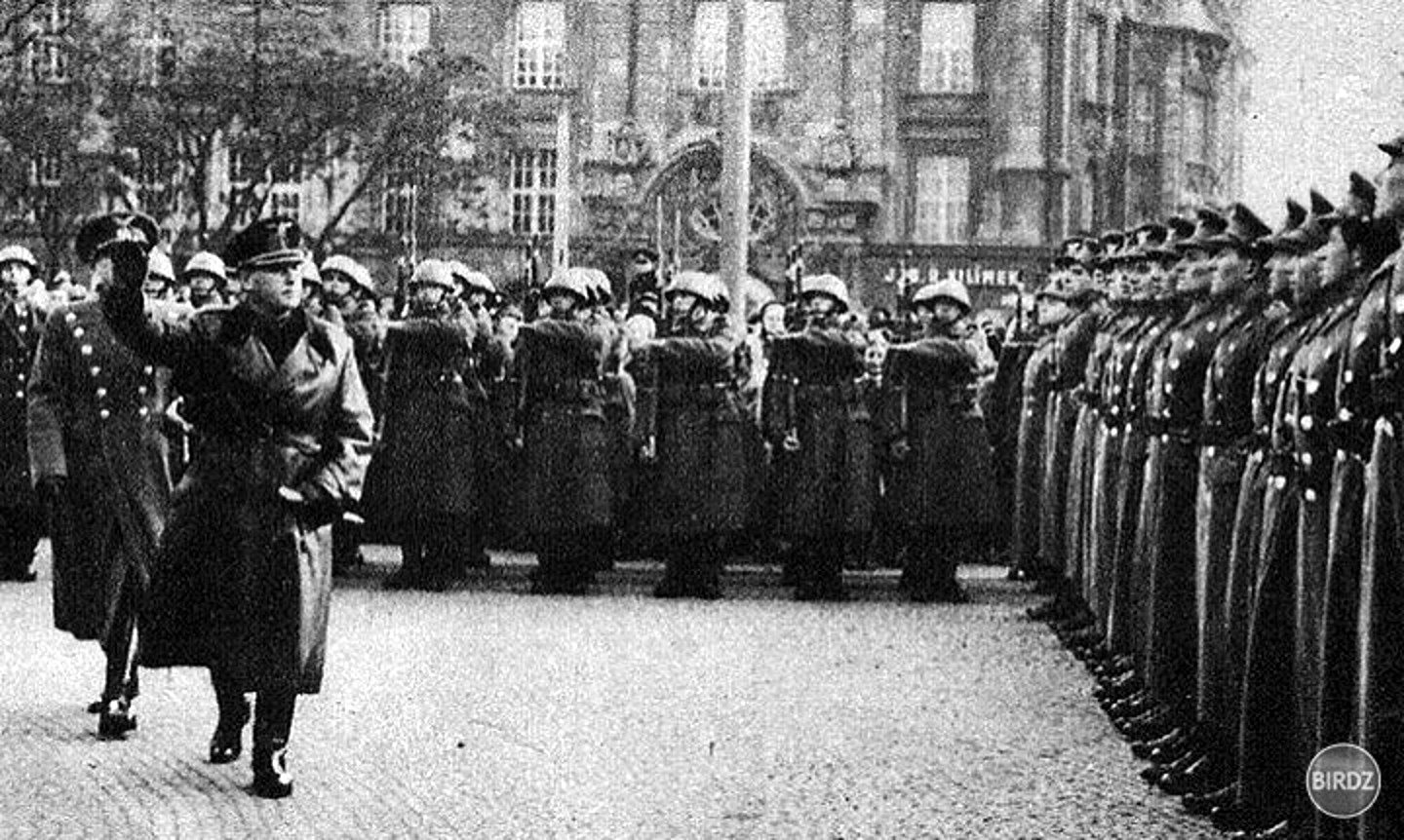
The Hlinka Guard was known for its participation in the Holocaust in Slovakia; its members appropriated Jewish property and rounded up Jews for deportation. In 1942, the guard was involved in the deportation of almost 60,000 Slovak Jews to occupied Poland. The victims were given only four hours' warning, to prevent them from escaping. Beatings and forcible shaving were commonplace, as was subjecting Jews to invasive searches to uncover hidden valuables. Some guards took advantage of their power to rape Jewish women.
The Hlinka Youth was also an organization subordinated to the Hlinka's Slovak People's Party. It was formed as a single nationwide organization in 1938. Initially, it was just for boys, but later, there was also a chapter for girls.
The Holocaust
Main article: The Holocaust in Slovakia
Soon after independence and along with the mass exile and deportation of Czechs, the Slovak Republic began a series of measures aimed against the Jews in the country. The Hlinka's Guard began to attack Jews, and the "Jewish Code" was passed in September 1941. Resembling the Nuremberg Laws, the code required Jews to wear a yellow armband and banned them from intermarriage and many jobs. By October 1941, the Slovak Republic had expelled 15,000 Jews from Bratislava, sending many to labor camps.
At the end of 1941, the Jews were concentrated in three labor camps located within Slovakian borders – Sereď, Nováky and Vyhne.
The Slovak Republic was one of the countries that agreed to deport its Jews as part of the Nazi Final Solution. Initially, the Slovak government tried to make a deal with Germany in October 1941 to deport its Jews as a substitute for providing Slovak workers to help the war effort. After the Wannsee Conference, the Germans agreed to the Slovak proposal, and a deal was reached where the Slovak Republic would pay for each Jew deported, and, in return, Germany promised that the Jews would never return to the republic. The initial terms were for "20,000 young, strong Jews", but the Slovak government quickly agreed to a German proposal to deport the entire population for "evacuation to territories in the East" meaning to Auschwitz-Birkenau. The Slovak Republic paid Germany 500 RM per every deported Jew for "retraining and accommodation" (a similar but smaller payment of 30 RM was paid by Croatia).
The deportations of Jews from Slovakia started on 25 March 1942 but halted on 20 October 1942 after a group of Jewish citizens, led by Gisi Fleischmann and Rabbi Michael Ber Weissmandl, built a coalition of concerned officials from the Vatican and the government, and, through a mix of bribery and negotiation, was able to stop the process. By then, however, some 58,000 Jews had already been deported, primarily to Auschwitz. Slovak government officials against Germany when it became clear that Germany had gassed many of the previously deported Slovak Jews in mass executions.

Jewish deportations resumed on 30 September 1944, when the Republic lost independence to a complete German occupation due to the Nazis' concern that the Soviet army had reached the Slovak border, and the Slovak National Uprising began. During the German occupation, another 13,500 Jews were deported, and 5,000 were imprisoned. Deportations continued until 31 March 1945. In all, German and Slovak authorities deported about 70,000 Jews from Slovakia; about 65,000 of them were murdered or died in concentration camps. The overall figures are inexact, partly because many Jews did not identify themselves. Still, one 2006 estimate is that approximately 105,000 Slovak Jews, or 77% of their pre-war population, died during the war.
Slovak National Uprising
Main article: Slovak National Uprising

In 1944, during the Slovak National Uprising, many Slovak units sided with the Slovak resistance and rebelled against Tiso's collaborationist government, while others helped German forces put the uprising down.
This resistance movement was represented mainly by members of the Democratic Party, social democrats, and communists. It was launched on 29 August 1944 from Banská Bystrica to resist German troops that had occupied Slovak territory and to overthrow the collaborationist government of Jozef Tiso. Although German forces largely defeated the resistance, guerrilla operations continued their efforts in the mountains.
In retaliation, Einsatzgruppe H and the Hlinka Guard Emergency Divisions executed many Slovaks suspected of aiding the rebels as well as Jews who had avoided deportation until then, and destroyed 93 villages on suspicion of collaboration. Several villages were burned to the ground, and all their inhabitants were murdered, as in Ostrý Grúň and Kľak (21 January 1945) or Kalište (18 March 1945). A later estimate of the death toll was 5,304, and authorities discovered 211 mass graves that resulted from those atrocities. The largest executions occurred in Kremnička (747 killed, mostly Jews and Roma) and Nemecká (900 killed).
End
Bratislava was often bombarded by the Allies. Major air raids included the bombing of Bratislava and its refinery Apollo on 16 June 1944 by American B-24 bombers of the Fifteenth Air Force with 181 victims. Bombardment group attacked in four waves with overall 158 planes.
After the anti-Nazi Slovak National Uprising in August 1944, the Germans occupied the country (from October 1944), which thereby lost much of its independence. The German troops were gradually pushed out by the Red Army, by Romanian, and by Czechoslovak soldiers coming from the east. The liberated territories again became de facto part of Czechoslovakia.
The First Slovak Republic ceased to exist de facto on 4 April 1945 when the Soviet Red Army 2nd Ukrainian Front captured Bratislava during the Bratislava–Brno offensive and occupied all of Slovakia. De jure it ceased to exist when the exiled Slovak government capitulated to General Walton Walker leading the XX Corps of the 3rd US Army on 8 May 1945 in the Austrian town of Kremsmünster. In the summer of 1945, the captured former president and members of the former government were handed over to Czechoslovak authorities.
Several prominent Slovak politicians escaped to neutral countries. Following his captivity, the deposed president Jozef Tiso authorized the former foreign minister Ferdinand Ďurčanský as his successor. Ďurčanský, Tiso's personal secretary Karol Murín, and cousin Fraňo Tiso were appointed by ex-president Tiso as the representatives of the Slovak nation; however, they failed to create a government-in-exile as no country recognized them. In the 1950s, fellow Slovak nationalists established the Slovak Action Committee (later Slovak Liberation Committee), which unsuccessfully advocated the restoration of the independent Slovak republic and the renewal of war against the Soviet Union. After the dissolution of Czechoslovakia and the creation of the modern Slovak republic, the Slovak Liberation Committee proclaimed Tiso's authorization as obsolete.

At the end of the war, Vojtech Tuka suffered a stroke which led him to use a wheelchair; he emigrated together with his wife, nursing attendants, and personal doctor to Austria, where he was arrested by Allied troops following the capitulation of Germany and handed over to the officials of the renewed Czechoslovakia. Following a brief trial, Vojtech Tuka was executed by hanging on 20 August 1946.
Jozef Tiso was sentenced to death, deprivation of his civil rights, and confiscation of all of his property. Tiso appealed to the Czechoslovak president Edvard Beneš and expected a reprieve; his prosecutor had recommended clemency. However, no reprieve was forthcoming. Wearing his clerical outfit, Tiso was hanged in Bratislava on 18 April 1947. The Czechoslovak government buried him secretly to avoid having his grave become a shrine, but far-right followers of Tiso soon identified the grave in the St Martin cemetery in Bratislava as his. Decades later, after a DNA test in April 2008 that confirmed it, the body of Tiso was exhumed and buried in St Emmeram's Cathedral in Nitra, in accordance with canon law.
Legacy
Some Slovak nationalists, such as the People's Party Our Slovakia, celebrate March 14 as the anniversary of Slovak independence. However, January 1 (the date of the Velvet Divorce) is the official independence day of modern Slovak Republic. The issue of March 14 commemorations divided the Christian Democratic Movement in the early 1990s.
Members of the far-right in admiration of Tiso created a memorial grave in Martin cemetery in October of 2008 to commemorate Tiso. It has since been used as an occasional gathering place for many far-right groups, including the People's Party Our Slovakia. Ultranationalist propaganda proclaims Tiso as a "martyr" who "sacrificed his life for his belief and nation" and so tries to paint him as an innocent victim of communism and a saint.
In popular culture
Film
The Shop on Main Street is a 1965 Czechoslovakian film about the Aryanization program during World War II in the Slovak Republic.
The film won the 1965 Academy Award for Best Foreign Language Film, and actress Ida Kamińska was nominated one year later for Best Actress in a Leading Role. It was entered into the 1965 Cannes Film Festival.
Television
In 2018, Slovak public broadcaster RTVS in the television poll The Greatest Slovak (spin-off of British television series 100 Greatest Britons), nominated Jozef Tiso, president of the wartime Slovak Republic, as one of the contenders for the title of the ‘Greatest Slovak’. After criticism RTVS excluded Jozef Tiso.
Notes
References
;Sources
References
- (May 1, 2024). "Slovensko v rokoch 1938 – 1945".
- (May 1, 2024). "Slovensko v rokoch 1938 – 1945".
- (May 1, 2024). "Slovensko v rokoch 1938 – 1945".
- Doe, Norman. (4 August 2011). "Law and Religion in Europe: A Comparative Introduction". OUP Oxford.
- Wells, John C.. (2008). "Longman Pronunciation Dictionary". Longman.
- Roach, Peter. (2011). "Cambridge English Pronouncing Dictionary". [[Cambridge University Press]].
- (8 December 2006). "Historical Dictionary of Slovakia". Scarecrow Press.
- (14 March 2016). "Tieto historické udalosti predchádzali vzniku Slovenského štátu". TERAZ.sk.
- Vladár, J. (Ed.), ''Encyklopédia Slovenska V. zväzok R – Š.'' Bratislava, Veda, 1981, pp. 330–331
- Plevza, V. (Ed.) ''Dejiny Slovenského národného povstania 1944 5. zväzok.'' Bratislava, Nakladateľstvo Pravda, 1985, pp. 484–487
- https://www.worldjewishcongress.org/en/news/bishop-praises-slovak-wwii-dictator
- https://encyclopedia.ushmm.org/content/en/article/czechoslovakia
- Dominik Jůn interviewing Professor Jan Rychlík. (2016). "Czechs and Slovaks – more than just neighbours". Radio Prague.
- William Shirer, ''The Rise and Fall of the Third Reich'' (Touchstone Edition) (New York: Simon & Schuster, 1990)
- Pavol Petruf, ''Vichy France and the diplomatic recognition of the Slovak Republic'', [in:] ''Historický Časopis'' 48 (2000), pp. 131–152
- Michal Považan, ''Slovakia 1939–1945: Statehood and International Recognition'', [in:] ''UNISCI Discussion Papers'' 36 (2014), pp. 75–78
- (May 1, 2024). "Slovakia 1939 – 1945: Statehood and International Recognition (de iure or de facto statehood?)". Unisci Discussion Papers.
- (4 October 2012). "Slowakei – Der mühsame Weg nach Westen". Promedia.
- (1998). "Poland's Holocaust: Ethnic Strife, Collaboration with Occupying Forces and Genocide in the Second Republic, 1918–1947". McFarland.
- National Archives, document reference FO 371/24856
- ''Third Axis Fourth Ally: Romanian Armed Forces in the European War, 1941–1945'', by Mark Axworthy, Cornel Scafeş and Cristian Crăciunoiu, page 73
- Nešťáková, Denisa (2023). Be Fruitful and Multiply. Slovakia's Family Planning Under Three Regimes (1918–1965), Marburg. https://bam-mr.buchkatalog.de/be-fruitful-and-multiply-9783879694853
- Denisa Nešťáková (2023) In the Name of Helping Women: Women Against the Family Policy of the Slovak State, Central Europe, 21:2, 78–96, DOI: 10.1080/14790963.2023.2294409
- Longerich, P. (2008), ''Heinrich Himmler'', p. 458, {{ISBN. 0-19-161989-2
- Weinberg, Gerhard L. (2005). ''A World at Arms: A Global History of World War II'' (2 ed.). Cambridge, England: Cambridge University Press. p. 52. {{ISBN. 0-521-85316-8. {{OCLC. 986290507
- "The Holocaust in Slovakia".
- (May 1, 2024). "Slovensko v rokoch 1938 – 1945".
- Jason Pipes. "Slovak Axis Forces in WWII". Feldgrau.
- (2008). "The Fate of the Slovak Jews". Holocaust Research Project.org.
- Nižňanský, Eduard (2010). ''Nacizmus, holokaust, slovenský štát'' [Nazism, holocaust, Slovak state] (in Slovak). Bratislava: Kalligram. {{ISBN. 978-80-8101-396-6.
- Rebekah Klein-Pejšová. (2006). "An overview of the history of Jews in Slovakia". Synagoga Slovaca.
- "The Slovak National Uprising".
- (August 23, 2016). "Bratislava in World War 2". Bratislava Shooting Club.
- (2005). "History – Wartime Bratislava". City of Bratislava.
- Kováč et al., "Kronika Slovenska 2", p. 300
- "Proces s dr.J Tisom – VÝPIS Z ROZSUDKU spracovaný obhajcom E. Zabkayom".
- "Jozefa Tisa pochovali v hrobke na Nitrianskom hrade". Nový Čas.
- (November 10, 2016). ""The Struggle for the Memory of the Nation": Post-Communist Slovakia and its World War II Past". Human Rights Quarterly.
- (26 February 2020). "Kotleba: Slovak Extremist Who Made Far Right Fashionable". Balkan Insight.
- (1999). "Politics without a Past: The Absence of History in Postcommunist Nationalism". Duke University Press.
- Azet.sk. "Skupina ľudí spomínala na Slovenský štát pri Tisovom hrobe". Nový Čas.
- "Jozef Tiso. Mučeník viery katolíckej a národa slovenského – Jozef Tiso. Mučeník viery katolíckej a národa slovenského".
- [http://sensesofcinema.com/2000/11/shop Andrew James Horton, "Just Who Owns the Shop? — Identity and nationality in ''Obchod na korze''"]
- "The 38th Academy Awards (1966) Nominees and Winners". oscars.org.
- [https://www.youtube.com/watch?v=SxddqJFbaJ8 Elizabeth Taylor Wins Best Actress: 1967 Oscars]
- "Festival de Cannes: The Shop on Main Street". festival-cannes.com.
- (November 6, 2018). "The Worst Choice for 'Greatest Slovak'".
This article was imported from Wikipedia and is available under the Creative Commons Attribution-ShareAlike 4.0 License. Content has been adapted to SurfDoc format. Original contributors can be found on the article history page.
Ask Mako anything about Slovak Republic (1939–1945) — get instant answers, deeper analysis, and related topics.
Research with MakoFree with your Surf account
Create a free account to save articles, ask Mako questions, and organize your research.
Sign up freeThis content may have been generated or modified by AI. CloudSurf Software LLC is not responsible for the accuracy, completeness, or reliability of AI-generated content. Always verify important information from primary sources.
Report