From Surf Wiki (app.surf) — the open knowledge base
Seyferth–Gilbert homologation

John C. Gilbert The Seyferth–Gilbert homologation is a chemical reaction of an aryl ketone 1 (or aldehyde) with dimethyl (diazomethyl)phosphonate 2 and potassium tert-butoxide to give substituted alkynes 3. Dimethyl (diazomethyl)phosphonate 2 is often called the Seyferth–Gilbert reagent.
This reaction is called a homologation because the product has exactly one additional carbon more than the starting material.
Reaction mechanism
Deprotonation of the Seyferth–Gilbert reagent A gives an anion B, which reacts with the ketone to form the oxaphosphetane D. Elimination of dimethylphosphate E gives the vinyl diazo-intermediate Fa and Fb. The generation of nitrogen gas gives a vinyl carbene G, which via a 1,2-migration forms the desired alkyne H.

Bestmann modification
The dimethyl (diazomethyl)phosphonate carbanion can be generated in situ from dimethyl-1-diazo-2-oxopropylphosphonate (also called the Ohira-Bestmann reagent) by reaction with methanol and potassium carbonate as the base by cleavage of the acetyl group as methyl acetate. Reaction of Bestmann's reagent with aldehydes gives terminal alkynes often in very high yield and fewer steps than the Corey–Fuchs reaction.

The use of the milder potassium carbonate makes this procedure much more compatible with a wide variety of functional groups.
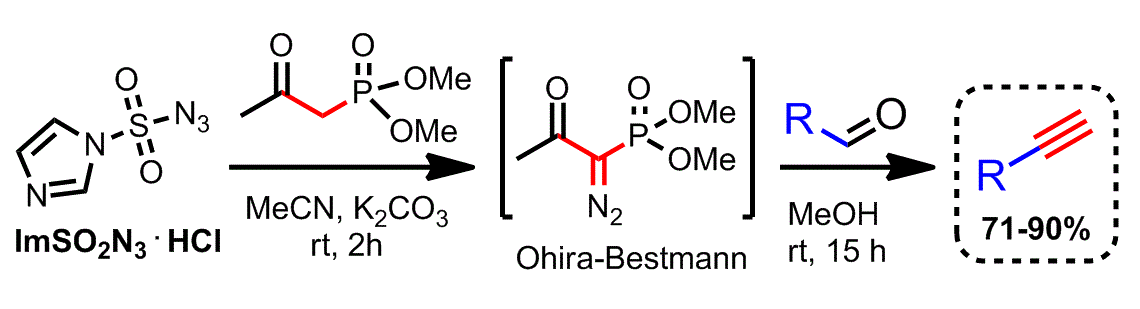
Traditional syntheses of the Ohira−Bestmann reagent use the rather explosive tosyl azide, but better diazo transfer agents are available.
Other modifications
Another modification for less reactive aldehydes is made by replacement of potassium carbonate with caesium carbonate in MeOH and results in a drastic yield increase.
References
References
- D. Seyferth. (1971). "Reactions of dimethylphosphono-substituted diazoalkanes. (MeO)2P(O)CR transfer to olefins and 1,3-dipolar additions of (MeO)2P(O)C(N2)R". J. Org. Chem..
- (1982). "Diazoethenes: their attempted synthesis from aldehydes and aromatic ketones by way of the Horner-Emmons modification of the Wittig reaction. A facile synthesis of alkynes". [[J. Org. Chem.]].
- D. G. Brown. (1996). "A Convenient Synthesis of Dimethyl (Diazomethyl)phosphonate (Seyferth/Gilbert Reagent)". J. Org. Chem..
- S. Müller. (1996). "An Improved One-pot Procedure for the Synthesis of Alkynes from Aldehydes". [[Synlett]].
- G. Roth. (2004). "Further Improvements of the Synthesis of Alkynes from Aldehydes". [[Synthesis (journal).
- Jepsen, T.H, Kristensen, J.L. ''J. Org. Chem.'' '''2014''', "''In Situ'' Generation of the Ohira–Bestmann Reagent from Stable Sulfonyl Azide: Scalable Synthesis of Alkynes from Aldehydes". http://pubs.acs.org/doi/abs/10.1021/jo501803f
- (2004). "Cyclophanes. Part LII:1 Ethynyl[2.2]paracyclophanes – New Building Blocks for Molecular Scaffolding". [[Synthesis (journal).
This article was imported from Wikipedia and is available under the Creative Commons Attribution-ShareAlike 4.0 License. Content has been adapted to SurfDoc format. Original contributors can be found on the article history page.
Ask Mako anything about Seyferth–Gilbert homologation — get instant answers, deeper analysis, and related topics.
Research with MakoFree with your Surf account
Create a free account to save articles, ask Mako questions, and organize your research.
Sign up freeThis content may have been generated or modified by AI. CloudSurf Software LLC is not responsible for the accuracy, completeness, or reliability of AI-generated content. Always verify important information from primary sources.
Report