From Surf Wiki (app.surf) — the open knowledge base
São João do Triunfo
.jpg)
| Field | Value |
|---|---|
| name | São João do Triunfo |
| settlement_type | Municipality |
| image_skyline | São João do Triunfo PR Brasil avenida central.jpg |
| image_caption | Partial view of the city. |
| image_seal | Brasão de Armas do Município de São João do Triunfo.jpg |
| image_flag | Bandeira São João do Triunfo.jpg |
| established_title | Founded |
| established_date | |
| population_demonym | Triunfense |
| leader_title | Mayor |
| leader_name | Mário Cezar da Silva |
| leader_party | PT |
| leader_title1 | Term ends |
| leader_name1 | 2028 |
| image_map | Parana Municip SaoJoaodoTriunfo.svg |
| map_caption | Location of São João do Triunfo in Paraná |
| pushpin_map | Brazil |
| pushpin_map_caption | Location of São João do Triunfo in Brazil |
| coordinates | |
| subdivision_type | Country |
| subdivision_name | Brazil |
| subdivision_type1 | Region |
| subdivision_name1 | South |
| subdivision_type2 | State |
| subdivision_name2 | Paraná |
| subdivision_type3 | Adjacent municipalities |
| subdivision_name3 | Palmeira, Lapa, Antônio Olinto, São Mateus do Sul, Rebouças, and Fernandes Pinheiro |
| subdivision_type4 | Distance to capital |
| subdivision_name4 | 106 km |
| subdivision_type5 | Districts |
| subdivision_name5 | Palmira and São João do Triunfo (seat) |
| area_total_km2 | 720.407 |
| area_footnotes | |
| population_total | 14996 |
| population_density_km2 | auto |
| population_footnotes | |
| timezone | BRT |
| utc_offset | −3 |
| elevation_m | 840 |
| blank_name_sec1 | Climate |
| blank_info_sec1 | Humid subtropical (Cfa) |
| blank1_name_sec1 | HDI (UNDP/2010) |
| blank1_info_sec1 | 0.629 |
| blank2_name_sec1 | HDI rank |
| blank2_info_sec1 | PR: 383rd |
| blank3_name_sec1 | GDP (IBGE/2016) |
| blank3_info_sec1 | |
| blank4_name_sec1 | GDP per capita (IBGE/2016) |
| blank4_info_sec1 |
São João do Triunfo is a Brazilian municipality located in the interior of the state of Paraná. Situated in southeastern Paraná, it is 106 km southwest of the state capital, Curitiba. The municipality covers an area of km², of which km² is within the urban area. According to the 2010 census conducted by the IBGE, its population was inhabitants.
The municipality has an average annual temperature of °C. Its predominant vegetation is the mixed ombrophilous forest. In 2009, 29.54% of its inhabitants lived in the urban area, and the municipality had eleven healthcare facilities. Its Human Development Index (HDI) is 0.679, which is considered to be medium for the state.
The first expedition to the region where São João do Triunfo is located occurred in 1845, when pioneers and their families sought land to settle. In 1864, the allocation of areas for the delimitation of the Rio da Vargem Parish began. Predominantly an agricultural municipality, its most significant products are tobacco, yerba mate, maize, and beans, with additional cultivation of soybeans, wheat, and potatoes. The municipality has one administrative district, Palmira. Established by State Law No. 13 on January 8, 1890, and implemented on February 15 of the same year, it was emancipated from Palmeira.
Etymology
The name honors the patron saint Saint John the Baptist and João Nunes de Souza, the founder of the locality. The adjective do Triunfo was added due to the success achieved by the brave explorers of the Rio da Vargem region. The name João comes from the Hebrew name Yohanan, which means "God's grace." Saint John the Baptist announced the arrival of the Messiah.
History
Origins and settlement
The region of São João do Triunfo began to be settled in 1864. It all began when João Nunes de Souza, who lived in São José dos Pinhais, planned to go hunting in the hinterlands. An avid hunter, João de Souza set out from his homeland, traveled along the Iguazu River, and climbed along the banks of the Rio da Vargem to a certain point.
There was an abundance of wild game, lush forests, abundant waters, and fertile soil, which captivated the explorer, who decided to settle there. His entire family accompanied him, facing all the dangers inherent in such an endeavor, but they survived. They explored the region, began farming, built trails in the forest, and promoted the area as much as possible.
In 1867, Antonio Dotes arrived at Rio da Vargem (the former name of the area) with other people, and together they built a small village.
Deeply religious, the local population erected a chapel, where the image of Saint John the Baptist was enshrined. Several residences were built around the small church, primarily on land donated by the community’s founder. It was not long before the village’s name changed from Rio da Vargem to São João do Triunfo.
Administrative formation

With the new name, on March 16, 1871, through Paraná Provincial Law No. 254, São João do Triunfo was elevated to the status of freguesia. Through Paraná State Law No. 13, dated January 8, 1890, during the Old Republic, the municipality of São João do Triunfo was established, with territory emancipated from Palmeira. It was officially implemented on February 15, 1890, with the inauguration of the mayor and councilors.
The territory of São João do Triunfo includes the district of Palmira, which welcomed Polish immigrants in the early 20th century through the Rio dos Patos and Brumado colonies. Palmira became a municipality on April 10, 1909, through State Law No. 874, and in 1920, it had a population of 2,423 inhabitants. Later, the municipality of Palmira was dissolved and incorporated into São João do Triunfo.
Through Paraná State Law No. 93, dated September 14, 1948, the municipality was elevated to the status of seat of the judicial district, with its implementation on January 25, 1949.
Geography
.jpg)
According to the Brazilian Institute of Geography and Statistics, the municipality’s area is km², of which km² constitutes the urban area. It is located at 25°40′58″ south latitude and 50°17′49″ west longitude, and it is 106 kilometers southwest of the state capital. Its neighboring municipalities are: Palmeira (N); São Mateus do Sul and Antônio Olinto (S); Lapa (E); and Rebouças and Fernandes Pinheiro (W).
According to the regional division in effect since 2017, established by the IBGE, the municipality belongs to the Intermediate and Immediate Geographical Regions of Ponta Grossa. Previously, under the division into microregions and mesoregions, it was part of the São Mateus do Sul microregion, which was included in the Southeastern Paraná mesoregion.
The municipality of São João do Triunfo is part of the Second Paraná Plateau, also known as the Ponta Grossa Plateau, where the terrain is undulating, and the average altitude ranges from 1,200 to 300 meters above sea level. The average altitude of the municipal seat is meters, one of the highest in the state, and the predominant geological age of the soil belongs to the Permian period.
The predominant vegetation is the Atlantic Forest, with remaining Atlantic forest reserves covering hectares in 2011, or 18.4% of the total municipal area. The main waterway that runs through the municipal territory is the Rio da Vargem.
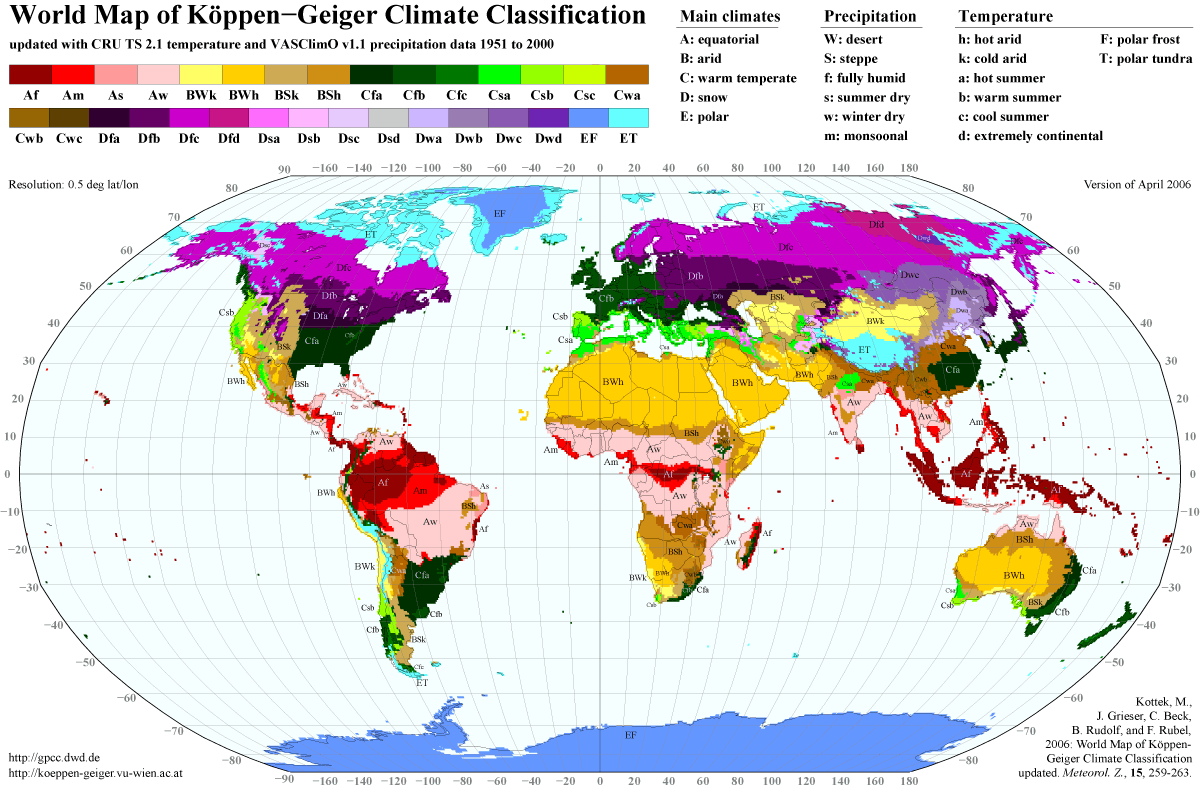
The climate of São João do Triunfo is classified, according to the IBGE, as oceanic (type Cfb according to the Köppen classification), with well-distributed rainfall throughout the year and an average annual temperature of °C. Winters are mild, and summers are warm. January, the warmest month, has an average temperature of °C, with a maximum of °C and a minimum of °C. July, the coldest month, has an average temperature of °C, with a maximum of °C and a minimum of °C. Autumn and spring are transitional seasons.
The average annual precipitation is mm, with July being the driest month, receiving mm. February, the wettest month, averages mm. In recent years, however, hot and dry days have become increasingly frequent during winter, often exceeding °C, especially between July and September. Frosts are common in winter, and between July 22 and 23, 2013, freezing rain was recorded in the city.
Demographics
| 1970 | 10296 | 1980 | 10803 | 1991 | 12320 | 2000 | 12479 | 2010 | 13704 In 2010, the municipality’s population was counted by the Brazilian Institute of Geography and Statistics (IBGE) at inhabitants. According to the census of that year, inhabitants were men and were women. According to the same census, residents lived in the urban area and in the rural area. Of the total population that year, 1,215 inhabitants (8.86%) were under 15 years old, residents (20.11%) were between 15 and 64 years old, and people (2.5%) were over 65, with a life expectancy at birth of 73.1 years and a fertility rate of 2.1 children per woman.
In 2010, the population consisted of 10,790 whites (78.74%), 244 blacks (1.78%), 69 Asians (0.50%), pardos (18.95%), and 4 indigenous people (0.03%). Regarding the region of birth, were born in the Southeast (0.12%), 6 in the North (0.04%), 5 in the Northeast (0.04%), and 13,620 in the South (99.39%). inhabitants were natives of Paraná (98.06%), and of these, were born in São João do Triunfo (86.67%). Among the 266 natives of other states, Santa Catarina had the highest representation with 112 people (0.82%), followed by Rio Grande do Sul with 70 residents (0.51%), and Minas Gerais with 11 residents (0.08%).
.jpg)
The Human Development Index (HDI) of São João do Triunfo is considered medium by the UNDP, with a value of 0.629 (the 3501st highest in Brazil and the 15th lowest in Paraná). Considering only the education index, the value is 0.475, the longevity index is 0.801, and the income index is 0.655. From 2000 to 2010, the proportion of people with a per capita household income of up to half a minimum wage decreased by 20.5%, and in 2010, 79.5% of the population lived above the poverty line, 11.7% were at the poverty line, and 8.8% were below it. The Gini coefficient was 0.500, with 0.41 being the worst and 0.36 the best. The share of the richest 20% of the population in the total municipal income was 52.6%, which is 15.3 times higher than that of the poorest 20%, which was 3.4%.
According to data from the 2010 census conducted by the IBGE, the municipal population consisted of: Catholics (86.96%), 1,473 evangelicals (10.75%), and 198 people with no religion (1.44%). According to the Catholic Church division, the city is home to the Saint John the Baptist Parish, under the Diocese of União da Vitória.
Politics and administration
The municipal administration is carried out by the executive and legislative powers. The representative of the executive power of São João do Triunfo, elected in the 2024 municipal elections, was Mário Cezar da Silva of the Workers' Party, who won a total of votes (60.63% of the voters), with Cristian Borges as vice-mayor.
The legislative power, in turn, is constituted by the municipal chamber, composed of 9 councilors elected for four-year terms (in accordance with Article 29 of the Constitution) and consists of two seats for the Republicans, two for the Progressistas, two for the Green Party, one seat for the Workers' Party, one for the Social Democratic Party, one for Solidarity, and one for the Liberal Party. It is responsible for drafting and voting on fundamental laws for the administration and the executive, especially the participatory budget (Budget Guidelines Law).
There were voters in April 2016, representing 0.142% of the state’s total. The municipality of São João do Triunfo is governed by an organic law and is the only municipality under the jurisdiction of the homonymous judicial district, of which it is the seat. It is subdivided into two districts, namely the seat and Palmira.
Subdivisions
When it was emancipated in 1890, São João do Triunfo was made up of several villages. The first to separate and later become a municipality was São Mateus do Sul. Other cities, such as Porto Amazonas, were also part of the territory. After São João do Triunfo became a municipality, Rio Azul and Rebouças also separated. On April 10, 1909, the district of Palmira was created, and in the territorial division of July 1, 1960, which is still in effect, São João do Triunfo consists of two districts: the seat and Palmira.
The urban area of the municipality consists only of the Centro, with no other neighborhoods. The rural area is divided into several farms, villages, and communities, listed as follows: Avencal, Santana, Faxinal dos Fabrícios, Faxinal Cachoeira, Mangueirinha, Bituva dos Machados, Cachoeira, Vitorinópolis, Rio Baio Terceiro, Pinhalzinho, Papuã, Faxinal do Louro, Serrinha, Morro Grande, Boa Vista, Bolo Grande, Taquaruçu, Solidão, Lajinha, Guaiaca, Colônia Bromado, Coxilhão de Santa Rosa, Coxilhão do Meio, Coxilhão das Ameixeiras, Faxinal dos Pereiras, Faxinal dos Rodrigues, Ponte Nova, Mato Queimado, Floresta São Paulo, Porto Feliz, Meia Lua, Barra Bonita, Água Branca, Poços, Salto, Monte Alegre, Fundão, Rodeio, Ladeira, Jacu, and Colônia Lagoa.
Economy
In the Gross Domestic Product (GDP) of São João do Triunfo, the agriculture and service sectors stand out. According to 2016 IBGE data, the municipality’s GDP was . were from taxes on products net of subsidies at current prices, and the per capita GDP was . In 2010, 70.72% of the population over 18 years old was economically active, while the unemployment rate was 2.61%.
Wages, including other remunerations, totaled , and the average monthly salary in the municipality was 2.0 minimum wages. There were 209 local units and 206 active companies. According to the IBGE, 16.31% of households survived on less than one minimum wage per month per resident ( households), 18.9% lived on between one and three minimum wages per person (767), 1.71% received between three and five (70), 0.83% had income above five per month (34), and 2.74% had no income (112).
Primary sector
| Product | Harvested area (hectares) | Production (tonnes) |
|---|---|---|
| Tobacco | 18,000 | |
| Soybeans | ||
| Maize | 1,200 |
.jpg)
In 2016, of the total GDP of the city, was the gross added value of agriculture, while in 2010, 70.72% of the municipality’s economically active population was employed in the sector. According to the IBGE, in 2013, the municipality had cattle, 398 buffalo, 180 goats, horses, sheep, chickens, and poultry. Six hundred and ten cows were milked, producing thousand liters of milk. Additionally, kilograms of honey were produced.
In terms of temporary crops, the main products are tobacco ( tonnes produced and hectares cultivated), soybeans ( tonnes produced and hectares planted), and maize ( tonnes produced and 2,600 hectares cultivated), in addition to garlic, rice, oats, potatoes, onions, rye, beans, cassava, wheat, and triticale. In terms of permanent crops, yerba mate (900 tonnes produced and 330 hectares harvested) and grapes (126 tonnes produced and 14 hectares harvested) stand out.
Secondary and tertiary sectors
Industrial production contributed to the municipality’s GDP in 2016, mainly from the manufacturing industry, with a small-scale presence of non-metallic mineral products, wood, furniture, chemical, and food industries. According to the IBGE, in 2014, m³ of timber was extracted for firewood and, according to 2010 statistics, 2.89% of São João do Triunfo’s workers were employed in the manufacturing industry.
In 2010, 3.18% of the employed population worked in construction, 0.29% in public utilities, 7.63% in commerce, and 16.52% in services. In 2016, of the municipal GDP came from the gross added value of the service sector, and from public administration.
Infrastructure
Housing, public safety, services, and communications
In 2010, São João do Triunfo had households, of which were houses and were apartments. Of the total households, were owned, with fully paid and under acquisition, were rented; properties were provided, with by employers and in other ways; and were occupied in other forms. The electricity supply service is provided by COPEL, and in 2010, according to the IBGE, households had access to the network.
.jpg)
In 2011, a rate of 3 homicides per 100,000 inhabitants was recorded, the 195th highest in the state and the 2620th in Brazil. The rate of traffic accidents in the same year was two incidents per 100,000 residents. Regarding suicides, the rate was 2.3 incidents per 100,000 inhabitants, the 162nd highest in the state and the 2074th in Brazil. By force of the Brazilian Federal Constitution, São João do Triunfo also has a Municipal Guard, responsible for protecting municipal assets, services, and facilities. The 2nd Platoon of the PMPR in São João do Triunfo is the headquarters of the municipality’s military police, under the jurisdiction of the 27th BPM, based in União da Vitória, of the 4th CRPM in Ponta Grossa.
The water supply and sewage collection services are provided by Sanepar, and in 2008, there were consumer units, with an average of m³ of treated water distributed per day. According to the IBGE, in 2010, households were served by the general water supply network, and had bathrooms for exclusive household use. The area code (DDD) of São João do Triunfo is 042, and the postal code CEP ranges from 84150–000 to 84150–000.
Healthcare, education, and transportation
.jpg)
In 2009, the municipality had eleven healthcare facilities, one private and ten public municipal facilities, including hospitals, emergency rooms, health centers, and dental services. There were 26 hospital beds available. In 2014, 99% of children under 1 year old were up to date with their vaccinations. In 2013, there were live births, with no infant mortality of children under five years old per thousand. In 2010, 4.31% of women aged 10 to 17 had children, with 12.22% of them aged 10 to 14, and the activity rate in this age group was 12.22%. 83.0% of children under 2 years old were weighed by the Family Health Program in 2013, with 1.2% of them malnourished.
.jpg)
In the field of education, the average IDEB score among public schools in 2013 was 4.4 (on a scale from 1 to 10), with 5th-grade students scoring 5.3 and 9th-grade students scoring 4.4; the national average was 4.0. In 2010, 85.08% of children aged seven to fourteen were not attending elementary school. The completion rate for young people aged 15 to 17 was 43.82%, and the literacy rate for youths and adolescents aged 18 to 24 was 26.40%. The age-grade distortion among elementary school students, i.e., those older than the recommended age, was 10.1% for the initial years and 33.2% for the final years, and in high school, the distortion reached 32.1%. Among residents aged 18 or older, 29.14% had completed elementary education, 26.40% had completed high school, and the population had an average of 9.88 expected years of study.
In 2010, according to census sample data, inhabitants attended daycares and/or schools. Of this total, 44 attended daycares, were in preschool, in literacy classes, 27 in youth and adult education, in elementary school, in high school, 93 in elementary adult education, 75 in high school adult education, 25 in higher education specialization, and in undergraduate courses. people did not attend educational institutions, with never having attended and having attended at some point. In 2012, the municipality had enrollments in the city’s educational institutions, with four of the twelve elementary schools belonging to the state public network and eight to the municipal network. All 47 high schools were part of the state public network.
In 2015, the municipal vehicle fleet of São João do Triunfo comprised 5,743 vehicles, including 3,292 automobiles, 279 trucks, 15 tractor-trucks, 620 pickup trucks, 123 vans, 14 minibuses, 1,171 motorcycles, 99 scooters, 41 buses, 70 trailers, 65 semi-trailers, and six utility vehicles. The municipality is served by the PR-151 highway, as well as the BR-277, which starts in Curitiba and passes through Campo Largo, Balsa Nova, São Luiz do Purunã, Colônia Witmarsum, Porto Amazonas, and Palmeira (along BR-277), before turning left onto PR-151.
| Level | Enrollments | Teachers | Schools (Total) | Early childhood education | Primary education | Secondary education |
|---|---|---|---|---|---|---|
| 143 | 7 | 3 | ||||
| 2,326 | 98 | 12 | ||||
| 596 | 47 | 4 |
Culture
.jpg)
To promote local socioeconomic development, the municipal government of São João do Triunfo, in collaboration with local and external institutions, has increased investments in festivals and events. The Department of Education, Culture, and Tourism is the municipal government body responsible for overseeing the cultural sector, with mandatory representation from various fields.
The only cultural venue in the municipality is the Professora Lina dos Santos Oliveira Public Library. The sole tourist attraction, the Arco Íris Waterfall, is located in the Coxilhão Santa Rosa community, near the Telepar tower, past the city of Palmeira. It is owned by Paulo Domingos Bedim and is open to visitors.
Holidays
São João do Triunfo observes two municipal holidays, eight national holidays, and several optional holidays. The municipal holidays are the feast day of John the Baptist, celebrated on June 24, and the city’s political emancipation day, celebrated on February 15. According to Brazil’s Federal Law No. 9,093, enacted on September 12, 1995, municipalities may designate up to four religious municipal holidays, including Good Friday.
Festivals
In São João do Triunfo, families from the communities of Pinhalzinho, Canudos, Cachoeira, Fabrícios, and Rio Baio organize the São Gonçalo Dance. During the festival, participants perform the dance in front of an altar adorned with various images, including that of São Gonçalo.
Cuisine
The traditional dish of São João do Triunfo is polenta with free-range chicken.
References
Bibliography
References
- Enciclopédia dos Municípios Brasileiros. (2007). "São João do Triunfo - Histórico". Instituto Brasileiro de Geografia e Estatística (IBGE).
- Instituto Brasileiro de Geografia e Estatística (IBGE). "São João do Triunfo".
- Instituto Brasileiro de Geografia e Estatística (IBGE). (September 9, 2013). "São João do Triunfo - Unidades territoriais do nível Distrito".
- Atlas do Desenvolvimento Humano. (July 29, 2013). "Ranking decrescente do IDH-M dos municípios do Brasil". Programa das Nações Unidas para o Desenvolvimento (PNUD).
- (November 29, 2010). "Tabela 608 - População residente, por situação de domicílio e sexo - Sinopse". Instituto Brasileiro de Geografia e Estatística (IBGE).
- "São João do Triunfo - Educadores".
- Ferreira, João Carlos Vicente. (1996). "O Paraná e seus municípios". Editora Memória Brasileira.
- Harper, Douglas. "John". Online Etymology Dictionary.
- "João Batista, O Mensageiro Precursor do Prometido Messias". Verdade em foco.
- Ferreira, João Carlos Vicente. (1996). "O Paraná e seus municípios". Editora Memória Brasileira.
- Embrapa Monitoramento por Satélite. "Paraná".
- Instituto Brasileiro de Geografia e Estatística (IBGE). (2017). "Divisão Regional do Brasil".
- Instituto Brasileiro de Geografia e Estatística (IBGE). (2017). "Divisão Territorial Brasileira 2017".
- Instituto Brasileiro de Geografia e Estatística (IBGE). (2016). "Divisão Territorial Brasileira 2016".
- Thais Pacievitch. "Geografia do Paraná". InfoEscola.
- Secretaria da Indústria, do Comércio e Assuntos do Mercosul do Paraná. (2006). "Idades geológicas".
- Cidades@ - IBGE. "Infográficos: dados gerais".
- [[SOS Mata Atlântica Foundation]]. (August 20, 2012). "Atlas dos Remanescentes Florestais da Mata Atlântica".
- Nonoya Filho. "São João do Triunfo". Editora Trieste.
- World Map of the Köppen-Geiger climate classification. "World Map of the Köppen-Geiger climate classification". Institute for Veterinary Public Health.
- Portal Brasil. (January 6, 2010). "Clima".
- Biblioteca IBGE. "Brasil - Climas".
- Redação. (July 23, 2013). "Geada entra no lugar da neve nesta quarta-feira no Paraná". Paraná Online.
- "Clima: São João do Triunfo". Climate-Data.org.
- Sistema IBGE de Recuperação Automática (SIDRA). (2010). "Tabela 200 - População residente por sexo, situação e grupos de idade - Amostra - Características Gerais da População".
- Atlas do Desenvolvimento Humano. (2013). "Perfil". [[United Nations Development Programme]] (PNUD).
- Sistema IBGE de Recuperação Automática (SIDRA). (2010). "População por raça e cor".
- Sistema IBGE de Recuperação Automática (SIDRA). (2010). "Tabela 1505 - População residente, por naturalidade em relação ao município e à unidade da federação - Resultados Gerais da Amostra".
- Sistema IBGE de Recuperação Automática (SIDRA). (2010). "Tabela 631 - População residente, por sexo e lugar de nascimento".
- (2010). "São João do Triunfo". Deepask.
- "São João do Triunfo no Atlas do Desenvolvimento Humano". Atlas do Desenvolvimento Humano.
- Portal ODM. "1 - acabar com a fome e a miséria".
- Portal ODM. (2012). "Perfil municipal".
- Sistema IBGE de Recuperação Automática (SIDRA). (2010). "Tabela 2094 - População residente por cor ou raça e religião".
- "Mapa diocesano". Diocese de União da Vitória.
- "Paróquias". Diocese de União da Vitória.
- Flávio Henrique M. Lima. (February 9, 2006). "O Poder Público Municipal à frente da obrigação constitucional de criação do sistema de controle interno". JusVi.
- (October 7, 2024). "Eleições 2024: Mario Cezar, do PT, é eleito prefeito de São João do Triunfo no 1º turno {{!}} Eleições 2024 em Campos Gerais e Sul - PR".
- DJI. "Constituição Federal - CF - 1988 / Art. 29".
- [[Superior Electoral Court]] (TSE). (April 12, 2013). "Consulta Quantitativo".
- "Lei Orgânica do Município de São João do Triunfo". Controle Municipal.
- "Comarca de São João do Triunfo". Subprocuradoria-Geral da Justiça para Assuntos de Planejamento Institucional do Ministério Público do Paraná.
- IBGE. (2007). "São João do Triunfo". Instituto Brasileiro de Geografia e Estatística.
- Instituto Brasileiro de Geografia e Estatística (IBGE). (2016). "Produto Interno Bruto dos Municípios - 2016".
- Cidades@ - IBGE. (2012). "Estatísticas do Cadastro Central de Empresas".
- Sistema IBGE de Recuperação Automática (SIDRA). (2010). "Domicílios particulares permanentes, por classes de rendimento nominal mensal domiciliar per capita".
- Cidades@ - IBGE. (2013). "Pecuária 2013".
- Cidades@ - IBGE. (2014). "Lavoura Temporária 2014".
- Cidades@ - IBGE. (2014). "Lavoura Permanente 2014".
- (2016). "Caderno Estatístico". Instituto Paranaense de Desenvolvimento Econômico e Social.
- Cidades@ - IBGE. (2014). "Extração vegetal e silvicultura - 2014".
- Cidades@ - IBGE. (2010). "Censo Demográfico 2010: Características da População e dos Domicílios: Resultados do Universo".
- Julio Jacobo Waiselfisz. (July 2, 2014). "Número e taxas (por 100 mil) de homicídio em municípios com mais de 20.000 habitantes". Mapa da Violência.
- Julio Jacobo Waiselfisz. (July 2, 2014). "Número e taxas (por 100 mil) de óbitos em acidentes de transporte em municípios com mais de 20.000 habitante". Mapa da Violência.
- Julio Jacobo Waiselfisz. (July 2, 2014). "Número e taxas (por 100 mil) de suicídio em municípios com mais de 20.000 mil habitantes". Mapa da Violência.
- Presidência da República. (1988). "Constituição da República Federativa do Brasil de 1988".
- "4º Comando Regional de Polícia Militar". Polícia Militar do Paraná.
- Cidades@ - IBGE. (2008). "Pesquisa Nacional de Saneamento Básico - 2008".
- Geografos.com.br. "DDD da Cidade".
- [[Correios]]. "CEP de cidades brasileiras".
- Cidades@ - IBGE. "Serviços de saúde - 2009".
- Portal ODM. (2012). "4 - reduzir a mortalidade infantil".
- Portal ODM. (2012). "2 - educação básica de qualidade para todos".
- Cidades@ - IBGE. (2010). "Censo Demográfico 2010: Resultados da Amostra - Educação".
- IPARDES. (2016). "Caderno Estatístico". Instituto Paranaense de Desenvolvimento Econômico e Social.
- "Mapa Multimodal do Paraná". Departamento Nacional de Infraestrutura de Transportes.
- Cidades@ - IBGE. (2012). "Ensino, matrículas, docentes e rede escolar 2012".
- Prefeitura. "SCRETARIA MUNICIPAL DE EDUCAÇÃO, CULTURA E TURISMO".
- (2016). "Caderno Estatístico". Instituto Paranaense de Desenvolvimento Econômico e Social.
- Governo do Paraná. "Bibliotecas Municipais". Biblioteca Pública do Paraná.
- Prefeitura. "Cachoeira Arco Íris".
- "Dias de Padroeiros".
- Sérgio Ferreira Pantaleão. "Carnaval - é ou não feriado? folga automática pode gerar alteração contratual". Guia Trabalhista.
- Presidência da República. "Lei n.º 9.093, de 12 de setembro de 1995".
- (2004). "Paraná da Gente: festas tradicionais". Secretaria de Estado da Cultura.
- Michele Pavoni. (April 21, 2018). "Sabores dos Campos Gerais: receitas típicas para fazer em casa". Diário dos Campos.

This article was imported from Wikipedia and is available under the Creative Commons Attribution-ShareAlike 4.0 License. Content has been adapted to SurfDoc format. Original contributors can be found on the article history page.
Ask Mako anything about São João do Triunfo — get instant answers, deeper analysis, and related topics.
Research with MakoFree with your Surf account
Create a free account to save articles, ask Mako questions, and organize your research.
Sign up freeThis content may have been generated or modified by AI. CloudSurf Software LLC is not responsible for the accuracy, completeness, or reliability of AI-generated content. Always verify important information from primary sources.
Report