From Surf Wiki (app.surf) — the open knowledge base
Salix × fragilis
Species of tree
Species of tree
|Oisodix × decipiens|Raf. |Psatherips × fragilis|(L.) Raf. |Salix alba var. elyensis|Burtt Davy |Salix × chlorocarpa|Schur |Salix × decipiens|Hoffm. |Salix × excelsa|Tausch ex W.D.J.Koch |Salix × excelsior|Host |Salix × fragilior|Host |Salix × fragilissima|Host |Salix × fragillima|Schur |Salix × gracilenta|Tausch |Salix × lyonii|J.Forbes |Salix × monspeliensis|J.Forbes |Salix × montana|J.Forbes |Salix × neotricha|Goerz |Salix × palustris|Host |Salix × pendula|Ser. |Salix × persicifolia|Schleich. |Salix × rubens|Schrank |Salix × russelliana|Sm. |Salix × sanguinea|Tausch ex Opiz |Salix × viridis|Fr. |Salix × wargiana|Lej. |Vimen × russeliana|(Sm.) Raf.
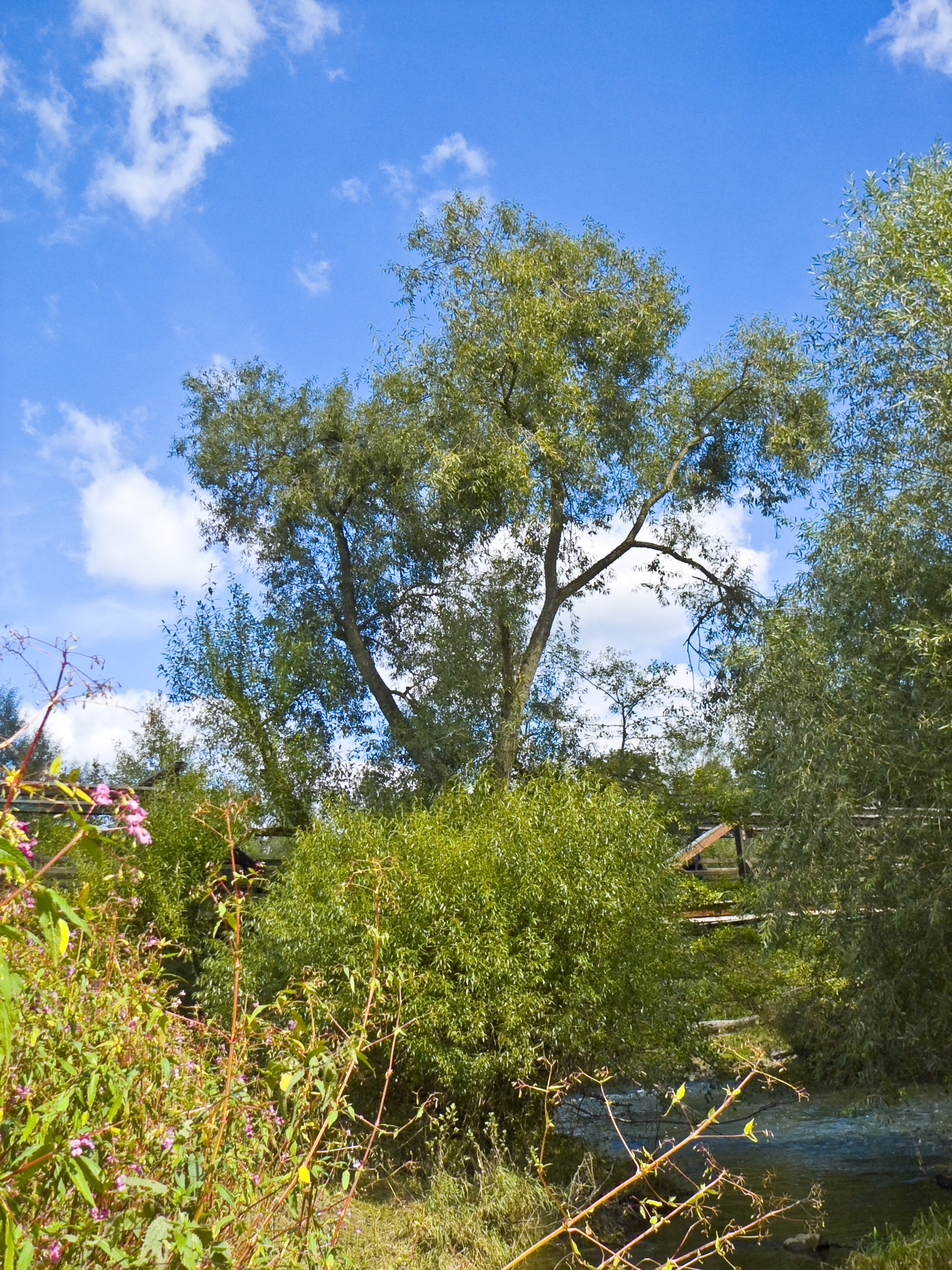
Salix × fragilis, with the common names crack willow and brittle willow, is a hybrid species of willow native to Europe and Western Asia. It is native to riparian habitats, usually found growing beside rivers and streams, and in marshes and water meadow channels. It is a hybrid between Salix euxina and Salix alba, and is very variable, with forms linking both parents.
Description
Salix × fragilis is a medium-sized to large deciduous tree, which grows rapidly to 10 – (rarely to 29 m) tall, with a trunk up to 1 m diameter, often multi-trunked, and an irregular, often leaning crown. The bark is dark grey-brown, coarsely fissured in older trees. The lanceolate leaves are bright green, 9–15 cm long and 1.5–3 cm wide, with a finely serrated margin; they are very finely hairy at first in spring, but soon become hairless.
The flowers are produced in catkins in early spring and are pollinated by insects. They are dioecious, with male and female catkins on separate trees. The male catkins are 4–6 cm long, the female catkins are the same length. The individual flowers have either one or two nectaries. In late spring, the fruit capsules release numerous small cotton-tufted seeds. These are easily distributed by wind and moving water and germinate immediately upon contact with the soil.
Taxonomy
Carl Linnaeus first described a willow species as "Salix fragilis" in 1753. It was later discovered that he was actually describing a species that he had also called Salix pentandra. Since at least the 1920s, botanists have applied Linnaeus's name "Salix fragilis" to both a pure species and to its hybrid with Salix alba. In 2005, it was proposed that "Salix fragilis" should be conserved for the pure species, with the hybrid called "Salix × rubens". The alternative was to conserve "Salix fragilis" for the hybrid, with the pure species requiring a new name. Following a discussion, the Nomenclature Committee for Vascular Plants rejected the initial proposal in 2009 and opted to conserve the name "Salix fragilis" for the hybrid. Irina V. Belyaeva subsequently described the previously unnamed parent species as Salix euxina, and designated a lectotype for the hybrid. The lectotype was shown by molecular evidence to be the hybrid between S. alba and S. euxina, the name of which is written as Salix × fragilis to show its hybrid status.
Varieties
S. × fragilis is very variable, with forms linking both parents. Some formally named varieties include the following. , none were accepted at this rank by Plants of the World Online, being treated as synonyms of the species. Clive A. Stace suggested some would be better treated as cultivars.
- S. × fragilis var. decipiens W.D.J.Koch (S. × decipiens Hoffm.) – assigned to S. × fragilis by Plants of the World Online and by Belyaeva, but to S. euxina by Stace
- S. × fragilis var. furcata Ser. ex Gaudin – male tree with relatively wide leaves; of cultivated origin
- S. × fragilis var. fragilis – male and female trees known; leaves with even, well spaced teeth
- S. × fragilis var. glauca Spenn.
- S. × fragilis var. polyandra Wimm.
- S. × fragilis var. rubens (Schrank) P.D.Sell
- S. × fragilis var. russelliana (Sm.) W.D.J.Koch – Bedford willow; female tree with long narrow leaves having somewhat uneven teeth; of cultivated origin
Ecology
The plant is commonly called crack willow or brittle willow because it is highly susceptible to damage from wind, ice and snow. The name also derives from the twigs, which break off very easily and cleanly at the base with an audible crack. Broken twigs and branches can readily take root, enabling the species to colonise new areas when they fall into waterways and are carried some distance downstream. The plant is particularly adept at colonising new riverside sandbanks formed after floods. It also spreads by root suckers, forming pure 'groves'.
Cultivation
Salix × fragilis is cultivated as a fast-growing ornamental tree. The cultivar 'Russelliana' (syn. S. × fragilis var. russelliana) is by far the most common clone of crack willow in Great Britain and Ireland, very easily propagated by cuttings. It is a vigorous tree commonly reaching 20 – tall, with leaves up to 15 cm long. It is a female clone.
Invasive species
Salix × fragilis has escaped cultivation to become an invasive species in various parts of the world, including: all states and territories in Australia, New Zealand; the upper half of the United States;, South Africa and Brazil. In New Zealand it is listed on the National Pest Plant Accord, which means it cannot be sold or distributed. It can replace a habitat's native plant species diversity by forming monospecific stands. As only the male plant is present in New Zealand no fruit is formed unless hybridised. Species spread is facilitated by stem fragmentation which are carried via waterways and nearby adult individuals. Control and management for habitat restoration projects often uses herbicides.
Gallery
File:Salix fragilis Globosa crown 2.jpg|[[File:Quality images logo.svg|25px|class=noviewer]] File:Salix fragilis Globosa crown.jpg|[[File:Quality images logo.svg|25px|class=noviewer]] File:Salix fragilis Globosa.jpg|[[File:Quality images logo.svg|25px|class=noviewer]] File:Salix fragilis Globosa 4.jpg|[[File:Quality images logo.svg|25px|class=noviewer]] File:Salix fragilis Globosa 5.jpg|[[File:Quality images logo.svg|25px|class=noviewer]] File:Salix fragilis Globosa 6.jpg|[[File:Quality images logo.svg|25px|class=noviewer]] File:Salix fragilis Globosa 3.jpg|[[File:Quality images logo.svg|25px|class=noviewer]] File:Salix fragilis Globosa 2.jpg|[[File:Quality images logo.svg|25px|class=noviewer]] File:Ивовая аллея в Новоселье.jpg|[[File:Quality images logo.svg|25px|class=noviewer]] File:Ивовая аллея в Новоселье 2.jpg|[[File:Quality images logo.svg|25px|class=noviewer]] File:2015.07.07.-22-Mulde Eilenburg--Bruch-Weide.jpg|[[File:Quality images logo.svg|25px|class=noviewer]] File:2015.07.07.-21-Mulde Eilenburg--Bruch-Weide.jpg|[[File:Quality images logo.svg|25px|class=noviewer]] File:2015.07.07.-20-Mulde Eilenburg--Bruch-Weide.jpg|[[File:Quality images logo.svg|25px|class=noviewer]] File:2015.07.07.-19-Mulde Eilenburg--Bruch-Weide.jpg|[[File:Quality images logo.svg|25px|class=noviewer]] File:2015.07.07.-18-Mulde Eilenburg--Bruch-Weide.jpg|[[File:Quality images logo.svg|25px|class=noviewer]] File:2015.07.07.-16-Mulde Eilenburg--Bruch-Weide.jpg|[[File:Quality images logo.svg|25px|class=noviewer]] Image:Salix fragilis(01).jpg Image:Salix fragilis(02).jpg Image:Salix fragilis Sturm22.jpg Image:Salix fragilis knäckepil.jpg Image:Salix fragilis 'Bullata'.jpg Image:Salix fragilis 001.jpg Image:Salix fragilis 002.jpg Image:Salix fragilis 003.jpg Image:Salix fragilis 004.jpg Image:Salix fragilis 005.jpg Image:Salix fragilis 006.jpg
References
References
- Meikle, R. D. (1984). ''Willows and Poplars of Great Britain and Ireland''. BSBI Handbook No. 4. {{ISBN. 0-901158-07-0.
- Rushforth, K. (1999). ''Trees of Britain and Europe''. Collins {{ISBN. 0-00-220013-9.
- [http://www.na.fs.fed.us/fhp/invasive_plants/weeds/crack-willow.pdf USFS—United States Forest Service: ''Salix fragilis'' — "Weed of the Week"] . accessed 1.13.2013
- 0-7195-2428-8.
- [http://www.invasive.org/browse/subinfo.cfm?sub=11590 Invasive.org Salix fragilis (crack willow)] . accessed 1.13.2013
- "Salix fragilis".
- U.S. states with invasive ''S.'' × ''fragilis'' sites include: CN, CO, ID, IL, IN, IO, MA, MI, MN, MO, NB, ND, NJ, OH, OR, NH, NM, NV, NY, PA, RI, SD, UT, VA, VT, WA, WI, WV, and WY. (USFS & invasive.org)
- "Plant an indigenous garden".
- (2020). "Invasion by a non-native willow (Salix × rubens) in Brazilian subtropical highlands". Perspectives in Ecology and Conservation.
- (2024). "Invasive non-native species in Brazil: an updated overview". Biological Invasions.
- (January 2018). "Can aerial herbicide application control Grey Willow (Salix cinerea L.) and stimulate native plant recovery in New Zealand wetlands?". Ecological Management & Restoration.
- "Crack willow | MPI Biosecurity New Zealand".
- (2023-12-07). "Understanding willow invasion in subtropical highlands". Biological Invasions.
- (2017). "Aerial glyphosate application reduces grey willow (Salix cinerea) canopy cover, increases light availability, and stimulates kahikatea (Dacrycarpus dacrydioides) growth". New Zealand Journal of Ecology.
- (2009). "Nomenclature of ''Salix fragilis'' L. and a new species, ''S. euxina'' (Salicaceae)". Taxon.
- (2009). "Report of the Nomenclature Committee for Vascular Plants: 60". Taxon.
- (2005). "(1698) Proposal to conserve the name ''Salix fragilis'' with a conserved type (Salicaceae)". Taxon.
- "''Salix'' × ''fragilis'' L.". [[International Plant Names Index.
- "''Salix euxina'' I.V.Belyaeva". [[International Plant Names Index.
- (July 2018). "Name change alert: ''Salix'' × ''fragilis'' L.". University of Connecticut.
- Stace, Clive A.. (2019). "New Flora of the British Isles". C & M Floristics.
- "''Salix'' × ''fragilis'' L.". Royal Botanic Gardens, Kew.
This article was imported from Wikipedia and is available under the Creative Commons Attribution-ShareAlike 4.0 License. Content has been adapted to SurfDoc format. Original contributors can be found on the article history page.
Ask Mako anything about Salix × fragilis — get instant answers, deeper analysis, and related topics.
Research with MakoFree with your Surf account
Create a free account to save articles, ask Mako questions, and organize your research.
Sign up freeThis content may have been generated or modified by AI. CloudSurf Software LLC is not responsible for the accuracy, completeness, or reliability of AI-generated content. Always verify important information from primary sources.
Report