From Surf Wiki (app.surf) — the open knowledge base
Rayleigh–Taylor instability
Unstable behavior of two contacting fluids of different densities

Unstable behavior of two contacting fluids of different densities
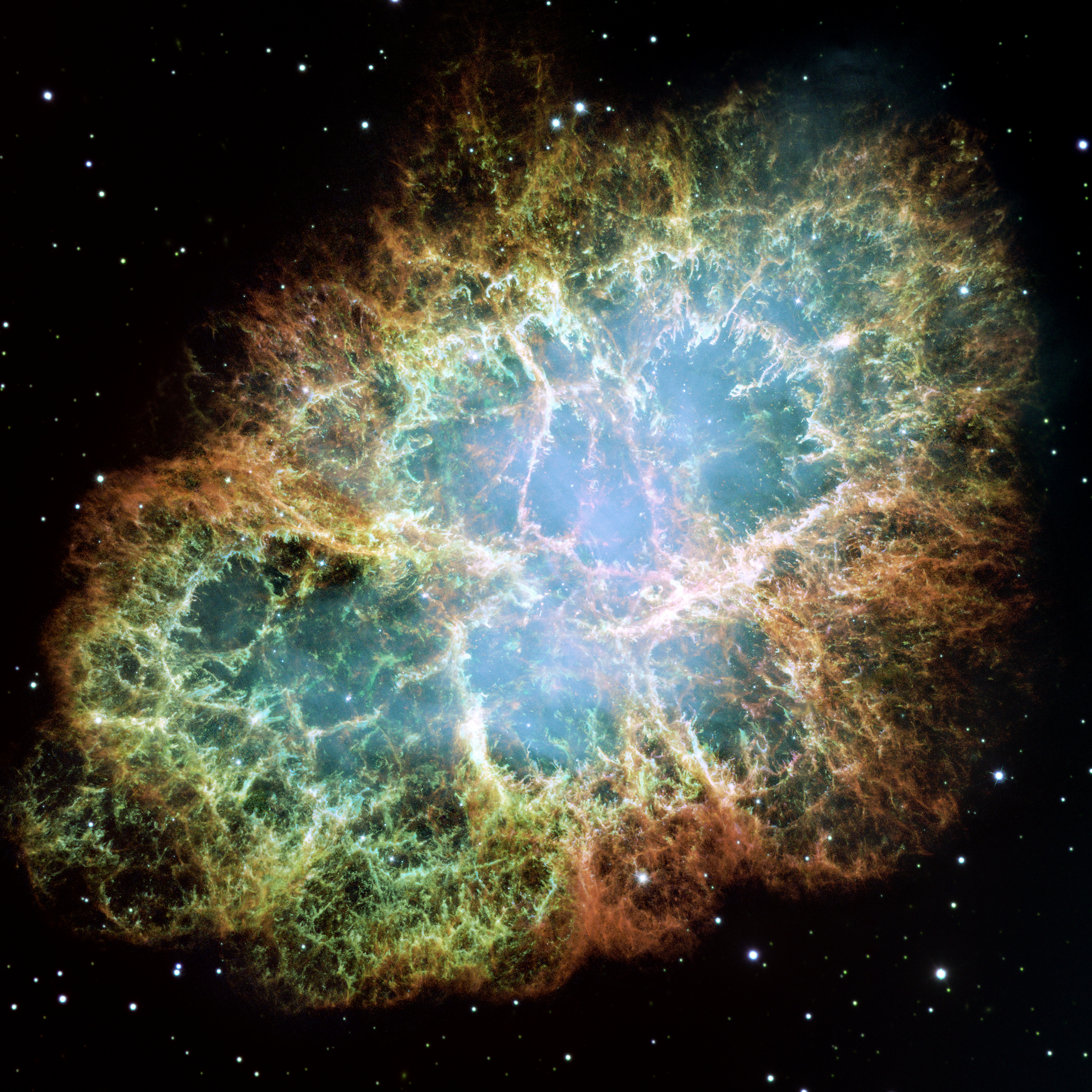
The Rayleigh–Taylor instability, or RT instability (after Lord Rayleigh and G. I. Taylor), is an instability of an interface between two fluids of different densities which occurs when the lighter fluid is pushing the heavier fluid. Examples include the behavior of water suspended above oil in the gravity of Earth, supernova explosions in which expanding core gas is accelerated into denser shell gas, merging binary quantum fluids in metastable configuration, instabilities in plasma fusion reactors and inertial confinement fusion.
Concept
Water suspended atop oil is an everyday example of Rayleigh–Taylor instability, and it may be modeled by two completely plane-parallel layers of immiscible fluid, the denser fluid on top of the less dense one and both subject to the Earth's gravity. The equilibrium here is unstable to any perturbations or disturbances of the interface: if a parcel of heavier fluid is displaced downward with an equal volume of lighter fluid displaced upwards, the potential energy of the configuration is lower than the initial state. Thus the disturbance will grow and lead to a further release of potential energy, as the denser material moves down under the (effective) gravitational field, and the less dense material is further displaced upwards. This was the set-up as studied by Lord Rayleigh.
As the RT instability develops, the initial perturbations progress from a linear growth phase into a non-linear growth phase, eventually developing "plumes" flowing upwards (in the gravitational buoyancy sense) and "spikes" falling downwards. In the linear phase, the fluid movement can be closely approximated by linear equations, and the amplitude of perturbations is growing exponentially with time. In the non-linear phase, perturbation amplitude is too large for a linear approximation, and non-linear equations are required to describe fluid motions. In general, the density disparity between the fluids determines the structure of the subsequent non-linear RT instability flows (assuming other variables such as surface tension and viscosity are negligible here). The difference in the fluid densities divided by their sum is defined as the Atwood number, A. For A close to 0, RT instability flows take the form of symmetric "fingers" of fluid; for A close to 1, the much lighter fluid "below" the heavier fluid takes the form of larger bubble-like plumes.
This process is evident not only in many terrestrial examples, from salt domes to weather inversions, but also in astrophysics and electrohydrodynamics. For example, RT instability structure is evident in the Crab Nebula, in which the expanding pulsar wind nebula powered by the Crab Pulsar is sweeping up ejected material from the supernova explosion 1000 years ago. The RT instability has also recently been discovered in the Sun's outer atmosphere, or solar corona, when a relatively dense solar prominence overlies a less dense plasma bubble. This latter case resembles magnetically modulated RT instabilities.
Note that the RT instability is not to be confused with the Plateau–Rayleigh instability (also known as Rayleigh instability) of a liquid jet. This instability, sometimes called the hosepipe (or firehose) instability, occurs due to surface tension, which acts to break a cylindrical jet into a stream of droplets having the same total volume but higher surface area.
Many people have witnessed the RT instability by looking at a lava lamp, although some might claim this is more accurately described as an example of Rayleigh–Bénard convection due to the active heating of the fluid layer at the bottom of the lamp.
Stages of development and eventual evolution into turbulent mixing
The evolution of the RTI follows four main stages.
Linear stability analysis
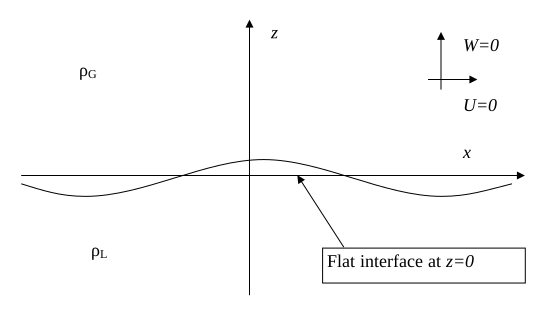
The inviscid two-dimensional Rayleigh–Taylor (RT) instability provides an excellent springboard into the mathematical study of stability because of the simple nature of the base state. Consider a base state in which there is an interface, located at z=0 that separates fluid media with different densities, \rho_1 for z and \rho_2 for z0. The gravitational acceleration is described by the vector \mathbf g = -g, \mathbf{e}_z. The velocity field and pressure field in this equilibrium state, denoted with an overbar, are given by
\overline{\mathbf v}=\mathbf{0}, \quad \overline p = \begin{cases}-\rho_1 g z \quad \text{for }z0,\end{cases}
where the reference location for the pressure is taken to be at z = 0. Let this interface be slightly perturbed, so that it assumes the position z = f(x,t). Correspondingly, the base state is also slightly perturbed. In the linear theory, we can write
\mathbf{v} = \overline{\mathbf v} + \hat{\mathbf{v}}(z) e^{ikx+\sigma t}, \quad p = \overline{p} + \hat p(z) e^{ikx+\sigma t}, \quad f =\hat{f} e^{ikx+\sigma t}
where k is the real wavenumber in the x-direction and \sigma is the growth rate of the perturbation. Then the linear stability analysis based on the inviscid governing equations shows that
\sigma^2 = \frac{\rho_2-\rho_1}{\rho_2+\rho_1} gk.
Thus, if \rho_2, the base state is stable and while if \rho_2\rho_1, it is unstable for all wavenumbers. If the interface has a surface tension \gamma, then the dispersion relation becomes
\sigma^2 = \frac{\rho_2-\rho_1}{\rho_2+\rho_1}gk - \frac{\gamma k^3}{\rho_2+\rho_1},
which indicates that the instability occurs only for a range of wavenumbers 0 where k_c^2 = (\rho_2-\rho_1)g/\gamma; that is to say, surface tension stabilises large wavenumbers or small length scales. Then the maximum growth rate occurs at the wavenumber k_m = k_c/\sqrt 3 and its value is
\sigma_m^2 = \frac{2\gamma}{\rho_2-\rho_1} \left[\frac{\left(\rho_2-\rho_1\right) g}{3\gamma}\right]^{3/2}.
The perturbation introduced to the system is described by a velocity field of infinitesimally small amplitude, (u'(x,z,t),w'(x,z,t))., Because the fluid is assumed incompressible, this velocity field has the streamfunction representation
\mathbf{u}' = (u'(x,z,t), w'(x,z,t)) = (\psi_z, -\psi_x),,
where the subscripts indicate partial derivatives. Moreover, in an initially stationary incompressible fluid, there is no vorticity, and the fluid stays irrotational, hence \nabla \times \mathbf{u}'=0,. In the streamfunction representation, \nabla^2\psi=0., Next, because of the translational invariance of the system in the x-direction, it is possible to make the ansatz
\psi\left(x,z,t\right) = e^{i\alpha\left(x-ct\right)}\Psi\left(z\right),,
where \alpha is a spatial wavenumber. Thus, the problem reduces to solving the equation
\left(D^2-\alpha^2\right)\Psi_j=0,,,,\ D=\frac{d}{dz},,,,\ j=L,G.,
The domain of the problem is the following: the fluid with label 'L' lives in the region -\infty, while the fluid with the label 'G' lives in the upper half-plane 0\leq z. To specify the solution fully, it is necessary to fix conditions at the boundaries and interface. This determines the wave speed c, which in turn determines the stability properties of the system.
The first of these conditions is provided by details at the boundary. The perturbation velocities w'_i, should satisfy a no-flux condition, so that fluid does not leak out at the boundaries z = \pm\infty., Thus, w_L'=0, on z=-\infty,, and w_G'=0, on z=\infty,. In terms of the streamfunction, this is
\Psi_L\left(-\infty\right)=0,\qquad \Psi_G\left(\infty\right)=0.,
The other three conditions are provided by details at the interface z=\eta\left(x,t\right),.
Continuity of vertical velocity: At z=\eta, the vertical velocities match, w'_L = w'_G,. Using the stream function representation, this gives
\Psi_L\left(\eta\right)=\Psi_G\left(\eta\right).,
Expanding about z=0, gives
\Psi_L\left(0\right)=\Psi_G\left(0\right)+\text{H.O.T.},,
where H.O.T. means 'higher-order terms'. This equation is the required interfacial condition.
The free-surface condition: At the free surface z=\eta\left(x,t\right),, the kinematic condition holds:
\frac{\partial\eta}{\partial t} + u' \frac{\partial\eta}{\partial x} = w'\left(\eta\right).,
Linearizing, this is simply
\frac{\partial\eta}{\partial t}=w'\left(0\right),,
where the velocity w'\left(\eta\right), is linearized on to the surface z=0,. Using the normal-mode and streamfunction representations, this condition is c \eta=\Psi,, the second interfacial condition.
Pressure relation across the interface: For the case with surface tension, the pressure difference over the interface at z=\eta is given by the Young–Laplace equation:
p_G\left(z=\eta\right) - p_L\left(z=\eta\right) = \sigma\kappa,,
where σ is the surface tension and κ is the curvature of the interface, which in a linear approximation is
\kappa = \nabla^2\eta=\eta_{xx}.,
Thus,
p_G\left(z{=}\eta\right) - p_L\left({z}=\eta\right) = \sigma\eta_{xx}.,
However, this condition refers to the total pressure (base+perturbed), thus
\left[P_G\left(\eta\right)+p'_G\left(0\right)\right] - \left[P_L\left(\eta\right) + p'L\left(0\right)\right] = \sigma\eta{xx}.
(As usual, The perturbed quantities can be linearized onto the surface z=0.) Using hydrostatic balance, in the form
P_L=-\rho_L g z+p_0,\qquad P_G=-\rho_G gz +p_0,,
this becomes
p'_G-p'L = g\eta\left(\rho_G-\rho_L\right)+\sigma\eta{xx},\qquad\text{on }z = 0.
The perturbed pressures are evaluated in terms of streamfunctions, using the horizontal momentum equation of the linearised Euler equations for the perturbations, \frac{\partial u_i'}{\partial t} = - \frac{1}{\rho_i}\frac{\partial p_i'}{\partial x}, with i=L,G,, to yield
p_i'=\rho_i c D\Psi_i,\qquad i=L,G.,
Putting this last equation and the jump condition on p'_G-p'_L together,
c\left(\rho_G D\Psi_G-\rho_L D\Psi_L\right)=g\eta\left(\rho_G-\rho_L\right)+\sigma\eta_{xx}.,
Substituting the second interfacial condition c\eta=\Psi, and using the normal-mode representation, this relation becomes
c^2\left(\rho_G D\Psi_G-\rho_L D\Psi_L\right)=g\Psi\left(\rho_G-\rho_L\right)-\sigma\alpha^2\Psi,,
where there is no need to label \Psi, (only its derivatives) because \Psi_L=\Psi_G, at z=0.,
; Solution
Now that the model of stratified flow has been set up, the solution is at hand. The streamfunction equation \left(D^2-\alpha^2\right)\Psi_i=0,, with the boundary conditions \Psi\left(\pm\infty\right), has the solution
\Psi_L = A_L e^{\alpha z},\qquad \Psi_G = A_G e^{-\alpha z}.,
The first interfacial condition states that \Psi_L=\Psi_G, at z=0,, which forces A_L=A_G=A., The third interfacial condition states that
c^2\left(\rho_G D\Psi_G-\rho_L D\Psi_L\right) = g\Psi\left(\rho_G-\rho_L\right)-\sigma\alpha^2\Psi.,
Plugging the solution into this equation gives the relation
Ac^2\alpha\left(-\rho_G-\rho_L\right)=Ag\left(\rho_G-\rho_L\right)-\sigma\alpha^2A.,
The A cancels from both sides and we are left with
c^2 = \frac{g}{\alpha} \frac{\rho_L-\rho_G}{\rho_L+\rho_G} + \frac{\sigma\alpha}{\rho_L+\rho_G}.,
To understand the implications of this result in full, it is helpful to consider the case of zero surface tension. Then,
c^2 = \frac{g}{\alpha} \frac{\rho_L-\rho_G}{\rho_L+\rho_G},\qquad \sigma=0,,
and clearly
- If \rho_G, c^20, and c is real. This happens when the lighter fluid sits on top;
- If \rho_G\rho_L,, c^2 and c is purely imaginary. This happens when the heavier fluid sits on top.
Now, when the heavier fluid sits on top, c^2, and
c=\pm i \sqrt{\frac{g\mathcal{A}}{\alpha}},\qquad \mathcal{A}=\frac{\rho_G-\rho_L}{\rho_G+\rho_L},,
where \mathcal{A}, is the Atwood number. By taking the positive solution, we see that the solution has the form
\Psi\left(x,z,t\right) = A e^{-\alpha|z|} \exp \left[i\alpha\left(x-ct\right)\right] = A \exp\left(\alpha\sqrt{\frac{g\tilde{\mathcal{A}}}{\alpha}}t\right) \exp\left(i\alpha x - \alpha|z|\right),
and this is associated to the interface position η by: Now define B = A/c.,
When the two layers of the fluid are allowed to have a relative velocity, the instability is generalized to the Kelvin–Helmholtz–Rayleigh–Taylor instability, which includes both the Kelvin–Helmholtz instability and the Rayleigh–Taylor instability as special cases. It was recently discovered that the fluid equations governing the linear dynamics of the system admit a parity-time symmetry, and the Kelvin–Helmholtz–Rayleigh–Taylor instability occurs when and only when the parity-time symmetry breaks spontaneously.
Vorticity explanation
The RT instability can be seen as the result of baroclinic torque created by the misalignment of the pressure and density gradients at the perturbed interface, as described by the two-dimensional inviscid vorticity equation, \frac{D\omega}{Dt} = \frac{\nabla \rho \times \nabla p}{\rho ^2} , where ω is vorticity, ρ density and p is the pressure. In this case the dominant pressure gradient is hydrostatic, resulting from the acceleration.
When in the unstable configuration, for a particular harmonic component of the initial perturbation, the torque on the interface creates vorticity that will tend to increase the misalignment of the gradient vectors. This in turn creates additional vorticity, leading to further misalignment. This concept is depicted in the figure, where it is observed that the two counter-rotating vortices have velocity fields that sum at the peak and trough of the perturbed interface. In the stable configuration, the vorticity, and thus the induced velocity field, will be in a direction that decreases the misalignment and therefore stabilizes the system.
A much simpler explanation of the basic physics of the Rayleigh–Taylor instability was published in 2006.
Late-time behaviour
The analysis in the previous section breaks down when the amplitude of the perturbation is large. The growth then becomes non-linear as the spikes and bubbles of the instability tangle and roll up into vortices. Then, as in the figure, numerical simulation of the full problem is required to describe the system.
Notes
References
Original research papers
- (Original paper is available at: https://www.irphe.fr/~clanet/otherpaperfile/articles/Rayleigh/rayleigh1883.pdf .)
Other
- xvii+238 pages.
- 626 pages.
References
- Li, Shengtai. "Parallel AMR Code for Compressible MHD or HD Equations". [[Los Alamos National Laboratory]].
- Sharp, D.H.. (1984). "An Overview of Rayleigh–Taylor Instability". Physica D.
- [[Philip Drazin. Drazin]] (2002) pp. 50–51.
- "Rayleigh–Taylor instability and mixing".
- (20 November 2013). "Why Nuclear Bombs Create Mushroom Clouds".
- Wang, C.-Y.. (2000). "Instabilities and Clumping in Type Ia Supernova Remnants". The Astrophysical Journal.
- (1992). "Stellar Astrophysics". [[CRC Press]].
- (2025). "The Rayleigh-Taylor instability in a binary quantum fluid". Science Advances.
- (1994). "The Rayleigh–Taylor instability in the spherical pinch". Journal of Fusion Energy.
- (1998). "Growth rates of the ablative Rayleigh–Taylor instability in inertial confinement fusion". Physics of Plasmas.
- Hester, J. Jeff. (2008). "The Crab Nebula: an Astrophysical Chimera". Annual Review of Astronomy and Astrophysics.
- (2010). "Quiescent Prominence Dynamics Observed with the Hinode Solar Optical Telescope. I. Turbulent Upflow Plumes". The Astrophysical Journal.
- (2012). "Numerical Simulations of the Magnetic Rayleigh–Taylor Instability in the Kippenhahn-Schlüter Prominence Model. I. Formation of Upflows". The Astrophysical Journal.
- Singh, Chamkor. (2016). "Single-mode instability of a ferrofluid-mercury interface under a nonuniform magnetic field". Physical Review E.
- (2015). "The effects of forced small-wavelength, finite-bandwidth initial perturbations and miscibility on the turbulent Rayleigh Taylor instability". Journal of Fluid Mechanics.
- Drazin (2002) pp. 48–52.
- Qin, H.. (2019). "Kelvin–Helmholtz instability is the result of parity-time symmetry breaking". Physics of Plasmas.
- Roberts, M.S.. (2012). "Experiments and Simulations on the Incompressible, Rayleigh–Taylor Instability with Small Wavelength Initial Perturbations". University of Arizona Dissertations.
- (2006-12-01). "The Rayleigh-Taylor instability". American Journal of Physics.
This article was imported from Wikipedia and is available under the Creative Commons Attribution-ShareAlike 4.0 License. Content has been adapted to SurfDoc format. Original contributors can be found on the article history page.
Ask Mako anything about Rayleigh–Taylor instability — get instant answers, deeper analysis, and related topics.
Research with MakoFree with your Surf account
Create a free account to save articles, ask Mako questions, and organize your research.
Sign up freeThis content may have been generated or modified by AI. CloudSurf Software LLC is not responsible for the accuracy, completeness, or reliability of AI-generated content. Always verify important information from primary sources.
Report