From Surf Wiki (app.surf) — the open knowledge base
Prince of Wales's Leinster Regiment (Royal Canadians)
Infantry regiment

Infantry regiment
| Field | Value |
|---|---|
| unit_name | Prince of Wales's Leinster Regiment |
| image | Leinster Regiment Cap Badge.jpg |
| caption | Badge of the Prince of Wales's Leinster Regiment |
| dates | 1881–1922 |
| allegiance | United Kingdom of Great Britain and Ireland |
| branch | |
| type | Infantry Regiment |
| role | Line Infantry |
| size | 2 Regular Battalions |
| garrison | Birr Barracks, Birr |
| nickname | Royal Canadians |
| patron | Prince of Wales |
| motto | Ich Dien (I Serve) |
| march | Quick: The Royal Canadian; Come Back to Erin |
3 Militia and Special Reserve Battalions
2 Hostilities-only Battalions The Prince of Wales's Leinster Regiment (Royal Canadians) was an infantry regiment of the line in the British Army, formed in 1881 by the amalgamation of the 100th (Prince of Wales's Royal Canadian) Regiment of Foot and the 109th Regiment of Foot (Bombay Infantry). The 100th Foot was first raised in 1858 and the 109th was first raised in 1853. Between the time of its formation and Irish independence, it was one of eight Irish regiments raised largely in Ireland, with its Birr Barracks home depot in Birr. It was disbanded with the Partition of Ireland following establishment of the independent Irish Free State in 1922 when the five regiments that had their traditional recruiting grounds in the counties of the new state were disbanded.
History
19th century
The regiment was formed in 1881 by the amalgamation of the 100th (Prince of Wales's Royal Canadian) Regiment of Foot and the 109th Regiment of Foot (Bombay Infantry). The amalgamation of the two regiments into one with the title Prince of Wales's Leinster Regiment (Royal Canadians), was part of the United Kingdom government's reorganization of the British Army under the Childers Reforms, a continuation of the Cardwell Reforms implemented in 1879.
It was one of eight Irish regiments raised largely in Ireland, with its home depot at Birr Barracks in Birr. The regiment recruited mainly in the province of Leinster. Militarily, the whole of Ireland was administered as a separate command within the United Kingdom with Command Headquarters at Parkgate (Phoenix Park) in Dublin, directly under the War Office in London.
The 1st Battalion, which had been in India, moved to Ireland in 1894. A detachment took part in the Fourth Anglo-Ashanti War in 1895, but the rest of the battalion remained in Ireland until moving to Halifax, Canada, in 1898. The 2nd Battalion moved to Ireland in 1882 and to England in 1888. It transferred to Malta in 1894, and joined the Bermuda Garrison the following year. In 1897, it moved to Halifax, and in 1898 to the West Indies.
Second Boer War
Both regular battalions were deployed to South Africa for the Second Boer War. The 1st Battalion saw action around Bethlehem in April 1902 when 14 men were wounded while the 2nd Battalion held the Heilbron branch line in February 1902 when they had 10 casualties. The 1st battalion stayed until the end of the war, following which 370 officers and men left Cape Town on the SS Englishman in late September 1902, and arrived at Southampton in late October, when they were posted to Fermoy. The 3rd (King's County Militia) Battalion, formed from the former King's County Royal Rifle Militia, was embodied in early 1900 for service in South Africa. 520 officers and men embarked from Southampton on the in early March 1900, returning to Ireland after more than two years in late May 1902.
In 1908, the Volunteers and Militia were reorganised nationally, with the former becoming the Territorial Force and the latter the Special Reserve; the regiment now had three Special Reserve but no Territorial battalions.
First World War

Regular army
The 1st Battalion, which had been at Faizabad in India, landed at Le Havre as part of the 82nd Brigade in the 27th Division in December 1914 for service on the Western Front but moved to Salonika in December 1915 and then moved to Egypt for service in Palestine in September 1917. The 2nd Battalion landed at Saint-Nazaire as part of the 17th Brigade in the 6th Division in September 1914 for service on the Western Front.
New Armies
The 6th (Service) Battalion landed at Anzac Cove as part of the 29th Brigade in the 10th (Irish) Division in August 1915 but moved to Salonika in September 1915 and on to Egypt for service in Palestine in September 1917 before landing at Marseille in June 1918 for service on the Western Front. The 7th Battalion landed at Le Havre as part of the 47th Brigade in the 16th (Irish) Division in December 1915 for service on the Western Front.
Post-war
After the war the 1st Leinsters returned to Madras. In August 1921, the governor of Madras requested military support to suppress resistance by Mappila rebels. By February 1922 the Malabar Force (which included the Leinsters) under command of Edward Thomas Humphreys had put down the rebellion.
Disbandment

Due to substantial defence cuts and the establishment of the Irish Free State in 1922, it was agreed that the six former Southern Ireland regiments would be disbanded, The six regiments were then all disbanded on 31 July 1922. Serving personnel of the Prince of Wales's Leinster Regiment were given the option of transferring to other units if they wished to continue to serve in the British Army.
In recognition of their Canadian roots, the officers of the 1st Battalion decided to give their officers' mess silver 'in trust' to the Government of Canada "as a token of the regard for the Great Dominion which gave birth to the Battalion to be held in trust until such time as the Battalion is again raised". The silver, known as "The Leinster Plate", was deposited for safe keeping at the Royal Military College of Canada in 1923 at the suggestion of Edward Mortimer Macdonald and James MacBrien, Canada's Minister of National Defence and Chief of Staff respectively. The silver is on display at Royal Military College of Canada in the Senior Staff Mess and Museum (Fort Frederic).
In 2013 the Regimental Association erected a memorial to commemorate the regiment's strong linkages with the Birr area, particularly to Birr Barracks.
Battle honours

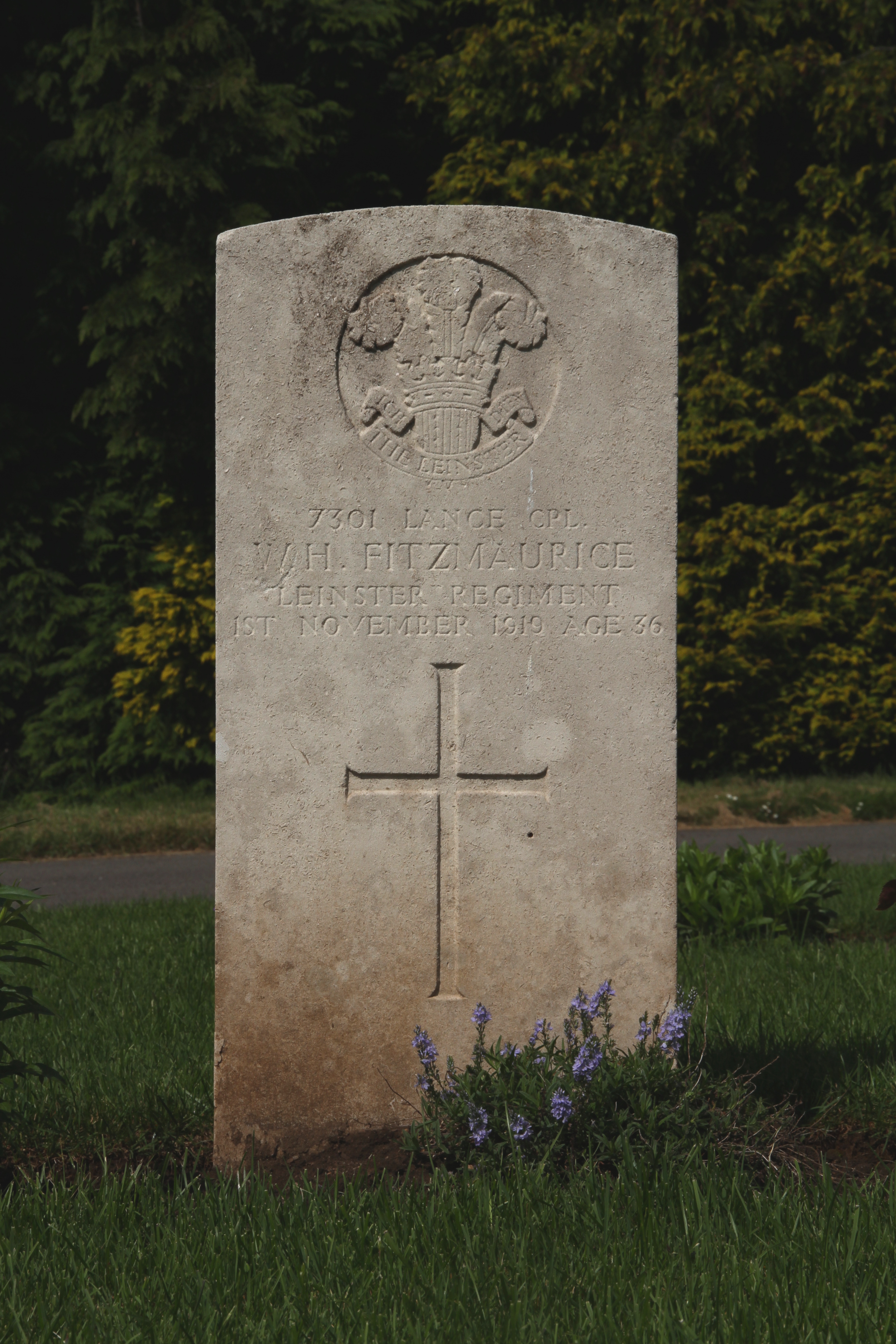
The regiment's battle honours were as follows:
- From 100th Regiment of Foot: Niagara
- From 109th Regiment of Foot: Central India
- Second Boer War: South Africa 1900–02
- The Great War:
| Campaign | Battle | Date |
|---|---|---|
| None | Armentières 1914 | 1914 |
| Second Battle of Ypres | Battle of Gravenstafel | 22–23 April 1915 |
| Battle of St. Julien | 24 April – 4 May 1915 | |
| Battle of Frezenberg | 8–13 May 1915 | |
| Battle of the Somme | Bourlon Wood | |
| Battle of Guillemont | 3–6 September 1916 | |
| Battle of Ginchy | 9 September 1916 | |
| Battle of Arras | Battle of Vimy Ridge | 9 – 14 April 1917 |
| Third Battle of Ypres | Battle of Messines | 7 – 14 June 1917 |
| Battle of Pilckem Ridge | 31 July – 3 August 1917 | |
| Battle of Langemarck (1917) | 16–18 August 1917 | |
| First Battle of Passchendaele | 12 October 1917 | |
| Second Battle of Passchendaele | 26 October – 10 November 1917 | |
| The German Offensives 1918 | First Battles of the Somme, 1918 | |
| St. Quentin | 21–23 March 1918 | |
| Actions at the Somme Crossings | 24–25 March 1918 | |
| Battle of Rosieres | 26–27 March 1918 | |
| Courtrai 1918 | 28 June 1918 | |
| The Advance To Victory 1918 | Battle of Amiens | 8 – 11 August 1918 |
| Second Battles of the Somme, 1918 | Delville Wood | |
| Cambrai, 1918 (Capture of Cambrai) | 8–9 October 1918 | |
| Battle of Ypres, 1918 | 28 September – 2 October 1918 | |
| Battle of Courtrai | 14–19 October 1918 | |
| Macedonia 1915–17 | Battle of Kastrino | |
| Battle of Struma | ||
| Gallipoli 1915 | Suvla | |
| Sari Bair | ||
| Palestine 1917–18 | First Battle of Gaza | 26 March 1917 |
| Battle of Jerusalem (1917) | 26–30 December 1917 | |
| Battle of Megiddo (1918) | 19 and 25 September 1918 | |
| Nablus | 19 and 25 September 1918 | |
| Battle of Tell 'Asur | 8 and 12 March 1918 |
Victoria Cross recipients
- Lieutenant John Vincent Holland, Great War
- Corporal John Cunningham, Great War
- Private Martin Joseph Moffat, Great War
- Sergeant John O'Neill, Great War
Colonel-in-chief
- 1919–: F.M. HM King Edward VIII
Regimental colonels

Colonels of the regiment were:
- 1881–1890 (1st Battalion): Gen. Sir Alexander Gordon, KCB (ex 100th Foot)
- 1881–1889 (2nd Battalion): Gen. Sir Richard Denis Kelly, KCB (ex 109th Foot)
- 1890–1891: Gen. Henry Meade Hamilton, CB
- 1891–1894: Gen. Sir Patrick Leonard MacDougall, KCMG
- 1894–1910: Lt-Gen. Alastair McIan Macdonald
- 1910–1919: Maj-Gen. George Upton Prior
- 1919–1922: Maj-Gen. Sir Gerald Farrell Boyd, KCB, CMG, DSO, DCM
- 1922: Regiment disbanded
Notes
References
References
- {{harvnb. Harris. 1999
- The 100th Regiment served in the War of 1812–14 against the [[United States]]. The Regiment was in [[Quebec]] from 1866 to 1868 as part of the Montreal garrison. The regiment paraded with its headdress decorated with maple leaves on the first “Dominion Day”, 1 July 1867. The Regiment participated in the [[Indian Mutiny]].
- {{harvnb. Harris. 1968. Royal Irish Regiment]] Depot [[Clonmel]], [[Royal Inniskilling Fusiliers]] Depot [[Omagh]], [[Royal Ulster Rifles. Royal Irish Rifles]] Depot [[Belfast]], [[Royal Irish Fusiliers. Royal Irish Fusiliers (Princess Victoria's)]] Depot [[Armagh]], [[Connaught Rangers]] Depot [[Galway City. Galway]], [[Prince of Wales's Leinster Regiment. Leinster Regiment]] Depot [[Birr, County Offaly. Birr]], [[Royal Munster Fusiliers]] Depot [[Tralee]], [[Royal Dublin Fusiliers]] Depot [[Naas]].
- {{harvnb. Murphy. 2007
- {{London Gazette. (1 July 1881)
- "Crinkle". Birr History Society.
- "Prince of Wales's Leinster Regiment (Royal Canadians)". National Army Museum.
- "Prince of Wales's Leinster Regiment (Royal Canadians)". Anglo-Boer War.
- (2 October 1902). "The Army in South Africa - Troops returning Home".
- (8 March 1900). "The War - Embarcation of Troops".
- (29 May 1902). "The War - Return of troops".
- (31 March 1908). "Territorial and Reserve Forces Act 1907". [[Hansard.
- These were the [[3rd (Reserve) Battalion, Prince of Wales's Leinster Regiment (Royal Canadians). 3rd (Reserve) Battalion]], the [[4th (Extra Reserve) Battalion, Prince of Wales's Leinster Regiment (Royal Canadians). 4th (Extra Reserve) Battalion]], and the [[5th (Extra Reserve) Battalion, Prince of Wales's Leinster Regiment (Royal Canadians). 5th (Extra Reserve) Battalion]].
- "Prince of Wales's Leinster Regiment (Royal Canadians)". The Long Long Trail.
- (1922). "Inquiry Report: The Mapilla Rebellion: 1921–1922". Superintendent, Government Press.
- Army Order 78/1922
- including the Prince of Wales's Leinster Regiment (Royal Canadians). On 12 June, five regimental [[Military colours, standards and guidons#Colours. colours]] were laid up in a ceremony at St George's Hall, [[Windsor Castle]] in the presence of [[George V. HM King George V]].{{harvnb. Harris. 1968
- With the simultaneous outbreak of the [[Irish Civil War]] conflict some thousands of their ex-servicemen and officers contributed to expanding the Free State government's newly formed [[National Army (Ireland). National Army]]. They brought considerable combat experience with them and by May 1923 comprised 50 per cent of its 53,000 soldiers and 20 per cent of its officers.{{harvnb. Cottrell. 2008
- "Disbandment". Oldsite.leinster-regiment-association.org.uk.
- "Leinster Silver Plate Collection at the Royal Military College of Canada Museum in Kingston, Ontario".
- (22 September 2013). "Leinster Regiment Memorial Birr". Leinster Regiment Association.
- "The Prince of Wales's Leinster Regiment (Royal Canadians)". Regiments.org.
This article was imported from Wikipedia and is available under the Creative Commons Attribution-ShareAlike 4.0 License. Content has been adapted to SurfDoc format. Original contributors can be found on the article history page.
Ask Mako anything about Prince of Wales's Leinster Regiment (Royal Canadians) — get instant answers, deeper analysis, and related topics.
Research with MakoFree with your Surf account
Create a free account to save articles, ask Mako questions, and organize your research.
Sign up freeThis content may have been generated or modified by AI. CloudSurf Software LLC is not responsible for the accuracy, completeness, or reliability of AI-generated content. Always verify important information from primary sources.
Report