From Surf Wiki (app.surf) — the open knowledge base
Port of Gdańsk
Seaport in Poland
Seaport in Poland
| Field | Value |
|---|---|
| name | Port of Gdańsk |
| image | Gdańsk port statki 01.jpg |
| image_caption | A view of the Port of Gdańsk (2021) |
| logo | Port of Gdańsk logo.svg |
| country | Poland |
| location | Gdańsk |
| coordinates | |
| locode | PLGDN |
| operated | Gdańsk Seaport Authority |
| owner | Government of Poland |
| sizewater | 412.56 ha |
| sizeland | 653 ha |
| size | 1065.56 ha |
| blankdetails3 | |
| cargotonnage | (2025) |
| containervolume | (2025) |
| passengertraffic | (2025) |
| website | Port of Gdańsk |
The Port of Gdańsk is a Polish seaport located on the southern coast of Gdańsk Bay in the city of Gdańsk, extending along the Vistula estuary Martwa Wisła, Port Channel and Kashubia Canal. It is one of the largest seaports on the Baltic Sea.
The Port of Gdańsk is divided into two parts, the Inner and Exterior Port.
Inner Port
- Port of Gdańsk Cargo Logistics S.A. - universal port operator providing handling and storage services for bulk and general cargo
- Gdańsk Container Terminal – providing feeder services
- Ferry terminals
- Polferries
- Westerplatte
- Phosphates terminal
- Liquid and bulk sulphur terminal
- Fruit handling terminal in the Port Free Zone
The Port of Gdańsk has specialized cargo handling equipment and port infrastructure, enabling among others the handling of grain, fertilizers, lumber, ore, steel and containers, as well as ro-ro vessel servicing.
Exterior — Northern Port
Northern Port is located directly in the water basins of Gdańsk Bay. The largest vessels with a capacity of up to and draft to 15 m that enter the Baltic Sea can be serviced here.
- Baltic Hub Container Terminal
- Coal terminal
- Naftoport — crude oil, heating oils, fuels terminal
- LPG terminal
Baltic Hub Container Terminal
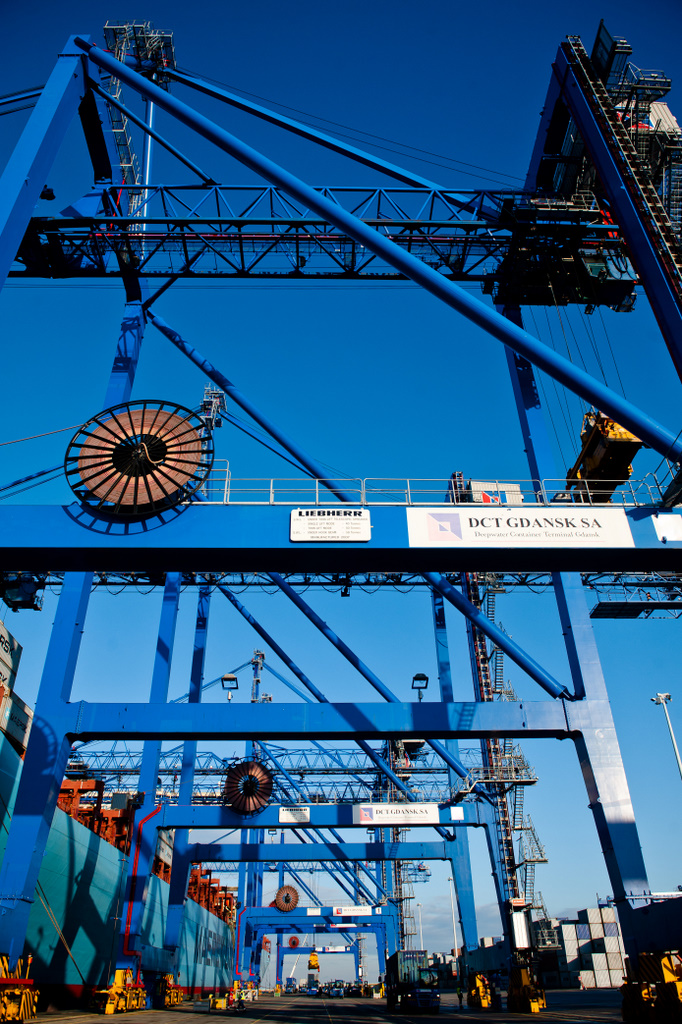
The Baltic Hub Container Terminal (previously Deepwater Container Terminal) is located in the northern port. It was officially opened on 1 October 2007 and is the largest container terminal in Poland. It also serves as a transshipment hub for Saint Petersburg and other ports in the Baltic Sea region. Currently the handling capacity of the container terminal amounts to 3,000,000 TEU with prospect to further increase by 250,000 TEU due to conversion of additional storage area as well as container handling equipment purchase.
The terminal has become a springboard for the Polish Maritime Economy. In 2011, some of the largest container ships in the world at that time, the 14,700-TEU capacity Mærsk E-class container ships began regular weekly calls in Gdańsk. These included Evelyn Maersk, Emma Maersk, Eleonora Maersk, Ebba Maersk and Eugen Maersk. DCT Gdańsk reached its first one millionth handling in June 2011. July 2011 saw the implementation of E-SMART, a modern tool by the British company International Terminal Solutions Ltd (ITS). Maersk were the first container line which to introduce direct navigational connection (AE10) from the Far East to the Baltic region.
Sea connectivity
- Maersk Line AE10 Asia–Europe–Asia (Kwangyang – Ningbo – Shanghai – Yantian – Tanjung Pelepas – Suez Canal – Rotterdam – Bremerhaven– Gdansk – Aarhus – Gothenburg – Bremerhaven – Rotterdam – Algeciras – Suez Canal – Yantian – Kwangyang)
- Gdansk Finnish Gulf Service (Gdansk – Kotka – Helsinki – Gdansk)
- Gdansk – St. Petersburg Service (Gdansk – St. Petersburg – Gdansk)
- OOCL line LL1 Asia-North Europe Loop1 (Shanghai - Ningbo - Xiamen - Yantian - Singapore - Felixstowe - Zeebrugge - Gdansk - Wilhelmshaven - Piraeus)
Statistics
| Year | Cargo tons | Containers TEU | Containers tons | Passengers |
|---|---|---|---|---|
| 2010 | ||||
| 2011 | ||||
| 2012 | ||||
| 2013 | ||||
| 2014 | ||||
| 2015 | ||||
| 2016 | ||||
| 2017 | ||||
| 2018 | ||||
| 2019 | ||||
| 2020 | ||||
| 2021 | ||||
| 2022 | ||||
| 2023 | ||||
| 2024 | ||||
| 2025 |
Gallery
File:Gdansk port.JPG|Entrance to the Inner Port File:Port of Gdansk from mainmast of Fryderyk Chopin.jpg|Port of Gdańsk from mainmast of Fryderyk Chopin File:Pleiades spirit in Gdańsk (Poland).jpg|Car carrier in the entrance to the inner port, as seen from the nearby beach File:StoczniaGdanska1.jpg|Industrial landscape of the Gdańsk Shipyard
References
References
This article was imported from Wikipedia and is available under the Creative Commons Attribution-ShareAlike 4.0 License. Content has been adapted to SurfDoc format. Original contributors can be found on the article history page.
Ask Mako anything about Port of Gdańsk — get instant answers, deeper analysis, and related topics.
Research with MakoFree with your Surf account
Create a free account to save articles, ask Mako questions, and organize your research.
Sign up freeThis content may have been generated or modified by AI. CloudSurf Software LLC is not responsible for the accuracy, completeness, or reliability of AI-generated content. Always verify important information from primary sources.
Report