From Surf Wiki (app.surf) — the open knowledge base
Pontic–Caspian steppe
One of the Eurasian steppes
One of the Eurasian steppes
| Field | Value |
|---|---|
| name | Pontic–Caspian steppe |
| map | Ecoregion PA0814.svg |
| map_caption | The steppe extends roughly from the Danube to the Ural River. This map shows the region known as the Pontic Steppe, which is the biggest portion of the whole Pontic–Caspian Steppe. |
| image | Обитатели Азово-Сивашского заповедника на Бирючем острове.jpg |
| image_caption | The steppe in Azov-Syvash National Nature Park, Ukraine, with reintroduced horses. |
| biogeographic_realm | Palearctic |
| biome | Temperate grasslands, savannas, and shrublands |
| border1 | Caspian lowland desert |
| border2 | Caucasus mixed forests |
| border3 | Central European mixed forests |
| border4 | Crimean Submediterranean forest complex |
| border5 | East European forest steppe |
| border6 | Kazakh semi-desert |
| border7 | Kazakh steppe |
| country1 | Bulgaria |
| country2 | Kazakhstan |
| country3 | Moldova |
| country4 | Romania |
| country5 | Russia |
| country6 | Ukraine |
| area | 994000 |
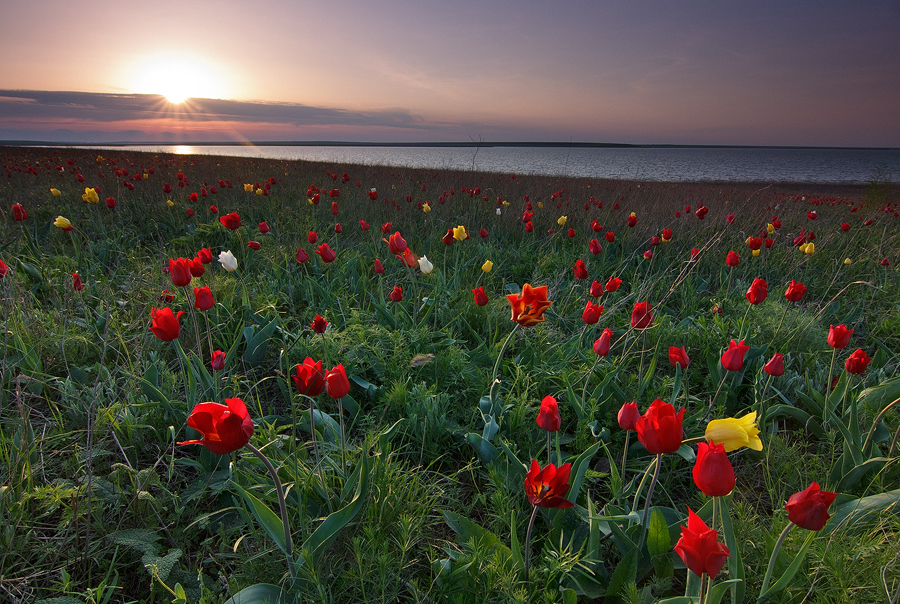
The Pontic–Caspian Steppe is a steppe extending across Eastern Europe to Central Asia, formed by the Caspian and Pontic steppes. It stretches from the northern shores of the Black Sea (the Pontus Euxinus of antiquity) to the northern area around the Caspian Sea, where it ends at the Ural-Caspian narrowing, which joins it with the Kazakh Steppe in Central Asia, making it a part of the larger Eurasian Steppe. Geopolitically, the Pontic–Caspian Steppe extends from northeastern Bulgaria and southeastern Romania through Moldova, southern and eastern Ukraine, through the North Caucasus of southern Russia, and into the Lower Volga region where it straddles the border of southern Russia and western Kazakhstan. Biogeographically, it is a part of the Palearctic realm, and of the temperate grasslands, savannas, and shrublands biome.
The area corresponds to Cimmeria, Scythia, and Sarmatia of classical antiquity. Across several millennia, numerous tribes of nomadic horsemen used the steppe; many of them went on to conquer lands in the settled regions of Central and Eastern Europe, West Asia, and South Asia.
In biogeography, the term Ponto-Caspian region refers to the distinctive plant and animal life of these steppes, covering species that are native to the surrounding waters of the Black Sea, the Caspian Sea, and the Azov Sea. Genetic research has identified this region as the most probable place where horses were first domesticated. The Kurgan hypothesis, the most prevalent theory in Indo-European studies, posits that the Pontic–Caspian steppe was the homeland of the speakers of the Proto-Indo-European language.
Geography and ecology
The Pontic–Caspian steppe covers an area of 994,000 sqkm of Central and Eastern Europe, that extends from northeastern Bulgaria and southeastern Romania, through Moldova, and southern and eastern Ukraine, through the Northern Caucasus of southern Russia, and into the Lower Volga region of western Kazakhstan, to the east of the Ural Mountains. The steppe is bounded by the East European forest steppe to the north, a transitional zone of mixed grasslands and temperate broadleaf and mixed forests.
To the south, the steppe extends to the Black Sea, except the Crimean and western Caucasus mountains' border with the sea, where the Crimean Submediterranean forest complex defines the southern edge of the steppes. The steppe extends to the western shore of the Caspian Sea in the Dagestan region of Russia, but the drier Caspian lowland desert lies between the steppe and the northwestern and northern shores of the Caspian. The Kazakh Steppe bounds the steppe to the east.
The Ponto-Caspian seas are the remains of the Turgai Sea, an extension of the Paratethys which extended south and east of the Urals and covering much of today's West Siberian Plain in the Mesozoic and Cenozoic.
Prehistoric cultures

Innumerable tribes, cultures, nations, kingdoms, empires, etc. had origins in Pontic Caspian Steppes including:
- Linear Pottery culture 5500–4500 BCE
- Cucuteni-Trypillian culture 5300–2600 BCE
- Khvalynsk culture 5000–3500 BCE
- Sredny Stog culture 4500–3500 BCE
- Maykop culture 3700–3000 BCE
- Mykhailivka culture 3600—3000 BCE
- Yamnaya/Kurgan cultures 3500–2300 BCE
- Kura-Araxes culture 3000–2000 BCE
- Catacomb culture 3000–2200 BCE
- Srubna culture 1600–1200 BCE
- Koban culture 1100–400 BCE
- Novocherkassk culture 900–650 BCE
Historical peoples and nations

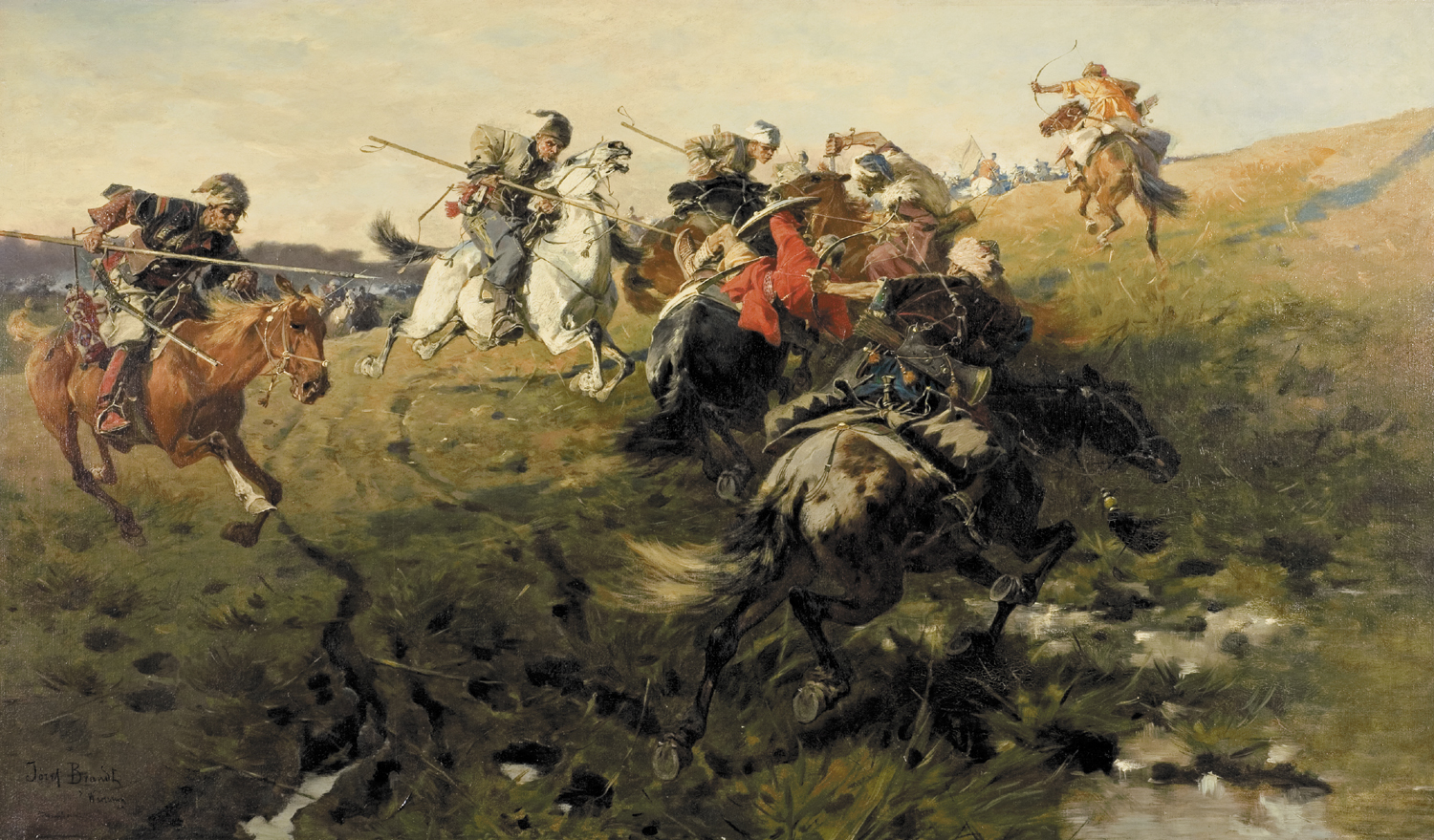
Innumerable tribes, cultures, nations, kingdoms, empires, etc. had origins in the Pontic Caspian Steppes including:
- Indo-Europeans 4th millennium BCE – now
- Cimmerians 12th–7th centuries BCE
- Dacians and Thracians (Getae) 11th century BCE – 3rd century CE
- Scythians 8th–4th centuries BCE
- Sarmatians 5th century BCE – 5th century CE
- Ostrogoths 3rd–6th centuries
- Huns and Avars 4th–8th centuries
- Bulgars, Onogurs, and Bulgarians 4th–21st centuries:
- Great Bulgaria 7th century
- First Bulgarian Empire 7th–11th centuries
- Second Bulgarian Empire 12th–15th centuries
- Principality of Karvuna
- Alans 5th–11th centuries
- Eurasian Avars 6th–8th centuries
- Göktürks 6th–8th centuries
- Sabirs 6th–8th centuries
- Khazars 6th–11th centuries
- Magyar tribes (Hungarians) 7th–9th centuries attested but probably from earlier
- Rus' people (Kievan Rus') 8th–13th centuries
- Pechenegs 8th–11th centuries
- Kipchaks and Cumans 11th–13th centuries
- Turkic Golden Horde 13th–15th centuries
- Cossacks, Kalmyks, Crimean Khanate, Volga Tatars, Nogais, and other Turkic states and tribes 15th–18th centuries
- Russian Empire 16th–20th centuries
- Mountainous Republic of the Northern Caucasus 19th–20th centuries
- Soviet Union 20th century
- Ukraine, Moldova, Southern Russia, Kazakhstan 21st century
References
References
- "Mystery Of Horse Domestication Solved?".
- Anthony, David W.. (2010). "The Horse, the Wheel, and Language: How Bronze-Age Riders from the Eurasian Steppes Shaped the Modern World". Princeton University Press.
- (2015). "Massive migration from the steppe was a source for Indo-European languages in Europe". Nature.
- (4 April 2017). "Steppe migrant thugs pacified by Stone Age farming women". Faculty of Science – University of Copenhagen.
- "The Proto-Turkic Urheimat and the Early Migrations of Turkic Peoples".
This article was imported from Wikipedia and is available under the Creative Commons Attribution-ShareAlike 4.0 License. Content has been adapted to SurfDoc format. Original contributors can be found on the article history page.
Ask Mako anything about Pontic–Caspian steppe — get instant answers, deeper analysis, and related topics.
Research with MakoFree with your Surf account
Create a free account to save articles, ask Mako questions, and organize your research.
Sign up freeThis content may have been generated or modified by AI. CloudSurf Software LLC is not responsible for the accuracy, completeness, or reliability of AI-generated content. Always verify important information from primary sources.
Report