From Surf Wiki (app.surf) — the open knowledge base
Pauson–Khand reaction
Chemical reaction

Chemical reaction
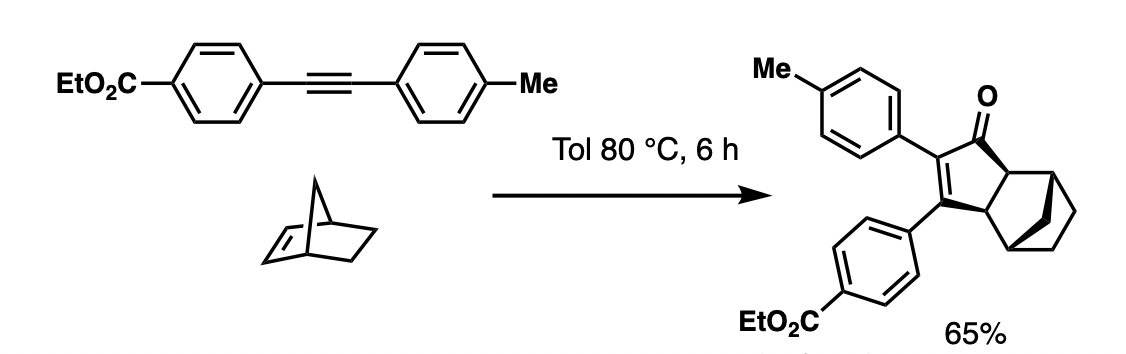
The Pauson–Khand (PK) reaction is a chemical reaction, described as a [2+2+1] cycloaddition. In it, an alkyne, an alkene, and carbon monoxide combine into a α,β-cyclopentenone in the presence of a metal-carbonyl catalyst Ihsan Ullah Khand (1935–1980) discovered the reaction around 1970, while working as a postdoctoral associate with Peter Ludwig Pauson (1925–2013) at the University of Strathclyde in Glasgow. Pauson and Khand's initial findings were intermolecular in nature, but the reaction has poor selectivity. Some modern applications instead apply the reaction for intramolecular ends.
The traditional reaction requires a stoichiometric amounts of dicobalt octacarbonyl, stabilized by a carbon monoxide atmosphere. Catalytic metal quantities, enhanced reactivity and yield, or stereoinduction are all possible with the right chiral auxiliaries, choice of transition metal (Ti, Mo, W, Fe, Co, Ni, Ru, Rh, Ir and Pd), and additives.
Mechanism
While the mechanism has not yet been fully elucidated, Magnus' 1985 explanation is widely accepted for both mono- and dinuclear catalysts, and was corroborated by computational studies published by Nakamura and Yamanaka in 2001. The reaction starts with dicobalt hexacarbonyl acetylene complex. Binding of an alkene gives a metallacyclopentene complex. CO then migratorily inserts into an M-C bond. Reductive elimination delivers the cyclopentenone. Typically, the dissociation of carbon monoxide from the organometallic complex is rate limiting.

1:Alkyne coordination, insertion and ligand dissociation to form an 18-electron complex; 2:Ligand dissociation to form a 16-electron complex; 3:Alkene coordination to form an 18-electron complex; 4:Alkene insertion and ligand association (synperiplanar, still 18 electrons); 5:CO migratory insertion; 6, 7:Reductive elimination of metal (loss of [Co2(CO)6]); 8:CO association, to regenerate the active organometallic complex. ]]
Selectivity
The reaction works with both terminal and internal alkynes, although internal alkynes tend to give lower yields. The order of reactivity for the alkene is(strained cyclic) (terminal) (disubstituted) (trisubstituted). Tetrasubstituted alkenes and alkenes with strongly electron-withdrawing groups are unsuitable.
With unsymmetrical alkenes or alkynes, the reaction is rarely regioselective, although some patterns can be observed.

For mono-substituted alkenes, alkyne substituents typically direct: larger groups prefer the C2 position, and electron-withdrawing groups prefer the C3 position.
But the alkene itself struggles to discriminate between the C4 and C5 position, unless the C2 position is sterically congested or the alkene has a chelating heteroatom.
The reaction's poor selectivity is ameliorated in intramolecular reactions. For this reason, the intramolecular Pauson-Khand is common in total synthesis, particularly the formation of 5,5- and 6,5-membered fused bicycles.

Generally, the reaction is highly syn-selective about the bridgehead hydrogen and substituents on the cyclopentane.

Appropriate chiral ligands or auxiliaries can make the reaction enantioselective (see ). BINAP is commonly employed.
Additives

Typical Pauson-Khand conditions are elevated temperatures and pressures in aromatic hydrocarbon (benzene, toluene) or ethereal (tetrahydrofuran, 1,2-dichloroethane) solvents. These harsh conditions may be attenuated with the addition of various additives.

Absorbent surfaces
Adsorbing the metallic complex onto silica or alumina can enhance the rate of decarbonylative ligand exchange as exhibited in the image below. This is because the donor posits itself on a solid surface (i.e. silica). Additionally using a solid support restricts conformational movement (rotamer effect).
Lewis bases
Traditional catalytic aids such as phosphine ligands make the cobalt complex too stable, but bulky phosphite ligands are operable.

Lewis basic additives, such as n-BuSMe, are also believed to accelerate the decarbonylative ligand exchange process. However, an alternative view holds that the additives make olefin insertion irreversible instead. Sulfur compounds are typically hard to handle and smelly, but n-dodecyl methyl sulfide and tetramethylthiourea do not suffer from those problems and can improve reaction performance.
Amine ''N''-oxides
The two most common amine N-oxides are N-methylmorpholine N-oxide (NMO) and trimethylamine N-oxide (TMANO). It is believed that these additives remove carbon monoxide ligands via nucleophilic attack of the N-oxide onto the CO carbonyl, oxidizing the CO into CO2, and generating an unsaturated organometallic complex. This renders the first step of the mechanism irreversible, and allows for more mild conditions. Hydrates of the aforementioned amine N-oxides have similar effect.

N-oxide additives can also improve enantio- and diastereoselectivity, although the mechanism thereby is not clear.

A step in the total synthesis of epoxydictymene: temperature and ultrasound failed to improve the d.r. for the desired diastereomer (the red hydrogen). But the N-oxide additive, while lower yielding, gave a d.r. of 11:1. ]]
Alternative catalysts
(Co)4(CO)12 and Co3(CO)9(μ3-CH) also catalyze the PK reaction although Takayama et al detail a reaction catalyzed by dicobalt octacarbonyl.

One stabilization method is to generate the catalyst in situ. Chung reports that Co(acac)2 can serve as a precatalyst, activated by sodium borohydride.
Other metals
catalyst requires a silver triflate co-catalyst to effect the Pauson–Khand reaction:

Molybdenum hexacarbonyl is a carbon monoxide donor in PK-type reactions between allenes and alkynes with dimethyl sulfoxide in toluene. Titanium, nickel,Titanium:
Nickel:
- and zirconium
- complexes admit the reaction. Other metals can also be employed in these transformations.
Substrate tolerance
In general allenes, support the Pauson–Khand reaction; regioselectivity is determined by the choice of metal catalyst. Density functional investigations show the variation arises from different transition state metal geometries.

Heteroatoms are also acceptable: Mukai et al's total synthesis of physostigmine applied the Pauson–Khand reaction to a carbodiimide.

Cyclobutadiene also lends itself to a [2+2+1] cycloaddition, although this reactant is too active to store in bulk. Instead, ceric ammonium nitrate cyclobutadiene is generated in situ from decomplexation of stable cyclobutadiene iron tricarbonyl with (CAN).

An example of a newer version is the use of the chlorodicarbonylrhodium(I) dimer, [(CO)2RhCl]2, in the synthesis of (+)-phorbol by Phil Baran. In addition to using a rhodium catalyst, this synthesis features an intramolecular cyclization that results in the normal 5-membered α,β-cyclopentenone as well as 7-membered ring.
Carbon monoxide generation ''in situ''
The cyclopentenone motif can be prepared from aldehydes, carboxylic acids, and formates. These examples typically employ rhodium as the catalyst, as it is commonly used in decarbonylation reactions. The decarbonylation and PK reaction occur in the same reaction vessel.
References
References
- (1971). "A cobalt induced cleavage reaction and a new series of arenecobalt carbonyl complexes". Journal of the Chemical Society D: Chemical Communications.
- (2004). "The Pauson–Khand reaction, a powerful synthetic tool for the synthesis of complex molecules". [[Chem. Soc. Rev.]].
- Werner, Helmut. (2014). "Obituary: Peter Ludwig Pauson (1925–2013)". [[Angew. Chem. Int. Ed.]].
- (1981-12-01). "Preparation of bicyclo[3.3.0]oct-1-en-3-one and bicyclo[4.3.0]non-1(9)-en-8-one via intramolecular cyclization of .alpha.,.omega.-enynes". The Journal of Organic Chemistry.
- Schore, Neil E.. (1991). "The Pauson–Khand Cycloaddition Reaction for Synthesis of Cyclopentenones". [[Org. React.]].
- (January 1985). "Origins of 1,2- and 1,3-stereoselectivity in dicobaltoctacarbonyl alkene-alkyne cyclizations for the synthesis of substituted bicyclo[3.3.0]octenones.". Tetrahedron Letters.
- (2001-02-01). "Density Functional Studies on the Pauson−Khand Reaction". Journal of the American Chemical Society.
- (2005). "Strategic Applications of Named Reactions in Organic Synthesis: background and detailed mechanisms". Elsevier Academic Press.
- (1984). "A simple organocobalt mediated synthesis of substituted 3-oxabicyclo[3.3.0]oct-6-en-7-ones". Tetrahedron Letters.
- (1986). "Oxidation by cobalt(III) acetate. Part 10. Effects of ring substituents on the product distributions in the oxidation of β-methylstyrenes by cobalt(III) acetate in acetic acid". J. Chem. Soc., Perkin Trans. 2.
- (1990). "The synthesis of nitrogen heterocycles via the intramolecular Khand reaction: formation of tetra- and hexa-hydrocyclopenta[c]pyrrol-5(1H)-ones and hexahydro-6H-2-pyrindin-6-ones". Journal of the Chemical Society, Perkin Transactions 1.
- (1987-05-31). "Activation and Catalytic Reactions of Alkanes in Solutions of Metal Complexes". Russian Chemical Reviews.
- (1989-01-01). "Methylenecyclopropane as an alkene component in the Khand-Pauson reaction". Tetrahedron Letters.
- (2005). "Lewis Base Promoters in the Pauson–Khand Reaction: A Different Scenario". Angewandte Chemie International Edition.
- (2021-01-08). "Advances in the cobalt-catalysed Pauson-Khand reaction: Development of a sulfide-promoted, microwave-assisted protocol". Tetrahedron.
- (March 2000). "Rotaxanes via Michael Addition†". Organic Letters.
- (1990-01-01). "N-oxide promoted pauson-khand cyclizations at room temperature". Tetrahedron Letters.
- (2011-02-03). "Reactions of iron pentacarbonyl with compounds containing the N—O linkage". Canadian Journal of Chemistry.
- (2006-12-04). "Use of a highly effective intramolecular Pauson–Khand cyclisation for the formal total synthesis of (±)-α- and β-cedrene by preparation of cedrone". Tetrahedron.
- (1992-09-01). "Pauson-Khand reaction with electron-deficient alkynes". The Journal of Organic Chemistry.
- (1995-10-01). "Asymmetric Pauson-Khand Cyclization: A Formal Total Synthesis of Natural Brefeldin A". The Journal of Organic Chemistry.
- (1997-05-01). "Tandem Use of Cobalt-Mediated Reactions to Synthesize (+)-Epoxydictymene, a Diterpene Containing a Trans-Fused 5−5 Ring System". Journal of the American Chemical Society.
- (2000-04-22). "Preparation and reaction of desymmetrised cobalt alkyne complexes". Tetrahedron Letters.
- (July 1999). "Generation and Reactions of Ammonium Ylides in Basic Two-Phase Systems: Convenient Synthesis of Cyclopropanes, Oxiranes and Alkenes Substituted with Electron-Withdrawing Groups". Synlett.
- (February 1998). "Pauson-Khand Reaction Catalyzed by Co4(CO)12". Synthesis.
- (1998-10-01). "The Pauson−Khand Reaction Catalyzed by the Methylidynetricobalt Nonacarbonyl Cluster". Journal of the American Chemical Society.
- (2011). "Asymmetric Total Synthesis of a Pentacyclic ''Lycopodium'' Alkaloid: Huperzine-Q". [[Angew. Chem. Int. Ed.]].
- Ho, Tse-Lok. (2016). "Fiesers' Reagents for Organic Synthesis". [[John Wiley & Sons]].
- (April 1996). "Synthesis of cyclopentenones: The new catalytic cocyclization reaction of alkyne, alkene, and carbon monoxide employing catalytic Co(acac)2 and NaBH4". Tetrahedron Letters.
- Nakcheol Jeong, Byung Ki Sung, Jin Sung Kim, Soon Bong Park,Sung Deok Seo, Jin Young Shin, Kyu Yeol In, Yoon Kyung Choi ''Pauson–Khand-type reaction mediated by Rh(I) catalysts'' ''Pure Appl. Chem.'', Vol. 74, No. 1, pp. 85–91, '''2002'''. ([http://www.iupac.org/publications/pac/2002/pdf/7401x0085.pdf Online article])
- (1995). "A new allenic Pauson-Khand cycloaddition for the preparation of α-methylene cyclopentenones". Tetrahedron Letters.
- (April 1994). "Catalytic version of the Intramolecular Pauson-Khand Reaction". Journal of the American Chemical Society.
- (2006-10-01). "Computational Insight Concerning Catalytic Decision Points of the Transition Metal Catalyzed [2 + 2 + 1] Cyclocarbonylation Reaction of Allenes". Organometallics.
- (January 2006). "Co2(CO)8-Catalyzed Intramolecular Hetero-Pauson−Khand Reaction of Alkynecarbodiimide: Synthesis of (±)-Physostigmine". Organic Letters.
- (2016). "Nineteen-step total synthesis of (+)-phorbol". [[Nature (journal).
- (2002). "CO-Transfer Carbonylation Reactions. A Catalytic Pauson−Khand-Type Reaction of Enynes with Aldehydes as a Source of Carbon Monoxide". [[Journal of the American Chemical Society]].
- (2002). "Catalytic Pauson−Khand-Type Reaction Using Aldehydes as a CO Source". [[Organic Letters]].
This article was imported from Wikipedia and is available under the Creative Commons Attribution-ShareAlike 4.0 License. Content has been adapted to SurfDoc format. Original contributors can be found on the article history page.
Ask Mako anything about Pauson–Khand reaction — get instant answers, deeper analysis, and related topics.
Research with MakoFree with your Surf account
Create a free account to save articles, ask Mako questions, and organize your research.
Sign up freeThis content may have been generated or modified by AI. CloudSurf Software LLC is not responsible for the accuracy, completeness, or reliability of AI-generated content. Always verify important information from primary sources.
Report