From Surf Wiki (app.surf) — the open knowledge base
National Provincial Championship (1976–2005)
Former New Zealand rugby union competition

Former New Zealand rugby union competition
| Field | Value |
|---|---|
| name | National Provincial Championship |
| logo | Npc.jpg |
| pixels | 90px |
| alt | National Provincial Championship logo |
| sport | Rugby union |
| inaugural | 1976 |
| folded | 2005 |
| country | New Zealand |
| gov_body | NZR |
| most_champs | Auckland |
| count | 15 |
| website | provincial.rugby |
| related_comps | Farah Palmer Cup |
| related_comps2 | Heartland Championship |
| related_comps3 | Ranfurly Shield |
The National Provincial Championship, often simply called the NPC, was an annual promotion and relegation rugby union competition in men's domestic New Zealand rugby. First played during the 1976 season, it was the highest level of competition in New Zealand until Super Rugby launched in 1996. It was organised by New Zealand Rugby (NZR) and ceased following the 2005 season.
The league was restructured into two distinct competitions for 2006. The National Provincial Championship would include professional and semi-professional players, and consist of the top fourteen financial and best performing regional teams. For sponsorship reasons it was rebranded as the Air New Zealand Cup. The remaining teams formed a new amateur competition known as the Heartland Championship.
Twenty-eight teams competed since the inception of the competition in 1976. Auckland were the most successful union with fifteen titles and Bay of Plenty were the inaugural champions. Six other teams had won the title: Canterbury (5), Wellington (4), Otago (2), Counties Manukau (1), Manawatu (1), and Waikato (1).
History
The first form of competition came in 1904 with the introduction of the Ranfurly Shield as a challenge trophy. Each year, fixtures were arranged in Wellington during the annual meeting of the New Zealand Rugby Football Union, where an elected representative from each provincial union would propose dates and opponents that ideally avoided conflicts with local club competitions. Across the country, neighbouring regions organised regular matches for challenge trophies. One of the most prestigious competitions, the Hanan Shield, was established in 1946 by Timaru's former mayor, A.E.S. Hanan, and was contested by Mid Canterbury, South Canterbury, and North Otago. Another significant trophy, the Seddon Shield, was first challenged in 1906. Named after former New Zealand premier Richard Seddon, it featured representative teams from Buller, Nelson Bays, Marlborough, and the West Coast. In the North Island, starting in the King Country and moving north, eleven teams competed for the Coronation Shield.
Given the numerous competitions across New Zealand, there was a clear need for a national tournament. In 1972, Barry Smith proposed an inter-provincial competition to the Auckland Rugby Union. After gaining approval, the proposal was brought to the New Zealand Rugby Football Union's annual conference in early 1974. It included an overview of the scheme, addressing finance, travel, sponsorship opportunities, implications for club and sub-union competitions, traditional representative matches, international laws, and Sunday play. Following discussions in October 1975, modifications were made and ultimately accepted by all provinces. Radio New Zealand secured sponsorship rights worth NZD 100,000 and helped market the new competition, later joined by Lion Breweries, National Mutual, and Air New Zealand. Teams were divided into two divisions based on their performance over the previous five years. The premier division included Auckland, Bay of Plenty, Canterbury, Counties, Hawke's Bay, Manawatu, Marlborough, North Auckland, Otago, Southland, and Wellington, determined by a ranking system. The remaining provinces, Buller, East Coast, Horowhenua, King Country, Mid Canterbury, Nelson Bays, North Otago, Poverty Bay, South Canterbury, Taranaki, Thames Valley, Waikato, Wairarapa Bush, Wanganui and the West Coast were split into North Island and South Island sub-divisions, with the potential for promotion to the top division.
Between 1980 and the early 2000s, Auckland experienced a golden era, dominating competitions and consistently retaining the Ranfurly Shield. During this time, they reached eighteen finals, finishing as runners-up multiple times, and secured over half of the available competition titles, totaling fifteen. This remarkable run included a record sixty-one Ranfurly Shield defenses, five South Pacific Championship titles, and recognition as the Halberg Awards Team of the Year in 1992.
Canterbury emerged as the only team to consistently challenge Auckland's supremacy, with several matches becoming historic. The 1985 clash, where Auckland ended Canterbury's record-equaling streak of twenty-five matches, was famously dubbed the "Match of the Century." In front of a record crowd of 52,000 at Lancaster Park, Canterbury nearly staged a stunning comeback from a 24–0 half-time deficit, but Auckland held on to win 28–23, setting a new benchmark with sixty-one consecutive defences over eight years.
Auckland's fortunes waned with the professionalisation of rugby, officially declared in August 1995. The introduction of Super 12 in 1996 marked the end of their dominance as many international players became unavailable. Notable stars like Sean Fitzpatrick, who captained the All Blacks and played 154 games for Auckland, and Grant Fox, who set a record for the most shield points (932), were pivotal during this era, along with John Kirwan, who scored forty-four tries.
Teams
The fourteen provincial unions that have participated in the current National Provincial Championship since its founding in 2006 are listed below. Ten teams are situated in the North Island and four teams in the South Island.
The NPC, which comes after Super Rugby and international rugby, constitutes the "third tier" of rugby union in New Zealand. Below this tier are numerous club competitions, which are organised by each provincial union.
| Team | Union | Established | Location | Venue |
|---|---|---|---|---|
| **** | Auckland Rugby Union | Auckland | Eden Park | |
| **** | Bay of Plenty Rugby Union | Tauranga | Tauranga Domain | |
| **** | Buller Rugby Football Union | Westport | Victoria Square | |
| **** | Canterbury Rugby Football Union | Christchurch | Jade Stadium | |
| **** | Central Vikings Rugby Union | Napier | McLean Park | |
| **** | Counties Manukau Rugby Football Union | Pukekohe | Pukekohe Stadium | |
| **** | East Coast Rugby Football Union | Ruatoria | Whakarua Park | |
| **** | Hawke's Bay Rugby Union | Napier | McLean Park | |
| **** | Horowhenua Kapiti Rugby Football Union | Levin | Levin Domain | |
| **** | King Country Rugby Union | Te Kuiti | Rugby Park | |
| **** | Manawatu Rugby Union | Palmerston North | Central Energy Trust Arena | |
| **** | Marlborough Rugby Union | Blenheim | Lansdowne Park | |
| **** | Mid Canterbury Rugby Union | Ashburton | Ashburton Showgrounds | |
| **** | Nelson Bays Rugby Union | Nelson | Trafalgar Park | |
| **** | North Harbour Rugby Union | Auckland | North Harbour Stadium | |
| **** | North Otago Rugby Football Union | Oamaru | Centennial Park | |
| **** | Northland Rugby Union | Whangārei | Okara Park | |
| **** | Otago Rugby Football Union | Dunedin | Carisbrook | |
| **** | Poverty Bay Rugby Football Union | Gisborne | Rugby Park | |
| **** | South Canterbury Rugby Football Union | Timaru | Fraser Park | |
| **** | Rugby Southland | Invercargill | Rugby Park Stadium | |
| **** | Taranaki Rugby Football Union | New Plymouth | Yarrow Stadium | |
| **** | Thames Valley Rugby Union | Paeroa | Boyd Park | |
| **** | Waikato Rugby Union | Hamilton | Waikato Stadium | |
| **** | Wairarapa Bush Rugby Football Union | Masterton | Memorial Park | |
| **** | Wellington Rugby Football Union | Wellington | Sky Stadium | |
| **** | West Coast Rugby Union | Greymouth | John Sturgeon Park | |
| **** | Wanganui Rugby Football Union | Wanganui | Cooks Gardens |
: One of the two home fields used by the Bay of Plenty Rugby Union is the Tauranga Domain. It serves as both their main stadium and training facility, with the Rotorua International Stadium serving as a temporary location for the occasional fixture. : A combined team of Hawke's Bay and Manawatu for the 1997 and 1998 NPC seasons : Named Counties Rugby Football Union until 1995 : Named Horowhenua Rugby Football Union until 1997 : Named North Auckland Rugby Union until 1994
Champions
The winner of the NPC trophy, also known as the Rugby Cup from the previous tournament, is chosen annually in New Zealand Rugby's National Provincial Championship final match since 1992. After the semi-finals, a New Zealand city is selected to host the contest, with the semi-final victor with the highest seed receiving home field advantage. Prior to 1992 the top team on the points table was the winner. The competition was split into three divisions, with division one being acknowledged and recognised as the champion.
| Edition | Year | Champion | Result | Runner-up | Venue | Location | Winning coach |
|---|---|---|---|---|---|---|---|
| 1 | 1976 | No play-offs | Eric Anderson | ||||
| 2 | 1977 | Canterbury | Counties | No play-offs | Tiny Hill | ||
| 3 | 1978 | Wellington | Counties | No play-offs | Ian Upston | ||
| 4 | 1979 | Counties | Auckland | No play-offs | Hiwi Tauroa | ||
| 5 | 1980 | Manawatu | Auckland | No play-offs | Graham Hamer | ||
| 6 | 1981 | Wellington | Manawatu | No play-offs | Ian Upston | ||
| 7 | 1982 | Auckland | Canterbury | No play-offs | John Hart | ||
| 8 | 1983 | Canterbury | Wellington | No play-offs | Alex Wyllie | ||
| 9 | 1984 | Auckland | Canterbury | No play-offs | John Hart | ||
| 10 | 1985 | Auckland | Canterbury | No play-offs | John Hart | ||
| 11 | 1986 | Wellington | Auckland | No play-offs | Earle Kirton | ||
| 12 | 1987 | Auckland | Wellington | No play-offs | Maurice Trapp | ||
| 13 | 1988 | Auckland | Wellington | No play-offs | Maurice Trapp | ||
| 14 | 1989 | Auckland | Canterbury | No play-offs | Maurice Trapp | ||
| 15 | 1990 | Auckland | Waikato | No play-offs | Maurice Trapp | ||
| 16 | 1991 | Otago | Auckland | No play-offs | Laurie Mains | ||
| 17 | 1992 | Waikato | 40–5 | Otago | Rugby Park | Hamilton | Kevin Greene |
| 18 | 1993 | Auckland | 27–18 | Otago | Eden Park | Auckland | Graham Henry |
| 19 | 1994 | Auckland | 22–16 | North Harbour | Onewa Domain | Auckland | Graham Henry |
| 20 | 1995 | Auckland | 23–19 | Otago | Eden Park | Auckland | Graham Henry |
| 21 | 1996 | Auckland | 46–15 | Counties Manukau | Eden Park | Auckland | Graham Henry |
| 22 | 1997 | Canterbury | 44–13 | Counties Manukau | Lancaster Park | Christchurch | Robbie Deans |
| 23 | 1998 | Otago | 49–20 | Waikato | Carisbrook | Dunedin | Tony Gilbert |
| 24 | 1999 | Auckland | 24–18 | Wellington | Eden Park | Auckland | Wayne Pivac |
| 25 | 2000 | Wellington | 34–29 | Canterbury | Jade Stadium | Christchurch | Dave Rennie |
| 26 | 2001 | Canterbury | 30–19 | Otago | Jade Stadium | Christchurch | Steve Hansen |
| 27 | 2002 | Auckland | 40–28 | Waikato | Waikato Stadium | Hamilton | Wayne Pivac |
| 28 | 2003 | Auckland | 41–29 | Wellington | Westpac Stadium | Wellington | Wayne Pivac |
| 29 | 2004 | Canterbury | 40–27 | Wellington | Westpac Stadium | Wellington | Brian McLean |
| 30 | 2005 | Auckland | 39–11 | Otago | Eden Park | Auckland | Pat Lam |
Second-tier champions
The 2002 season saw the introduction of the Meads Cup and Lochore Cup, which were contested by unions from the second and third divisions respectively. North Otago and Hawke's Bay were the first honourable winners. New Zealand Rugby made the decision to incorporate the trophies in the new Heartland Championship tournament when the National Provincial Championship was discontinued in 2005. The silverware commemorate the names of Sir Brian Lochore and Sir Colin Meads, two legendary international rugby players from New Zealand.
| Season | Division 2 North | Division 2 South | Champion | Runner-up | Champion | Runner-up |
|---|---|---|---|---|---|---|
| 1976 | Taranaki | Wanganui | South Canterbury | Buller | ||
| 1977 | North Auckland | Waikato | South Canterbury | Mid Canterbury | ||
| 1978 | Bay of Plenty | Waikato | Marlborough | Nelson Bays | ||
| 1979 | Hawke's Bay | Waikato | Marlborough | Mid Canterbury | ||
| 1980 | Waikato | Taranaki | Mid Canterbury | Marlborough | ||
| 1981 | Wairarapa Bush | Taranaki | South Canterbury | Marlborough | ||
| 1982 | Taranaki | Wanganui | Southland | Mid Canterbury | ||
| 1983 | Taranaki | Wanganui | Mid Canterbury | Southland | ||
| 1984 | Taranaki | Wanganui | Southland | Marlborough |
| Season | Division 2 | Division 3 | Champion | Runner-up | Champion | Runner-up |
|---|---|---|---|---|---|---|
| 1985 | Taranaki | Hawke's Bay | North Harbour | Nelson Bays | ||
| 1986 | Waikato | North Harbour | South Canterbury | East Coast | ||
| 1987 | North Harbour | Hawke's Bay | Poverty Bay | Horowhenua | ||
| 1988 | Hawke's Bay | Marlborough | Thames Valley | Wanganui | ||
| 1989 | Southland | Manawatu | Wanganui | South Canterbury | ||
| 1990 | Hawke's Bay | King Country | Thames Valley | Horowhenua | ||
| 1991 | King Country | Southland | South Canterbury | Mid Canterbury | ||
| 1992 | Taranaki | Counties | Nelson Bays | Horowhenua | ||
| 1993 | Counties | Bay of Plenty | Horowhenua | Wanganui | ||
| 1994 | Southland | Hawke's Bay | Mid Canterbury | Poverty Bay | ||
| 1995 | Taranaki | Northland | Thames Valley | Poverty Bay | ||
| 1996 | Southland | Northland | Wanganui | Marlborough | ||
| 1997 | Northland | Central Vikings | Marlborough | North Otago | ||
| 1998 | Central Vikings | Bay of Plenty | Mid Canterbury | Horowhenua Kapiti | ||
| 1999 | Nelson Bays | Bay of Plenty | East Coast | Poverty Bay | ||
| 2000 | Bay of Plenty | Nelson Bays | East Coast | North Otago | ||
| 2001 | Hawke's Bay | East Coast | South Canterbury | North Otago | ||
| 2002 | Hawke's Bay | Counties Manukau | North Otago | Horowhenua Kapiti | ||
| 2003 | Hawke's Bay | Nelson Bays | Wanganui | King Country | ||
| 2004 | Nelson Bays | Hawke's Bay | Poverty Bay | Wairarapa Bush | ||
| 2005 | Hawke's Bay | Nelson Bays | Wairarapa Bush | Horowhenua Kapiti |
Honours
The inaugural trophy was first displayed at the tournaments' launch at Auckland's Mt Smart Stadium in July 2006. It was also stated that it would be on display for the general public to witness during the competition's opening game, which was played in Napier between Hawke's Bay and Canterbury. Thorkild Hansen, the son of Jens Hoyer Hansen, crafted the trophy by hand. Black basalt from the Bombay Hills was used to create the polished stone base by Waihi stone carver Jeff Beckwith. The 45-centimeter-tall cup was constructed of 2.7 kilograms of sterling silver and weighed 3.9 kilograms.
Ranfurly Shield
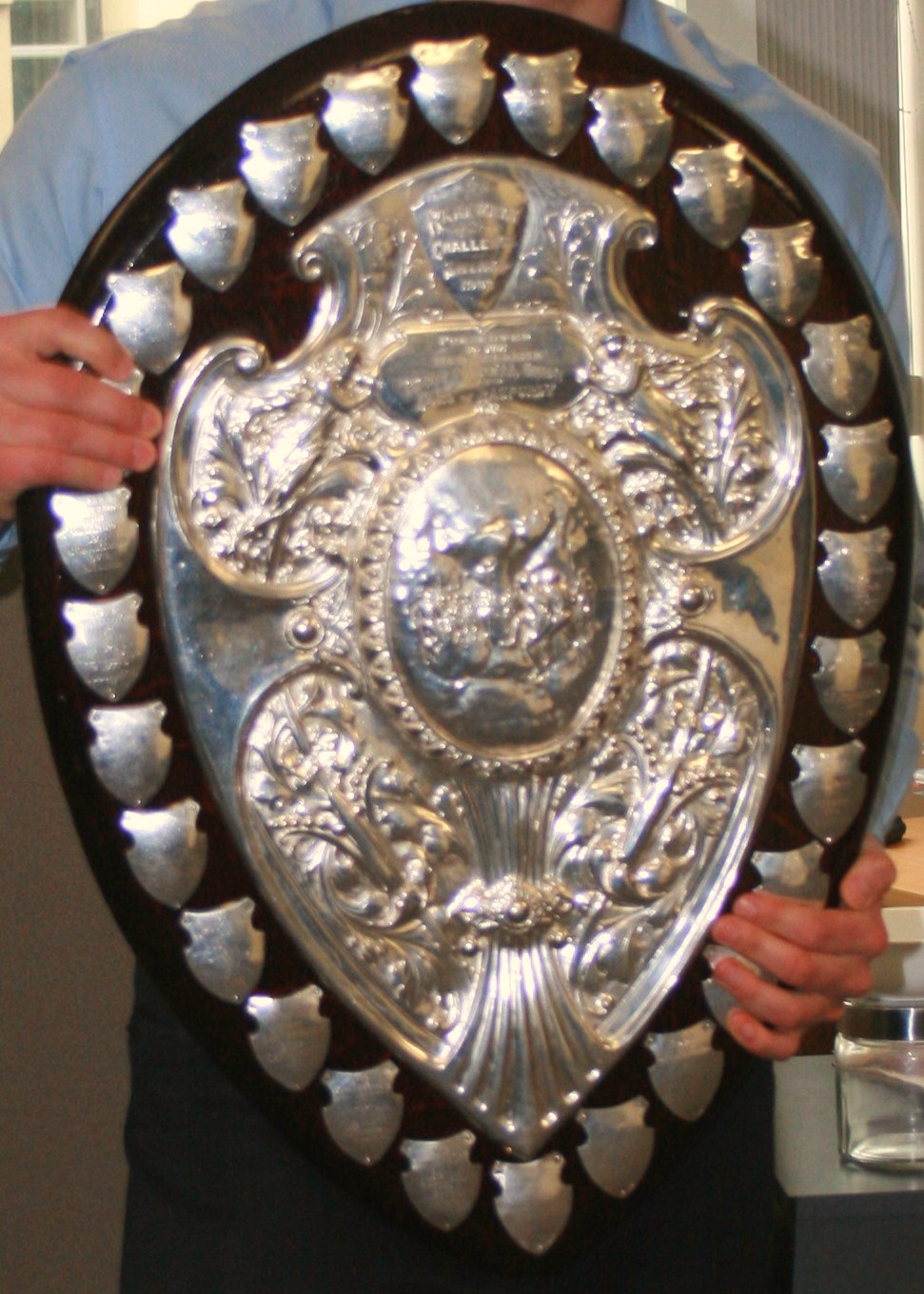
The Ranfurly Shield, colloquially known as the Log o' Wood, is perhaps the most prestigious trophy in New Zealand's domestic rugby union competition. First presented to Auckland in 1902, the Shield is based on a challenge system, rather than a league or knockout competition as with most football trophies. The holding union must defend the Shield in challenge matches, and a successful challenger becomes the new holder of the Shield. The Shield holder at the end of each season is required to accept at least seven challenges for the following year. All home games during league play, but not during knockout playoffs, in the NPC or Heartland Championship are automatic challenges. The remaining Shield defences must be made up of challenges from unions in the other domestic competition.
Player of the Year
The player of the year award was given to the best player during the season and was selected by a committee of committee members, retired players, and media representatives.
| Season | Player | Position | Team | Ref |
|---|---|---|---|---|
| 1994 | Waisake Sotutu | Wing | Auckland | |
| 1995 | Olo Brown | Prop | Auckland | |
| 1996 | Justin Marshall | Half-back | Canterbury | |
| 1997 | Todd Blackadder | Flanker | Canterbury | |
| 1998 | Tony Brown | First five-eighth | Otago | |
| 1999 | Filo Tiatia | Number 8 | Wellington | |
| 2000 | Andrew Slater | Lock | Taranaki | |
| 2001 | Richie McCaw | Flanker | Canterbury | |
| 2002 | Keith Lowen | Centre | Waikato | |
| 2003 | Iliesa Tanivula | Wing | Auckland | |
| 2004 | Richie McCaw | Flanker | Canterbury | |
| 2005 | Chris Smylie | Half-back | Otago |
References
References
- (4 November 2004). "NZRU releases eligibility criteria for new competitions".
- Garland, Steve. (29 May 2013). "Fields of Glory: 21 NPC Years, 1976-1996". HarperCollins Publishers New Zealand.
- (3 October 2022). "Regional rugby".
- (5 September 2013). "Club and provincial rugby".
- (5 September 2013). "Provincial and regional rugby since 1976".
- (27 September 2024). "History".
- (27 September 2024). "Auckland rugby".
- (26 August 2020). "Inside the meeting that took rugby professional".
- (25 August 2015). "Regional rugby map".
- (9 May 2022). "No Rotorua games for Bay of Plenty Steamers, Volcanix this season".
- (4 November 2005). "Division One pools and draw released for 2006". Air New Zealand Cup.
- (29 June 2006). "Heartland Championship competition announced". Air New Zealand Cup.
- (13 July 2006). "Air New Zealand Cup launched in grand style". Air New Zealand Cup.
- (13 July 2006). "Stunning new Air New Zealand Cup unveiled". Air New Zealand Cup.
- (16 August 2017). "National provincial rugby's best men's player to get Duane Monkley Medal". Stuff.
- Miller, Geoff. (March 2003). "The Sky Television 2003 Rugby Almanack". Hachette New Zealand.
- Miller, Geoff. (April 2006). "Sky Sport Rugby Almanack 2006". Quarto Publishing Group UK.
This article was imported from Wikipedia and is available under the Creative Commons Attribution-ShareAlike 4.0 License. Content has been adapted to SurfDoc format. Original contributors can be found on the article history page.
Ask Mako anything about National Provincial Championship (1976–2005) — get instant answers, deeper analysis, and related topics.
Research with MakoFree with your Surf account
Create a free account to save articles, ask Mako questions, and organize your research.
Sign up freeThis content may have been generated or modified by AI. CloudSurf Software LLC is not responsible for the accuracy, completeness, or reliability of AI-generated content. Always verify important information from primary sources.
Report