From Surf Wiki (app.surf) — the open knowledge base
Morgan Library & Museum
Institution in Manhattan, New York

Institution in Manhattan, New York
| Field | Value |
|---|---|
| name | Morgan Library & Museum |
| image | Morgan Library & Museum, New York 2017 02.jpg |
| image_size | 250 |
| caption | The museum's entrance in 2017 |
| mapframe | yes |
| mapframe-zoom | 12 |
| mapframe-marker | museum |
| mapframe-wikidata | yes |
| mapframe-frame-width | 250 |
| mapframe-frame-height | 250 |
| coordinates | |
| former_name | Pierpont Morgan Library |
| established | (private library) |
| (public institution) | |
| location | 225 Madison Avenue (at East 36th Street), Manhattan, New York, U.S. |
| type | Museum and research library |
| collection_size | 350,000 |
| visitors | 274,000 (fiscal year 2019) |
| founder | J. P. Morgan |
| director | Colin B. Bailey |
| architect | Charles Follen McKim (main building) |
| Benjamin Wistar Morris (main building annex) | |
| Isaac Newton Phelps (231 Madison Avenue) | |
| Renzo Piano and Beyer Blinder Belle (expansion) | |
| publictransit | Subway: at Grand Central–42nd Street |
| at 33rd Street | |
| Bus: | |
| website | |
| embedded | {{Infobox NRHP |
| embed | yes |
| name | J. Pierpont Morgan Library |
| nrhp_type | nhl |
| map_label | Morgan Library & Museum |
| designated_nrhp_type | November 13, 1966 (main building) |
| added | November 13, 1966 (main building) |
| refnum | 66000544 |
| designated_other1 | New York State Register of Historic Places |
| designated_other1_abbr | NYSRHP |
| designated_other1_date | June 23, 1980 |
| designated_other1_number | 06101.000434 |
| designated_other1_num_position | bottom |
| designated_other2_name | New York City Landmark |
| designated_other2_date | May 17, 1966 (main building exterior) |
| March 23, 1982 (main building interior) | |
| February 26, 2002 (231 Madison Avenue exterior) | |
| designated_other2_abbr | NYCL |
| designated_other2_link | New York City Landmarks Preservation Commission |
| designated_other2_number | 0239, 1119, 2114 |
| designated_other2_color | #ffe978 |
| mapframe-zoom = 12 | mapframe-marker = museum | mapframe-wikidata = yes | mapframe-frame-width = 250 | mapframe-frame-height = 250 (public institution) Benjamin Wistar Morris (main building annex) Isaac Newton Phelps (231 Madison Avenue) Renzo Piano and Beyer Blinder Belle (expansion) at 33rd Street Bus: March 23, 1982 (main building interior) February 26, 2002 (231 Madison Avenue exterior)
The Morgan Library & Museum (formerly the Pierpont Morgan Library; colloquially the Morgan) is a museum and research library in New York City, New York, United States. Completed in 1906 as the private library of the banker J. P. Morgan, the institution is housed at 225 Madison Avenue in the Murray Hill neighborhood of Manhattan. , the museum is directed by Colin B. Bailey and governed by a board of trustees.
The site was formerly occupied by several Phelps family residences, one of which was sold to J. P. Morgan in 1880. After collecting thousands of objects in the late 19th century, Morgan erected the main building between 1902 and 1906, with Belle da Costa Greene serving as its first librarian for more than four decades. The library was made a public institution in 1924 by J. P. Morgan's son John Pierpont Morgan Jr., in accordance with his father's will, and further expansions were completed in 1928, 1962, and 1991. The Morgan Library was renamed the Morgan Library & Museum after the completion of a major expansion in 2006. Further renovations were completed in 2010 and 2022.
The Morgan Library & Museum is composed of several structures. The main building was designed by Charles McKim of the firm of McKim, Mead and White, with an annex designed by Benjamin Wistar Morris. A 19th-century Italianate brownstone house at 231 Madison Avenue, built by Isaac Newton Phelps, is also part of the grounds. The complex includes three additional structures, including a glass entrance building designed by Renzo Piano and Beyer Blinder Belle. The main building and its interior is a New York City designated landmark and a National Historic Landmark, while the house at 231 Madison Avenue is a designated city landmark.
The Morgan Library & Museum's collection has more than 350,000 objects, which include illuminated manuscripts, authors' original manuscripts, books, and sheets of music. The Morgan also houses collections of drawings, photographs, paintings, maps, and other objects. In addition to its permanent collection, the museum has hosted temporary exhibitions, as well as events such as concerts and lectures. Both the collection and the original building's architecture have received praise over the years, while the annexes' architecture has received mixed commentary.
History
Background
Phelps Stokes/Dodge houses
In the second half of the 19th century, the Morgan Library & Museum's site was occupied by four brownstone houses on the east side of Madison Avenue, between 36th Street to the south and 37th Street to the north. The houses were all built in 1852 or 1853 by members of the Phelps Stokes/Dodge merchant family. Three houses were built along Madison Avenue on lots measuring 65 ft wide by 157 ft deep, while a fourth house to the east measured 18 ft wide and stretched 197.5 ft between 37th and 36th Streets. All the houses were designed in an Italianate style with pink brownstone. A driveway and stables were located behind the homes. The Madison Avenue houses, from north to south, were owned by Isaac Newton Phelps, William E. Dodge, and John Jay Phelps, while the 37th Street house was owned by George D. Phelps. The houses were separated from each other by gardens. The surrounding neighborhood of Murray Hill was not yet developed at the time, but began to grow after the American Civil War.
Isaac Newton Phelps's daughter Helen married Anson Phelps Stokes in 1865. Their son, the architect Isaac Newton Phelps Stokes, was born in the Isaac Newton Phelps house at 231 Madison Avenue two years later. Helen Phelps inherited the house following her father's death. In 1888, she doubled the size of her house and added an attic; the architect R. H. Robertson designed the expansion.
The banker John Pierpont Morgan, who lived at 6 East 40th Street in the 1870s, was looking to buy his own house by 1880. He wished to live in Murray Hill, where many of his and his wife's friends and business contacts lived. Morgan sought to buy John Jay Phelps's house at 219 Madison Avenue, at the corner with 36th Street, which was offered for $225,000. He acquired the house in 1880 and renovated it over the following two years, moving there in 1882. The exterior design was largely retained, but the interior was extensively renovated by the Herter Brothers.
Morgan collection
Morgan had collected handwriting samples as early as the 1850s, and he also acquired pictures and stained glass pieces throughout the years. In the late 19th century, Morgan became one of the most influential financiers in the United States. As his wealth grew, Morgan amassed a collection of fine art, inspired by the collection of his father Junius Spencer Morgan, and he also began collecting rare books and other bindings at his nephew Junius's suggestion. The fine art was subject to import taxes and was stored in England; since books were not subject to import taxes, they were stored in the basement of his New York residence. J. P. Morgan's collection included 160 titles by 1883.
The collection grew quickly after his father died in 1890. Morgan began acquiring historically important manuscripts after his father obtained Walter Scott's original manuscript of the book Guy Mannering. From 1899 to 1902 alone, he took over three collectors' libraries, which included hundreds of illuminated manuscripts, prints, and other manuscripts. Morgan also acquired smaller collections, such as French literature, medieval chivalry, and American manuscript collections. Morgan may have collected these objects exclusively for pleasure and not for investment purposes. Morgan brought his art collection to the U.S. because an 1897 law allowed him to do it without paying import taxes, and also because he wanted to preserve the objects for the American people.
Development of library
By 1900, Morgan's collection took up more space than was available in his residence, and his son-in-law described the basement as being packed with piles of objects. Some of his collection had to be stored at the Lenox Library. Morgan was unable to expand the house due to an 18 ft driveway east of it. While part of Morgan's collection was stored in the basement of his house, other items were loaned to institutions or placed in storage.
Site acquisition
In 1900, the plots north and east of J. P. Morgan's house were placed for sale after the death of Melissa Stokes Dodge, who lived in the Dodge mansion just north of Morgan's house. That January, he bought a 75 by plot of land on 36th Street, for a library. The site had been occupied by two brownstone homes at 35 and 37 East 36th Street, which Morgan promptly razed. In 1902, Morgan acquired two more lots on 36th Street with a total frontage of 50 ft. On the far eastern side of that plot, McKim, Mead & White designed a six-story house at 33 East 36th Street for Morgan's daughter Louisa and her husband Herbert Satterlee. The Satterlees' house was made of limestone, as contrasted with the brownstones on Madison Avenue, and was connected to Morgan's own home by tunnels. The Satterlee residence measured 28 ft wide, and Morgan used the 135 ft plot between his house and the Satterlees' home for his new library.
Morgan acquired William E. Dodge's home in April 1903. While the Satterlee house was under construction, the couple moved into the Dodge mansion. By late 1904, Morgan had also purchased the old Isaac Newton Stokes house at 229 Madison Avenue for his son J. P. Morgan Jr., who was known as "Jack". Jack initially lived nearby at 22 Park Avenue. When Jack and his wife Jane Norton Grew moved into 229 Madison Avenue in 1905, he commissioned a major renovation of the interior and renumbered it as 231 Madison Avenue. Jack Morgan also performed $1,900 in changes to the house's exterior. J. P. Morgan came to own two-thirds of the city block; his holdings by 1907 included the whole 197.5 ft frontage on Madison Avenue, stretching 300 ft on 36th Street and 167 ft on 37th Street.
Construction
Morgan first hired Warren and Wetmore to design a Baroque-style library, which would have had a heavily decorated upper section. Whitney Warren of Warren and Wetmore had then just completed the elaborately decorated New York Yacht Club Building, and Warren had wanted to design a domed structure. Morgan's preference for an austere structure may have led him to reject Warren and Wetmore. He instead hired Charles McKim of McKim, Mead & White to design the library in 1902. C. T. Wills was hired as the builder. The library was to be a classical marble structure with a simple design; Morgan had told McKim that he wanted "a gem". McKim's designs were traditional for their time, while those who wanted more fashionable designs typically hired McKim's partner Stanford White.
At the time of the library's planning, restrictive covenants in Murray Hill prohibited the construction of museums there, but the library was originally not planned as a museum. While McKim was responsible for the overall design, Morgan had final say over the aspects of the plan. An initial proposal called for a projecting central mass flanked by recessed wings, which Morgan deemed unwieldy. The second version of the plan reduced the size of the central mass and added a recessed entrance. Morgan also rejected a proposal for a Greek temple–like structure topped by a portico. The final designs called for the central section and wings to be the same distance from the street. Morgan insisted the library be made of marble, even though his whole family except for his daughter Louisa lived in a brownstone house. Morgan originally planned to use white marble, but he used pinkish-gray Tennessee marble instead after a neighbor told him that white marble would make the building look like a mausoleum.
By early 1903, workers were laying the foundation for the library. Construction began that April, and the library was being dubbed as "Mr. Morgan's jewel case" by the next year. Few details of the library were given out during construction, as Morgan prohibited the workers from talking to the press. The Wall Street Journal reported in June 1906 that Morgan had "wanted the most perfect structure that human hands could erect and was willing to pay whatever it cost". For example, the usage of dry masonry marble blocks, an uncommon construction method that eliminated the need for joints made of mortar, added $50,000 to the cost of construction. McKim had suggested the dry masonry blocks to Morgan, who readily agreed to pay the extra cost. To fit New York City's climate, tinfoil sheeting was placed between the blocks. In addition, the stonework contractor nearly went out of business because the builders would not use any stones with cracks.
Morgan was impressed with the quality of the work and often upheld the library as an accomplishment of McKim's. This was because McKim was not only responsible for selecting the marble from Rome but also for hiring the library's decorators and craftsmen. The final design was more representative of the work of William M. Kendall from McKim, Mead & White. Morgan acquired two hundred cases of books, which were temporarily stored in the Lenox Library and moved to Morgan's personal library starting in December 1905. Around the same time, Morgan hired Belle da Costa Greene as his personal librarian; she remained in charge of the collection for the next four decades. Toward the library's completion, Morgan reportedly requested that the entire library be shortened by one foot.
Private library
Opening and early years
Morgan first used his office in November 1906 with a reception for the Metropolitan Museum of Art's purchasing committee. The decorative details were not completed until January 1907, and the collection was relocated into the library later that year. Morgan's library had cost $1.2 million (equivalent to $ million in ). During the Panic of 1907, the presidents of the city's banks and trust companies were locked in the library overnight until they agreed on a plan to stop the financial crisis. To allow people to see his new library from Madison Avenue, Morgan demolished the Dodge house in 1907–1908 and replaced it with a garden designed by Beatrix Farrand.
As the librarian, Greene was tasked with expanding the collection, as well as cataloging and researching the history of each item. She frequently searched for rare volumes in back alleys, but initially tended to avoid auctions and rarely spent more than $10,000 on a book without permission. Greene tended to acquire items created before the 16th century, since Morgan believed that other libraries were able to adequately care for newer items. Morgan also decided to import the rest of his collection and display it at his library. To avoid paying import taxes, he was required to open the library to the public on certain days of the week. Morgan sometimes acquired art on short notice; in one case, he bought a Vermeer painting minutes after learning about the artist. He also refused to buy works that he believed were too expensive, and, although Morgan sometimes bought whole collections, in other instances he acquired a small number of pieces from a collection.
Morgan frequently met with foreign bankers in the library's study, and he often opted to work in the library rather than in his downtown office. Among Morgan's larger acquisitions in the late 1900s and early 1910s was a collection of rare American authors' manuscripts from merchant S. H. Wakeman in 1909. The Wall Street Journal wrote in 1911 that "Mr. Morgan buys books as some financiers buy a thousand shares of stock"; in some years, he spent half his income on the collection. Acquisitions continued until his death in March 1913. Morgan had bought thousands of objects since 1899, including 600 manuscripts and 3,000 medieval items.
After J. P. Morgan's death

Morgan's estate was valued at $128 million (about $ billion in ), over half of which lay in the worth of his collection. J. P. Morgan bequeathed all except one piece in the collection to the library, with the request that Jack make the collection "permanently available for the instruction and pleasure of the American people". The month after J. P. Morgan's death, the New York state legislature granted a two-year exemption enabling Jack to import his father's overseas collection without having to pay import duties. Jack did not publicly show interest in his father's art collection and reportedly did not expand it in the year after his father died. Jack sold off much of the overseas collection rather than importing it, but he decided to keep the items that were already in his father's library. During 1914, the collection was displayed in full at the Metropolitan Museum of Art, the only time the whole collection was displayed.
The import duty exemption expired in April 1915, and Jack sold various items in the collection to pay the inheritance taxes and to raise money for the cash bequests in his father's will. The next year, the collection was valued at $7.5 million for taxation purposes. Jack and Jane Morgan continued to employ Greene as the librarian, adding items that personally interested them. Frances Morgan, Jack's mother and John Pierpont's widow, lived at J. P. Morgan's old residence until her death in November 1924. By then, despite Jack's opposition, the surrounding stretch of Madison Avenue was being redeveloped as a business street. Although Jane Morgan died in 1925, Jack continued to live at 231 Madison Avenue until his death in 1943, and the Satterlee home remained in the Morgan family until 1944. The United Lutheran Church in America bought 231 Madison Avenue for its headquarters in 1943 and built a five-story annex there in 1957. It was the only remaining brownstone house along the Murray Hill section of Madison Avenue by the 1960s.
Public institution
1920s to 1940s
.jpg)
The Pierpont Morgan Library was incorporated as a public institution in March 1924, a month after Jack Morgan announced that he would transfer the collection to a board of trustees and provide a $1.5 million endowment for the library. The library's name reflected the fact that the elder J. P. Morgan had disliked being called by his first name and even his first initial. The Morgans transferred the library building, and the land under 219 Madison Avenue, to the Morgan Library. Greene was retained as the librarian. The Morgan Library was not a public library and initially only allowed researchers into the space; as Jack Morgan said, "one soiled thumb could undo the work of 900 years". Only ten scholars could initially enter the building at once. The library's collection continued to grow, with emphasis placed on rare items; for example, though only four items were acquired in 1926, all of these were unique manuscripts.
To accommodate additional scholars, the Morgan Library announced plans for an annex in January 1927. Though Jack initially denied that 219 Madison Avenue would be demolished, that house was ultimately razed. Benjamin Wistar Morris was hired to design the annex, while Marc Eidlitz & Son was hired to build it. The annex was completed in 1928. The Morgan Library continued to expand its collections; for instance, between 1936 and 1940, it acquired twelve manuscripts and dozens of drawings. In the 25 years after it became a public institution, the Morgan Library acquired 200 total manuscripts, 83 books, and hundreds of autographed letters and papers.
Through the early 1940s, the Morgan Library continued to limit access only to researchers, prompting city officials to request that the library's tax-exempt status be removed because it was not a public library. In December 1942, Morgan Library officials agreed to open the library to the general public, and city officials agreed not to fight the library's tax-exempt status. Many of the library's most valuable artifacts were transported to other locations in the U.S. in 1942 to protect them from possible World War II airstrikes; the objects were returned to the library in December 1944. The Fellows of the Pierpont Morgan Library was formed in 1949 to raise funds for the collections and distribute funds to scholars and publications. After Belle da Costa Greene retired from the library in 1948, Frederick Baldwin Adams Jr. was appointed as the Morgan's second director.
1950s to mid-1980s

Adams retired as the Morgan's director in 1969 and was succeeded by Charles Ryskamp. During Ryskamp's 17-year tenure, the $11 million endowment was expanded to $38 million. By the early 1970s, the Morgan Library had several hundred fellows, or members, and Ryskamp wanted to attract more visitors to the library. The Morgan Library constructed a five-story addition with storage vaults and offices in 1975.
The library continued to acquire other collections in the 1970s and 1980s, including the musical manuscript collection of Mary Flagler Cary; 1,500 Italian drawings from János Scholz; Dannie Heineman's collection of letters, books, and newspaper clippings; part of Robin Lehman's music manuscript collection; and 75 rare manuscripts from William S. Glazier. Ryskamp also arranged various temporary exhibitions. During the 1980s, the library raised $1.5 million each year for its operating budget, in addition to funding for repairs. The institution received a $1 million grant for the preservation of its printed books (the largest donation it had ever received at the time) and a $600,000 matching grant for its conservation department in 1981. In the mid-1980s, the institution was officially renamed the Morgan Library.
1980s and 1990s expansion

Ryskamp resigned as director in 1986 and was replaced the next year by Charles Eliot Pierce Jr. Pierce was the first director of the Morgan who was not associated with Princeton University. After he was appointed, Pierce sought to attract visitors; he would later recall that he was "disconcerted" by reports that previous visitors had been turned away from the library. In 1988, the Morgan Library bought 231 Madison Avenue from the Lutheran Church for $15 million. The library planned to spend $5 million restoring the house, and it also announced that it would raise $40 million for a capital campaign. The original buildings could display only one percent of the total collection at once, and the entire exhibition space consisted of two rooms and a corridor.
In 1989, the firm of Voorsanger and Mills designed a glass conservatory connecting 231 Madison Avenue and the main building's annex. The conservatory would expand the library's space to 45000 ft2, add a walled terrace on Madison Avenue, and make the structures wheelchair-accessible. Because the original building was a city landmark, the New York City Landmarks Preservation Commission (LPC) had to approve the plans. An early plan called for converting 231 Madison Avenue to exhibition galleries, but the house's internal structure made this impossible, so 231 Madison Avenue became offices and a bookstore. The library's artworks were also extensively cleaned, display cases were added to the original East Library, and the West Study was opened to the public. The expansion was finished in October 1991, initially with 275 pieces from the permanent collection, along with temporary exhibition space in the main building. The project was originally planned to cost $9–10 million, but it ultimately cost either $15 million or $30 million. The Morgan finished raising $40 million in November 1992.
Visitor numbers had increased by the mid-1990s, and the library had pay-what-you-wish admission fees. At the time, the library still had a reputation for being a rich enclave, and many board members were part of rich families. The library's acquisitions in the 1990s included part of Alice Tully's art collection, Carter Burden's collection of over 30,000 American literary volumes, and Pierre Matisse's collection of 2,000 letters from artists. The Morgan opened a drawing center on the second floor of the annex, designed by Beyer Blinder Belle, in 1999. The same year, the Morgan received $10 million from Eugene V. Thaw and Clare E. Thaw; these funds were used to establish the Thaw Conservation Center, completed in 2002. By the beginning of the 21st century, the library's facilities had become dated. Pierce said later: "We had a lecture hall, not a concert hall; a reading room that owed more to 1928 instead of 2006."
2000s expansion
The Morgan's board began planning another expansion in the late 1990s. The board hosted an architectural design competition and selected three finalists, all of whose plans involved demolishing the 1991 conservatory. Ultimately, the board hired the Italian architect Renzo Piano (who had not participated in the original competition), along with Beyer Blinder Belle. Although Piano had not previously designed a building in New York City, he had been selected because of his experience designing buildings in various styles and geographical contexts. The plans called for new exhibit areas, a reading room, an auditorium, and more storage space. The Morgan planned to raise $25 million for maintenance and $100 million for the renovation itself. Despite the September 11 attacks, the Morgan decided to proceed with the expansion. The library presented preliminary plans to the LPC in January 2002. The LPC approved the proposal shortly afterward, despite concerns about the design from Manhattan Community Board 6 and the architect Robert A. M. Stern.
In May 2003, the Morgan Library's buildings were closed for construction and expansion, and the collection was placed into storage or moved to other institutions. At the time, the museum recorded about 200,000 annual visitors but wanted to accommodate twice that number. The library sponsored numerous traveling exhibitions around the country. All of the post-1928 annexes were demolished. Workers built most of the new spaces underground, excavating nearly 50000 ST of bedrock. The entrance was also relocated to Madison Avenue. In conjunction with the renovation, Pierce planned to rebrand the institution as a museum. The Morgan also continued to acquire objects during the renovation, such as the collection of the lyricist Fred Ebb. The project cost $106 million in total; the renovation did not include the main building.

The library reopened on April 29, 2006, and was renamed the Morgan Library & Museum. J. P. Morgan's private office and vault were also opened to the public. Following the renovation, the number of annual visitors increased to 223,000, but this number had declined to 150,000 by 2010. The museum also hosted concerts in its new auditorium, and it hired Restaurant Associates to operate a cafe there. Pierce retired as the museum's director in early 2007, saying that some museum members had opposed changes made during his tenure. William M. Griswold was hired as the museum's next director that April, overseeing the growth of its collections, exhibition programs, and curatorial departments. By the late 2000s, there was still not enough space for the museum's permanent collection. The museum began planning to restore the main building .
2010s to present
In May 2010, Griswold announced that the main building would be renovated, and the museum started providing audio guides about its collections. The renovation cost $4.5 million and included cleaning the marble facade, replacing electrical systems and lighting, and opening the North Room to the public. Beyer Blinder Belle designed the restoration, which was completed in October 2010. Alongside the main building's renovation, Griswold wanted to digitize the collection. The Morgan established a photography department in 2012. Griswold resigned as the Morgan's director in 2014, and Colin Bailey was appointed as the director of the Morgan Library & Museum the next year.
The Morgan Library & Museum announced in February 2019 that it would renovate the main building's facade. Integrated Conservation Resources restored the main building, completing the facade's restoration later that year. The landscape designer Todd Longstaffe-Gowan designed a garden surrounding the original building, since the neighborhood, at the time, lacked parkland. The LPC had initially opposed the garden, as the original building had never had a garden, but approved the project after learning that J. P. Morgan had wanted a garden around the library. The museum was temporarily closed from March to September 2020 during the COVID-19 pandemic, and the renovation was delayed as a result. The garden opened to the public in June 2022; the renovation had cost $13 million.
The Morgan Library & Museum celebrated its 100th anniversary as a public institution in 2024. To celebrate its centennial, the museum began raising $50 million in 2023, including $35 million for its endowment and $15 million for capital improvements. The heiress Katharine Rayner donated $10 million to endow the director's position, which was renamed in her honor in early 2024, and the Jerome L. Greene Foundation donated another $5 million.
Collection
Main article: Collection of the Morgan Library & Museum
John Pierpont Morgan's original collection included porcelains, triptychs, books, and manuscripts. The collection of the Morgan Library & Museum contained more than 350,000 objects by the early 21st century. One late-20th-century reporter described the collection as including a variety of "almost random treasures". The library's online catalog, Corsair, contains records for many of the collection's objects.
Manuscripts and letters

The Morgan Library & Museum has long contained a collection of illuminated manuscripts, which date from the sixth to sixteenth centuries. As early as 1923, the Morgan Library counted 560 illuminated manuscripts in its collection, a number that had grown to over 1,100 by the 21st century. Among the manuscripts are the Morgan Bible, Morgan Beatus, Hours of Catherine of Cleves, Farnese Hours, Morgan Black Hours, and Codex Glazier, as well as an Anglo-Saxon Gospels manuscript.
The manuscript collection also contains authors' original manuscripts, many of them autographed. The library's early acquisitions included a Charles Dickens manuscript of A Christmas Carol; a J. M. Barrie manuscript; and original drawings for The Pickwick Papers and the Book of Job. The collection also includes manuscripts of poems by Robert Burns; nine of Walter Scott's novels; Alexander Pope's poem An Essay on Man; John Keats's poem Endymion; Francis Bacon's book Novum Organum, Edgar Allan Poe's short story "A Tale of the Ragged Mountains"; and Ernest Hemingway's short story "Three Stories and Ten Poems". There are also writings from Émile Zola, Victor Hugo, Marie Antoinette, George Sand, Alexandre Dumas, Thomas Moore, Jane Austen, John Milton, John Ruskin, and Honoré de Balzac. Other documents in the Morgan's collection are a collection of 64 Central European manuscripts and one of about two dozen original prints of the United States Declaration of Independence.
There are many letters in the collection, some dating as far back as ancient Babylonian times. The Morgan holds original letters by Napoleon, Horace Walpole, Voltaire, Francesco Filelfo, John Cheever, Thomas Pynchon, Vincent van Gogh, and George Beaumont. There is also a rare 1516 letter from Andrea Corsali with the first description of the Southern Cross.
The collection includes notebooks and journals as well. These include the notebooks of Percy Bysshe Shelley, Nathaniel Hawthorne, Tennessee Williams, and Henry David Thoreau. Diaries are also displayed, including those of Queen Victoria, pirate Bartholomew Sharp, writer E. B. White, and J. P. Morgan Sr. himself.
Musical collection
The Morgan Library & Museum also houses a sizable musical manuscript collection. A 1998 magazine article about the collection described it as containing 1,250 music manuscripts; 1,900 pieces of music-related literature; and 7,000 letters written by musicians. The music collection includes autographed and annotated libretti and scores from Ludwig van Beethoven, Johannes Brahms, Luigi Cherubini, Frédéric Chopin, Charles Gounod, George Frideric Handel, Joseph Haydn, Gustav Mahler, Gioachino Rossini, and Giuseppe Verdi. It also contains letters by Wolfgang Amadeus Mozart, Felix Mendelssohn, and Richard Wagner, among other musicians.
The only significant music manuscript that Morgan bought in his lifetime was Beethoven's Violin Sonata in G major, Opus 96, which he acquired in 1907. Notable specific pieces include two sets of Schubert's Impromptus manuscripts; Andrea Antico's Motetti e Canzone, and Mozart's Haffner Symphony. The collection also contains the scraps of paper on which Bob Dylan jotted down "Blowin' in the Wind" and "It Ain't Me Babe". There are several pieces of Victorian-era musical artifacts, such as Gilbert and Sullivan manuscripts and related artifacts. In 2024, museum staff discovered an unpublished waltz by Chopin, dating from the 1830s, in the collection.
Books

The collection includes early printed Bibles and other religious works, among them three Gutenberg Bibles, one of six original copies of the first Italian Bible, one of three known copies of the Constance Missal, a rare copy of the Mainz Psalter, and the Golden Gospels of Henry III. The Morgan also contains material from ancient Egypt and medieval liturgical objects (including Coptic literature examples); William Blake's original drawings for his edition of the Book of Job; and concept drawings for Saint-Exupéry's The Little Prince. The Morgan has a collection of ancient Near Eastern cylinder seals: small stone cylinders finely engraved with images for transfer to clay by rolling.
The Morgan contains various examples of Latin and Greek literary classics, along with more modern American and European printed books. The collection includes numerous examples of fine bookbinding. These include various bindings of Coptic manuscripts from the 9th and 10th centuries, the metalwork covers of the Lindau Gospels, copies of books by early British printer William Caxton, and a binding made for Christina, Queen of Sweden.
There are also children's books. For example, the collection includes a book with the first known printing of the rhyme "This Is the House That Jack Built". In addition, the collection contains the first editions or proofread versions of Struwwelpeter, Alice's Adventures in Wonderland, and Max and Moritz.
Visual art

The Morgan contains a large collection of incunabula, prints, and drawings. The collection includes some Old Master paintings collected by Morgan, as well as objects like wedding portraits. The Old Master paintings include works by Hans Memling, Perugino, and Cima da Conegliano. Some Old Master works have been sold off over the years, such as Domenico Ghirlandaio's masterpiece Portrait of Giovanna Tornabuoni. The collection also includes numerous drawings from 13th-to-19th-century French masters such as Antoine Watteau, François Boucher, Jacques-Louis David, and Jean Auguste Dominique Ingres. The Morgan also holds a set of miniature Rajput paintings. Other notable artists of the Morgan Library & Museum include Jean de Brunhoff, Paul Cézanne, Gaston Phoebus, and Rembrandt van Rijn.
The Morgan's collection includes around 12,000 drawings and watercolors dating as far back as the 14th century, including 1,000 sheets from British artists and 3,000 sheets from Italian artists. Notable specific objects include twelve William Blake watercolors, the drawing Bathers by Renoir, eight Rembrandt etchings, and 54 drawings by Eugène Delacroix. The Morgan also has a photography department. The collection includes work from such photographers as Dennis Oppenheim and Henri Cartier-Bresson, and the photographs themselves are collected from various genres and time periods.
Other objects

Before J. P. Morgan died, he had acquired a variety of decorations such as a Persian carpet, Genoese and Chinese vases, and an Egyptian carved-stone group. The Washington Post reported in 1914 that the collections included "tapestries, bronzes and silver, Greek antiques, jeweled miniatures, porcelains, ancient jewelry, and wonderful books and manuscripts". Among these were royal jewels, 70 pieces of old German silver, 64 miniatures, a set of 15th-century marble and bronze objects, Chinese porcelain, and watches. Morgan also kept various "knickknacks" such as a four-thousand-year-old Babylonian figure found near Pompeii. The institution once had a reliquary that supposedly included Mary Magdalene's tooth, as well as Renaissance-era bronze medals, which have been sold off.
The modern-day museum has a silver-gilt figure of Le Roi de Bourges, and the 12th-century Stavelot Triptych. Other notable objects include stage and costume designs from the collection of Donald Oenslager and a map of the Palestine region from around 1300. The museum's Gilder Lehrman Collection also contains various maps.
Restitution claims
Over the years, there have been several restitution claims regarding alleged stolen artwork in the Morgan's collection. The Morgan returned two items to Germany in 2001 after the Morgan's officials confirmed that they had been stolen. In 2019, an Italian prosecutor claimed that the museum hosted a sacramentary that was stolen in 1925 from the municipality of Apiro. In 2023, the Morgan and several other institutions surrendered seven pieces painted by Egon Schiele after the New York County District Attorney determined that the works had been looted from the collection of Fritz Grünbaum, who was murdered in the Holocaust.
Programming and events
Various events and programs are hosted at the Morgan, such as concerts, films, and lectures. The museum has hosted concerts and tours since the 1950s, and it began hosting regular concerts and recitals in Gilder Lehrman Hall in 2006. In addition, guided tours of the permanent collection are hosted each afternoon except Monday. The Morgan also operates several classes for school groups, including the "Exploring with the Morgan" course for humanities and the arts. Parties are hosted at the Morgan annually, such as the Young Fellows Summer Cocktail Party and Mr. Morgan's Winter Gala.
The Morgan hosts exhibits on a variety of topics throughout the year. In the mid-20th century, the Morgan's annual exhibits included showcases of recent acquisitions and rare books. Temporary exhibitions were staged in the annex buildings, while the main building was reserved for Morgan's main collection. Until the Morgan Library's expansion was completed in 1991, the institution had so little space that parts of the permanent collection had to be hidden from view whenever there was a temporary exhibition. Although the 1991 expansion allowed for more temporary exhibitions, the museum could host only one exhibition at once, and it often could not display its permanent collection. After the 2006 expansion, it could host multiple exhibitions at once.
Buildings
Main building
The main building (also known as the McKim Building) was constructed between 1902 and 1906 as the original structure in the complex. It was designed in the Classical Revival style by Charles Follen McKim of McKim, Mead & White. The original building occupies a lot of 117 by and was intended to be built in a similar scale to contemporary New York Public Library branches. The center of the original structure contains an extension measuring 73.5 ft long, giving the structure a "T" shape; this small wing was intended to connect to a similar structure along 37th Street. The original library building is placed behind a solid-bronze fence with hand-twisted bars.
Facade
The building has a facade of Tennessee marble, behind which is an air gap and an interior brick wall. McKim took his inspiration from the Villa Giulia, particularly the attic of its Nymphaeum. Further inspiration came from the 16th-century Villa Medici in Rome. The exterior walls are made of dry masonry, which allowed the marble blocks to be set evenly, thus requiring a minimal amount of mortar. Tinfoil sheeting was placed between the blocks to prevent moisture buildup; the tinfoil sheeting measures 1/64 in thick and is laid between the horizontal joints. Charles T. Wills was responsible for the dry masonry construction. The Wall Street Journal reported upon the library's completion, "No other building in Europe or America was ever erected with this care."
The main entrance is a Palladian arch at the center of the 36th Street facade. It is composed of an arched opening 14 ft wide, flanked by two openings under flat lintels, each of which is 9 ft wide. There are two recessed niches on that facade, one on each side of the entrance. Surrounding the library is a garden, which covers 5000 ft2 and contains artifacts from J. P. Morgan's collection. The garden also contains pathways embedded with pebbles, which Sicilian craftsman Orazio Porto laid manually.
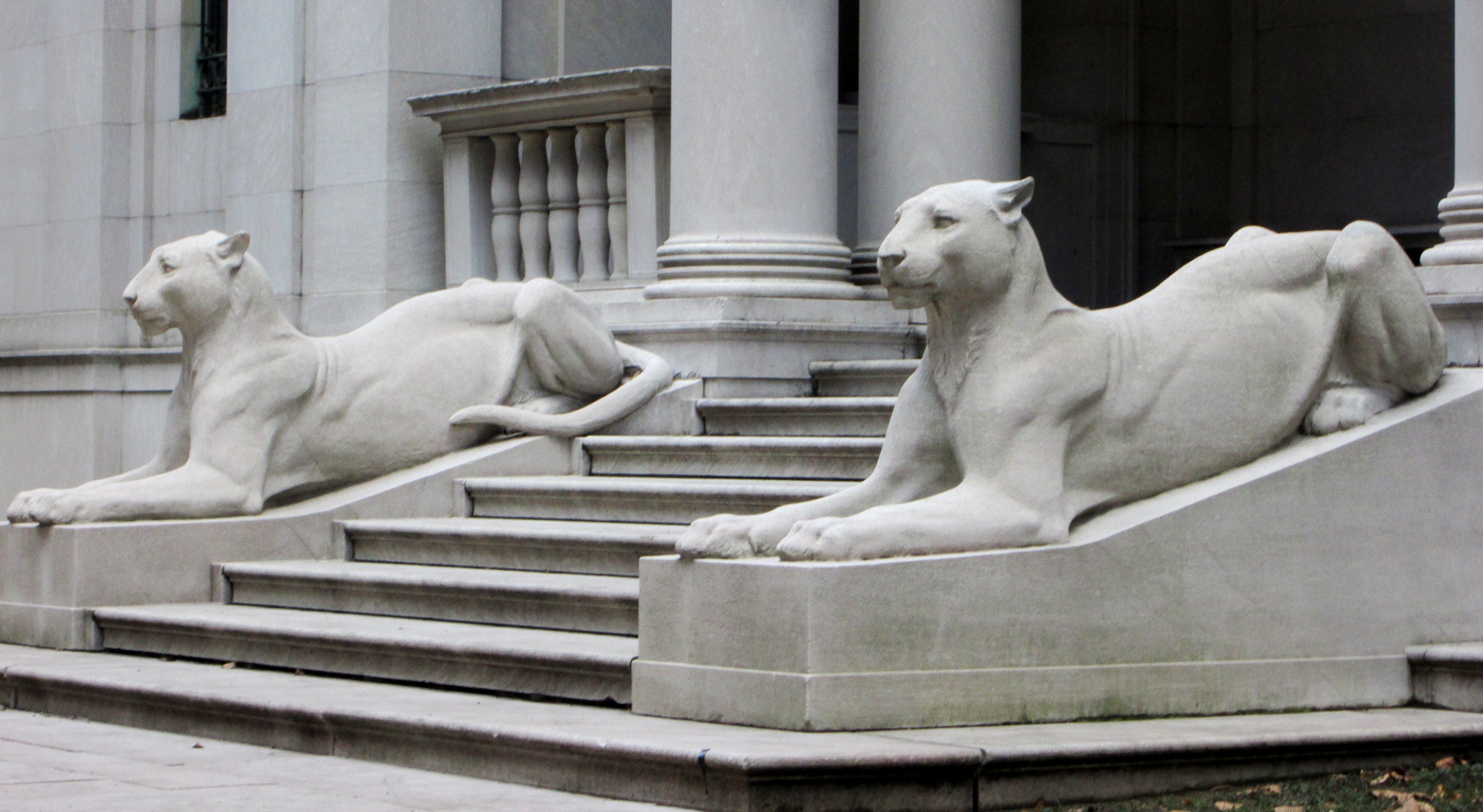
The central archway contains a portico with a groin vaulted ceiling, supported by two Ionic columns on each side. A flight of steps, leading to the main entrance, is flanked by two lionesses sculpted by Edward Clark Potter, who would later create the two lions that guard the New York Public Library Main Branch. Above the entranceway are allegorical roundels and panels, which was originally given to Andrew O'Connor and then reassigned to Adolph Weinman after O'Connor could not complete his contract. These panels depict tragic and lyric poetry. The portico has a geometric mosaic tile floor with marble. Inside the portico is a 16th-century pair of bronze doors, imported from Florence and made in the style of Lorenzo Ghiberti's doors at the Florence Baptistery. Each door contains five carved bronze panels, which depict allegorical scenes. By the 21st century, the doors were opened extremely infrequently. There are six Doric style pilasters flanking the main entrance.
Interior
|File:Morgan Library & Museum, New York 2017 17.jpg|Library (east) room |File:Detail of Rotunda ceiling, Morgan Library & Museum, New York City.jpg|Rotunda (center) room |File:Morgan Library & Museum, New York 2017 07.jpg|Study (west) room
The interior of the main library building is richly decorated, with a polychrome rotunda. It leads to three public rooms: Morgan's private study to the west, the librarian's office to the north, and the original library to the east. Each of the three rooms had dozens of bookcase doors. As a fireproofing measure, almost nothing in the library was made of wood, except for the bookcases' frames and some doors. The bookcases had glass shelves and were covered with steel grilles. Morgan also had a steel vault where he kept his most valuable manuscripts, such as about 600 Renaissance and medieval manuscripts. There were asbestos shutters that could seal off the building's windows if necessary. The main building contains 14,700 ft2 of space and has displayed over 300 objects since 2010.
The rotunda has a ceiling with murals and plasterwork inspired by Raphael, created by H. Siddons Mowbray. On the north side of the ceiling is a half-dome with ten relief panels in a blue-and-white color scheme. The lunette panels on the west, east, and south sides of the ceiling, measuring 23 ft high, allude to material in Morgan's collection. There is also a dome with roundels and decorative rectangular panels, as well as an octagonal central skylight. The rotunda floor is clad with multicolored marble, patterned after the floor of the Villa Pia in Vatican City, and features a porphyry centerpiece. The walls contain mosaic baseboards and are separated into panels with vertical pilasters, topped by Composite style pilasters. When the library opened, the rotunda was furnished with two 15th-century chairs and a bronze bust by Benvenuto Cellini. Following a 2010 renovation, the rotunda has several display cases. The doorways to the rooms on the east and west are made of white marble, topped by marble entablatures and flanked by green marble columns.
Morgan's study is the West Room. The design of the study reflected Morgan's tastes; as his son-in-law Herbert Satterlee said, "No one could really know Mr. Morgan at all unless he had seen him in the West Room." The West Room contains low wooden bookshelves as well as a fireplace with a marble mantelpiece. The decorative elements include stained glass panels in the study's windows, as well as a wall covering of red damask. The current damask covering replicates a pattern that was displayed at Rome's Chigi Palace. The coffered ceiling was reportedly purchased in Italian cardinal's palace. The artist James Wall Finn painted coats-of-arms onto the ceiling based on Italian bookplates from Morgan's collection. Finn's work was designed in such an authentic manner that it was frequently mistaken as part of the ceiling's original design. By 2010, the room displayed some of the objects that Morgan collected.
To the north or rear of the rotunda is the original librarian's office. During the mid-20th century, the room was also used as a directors' office. Since 2010, the office has been open to the public as a gallery known as the North Room. The space hosts ancient Roman, Greek, and Near Eastern objects, as well as items such as Egyptian figures and ancient seals. Bookcases are placed on a mezzanine, while the main level includes display cases.
The East Room (also the library room) is the largest room in the main building and has triple-tiered bookcases. The bookcases were lined with asbestos and encased in glass; the original Plexiglas was replaced with acrylic in 2010. Some of the bookcases can be moved, providing access to a stairway to the upper tiers and to a secret compartment. On the east wall of the East Room is a fireplace with a tapestry showing the "Triumph of Avarice". The fireplace itself dates from the 15th century and was imported from Italy. Mowbray designed eighteen lunettes and spandrels atop each wall, modeled after the work of Pinturicchio. The figures in the lunettes alternate between allegorical female muses and notable artists, explorers, or teachers. Zodiac symbols are placed on the spandrels, as the signs of the zodiac were particularly important to J. P. Morgan. Two additional spandrels contain allegorical motifs that depict changing seasons.
Madison Avenue and 36th Street annex
The corner of Madison Avenue and 36th Street contains a two-story Italianate style structure designed by Benjamin Wistar Morris, with space for offices, exhibitions, and a research library. The annex, made of the same Tennessee marble as the original, was completed in 1928. It measures 90.67 by, with a later 26 by addition. The Morris annex is accessed by a 22 ft stair facing 36th Street. Compared with the main building, the Morris annex is simpler in design.
The Morris annex included a bookstore until 1991, when it became a gallery space. After 2006, the gallery space was split up, and the partitions there were removed. At the center of the Morris annex is the Marble Hall, flanked by the Morgan Stanley Galleries West and East.
231 Madison Avenue
.jpg)
Facade
The New York Herald Tribune wrote in 1943 that the facade had "a slight suggestion of French Renaissance influence". The Madison Avenue facade is divided vertically into three bays. An entrance stoop with a balustrade leads up to a central portico with two Corinthian columns flanked by rectangular sash windows. The second and third stories each have three rectangular windows, and a cornice runs above the third story. The attic contains small Ionic colonettes and pediments.
Along 37th Street, the water table containing the raised basement is topped by a molding. The original 1853 house to the west and the 1888 extension to the east are divided by a pier. The original section of the house is three bays wide, with a balcony and pediment on the first floor, and oval windows and an oriel window on the second. Within the 1888 extension, the first floor contains a projecting three-sided bay and a windowless arch, and the other two stories contain various windows. The cornice above the third floor, as well as the attic, in both the original house and its extension are similar to on Madison Avenue.
The southern facade of the house faces the rest of the library and is mostly obscured behind the 2006 addition. The westernmost portion of that facade, near Madison Avenue, contains rounded first- and second-story windows. There are also three-sided angled windows at the center of that facade.
Interior
Inside the house were 45 rooms. These spaces included a ballroom and 12 restrooms; in addition, the house had 22 fireplaces. After the museum's 1991 expansion, the house contained offices, conference rooms, meeting areas, and a gift shop. In addition, the ground-floor spaces were converted to lecture spaces. Following a 2006 renovation, one of the house's first-floor rooms was converted to a dining room, while the shop was relocated to another space. Inside the residence's attic is the 5600 ft2 Thaw Conservation Center, which is composed of spaces such as a library, reception area, and conservation rooms.
Entrance building and other annexes

In 2006, three structures were completed to designs by Renzo Piano, who worked alongside preservation architect Beyer Blinder Belle. There are four galleries in this section of the museum: the Clare Eddy Thaw Gallery, the Morgan Stanley Galleries West and East, and the Engelhard Gallery. The facades of the new above-ground buildings contain pinkish steel-and-glass curtain walls and are set back slightly from the museum's other structures. The buildings expanded the Morgan Library's area by 75000 ft2, much of which is below ground.
Entrance building
The primary structure in that grouping is a four-story, steel-and-glass entrance building on Madison Avenue. The structure links McKim's library building, the annex, and the Phelps Stokes/Morgan house. The steel structural members are covered in rose-tinted paint as an allusion to the designs of main library and Phelps Stokes/Morgan house. Although externally inconspicuous, the building links the interior spaces of the complex. Inside the structure, a glass elevator links the different levels.
The entrance building contains the JPMorgan Chase Lobby, a space clad in cherry wood. Stairs lead up to the Morgan Shop and Morgan Dining Room, and there is an admission counter and coat room. The south wall has a corridor to the Morris annex and stairs to the second-floor Engelhard Gallery, the latter of which is a temporary-exhibition space. The Sherman Fairchild Reading Room, the museum's research library, is located on the top floor of the Madison Avenue pavilion and has balconies and a skylight. At the northeast corner of the entrance building is Gilder Lehrman Hall, an auditorium about 65 ft below street level. Lehrman Hall has 280 seats. New storage rooms were also created by drilling into Manhattan's bedrock schist. The underground rooms exten 55 ft deep and contain much of the Morgan Library's collection.
Adjacent structures
Gilbert Court, a covered courtyard at the center of the complex, surrounds the entrance building on the north, east, and south. The courtyard is topped by a 50 ft glass roof. On the south wall of the court is the Clare Eddy Thaw Gallery, a 20 x space inspired by Renaissance chambers that Piano observed in Italy. At the court's southeast corner, stairs lead up to the original Morgan Library building, connecting to a vestibule between Morgan's study (the West Library) and the rotunda. There is also a structure next to 231 Madison Avenue, with ancillary areas and offices, in addition to a loading dock.
Former structures
The 2006 annexes replaced all of the additions built after 1928. These included a glass conservatory called the Garden Court, which was designed by Bartholomew Voorsanger of Voorsanger & Associates and completed in 1991. The Garden Court had a curved roof measuring 42 ft tall. Under the roof was a vaulted space with plants selected by landscape architect Dan Kiley. The roof was supported by a 55 ft truss and was covered by clear laminated glass to allow the plants to grow. The space also had metal-and-translucent-glass wall panels and a limestone wall on Madison Avenue. There was a vestibule connecting with the Morris annex to the south.
The post-1928 annexes also included a cloister structure between the main building and the Morris annex, built in 1960. A five-story, 26 by expansion was built in 1975 and designed by Platt, Wyckoff & Coles, with storage vaults and offices.
Operation
Management

The Morgan Library & Museum is operated by a nonprofit organization of the same name, which is dedicated to conserving the artworks in the museum's collection. Colin Bailey has been the director of the Morgan Library & Museum since 2015. As a result of a 2024 donation from Katharine Rayner, the director's position is known as the Katharine J. Rayner Director until 2049. The museum is administered by a board of trustees. , Robert K. Steel and G. Scott Clemons were the co-presidents of the museum's board of trustees.
Until 1981, the president of the museum was a Morgan family member. Previous museum presidents have included Jack Morgan's sons Junius Spencer Morgan III and Henry Sturgis Morgan. Other notable people in the museum's history have included Felice Stampfle, who was appointed the first Curator of Drawings and Prints at the Morgan Library in 1945. Some of the museum's past staff have donated objects to the collection, such as longtime librarian Curt F. Bühler, who donated illuminated manuscripts upon his death in 1985.
Attendance and funding
Admission and attendance, the museum accommodates 250,000 in-person visitors annually, while its online programming serves seven million additional people each year. Starting in January 2024, college students have been able to visit for free on the first Sunday of each month. The museum also allows visitors to reserve tickets for free admission on Friday evenings. According to the Condé Nast Traveler, most visitors are tourists, though local residents also visit the museum whenever there was an event or new exhibition.
FundingJack Morgan established a $1.5 million endowment fund for the Pierpont Morgan Library when it was opened to researchers in 1924. The endowment had grown to $53.5 million by the mid-1990s and $105 million by the early 2000s. , the museum recorded revenue of $23.7 million, expenses of $31.4 million, total assets of $386 million, and liabilities of $19.5 million.
Reception and commentary
Collection commentary

A correspondent for the London Times, in 1908, characterized John Pierpont Morgan as "probably the greatest collector of things splendid and beautiful and rare who has ever lived". In 1927, after the library became a research institution, one writer for the New York Herald Tribune called it "a temple of white marble, most fair and proportionate yet with an air of secret exclusiveness". A writer for The Christian Science Monitor said in 1961 that the library housed "one of the most important private art collections in the world", and the Los Angeles Times wrote in 1966 that the Morgan Library was "a source of aesthetic refreshment and intellectual stimulation in any season". Another writer in 1969 described the Morgan as shunning publicity and that the collection of illuminated manuscripts, book bindings, and drawings was "unsurpassed in the Western Hemisphere".
A Newsweek article from 1970 described the library as having a "regal atmosphere", and a 1974 article from the same magazine called the library a symbol of the "patronage and connoisseurship" of the early 20th century. The Globe and Mail described the library in 1980 as a "treasure trove of early art". A writer for The New York Times Magazine said in 1994 that she felt the library was inviting, despite its formidable appearance.
In 1998, a reporter for The Journal News described the library as "a hushed and shady refuge from the city's sweltering asphalt". During the 2000s, a writer for the Chicago Tribune said that, although the Morgan was "a bibliophile's vision of paradise on Earth", it had a lower profile than other New York City museums because of its location. A 21st-century review from the Condé Nast Traveler said: "The Morgan is like a multi-hyphenate millennial—only instead of actress/model/influencer/whatever leads to early retirement, it's museum/library/landmark/historic site/music venue." A Fodor's review described the museum as having an "exceptional" collection of artifacts.
Architectural reception
Architectural commentary
Several publications praised the library after its completion. In 1906, the Real Estate Record and Guide wrote of McKim, Mead & White: "the new Morgan Library, in Thirty-sixth street, is among their most carefully studied designs." The library building was described in another publication as "one of the Seven Wonders of the Edwardian World", while Architectural Review called it "icy and exquisite". In a 1932 survey of 50 American architects, eleven ranked the Morgan Library as the United States' best building. A 1969 news article described the interiors' opulence as "almost indescribable", and Newsweek called Morgan's study as emblematic of "his taste, his power and his vanity". Morgan's private study was described by historian Wayne Andrews as "one of the greatest achievements of American interior decoration". Paul Goldberger wrote in 1981 that the main building's facade represented "rigorous, not fanciful, classicism" and the interiors were "very rich and very cold".
The annexes received mixed reviews. Architectural historian Robert A. M. Stern said the 1928 addition "did not frame McKim's jewel box so much as sidle up to it like an unattractive sibling", and Washington Post reporter Benjamin Forgey said it was "not nearly so exquisite" as the original structure. Conversely, Norval White and Elliot Willensky thought the 1928 annex "modestly defers to its master". Goldberger described the Garden Court in 1991 as having "a sleek, almost brittle quality", and Forgey described the conservatory as helping create "a definable low-rise historical place in high-rise New York".
When the Piano annex opened in 2006, Ada Louise Huxtable wrote that the museum was "cool in its understated excellence, its laid-back drama, the refinement of its details", as opposed to the old museum, which was "hot" because it was outwardly extravagant. Although Newsday and the Wall Street Journal both described the new entrance atrium as inviting, the Architectural Record criticized the atrium as not being distinctive. The Financial Times wrote that the 2006 annex's "luminous steel and glass spaces, was as radically different to the heavy stone and dense ornament of the library as was possible". Zachary Woolfe of The New York Times wrote of Lehrman Hall in 2025: "The space is precipitously raked and feels stifling, with flinty acoustics."
Landmark designations
231 Madison Avenue was designated by the New York City Landmarks Preservation Commission (LPC) in 1965, being one of the first structures protected under New York City's landmarks law. The Lutheran Church, then the owner of 231 Madison Avenue, had hoped to erect an office structure on the site of the Phelps Stokes/Morgan house and heavily opposed the house's designation. As a result, in 1974, the landmark status was removed from that house following a New York Court of Appeals ruling. After the Morgan acquired 231 Madison Avenue, that house was re-designated as a city landmark in 2002; the Morgan did not oppose the designation.
In 1952, the Municipal Art Society and the Society of Architects' New York chapter published a list of 20 buildings in the city that should "be preserved at all costs". The main library building on 36th Street was the only 20th-century building on that list. The LPC designated the exterior of the library's main building as a city landmark in 1966, and that structure was declared a National Historic Landmark the same year. In 1982, the main library building's interior was designated a city landmark. After the 1991 renovation made the main building wheelchair-accessible, the LPC gave the library an excellence award.
Media
The Morgan has also occasionally appeared in works of popular culture. E. L. Doctorow's 1975 novel Ragtime and its 1981 film adaptation depicted the library as a symbol of the wealthy. In addition, part of the Netflix TV series Dash & Lily was filmed in the museum.
References
Informational notes
Citations
Bibliography
References
- "Pierpont Morgan Library". GuideStar.
- {{Cite NYC bus map. M
- {{NRISref
- (November 7, 2014). "Cultural Resource Information System (CRIS)". [[New York State Office of Parks, Recreation and Historic Preservation]].
- {{harvnb. Landmarks Preservation Commission. 1982
- {{harvnb. Landmarks Preservation Commission. 2002
- Gray, Christopher. (August 26, 2001). "Streetscapes/Morgan Library's Bookstore at 37th Street and Madison Avenue; A Brownstone Holdout Among the Skyscrapers".
- {{harvnb. Landmarks Preservation Commission. 2002
- Gray, Christopher. (November 4, 2010). "New York's Rare Family Compounds". The New York Times.
- (March 15, 1908). "A Stonishing Extravagances of the Hopelessly Rich: How J. Pierpont Morgan Tore Down a Half Million Dollar Mansion to Make a Garden Palaces of Other Multi-Millionaires". Detroit Free Press.
- {{harvnb. Strouse. 1999. Landmarks Preservation Commission. 2002
- {{harvnb. Tauranac. 1985
- {{harvnb. Landmarks Preservation Commission. 2002
- {{harvnb. Strouse. 1999
- {{harvnb. Strouse. 1999
- {{harvnb. Boyce. 1952
- Chapin, Louis. (July 23, 1971). "Museum Treasure Hunt: Pierpont Morgan Library". The Christian Science Monitor.
- Russell, John. (April 20, 1988). "Morgan Library, In an Expansion, Is Buying a Neighboring Mansion". The New York Times.
- {{harvnb. National Park Service. 1966. Wilson. 1983
- {{harvnb. Roth. 1983
- {{harvnb. Landmarks Preservation Commission. 2002. Strouse. 1999
- {{harvnb. Landmarks Preservation Commission. 1982. Adams. 1974
- {{harvnb. Boyce. 1952
- {{harvnb. Boyce. 1952
- {{harvnb. Boyce. 1952
- Davis, Douglas. (April 1, 1974). "Morgan's Treasure".
- {{harvnb. Byard. 2008
- Goldberger, Paul. (December 30, 1981). "Morgan Library Show Traces 75-Year History". The New York Times.
- Goldberger, Paul. (December 30, 1981). "Morgan Library Show Traces 75-Year History". The New York Times.
- {{harvnb. Byard. 2008
- (June 16, 1907). "J. P. Morgan's Plans for Beautified Home; Private Park Will Take the Place of the Old Buildings Adjoining Financier's Residence and Art Museum. Preservation of Murray Hill Section of Madison Avenue Assured by Elaborate Scheme Proposed". The New York Times.
- (February 24, 1900). "Fireproof Home: For His Valuable Manuscripts Will Be Built by Pierpont Morgan". Cincinnati Enquirer.
- {{harvnb. Landmarks Preservation Commission. 1982
- Swanson, Stevenson. (May 13, 2005). "Cultural Butterfly Looking to Emerge; The Morgan Library's $102 Million Makeover Aims to Take It from Drab to Fab in the New York Museum Scene". Chicago Tribune.
- {{harvnb. Landmarks Preservation Commission. 2002
- (January 13, 1900). "Clubs on Upper 5Th Avenue—Historical Interest of A Coming Sale.". The Real Estate Record: Real Estate Record and Builders' Guide.
- (March 15, 1908). "The Gorgeous Homes of New York Millionaires: Pierpont Morgan Tore Down Two $150,000 Houses to Make Room for His Art Gallery". The Sun.
- (October 8, 1904). "Status of New Work". The Real Estate Record: Real Estate Record and Builders' Guide.
- {{cite NY1900
- {{harvnb. Roth. 1983
- {{harvnb. Roth. 1983
- (April 29, 1903). "Mr. Morgan's Purchase of Dodge House". The New York Times.
- Forbes, John. (November 23, 1904). "J. P. Morgan Jr., 1867–1943". University Press of Virginia.
- {{harvnb. Tauranac. 1985
- (May 13, 1905). "The Real Estate World; Gossip, News and Personals". The Real Estate Record: Real Estate Record and Builders' Guide.
- Gray, Christopher. (February 12, 2006). "A Private Library That Became a Public Treasure". The New York Times.
- {{harvnb. Landmarks Preservation Commission. 1982
- {{harvnb. Wilson. 1983
- {{harvnb. Tauranac. 1985
- Lewis, Michael J.. (July 27, 2022). "'J. Pierpont Morgan's Library: Building the Bookman's Paradise' Review: Speaking Volumes". The Wall Street Journal.
- {{harvnb. Roth. 1983
- Huxtable, Ada Louise. (June 8, 2006). "The New Morgan Library's Building Is Cool...". The Wall Street Journal.
- {{harvnb. Tauranac. 1985
- (March 1, 1903). "Palace for Morgan's Books.". The Atlanta Constitution.
- {{harvnb. Tauranac. 1985
- {{harvnb. Roth. 1983
- (June 10, 1906). "J. P. Morgan's Library: Massive New Structure for Literary and Artistic Treasures". New-York Tribune.
- (June 23, 1906). "J. Pierpont Morgan's New Library". The Wall Street Journal.
- {{harvnb. Andrews. 1957
- {{harvnb. Tauranac. 1985
- (May 19, 1964). "Library Has a Greek Style, Unlike 'Boxes-On-Boxes'". Poughkeepsie Journal.
- {{harvnb. Landmarks Preservation Commission. 1982
- {{harvnb. Andrews. 1957
- {{harvnb. Andrews. 1957
- {{harvnb. Wilson. 1983
- (December 21, 1905). "Assembling Morgan's Books; Volumes in Big Private Library to Be Together by Jan. 1.". The New York Times.
- {{harvnb. Landmarks Preservation Commission. 2002
- {{harvnb. Ardizzone. 2007
- Wilkin, Karen. (2025-02-22). "'Belle da Costa Greene: A Librarian's Legacy' Review: The Woman Who Shaped the Morgan Museum". The Wall Street Journal.
- {{cite nycland
- {{cite inside
- {{harvnb. Roth. 1983
- (February 28, 1907). "Morgan Overbid Kaiser; News of the Sale of the Van Dycks Arouses Anger in Italy". The New York Times.
- (1995). "Beatrix : The Gardening Life of Beatrix Jones Farrand, 1872–1959". Viking.
- (August 3, 1913). "Young Woman Librarian Continues Work of Great Morgan Collection". The Buffalo News.
- (April 7, 1912). "Spending J.P. Morgan's Money for Rare Books; That Is One of the Pleasant Duties of the Librarian of the Financier, Miss Belle Green, Who at 26 Has Won Fame by Her Intimate Knowledge of Valuable Tomes.". The New York Times.
- Johnson, Ralph. (October 2, 1910). "Great Fortunes Are Exaggerated: Immense Fortunes Have Way of Dwindling. Men Reputed to Be Worth $50,000,000 Generally Leave Estates Valued at Around $10,000,000—a Remarkable New York Woman". The Atlanta Constitution.
- (March 8, 1903). "The Great Morgan Museum: Financier Plans a Wonderful Storehouse for His More Wonderful Treasures of Art". The Sun.
- Brake, Alan G.. (October 21, 2010). "The Morgan Opens the Vault (And the Director's Office)".
- (September 16, 1915). "Room: In Morgan Library Destined to Live Long in Financial History". Cincinnati Enquirer.
- Gray, Christopher. (October 28, 2010). "The Architect Charles McKim, Designer of the Morgan Library". The New York Times.
- (October 27, 1909). "J.P. Morgan Buys Rare Manuscripts; Gets Wakeman Collection of Poe, Thoreau, Lowell, Longfellow, Whittier, And Bryant". The New York Times.
- (December 23, 1911). "Hobbies of Several Millionaires.: While Morgan Turns to Art and Books Hill's Delight Is in Holstein Cattle.". The Wall Street Journal.
- Irwin, Will. (April 10, 1927). "Morgan Island: On the Crest of Murray Hill Stands the One Perfect Great Thing on Manhattan Island-- The Morgan Library-- Whose Marble Walls Inclose Treasure More Valuable Than the Vault Contents of Most New York Banks". New York Herald Tribune.
- {{harvnb. Strouse. 1999
- (April 23, 2006). "The House of Morgan, An Expansion Reinvigorates the Legendary Financier's Famous Library". Newsday.
- (March 5, 1999). "Object Lessons: A Stroll Through House of Morgan". The Wall Street Journal.
- (April 20, 1913). "$3,000,000 To Each Child and $1,000,000 To Mrs. Morgan". The New York Times.
- (December 18, 1917). "Carries Out Wishes of the Elder Morgan; His Will Suggested a Public Gift—No Advantage Taken of the Tax Exemption Law. Grew Impatient at Delay. Breaks in the Collection.". The New York Times.
- (February 8, 1914). "Great Morgan Art Collection May Prove White Elephant to New Head of House: Son Said to Lack the Father's Artistic Appreciation of Rare Treasures Costing Millions, And Even Proposes to Sell Some of Them -Will He, In Time, Make Gift to the People as Father Planned?". The Washington Post.
- (April 2, 1915). "Morgan Will Keep His Library Intact; Appraisal of 30,000 Volumes Is Now Being Made for the Inheritance Tax.". The New York Times.
- (February 22, 1914). "Art at Home and Abroad; Enamels in Morgan Collection on Exhibition at Metropolitan Museum Not Only Priceless Works of Art, But Extremely Valuable as Human Documents". The New York Times.
- (April 1, 1915). "Morgan Art Tax Must Be Levied; Controller Travis Announces the State Will Collect on Objects Worth Many Millions". The New York Times.
- (March 19, 1916). "J. P. Morgan Library Taxed at $7,500,000; State Transfer Appraisal Puts Books at $5,000,000 And Other Objects at $2,500,000". The New York Times.
- {{harvnb. Ardizzone. 2007
- (1994). "Encyclopedia of Library History". Garland Pub..
- (April 27, 1926). "J. P. Morgan Loses Long Zoning Fight; City Plan Committee Votes to Open Madison Avenue to Trade Near His Home". The New York Times.
- {{cite NY1930
- (March 13, 1943). "J. P. Morgan Dies, Victim of Stroke at Florida Resort; Financier, 75, Had a Recurrence of Heart Ailment on Vacation Trip 2 Weeks Ago". The New York Times.
- Cooper, Lee E.. (December 10, 1944). "Brown Assembles Murray Hill Land for Housing Site: Realty Man Gets Four Parcels at Park Avenue Corner in the Morgan Block". The New York Times.
- (September 11, 1943). "Morgan Deal Completed; Lutherans Sign Contract for Purchase of Madison Ave. Home". The New York Times.
- (2 Sep 1943). "United Lutheran Church Buying J. P. Morgan Madison Av. Home". New York Herald Tribune.
- Hampson, Rick. (April 22, 1988). "Manhattan Neighborhoods Manhattan Closeup; Morgan Library to Expand Next Door". Newsday.
- (March 5, 1961). "Contrasts Sharp on Murray Hill: Modern Apartment Houses Tower Among Opulent Brownstones". The New York Times.
- Stam, D.H.. (2001). "International Dictionary of Library Histories". Taylor & Francis.
- (March 28, 1924). "Morgan Library Bill a Law; Senate Committee Reports in Favor of Phone Rate Inquiry.". The New York Times.
- (February 17, 1924). "Morgan Gives Great Library to the Public: $8,500,000 Memorial to His Father". Chicago Tribune.
- (February 17, 1924). "Puts Its Value at $8,500,000; Scholars Call Gift Most Splendid of the Kind Ever Made.". The New York Times.
- Smith, Dinitia. (November 9, 1995). "The Morgan Tries to Unstuff the Shirts". The New York Times.
- (February 24, 1924). "Morgan Library Doors Ajar in Welcome to Needy Students". New-York Tribune.
- Dashwood, Wyona. (February 3, 1932). "Morgan Library's Rich Stores Placed on Special Exhibition: Treasure House of World's Rare Manuscripts and First Editions". The Christian Science Monitor.
- (April 16, 1924). "Seekers for Admission Swamp Morgan Library: Consideration of Applications Halted Until Late Summer". The New York Herald, New York Tribune.
- (January 7, 1927). "Morgan Library to Be Given City". The Christian Science Monitor.
- (January 7, 1927). "Razing of Morgan Home Denied; Fenced In- For Library Addition". New York Herald Tribune.
- (February 1, 1927). "Morgan Library to Build Annex: Will Aid Research Workers". The Christian Science Monitor.
- (January 30, 1927). "Outlines Annex to Morgan Library; Plan Calls for a Two-Story Structure on Site of Late Financier's Home.". The New York Times.
- {{harvnb. Strouse. 1999
- {{harvnb. Wilson. 1983
- (March 14, 2014). "Timeline".
- (November 12, 1941). "Rarities Enrich Morgan Library; Art and Literary Treasures Acquired in Last 4 Years Described in Report".
- (April 4, 1949). "Morgan Library to Review Gains; Exhibition Opening Tomorrow Will Feature Acquisitions in Quarter Century". The New York Times.
- (December 8, 1942). "Morgan Library Opened to Public; In Return, The City Withdraws Its Opposition to Exemption From Taxes Since 1935". The New York Times.
- (July 9, 1941). "Court Blocks Tax on Morgan Library; Justice McLaughlin Rules It Is Public Institution and Exempt From Levy".
- (December 15, 1942). "Pierpont Morgan Library Is Opened To General Public". The Christian Science Monitor.
- Devee, Howard. (December 14, 1944). "Morgan Library Art Items Back From Hideouts: Treasures, Which Had Been Guarded From Air Raids, Will Be Exhibited Today". New York Herald Tribune.
- {{harvnb. Landmarks Preservation Commission. 1982
- Knox, Sanka. (November 24, 1959). "Morgan Library Seeks $3,000,000; Funds Needed to Enlarge Building, Widen Program and Spur Acquisitions". The New York Times.
- (October 22, 1948). "Miss Greene Retiring as Morgan Librarian". The New York Times.
- (December 2, 1948). "F. B. Adams Jr. Takes Post at Morgan Library". New York Herald Tribune.
- (March 31, 1970). "Unpublished Dickens Blast at U. S. Shown: 1842 Letter on Display in Morgan Library". Chicago Tribune.
- (November 24, 1959). "Pierpont Morgan Library Begins Drive". New York Herald Tribune.
- (September 6, 1960). "Morgan Library Opens Silken Room 6 Days a Week". The New York Times.
- {{harvnb. National Park Service. 1966
- Knox, Sanka. (October 5, 1962). "Morgan Library, Remodeled, Opens; Cost of Reconstruction, And Additions Is $1.4 Million". The New York Times.
- (February 14, 1960). "The Pierpont Morgan Library". New York Daily News.
- (December 1, 1969). "Pierpont Morgan Library Appoints a New Director". The New York Times.
- Glueck, Grace. (December 19, 1986). "The Frick Gets New Director". The New York Times.
- (December 19, 1986). "Frick Collection Names New Director". Newsday.
- Shirey, David L.. (January 12, 1970). "J.P.'s Place".
- Horsley, Carter B.. (July 9, 1975). "Morgan Library Starts New Wing". The New York Times.
- Otto E. (June 1, 1972). "Musical Treasures in the Morgan Library".
- {{harvnb. Turner. 1998
- Loercher, Diana. (December 20, 1973). "A Dazzling Gift of Italian Drawings: New York's Pierpont Morgan Library Gets Private Janos Scholz Collection--'finest In America' Art Outright Gift". The Christian Science Monitor.
- Shenker, Israel. (November 18, 1977). "Treasures for Morgan Library". The New York Times.
- Schonberg, Harold C.. (March 3, 1983). "Morgan Library Buys 19 Rare Music MSS.". The New York Times.
- Russell, John. (May 9, 1984). "Morgan Library Gets Rare Manuscript Collection". The New York Times.
- (April 9, 1981). "Morgan Library Receives A $1 Million Astor Grant". The New York Times.
- (May 3, 1981). "Conservation Grant To Morgan Library". The New York Times.
- Gibson, Eric. (June 8, 2006). "...and Its Collections Are Showcased as Never Before". The Wall Street Journal.
- McGill, Douglas C.. (May 27, 1987). "Morgan Library Names Scholar Its New Director". The New York Times.
- Shepard, Joan. (March 24, 1989). "Morgan Library Ready to Put Wings Together". New York Daily News.
- Lipson, Karin. (October 1, 1991). "Expanded Facility Debuts Today a Bigger and Better Morgan Library". Newsday.
- Goldberger, Paul. (March 1, 1989). "Bridging 2 Architectural Styles at the Morgan". The New York Times.
- Goldberger, Paul. (November 3, 1991). "Architecture View; J. P. Morgan Jr.'s House Is Back". The New York Times.
- Blau, Eleanor. (August 8, 1991). "As Reopening Nears, The Morgan Library Gets a Good Scrubbing". The New York Times.
- {{harvnb. Pearson. 1992
- Kimmelman, Michael. (September 29, 1991). "ART VIEW; The New Morgan Is More Museum, No Less Library".
- Fenster, Julie M.. (March 8, 1992). "Morgan Library Spreads Its Wings: Recent Expansion Has Created New Interest in Banker's Impressive Collection of Rare Books". Los Angeles Times.
- (October 1, 1991). "Enlarged Morgan Library opens with resplendent show".
- (November 17, 1992). "Fund Drive Successful, Morgan Library Says". The New York Times.
- Johnston, Colleen. (December 16, 1995). "New York on the Cheap : No Need to Drop a Bundle on Visit to the Big Apple". The Record.
- Page, Tim. (March 2, 1994). "Big Bequests to Morgan Library, NYU Tully's Will: An Intricate Work for the Arts". Newsday.
- Samway, Patrick H.. (January 23, 1999). "New Treasures at the Pierpont Morgan Library". The New York Times.
- Vogel, Carol. (July 8, 1998). "A Pack Rat's Art Treasures; For Morgan Library, Pierre Matisse's Archives Are a Bonanza". The New York Times.
- (August 22, 1999). "Arts Notes". Fort Worth Star-Telegram.
- Vogel, Carol. (Aug 1999). "Morgan Library Given $10 Million". The New York Times.
- Snoonian, Deborah. (Oct 2002). "For Paper Savers, Samuel Anderson Architect Transforms an Old Attic at the Pierpont Morgan Library in New York City into the Modern Thaw Conservation Center".
- Kissel, Howard. (October 27, 2002). "Art for Art's Sake". New York Daily News.
- Swanson, Stevenson. (May 14, 2006). "New Morgan Library and Museum Exudes 'Vitality'". Chicago Tribune.
- Stephens, Suzanne. (Jan 2003). "Identity with Integrity Museum Expansion Is Proceeding, In Spite of a Troubled Economy. Questions of Growth Linger About New Buildings and Additions. When Is Small Just Enough?".
- Pierce, Charles E. Jr. (October 15, 2003). "'First, Pick an Architect'". The Wall Street Journal.
- Dunlap, David W.. (May 5, 2002). "When Expansion Leads to Inner Space". The New York Times.
- Horowitz, Jason. (July 25, 2005). "Architects Live In Class Houses: Piano Vs. Gehry".
- Post, Nadine M.. (May 5, 2003). "Global 'Starchitects' Sow Passion into Land of Pragmatism U.S. Teammates 'Wowed' by Foreign Cultures of Charisma, Clout, Collaboration and Design Above Dollar Sign".
- Kenney, Brian. (March 1, 2002). "Morgan Plans $75m Expansion".
- Vogel, Carol. (April 26, 2005). "Morgan Library Plans a Makeover and an Image Upgrade". The New York Times.
- Bernstein, Fred A.. (April 23, 2003). "Nuts and Bolts; Renovation Question: Stay Open or Shut?". The New York Times.
- Dunlap, David W.. (January 30, 2002). "A Plan Unfolds for a $75 Million Morgan Makeover". The New York Times.
- Sokol, David. (April 2002). "Piano's Morgan Addition Approved". The New York Times.
- (March 4, 2002). "Manhattan Community Boards".
- Kramer, Hilton. (May 5, 2003). "The Museum Follies: Giant Expansions Of Vast Pretension". New York Daily News.
- Vogel, Carol. (April 25, 2003). "Inside Art: The Morgan Goes on Hiatus". The New York Times.
- Matthews, Karen. (April 29, 2006). "J.P. Morgan's Manhattan Jewel Reopens to Public". The Globe and Mail.
- {{harvnb. Newhouse. 2006
- Vogel, Carol. (March 30, 2005). "Rebuilding? It's Time for Rebranding". The New York Times.
- Vogel, Carol. (July 22, 2005). "At Morgan Library, Many New Treats". The New York Times.
- {{harvnb. Newhouse. 2006
- Johnson, Caitlin. (March 4, 2007). "Mr. Morgan's Library Opens Its Doors".
- Kissel, Howard. (May 28, 2006). "A Rich History; The Morgan Library Adds to J. Pierpont's Treasures".
- Cunningham, Bill. (April 30, 2006). "Books, Boogie And Buffets: A Show House Opens, And the Morgan Library Reopens.". The New York Times.
- Vogel, Carol. (April 20, 2006). "Morgan Library to Reopen With an Expanded Look, Name and Mission". The New York Times.
- Akers, W.M.. (September 8, 2010). "Extreme Makeover: Morgan Library Edition".
- Schweitzer, Vivien. (September 19, 2006). "George London Foundation Announces First Season at Morgan Library's New Concert Hall". The New York Times.
- Elan, Elissa. (June 26, 2006). "Morgan Library Books RA for Renewed Dining Room".
- Vogel, Carol. (May 24, 2007). "Morgan Library Chooses Familiar Face for Its Next Chief". The New York Times.
- (May 23, 2007). "Griswold Leaving MIA to Head NY'S Morgan Library & Museum".
- Miller, M.H.. (May 20, 2014). "Morgan Library's William Griswold Named Director of Cleveland Museum of Art". The New York Times.
- Vogel, Carol. (May 12, 2010). "At the Morgan, Gently Restoring a Treasure-Filled Building". The New York Times.
- Hart, Sara. (Dec 2010). "Morgan Library & Museum McKim Building".
- Sheets, Hilarie M.. (October 1, 2010). "The Morgan Behind the Morgan".
- Murdock, James. (February 15, 2011). "The Morgan Library & Museum".
- Rosenbaum, Lee. (November 23, 2010). "The Morgan Library & Museum in a New Light". The Wall Street Journal.
- Cotter, Holland. (October 31, 2010). "J.P. Morgan's Domain, Dusted and Illuminated".
- Catton, Pia. (October 17, 2010). "A Library to Shout About". The Wall Street Journal.
- Johnson, Ken. (February 27, 2014). "A Certain Something, Repeated". The New York Times.
- Pobric, Pac. (April 16, 2015). "Colin Bailey Named Head of the Morgan Library and Museum". The New York Times.
- Plitt, Amy. (February 14, 2019). "The Morgan Library's Charles McKim-Designed Landmark Building to Get a Facelift". The New York Times.
- Holmes, Helen. (October 2, 2019). "The Morgan Library and Museum Announces Plans for a New Public Garden".
- Conklin, Emily. (October 10, 2019). "AN Gets up Close with McKim, Mead & White at the Morgan Library Restoration".
- Levere, Jane L.. (June 10, 2022). "Manhattan's New Green Space Was J. P. Morgan's Side Yard". The New York Times.
- Davidson, Justin. (June 9, 2022). "The Morgan Library's Gilded Age Garden Gets a Glow-Up".
- Walker, Victoria M.. (July 23, 2022). "The Morgan Library & Museum Opens Garden to the Public".
- (September 10, 2020). "New York's Reopened Museums: Where to Go and What to See". The New York Times.
- Heathcote, Edwin. "A New Chapter for New York's Morgan Library".
- (March 5, 2024). "Patti Smith Sings for the Morgan Library & Museum's 100th Anniversary".
- Cassady, Daniel. (March 6, 2024). "Morgan Library Rings in Its Centennial with Black-Tie Gala and $15 M. In Birthday Gifts".
- Culgan, Rossilynne Skena. (November 10, 2023). "The Morgan Is Celebrating 100 Years with a Free Party and a Beatrix Potter Exhibit".
- Tremayne-Pengelly, Alexandra. (November 15, 2023). "The Morgan Library & Museum Celebrates 100 Years of History, Literature and Art".
- Goukassian, Elena. (March 4, 2024). "Happy 100th! The Morgan Library and Museum Gets Birthday Gifts Totalling $15m".
- (March 13, 2024). "$10 Million Gift to Library from Katharine J. Rayner – Lifestyles Magazine".
- (January 16, 2024). "Morgan Library Receives $15 Million for Centennial Campaign".
- Esplund, Lance. (April 27, 2006). "The Museum As Mall".
- Izbicki, T. M.. (February 2013). "Corsair, The Online Collection Catalog of the Pierpont Morgan Library".
- Pastore, Arthur Jr.. (September 22, 1961). "Art Splendors Tucked Away in N.Y.". The Christian Science Monitor.
- (May 29, 2013). "Medieval & Renaissance Manuscripts".
- Honsford, Conkling. (1923). "Banker Morgan's $8,500,000 Gift". The Association.
- (May 29, 2013). "Medieval & Renaissance Manuscripts".
- (May 11, 1955). "11th-Century Gospel MS. Bought by Morgan Library". New York Herald Tribune.
- (December 8, 1912). "Mr. Morgan Owns Manuscript of "A Christmas Carol"; Original in Dickens's Handwriting of the Most Famous Yuletide Story Ever Written Is in the Private Library of the Financier and Collector". The New York Times.
- Knox, Sanka. (September 4, 1967). "Pierpont Morgan Library Show Will Display Son's Collections". The New York Times.
- (April 5, 1913). "Obituary Notes". F. Leypoldt.
- (October 7, 2015). "The Morgan Library & Museum Debuts "Ernest Hemingway: Between Two Wars"".
- Burd, Van Akin. (September 30, 2000). "Frederick James Sharp: 1880–1957". Collector Limited.
- (December 15, 1957). "Historic European Manuscripts to Go On Display at Morgan Library Tuesday". The New York Times.
- (December 23, 1983). "Declaration on Display". The New York Times.
- (February 6, 1950). "Notable Letters on Display Today; 150 on Clay, Papyrus and Paper Begin 10-Weak Exhibition in Morgan Library". The New York Times.
- (May 15, 1956). "About Art and Artists; Exhibition of the Morgan Library's New Acquisitions Offers Interesting Variety". The New York Times.
- Rogers, Michael. (May 15, 1998). "What's Happening in...Special Libraries".
- (September 30, 2007). "Van Gogh's Art, In His Own Words". The New York Times.
- Preston, Stuart. (May 17, 1959). "From Past to Present; New Morgan Library Acquisitions – Contemporary Art in Galleries". The New York Times.
- (July 25, 2017). "Contemporary Manuscript Copy of His Letter : Cochin, To Giuliano de'Medici, 1515 Jan. 6.".
- Gorman, Herbert. (December 25, 1932). "Hawthorne's Notebooks Are Rescued From Distortion; The Manuscript as It Was Before Mrs. Hawthorne Edited It to Conform to "Genteel Standards"". The New York Times.
- (February 15, 2017). "This Ever New Self: Thoreau and His Journal". The New York Times.
- Rothstein, Edward. (January 21, 2011). "Tales of Lives Richly Lived, But True?". The New York Times.
- {{harvnb. Turner. 1998
- {{harvnb. Turner. 1998
- (August 27, 1979). "Holograph of Mozart's 'Haffner' Acquired by Morgan Library". Los Angeles Times.
- Sisario, Ben. (March 2, 2016). "Bob Dylan's Secret Archive". The New York Times.
- Wilson, Frederic Woodbridge. [http://arcadia.org/pml/gs-collection.html The Gilbert and Sullivan Collection] {{webarchive. link. (January 5, 2009 at The Morgan Library website, accessed May 5, 2010)
- Peart, Hannah. (October 29, 2024). "Lost Chopin waltz discovered in New York museum after almost 200 years".
- Schuessler, Jennifer. (January 17, 2024). "'Gutenberg!': A Guide to the Inventor Behind the Broadway Musical".
- (April 26, 1931). "Italian Bible, Rarer Than the Gutenberg, Acquired by Morgan for His Library Here". The New York Times.
- Knox, Sanka. (February 26, 1954). "Morgan Library Gets 'Oldest Book'; Missal, Placed Prior to Gutenberg Bible, Is Exhibited Here". Daily Boston Globe.
- Mackall, Leonard L.. (November 2, 1930). "Notes for Bibliophiles: The Morgan Library". New York Herald Tribune.
- (March 1, 1914). "Catholic Encyclopedia: Coptic Literature". Newadvent.org.
- (May 30, 2013). "Ancient Western Asian Seals & Tablets".
- (May 29, 2013). "Printed Books & Bindings".
- (2021). "Coptic Bookbindings in the Pierpont Morgan Library". Legacy Press.
- (January 27, 2016). "Lindau Gospels".
- Jacobson, Aileen. (November 22, 1977). "Library's Tiny Book a Rare Treasure". Newsday.
- Russell, John. (November 30, 1986). "Art View; Morgan Library Shows Off Its New Treasures". The New York Times.
- (May 30, 2013). "Paintings & Art Objects".
- Cotter, Holland. (September 1, 2016). "A Hans Memling Show Is More Than the Sum of Its Divine Parts". The New York Times.
- Pergam, Elizabeth A.. (2017). "The Manchester Art Treasures Exhibition of 1857: "Entrepreneurs, Connoisseurs and the Public "". Taylor & Francis.
- (September 23, 1991). "Museums". New York Media, LLC.
- Kandell, Jonathan. (April 28, 2002). "Baron Thyssen-Bornemisza, Industrialist Who Built Fabled Art Collection, Dies at 81". ARTnews Associates.
- Revzin, Philip. (June 18, 1993). "Morgan's French Masters Visit the Louvre". The Wall Street Journal.
- (October 10, 2008). "Babar, From Concept to Creation". The Wall Street Journal.
- (October 3, 2017). "Paul Cézanne Sketchbook".
- Rosenberg, Karen. (April 18, 2008). "The Art of the Hunt, As Practiced Way Back When". The New York Times.
- (May 22, 2014). "The Morgan Library & Museum Has Digitized Its Entire Collection of Rembrandt Etchings".
- (May 29, 2013). "Drawings & Prints".
- (March 7, 1950). "Morgan Library Gets Blake Water-Colors".
- (December 7, 2018). "Acquisitions of the Month: November 2018".
- (March 7, 2024). "Seen Together: Acquisitions in Photography at the Morgan Library & Museum.".
- (December 29, 1914). "Million Taxable in Morgan Home; State Appraisal of Furnishings of Dead Financier's City Residence Filed.". The New York Times.
- (April 2, 1913). "Was Greatest Art Collector: Morgan's Gems Would Bring $125,000,000". Boston Daily Globe.
- Strickland, Carol. (December 13, 1993). "Pierpont Morgan's Palace of Culture In Mid-Manhattan: Rare Books, Relics, Letters, And Illuminated Manuscripts Share Space in the Lavishly Appointed Morgan Library". The Christian Science Monitor.
- (May 7, 1950). "Many Art Items to Be Auctioned; Renaissance Bronze Medals From Morgan Library to Be Sold This Week Moonlight Cruise June 13". The New York Times.
- Callahan, Rosellen. (May 24, 1980). "Secondary Museums Shine Too Among New York Superstars". The Globe and Mail.
- Stracke, Dick. (July 27, 2018). "Stavelot Triptych". Brill.
- Barron, James. (September 20, 2003). "Looking Forward to Reading, Not Minding, Books". The New York Times.
- (June–July 2001). "Morgan Library Returns Rare Items".
- (April 26, 2019). "Italian Prosecutor Claims Medieval Missal in Morgan Library Was Stolen from Parish Church".
- Tremayne-Pengelly, Alexandra. (September 20, 2023). "Schiele Artworks Returned to Heirs of Owner Killed by Nazis".
- (April 23, 2013). "Public Programs".
- (August 7, 2013). "The Morgan Library & Museum – Museum Review".
- (May 8, 2013). "Exploring with the Morgan".
- Taylor, Mike. (July 24, 2013). "Bibles, Lies and Innuendo at the Morgan Library Young Fellows Party".
- (September 1, 2019). "Mr. Morgan's Winter Gala".
- (September 30, 2014). "Morgan Library & Museum".
- Bromley, Dorothy Dunbar. (March 5, 1951). "New Morgan Library Treasures Will Be Opened to Public Today: 15th-Century Book of Hours on View at Morgan Library". New York Herald Tribune.
- (November 14, 1954). "Rare Book Show Set for Morgan Library".
- Forgey, Benjamin. (October 13, 1991). "At Home With J.P. Morgan; Expansion Allows More Art to Go on Public View". The Washington Post.
- Barker, Olivia. (July 18, 1998). "Cooling Off in the Shade of J.P. Morgan's Library". The Journal News.
- {{cite aia5
- Fischer, Heinz D.. (2017). "American History Awards 1917–1991: From Colonial Settlements to the Civil Rights Movements". De Gruyter.
- (May 17, 1966). "The Pierpont Morgan Library and Annex". [[New York City Landmarks Preservation Commission]].
- (1922). "Pencil Points". Reinhold.
- (March 13, 2014). "The Building".
- {{harvnb. Landmarks Preservation Commission. 1982
- {{harvnb. Roth. 1983
- {{harvnb. Wilson. 1983
- (January 6, 1909). "The Library of J. Pierpont Morgan, Esq.".
- Catterson, Lynn. (October 15, 2017). "From Florence, To London, To New York: Mr. Morgan's Bronze Doors". Nineteenth-Century Art Worldwide.
- {{harvnb. Walton. 1910
- (March 13, 2014). "The Rotunda".
- {{harvnb. Landmarks Preservation Commission. 1982
- {{harvnb. Andrews. 1957
- {{harvnb. Walton. 1910
- {{harvnb. Landmarks Preservation Commission. 1982
- (March 14, 2014). "The Study".
- {{harvnb. Adams. 1974
- {{harvnb. Wilson. 1983
- (March 21, 2014). "Building Work Concludes, Reinstallation of Library Begins".
- Margolies, Jane. (March 7, 2024). "Not Just for Scooby-Doo Anymore — the Secret Door Is Having a Moment". The New York Times.
- {{harvnb. Andrews. 1957
- {{harvnb. Wilson. 1983
- (March 14, 2014). "Library Ceiling".
- {{harvnb. Landmarks Preservation Commission. 1982
- (May 6, 2013). "Floor Plan".
- {{harvnb. Landmarks Preservation Commission. 2002
- (March 14, 2014). "The Morgan House".
- {{harvnb. Landmarks Preservation Commission. 2002
- Klinkenborg, Verlyn. (August 8, 1988). "The Morgan Mansion".
- {{harvnb. Byard. 2008
- (July 30, 2013). "Thaw Conservation Center".
- "Renovation and Expansion of the Morgan Library".
- Bendov, Pavel. (2017). "New Architecture New York". Prestel Publishing.
- Rochon, Lisa. (May 11, 2006). "Cityspace Morgan Library & Museum: Modern Shine on an Old Gem". The Globe and Mail.
- (March 14, 2014). "Expansion Design".
- {{harvnb. Newhouse. 2006
- (May 1, 2014). "Sherman Fairchild Reading Room".
- {{harvnb. Byard. 2008
- (May 12, 2010). "Gilder Lehrman Hall (At the Morgan Library & Museum)".
- Vogel, Carol. (April 28, 2005). "A Better Look at the Morgan Library". The New York Times.
- (March 18, 2014). "Gilbert Court". R.R. Bowker Company.
- {{harvnb. Pearson. 1992
- "Pierpont Morgan Library".
- (February 1, 2015). "Board of Trustees and Administration".
- (April 27, 2024). "The Morgan Library & Museum Announces New Co-Presidents Of the Board of Trustees, G. Scott Clemons and Robert K. Steel".
- (March 21, 1981). "Head of Morgan Library".
- (November 21, 1960). "Morgan Library Elects New Head". The New York Times.
- Smith, Roberta. (January 6, 2001). "Felice Stampfle, 88, Curator Of Prints at the Morgan Library". The New York Times.
- (January 3, 2024). "Best Free Museum Days and Discount Hours in NYC".
- (May 9, 2013). "Pierpont Morgan Library".
- (December 4, 1908). "Mr. Morgan's Great Library; First Authorized Description of One of the Chief Treasure Houses of the World". The New York Times.
- Seldis, Henry J.. (July 17, 1966). "Oasis of Opulence in Manhattan". Los Angeles Times.
- Pahlmann, William. (May 20, 1969). "Splendors Are Many at Morgan Library". The Standard-Star.
- Humphreys, Josephine. (September 18, 1994). "New York: Two Temples to Glorious Books". The New York Times.
- (April 26, 2024). "The Morgan Library & Museum Review".
- (June 30, 1906). "Mr. Stanford White". The Real Estate Record: Real Estate Record and Builders' Guide.
- Taylor, Francis Henry. (1957). "Pierpont Morgan as Collector and Patron, 1837–1913". Pierpont Morgan Library.
- (April 29, 1932). "Empire State Building Ranked Second in U. S.: Fifty Architects Put Lincoln Memorial First in Vote". New York Herald Tribune.
- Woolfe, Zachary. (2025-05-12). "The Frick's Gift to New York: A Superb New Concert Hall". The New York Times.
- Farrell, William E.. (June 3, 1965). "Morgan Mansion Reported in Peril; Rezoning Plan for Madison Avenue Termed a Step Toward Demolition". The New York Times.
- Goldberger, Paul. (July 16, 1974). "Morgan Mansion Loses Status as City Landmark". The New York Times.
- (April 17, 1952). "20 Buildings in City on Preservation List".
- (June 10, 1966). "7 Buildings in Manhattan Are Picked as Landmarks". The New York Times.
- (September 18, 2007). "J. Pierpont Morgan Library". National Park Service.
- Greenwood, Richard. (July 18, 1975). ""The Pierpont Morgan Library", National Register of Historic Places Inventory-Nomination". National Park Service.
- (July 18, 1975). "National Register of Historic Places Inventory-Nomination". National Park Service.
- (March 24, 1982). "City Landmarks Panel Adds 6 Sites to Its Roll". The New York Times.
- (June 7, 1992). "The Landmarks Agency Honors Places and People". The New York Times.
- O'Keefe, Meghan. (November 11, 2020). "How 'Dash & Lily' Snagged the Morgan Library, NYC's Spectacular, Little-Filmed Museum".
This article was imported from Wikipedia and is available under the Creative Commons Attribution-ShareAlike 4.0 License. Content has been adapted to SurfDoc format. Original contributors can be found on the article history page.
Ask Mako anything about Morgan Library & Museum — get instant answers, deeper analysis, and related topics.
Research with MakoFree with your Surf account
Create a free account to save articles, ask Mako questions, and organize your research.
Sign up freeThis content may have been generated or modified by AI. CloudSurf Software LLC is not responsible for the accuracy, completeness, or reliability of AI-generated content. Always verify important information from primary sources.
Report