From Surf Wiki (app.surf) — the open knowledge base
McKim, Mead & White
American architectural firm

American architectural firm
McKim, Mead & White was an American architectural firm based in New York City. The firm came to define architectural practice, urbanism, and the ideals of the American Renaissance in fin de siècle New York.
The firm's founding partners, Charles Follen McKim (1847–1909), William Rutherford Mead (1846–1928), and Stanford White (1853–1906), were giants in the architecture of their time, and remain important as innovators and leaders in the development of modern architecture worldwide. They formed a school of classically trained, technologically skilled designers who practiced well into the mid-20th century. According to Robert A. M. Stern, only Frank Lloyd Wright was more important to the identity and character of modern American architecture.
The firm's New York City buildings include Manhattan's former Pennsylvania Station, the Brooklyn Museum, and the main campus of Columbia University.
Elsewhere in the state of New York and New England, the firm designed college, library, school and other buildings such as the Boston Public Library, Walker Art Building at Bowdoin College, the Garden City campus of Adelphi University, and the Rhode Island State House. In Washington, D.C., the firm renovated the West and East Wings of the White House, and designed Roosevelt Hall on Fort Lesley J. McNair and the National Museum of American History.
Across the United States, the firm designed buildings in Illinois, Kentucky, Michigan, Ohio, Pennsylvania, Rhode Island, Tennessee, Washington and Wisconsin. Outside of the United States, the firm developed buildings in Canada, Cuba, and Italy. The scope and breadth of their achievement is notable, considering that many of the technologies and strategies they employed were nascent or non-existent when they began working in the 1880s.
History
Background
Charles McKim, who grew up in West Orange, New Jersey, was the son of a prominent Presbyterian abolitionist. He attended Harvard College and the École des Beaux-Arts in Paris, a leading training ground for American artists.
William Rutherford Mead, a cousin of president Rutherford B. Hayes, went to Amherst College and trained with Russell Sturgis in Boston. McKim and Mead formed a partnership with William Bigelow in New York City in 1877.
White was born in New York City, the son of Shakespearean scholar Richard Grant White and Alexina Black Mease (1830–1921). His father was a dandy and Anglophile with no money, but a great many connections in New York's art world, including painter John LaFarge, jeweler Louis Comfort Tiffany and landscape architect Frederick Law Olmsted.
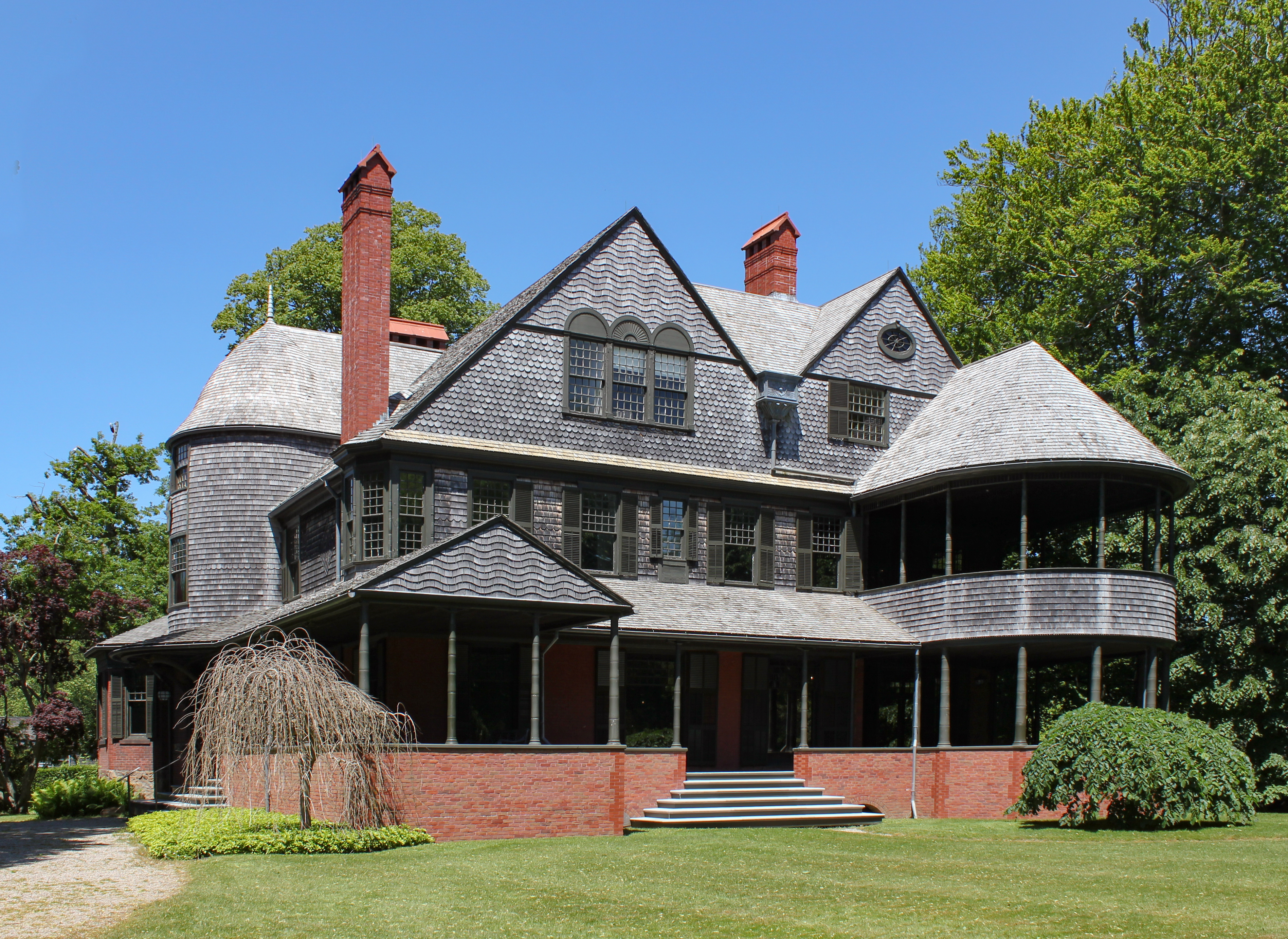
White had no formal architectural training; he began his career at the age of 18 as the principal assistant to Henry Hobson Richardson, the most important American architect of the day and creator of a style recognized today as "Richardsonian Romanesque". He remained with Richardson for six years, playing a major role in the design of the William Watts Sherman House in Newport, Rhode Island, an important Shingle Style work.
White joined the partnership in 1879, and quickly became known as the artistic leader of the firm. McKim's connections helped secure early commissions, while Mead served as the managing partner. Their work applied the principles of Beaux-Arts architecture, with its classical design traditions and training in drawing and proportion, and the related City Beautiful movement after 1893. The designers quickly found wealthy and influential clients amidst the bustle and economic vigor of metropolitan New York.
Early developments

The firm initially distinguished itself with the innovative Shingle Style Newport Casino (1879-1880) and summer houses, including Victor Newcomb's house in Elberon, New Jersey (1880–1881), the Isaac Bell House in Newport, Rhode Island (1883), and Joseph Choate's house "Naumkeag" in Lenox, Massachusetts (1885–88). Their status rose when McKim was asked to design the Boston Public Library in 1887, ensuring a new group of institutional clients following its successful completion in 1895. The firm had begun to use classical sources from Modern French, Renaissance and even Roman buildings as sources of inspiration for daring new work.
In 1877, White and McKim led their partners on a "sketching tour" of New England, visiting many of the key houses of Puritan leaders and early masterpieces of the colonial period. Their work began to incorporate influences from these buildings, contributing to the Colonial Revival.
The H.A.C. Taylor house in Newport, Rhode Island (1882–1886) was the first of their designs to use overt quotations from colonial buildings. A less successful but daring variation of a formal Georgian plan was White's house for Commodore William Edgar, also in Newport (1884–86). Rather than traditional red brick or the pink pressed masonry of the Bell house, White tried a tawny, almost brown color, leaving the building neither fish nor fowl.
The William G. Low House in Bristol, Rhode Island (1886–1887), demolished in 1962, is today seen as a quintessential expression of the Shingle Style. The architectural historian Vincent Scully saw it as "at once a climax and a kind of conclusion" for McKim, since its "prototypal form ... was almost immediately to be abandoned for the more conventionally conceived columns and pediments of McKim, Mead, and White's later buildings."
The partners added talented designers and associates as the 1890s loomed, with Thomas Hastings, John Carrère, Henry Bacon and Joseph M. Wells on the payroll in their expanding office. With a larger staff, each partner had a studio of designers at his disposal, similar to the organization of a modern design firm, and this increased their capacity for doing even larger projects, including the design of entire entire college campuses for Columbia University and New York University, and a massive entertainment complex at Madison Square Garden, all located in New York City.
Major works
.jpg)

McKim, Mead and White gained prominence as a cultural and artistic force through their construction of Madison Square Garden. White secured the job from the Vanderbilt family, and the other partners brought former clients into the project as investors. The extraordinary building opened its doors in 1890. What had once been a dilapidated arena for horse shows was now a multi-purpose entertainment palace, with a larger arena, a theater, apartments in a Spanish style tower, restaurants, and a roof garden with views both uptown and downtown from 34th Street. White's masterpiece was a testament to his creative imagination, and his taste for the pleasures of city life.
The architects paved the way for many subsequent colleagues by fraternizing with the rich in a number of other settings similar to The Garden, enhancing their social status during the Progressive Era. McKim, Mead and White designed not only the Century Association building (1891), but also many other clubs around Manhattan: the Colony Club, the Metropolitan Club, the Harmonie Club, and the University Club of New York.
Though White's subsequent life was plagued by scandals, and McKim's by depression and the loss of his second wife, the firm continued to produce magnificent and varied work in New York and abroad. They worked for the titans of industry, transportation and banking, designing not only classical buildings (the New York Herald Building, Morgan Library, Villard Houses, and Rhode Island State Capitol), but also planning factory towns (Echota, near Niagara Falls, New York; Roanoke Rapids, North Carolina; and Naugatuck, Connecticut), and working on university campuses (the University of Virginia, Harvard, Adelphi University and Columbia). The magnificent Low Library (1897) at Columbia was similar to Thomas Jefferson's at the University of Virginia, where White added an academic building on the other side of the Lawn.
Some of their later, classical country houses also enhanced their reputation with wealthy oligarchs and critics alike. The Frederick Vanderbilt Mansion (1895–1898) at Hyde Park, New York and White's "Rosecliff" for Tessie Oelrichs (1898–1902) in Newport were elegant venues for the society chronicled by Edith Wharton and Henry James. Newly-wealthy Americans were seeking the right spouses for their sons and daughters, among them idle aristocrats from European families with dwindling financial resources. When called for, the firm could also deliver a house-full of continental antiques and works of art, many acquired by Stanford White from dealers abroad. Clarence Mackay'sHarbor Hill (1899–1902), demolished in 1949, was probably the most opulent of these flights of fancy. Though many are gone, some now serve new uses, such as "Florham", in Madison, New Jersey (1897–1900), now the home of Fairleigh Dickinson University.
New York's City's enormous Penn Station (1906–1910) was the firm's crowning achievement, reflecting not only its commitment to new technological advances, but also to architectural history stretching back to Greek and Roman times. McKim, Mead & White also designed the General Post Office Building across from Penn Station at the same time, part of which became an above-ground expansion of Penn Station in 2021. The original Penn Station was demolished in 1963–1964 and replaced with a newer Madison Square Garden, in spite of large opposition to the move.
Later years
.jpg)
.jpg)

.jpg)
In January 1906 the founders were joined by three additional partners: William Mitchell Kendall (1856 – 1941), Burt Leslie Fenner (1869 – 1926) and William Symmes Richardson (1873 – 1931). Each had worked as assistants to McKim, Mead and White, respectively, though they had been delegated executive responsibility for individual projects since 1904. After a 1907 invitation to participate in the competition to design the Manhattan Municipal Building (1915), the new partners reversed the firm's long standing policy against participation in such competitions. Their entry, designed by Kendall, was successful, and the completed building was the firm's first serious entry into skyscraper design.
The firm retained its name long after the deaths of the founders. White was murdered in 1906, McKim died in 1909 and Mead retired in 1919. Kendall and Richardson divided most design responsibilities while Fenner took on the role of chief executive. Architectural historian Mosette Broderick described the design partners thusly: Kendall as "hardworking, dull and mean," Richardson as "the best designer of the three." This summation of Kendall's design skills is contradicted by his buildings, such as the Butler Institute of American Art (1919); his contemporaries considered him scholarly in the way that McKim had been. The recollections of employees such as Royal Cortissoz, however, confirm that his behavior towards his colleagues and subordinates could be actively malicious. Leland M. Roth identified the Racquet and Tennis Club (1918), designed by Richardson, as "the last and best work" of the decade following McKim and White's deaths. Richardson here combined Italian Renaissance precedents, such as the Florentine Palazzo Antinori, with modern functionalism. The final two partners, Lawrence Grant White (1887 – 1956)–Stanford White's son–and James Kellum Smith (1893 – 1961), were admitted to the partnership in 1920 and 1929, respectively. In its later years the firm maintained its commitment to quality materials and workmanship, but without its earlier creative abilities. In prior years the firm had been unfairly accused of being a "plan factory," a firm which executed generic, repetitive work as quickly as possible, but after about 1920 the comparison came to be seen as apt.
In 1914 the firm was approached by the Architectural Book Publishing Company with a proposal to publish a monograph of the firm's work. New drawings and photographs were prepared for the work, which was published in unbound, large folio installments from 1915 to 1920 as A Monograph of the Work of McKim, Mead & White, 1879–1915. With the exception of some important early works, this publication was focused on neoclassical works from the World's Columbian Exposition forward and served as a means for the later partners to curate their legacy. The Monograph also had a large influence on architects in the United States, England and elsewhere, for whom it served as a reference work. An abridged Student's Edition was published in 1925 and in 1952 they privately printed a more limited follow-up, Recent Work by the Present Partners of McKim, Mead & White, Architects. Both the Student's Edition and the unabridged Monograph have been reissued, the former by Classical America in 1981 and the latter by Dover Publications in 1990.
Richardson retired in 1921 after a disabling accident and Fenner died in 1926. Teunis Jacob van der Bent (1862 – 1936), a partner since 1909, took over Fenner's management role and died a decade later. Kendall gradually withdrew from the firm during the 1930s and died in 1941, leaving control of the firm with White and Smith. The firm's design efforts after World War II may be summed up by the Mead Art Building (1949) of Amherst College, a memorial to Mead. Mead and his wife had left a large sum of money to Amherst, his alma mater, for the construction of an art gallery. The new building was assigned to Smith, who was college architect and another alumnus. According to Blair Kamin, at this point Smith and his firm "were struggling with the challenge[s] posed by...modernism," resulting in a building which attempts gamely to meld Beaux-Arts and modernist principles but fails at both. Shortly before White's death in 1956, he won for the firm the National Museum of American History (1964) in Washington, DC. His grandson, architect Samuel White, described the commission as "[h]is personal Mount Everest." The museum, among the final works initiated under the name McKim, Mead & White, was designed principally by Smith and Walker O. Cain. Here as at Amherst they attempted to meld traditionalism and modernism with little success. Martin Moeller, then curator of the National Building Museum, described it as "neither convincingly modern nor credibly neoclassical."
Successors
Smith, the last surviving partner, died in February 1961. The surviving associates, Milton Bode Steinmann (1899 – 1987), Alexander Stevenson Corrigill (1891 – 1961), Walker Oscar Cain (1915 – 1993) and Cornelius John White (1894 – 1962)–no relation to Stanford White–formed a new partnership under the name Steinmann, Corrigill, Cain & White. After the deaths of Corrigill and White shortly thereafter, the firm was reduced first to Steinmann, Cain & White and second to Steinmann & Cain. Steinmann retired in 1967 and the firm continued under the leadership of Cain as Walker O. Cain & Associates. In 1978 the firm was reorganized as Cain, Farrell & Bell to include two new partners, including Byron Bell. In the 1990s Bell changed the name of the firm first to Bell Larson and second to Bell Larson Raucher, acknowledging the contributions of partners Douglas Larson and Alice Raucher. At the turn of the millennium Bell downplayed his firm's relation to its now-distant origins, observing that "[i]t's a different time. That was a giant firm, a major force in the world. Our firm has 10 people." A late work of the firm is Peterson Hall (1999) of the Council on Foreign Relations, a New Classical townhouse on East 68th Street in Manhattan. The firm was later renamed Bell Donnelly and lastly to Byron Bell Architects and Planners in 2012.
Selected works
New York City
| Building | Location | Year | Features | Image | ||
|---|---|---|---|---|---|---|
| Villard Houses | Manhattan | 1884 | for Henry Villard, Renaissance Revival | [[File:Villard_Houses_(53871456772).jpg | 75px]] | |
| 169 West 83rd Street | Manhattan | 1885 | for David H. King Jr, Romanesque revival | |||
| Robb House | ||||||
| 23 Park Avenue | Manhattan | 1888-92 | for J. Hampden Robb, Italian Renaissance revival style | [[File:23 Park Avenue Robb House 2.jpg | 75px]] | |
| Madison Square Garden II | Manhattan | 1890 | second of four buildings known by this name; razed in 1925 | [[File:Madison-square2.jpg | 75px]] | |
| Century Club | Manhattan | 1891 | [[File:Century 7 West 43 cloudy jeh.jpg | 75px]] | ||
| Cable Building | Manhattan | 1893 | [[File:Broadway_and_W_Houston_St_(6231921503).jpg | 75x75px]] | ||
| Washington Arch, Washington Square Park | Manhattan | 1892 | [[File:Washington_Square_Arch,_New_York.jpg | 75x75px]] | ||
| Metropolitan Club | Manhattan | 1893 | [[File:Metro Club 5 Av jeh.jpg | 75px]] | ||
| Harvard Club of New York City | Midtown Manhattan | 1894 | [[File:Harvard_Club_Interior.jpg | 75x75px]] | ||
| New York Herald Building | Manhattan | 1895 | razed in 1921 | [[File:Herald Building, New York, N.Y. (LC-DIG-det-4a17016).jpg | 75px]] | |
| Brooklyn Museum | Brooklyn | 1895 | [[File:Brooklyn_Institute_of_Arts_and_Sciences,_Brooklyn,_N.Y_(NYPL_b12647398-70040).tiff | 75x75px]] | ||
| Bowery Savings Bank Building | Manhattan | 1895 | [[File:Bowery_Savings_Bank_-_Entrance_(51624125693).jpg | 75px]] | ||
| 900 Broadway | Manhattan | 1897 | [[File:Goelet Building 900 Broadway.jpg | 75px]] | ||
| Former New York Life Insurance Company Building | Manhattan | 1894–1898 | White marble Renaissance palazzo-style building. MMW took over the commission upon the death of Stephen D. Hatch in 1894. | [[File:Clock_Tower_Building.jpg | 145x145px]] | |
| James J. Goodwin Residence | Manhattan | 1896–1898 | [[File:W_54th_St_Mar_2021_09.jpg | 75x75px]] | ||
| University Club of New York | Manhattan | 1899 | [[File:University Club of New York jeh.jpg | 75px]] | ||
| University Heights campus, New York University | The Bronx | 1891–1900 | including Hall of Fame for Great Americans and Gould Memorial Library 1900, now site of Bronx Community College | [[File:Bronx_Community_College_Library_exterior_-2_(cropped).jpg | 75x75px]] | |
| Morningside Heights campus, Columbia University | Manhattan | 1893–1900 | general design and individual buildings including Low Memorial Library, Philosophy Hall, John Jay Hall, Avery Hall, Hamilton Hall, Kent Hall, Hartley Hall, Havemeyer Hall, Schermerhorn Hall, Pupin Hall, Earl Hall, Wallach Hall, St. Paul's Chapel, and Casa Italiana. | [[File:Low Memorial Library Columbia University College Walk Court Yard 05.jpg | 75px]] | |
| Prospect Park | Brooklyn | 1895–1900 | Various features including Parade Place on Lookout Hill, Peristyle, Park Circle granite fixtures, Lullwater Bridge, 1895 Maryland Monument on Lookout Hill | [[File:Grecian_Shelter_shade_jeh.JPG | 75x75px]] | |
| William H. Moore House | Manhattan | 1898–1900 | [[File:William-moore-house.jpg | 103x103px]] | ||
| Harry B. Hollins Residence | Manhattan | 1899–1901 | [[File:Hollins_Residence_12-14_West_56th_Street.jpg | 110x110px]] | ||
| Morgan Library & Museum | Manhattan | 1903 | expanded in 1928 | [[File:Morgan_Library_McKim_Building_from_west.jpg | 75px]] | |
| IRT Powerhouse | Manhattan | 1904 | [[File:IRT 58 St power sunny jeh.jpg | 75px]] | ||
| Harmonie Club | Manhattan | 1905 | [[File:Harmonie Club 1905.JPG | 75px]] | ||
| 390 Fifth Avenue | Manhattan | 1906 | for the Gorham Manufacturing Company | [[File:Gorham_390_5th_jeh.JPG | alt= | 85x85px]] |
| 1 West 28th Street | NoMad | 1907 | former estate of Gilded Age socialite Charlotte Goodridge demolished and reconstructed into five-story bank designed by McKim, Mead & White, commissioned by Second National Bank. | |||
| Prison Ship Martyrs' Monument | Brooklyn | 1908 | [[File:Prison Ship Martyrs' Monument from southwest.jpg | 75px]] | ||
| Knickerbocker Trust Building | Manhattan | 1909 | for the Knickerbocker Trust Company; now razed | [[File:Knickerbocker_trust_company.jpg | 75px]] | |
| Pennsylvania Station | Manhattan | 1904–1910 | above-ground portion razed in 1963 | [[File:NYP_LOC5.jpg | 106x106px]] | |
| 998 Fifth Avenue | Manhattan | 1912 | [[File:998_5th_Ave.jpg | 75px]] | ||
| Bellevue Hospital Center | Manhattan | 1912 | general design and some individual buildings including R & S Building | [[File:Bellevue_Psychiatric_Hospital_old_building.jpg | 75px]] | |
| New York Public Library branches | Manhattan and The Bronx | 1902–1914 | designed 11 branches including Hamilton Grange Branch 1905–1906, 115th Street Branch 1907–1908 | [[File:Hamilton_Grange_Branch,_exterior_(NYPL_b11524053-ps_mss_cd22_328).tiff | 94x94px]] | |
| James A. Farley Building | Manhattan | 1911–1914 | designed as the architectural twin of New York City's Pennsylvania Station; annex also designed by McKim, Mead & White in 1932. Now contains Moynihan Train Hall | [[File:Old_Post_Office_(6222197041).jpg | 75x75px]] | |
| Manhattan Municipal Building | Manhattan | 1909–1915 | [[File:Manhattan_Municipal_Building_from_the_East_River_(6217125120).jpg | 75x75px]] | ||
| Racquet and Tennis Club | Manhattan | 1916–1918 | [[File:Racquet and Tennis Club 370 Park Avenue.jpg | 75px]] | ||
| Hotel Pennsylvania | Manhattan | 1919 | razed in 2022 | [[File:Hotel Pennsylvania, NY (external view, ca 1919).jpg | 75px]] | |
| Town Hall | Manhattan | 1921 | [[File:Town Hall 123 W43 near sun jeh.jpg | 75px]] | ||
| 110 Livingston Street | Brooklyn | 1926 | former Elks Lodge, former headquarters of New York City Department of Education | [[File:WSTM Zefferus 0055.jpg | 75px]] | |
| Savoy-Plaza Hotel | Manhattan | 1927 | razed in 1965 | [[File:Central_Park%2C_Plaza_at_the_pond%2C_New_York_City%2C_NY_5a18137u_original.jpg | 75px | alt=the large building at center, to the right of the taller, narrow spire]] |
| Liggett Hall, Governors Island | Manhattan | 1929 | [[File:Liggett_Hall_New_York_September_2016_001.jpg | 75x75px]] | ||
| DeKalb Hall and Information Science Center | Brooklyn | 1955 | ||||
| North Hall at Pratt Institute | Brooklyn | 1957 |
New England, Upstate New York, and Long Island
| Building | Location | Year | Features | Image | |||||||
|---|---|---|---|---|---|---|---|---|---|---|---|
| Newport Casino | Newport, Rhode Island | 1880 | [[File:ITHF_Grounds_and_Newport_Casino_building.jpg | 75x75px]] | |||||||
| John Howard Whittemore House | Naugatuck, Connecticut | 1880s | |||||||||
| Isaac Bell House | Newport, Rhode Island | 1881–1883 | [[File:Isaac_Bell_House_2018-06-13.jpg | 75x75px]] | |||||||
| Cyrus McCormick summer estate, shingle-style | Richfield Springs, New York | 1882 | razed 1957 | ||||||||
| Emdalar Castle – Tickner Estate | South Kingstown, Rhode Island | 1883 | Restored to its original condition in 2014. | [[File:Emdalar Castle Entrance.jpg | 75x75px]] | ||||||
| Narragansett Pier Casino | Narragansett, Rhode Island | 1883 | [[File:The_Towers,_Narragansett_Pier_RI.jpg | 75x75px]] | |||||||
| Narragansett Pier Life Saving Station | Narragansett, Rhode Island | 1888 | Coast Guard House Restaurant since 1960's | [[File:The Coast Guard House, Narragansett RI.jpg | 80x60px]] | ||||||
| Salem School | Naugatuck, Connecticut | 1884 | [[File:PostcardSalemSchoolNaugatuckCT1915.jpg | 75px | alt=about 1905]] | ||||||
| Wolf's Head Society, "Old Hall", Yale University | New Haven, Connecticut | 1884 | [[File:Old Wolf's Head society hall built 1884 Yale College New Haven Connecticut.jpg | 75px]] | |||||||
| Charles J. Osborn Residence | Mamaroneck, New York | 1885 | Mamaroneck Beach and Yacht Club since 1952 | ||||||||
| "Four Chimneys" Mansion | New Rochelle, New York | ? | |||||||||
| John F. Andrew Mansion, 32 Hereford Street | Boston, Massachusetts | 1886 | |||||||||
| William G. Low House | Bristol, Rhode Island | 1887 | epitome of Shingle Style architecture; razed 1962 | [[File:LowHouseBristolRI.jpg | 75px]] | ||||||
| Algonquin Club | Boston, Massachusetts | 1888 | [[File:Algonquin_Club_facade,_Boston.JPG | 75x75px]] | |||||||
| Johnston Gate, Harvard University | Cambridge, Massachusetts | 1889 | [[File:Johnston Gate (Harvard Yard) - IMG 8974.JPG | 75px]] | |||||||
| Fayerweather Hall, Amherst College | Amherst, Massachusetts | 1890 | [[File:Fayerweather_Hall,_Amherst_College.jpg | 75x75px]] | |||||||
| Walker Art Building, Bowdoin College | Brunswick, Maine | 1894 | [[File:Walker_Art_Building_-_Bowdoin_College_-_IMG_7772.JPG | 75x75px]] | |||||||
| Whittemore Memorial Library | Naugatuck, Connecticut | 1894 | [[File:NaugatuckCT_WhittemoreLibrary.jpg | 75x75px]] | |||||||
| Adams Power Plant Transformer House | Niagara Falls, New York | 1895 | [[File:Westinghouse Generators at Niagara Falls.jpg | 75px]] | |||||||
| Boston Public Library | Boston, Massachusetts | 1895 | [[File:Boston_Public_Library_(49223023682).jpg | 75x75px]] | |||||||
| Dudley Pickman House, 303 Commonwealth Avenue (Back Bay) | Boston, Massachusetts | 1895 | |||||||||
| Reid Hall, Manhattanville College | Purchase, New York | 1895 | [[File:Reid_Hall,_Manhattanville_College.jpg | 75x75px]] | |||||||
| Rhode Island State House | Providence, Rhode Island | 1895–1904 | [[File:Rhode_Island_State_House_2.jpg | 75x75px]] | |||||||
| Garden City Hotel | Garden City, New York | 1895 | burned 1899 | ||||||||
| House for Frederick Vanderbilt, "Hyde Park" | Hyde Park, New York | 1895–1898 | [[File:Vanderbilt_Mansion_-_IMG_7944.JPG | 75x75px]] | |||||||
| Woodlea | Briarcliff Manor, New York | 1895 | now Sleepy Hollow Country Club | [[File:Woodlea in Briarcliff Manor.tiff | 75px]] | ||||||
| James L. Breese House | Southampton, New York | 1897–1906 | [[File:Breese_House;_155_Hill_Road;_Southampton,_New_York.jpg | 75x75px]] | |||||||
| Rosecliff | Newport, Rhode Island | 1898–1902 | [[File:Rosecliff_as_seen_from_the_front._Built_by_Theresa_Fair_Oelrichs,_heiress_to_the_Comstock_Lode_fortune._-_panoramio.jpg | 75x75px]] | |||||||
| Harbor Hill | Long Island, New York | 1899–1902 | razed 1947 | [[File:American_estates_and_gardens_(1904)_(14781237585).jpg | 75x75px]] | ||||||
| Symphony Hall | Boston, Massachusetts | 1900 | [[File:Boston_Symphony_Hall_from_the_south.jpg | 75px]] | |||||||
| Hill-Stead Museum | Farmington, Connecticut | 1901 | estate of Alfred Atmore Pope, designed with Theodate Pope Riddle | [[File:Hill-Stead Museum (Farmington, CT) - west facade.JPG | 75px]] | ||||||
| Astor Courts | Rhinebeck, New York | 1902–1904 | estate of John Jacob Astor | ||||||||
| Rockefeller Hall, Brown University | Providence, Rhode Island | 1904 | now Faunce House | [[File:Faunce_House,_Brown_University.jpg | 75x75px]] | ||||||
| Naugatuck High School | Naugatuck, Connecticut | 1904 | Hillside Middle School since 1959 | [[File:NaugatuckHighSchool.jpg | 75px]] | ||||||
| New England Trust Company Building | Boston, Massachusetts | 1906 | |||||||||
| Waterbury Union Station | Waterbury, Connecticut | 1909 | Renaissance Revival style featuring a clock tower modeled on the Torre del Mangia in Siena, Italy | ||||||||
| Plymouth Rock portico | Plymouth, Massachusetts | 1920 | [[File:Plymouth_Rock_Monument.jpg | 75px]] | |||||||
| Foster Hall, University at Buffalo South Campus | Buffalo, New York | 1921 | |||||||||
| Harvard Business School | Boston, Massachusetts | 1925 | |||||||||
| Ira Allen Chapel, University of Vermont | Burlington, Vermont | 1925 | [[File:Ira_Allen_Chapel_UVM_5.JPG | 139x139px]] | |||||||
| Olin Memorial Library, Wesleyan University | Middletown, Connecticut | 1925 | [[File:Wesleyan_University_-_Olin_Library_02.jpg | 75x75px]] | |||||||
| Memorial Chapel, Union College | Schenectady, New York | 1925 | [[File:Memorial_Chapel_4.JPG | 75x75px]] | |||||||
| Lincoln Alliance Building | Rochester, New York | 1926 | |||||||||
| Rochester Savings Bank | Rochester, New York | 1927 | [[File:Rochester Savings Bank.jpg | 75px]] | |||||||
| George Eastman House | Rochester, New York | c.1903 | Eastman hired McKim, Mead & White to design the interior of his Georgian Colonial Revival Mansion which was nearly an exact, large scale duplicate of the Robert Root House that was built by the firm in Buffalo, New York c.1894 | ||||||||
| Burlington City Hall | Burlington, Vermont | 1928 | [[File:City Hall Burlington Vermont from southeast on Main Street.jpg | 75px]] | |||||||
| Levermore Hall, Blodgett Hall, and Woodruff Hall, Adelphi University | Garden City, New York | 1929 | |||||||||
| Schenectady City Hall | Schenectady, New York | 1931–1933 | [[File:SchenectadyCityHallRear.jpg | 75x75px]] | |||||||
| The Little Red Schoolhouse, Amherst College | Amherst, Massachusetts | 1937 | razed May 2016 | [[File:Little_Red_Schoolhouse_Amherst_Massachusetts_2015.jpg | 75px]] | ||||||
| Ballou Hall, Tufts College | Medford, Massachusetts | 1955 | Renovation | [[File:Ballou Hall - Tufts University - 4a08562u.jpg | 75px]] | ||||||
| title = Great American Railroad Stations | last = Potter | first = Janet Greenstein | publisher = John Wiley & Sons, Inc. | year = 1996 | isbn = 978-0471143895 | location = New York | pages = 94, 154, 164}} | Stockbridge, Massachusetts | 1893 | English Gothic Revival style, stone | |
| New York Central Railroad Station | Ardsley-on-Hudson, New York | 1895 | Shingle Style with Tudor and Romanesque Revival elements | ||||||||
| Park Lane Apartments | Mount Vernon, New York | 1929 | |||||||||
| The Cedars/Lord's Castle Remodel | Piermont, New York | 1892 | "The original gable ends were stepped, the pointy 'Gothick' windows were Edwardianized, the wooden porches reconstructed in stone, the tower on the west capped with a conical roof, the forest of delicate chimney pots combined and bulked up, and the reconfigured interior given heavy doses of classical columns, balusters, dadoes, fireplaces and moldings." |
New Jersey
| Building | Location | Year | Features | Image | |
|---|---|---|---|---|---|
| Florham Campus, Fairleigh Dickinson University | Madison and Florham Park, New Jersey | 1897 | originally "Florham," the estate of Hamilton Twombly and Florence Vanderbilt, one of many Vanderbilt houses | [[File:Fairleigh Dickinson University, Florham panorama.jpg | 75px]] |
| Orange Public Library | Orange, New Jersey | 1901 | [[File:ORANGE FREE PUBLIC LIBRARY, ORANGE, ESSEX COUNTY, NJ.jpg | 75px]] | |
| St. Peter's Episcopal Church | Morristown, New Jersey | 1889–1913 | English-medieval style parish church. | [[File:St. Peter's Episcopal Church, Morristown, NJ - looking northeast.jpg | 75x75px]] |
| Hurstmont | Morristown, New Jersey | 1902–1903 | Private estate | In the process of being demolished. | |
| FitzRandolph Gate | Princeton, New Jersey | 1905 | The official entrance of Princeton University | [[File:Fitzrandolph Gate.jpg | 75px]] |
| University Cottage Club, Princeton University | Princeton, New Jersey | 1906 | One of the Eating clubs at Princeton University | [[File:University_Cottage_Club_Princeton.JPG | 75px]] |
| Pennsylvania Station | Newark, New Jersey | 1935 | Art Deco style | [[File:Newark Pennsylvania Station interior.jpg | 75px]] |
Washington, D.C.
| Building | Location | Year | Features | Image | ||
|---|---|---|---|---|---|---|
| White House, West Wing and East Wing | 1600 Pennsylvania Avenue NW | 1903 | Renovation | [[File:White House Office Building, and tennis court c.1909.jpg | 75px | alt=West wing c. 1909]] |
| Thomas Nelson Page House | 1759 R Street NW | 1897 | [[File:Thomas Nelson Page House - Washington, D.C..JPG | 75px]] | ||
| Roosevelt Hall, National War College | Fort Lesley J. McNair | 1903–1907 | [[File:Roosevelt Hall.jpg | 75px]] | ||
| National Museum of American History | 1300 Constitution Avenue NW | 1964 | [[File:Aerial view of National Museum of American History.jpg | 75px]] | ||
| Patterson Mansion | 15 Dupont Circle NW | 1903 | [[File:Patterson House.jpg | 75px]] | ||
| St. John's Episcopal Church, Lafayette Square | 1525 H Street NW | 1919 | Renovation | [[File:St. John's Church, Washington, D.C. LCCN2011631449.jpg | 94x94px]] | |
| Pedestal, Jeanne d'Arc | Meridian Hill Park | 1922 | Measures about 10 feet long and 6 feet high |
Other U.S. locations
| Building | Location | Year | Features | Image | |
|---|---|---|---|---|---|
| Ross Winans Mansion | Baltimore, Maryland | 1882 | Possibly the only fully intact late-nineteenth-century urban mansions designed almost exclusively by MM&K. Also one of their first residential homes. | [[File:Ross Winans Mansion, 1217 Saint Paul Street, Baltimore, MD 21202 (38898254604).jpg | 75px]] |
| First Methodist Episcopal Church, Lovely Lane United Methodist Church | Baltimore, Maryland | 1884 | [[File:First Methodist Episcopal Church (Lovely Lane United Methodist Church).jpg | 75px]] | |
| Cramond | Tredyffrin Township, Pennsylvania | 1886 | [[File:Cramond ECC.JPG | 75px]] | |
| McKelvy House (formerly "Oakhurst"), Lafayette College, College Hill | Easton, Pennsylvania | 1888 | |||
| New York Life Insurance Building | Kansas City, Missouri | 1890 | [[File:NY Life Bldg Kansas City MO.jpg | 75px]] | |
| Open Gates, George Sealy Mansion | Galveston, Texas | 1891 | [[File:Open-Gates-The George Sealy Mansion.jpg | 75px]] | |
| Germantown Cricket Club | Philadelphia, Pennsylvania | 1891 | [[File:Germantown Clubhouse.gif | 75px]] | |
| The Agricultural Building at the World Columbian Exposition | Chicago, Illinois | 1893 | [[File:Agricultural Building — Official Views Of The World's Columbian Exposition — 18.jpg | 75px]] | |
| Old Cabell Hall, Cocke Hall, and Rouss Hall, University of Virginia | Charlottesville, Virginia | c. 1898 | Part of the UNESCO World Heritage Site at Monticello and the University of Virginia | [[File:Old Cabell Hall and Homer University of Virginia.jpg | 75px]] |
| Savoyard Centre | Detroit, Michigan | 1900 | Originally State Savings Bank; National Register of Historic Places, 1982 | [[File:PeoplesStateBankDetroitc1920.jpg | 75px]] |
| Protection of the Flag Monument | Athens, Pennsylvania | 1900–1902 | |||
| English Building, University of Illinois Urbana-Champaign | Urbana, Illinois | 1905 | [[File:PSM V67 D763 The womens building university of illinois.png | 75px]] | |
| Carr's Hill, or University of Virginia President's House | Charlottesville, Virginia | 1906 | [[File:Carrs hill.JPG | 75px]] | |
| Omaha National Bank Building | Omaha, Nebraska | 1906 | originally the New York Life Building, 1889) | [[File:wiki photos 050a.png | 75px]] |
| Girard Bank | Philadelphia, Pennsylvania | 1908 | [[File:GirardTrust.jpg | 75x75px]] | |
| Fayette National Bank Building | Lexington, Kentucky | 1914 | now 21c Museum Hotel Lexington | [[File:Fayette National Bank Building.jpg | 75px]] |
| Minneapolis Institute of Arts | Minneapolis, Minnesota | 1915 | [[File:Minneapolis_Institute_of_Art.jpg | 75x75px]] | |
| Peabody Demonstration School | Nashville, Tennessee | 1915 | now University School of Nashville | ||
| National McKinley Birthplace Memorial Library and Museum | Niles, Ohio | 1915 | [[File:McKinleyMem08ent.jpg | 75px]] | |
| Butler Institute of American Art | Youngstown, Ohio | 1919 | listed on National Register of Historic Places | [[File:Youngstown 021 crop.jpg | 75px]] |
| Cohen Memorial Hall (Vanderbilt Fine Arts Gallery), Vanderbilt University | Nashville, Tennessee | 1928 approx | |||
| Milwaukee County Courthouse | Milwaukee, Wisconsin | 1931 | [[File:Milwaukee County Courthouse.jpg | 75px]] | |
| Chittenden Hall, University of Vermont | Burlington, Vermont | 1947 | |||
| Dietrich Hall, now Steinberg-Dietrich Hall, University of Pennsylvania | Philadelphia, Pennsylvania | 1952 | |||
| University of North Carolina, Chapel Hill | Chapel Hill, North Carolina | 1929 | Expansion of campus | [[File:MJK49440_Louis_Round_Wilson_Library_(Chapel_Hill).jpg | 75x75px]] |
Other countries
| Building | Location | Year | Features | Image | ||
|---|---|---|---|---|---|---|
| Bank of Montreal Head Office | Montreal, Quebec, Canada | 1901–1905 | additions | [[File:Bank_of_Montreal_Head_Office,_Montréal,_Southeast_view_20170410_1.jpg | 100x100px]] | |
| Bank of Montreal Building | Winnipeg, Manitoba, Canada | 1913 | [[File:Bank_of_Montreal_building_in_Winnipeg.jpg | 100x100px]] | ||
| Mount Royal Club | Montreal, Quebec, Canada | 1906 | [[File:Édifice du Mount Royal Club.JPG | frameless | 100x100px]] | |
| American Academy in Rome Main Building | Rome, Italy | 1914 | [[File:americanacademyrome.jpg | 101x101px]] | ||
| Hotel Nacional de Cuba | Havana, Cuba | 1930 | [[File:Hotel Nacional de Cuba - panoramio.jpg | 101x101px]] |
Notable architects who worked for McKim, Mead & White
- Henry Bacon – worked at the firm from about 1886 through 1897; left with fellow employee James Brite to open their own office.
- William A. Boring – worked at the firm in 1890 before forming a separate partnership with Edward Lippincott Tilton.
- Charles Lewis Bowman – a draftsman at the firm until 1922, noted for his large number of private residences throughout Westchester County, New York including Bronxville, Pelham Manor, Mamaroneck and New Rochelle.
- A. Page Brown – worked with the firm beginning in the 1880s; went to California, where he was known for the San Francisco Ferry Building.
- Walker O. Cain – worked at the firm; he took it over in 1961 and renamed it several times.
- J.E.R. Carpenter – worked at the firm for several years before designing much of upper Fifth and Park Avenues, including 907 Fifth Avenue, 825 Fifth Avenue, 625 Park Avenue, 550 Park Avenue and the Lincoln Building on 42nd Street.
- John Merven Carrère (1858–1911) – worked with McKim, Mead & White from 1883 through 1885, then joined Thomas Hastings to form the firm Carrère and Hastings.
- Thomas Harlan Ellett (1880–1951)
- Cass Gilbert – worked with the firm until 1882, when he went to work with James Knox Taylor; later designed many notable structures, among them the George Washington Bridge and the Woolworth Building.
- Arthur Loomis Harmon – later of Shreve, Lamb and Harmon.
- Thomas Hastings (1860–1929) – of Carrère and Hastings, worked with McKim, Mead & White from 1883 through 1885.
- John Galen Howard (1864–1931)
- John Mead Howells (1868–1959)
- William Mitchell Kendall (1856–1941) – worked with the firm from 1882 until his death.
- Harrie T. Lindeberg – started at the firm in 1895 as an assistant to Stanford White and remained with the firm until White's death in 1906.
- Austin W. Lord – worked with the firm in 1890–1894 on designs for Brooklyn Museum of Arts and Sciences, the Metropolitan Club and buildings at Columbia University
- Harold Van Buren Magonigle (1867–1935)
- Albert Randolph Ross
- Philip Sawyer (1868–1949)
- James Kellum Smith (1893–1961) – a member of the firm from 1924 to 1961; full partner in 1929, and the last surviving partner of MM&W. He primarily designed academic buildings, but his last major work was the National Museum of American History.
- Robert Storer Stephenson (1858-1929) — began his career at the firm and in 1882 went on to found Stephenson & Wheeler, which designed the mansion at Edgerton Park and the Brewster Building, among many others.
- Egerton Swartwout of Tracy and Swartwout – both Tracy and Swartwout worked together for the firm on multiple projects prior to starting their own practice.
- Edward Lippincott Tilton – helped design the Boston Public Library in 1890 before leaving with Boring.
- Robert von Ezdorf – took over much of the firm's business after White's death.
- Joseph Morrill Wells (1853–1890) – worked as firm's first Chief Draftsman from 1879 to 1890; often considered to be the firm's "fourth partner", and largely responsible for its Renaissance Revival designs in the 1880s.
- William M. Whidden – worked at the firm from at least 1882 until 1888; projects included the Tacoma and Portland hotels in Washington and Oregon, respectively; moved to Portland, Oregon, in 1888 to finish the hotel and established his own firm with Ion Lewis
- York and Sawyer – Edward York (1863–1928) and Philip Sawyer (1868–1949) worked together for the firm before starting their own partnership in 1898.
References
Citations
General and cited bibliography
- Baker, Paul R. (1989). Stanny: The Gilded Life of Stanford White. New York: Free Press. .
- Broderick, Mosette (2010). Triumvirate: McKim, Mead & White: Art, Architecture, Scandal, and Class in America's Gilded Age. New York: Knopf. .
- McKim, Mead & White (1915–1920). A Monograph of the Work of McKim, Mead & White, 1879–1915, 4 vols. New York: Architectural Book Publishing Co.
- Reprinted as The Architecture of McKim, Mead & White in Photographs, Plans and Elevations, with an introduction by Richard Guy Wilson. New York: Dover Publications, 1990. .
- Roth, Leland M. (September 1, 1978). The Architecture of McKim, Mead & White, 1870–1920: A Building List. Garland Reference Library of the Humanities. Garland Publishing. .
- Roth, Leland M. (October 1985). McKim, Mead and White, Architects (First edition). Harper & Row. .
References
- See Mark Alan Hewitt, ''The Architect and the American Country House, 1890–1940,'' (New Haven, Yale Univ. Press: 1990) pages 15–67, for a discussion of their influence.
- {{Cite New York 1900
- White, Samuel. (2003). "McKim, Mead & White: The Masterworks". Random House Incorporated.
- Leland M. Roth, ''McKim, Mead and White, Architects'', (New York, Harper & Row: 1985)
- See Vincent Scully, Jr. ''The Shingle Style and the Stick Style: architectural theory and design from Richardson to the origins of Wright'' (New Haven, Yale Univ. Press: 1971)
- William B. Rhoads, ''The Colonial Revival'', Ph.D. dissertation, Princeton University, (New York, Garland Publishing: 1977) pages 594 and 942.
- Scully, Vincent (1971) [1955]. The Shingle Style and the Stick Style. New Haven: Yale University Press. p. 153. {{ISBN. 978-0-300-01519-5
- Richard Guy Wilson, ''McKim, Mead and White, architects'' (New York, Rizzoli: 1983).
- Mosette Broderick, ''Triumvirate: McKim, Mead & White Art, Architecture, Scandal, and Class in America's Gilded Age'' (New York, Alfred Knopf: 2010).
- Leland Roth. "Three Factory Towns by McKim, Mead and White". ''Journal of the Society of Architectural Historians''. Vol. 38, No. 4 (1979): 317–347.
- See Samuel G. White, ''The Houses of McKim, Mead and White'' (New York, Rizzoli: 1998).
- See Steven Parissien, ''Pennsylvania Station: McKim, Mead and White'' (London, Phaidon: 1996).
- (April 11, 1908). "White's Firm Selected.: New York Architects Win Competition for Post-office Building.". The Washington Post.
- Tolchin, Martin. (October 29, 1963). "Demolition Starts At Penn Station; Architects Picket; Penn Station Demolition Begun; 6 Architects Call Act a 'Shame'".
- Leland M. Roth, ''McKim, Mead & White, Architects'' (New York: Harper & Row, 1983): 336-337.
- ''A Monograph of the Works of McKim, Mead and White'', New York, Architectural Book Publishing Company: 1925.
- Leland M. Roth, ''McKim, Mead & White, Architects'' (New York: Harper & Row, 1983): 337-339.
- Leland M. Roth, ''McKim, Mead & White, Architects'' (New York: Harper & Row, 1983): 335-336.
- Mosette Broderick, ''Triumvirate: McKim, Mead & White: Art, Architecture, Scandal and Class in America's Gilded Age'' (New York: Alfred A. Knopf, 2010): 512-513.
- "William M. Kendall" in ''Pencil Points'' 22, no. 3 (September 1941): 65.
- Mosette Broderick, ''Triumvirate: McKim, Mead & White: Art, Architecture, Scandal and Class in America's Gilded Age'' (New York: Alfred A. Knopf, 2010): 275.
- Leland M. Roth, ''McKim, Mead & White, Architects'' (New York: Harper & Row, 1983): 343-344.
- ''Recent Work by the Present Partners of McKim, Mead & White, Architects'' (New York: McKim, Mead & White, 1952): 7.
- Leland M. Roth, ''McKim, Mead & White, Architects'' (New York: Harper & Row, 1983): 345.
- Mosette Broderick, ''Triumvirate: McKim, Mead & White: Art, Architecture, Scandal and Class in America's Gilded Age'' (New York: Alfred A. Knopf, 2010): 513.
- Richard Guy Wilson, "Introduction" in ''The Architecture of McKim, Mead & White in Photographs, Plans and Elevations'' (Mineola, Dover Publications: 1990)
- ''Recent Work by the Present Partners of McKim, Mead & White, Architects'' (New York: McKim, Mead & White, 1952): 6.
- (November 27, 1928). "W.R. Mead's Estate Bequeathed to Wife – Marrow Named as Executor — Luther's Widow Chief Beneficiary – Lather Left Most to Wife – Justice Keogh's Will Filed". [[The New York Times]].
- (April 23, 1936). "Mrs. Mead's Estate Is Left to Amherst – Widow of Architect Makes an Unconditional Bequest to Husband's Alma Mater". [[The New York Times]].
- Blair Kamin, ''Amherst College: An Architectural Tour'' (New York: Princeton Architectural Press, 2020): 58-61.
- David W. Dunlap, "The delicate matter of passing the torch," ''New York Times'', November 21, 1999.
- G. Martin Moeller Jr., ''AIA Guide to the Architecture of Washington, D.C.'' (Baltimore: Johns Hopkins University Press, 2012): 77-78.
- "The Record reports" in ''Architectural Record'' 129, no. 4 (April 1961): 268.
- "Office notes" in ''Architectural Record'' 1242, no. 1 (July 1967): 73.
- Robert A. M. Stern, David Fishman and Jacob Tilove, ''New York 2000'' (New York : Monacelli Press, 2006): 935.
- "[https://www.vanalen.org/person/byron-bell/ Byron Bell]," Van Alen Institute, no date. Accessed June 10, 2025.
- Goeschel, Nancy. (February 10, 1987). "Former New York Life Insurance Building".
- Blackwell, D. and The Naugatuck Historical Society 1996 "Images of Naugatuck". Arcadia Publishing
- [http://library24.library.cornell.edu:8280/luna/servlet/view/search?QuickSearchA=QuickSearchA&q=osborn+residence&sort=Preferred_Name%2CEarliest_Year%2CTitle%2CDescription&search=Search Charles J. Osborn Residence]
- Potter, Janet Greenstein. (1996). "Great American Railroad Stations".
- "George Eastman Questions · George Eastman House".
- Tolles, Bryant Franklin Jr.. (1973). "Gridley J.F. Bryant and the First Building at Tufts College".
- Potter, Janet Greenstein. (1996). "Great American Railroad Stations". John Wiley & Sons, Inc..
- "Piermont Historical Society".
- (January 8, 2013). "Big Old Houses: I Love This House". New York Social Diary.
- (1922). "Art and Archaeology". Archaeological Institute of America.
- (January 10, 2011). "Ross Winans Mansion". Baltimore Heritage.
- [http://hcap.artstor.org/cgi-bin/library?a=d&d=p955 "McKelvy House"] on the Council of Independent Colleges Historic Campus Architecture Project website
- "Monticello and the University of Virginia in Charlottesville".
- [http://www.bluffton.edu/~sullivanm/ Bluffton University Digital Imagine Project]
- {{NRHP url
This article was imported from Wikipedia and is available under the Creative Commons Attribution-ShareAlike 4.0 License. Content has been adapted to SurfDoc format. Original contributors can be found on the article history page.
Ask Mako anything about McKim, Mead & White — get instant answers, deeper analysis, and related topics.
Research with MakoFree with your Surf account
Create a free account to save articles, ask Mako questions, and organize your research.
Sign up freeThis content may have been generated or modified by AI. CloudSurf Software LLC is not responsible for the accuracy, completeness, or reliability of AI-generated content. Always verify important information from primary sources.
Report