From Surf Wiki (app.surf) — the open knowledge base
Maxwell–Boltzmann distribution
Specific probability distribution function, important in physics
Specific probability distribution function, important in physics
(where exp is the exponential function) (where erf is the error function) In physics (in particular in statistical mechanics), the Maxwell–Boltzmann distribution, or Maxwell(ian) distribution, is a particular probability distribution named after James Clerk Maxwell and Ludwig Boltzmann.
It was first defined and used for describing particle speeds in idealized gases, where the particles move freely inside a stationary container without interacting with one another, except for very brief collisions in which they exchange energy and momentum with each other or with their thermal environment. The term "particle" in this context refers to gaseous particles only (atoms or molecules), and the system of particles is assumed to have reached thermodynamic equilibrium. The energies of such particles follow what is known as Maxwell–Boltzmann statistics, and the statistical distribution of speeds is derived by equating particle energies with kinetic energy.
Mathematically, the Maxwell–Boltzmann distribution is the chi distribution with three degrees of freedom (the components of the velocity vector in Euclidean space), with a scale parameter measuring speeds in units proportional to the square root of T/m (the ratio of temperature and particle mass).
The Maxwell–Boltzmann distribution is a result of the kinetic theory of gases, which provides a simplified explanation of many fundamental gaseous properties, including pressure and diffusion. The Maxwell–Boltzmann distribution applies fundamentally to particle velocities in three dimensions, but turns out to depend only on the speed (the magnitude of the velocity) of the particles. A particle speed probability distribution indicates which speeds are more likely: a randomly chosen particle will have a speed selected randomly from the distribution, and is more likely to be within one range of speeds than another. The kinetic theory of gases applies to the classical ideal gas, which is an idealization of real gases. In real gases, there are various effects (e.g., van der Waals interactions, vortical flow, relativistic speed limits, and quantum exchange interactions) that can make their speed distribution different from the Maxwell–Boltzmann form. However, rarefied gases at ordinary temperatures behave very nearly like an ideal gas and the Maxwell speed distribution is an excellent approximation for such gases. This is also true for ideal plasmas, which are ionized gases of sufficiently low density.
The distribution was first derived by Maxwell in 1860 on heuristic grounds. Boltzmann later, in the 1870s, carried out significant investigations into the physical origins of this distribution. The distribution can be derived on the ground that it maximizes the entropy of the system. A list of derivations are:
- Maximum entropy probability distribution in the phase space, with the constraint of conservation of average energy \langle H \rangle = E;
- Canonical ensemble.
Distribution function
For a system containing a large number of identical non-interacting, non-relativistic classical particles in thermodynamic equilibrium, the fraction of the particles within an infinitesimal element of the three-dimensional velocity space dv, centered on a velocity vector \mathbf{v} of magnitude v, is given by f(\mathbf{v}) ~ d^3\mathbf{v} = \biggl[\frac{m}{2 \pi k_\text{B}T}\biggr]^ , \exp\left(-\frac{mv^2}{2k_\text{B}T}\right) ~ d^3\mathbf{v}, where:
- m is the particle mass;
- kB is the Boltzmann constant;
- T is thermodynamic temperature;
- f(\mathbf{v}) is a probability distribution function, properly normalized so that \int f(\mathbf{v}) , d^3\mathbf{v} over all velocities is unity.
One can write the element of velocity space as d^3\mathbf{v} = dv_x , dv_y , dv_z, for velocities in a standard Cartesian coordinate system, or as d^3\mathbf{v} = v^2 , dv , d\Omega in a standard spherical coordinate system, where d\Omega = \sin{v_\theta} ~ dv_\phi ~ dv_\theta is an element of solid angle and v^2 = |\mathbf{v}|^2 = v_x^2 + v_y^2 + v_z^2.
Alternately, the distribution function can also be written in momentum space asf(\mathbf{p}) , d^3\mathbf{p} = \left[\frac{1}{2\pi m k_\text{B}T}\right]^{3/2} \exp\left(-\frac{p^2}{2 m k_\text{B}T}\right) , d^3\mathbf{p}where \mathbf{p} = m \mathbf{v} is the momentum vector.
The Maxwellian distribution function for particles moving in only one direction, if this direction is x, is a normal distribution with a standard deviation of \sqrt{k_\text{B}T / m}: f(v_x) ~dv_x = \sqrt{\frac{m}{2 \pi k_\text{B}T}} , \exp\left(-\frac{mv_x^2}{2k_\text{B}T}\right) ~ dv_x, which can be obtained by integrating the three-dimensional form given above over v and v.
Recognizing the symmetry of f(v), one can integrate over solid angle and write a probability distribution of speeds as the function
f(v) = \biggl[\frac{m}{2 \pi k_\text{B}T}\biggr]^ , 4\pi v^2 \exp\left(-\frac{mv^2}{2k_\text{B}T}\right).
This probability density function gives the probability, per unit speed, of finding the particle with a speed near v. This equation is simply the Maxwell–Boltzmann distribution (given in the infobox) with distribution parameter a = \sqrt{k_\text{B}T/m},. The Maxwell–Boltzmann distribution is equivalent to the chi distribution with three degrees of freedom and scale parameter a = \sqrt{k_\text{B}T/m},.
The simplest ordinary differential equation satisfied by the distribution is: \begin{align} 0 &= k_\text{B}T v f'(v) + f(v) \left(mv^2 - 2k_\text{B}T\right), \[4pt] f(1) &= \sqrt{\frac{2}{\pi}} , \biggl[\frac{m}{k_\text{B} T}\biggr]^{3/2} \exp\left(-\frac{m}{2k_\text{B}T}\right); \end{align}
or in unitless presentation: \begin{align} 0 &= a^2 x f'(x) + \left(x^2-2 a^2\right) f(x), \[4pt] f(1) &= \frac{1}{a^3} \sqrt{\frac{2}{\pi }} \exp\left(-\frac{1}{2 a^2} \right). \end{align} With the Darwin–Fowler method of mean values, the Maxwell–Boltzmann distribution is obtained as an exact result.
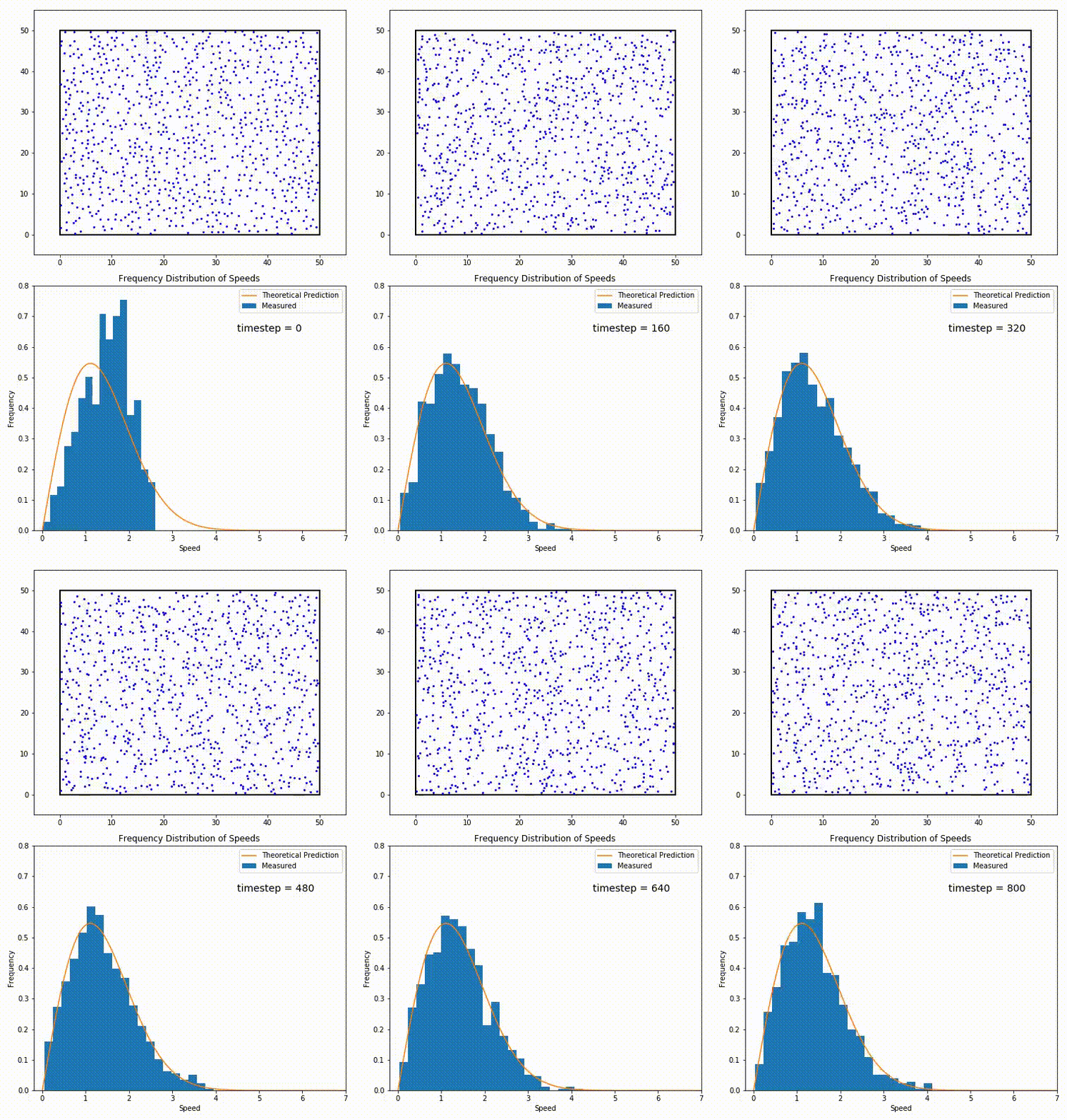
Relaxation to the 2D Maxwell–Boltzmann distribution
For particles confined to move in a plane, the speed distribution is given by
P(s
This distribution is used for describing systems in equilibrium. However, most systems do not start out in their equilibrium state. The evolution of a system towards its equilibrium state is governed by the Boltzmann equation. The equation predicts that for short range interactions, the equilibrium velocity distribution will follow a Maxwell–Boltzmann distribution. To the right is a molecular dynamics (MD) simulation in which 900 hard sphere particles are constrained to move in a rectangle. They interact via perfectly elastic collisions. The system is initialized out of equilibrium, but the velocity distribution (in blue) quickly converges to the 2D Maxwell–Boltzmann distribution (in orange).
Typical speeds

The mean speed \langle v \rangle, most probable speed (mode) vp, and root-mean-square speed \sqrt{\langle v^2 \rangle} can be obtained from properties of the Maxwell distribution.
This works well for nearly ideal, monatomic gases like helium, but also for molecular gases like diatomic oxygen. This is because despite the larger heat capacity (larger internal energy at the same temperature) due to their larger number of degrees of freedom, their translational kinetic energy (and thus their speed) is unchanged.
| The most probable speed, vp, is the speed most likely to be possessed by any molecule (of the same mass m) in the system and corresponds to the maximum value or the mode of f(v). To find it, we calculate the derivative set it to zero and solve for v: \frac{df(v)}{dv} = -8\pi \biggl[\frac{m}{2 \pi k_\text{B}T}\biggr]^{3/2} , v , \left[\frac{mv^2}{2k_\text{B}T}-1\right] \exp\left(-\frac{mv^2}{2k_\text{B}T}\right) = 0 with the solution: \frac{mv_\text{p}^2}{2k_\text{B}T} = 1; \quad v_\text{p} = \sqrt{ \frac{2k_\text{B}T}{m} } = \sqrt{ \frac{2RT}{M} } where:
- R is the gas constant;
- M is molar mass of the substance, and thus may be calculated as a product of particle mass, m, and Avogadro constant, NA: M = m N_\mathrm{A}. For diatomic nitrogen (, the primary component of air)The calculation is unaffected by the nitrogen being diatomic. Despite the larger heat capacity (larger internal energy at the same temperature) of diatomic gases relative to monatomic gases, due to their larger number of degrees of freedom, \frac{3RT}{M_\text{m}} is still the mean translational kinetic energy. Nitrogen being diatomic only affects the value of the molar mass . See e.g. K. Prakashan, Engineering Physics (2001), 2.278. at room temperature (), this gives v_\text{p} \approx \sqrt{\frac{2 \cdot 8.31, \mathrm{J {\cdot} {mol}^{-1} K^{-1}} \ 300, \mathrm{K}}{0.028, \mathrm{ {kg} {\cdot} {mol}^{-1} }}} \approx 422, \mathrm{m/s}. | The mean speed is the expected value of the speed distribution, setting b= \frac{1}{2a^2} = \frac{m}{2k_\text{B}T}: \begin{align} \langle v \rangle &= \int_0^{\infty} v , f(v) , dv \[1ex] &= 4\pi \left[ \frac{b}{\pi} \right]^{3/2} \int_0^\infty v^3 e^{-b v^2} dv = 4\pi \left[ \frac{b}{\pi} \right]^{3/2} \frac{1}{2b^2} \[1.4ex] &= \sqrt{\frac{4}{\pi b}} = \sqrt{ \frac{8k_\text{B}T}{\pi m}} = \sqrt{ \frac{8RT}{\pi M}} = \frac{2}{\sqrt{\pi}} v_\text{p} \end{align} | The mean square speed \langle v^2 \rangle is the second-order raw moment of the speed distribution. The "root mean square speed" v_\text{rms} is the square root of the mean square speed, corresponding to the speed of a particle with average kinetic energy, setting b = \frac{1}{2a^2} = \frac{m}{2k_\text{B}T}: \begin{align} v_\text{rms} & = \sqrt{\langle v^2 \rangle} = \left[\int_0^{\infty} v^2 , f(v) , dv \right]^{1/2} \[1ex] & = \left[ 4 \pi \left (\frac{b}{\pi } \right)^{3/2} \int_{0}^{\infty} v^4 e^{-bv^2} dv\right]^{1/2} \[1ex] & = \left[ 4 \pi \left (\frac{b}{\pi}\right )^{3/2} \frac{3}{8} \left(\frac{\pi}{b^5}\right)^{1/2} \right]^{1/2} = \sqrt{ \frac{3}{2b} } \[1ex] &= \sqrt { \frac{3k_\text{B}T}{m}} = \sqrt { \frac{3RT}{M} } = \sqrt{ \frac{3}{2} } v_\text{p} \end{align}
In summary, the typical speeds are related as follows: v_\text{p} \approx 88.6%\ \langle v \rangle
The root mean square speed is directly related to the speed of sound c in the gas, by c = \sqrt{\frac{\gamma}{3}} \ v_\mathrm{rms} = \sqrt{\frac{f+2}{3f}}\ v_\mathrm{rms} = \sqrt{\frac{f+2}{2f}}\ v_\text{p} , where \gamma = 1 + \frac{2}{f} is the adiabatic index, f is the number of degrees of freedom of the individual gas molecule. For the example above, diatomic nitrogen (approximating air) at , f = 5Nitrogen at room temperature is considered a "rigid" diatomic gas, with two rotational degrees of freedom additional to the three translational ones, and the vibrational degree of freedom not accessible. and c = \sqrt{\frac{7}{15}}v_\mathrm{rms} \approx 68%\ v_\mathrm{rms} \approx 84%\ v_\text{p} \approx 353\ \mathrm{m/s}, the true value for air can be approximated by using the average molar weight of air (), yielding at (corrections for variable humidity are of the order of 0.1% to 0.6%).
The average relative velocity \begin{align} v_\text{rel} \equiv \langle |\mathbf{v}_1 - \mathbf{v}_2| \rangle &= \int ! d^3\mathbf{v}_1 , d^3\mathbf{v}_2 \left|\mathbf{v}_1 - \mathbf{v}2\right| f(\mathbf{v}1) f(\mathbf{v}2) \[2pt] &= \frac{4}{\sqrt{\pi}}\sqrt{\frac{k\text{B}T}{m}} = \sqrt{2}\langle v \rangle \end{align} where the three-dimensional velocity distribution is f(\mathbf{v}) \equiv \left[\frac{2\pi k\text{B}T}{m}\right]^{-3/2} \exp\left(-\frac{1}{2}\frac{m\mathbf{v}^2}{k\text{B}T} \right).
The integral can easily be done by changing to coordinates \mathbf{u} = \mathbf{v}_1-\mathbf{v}_2 and \mathbf{U} = \tfrac{1}{2}(\mathbf{v}_1 + \mathbf{v}_2).
Limitations
The Maxwell–Boltzmann distribution assumes that the velocities of individual particles are much less than the speed of light, i.e. that T \ll \frac{m c^2}{k_\text{B}}. For electrons, the temperature of electrons must be T_e \ll 5.93 \times 10^9~\mathrm{K}. For distribution of speeds of relativistic particles, see Maxwell–Jüttner distribution.
In ''n''-dimensional space
In n-dimensional space, Maxwell–Boltzmann distribution becomes: f(\mathbf{v}) ~ d^n\mathbf{v} = \biggl[\frac{m}{2 \pi k_\text{B}T}\biggr]^{n/2} \exp\left(-\frac{m|\mathbf{v}|^2}{2k_\text{B}T}\right) ~d^n\mathbf{v}
Speed distribution becomes: f(v) ~ dv = A \exp\left(-\frac{mv^2}{2k_\text{B} T}\right) v^{n-1} ~ dv where A is a normalizing constant.
The following integral result is useful: \begin{align} \int_{0}^{\infty} v^a \exp\left(-\frac{mv^2}{2k_\text{B} T}\right) dv &= \left[\frac{2k_\text{B} T}{m}\right]^\frac{a+1}{2} \int_{0}^{\infty} e^{-x}x^{a/2} , dx^{1/2} \[2pt] &= \left[\frac{2k_\text{B} T}{m}\right]^\frac{a+1}{2} \int_{0}^{\infty} e^{-x}x^{a/2}\frac{x^{-1/2}}{2} , dx \[2pt] &= \left[\frac{2k_\text{B} T}{m}\right]^\frac{a+1}{2} \frac{\Gamma{\left(\frac{a+1}{2}\right)}}{2} \end{align} where \Gamma(z) is the Gamma function. This result can be used to calculate the moments of speed distribution function: \langle v \rangle = \frac {\displaystyle \int_{0}^{\infty} v \cdot v^{n-1} \exp\left(-\tfrac{mv^2}{2k_\text{B} T}\right) , dv} {\displaystyle \int_{0}^{\infty} v^{n-1} \exp\left(-\tfrac{mv^2}{2k_\text{B} T}\right) , dv} = \sqrt{\frac{2k_\text{B} T}{m}} ~~ \frac{\Gamma{\left(\frac{n+1}{2}\right)}}{\Gamma{\left(\frac{n}{2}\right)}} which is the mean speed itself v_\mathrm{avg} = \langle v \rangle = \sqrt{\frac{2k_\text{B} T}{m}} \ \frac{\Gamma \left(\frac{n+1}{2}\right)}{\Gamma \left(\frac{n}{2}\right)}.
\begin{align} \langle v^2 \rangle &= \frac {\displaystyle\int_{0}^{\infty} v^2 \cdot v^{n-1} \exp\left(-\tfrac{mv^2}{2k_\text{B} T}\right) , dv} {\displaystyle\int_{0}^{\infty} v^{n-1} \exp\left(-\tfrac{mv^2}{2k_\text{B}T}\right) , dv} \[1ex] &= \left[\frac{2k_\text{B}T}{m}\right] \frac{\Gamma {\left(\frac{n+2}{2}\right)}}{\Gamma {\left(\frac{n}{2}\right)}} \[1.2ex] &= \left[\frac{2k_\text{B}T}{m}\right] \frac{n}{2} = \frac{n k_\text{B}T}{m} \end{align} which gives root-mean-square speed v_\text{rms} = \sqrt{\langle v^2 \rangle} = \sqrt{\frac{n k_\text{B}T}{m}}.
The derivative of speed distribution function: \frac{df(v)}{dv} = A \exp\left(-\frac{mv^2}{2k_\text{B}T}\right) \biggl[-\frac{mv}{k_\text{B}T} v^{n-1}+(n-1)v^{n-2}\biggr] = 0
This yields the most probable speed (mode) v_\text{p} = \sqrt{\left(n-1\right) k_\text{B}T/m}.
Extension to real gases
The derivations show that the validity of the Maxwell–Boltzmann velocity distribution is limited to ideal gases. A generalization of the formula to all gases (ideal and real alike) is known, its derivation starts from the fact that the properties of both ideal and real gases must be independent of the direction. The formula obtained contains pV_\text{m} terms instead of RT, where p is the pressure, V_\text{m} is the molar volume of the gas sample:
f(v) = \biggl[\frac{M}{2 \pi pV_\text{m}}\biggr]^ , 4\pi v^2 \exp\left(-\frac{Mv^2}{2pV_\text{m}}\right).
Notes
References
References
- Mandl, Franz. (2008). "Statistical Physics". John Wiley & Sons.
- (2008). "Sears and Zemansky's University Physics: With Modern Physics". Pearson, Addison-Wesley.
- Encyclopaedia of Physics (2nd Edition), [[Rita G. Lerner. R.G. Lerner]], G.L. Trigg, VHC publishers, 1991, {{isbn. 3-527-26954-1 (Verlagsgesellschaft), {{isbn. 0-89573-752-3 (VHC Inc.)
- N.A. Krall and A.W. Trivelpiece, Principles of Plasma Physics, San Francisco Press, Inc., 1986, among many other texts on basic plasma physics
- Maxwell, J.C. (1860 A): ''Illustrations of the dynamical theory of gases. Part I. On the motions and collisions of perfectly elastic spheres. The London, Edinburgh, and Dublin Philosophical Magazine and Journal of Science'', 4th Series, vol.19, pp.19–32. [https://www.biodiversitylibrary.org/item/53795#page/33/mode/1up]
- Maxwell, J.C. (1860 B): ''Illustrations of the dynamical theory of gases. Part II. On the process of diffusion of two or more kinds of moving particles among one another. The London, Edinburgh, and Dublin Philosophical Magazine and Journal of Science'', 4th Ser., vol.20, pp.21–37. [https://www.biodiversitylibrary.org/item/20012#page/37/mode/1up]
- Müller-Kirsten, H. J. W.. (2013). "Basics of Statistical Physics". [[World Scientific]].
- (2011). "College Physics, Volume 1". Cengage Learning.
- (2017). "Maxwell and the normal distribution: A colored story of probability, independence, and tendency towards equilibrium". Studies in History and Philosophy of Modern Physics.
- Boltzmann, L., "Weitere studien über das Wärmegleichgewicht unter Gasmolekülen." ''Sitzungsberichte der Kaiserlichen Akademie der Wissenschaften in Wien, mathematisch-naturwissenschaftliche Classe'', '''66''', 1872, pp. 275–370.
- Boltzmann, L., "Über die Beziehung zwischen dem zweiten Hauptsatz der mechanischen Wärmetheorie und der Wahrscheinlichkeitsrechnung respektive den Sätzen über das Wärmegleichgewicht." ''Sitzungsberichte der Kaiserlichen Akademie der Wissenschaften in Wien, Mathematisch-Naturwissenschaftliche Classe''. Abt. II, '''76''', 1877, pp. 373–435. Reprinted in ''Wissenschaftliche Abhandlungen'', Vol. II, pp. 164–223, Leipzig: Barth, 1909. '''Translation available at''': http://crystal.med.upenn.edu/sharp-lab-pdfs/2015SharpMatschinsky_Boltz1877_Entropy17.pdf {{Webarchive. link. (2021-03-05)
- Parker, Sybil P.. (1993). "McGraw-Hill Encyclopedia of Physics". McGraw-Hill.
- (2005). "Statistical Thermodynamics: Fundamentals and Applications". Cambridge University Press.
- (2025). "The ideal gas law: derivations and intellectual background". ChemTexts.
- Lente, G.. (2025). "Direction independence as a key property to derive a particle speed distribution in real gases". Journal of Mathematical Chemistry.
This article was imported from Wikipedia and is available under the Creative Commons Attribution-ShareAlike 4.0 License. Content has been adapted to SurfDoc format. Original contributors can be found on the article history page.
Ask Mako anything about Maxwell–Boltzmann distribution — get instant answers, deeper analysis, and related topics.
Research with MakoFree with your Surf account
Create a free account to save articles, ask Mako questions, and organize your research.
Sign up freeThis content may have been generated or modified by AI. CloudSurf Software LLC is not responsible for the accuracy, completeness, or reliability of AI-generated content. Always verify important information from primary sources.
Report