From Surf Wiki (app.surf) — the open knowledge base
Lech Wałęsa
President of Poland from 1990 to 1995
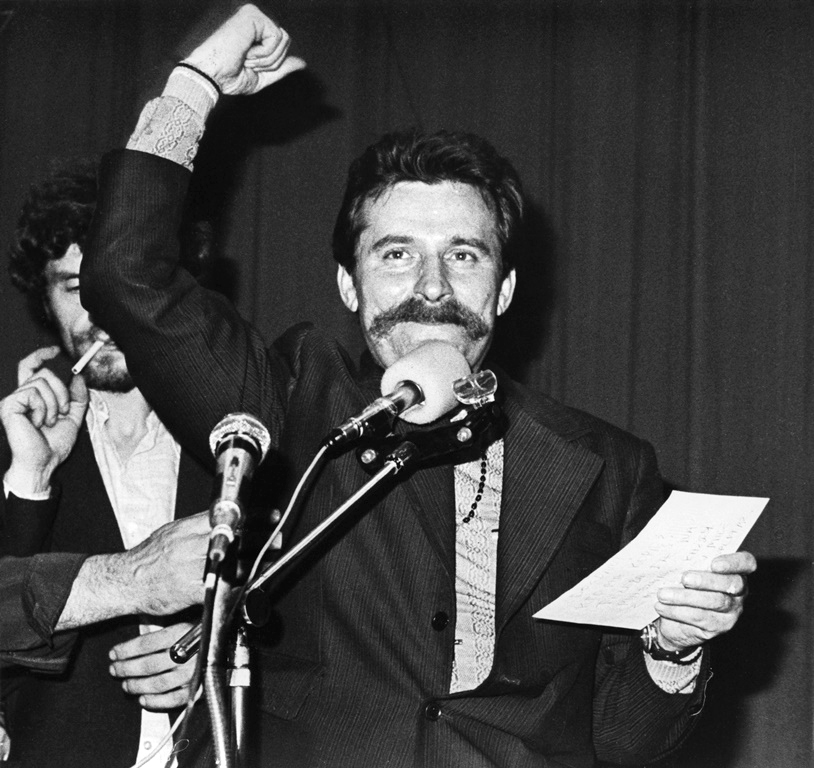
President of Poland from 1990 to 1995
| Field | Value |
|---|---|
| name | Lech Wałęsa |
| image | Lech Wałęsa z monetą Wiedźmina (Walesa cropped2).jpg |
| caption | Wałęsa in 2020 |
| order | |
| office | President of Poland |
| primeminister | Tadeusz Mazowiecki |
| Jan Krzysztof Bielecki | |
| Jan Olszewski | |
| Waldemar Pawlak (caretaker) | |
| Hanna Suchocka | |
| Waldemar Pawlak | |
| Józef Oleksy | |
| term_start | 22 December 1990 |
| term_end | 22 December 1995 |
| predecessor | Wojciech Jaruzelski (in country)Ryszard Kaczorowski (as the last President in exile) |
| successor | Aleksander Kwaśniewski |
| birth_date | |
| birth_place | Popowo, German-occupied Poland |
| party | Solidarity (1980–1988) |
| Solidarity Citizens' Committee (1988–1993) | |
| Nonpartisan Bloc for Support of Reforms (1993–1997) | |
| Solidarity Electoral Action (1997–2001) | |
| Christian Democracy of the Third Polish Republic (1997–2001) | |
| spouse | |
| children | 8, including Jarosław |
| awards | Full list |
| signature | Lech Walesa Signature.svg |
| module |
Jan Krzysztof Bielecki Jan Olszewski Waldemar Pawlak (caretaker) Hanna Suchocka Waldemar Pawlak Józef Oleksy Solidarity Citizens' Committee (1988–1993) Nonpartisan Bloc for Support of Reforms (1993–1997) Solidarity Electoral Action (1997–2001) Christian Democracy of the Third Polish Republic (1997–2001)
Lech Wałęsa (born 29 September 1943) is a Polish statesman, dissident and Nobel Peace Prize laureate who served as the president of Poland between 1990 and 1995. After winning the 1990 election, Wałęsa became the first democratically elected president of Poland since 1926 and the first-ever Polish president elected by popular vote. An electrician by trade, Wałęsa became the leader of the opposition Solidarity movement and led a successful pro-democratic effort, which in 1989 ended Communist rule in Poland and ushered in the end of the Cold War.
While working at the Lenin Shipyard (now Gdańsk Shipyard), Wałęsa, an electrician, became a trade-union activist, for which he was persecuted by the government, placed under surveillance, fired in 1976 and arrested several times. In August 1980, he was instrumental in political negotiations that led to the ground-breaking Gdańsk Agreement between striking workers and the government. He co-founded the Solidarity trade-union, whose membership rose to over ten million.
After martial law in Poland was imposed and Solidarity was outlawed, Wałęsa was arrested again. Released from custody, he continued his activism and was prominent in the establishment of the Round Table Agreement that led to the semi-free 1989 Polish parliamentary election and a Solidarity-led government. He presided over Poland's transition from Marxist–Leninist state socialism into a free-market capitalist liberal democracy, but his active role in Polish politics diminished after he narrowly lost the 1995 Polish presidential election. In 1995, he established the Lech Wałęsa Institute.
Since 1980, Wałęsa has received hundreds of prizes, honors and awards from multiple countries and organizations worldwide. He was named the Time Person of the Year (1981) and one of Time's 100 most important people of the 20th century (1999). He has received over forty honorary degrees, including from Harvard University, Fordham University and Columbia University, as well as dozens of the highest state orders, including the Presidential Medal of Freedom, the Knight Grand Cross of the Order of the Bath, and the French Grand Cross of Legion of Honour. In 1989, Wałęsa was the first foreign non-head of state to address the Joint Meeting of the U.S. Congress. The Gdańsk Lech Wałęsa Airport has borne his name since 2004.
Early life
Wałęsa was born in Popowo, Lipno county in the present-day Kuyavian-Pomeranian voivodeship, then under Nazi German occupation. His father, Bolesław Wałęsa (1909–1945), was a carpenter who was rounded up and interned in a forced labour camp at Młyniec (outpost of KL Stutthof) by the German occupying forces before Lech was born. Bolesław returned home after the war but died two months later from exhaustion and illness. Lech's mother, Feliksa Wałęsa (née Kamieńska; 1915–1976), has been credited with shaping her son's beliefs and tenacity. After Bolesław's death, Feliksa remarried her brother-in-law, Stanisław Wałęsa (1917–1981), a farmer. Lech had three elder full siblings; Izabela (1935–2012), Edward (born 1937) and Stanisław (born 1940); and three younger half-brothers; Tadeusz (born 1945), Zygmunt (born 1948) and Wojciech (1950–1988). In 1973, Lech's mother and stepfather emigrated to the US for economic reasons. They lived in Jersey City, New Jersey, where Feliksa died in a car accident in 1976 and Stanisław died of a heart attack in 1981. Both of them were buried in Poland.
In 1961, Lech graduated from primary and vocational school in nearby Chalin and Lipno as a qualified electrician. He worked as a car mechanic from 1962 to 1964, and then embarked on his two-year, obligatory military service, attaining the rank of corporal before beginning work on 12 July 1967 as an electrician at Lenin Shipyard (Stocznia Gdańska im. Lenina), now called Gdańsk Shipyard (Stocznia Gdańska) in Gdańsk.
Solidarity movement
Main article: Solidarity (Polish trade union)
From early in his career, Wałęsa was interested in workers' concerns; in 1968 he encouraged shipyard colleagues to boycott official rallies that condemned recent student strikes. He was a charismatic leader, who helped organize the illegal 1970 protests at the Gdańsk Shipyard when workers protested at the government's decree raising food prices and he was considered for the position of chairman of the strike committee. The strikes' outcome, which involved the deaths of over 30 workers, galvanized Wałęsa's views on the need for change. In June 1976, Wałęsa lost his job at the Gdańsk Shipyard because of his continued involvement in illegal unions, strikes, and a campaign to commemorate the victims of the 1970 protests. Afterwards, he worked as an electrician for several other companies but his activism led to him continually being laid off and he was jobless for long periods. Wałęsa and his family were under constant surveillance by the Polish secret police; his home and workplace were always bugged. Over the next few years, he was arrested several times for participating in dissident activities.
Wałęsa worked closely with the Workers' Defence Committee (KOR), a group that emerged to lend aid to people arrested after the 1976 labor strikes and to their families. The agreement granted the Lenin Shipyard workers the right to strike and permitted them to form an independent trade union. The Strike Coordinating Committee legalized itself as the National Coordinating Committee of the Solidarność (Solidarity) Free Trade Union, and Wałęsa was chosen as chairman of the committee. The Solidarity trade union quickly grew, ultimately claiming over 10 million members—more than a quarter of Poland's population. Wałęsa's role in the strike, in the negotiations, and in the newly formed independent trade union gained him fame on the international stage.

On 10 March 1981, through the introduction of his former superior in the army, Wałęsa met Wojciech Jaruzelski for the first time in the office building of the Council of Ministers for three hours. During the meeting, Jaruzelski and Wałęsa agreed that mutual trust was necessary if the problems of Poland were to be solved. Wałęsa said "It's not the case that the name of socialism is bad. Only some people spoiled the name of socialism". He also complained about and criticized the government. Jaruzelski informed Wałęsa of the coming war games of the Warsaw Pact from 16 to 25 March, hoping he could help maintain the social order and avoid anti-Soviet remarks. Jaruzelski also reminded Wałęsa that Solidarity had used foreign funds. Wałęsa joked "We don't have to take only dollars. We can take corn, fertilizer, anything is okay. I told Mr. Kania before that I would take everything from the enemy. The more the better, until the enemy was weakened no more".
Wałęsa held his position until 13 December 1981, when General Jaruzelski declared martial law in Poland. In 1983, Wałęsa applied to return to the Gdańsk Shipyard as an electrician. The same year, he was awarded the Nobel Peace Prize. He was unable to accept it himself, fearing Poland's government would not let him back into the country. His wife Danuta accepted the prize on his behalf.
Through the mid-1980s, Wałęsa continued underground Solidarity-related activities. Following a 1986 amnesty for Solidarity activists, Wałęsa co-founded the Provisional Council of NSZZ Solidarity (Tymczasowa Rada NSZZ Solidarność), the first overt legal Solidarity entity since the declaration of martial law. He was frequently hauled in for interrogations by the Polish secret police, the Security Service, during the 1980s. On many of these occasions, Danuta—who was even more anti-Communist than her husband—was known to openly taunt Security Service agents when they picked Lech up.
After months of strikes and political deliberations, at the conclusion of the 10th plenary session of the Polish United Workers' Party (PZPR, the Polish Communist party), the government agreed to enter into Round Table Negotiations that lasted from February to April 1989.
In December 1988, Wałęsa co-founded the Solidarity Citizens' Committee; this was ostensibly an advisory body but in practice a political party that won the parliamentary elections in June 1989. Solidarity took all the seats in the Sejm that were subject to free elections, and all but one seat in the newly re-established Senate. Wałęsa was one of Solidarity's most public figures; he was an active campaigner, appearing on many campaign posters, but did not run for parliament himself.
While ostensibly only chairman of Solidarity, Wałęsa played a key role in practical politics. In August 1989, he persuaded leaders of parties formerly allied with the Communist party to form a non-Communist coalition government—the first non-Communist government in the Soviet Bloc. The parliament elected Tadeusz Mazowiecki as the first non-Communist Prime Minister of Poland in over forty years. In November 1989, he delivered the speech "We the People" – taken from the preamble to the US Constitution.
Presidency
.svg)

Following the June 1989 parliamentary elections, Wałęsa was disappointed that some of his former fellow campaigners were satisfied to govern alongside former Communists.
.png)
During his presidency, Wałęsa saw Poland through privatization and transition to a free-market economy (the Balcerowicz Plan), Poland's first completely free parliamentary elections in 1991, and a period of redefinition of the country's foreign relations. He successfully negotiated the withdrawal of Soviet troops from Poland and won a substantial reduction in foreign debts.
Wałęsa has been criticized for a confrontational style and for instigating "war at the top", wherein former Solidarity allies clashed with one another, causing annual changes of government. Some thought Wałęsa, an ex-electrician with no higher education, was too plain-spoken and too undignified for the post of president. Others thought him too erratic in his views or complained he was too authoritarian and that he sought to strengthen his own power at the expense of the Sejm. Wałęsa's problems were compounded by the difficult transition to a market economy; in the long run it was seen as highly successful but it lost Wałęsa's government much popular support.
Wałęsa's BBWR performed poorly in the 1993 parliamentary elections; at times his popular support dwindled to 10 percent and he narrowly lost the 1995 presidential election, winning 33.11 percent of the vote in the first round and 48.28 percent in the run-off against Aleksander Kwaśniewski, who represented the resurgent Polish post-Communist Democratic Left Alliance (SLD).
Post-presidency
_05.jpg)
After losing the 1995 election, Wałęsa announced he would return to work as an electrician at the Gdańsk Shipyard. Soon afterwards, he changed his mind and chose to travel around the world on a lecture circuit. Wałęsa developed a portfolio of three lectures ("The Impact of an Expanded NATO on Global Security", "Democracy: The Never-Ending Battle" and "Solidarity: The New Millennium"), and reads them at universities and public events with an appearance fee of around £50,000 ($70,000).
In 1995, Wałęsa founded the Lech Wałęsa Institute, a think tank with a mission "to popularize the achievements of Polish Solidarity, educate young generations, promote democracy, and build civil society in Poland and around the world". Wałęsa's contention for the 2000 presidential election ended with a crushing defeat when he polled 1.01 percent of the vote. Wałęsa polled in seventh place, after which he announced his withdrawal from Polish politics.
In 2006, Wałęsa quit Solidarity in protest of the union's support of the ruling right-wing Law and Justice party, and Lech and Jarosław Kaczyński—twin brothers who had been prominent in Solidarity and were now serving as the country's president and prime minister, respectively.


Political views
In 2011, Wałęsa rejected Lithuania's Order of Vytautas the Great due to his concerns over the treatment of the Polish minority and Polish culture by the Lithuanian government.
Wałęsa is known for his conservative stance on LGBT rights. In 2013, he said on Polish television: "I do not wish for this minority, which I tolerate and understand, to impose itself on the majority". Referring to Robert Biedroń, he argued that, considering they represent less than one percent of Polish society, homosexual MPs should sit "in the last row of the parliament, or even behind its walls". After sharp international criticism, including the San Francisco Board of Supervisors's decision to rename Walesa Street as a result of these remarks, Wałęsa apologized for his comments, stressing that "being a man of old date, in my view one's sexual orientation should lie in one's intimate sphere". He said that his intentions were "distorted by the media" and that homosexuality should be respected. Over the following years, Wałęsa's views shifted, and he has voiced his support for the introduction of same-sex marriage in Poland and has repeatedly met with Biedroń, whom he called "a talent" and "a future president of Poland".
In 2013, Wałęsa suggested the creation of a political union between Poland and Germany. In 2014, in a widely publicized interview, Wałęsa expressed his disappointment in another Nobel laureate, US president Barack Obama: he told CNN, "When he was elected there was great hope in the world. We were hoping that Obama would reclaim moral leadership for America, but that failed ... in terms of politics and morality America no longer leads the world". Wałęsa also accused Obama of not deserving his Nobel Peace Prize; during the 2012 US presidential campaign he endorsed Obama's opponent Mitt Romney.
In September 2015, Wałęsa, referring to the migrant crisis in Europe, said: "watching the refugees on television, I noticed that ... they are well fed, well dressed and maybe even are richer than we are ... If Europe opens its gates, soon millions will come through and while living among us will start exercising their own customs, including beheading". In August 2017, ten Nobel Peace Prize laureates, including Wałęsa, urged Saudi Arabia to stop the executions of 14 young people for participating in the 2011–12 Saudi Arabian protests.
Wałęsa regarded a victory by Donald Trump in the 2024 United States presidential election as a "misfortune" both for the United States and the world, without providing further explanation. In March 2025, he and other former Polish political prisoners wrote a letter to Trump expressing their "horror and distaste" with his conduct during a contentious meeting between him and Ukrainian president Volodymyr Zelenskyy, which took place in the backdrop of American aid during the Russian invasion of Ukraine. Wałęsa has actively backed Ukraine's defence, calling upon NATO to continually provide support and suggesting a Ukrainian victory is imperative to protecting democracy. He calls for reducing Russia's population to “less than 50 million inhabitants” by organizing an “uprising of the peoples” who have been “annexed” so that Russia no longer poses a threat to neighboring countries. From August to October 2025, he traveled around the United States and Canada to promote the idea of "Solidarity" and commemorate its 45th anniversary. During this trip he met Bill Clinton.
Wałęsa and secret police allegations
Despite the 2000 ruling of a special lustration court affirming his innocence, for many years there have been allegations that Wałęsa was an informant of the Security Service of the Polish People's Republic (Służba Bezpieczeństwa or SB), the Communist security services, in his twenties. In his 2002 book titled The Polish Revolution: Solidarity, British historian Timothy Garton Ash writes that Wałęsa, while vehemently denying being a regular Security Service informer, admitted that he had "signed something" under interrogation in the 1970s. In 2008, a book written by historians Sławomir Cenckiewicz and Piotr Gontarczyk titled SB a Lech Wałęsa. Przyczynek do biografii (SB and Lech Wałęsa. Contribution to biography) purported to show that Wałęsa, codenamed Bolek, had been an operative for the security services from 1970 to 1976.
The issue of Wałęsa's alleged collaboration with the communist regime resurfaced again in February 2016, when the Institute of National Remembrance seized materials from the widow of Czesław Kiszczak, former minister of the Minister of Interior, that were said to document Wałęsa's role as a spy for the security services. In 2017, a handwriting study ordered by the government-controlled Institute of National Remembrance (INR), stated that signatures on several documents from the 1970s belonged to Wałęsa. The exact nature of Wałęsa's relationship with Security Service continues to be a source of scholarly debate among historians. In 2018 INR Court Case against Wałęsa was dismissed, as the investigation concluded: "The reason for discontinuing the investigation was the finding that the above-mentioned act had not been committed," the release stated, which would indicate that Wałęsa could be innocent. The allegations remain controversial to this day, since both opponents and supporters of Wałęsa present evidence and arguments, which contradict each other.
2000 Lustration Court ruling
On 12 August 2000, Wałęsa, who was running a presidential campaign at the time, was cleared by the special Lustration Court of charges that he collaborated with the Communist-era secret services and reported on the activities of his fellow shipyard workers, due to the lack of evidence. Anti-Communists Piotr Naimski, one of the first members of the Workers' Defense Committee that led to the Solidarity trade union, and Antoni Macierewicz, Wałęsa's former Interior Minister, testified against him in the closed vetting trial. Naimski, who said he testified with a "heavy heart", expressed his disappointment that Wałęsa "made a mistake by not going openly to the public, and he has missed an important chance". According to Naimski, the court cleared Wałęsa on "technical grounds" because it did not find certain original documents—many of which had been destroyed since 1989—that offered sufficient proof that Wałęsa was lying.
In 1992, Naimski, as a head of the State Protection Office, started the process of screening people suspected of being Communist collaborators in Poland. In June that year, he helped Antoni Macierewicz prepare a list of 64 members of the government and parliament who were named as spies in the police records; these included Wałęsa, then the Polish president. Wałęsa's name was included on the list after a wrenching internal debate about the virtues of honesty versus political discretion. In response to the publication of this list, President Wałęsa immediately engineered the fall of prime minister Jan Olszewski and the dismissal of Interior Minister Macierewicz. A parliamentary committee later concluded Wałęsa had not signed an agreement with the secret police.
A 1997 Polish law made vetting a requirement for those seeking high public office. According to the law, it is not a crime to have collaborated, but those who deny it and are found to have lied are banned from political life for ten years. The 2000 presidential election was the first use of this law. Despite helping Wałęsa in 2005 to receive the official status of a "victim of communist regime" from the Institute of National Remembrance (IPN), this court ruling did not convince many Poles. In November 2009, Wałęsa sued the president of Poland, Lech Kaczyński, over his repeated collaboration allegations. Five months later, Kaczyński failed to invite Wałęsa to the commemoration service at Katyn, which almost certainly saved Wałęsa's life because the presidential plane crashed, killing all on board. In August 2010, Wałęsa lost a libel case against Krzysztof Wyszkowski, his former fellow activist, who also publicly accused Wałęsa of being a Communist agent in 1970s.
''SB and Lech Wałęsa. A contribution to biography'' (2008)
The most comprehensive analysis of Wałęsa's possible collaboration with secret police was provided in a 2008 book ** (SB and Lech Wałęsa. Contribution to biography). The book was written by two historians from the Institute of National Remembrance, Sławomir Cenckiewicz and Piotr Gontarczyk, and included documents from the archives of the secret police that were inherited by the institute. Among the documents were registration cards, memos, notes from the secret police, and reports from the informant.
The book's authors argue that Wałęsa, working under the code name Bolek, was a secret police informant from 1970 (after being released from jail) until 1976 (before he was fired from the shipyard). According to the authors, "he wrote reports and informed on more than 20 people and some of them were persecuted by the Communist police. He identified people and eavesdropped on his colleagues at work while they were listening to Radio Free Europe for example". The book describes the fate of seven of his alleged victims; information regarding others was destroyed or stolen from the files.}}
The authors also claim that during his 1990–1995 presidency, Wałęsa used his office to destroy the evidence of his collaboration with the secret police by removing incriminating documents from the archives. According to the book, historians discovered that with the help of the state intelligence agency, Wałęsa, Interior Minister Andrzej Milczanowski, and other members of Wałęsa's administration had borrowed from the archives the secret police files that had connections to Wałęsa, and returned them with key pages removed. When it was discovered at the turn of 1995/96, the following prosecutorial inquiry was discontinued for political reasons despite the case attracting much public attention.
Sławomir Cenckiewicz also said that in 1983, when Wałęsa was nominated for the Nobel Peace Prize, the secret police tried to embarrass him and leaked information about Wałęsa's previous collaboration with the government. By this time though, Wałęsa was already so popular that most Poles did not believe the official media and dismissed the allegations as a manipulation by the Communist authorities. The book received substantial coverage in the media, provoked nationwide debate, and was noted by the international press. Wałęsa vowed to sue the authors but never did.
Kiszczak archives
On 18 February 2016, the government-affiliated INR in Warsaw announced it had seized a package of original documents that allegedly proved Wałęsa was a paid Security Service informant. The documents' authenticity was confirmed by an archival expert, but the prosecutors demanded a handwriting examination. Eventually, the requested examination concluded that the documents were authentic, which suggest he was a paid informant. Wałęsa previously said that he had signed a commitment to inform document, but that he had never acted on it.

The dossier consists of two folders. The first is a "personal file" containing 90 pages of documents, including a handwritten commitment to cooperate with Polish Security Service dated 21 December 1970,
The sealed dossier also contained a letter, hand-written by Kiszczak in April 1996, in which he informs the Director of the Polish Central Archives of Modern Records (Archiwum Akt Nowych) about the accompanying files documenting the collaboration of Wałęsa with the Polish Security Service and asks him not to publish this information until five years after Wałęsa's death. In his letter, Kiszczak said he kept the documents out of reach: before the 1989 revolution, trying to protect Wałęsa's reputation; and afterwards to make sure they did not disappear or were used for political reasons. This letter and the accompanying documents had never been sent.
On 16 February 2016, about three months after Kiszczak's death, his widow Maria approached the Institute of National Remembrance and offered to sell the documents to the archives for 90,000 zlotys ($23,000). However, according to Polish law, all documents of the political police must be handed in to the state. The administration of the institute notified the prosecutor's office, which conducted a police search of the Kiszczaks' house and seized all the historic documents. Maria Kiszczak later said she had not read her husband's letter and had "made a mistake".
Wałęsa's response
For years, Wałęsa vehemently denied collaborating with the Polish Security Service and dismissed the incriminating files as forgeries created by the Security Service to compromise him. Wałęsa also denies that during his presidency he removed documents incriminating him from the archives. Wałęsa's interior minister Andrzej Milczanowski denied the cover-up and said he "had full legal rights to make those documents available to President Wałęsa" and that "no original documents were removed from the file", which contained only photocopies.
Wałęsa has offered conflicting statements regarding the authenticity of the documents. Initially he appeared to come close to an admission, saying in 1992, "in December 1970, I signed three or four documents" to escape from the secret police. In his 1987 autobiography A Way of Hope, Wałęsa said, "It is also the truth that I had not left that clash completely pure. They gave me a condition: sign! And then I signed." However, in his later years Wałęsa said all the documents are forgeries and told the BBC in 2008, "you will not find any signature of mine agreeing to collaborate anywhere".
In 2009, after the publication of another biography connecting him with the secret police (Lech Wałęsa: Idea and History by Pawel Zyzak), Wałęsa threatened to leave Poland if historians continue to question his past. He said that before revealing such information "a historian must decide whether this serves Poland". After the accusations against him resurfaced with the discovery of the Kiszczak dossier on 16 February 2016, Wałęsa called the files "lies, slander and forgeries", and said he "never took money and never made any spoken or written report on anyone". He said of the Polish public, which was about to believe in the allegations, "you have betrayed me, not me you", and "it was I who safely led Poland to a complete victory over communism". On 20 February 2016, Wałęsa wrote in his blog that a secret police officer had begged him to sign the financial documents in the 1970s because the officer had lost money entrusted to him to purchase a vehicle. Wałęsa appealed to the officer to step forward and clear him of the accusations.
Personal life
On 8 November 1969, Wałęsa married Mirosława Danuta Gołoś, who worked at a flower shop near the Lenin Shipyard where Wałęsa worked. Soon after they married, she began using her middle name more often than her first name, as per Lech's request. The couple had eight children; Bogdan (born 1970), Sławomir (1972–2025), Przemysław (1974–2017), Jarosław (born 1976), Magdalena (born 1979), Anna (born 1980), Maria-Wiktoria (born 1982), and Brygida (born 1985). , Anna is running her father's office in Gdańsk
In 2008, Wałęsa underwent a coronary artery stent placement and the implantation of a cardiac pacemaker at the Houston Methodist Hospital in Houston, Texas. He underwent a heart operation in 2021.
Honours
Main article: List of awards and honors received by Lech Wałęsa
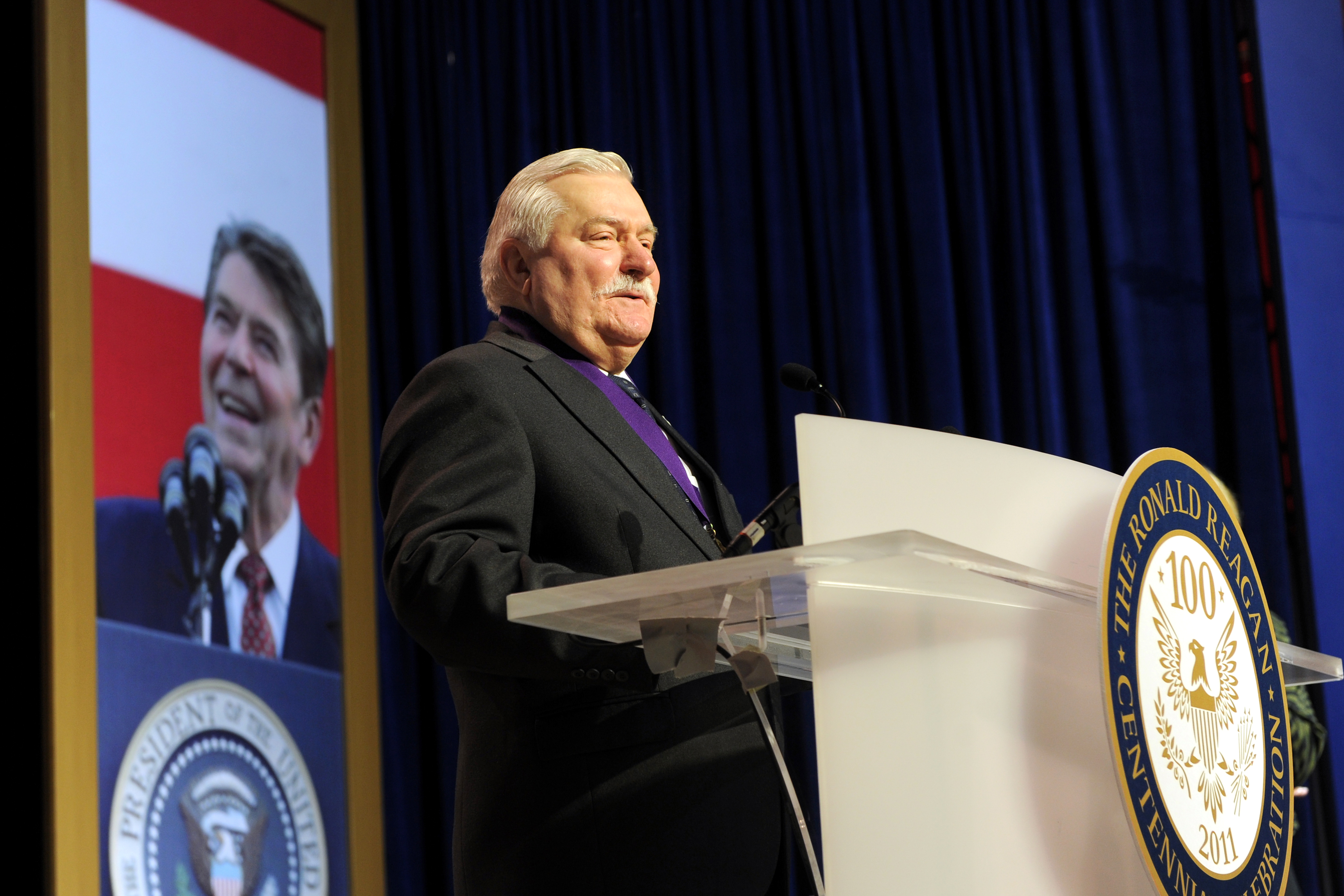
In 1983, Wałęsa was awarded the Nobel Peace Prize. Since then, he has received more than 30 state decorations and more than 50 awards from 30 countries, including Order of the Bath (UK), Order of Merit (Germany), Legion of Honour (France) and European Human Rights Prize (EU 1989). In 14 July 1994, He was honored by the Order of the State of Republic of Turkey, which is the highest state order awarded to foreign nationals by the President of the Republic of Turkey. In 2011, he declined to accept the Lithuanian highest order, citing his displeasure at Lithuania's policy towards the Polish diaspora. In 2008, he established the
In 2004, Gdańsk International Airport was officially renamed Gdańsk Lech Wałęsa Airport and Wałęsa's signature was incorporated into the airport's logo. A college hall in Northeastern Illinois University (Chicago), six streets, and five schools in Canada, France, Sweden and Poland also were named after Lech Wałęsa
Wałęsa was named Man of the Year by Time magazine (1981), Financial Times (1980), Saudi Gazette (1989) and 12 other newspapers and magazines. He was awarded with over 45 honorary doctorates by universities around the world, Wałęsa is also an honorary citizen of more than 30 cities, including London, Buffalo and Turin.
In the United States, Wałęsa was the first recipient of the Liberty Medal, in 1989. That year, he also received the Presidential Medal of Freedom and became the first non-head-of-state to address a joint meeting of the United States Congress. In 2000, Wałęsa received the Golden Plate Award of the American Academy of Achievement. Wałęsa symbolically represented Europe by carrying the Olympic flag at the opening ceremony of the 2002 Winter Olympics. In 2004, he represented ten newly acceded EU countries during the official accession ceremony in Strasbourg. In 1993, the heraldic authority of the Kingdom of Sweden assigned Wałęsa a personal coat of arms on the occasion of his admittance into the Royal Order of the Seraphim.
In popular culture
Wałęsa has been portrayed, as himself or a character based on him, in a number of feature and television films. The two most notable of them are:
- Walesa: Man of Hope (2013) is a biographical drama by Oscar-winning filmmaker Andrzej Wajda about the lives of Wałęsa (Robert Więckiewicz) and his wife Danuta (Agnieszka Grochowska) from 1970 to 1989. It shows Wałęsa's change from a shipyard worker into a charismatic labor leader. The film was shot in the historical locations of the depicted events, including the former Lenin Shipyard. It won three awards, including Silver Hugo for Robert Więckiewicz at Chicago International Film Festival and a Pasinetti Award for Maria Rosaria Omaggio at Venice Film Festival, and was nominated for five more awards.
- Man of Iron (1981) is another Andrzej Wajda film about the Solidarity movement. The main character, a young worker Maciej Tomczyk (Jerzy Radziwiłowicz) is involved in the anti-Communist labor movement. Tomczyk is clearly portrayed as a parallel to Wałęsa, who appears as himself in the movie. The film was made during the brief relaxation of censorship in Poland between the formation of Solidarity in August 1980 and its suppression in December 1981. Waida was awarded both the Palme d'Or and the Prize of the Ecumenical Jury at the Cannes Film Festival for the film. In 1982, it was nominated for Oscar as the Best Foreign Language Film and gained seven other awards and nominations.

Both of these films were produced in Poland. In December 1989, Warner Bros. intended to produce a "major" movie about Wałęsa, to be made in 1990 and released in 1991. The company paid Wałęsa a $1 million fee for the rights to produce a biopic. Although the movie was never made, this payment sparked controversy in Poland when five years later it emerged that Wałęsa concealed this income to avoid paying taxes on it. The Gdańsk tax office initiated a tax fraud case against Wałęsa but it was later dismissed because the five-year statute of limitations had already run out.
- Polish actor played Walesa in the 2005 television miniseries Pope John Paul II.
English musician Peter Gabriel drew from Wałęsa and the Solidarity movement as one of multiple sources of inspiration for his 1982 song "Wallflower", about the plight of political prisoners in Europe and Latin America. That same year, Bono was inspired by Wałęsa to write U2's first hit single, "New Year's Day". Coincidentally, the Polish authorities lifted martial law on 1 January 1983, the same day this single was released. Wałęsa also became a hero of a number of Polish pop songs, including a satirical 1991 hit titled Nie wierzcie elektrykom (Don't Trust the Electricians) from the second studio album by the punk rock band Big Cyc which featured a caricature of Wałęsa on its cover.
Patrick Dailly's chamber opera Solidarity, starring Kristen Brown as Wałęsa, was premiered by the San Francisco Cabaret Opera in Berkeley, California, in September 2009.
Sid Meier's Civilization V video game lists Lech Wałęsa amongst its world leader rankings. Wałęsa is ranked 11th on a scale of 1 to 21, with Augustus Caesar ranked as the best world leader of all time and Dan Quayle as the worst. Wałęsa is immediately outranked by Simon Bolivar and is ranked just above Ivan the Terrible. Lech Wałęsa ranks 9th out of 21 in Sid Meier's Civilization VI, immediately outranked by Marcus Aurelius and ranked just above Hatshepsut.
Wałęsa is also notable for his "Wałęsisms", his peculiar utterances, many of which had become a well-established part of Polish culture.
Publications
Notes
References
References
- {{Cite Dictionary.com. Wałęsa
- Pace, Eric. (1984-05-20). "Fordham Graduation Honors Walesa in Absentia". [[The New York Times]].
- "Profile: Lech Walesa".
- "Profile: Lech Wałęsa". CNN.
- "Standort Danzig". Lexikon-der-Wehrmacht.de.
- Pages 129–131. Walesa, Lech. "The Struggle and the Triumph: An Autobiography". Arcade Publishing (1991). {{ISBN. 1-55970-221-4. "He was not yet thirty-four years old."
- "Rys biograficzny". Instytut Lecha Wałęsy.
- David C. Cook (2005), ''Mothers of Influence: The Inspiring Stories of Women Who Made a Difference in Their Children and Their World.'' New edition. {{ISBN. 1562923684. {{page needed. (November 2024)
- (19 August 1981). "Stanislaw Walesa, stepfather of Polish unionist, dies at 64". [[The Register-Guard.
- Ennis, Thomas W.. (19 August 1981). "Stepfather of Lech Wałęsa Dies in Jersey City". [[The New York Times]].
- Walesa, Lech. ''The Struggle and the Triumph: An Autobiography''. Arcade Publishing (1991). p. 95. {{ISBN. 1-55970-221-4.
- (31 August 2017). "Kiedy Polska zobaczyła Wałęsę z tym długopisem, każdy chciał go mieć".
- Hunter, Richard J.. (1998). "From Autarchy to Market: Polish Economics and Politics 1945–1995". Praeger.
- (2016). "Jaruzelski, the Shaker of Polish History". Shijiezhishi.
- "Unerbittlicher General und Figur der Wende".
- Every issue of the leading underground weekly publication ''Tygodnik Mazowsze'' bore his motto, "Solidarity will not be divided or destroyed".Timothy Garton Ash, [https://web.archive.org/web/20080706051605/http://www.nybooks.com/articles/3224 "Poland After Solidarity]," ''The New York Review of Books'', vol. 38, no. 11 (13 June 1991).
- "Negotiations and the big debate (1984–88)". BBC News.
- Sebetsyen, Victor. (2009). "Revolution 1989: The Fall of the Soviet Empire". [[Pantheon Books]].
- Lewis Pauk, "Non-Competitive Elections and Regime Change: Poland 1989," ''Parliamentary Affairs'', 1990, 43: 90–107.
- [http://www.ipu.org/parline-e/reports/arc/2255_89.htm Poland. Parliamentary Chamber: Sejm. Elections held in 1989]. Inter-Parliamentary Union. Last accessed 28 January 2010.
- Jarosław Osowski, {{in lang. pl "[http://warszawa.gazeta.pl/warszawa/1,34889,6684988,Warszawska_druzyna_Lecha_Walesy.html Warszawska drużyna Lecha Wałęsy]" ("Lech Wałęsa's Warsaw Team"), ''Gazeta Wyborcza'', 4 June 2009.
- Ash, Timothy Garton. (13 April 1998). "Lech Wałęsa".
- ""My naród!" Historyczne słowa Lecha Wałęsy w amerykańskim Kongresie".
- (2016). "Revolution and Change in Central and Eastern Europe: Revised Edition". Bloomsbury Academic.
- Wałęsa supported Poland's entry into [[NATO]] and the [[European Union]], both of which occurred after his presidency, in 1999 and [[2004 enlargement of the European Union
- [https://www-tc.pbs.org/wgbh/commandingheights/shared/pdf/prof_lechwalesa.pdf From "Walesa, Lech," ''Microsoft Encarta Encyclopedia'', 2001.]
- This increasingly isolated Wałęsa on the political scene. As he lost political allies, he came to be surrounded by people who were viewed by the public as incompetent and disreputable. Mudslinging during election campaigns tarnished his reputation.Wojtek Kosc, {{usurped|1=[https://web.archive.org/web/20120305011911/http://www.ce-review.org/00/35/kosc35.html "Here He Comes Again: The Predicted Re-election of Kwaśniewski]}}," ''Central Europe Review'', vol. 2, no. 35, 16 October 2000.
- (22 September 1990). "Economist article". Economist.
- Szporer, Michael. (2012). "The Great Workers Strike of 1980". Lexington Books.
- [https://www.nytimes.com/2003/12/17/world/world-briefing-europe-poland-walesa-in-polystyrene.html?scp=14&sq=Lech+Walesa&st=nyt "Europe: Poland: Walesa In Polystyrene]," ''New York Times'', 17 December 2003.
- Bridge, Adrian. (3 April 1996). "Walesa cruises into shipyard". [[The Independent]].
- Perlez, Jane. (29 February 1996). "Out of a Job, Walesa Decides to Take to the Lecture Circuit". [[The New York Times]].
- "Lech Wałęsa". Speakers Associates Ltd.
- "Lech Wałęsa". APB Speakers International.
- "Lech Wałęsa". London Speaker Bureau.
- "About foundation • Fundacja Instytut Lecha Wałęsy".
- (3 December 1997). "Walesa sets up new party". [[The Independent]].
- Day, Matthew. (10 October 2000). "Poles spurn Walesa with 0.8pc of vote". [[The Daily Telegraph.
- "Wybory Prezydenta Rzeczypospolitej Polskiej 2000: Wyniki Oficjalne".
- (15 October 2000). "Walesa leaves Polish politics". [[BBC World Service]].
- (22 August 2006). "Walesa leaves Solidarity movement". [[BBC World Service]].
- "[http://thenews.pl/1/10/Artykul/54645,Walesa-declines-Lithuanian-honour Walesa declines Lithuanian honour]". Radio Poland. 7 September 2011.
- "Wałęsa ostro o homoseksualistach: Oni muszą wiedzieć, że są mniejszością".
- Wałęsa, Lech. (26 March 2013). "Wałęsa: Drodzy geje!".
- "Wałęsa: Drodzy Geje! Nie patrzę nikomu do łóżka".
- (June 2018). "Lech Walesa: 'If we don't give people solutions, it will awaken the demons of the past'".
- (31 August 2017). "'Jest talentem'. Tak Wałęsa powiedział o Biedroniu".
- "Wałęsa za związkami partnerskimi, ale jak nie "będą łazić nago po ulicach"".
- (29 September 2015). "Wałęsa już nie wygania homoseksualistów 'za mur'? 'Od teraz siedzimy zawsze w pierwszym rzędzie'".
- (24 September 2013). "Poland and Germany should unite, says Lech Wałęsa". The Telegraph.
- (1 January 2014). "Nobel Peace Prize winner: Obama failed to reclaim America's role as world leader". [[CNN]].
- (30 July 2012). "Romney wins backing of former Polish President Lech Wałęsa". [[Los Angeles Times]].
- Melman, Yossi. (20 September 2015). "If Europe opens its gates to Muslims, there will be beheadings here". [[The Jerusalem Post]].
- "[https://web.archive.org/web/20170811210806/https://www.washingtonpost.com/world/nobel-laureates-urge-saudi-king-to-halt-14-executions/2017/08/11/234f43b4-7ec9-11e7-b2b1-aeba62854dfa_story.html Nobel laureates urge Saudi king to halt 14 executions]". ''The Washington Post''. 11 August 2017.
- (14 October 2024). "Polish democracy leader Lech Walesa says a Trump victory would be a 'misfortune' for the world". [[Associated Press News]].
- (3 March 2025). "Polish democracy hero Wałęsa says Trump's treatment of Zelenskyy filled him with 'horror'". [[Associated Press]].
- Perez, M.G.. (16 November 2022). "Ex-Poland President Lech Walesa in San Diego, discusses Ukraine, Russia and democracy". [[KPBS (TV).
- (11 July 2022). ""Reduce Russia's population to less than 50M" says former President of Poland". Euro Weekly News.
- "An Evening with President Lech Walesa - Nobel Peace Prize Winner and Former President of Poland".
- "Wałęsa podbija Amerykę. Za 790 dolarów można uścisnąć mu dłoń na prywatnym spotkaniu".
- (2025-10-28). "Lech Wałęsa w Toronto: "Świat wyczerpał swoje możliwości. Czas na nowy porządek" - GAZETA dziennik Polonii w Kanadzie".
- (2025-11-03). "Lech Wałęsa o zarobkach po tournée w Ameryce. "Z wszystkimi muszę się podzielić"".
- (2025-10-22). "Lech Wałęsa spotkał się z Billem Clintonem w Nowym Jorku. Zdjęcia obiegły sieć".
- (4 June 2023). "Lech Walesa {{!}} Biography, Solidarity, Nobel Prize, & Facts".
- Garton Ash, Timothy. (2002). "The Polish revolution : Solidarity". Yale University Press.
- (18 February 2016). "Lech Wałęsa".
- (31 January 2017). "Institute says Poland's Walesa collaborated with Polish Security Service". [[Reuters]].
- Karatnycky, Adrian. (29 February 2016). "Don't Panic About Poland".
- "Prof. A. Dudek: Ujawnienie współpracy L. Wałęsy z SB nie obciąża jego wizerunku jako przywódcy Solidarności".
- Erlanger, Steven. (21 August 2000). "Polish Watchdog Nips at Walesa's Heels". [[The New York Times]].
- Engelberg, Stephen. (12 June 1992). "Charge of Spying Denied by Walesa". [[The New York Times]].
- (17 November 2005). "Walesa Cleared of Collaboration Charges". [[Los Angeles Times]].
- Kulish, Nicholas. (25 November 2009). "Poland: Former Leader Sues President". [[The New York Times]].
- Borger, Julian. (4 April 2011). "Lech Wałęsa: the man who 'never made a mistake' sees errors all around". [[The Guardian]].
- (22 May 2012). "Justification for the Judgement from 31 August 2010".
- (6 September 2010). "Lech Wałęsa loses court case". [[The Budapest Times]].
- (2008). "SB a Lech Wałęsa. Przyczynek do biografii". [[Institute of National Remembrance.
- Puhl, Jan. (23 June 2008). "'Positive Proof' Lech Wałęsa was a Communist Spy: Interview with Historian Slawomir Cenckiewicz". [[Der Spiegel]].
- Paterson, Tony. (25 June 2008). "Lech Wałęsa fights claims that he was secret police informant". [[The Independent]].
- Boyes, Roger. (25 June 2008). "Lech Wałęsa was a Communist spy, says new book". [[The Times]].
- de Quetteville, Harry. (14 Jun 2008). "Lech Wałęsa was Communist spy, claims book". [[The Daily Telegraph.
- Easton, Adam. (23 June 2008). "Walesa scorns collaboration claim". [[BBC World Service]].
- According to them, Wałęsa received over 13,000 [[Polish złoty. zlotys]] as remuneration for his services from the Security Service, while the monthly salary at the time was about 3,500 zlotys.{{efn. In a book published in 2011, Wałęsa's wife Danuta said she believed the source of her husband's extra money during the 1970s was lottery winnings.[https://www.wsj.com/articles/poland-state-archives-says-former-president-walesa-was-communist-spy-1455820685 ''The Wall Street Journal'']
- Sobczyk, Martin M.. (18 February 2016). "Poland State Archives Says Former President Walesa Was Communist Spy". [[The Wall Street Journal]].
- (17 June 2008). "Polish book revives informer claims against Walesa". [[Reuters]].
- [[n:Row over Lech Wałęsa's alleged collaboration with communists escalates. "Row over Lech Wałęsa's Alleged Collaboration with Communists Escalates]]," ''Wikinews'', Friday, 20 June 2008.
- Szporer, Michael. (Spring 2009). "Sławomir Cenckiewicz and Piotr Gontarczyk, Security Service a Lech Wałęsa: Przyczynek do biografii [The SB and Lech Wałęsa: A Contribution toward a Biography]". [[MIT Press]].
- Scally, Derek. (24 June 2008). "Walesa vows to sue authors over informer claims". [[The Irish Times]].
- (18 February 2016). "Lech Wałęsa 'was paid Communist informant'". [[BBC World Service]].
- (18 February 2016). "Official statement on the inspection of the first batch of materials secured by the prosecutor of the IPN on 16 February 2016". [[Institute of National Remembrance]].
- Berendt, Joanna. (18 February 2016). "Lech Wałęsa Faces New Accusations of Communist Collaboration". [[The New York Times]].
- (25 February 2016). "Polish Prosecutors to Probe Secret Files on Lech Wałęsa". [[ABC News (United States).
- Scislowska, Monika. (22 February 2016). "Polish state archive releases secret file on Lech Wałęsa". [[The Washington Post]].
- Sobczyk, Martin M.. (22 February 2016). "Poland's State Archives Releases Lech Wałęsa Documents". [[The Wall Street Journal]].
- (17 February 2016). "Old documents revive Poland's debate over Walesa's past".
- Berendt, Joanna. (22 February 2016). "Lech Wałęsa Files Made Public Despite Forgery Claims". [[The New York Times]].
- Easton, Adam. (18 February 2016). "Informant claims unlikely to alter Polish view of Walesa". [[BBC World Service]].
- (18 June 2008). "IPN Launching Hunt for Wałęsa". [[Gazeta Wyborcza]].
- (8 June 1992). "Trzy podpisy Wałęsy". [[Gazeta Wyborcza]].
- Wałęsa, Lech. (1987). "A Way of Hope". [[Henry Holt and Company]].
- Zyzak, Paweł. (2009). "[[:pl:Lech Wałęsa – idea i historia. Biografia polityczna legendarnego przywódcy 'Solidarności' do 1988 roku". Arcana.
- Day, Matthew. (30 March 2009). "Lech Wałęsa threatens to leave Poland and return Nobel peace prize over spy claims". [[The Daily Telegraph.
- (30 March 2009). "Walesa threatens to leave Poland". [[BBC World Service]].
- Scislowska, Monika. (19 February 2016). "Ex-Polish president Walesa denies he was a paid informant".
- Day, Matt. (17 February 2008). "Nobel Peace Prize winner accused of being informant for Poland's secret police". [[The Daily Telegraph.
- Skłodowski, Tomasz. (20 February 2016). "Lech Wałęsa znów zmienia wersję ws. podpisu w dokumentach SB. 'Obiecał, że papiery wrócą do mnie'". Kurier Lubelski.
- Stankiewicz, Andrzej. (20 February 2016). "Lech Wałęsa, niewolnik 'Bolka'". [[Rzeczpospolita (newspaper).
- Sebetsyen, Victor. (2009). "Revolution 1989: The Fall of the Soviet Empire". [[Pantheon Books]].
- (May 2025). "Nie żyje Sławomir Wałęsa. Tragiczne odkrycie w mieszkaniu syna Lecha Wałęsy".
- (13 January 2017). "Lech Walesa buries son, 43, who had struggled with alcohol". [[Fox News]].
- "A Biographical Note". Lech Wałęsa Institute.
- "ON THE FOUNDER". Lech Wałęsa Institute.
- (13 September 1976). "8th parliamentary term {{!}} Jarosław WAŁĘSA {{!}} MEPs {{!}} European Parliament".
- Nichols, Bruce. (4 March 2008). "Walesa leaves Texas hospital after heart treatment Reuters". Reuters.
- (21 January 2022). "Former Polish president, Solidarity leader Walesa has COVID". [[Thomson Reuters]].
- (5 October 1983). "Lech Wałęsa – Biographical". [[Nobel Foundation]].
- (February 2013). "Dostluk İlişkilerine Katkının Altın Sembolü: Devlet ve Cumhuriyet Nişanları (Turkish) – The Gold Symbol Contribution of Friendly Relations : State and Republic Orders". Haberler.com.
- Maslikowski, Dominika. (9 September 2011). "Walesa rejects Lithuanian honor, cites treatment of Polish minority". [[Charleston Gazette-Mail]].
- (24 March 2014). "Founder: Biography". Lech Wałęsa Institute.
- (25 November 2004). "Profile: Lech Wałęsa". [[BBC World Service]].
- (23 February 2016). "Polish MP wants referendum over airport named after Wałęsa". [[Polish Radio External Service.
- Simonette, Matt. (14 April 2014). "NEIU faculty, students ask for renaming of Walesa building". [[Windy City Times]].
- (4 January 1982). "Lech Wałęsa, Man of the Year".
- (4 July 1989). "Lech Wałęsa". [[National Constitution Center]].
- Dowd, Maureen. (14 November 1989). "Solidarity's Envoy: Bush Give Walesa Medal of Freedom". [[The New York Times]].
- "History: Art & Archives: U.S. House of Representatives: 'Fast Facts'". [[United States House of Representatives]].
- "Golden Plate Awardees of the American Academy of Achievement".
- (24 March 2014). "Founder: Current Activity". Lech Wałęsa Institute.
- {{IMDb title. 2113820. Walesa. Czlowiek z nadziei
- {{IMDb title. 0082222. Czlowiek z zelaza
- (4 December 1989). "Warners Plans Major Film on Lech Wałęsa". [[Los Angeles Times]].
- (12 January 1990). "Million Dollar Story". [[Orlando Sentinel]].
- (16 November 1995). "Walesa Didn't Pay Polish Taxes on $1 Million From Warner Bros". [[Associated Press]].
- Easter, Gerald M.. (2012). "Capital, Coercion, and Postcommunist States". [[Cornell University Press]].
- "Pope John Paul II (TV Mini-Series 2005– )". IMDb.
- (2 September 2016). "Experiencing Peter Gabriel: A Listener's Companion". Rowman & Littlefield Publishers.
- Fields, Gaylord. (7 May 2012). "New Year's Day".
- Big Cyc (1991). Nie Wierzcie Elektrykom. [CD] Poland: Polskie Nagrania Muza.
- Bullock, Ken. (24 September 2009). "SF Cabaret Opera Premieres 'Solidarity'". [[Berkeley Daily Planet]].
- [https://www.wprost.pl/tygodnik/11350/oszolom-kontra-pacholek.html Oszołom kontra pachołek. Dosadny język stał się zaletą polskich polityków - dowodzą uczestnicy plebiscytu "Srebrne usta"], ''[[Wprost]]''
- [https://facet.wp.pl/jestem-za-a-nawet-przeciw-najpopularniejsze-walesizmy-6071962410841217a „Jestem za, a nawet przeciw” – najpopularniejsze „wałęsizmy”]
- {{ill. Jerzy Bralczyk. pl, [https://rcin.org.pl/Content/234648/WA248_71832_P-I-2524_bralczyk-o-jezyku_o.pdf "O języku Wałęsy"] (""About Wałęsa's Language), ''Teksty Drugie'', 1990, no. 4, pp. 60-81
This article was imported from Wikipedia and is available under the Creative Commons Attribution-ShareAlike 4.0 License. Content has been adapted to SurfDoc format. Original contributors can be found on the article history page.
Ask Mako anything about Lech Wałęsa — get instant answers, deeper analysis, and related topics.
Research with MakoFree with your Surf account
Create a free account to save articles, ask Mako questions, and organize your research.
Sign up freeThis content may have been generated or modified by AI. CloudSurf Software LLC is not responsible for the accuracy, completeness, or reliability of AI-generated content. Always verify important information from primary sources.
Report