From Surf Wiki (app.surf) — the open knowledge base
Leakage inductance
Magnetic perturbation of imperfectly coupled transformers
Summary
Magnetic perturbation of imperfectly coupled transformers
Leakage inductance derives from the electrical property of an imperfectly coupled transformer whereby each winding behaves as a self-inductance in series with the winding's respective ohmic resistance constant. These four winding constants also interact with the transformer's mutual inductance. The winding leakage inductance is due to leakage flux not linking with all turns of each imperfectly coupled winding.
Leakage reactance is usually the most important element of a power system transformer due to power factor, voltage drop, reactive power consumption and fault current considerations.
Leakage inductance depends on the geometry of the core and the windings. Voltage drop across the leakage reactance results in often undesirable supply regulation with varying transformer load. But it can also be useful for harmonic isolation (attenuating higher frequencies) of some loads.
Leakage inductance applies to any imperfectly coupled magnetic circuit device including motors.
Leakage inductance and inductive coupling factor
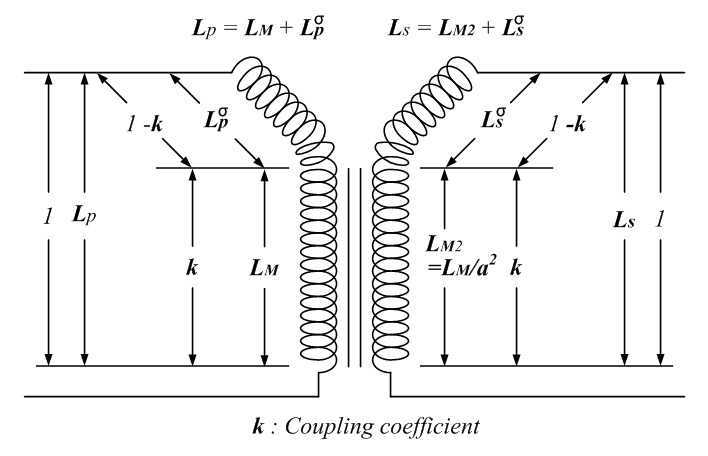
Fig. 1 L<sub>P</sub><sup>σ</sup>and L<sub>S</sub><sup>σ</sup> are primary and secondary '''leakage inductances''' expressed in terms of '''inductive coupling coefficient <math>k</math>''' under open-circuited conditions.
The magnetic circuit's flux that does not interlink both windings is the leakage flux corresponding to primary leakage inductance LPσ and secondary leakage inductance LSσ. Referring to Fig. 1, these leakage inductances are defined in terms of transformer winding open-circuit inductances and associated coupling coefficient or coupling factor k.
The primary open-circuit self-inductance is given by
:*L_{oc}^{pri}=L_P is primary self-inductance
:*L_P^\sigma is primary leakage inductance
:*L_M is magnetizing inductance
:*k is inductive coupling coefficient
Measuring basic transformer inductances & coupling factor
Transformer self-inductances L_P & L_S and mutual inductance M are, in additive and subtractive series connection of the two windings, given by,
::::L_{ser}^{+}-L_{ser}^{-}=4M
::::L_{ser}^{+}+L_{ser}^{-}=2 \cdot (L_{P}+L_{S})
::::L_P=a^2.L_S.
The coupling factor is derived from the inductance value measured across one winding with the other winding short-circuited according to the following:
:::Per **Eq. 2.7**,
::::L_{sc}^{pri}=L_S\cdot{(1-k^2)} and L_{sc}^{sec}=L_P\cdot{(1-k^2)}
:::Such that
::::k=\sqrt{1-\frac{L_{sc}^{pri}}{L_S}}=\sqrt{1-\frac{L_{sc}^{sec}}{L_P}}
The Campbell bridge circuit can also be used to determine transformer self-inductances and mutual inductance using a variable standard mutual inductor pair for one of the bridge sides.
It therefore follows that the open-circuit self-inductance and inductive coupling factor k are given by
:L_{oc}^{sec}=L_S=L_{M2}+L_S^\sigma ------ **(Eq. 1.2)**, and,
:k=\frac {\left | M\right|}{\sqrt{L_PL_S}}, with 0 k
where
:L_S^\sigma=L_S\cdot{(1-k)}
:L_{M2}=L_S\cdot {k}
and
:*M is mutual inductance
:*L_{oc}^{sec}=L_S is secondary self-inductance
:*L_S^\sigma is secondary leakage inductance
:*L_{M2}= L_M/a^2 is magnetizing inductance referred to the secondary
:*k is inductive coupling coefficient
:*a \equiv \sqrt {\frac {L_p} {L_s}} \approx N_P/N_S is the approximate turns ratio
The electric validity of the transformer diagram in Fig. 1 depends strictly on open-circuit conditions for the respective winding inductances considered. More generalized circuit conditions are as developed in the next two sections.
## Inductive leakage factor and inductance
A nonideal linear two-winding transformer can be represented by two mutual inductance-coupled circuit loops linking the transformer's five impedance constants as shown in Fig. 2.
::figure[src="https://upload.wikimedia.org/wikipedia/commons/e/e1/Basic_transformer_circuits.jpg" caption="Fig. 2 Nonideal transformer circuit diagram"]
::
where
:*M is mutual inductance
:*R_P & R_S are primary and secondary winding resistances
:*Constants M, L_P, L_S, R_P & R_S are measurable at the transformer's terminals
:*Coupling factor k is defined as
:::k=\left | M\right |/\sqrt{L_PL_S}, where 0 k
The winding turns ratio a is in practice given as
:a=\sqrt{L_P/L_S}=N_P/N_S\approx v_P/v_S \approx i_S/i_P= ------ **(Eq. 2.2)**.
where
:*NP & NS are primary and secondary winding turns
:*vP & vS and iP & iS are primary & secondary winding voltages & currents.
The nonideal transformer's mesh equations can be expressed by the following voltage and flux linkage equations,
:v_P=R_P \cdot i_P+\frac{d\Psi{_P}}{dt} ------ **(Eq. 2.3)**
:v_S=-R_S \cdot i_S-\frac{d\Psi{_S}}{dt} ------ **(Eq. 2.4)**
:\Psi_P=L_P \cdot i_P-M \cdot i_S ------ **(Eq. 2.5)**
:\Psi_S=L_S \cdot i_S-M \cdot i_P ------ **(Eq. 2.6)**,
:where
:*\Psi is flux linkage
:*\frac {d \Psi}{d t} is derivative of flux linkage with respect to time.
These equations can be developed to show that, neglecting associated winding resistances, the ratio of a winding circuit's inductances and currents with the other winding short-circuited and at open-circuit test is as follows,
:\sigma=1-\frac{M^2}{L_PL_S}=1-k^2\approx\frac{L_{sc}}{L_{oc}}\approx \frac{L_{sc}^{sec}}{L_P}\approx\frac{L_{sc}^{pri}}{L_S}\approx\frac{i_{oc}}{i_{sc}} ------ **(Eq. 2.7)**,
:where,
:*ioc & isc are open-circuit and short-circuit currents
:*Loc & Lsc are open-circuit and short-circuit inductances.
:*\sigma is the inductive leakage factor or Heyland factor
:*L_{sc}^{pri} & L_{sc}^{sec} are primary and secondary short-circuited leakage inductances.
The transformer inductance can be characterized in terms of the three inductance constants as follows,
:L_M=a{M} ------ **(Eq. 2.8)**
:L_P^\sigma=L_P-a{M} ------ **(Eq. 2.9)**
:L_S^\sigma=L_S-{M}/a ------ **(Eq. 2.10)** ,
where,
::figure[src="https://upload.wikimedia.org/wikipedia/commons/0/05/TREQCCTHeyland.jpg" caption="Fig. 3 Nonideal transformer equivalent circuit"]
::
:*LM is magnetizing inductance, corresponding to magnetizing reactance XM
:*LPσ & LSσ are primary & secondary leakage inductances, corresponding to primary & secondary leakage reactances XPσ & XSσ.
The transformer can be expressed more conveniently as the equivalent circuit in Fig. 3 with secondary constants referred (i.e., with prime superscript notation) to the primary,
:L_S^{\sigma\prime}=a^2L_S-aM
:R_S^\prime=a^2R_S
:V_S^\prime=aV_S
:I_S^\prime=I_S/a.
::figure[src="https://upload.wikimedia.org/wikipedia/commons/2/24/TREQCCTHeyland-to-k.jpg" caption="loc=p. 602, "Fig. 18-18 In this equivalent circuit of a (nonideal) transformer the elements are physically realizable and the isolationg property of the transformer has been retained."}}</ref>"]
::
Since
:k=M/\sqrt{L_PL_S} ------ **(Eq. 2.11)**
and
:a=\sqrt{L_P/L_S} ------ **(Eq. 2.12)**,
we have
:aM=\sqrt{L_P/L_S} \cdot k \cdot \sqrt{L_PL_S}=kL_P ------ **(Eq. 2.13)**,
which allows expression of the equivalent circuit in Fig. 4 in terms of winding leakage and magnetizing inductance constants as follows,
::figure[src="https://upload.wikimedia.org/wikipedia/commons/f/fb/TREQCCTHeylandConverted.jpg" caption="Fig. 5 Simplified nonideal transformer equivalent circuit"]
::
:L_P^\sigma=L_S^{\sigma\prime}=L_P \cdot (1-k) ------ **(Eq. 2.14 \equiv Eq. 1.1b)**
:L_M=kL_P ------ **(Eq. 2.15 \equiv Eq. 1.1c)**.
The nonideal transformer in Fig. 4 can be shown as the simplified equivalent circuit in Fig. 5, with secondary constants referred to the primary and without ideal transformer isolation, where,
:i_M = i_P - i_S^' ------ **(Eq. 2.16)**
:*i_M is magnetizing current excited by flux ΦM that links both primary and secondary windings
:*i_P is the primary current
:*i_S' is the secondary current referred to the primary side of the transformer.
## Refined inductive leakage factor
**Refined inductive leakage factor derivation**
a. Per Eq. 2.1 & IEC IEV 131-12-41 inductive coupling factor k is given by
:k=\left | M\right | /\sqrt{L_PL_S} --------------------- **(Eq. 2.1)**:
b. Per Eq. 2.7 & [IEC IEV 131-12-42](http://www.electropedia.org/iev/iev.nsf/display?openform&ievref=131-12-42) Inductive leakage factor \sigma is given by
:\sigma=1-k^2=1-\frac{M^2}{L_PL_S} ------ **(Eq. 2.7)** & **(Eq. 3.7a)**
c. \frac{M^2}{L_PL_S} multiplied by \frac{a^2}{a^2} gives
:\sigma=1-\frac{a^2M^2}{L_Pa^2L_S} ----------------- **(Eq. 3.7b)**
d. Per Eq. 2-8 & knowing that a^2L_S=L_S^\prime
:\sigma=1-\frac{L_M^2}{L_PL_S^\prime} ---------------------- **(Eq. 3.7c)**
e. \frac{L_M^2}{L_PL_S^\prime} multiplied by \frac{L_M.L_M}{L_M^2} gives
:\sigma=1-\frac{1}{\frac{L_P}{L_M}.\frac{L_S^\prime}{L_M}} ------------------ **(Eq. 3.7d)**
f. Per Eq. 3.5 \approx Eq. 1.1b & Eq. 2.14 and Eq. 3.6 \approx Eq. 1.1b & Eq. 2.14:
:\sigma=1-\frac{1}{(1+\sigma_P)(1+\sigma_S)} --- **(Eq.3.7e)**
All equations in this article assume steady-state constant-frequency waveform conditions the k & \sigma values of which are dimensionless, fixed, finite & positive but less than 1.
Referring to the flux diagram in Fig. 6, the following equations hold:
::figure[src="https://upload.wikimedia.org/wikipedia/commons/3/3d/Main_&_leakage_inductances.jpg" caption="loc=p. 4, Fig. 1, Magnetic field due to current in the inner winding"]
::
of a core-type transformer; Fig. 2, Magnetic field due to current in the outer winding of Fig. 1}}
]]
:σP = ΦPσ/ΦM = LPσ/LM ------ **(Eq. 3.1 \approx Eq. 2.7)**
In the same way,
:σS = ΦSσ'/ΦM = LSσ'/LM ------ **(Eq. 3.2 \approx Eq. 2.7)**
And therefore,
:ΦP = ΦM + ΦPσ = ΦM + σPΦM = (1 + σP)ΦM ------ **(Eq. 3.3)**
:ΦS' = ΦM + ΦSσ' = ΦM + σSΦM = (1 + σS)ΦM ------ **(Eq. 3.4)**
:LP = LM + LPσ = LM + σPLM = (1 + σP)LM ------ **(Eq. 3.5 \approx Eq. 1.1b & Eq. 2.14)**
:LS' = LM + LSσ' = LM + σSLM = (1 + σS)LM ------ **(Eq. 3.6 \approx Eq. 1.1b & Eq. 2.14)**,
where
:*σP & σS are, respectively, primary leakage factor & secondary leakage factor
:*ΦM & LM are, respectively, mutual flux & magnetizing inductance
:*ΦPσ & LPσ are, respectively, primary leakage flux & primary leakage inductance
:*ΦSσ' & LSσ' are, respectively, secondary leakage flux & secondary leakage inductance both referred to the primary.
The leakage ratio σ can thus be refined in terms of the interrelationship of above winding-specific inductance and Inductive leakage factor equations as follows:
:\sigma=1-\frac{M^2}{L_PL_S}=1-\frac{a^2M^2}{L_Pa^2L_S}=1-\frac{L_M^2}{L_PL_S{^'}}=1-\frac{1}{\frac{L_P}{L_M}.\frac{L_S^'}{L_M}} =1-\frac{1}{(1+\sigma_P)(1+\sigma_S)} ------ **(Eq. 3.7a to 3.7e)**.
## Applications
Leakage inductance can be an undesirable property, as it causes the voltage to change with loading.
::figure[src="https://upload.wikimedia.org/wikipedia/commons/7/7e/Kvglr.jpg" caption="High leakage transformer"]
::
In many cases it is useful. Leakage inductance has the useful effect of limiting the current flows in a transformer (and load) without itself dissipating power (excepting the usual non-ideal transformer losses). Transformers are generally designed to have a specific value of leakage inductance such that the leakage reactance created by this inductance is a specific value at the desired frequency of operation. In this case, actually working useful parameter is not the leakage inductance value but the short-circuit inductance value.
Commercial and distribution transformers rated up to say 2,500 kVA are usually designed with short-circuit impedances of between about 3% and 6% and with a corresponding X/R ratio (winding reactance/winding resistance ratio) of between about 3 and 6, which defines the percent secondary voltage variation between no-load and full load. Thus for purely resistive loads, such transformers' full-to-no-load voltage regulation will be between about 1% and 2%.
High leakage reactance transformers are used for some negative resistance applications, such as neon signs, where a voltage amplification (transformer action) is required as well as current limiting. In this case the leakage reactance is usually 100% of full load impedance, so even if the transformer is shorted out it will not be damaged. Without the leakage inductance, the negative resistance characteristic of these gas discharge lamps would cause them to conduct excessive current and be destroyed.
Transformers with variable leakage inductance are used to control the current in arc welding sets. In these cases, the leakage inductance limits the current flow to the desired magnitude. Transformer leakage reactance has a large role in limiting circuit fault current within the maximum allowable value in the power system.
In addition, the leakage inductance of a HF-transformer can replace a series inductor in a resonant converter. In contrast, connecting a conventional transformer and an inductor in series results in the same electric behavior as of a leakage transformer, but this can be advantageous to reduce the eddy current losses in the transformer windings caused by the stray field.
## Notes
## References
### Bibliography
-
-
-
-
-
-
-
-
-
-
-
-
-
-
-
-
-
-
## References
1. {{harvnb. Kim. 1963
2. {{harvnb. Saarbafi. Mclean. 2014
3. {{harvnb. Pyrhönen. Jokinen. Hrabovcová. 2008
4. The terms inductive coupling factor and inductive leakage factor are in this article as defined in [[International Electrotechnical Commission]] [https://web.archive.org/web/20160619074202/http://www.electropedia.org/iev/iev.nsf/d253fda6386f3a52c1257af700281ce6?OpenForm Electropedia]'s [http://www.electropedia.org/iev/iev.nsf/display?openform&ievref=131-12-41 IEV-131-12-41, Inductive coupling factor] and [http://www.electropedia.org/iev/iev.nsf/display?openform&ievref=131-12-42 IEV-131-12-42, Inductive leakage factor].
5. {{harvnb. Brenner. Javid. 1959
6. IEC 60050 (Publication date: 1990-10). Section 131-12: Circuit theory / Circuit elements and their characteristics, [http://www.electropedia.org/iev/iev.nsf/display?openform&ievref=131-12-41 IEV 131-12-41 '''Inductive coupling factor''']
7. {{harvnb. Brenner. Javid. 1959
8. Brenner & Javid 1959, pp. 591-592, Fig. 18-6
9. Harris 1952, p. 723, fig. 43
10. {{harvnb. Voltech. 2016
11. {{harvnb. Rhombus Industries. 1998
12. This measured [[short-circuit inductance]] value is often referred to as the leakage inductance. See for example are, [http://www.voltech.com/Articles/104-105%20Leakage%20Inductance/104-105.pdf Measuring Leakage Inductance], [http://www.rhombus-ind.com/app-note/l-leak.pdf Testing Inductance]. The formal leakage inductance is given by '''(Eq. 2.14)'''.
13. Harris 1952, p. 723, fig. 42
14. Khurana 2015, p. 254, fig. 7.33
15. Brenner. Javid. 1959
16. {{harvnb. Hameyer. 2001
17. {{harvnb. Singh. 2016
18. {{harvnb. Brenner. Javid. 1959
19. {{harvnb. Hameyer. 2001
20. {{harvnb. Hameyer. 2001
21. {{harvnb. Knowlton. 1949
22. IEC 60050 (Publication date: 1990-10). Section 131-12: Circuit theory / Circuit elements and their characteristics, [http://www.electropedia.org/iev/iev.nsf/display?openform&ievref=131-12-42 IEV ref. 131-12-42: "'''Inductive leakage factor''']
23. IEC 60050 (Publication date: 1990-10). Section 221-04: Magnetic bodies, [http://www.electropedia.org/iev/iev.nsf/display?openform&ievref=221-04-12 IEV ref. 221-04-12: "'''Magnetic leakage factor''' - the ratio of the total magnetic flux to the useful magnetic flux of a magnetic circuit."] This factor is also different from the inductive leakage factor described in this Leakage inductance article.
24. {{harvnb. Hameyer. 2001
25. {{harvnb. Brenner. Javid. 1959
26. {{harvnb. Brenner. Javid. 1959
27. {{harvnb. Erickson. Maksimovic. 2001
28. {{harvnb. Kim. 1963
29. {{harvnb. Hameyer. 2001
30. {{harvnb. Hameyer. 2001
31. {{harvnb. Hameyer. 2001
32. {{harvnb. Hameyer. 2001
33. {{harvnb. Kim. 1963
34. {{harvnb. Hameyer. 2001
35. {{harvnb. Kim. 1963
36. {{harvnb. Hameyer. 2001
37. {{harvnb. Hameyer. 2001
38. {{harvnb. Hameyer. 2001
39. (November 2020). "11kW, 70kHz LLC Converter Design for 98% Efficiency".
::callout[type=info title="Wikipedia Source"]
This article was imported from [Wikipedia](https://en.wikipedia.org/wiki/Leakage_inductance) and is available under the [Creative Commons Attribution-ShareAlike 4.0 License](https://creativecommons.org/licenses/by-sa/4.0/). Content has been adapted to SurfDoc format. Original contributors can be found on the [article history page](https://en.wikipedia.org/wiki/Leakage_inductance?action=history).
::
electric-transformers
Want to explore this topic further?
Ask Mako anything about Leakage inductance — get instant answers, deeper analysis, and related topics.
This content may have been generated or modified by AI. CloudSurf Software LLC is not responsible for the accuracy, completeness, or reliability of AI-generated content. Always verify important information from primary sources.