From Surf Wiki (app.surf) — the open knowledge base
Kecskemét
City with county rights in Southern Great Plain, Hungary

City with county rights in Southern Great Plain, Hungary
| Field | Value | |
|---|---|---|
| name | Kecskemét | |
| settlement_type | City with county rights | |
| official_name | Kecskemét Megyei Jogú Város | |
| image_skyline | {{Photomontage | |
| photo1a | Városi Tanácsház (2253. számú műemlék) 4.jpg | |
| photo2a | Canadair NF-5A Freedom Fighter, Turkey - Air Force JP6913865.jpg | |
| photo2b | PiarKecskemetFotoThalerTamas (2).JPG | |
| photo3a | Mercedes Kecsemét, open hatch, Automotive 2017 Hungexpo.jpg | |
| photo3b | 20170819 111250 Kecskemét Kossuth szobor.jpg | |
| photo4a | Ev._templom_(2225._számú_műemlék).jpg | |
| photo4b | Technika Háza, 2010 Kecskemét - panoramio - Bocskai László (4).jpg | |
| spacing | 2 | |
| position | center | |
| color_border | white | |
| color | white | |
| size | 300 | |
| image_shield | Coa_Hungary_Town_Kecskemét.svg | |
| image_flag | Flag_Hungary_Town_Kecskemét.svg | |
| timezone | CET | |
| utc_offset | +1 | |
| timezone_DST | CEST | |
| utc_offset_DST | +2 | |
| leader_title | Mayor | |
| leader_name | Klaudia Szemerey-Pataki (Fidesz-KDNP) | |
| leader_title1 | Deputy Mayor | |
| leader_name1 | Gyula Tamás Szeberényi (Fidesz-KDNP) | |
| Kornél Mák (Fidesz-KDNP) | ||
| József Gaál (Independent) | ||
| Tamás Homoki (Independent) | ||
| leader_title2 | Town Notary | |
| leader_name2 | Mária Berenténé Meskó | |
| pushpin_map | Hungary Bács-Kiskun#Hungary#Europe | |
| pushpin_relief | 1 | |
| map | [[File:HU county Bacs-Kiskun.svg | 275px]][[File:Red Dot.gif]]-- |
| subdivision_type | Country | |
| subdivision_name | ||
| subdivision_type1 | Region | |
| subdivision_name1 | Southern Great Plain | |
| subdivision_type2 | County | |
| subdivision_name2 | Bács-Kiskun | |
| subdivision_type3 | District | |
| subdivision_name3 | Kecskemét | |
| established_title1 | Established | |
| established_date1 | 9th century AD | |
| established_title2 | Market town | |
| established_date2 | 14th century AD | |
| area_total_km2 | 321.36 | |
| elevation_m | 105 | |
| population_as_of | 1 January 2016 | |
| population_total | 110,813 | |
| population_rank | 8th in Hungary | |
| population_urban | 187,835 (8th) | |
| population_demonym | kecskeméti | |
| demographics_type1 | Population by ethnicity | |
| demographics1_footnotes | ||
| demographics1_title1 | Hungarians | |
| demographics1_info1 | 84.8% | |
| demographics1_title2 | Germans | |
| demographics1_info2 | 1.3% | |
| demographics1_title3 | Gypsies | |
| demographics1_info3 | 1.1% | |
| demographics1_title4 | Romanians | |
| demographics1_info4 | 0.3% | |
| demographics1_title5 | Serbs | |
| demographics1_info5 | 0.1% | |
| demographics1_title6 | Slovaks | |
| demographics1_info6 | 0.1% | |
| demographics1_title7 | Croats | |
| demographics1_info7 | 0.1% | |
| demographics1_title8 | Bulgarians | |
| demographics1_info8 | 0.1% | |
| demographics1_title9 | Ukrainians | |
| demographics1_info9 | 0.1% | |
| demographics1_title10 | Others | |
| demographics1_info10 | 1.1% | |
| demographics_type2 | Population by religion | |
| demographics2_footnotes | ||
| demographics2_title1 | Roman Catholic | |
| demographics2_info1 | 39.7% | |
| demographics2_title2 | Greek Catholic | |
| demographics2_info2 | 0.3% | |
| demographics2_title3 | Calvinists | |
| demographics2_info3 | 10.2% | |
| demographics2_title4 | Lutherans | |
| demographics2_info4 | 1.2% | |
| demographics2_title5 | Jews | |
| demographics2_info5 | 0.1% | |
| demographics2_title6 | Other | |
| demographics2_info6 | 1.6% | |
| demographics2_title7 | Non-religious | |
| demographics2_info7 | 17.3% | |
| demographics2_title8 | Unknown | |
| demographics2_info8 | 29.6% | |
| postal_code_type | Postal code | |
| postal_code | 6000 to 6008, 6044 | |
| area_code_type | Area code | |
| area_code | (+36) 76 | |
| coordinates | ||
| blank_name | Motorways | |
| blank_info | M5, M8 (planned), M44 (planned) | |
| blank6_name_sec1 | International airports | |
| blank6_info_sec1 | Kecskemét | |
| blank2_name | Distance from Budapest | |
| blank2_info | 91.5 km Northeast | |
| blank1_name_sec1 | NUTS 3 code | |
| blank1_info_sec1 | HU331 | |
| blank3_name_sec2 | MP | |
| blank3_info_sec2 | László Salacz (Fidesz) | |
| Gábor Zombor (Fidesz) | ||
| website |
Kornél Mák (Fidesz-KDNP) József Gaál (Independent) Tamás Homoki (Independent) Gábor Zombor (Fidesz)
Kecskemét ( ) is a city with county rights in central Hungary. It is the eighth-largest city in the country, and the county seat of Bács-Kiskun.
Kecskemét lies halfway between the capital Budapest and the country's third-largest city, Szeged, 86 km from both of them and almost equal distance from the two big rivers of the country, the Danube and the Tisza. It is the northern of two centres of the Hungarian Southern Great Plain () region (comprising the three counties Bács-Kiskun, Békés and Csongrád); the southern centre is Szeged, the seat of Csongrád county.
Etymology
The name of the city stems from the Hungarian word kecske meaning 'goat' and -mét meaning 'pass'.
Geography
Kecskemét was established at the meeting point of a large sandy region and a sandy yellow soil; its elevation is 120 m above sea level. The territory west of the city is covered by wind-blown sand, characterised by the almost parallel northern-southern sand dunes and the plain between them. At the end of the 18th and the beginning of the 19th centuries, the pastures had become depleted. Overgrazing by cattle had destroyed the natural vegetation cover, and the movement of sand seriously endangered the town. Concentrated reforestation and planting of fruit and vines was carried out to stabilise the soil again.
Kecskemét is in the centre of Kiskunság, one of Hungary's famous regions. The Kiskunság National Park was established in 1975 to preserve the many different regional species of plants and animals. It is a "mosaic"-type national park, consisting of units that are not connected.
Climate
The characteristic weather in the Kecskemét region of Kiskunság is continental warm, dry, sometimes extreme. The amount of sunlight makes it possible for the region to produce agricultural products such as wheat, apricots, red peppers, and tomatoes. The warmest month in Kecskemét is July, with an average temperature of 22.2 C; the coldest is January, with -0.3 C.
Early spring and late autumn frosts are frequent on the Great Hungarian Plain. The possibility of frost usually ends only in the middle of April. After the third week of October, the temperature is frequently below 0 °C. |Jan record high C = 19.0 |Feb record high C = 20.5 |Mar record high C = 26.2 |Apr record high C = 30.6 |May record high C = 34.3 |Jun record high C = 37.7 |Jul record high C = 41.1 |Aug record high C = 38.1 |Sep record high C = 35.6 |Oct record high C = 28.3 |Nov record high C = 22.6 |Dec record high C = 18.5 |year record high C = 41.1 |Jan record low C = -23.7 |Feb record low C = -21.1 |Mar record low C = -14.9 |Apr record low C = -5.1 |May record low C = -0.3 |Jun record low C = 4.4 |Jul record low C = 6.8 |Aug record low C = 7.1 |Sep record low C = 0.7 |Oct record low C = -8.0 |Nov record low C = -12.2 |Dec record low C = -21.7 |year record low C = -23.7 |access-date = 28 August 2023 |archive-url = https://web.archive.org/web/20230828013307/https://www.nodc.noaa.gov/archive/arc0216/0253808/1.1/data/0-data/Region-6-WMO-Normals-9120/Hungary/CSV/Kecskemet_12970.csv |archive-format=CSV |format=CSV |archive-date = 28 August 2023}} Meteomanz(snowy days 2000-2023, extremes since 2021)}}
History

The first archaeological trace of a human in the area is about five thousand years old. The Sarmatians invaded the area in the first century B.C.; since then the area has been continuously inhabited by a variety of cultures. János Hornyik, the first town historian, believed that the settlement known as Partiskum of the Sarmatian Jazygian was here. Contemporary consensus among historians is that it is more likely permanent settlement occurred only after the Hungarian conquest. At the beginning of the 13th century, there were seven villages in the area, each with a population of 200–300 formed near the village church, a typical rural pattern. They were all destroyed by the Mongol Invasion. Some of the villages revived at the time of the Cumanians' colonization.
As Kecskemét was situated at an important trading route, it grew as a customhouse and a market-place; in 1368 it was identified in one of King Louis I of Hungary's charters as an oppidium (town). The town's active economic life and relatively dense population attracted more traders, craftsmen and residents, including Jews who became an important part of the town.
During the Turkish invasion, settlers from neighboring villages sought shelter in Kecskemét, which was protected by defensive palisades. They also were escaping the oppression of the spahi landlords. In addition to the protection of its setting, the town of Kecskemét had arranged to pay tax directly to the pasha in Buda, thus gaining his protection and enjoying a special situation.
Kecskemét gradually absorbed the lands of those who had taken refuge in the town. Residents created a large common field for the animals they were breeding. By the beginning of the 18th century, residents held nearly 30,000 cattle, which grazed on an almost 2000 km2 field.
At the end of the 18th century, animal breeding started to decline in economic importance, as the fields had become overgrazed and denuded. It took nearly 100 years before the region developed its next major agricultural commodity. In the 19th century, Kecskemét was already part of an important wine district, but the city increased in importance after the vine-pest destroyed most vineyards in the hilly regions. Damage was less significant in the plains' areas of loose, sandy soil. In the 1870s, landowners planted large plantations of grapevines around the town. These were the basis of the 20th-century vineyards and wine industry of the 20th century in Kecskemét. Cottage-type settlements grew up at the vineyards to house workers, a pattern still characteristic of the rural areas around the town. The growth of the wine industry stimulated those of the food industry and trade. The city is still known for its barackpálinka, an apricot brandy.
With their accumulation of capital, peasants began to adopt bourgeois customs and goods, stimulating trade in the town. Such regional wealth led to construction of new buildings, especially those surrounding Kecskemét's main square. This Art Nouveau complex is architecturally significant: the Town Hall, the New College, the Ornamented Palace, the Luther-Palace, the House of Trade (today the House of Young), and the Gentlemen's Casino, now used as the Hungarian Museum of Photography.
The town's growth suffered in the 1929–33 economic world crisis and Great Depression, followed by the upheaval and destruction of World War II. During the war and especially May–June 1944, Hungarian authorities rounded up and deported most of the Jews from the city to Auschwitz-Birkenau, where most were killed. Jewish Hungarians had been an important part of Kecskemét's thriving culture and trade. After 1945, the new Communist government, strongly influenced by the Soviet Union, imposed a different social-political system. Kecskemét's development slowed. Due to reorganisation in local government, Kecskemét lost its big territory; several new independent villages were formed in the area. They were economically connected to the town.
In 1950, for the first time, Kecskemét took on a significant political administrative role, as it was made seat of the country's largest county, Bács-Kiskun. In the special system of the so-called controlled economy under the Communist regimes, such status provided political and financial advantages that greatly helped the city continue its growth. The architect József Kerényi (1900–1975) adapted and renovated several historic buildings for other uses, helping keep the varied historical character of the city alive. For instance, in the early 1970s, he renovated the early-eighteenth-century Franciscan monastery for use as the Zoltán Kodály Conservatory; it opened for classes in 1975.[[File:Feszület Kecskemét Belvárosában.jpg|thumb|Crucifix in the centre of Kecskemét—51.4% of the city's population are Christians|248x248px]]The Hungarian Association of Photographers formed the Hungarian Photography Foundation in 1990. It helped raise funds for the restoration of an 18th-century building in Kecskemét last used as an Orthodox synagogue. It was adapted for the Hungarian Museum of Photography (Magyar Fotográfiai Múzeum), which opened in 1991. The museum holds work by Hungarian and other photographers of international and national reputations. It especially collects Hungarian photographers who successfully worked abroad.
On 18 June 2008, German car manufacturer Daimler announced that it would build a Mercedes-Benz manufacturing plant in Kecskemét, planning to invest €800 million (US$1.24 billion). The plant, one of the biggest if not the biggest-ever in the region, provides work for 2,500 people.
Economy
In March 2012, the German automobile manufacturer Daimler AG opened a plant nearby Kecskemét, to manufacture the new B-Class, A-Class and CLA-Class models. The Stuttgart-based company invested €800 million (US$1.24 billion) to build the new plant, which is expected to create 3,000 new jobs in the region. According to the plans, more than 100,000 vehicles will be produced annually at the factory.

As of 2021, the largest companies were:
- Mercedes-Benz – cars: 5,000 employees
- Duvenbeck IMMO – logistic: 1,100 employees
- ACPS Automotive – towbars: 1,000 employees
- Knorr-Bremse – brakes: 950 employees
- Phoenix Mecano – enclosures and mechanical components: 850 employees
- CabTec – cable: 800 employees
- Fornetti – baked goods: 800 employees
- Univer Product – canned goods: 800 employees
In the city, unemployment is extremely low. Over the last few years, thousands of jobs have been created to promote a low unemployment rate. In 2024, unemployment was 2,70%.
Public transport


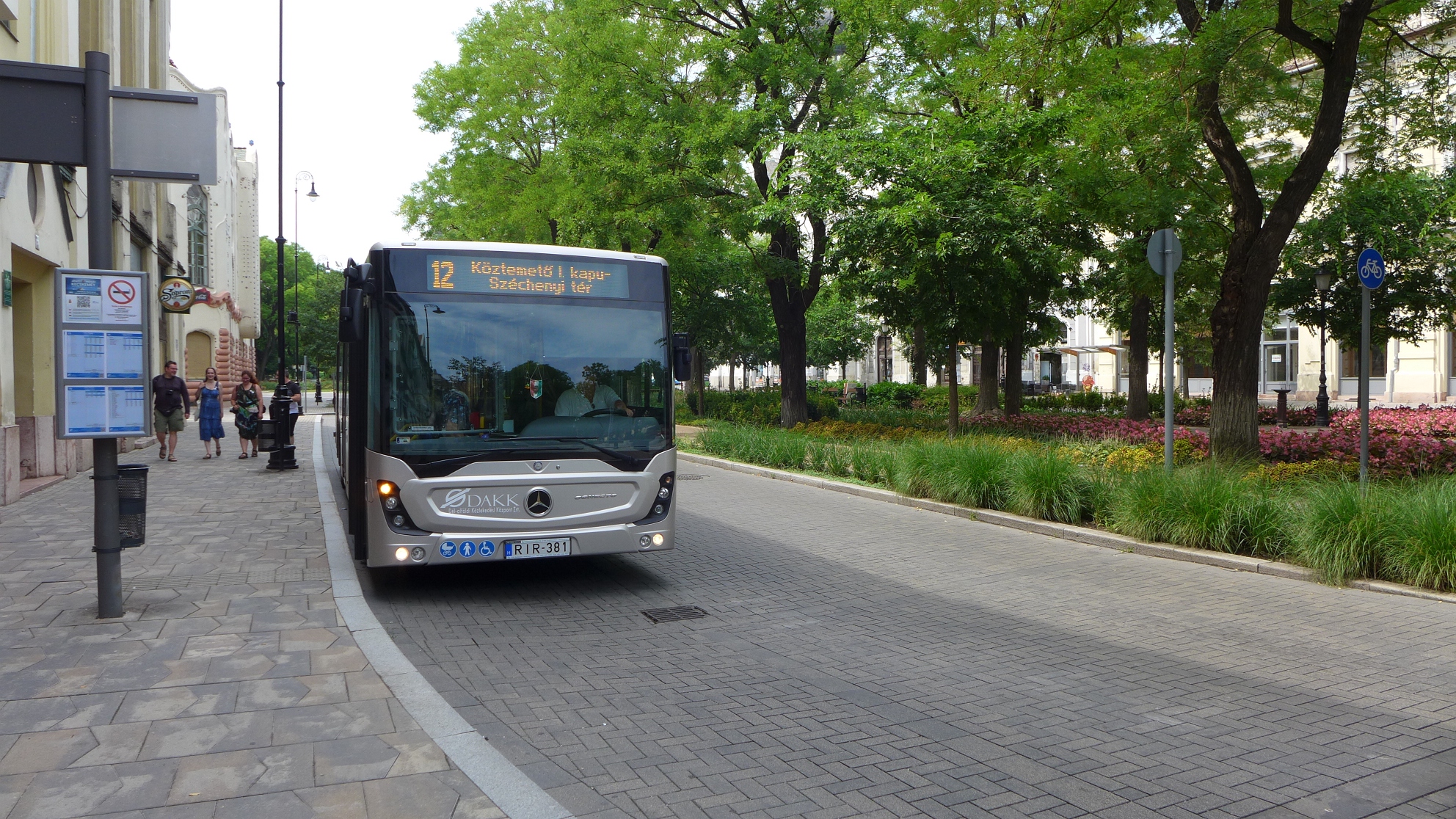
With the 1900s industrialisation of Hungary, Kecskemét developed public transportation by trams for a population of 50,000. Not until after World War II did bus travel begin in the city. In 2010, with competitive funding from the EU, the city launched a number of trolley bus lines and in 2011 completely rebuilt the town centre as a trolleybus and pedestrian tourist zone.
Currently, bus travel is the only public transportation to many destinations. Bus destinations ():
- 1 Noszlopy park - GAMF - Homokbánya kollégium
- 1D Homokbánya kollégium - Mercedes gyár I. kapu
- 2 Széchenyi tér - Rendőrfalu
- 2A Széchenyi tér - Gokart Stadion
- 2D Noszlopy park - Mercedes gyár I. kapu
- 2S Noszlopy park - Déli Ipartelep - SMP gyár
- 3 Széchenyi tér - Műkertváros - Nyíri Úti Kórház
- 3A Széchenyi tér - Műkertváros
- 4 Margaréta Otthon - Széchenyi tér - Repülőtér
- 4A Széchenyi tér - Kisfái
- 4C Széchenyi tér - Repülőtér
- 5 Széchenyi tér - Máriaváros
- 6 Széchenyi tér - Szeleifalu
- 7 Noszlopy park - Knorr Bremse - Szilády Nyomda
- 7C Noszlopy park - Mindszenti körút
- 9 Széchenyi tér - Talfája köz
- 10 Széchenyi tér - TESCO M5 Hipermarket
- 11 Széchenyi tér - Petőfiváros - Kadafalvi út
- 11A Széchenyi tér - Petőfiváros - AUCHAN Kereskedelmi Központ
- 12 Margaréta Otthon - Belváros - Köztemető I. kapu
- 12D Hunyadiváros (Serleg utca) - Mercedes gyár I. kapu
- 13 Széchenyi tér - Knorr Bremse
- 13D Széchenyi tér - Mercedes-gyár I. kapu
- 13K Széchenyi tér - Georg Knorr út
- 14 Széchenyi tér - Széchenyiváros
- 14D Széchenyiváros (Margaréta Otthon) - Mercedes gyár I. kapu
- 15 Noszlopy park - Hetényegyháza
- 15D Hetényegyháza - Mercedes gyár I. kapu
- 16 Széchenyi tér - Miklovicsfalu
- 18 Széchenyi tér - Köztemető II. kapu
- 19 Noszlopy park - Miklóstelep
- 20 Széchenyi tér - Megyei Kórház - Széchenyiváros
- 20H Széchenyi tér - Köztemető II. kapu - Kórházak - Széchenyi tér
- 21 Noszlopy park - Széchenyiváros - Nagykörút - Noszlopy park
- 21D Noszlopy park - Kurucz körút - Mercedes gyár I. kapu
- 22 Noszlopy park - Csabay Géza körút - Nagykörút - Noszlopy park
- 23 Széchenyi tér - Katonatelep
- 23A Széchenyi tér - Hunyadiváros - Katonatelep
- 25 Noszlopy park - Műkertváros
- 28 Széchenyi tér - Szeleifalu
- 29 Széchenyi tér - Hetényegyháza
- 32 Noszlopy park - Matkó
- 34 Kadafalva - Széchenyiváros - Kadafalva
- 34A Széchenyi tér - Széchenyiváros - Kadafalva
- 34V Kadafalva - Petőfiváros - Kadafalva
- 169 Széchenyi tér - Miklovicsfalu - Széchenyi tér
- 350 Máriaváros vasútállomás - Széchenyiváros
- 353 Hetényegyháza vasútállomás - Hetényegyháza központ
- 354 Hetényegyháza vasútállomás - Hetényegyháza központ
- 916 Széchenyi tér - Talfája köz - Széchenyi tér
Demographics
| Nationality | Population (2011) | ||
|---|---|---|---|
| German | |||
| Romanian | |||
| Russian | |||
| Serbian | |||
| Croatian | |||
| Slovakian |
Kecskemét has 107,267 residents (). The population is homogeneous with a large Hungarian majority. A few thousand of the Romani minority live in the city; they formed their independent minority government in 1994. (95% Hungarian; 0.8% Romani; 0.4% German; 0.2% Slovak; 4.8% other.) The city had a thriving Jewish population before World War II, as represented by their grand synagogue. Most of the Jews were deported by the Nazi forces in 1944 to concentration camps, where they were killed.
The Vice President of the German minority in Kecskemet is Ms Rozalia Neuendorf. Since 19 March 2007, there is also a minority self-government for Croats in Kecskemét.
Districts
|1739 | 19556 |1742 | 12978 |1784 | 22356 |1850 | 32308 |1857 | 41539 |1870 | 32830 |1880 | 35122 |1890 | 38439 |1900 | 46059 |1910 | 52270 |1920 | 55153 |1930 | 58169 |1941 | 63256 |1949 | 61370 |1960 | 71226 |1970 | 84482 |1980 | 96882 |1990 | 102516 |2001 | 107749 |2011 | 111411 |2022 | 108334
Kecskemét is divided into 21+1 sections.
- Belváros (Downtown)
- I. Árpádváros (Árpádtown)
- II. Máriaváros (Marytown)
- III. Széchenyiváros (Széchenyitown)
- IV. Bethlenváros (Bethlentown)
- V. Rákócziváros (Rákóczitown)
- VI. Erzsébetváros (Elisabethtown)
- VII. Kossuthváros (Kossuthtown)
- VIII. Hunyadiváros (Hunyaditown)
- IX. Szent István-város (Műkertváros, Szolnoki-hegy) (Saint Stephen town)
- X. Szent László-város (Rendőrfalu) (Saint Ladislaus town)
- XI. Alsószéktó (Szeleifalu)
- XII. Felsőszéktó (Petőfiváros, Sutusfalu)
- XIII. Talfája
- XIV. Katonatelep
- XV. Repülőtér (Reptéri-lakótelep)
- XVI. Matkó
- XVII. Kadafalva
- XVIII. Szarkás
- XIX. Hetényegyháza
- XX. Méntelek
- XXI. Borbáspuszta
Main sights
- City Hall
- "Cifra Palota"
- Co-Cathedral of the Ascension of the Lord, Kecskemét
- Old Church
- Synagogue
- József Katona Theatre
- Hungarian Museum of Photography
- Museum of Hungarian Naive Artists
- MiG-21 Monument File:Ev. templom (2225. számú műemlék).jpg|Evangelical Church File:Görögkeleti templom (Szentháromság) (2252. számú műemlék) 2.jpg|Orthodox Church
Activities
- Adventure Spa & Waterslide Park www.csuszdapark.hu
- Kecskemét Baths http://www.kecskemetifurdo.hu/
- Kecskemét Wild Park http://www.zookecskemet.hu/
- Katona József Theatre of Kecskemét http://kecskemetikatona.hu/hu/english.
- Kecskemét Arboretum http://www.kecskemetiarboretum.hu/
Events
- Csiperó- Future of Europe International childrend and youth meeting
- Kecskemét Animation Film Festival
- Kecskemét Air Show
Politics
The current mayor of Kecskemét is Klaudia Szemereyné Pataki (Fidesz-KDNP).
The local Municipal Assembly, elected at the 2019 local government elections, is made up of 21 members (1 Mayor, 14 Individual constituencies MEPs and 6 Compensation List MEPs) divided into this political parties and alliances:
| Party | Seats | Current Municipal Assembly | |
|---|---|---|---|
| Fidesz}} | Fidesz-KDNP | 12 | |
| Alliance for Hírös City | 9 |
List of mayors
List of city mayors from 1990:
| Member | Party | Term of office | |
|---|---|---|---|
| Endre Bányai | Hungarian Democratic Forum}}" | MDF | |
| József Merász | Independent (politician)}}" | Independent | |
| László Katona | Hungarian Democratic Forum}}" | MDF | |
| Gábor Szécsi | Fidesz}}" | Fidesz | |
| Gábor Zombor | Fidesz}}" | Fidesz-KDNP | |
| Klaudia Szemereyné Pataki | Fidesz}}" | Fidesz-KDNP |
Notable natives and residents
- József Katona (1791–1830), author
- Antal Szabó (1875–1926), painter
- Zoltán Kodály (1882–1967), Hungarian composer, ethnomusicologist, educator, linguist and philosopher. A music conservatory was named in his honor. The train station was built on the site of his family's house.
- Kálmán Latabár (1902–1970), actor, comedian
- Nicolas Abraham (1919–1975), French psychoanalyst
- Tamás Adamik (born 1937), Hungarian linguist and professor
- Ákos Kónya (born 1974), ultramarathoner
- Kati Zsigóné (born 1953), artist
Twin towns – sister cities
Kecskemét is twinned with:
- JPN Aomori, Japan
- UKR Berehove, Ukraine
- ENG Coventry, England, United Kingdom
- AUT Dornbirn, Austria
- SVK Galanta, Slovakia
- FIN Hyvinkää, Finland
- SWE Lidköping, Sweden
- ISR Nahariya, Israel
- GER Rüsselsheim am Main, Germany
- ROU Sfântu Gheorghe, Romania
- ROU Târgu Mureș, Romania
- TUR Tekirdağ, Turkey
- POL Wadowice, Poland
Friendly cities
Kecskemét also cooperates with:
- GER Großenhain, Germany
- SRB Novi Sad, Serbia
- CZE Tábor, Czech Republic
Military
The MH 59th "Dezső Szentgyörgyi" Tactical Wing, the only jet fighter unit of the Hungarian Defence Forces, is based at Kecskemét air force base. The Kecskemét Air Show is held here every two years.
Sport
- Kecskeméti TE, association football club
- Kecskeméti LC, association football club
References
;Notes
References
- "KSH - Kecskemét, 2011".
- "Eurostat, 2016".
- "Kecskemét". [[HarperCollins]].
- {{Cite Merriam-Webster. Kecskemet
- "Kecskemet - Weather data by months".
- [http://fotomuzeum.hu/en "Hungarian Museum of Photography"] {{Webarchive. link. (12 August 2010 , official website, English, accessed 7 September 2010)
- "Mercedes Attacks BMW From Hungary With New Facility". Washington Post.
- (18 June 2008). "Carmaker Daimler to build new factory in Kecskemet, Hungary". International Herald Tribune.
- (28 October 2008). "A Mercedes kecskeméti gyára az eredeti tervek szerint épül". LogSped.hu.
- "Kecskemét". Kecskeméti Közlekedési Központ.
- [http://www.croatica.hu/fileadmin/glasnik/2007/glasnik14internet.pdf Hrvatski glasnik] {{Webarchive. link. (6 June 2007 , 5 April 2007, Croatian, page 3, accessed 6 October 2008)
- "Városi közgyűlés tagjai 2019-2024 - Kecskemét (Bács-Kiskun megye)".
- "Kecskemét nemzetközi, testvér- és partnervárosi kapcsolatai". Kecskemét.
This article was imported from Wikipedia and is available under the Creative Commons Attribution-ShareAlike 4.0 License. Content has been adapted to SurfDoc format. Original contributors can be found on the article history page.
Ask Mako anything about Kecskemét — get instant answers, deeper analysis, and related topics.
Research with MakoFree with your Surf account
Create a free account to save articles, ask Mako questions, and organize your research.
Sign up freeThis content may have been generated or modified by AI. CloudSurf Software LLC is not responsible for the accuracy, completeness, or reliability of AI-generated content. Always verify important information from primary sources.
Report