From Surf Wiki (app.surf) — the open knowledge base
Kahramanmaraş
City in Turkey

City in Turkey
| Field | Value |
|---|---|
| official_name | Kahramanmaraş |
| settlement_type | Metropolitan municipality |
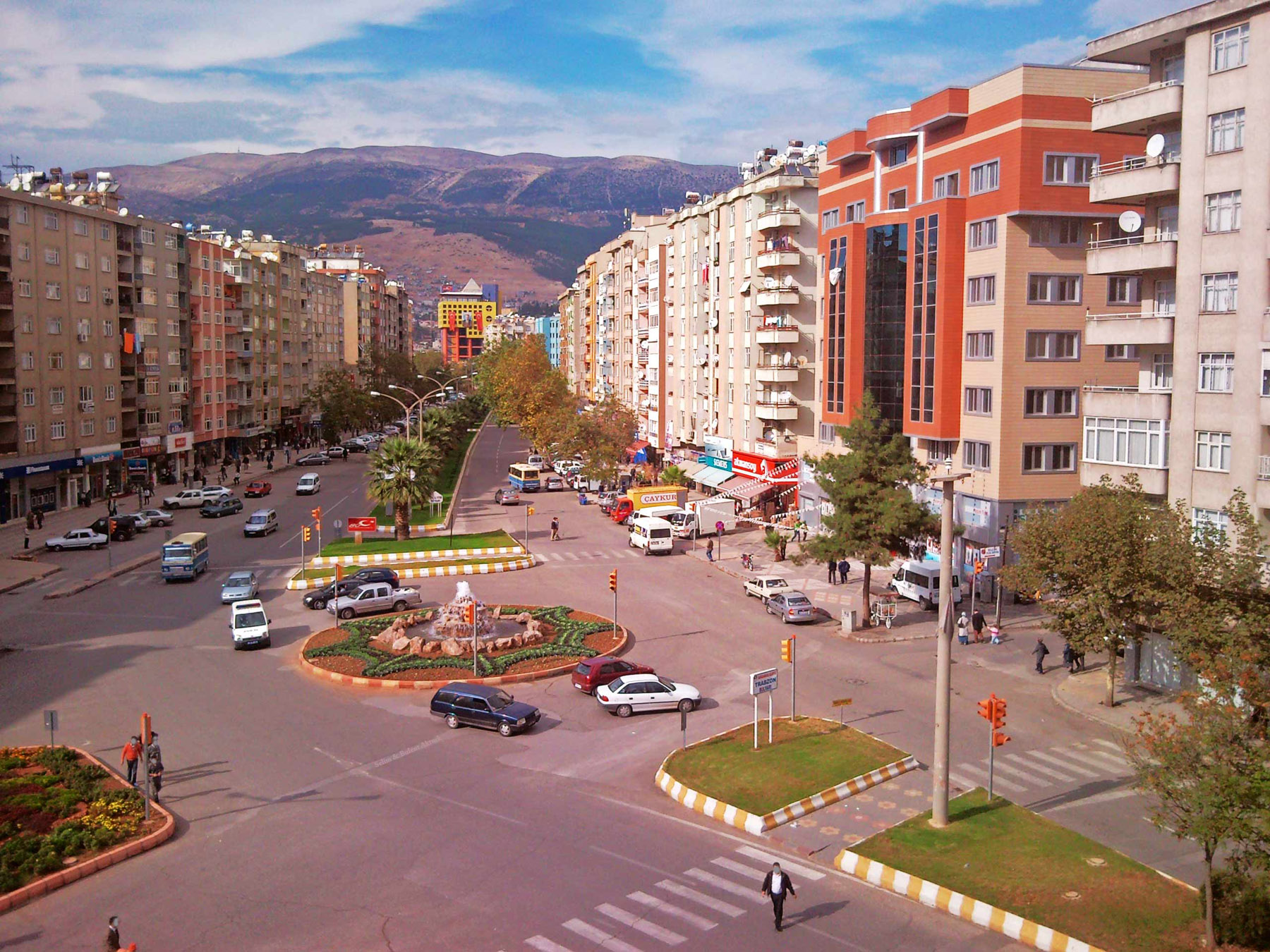
| image_skyline | Kahramanmaraş city center.jpg |
| image_caption | A view of the city center in 2023 |
| image_blank_emblem | Kahramanmaraş Metropolitan Municipality Logo.png |
| pushpin_relief | 1 |
| blank_emblem_type | Emblem of Kahramanmaraş Municipality |
| map_caption | Location of Kahramanmaraş within Turkey. |
| subdivision_type | Country |
| subdivision_name | Turkey |
| subdivision_type1 | Region |
| subdivision_name1 | Mediterranean |
| subdivision_type2 | Province |
| subdivision_name2 | Kahramanmaraş |
| pushpin_map | Turkey |
| coordinates | |
| elevation_m | 568 |
| population_footnotes | |
| population_as_of | 2022 |
| population_urban | 571,266 |
| timezone | TRT |
| utc_offset | +3 |
| postal_code_type | Postal code |
| area_code | 0344 |
| blank_info | 46 |
| blank_name | Licence plate |
Kahramanmaraş (), historically Marash (; ) and Germanicea (), is a city in the Mediterranean region of Turkey and the administrative centre of Kahramanmaraş province. After 1973, Maraş was officially named Kahramanmaraş with the prefix kahraman (Turkish word meaning "heroic") to commemorate the Battle of Marash. The city lies on a plain at the foot of Mount Ahır.
On 6 February 2023, much of the city was destroyed in the 2023 Turkey–Syria earthquakes which had their epicentre in Pazarcık and Elbistan in Kahramanmaraş province.
Geography
The city center is 568 meters above sea level. Ceyhan River, which originates from the mountains surrounding Elbistan Plain is the most important hydrological feature in the city.
Climate
| | | | |
Kahramanmaraş has a Mediterranean climate (Köppen: Csa, Trewartha: Cs) with continental influences from the surrounding northern areas. Summers are very hot and dry with a daytime average of 35 °C but temperatures can reach 40 °C quite easily. The highest recorded temperature is 47.2 °C on 14 August 2023. Winters are cool and wet with daytime temperatures typically in the 5 - range. The coldest temperature recorded is -9.6 °C on 6 February 1997.
| Jan record high C = 18.7 | Feb record high C = 25.3 | Mar record high C = 29.8 | Apr record high C = 36.0 | May record high C = 39.3 | Jun record high C = 42.0 | Jul record high C = 45.2 | Aug record high C = 47.2 | Sep record high C = 42.5 | Oct record high C = 38.6 | Nov record high C = 29.6 | Dec record high C = 24.0 | year record high C = 47.2 | Jan record low C = -9.0 | Feb record low C = -9.6 | Mar record low C = -7.6 | Apr record low C = -1.8 | May record low C = 4.7 | Jun record low C = 6.6 | Jul record low C = 12.4 | Aug record low C = 12.5 | Sep record low C = 4.0 | Oct record low C = 0.0 | Nov record low C = -4.4 | Dec record low C = -7.6 | year record low C = -9.6 | access-date = 6 July 2021}}
History
Early history

In the early Iron Age (late 11th century BC to ca. 711 BC), Maraş was the capital city of the Syro-Hittite state Gurgum (Hieroglyphic Luwian Kurkuma). It was known as "the Kurkumaean city" to its Luwian inhabitants and as Marqas to the Assyrians. In 711 BC, the land of Gurgum was annexed as an Assyrian province and renamed Marqas after its capital.
Maraş was called Germanicia Caesarea (, Germanikeia) by the Romans, which is a phonetic spelling Kermanicaeia/Germanicaeia and Kermanicia/Germanicia. in the time of the Roman and Byzantine empires. Various and often inacurate, wrong and incoreect spellings, misattributions and confusions of names, words or toponyms, during Roman period, were very common. According to a 2010 Cumhuriyet article, the first ruins of the Kurkumaean settlement have already been unearthed in the Dulkadiroğulları quarters of the city.
Medieval period
During the Byzantine Empire, Germanikeia was seat of an eparch and one of the city's eparch participated in the First Council of Nicea. The city was lost to the Muslims in the 7th century and during the rule of al-Mansur the whole Christian population of the Germanikeia valley was deported and resettled at Ramla in Palestine. After the fall of the Armenian kingdoms in the 11th century the city became an important stronghold for the exiled Armenians and the city became the capital of the short-lived principality of Philaretos Brachamios that at times included Antioch and Edessa.
After Philaretos's death, another Armenian general named Tatoul took over the city and hosted the exhausted army of the First Crusade for four days before it moved on to the Siege of Antioch. According to the Chronicle of Matthew of Edessa, it was destroyed by an earthquake and 40,000 people were killed on the 12th of the month of Mareri in the Armenian year 563 (November 29, 1114). In 1100, the city was captured by the Danishmends, followed by the Seljuks in 1103. In 1107, Crusaders led by Tancred retook it with aid from Toros I of Cilician Armenia. In 1135, the Danishmends besieged Germanikeia unsuccessfully, but captured it the next year. However, the Crusaders retook it in 1137.
_p145_MARASH,_GIAUR_DAGH_MOUNTAINS_IN_THE_DISTANCE.jpg)
Marash was ruled by the Beylik of Dulkadir as vassals of the Mamluk Empire from 1337 to 1515 before being annexed to the Ottoman Empire. In the early days of Ottoman rule (1525–6) there were 1,557 adult males (total population 7,500); at this time all the inhabitants were Muslims, but later a substantial number of non-Muslims migrated to the city, mainly in the 19th century.
Modern period
Around Maras, Armenians from Kishifli, Dere Keoy, and Fundijak chose to fight the Ottoman army to oppose deportation. On the morning of 26 July 1915, they attacked and burned six Turkish villages and their crops. Due to Muslim conscription for World War One, victims were women, children, and the elderly. In response, the Turkish army began a siege of Fundijak under Ali Bey on August 1. 91 captured fighters were executed, and another 100 were deported. The Turkish losses were estimated at 2,000 soldiers and between 4,000 and 5,000 villagers, while the Armenians lost 2,100, mostly civilians.
In the months following the end of the war, Cilicia had also become a source of dispute between the British and French, who both aspired to establish influence in the region. The British government, however, was under strong domestic pressure to withdraw and demobilize its forces in the Middle East and on 15 September 1919, Prime Minister David Lloyd George begrudgingly accepted a proposal by Prime Minister Georges Clemenceau to have the French formally assume control of Cilicia. The transfer of command took place on 4 November, but Field Marshal Ferdinand Foch's promise to reinforce the existing forces in the area with at least 32 infantry battalions, 20 cavalry squadrons and 14 artillery batteries went unfulfilled. The French units were thus deprived of armoured cars and air support and lacked automatic weapons, heavy artillery and even wireless transmitters and carrier pigeons.
Post Turkish Independence
In December 1978, the Maraş Massacre of leftist Alevis took place in the city. A Turkish nationalist group, the Grey Wolves, incited the violence that left more than 100 dead. The incident was important in the Turkish government's decision to declare martial law, and the eventual military coup in 1980.
In February 2023, a powerful 7.8 magnitude earthquake struck near Kahramanmaraş, causing widespread damage to the city, leaving more than 50,000 people dead. The city center was hardest-hit as many homes were destroyed. An estimated 17.37 percent of the city was destroyed.
Ecclesiastical history
Main article: Diocese of Marash
Demographics
| Year | Population |
|---|---|
| 1525–6 | 7,500 |
| 1564–5 | 13,500 |
| 1914 | 32,700 |
| 1927 | 25,672 |
| 1940 | 27,744 |
| 1945 | 33,104 |
| 1950 | 34,641 |
| 1960 | 54,447 |
| 1970 | 110,761 |
| 1980 | 178,557 |
| 2009 | 399,783 |
| 2013 | 458,860 |
| 2017 | 513,582 |
| 2021 | 559,873 |
In 1904, Mark Sykes recorded Marash as a city inhabited by Armenians and Turks. Ephraim K. Jernazian estimated that in 1913 the city was home to 45 thousand Turks and 30 thousand Armenians, while other ethnic groups had very small representation. Stanley Kerr reported Turks comprised 75% of the population. Ottoman censuses from the time are not fully reliable for many reasons, one of which being that during census taking every household was assumed to have 5 residents.
The Armenian population of Maraş, like many other Armenian communities in Turkey. Maraş was the site of massacres and deportations of Armenians, who were subjected to violence, harassment, looting and appropriation of property, and were forced to flee. In 1915, Armenians from Marash villages attacked and burned six Turkish villages and their crops. 4,000-5,000 Turkish villagers died, and the Turkish forces lost 2,000 soldiers. This would severely accelerate the deportation process for Armenians in Marash. A total of 20,000 Armenians from Marash would be deported, as local officials intentionally grouped the local population under the deportation orders for 'foreign armies'.
During the Turkish War of Independence, the French army occupied Maraş, and some Armenians returned to the city as French legionnaires, in addition to returning locals. In February 1920, Turkish nationalist forces regained control from the French, resulting in a massacre of the Armenian population. The official French report stated that the victims did "not exceed 5,000", though the initial estimates varied. According to Dr. Robert Lambert's report to the American Board of Commissioners for Foreign Missions, 4,500 Turks were killed during the battle.
In modern Turkey, data on the ethnic makeup of the country is not officially collected, though estimates exist. Kahramanmaraş is currently predominantly populated by Turkish and also Kurdish people, with a small Armenian population. The population of the city was 571,266 as of 2022. In February 2023, a powerful 7.8 magnitude earthquake struck near Kahramanmaraş, causing widespread damage to the city and leaving more than 50,000 people dead.
Industry

Several internationally known ice cream companies, like MADO, Yaşar Pastanesi, EDO and Ferah Pastanesi, started their business in Kahramanmaraş, and thousands of people visit the city because of its ice cream (dondurma in Turkish).
.jpg)
Sports
At 2300 m elevation, the nearby Yedikuyular Ski Resort offers winter sports activities.
Notable people
- Leo III, Byzantine emperor (717 - June 18, 741)
- Nestorius, 5th century religious leader
- Veysi Kaynak, Turkish politician from the Justice and Development Party (AKP) who currently serves as a Deputy Prime Minister of Turkey
- Ben Bagdikian, Armenian-American journalist, news media critic and commentator
- Mike Gulian, sometimes known as the Armenian Prince, Ottoman Empire-born player of American football
- Emine Hatun, principal consort of Sultan Mehmed I of the Ottoman Empire
- Soner Sarikabadayi, Turkish singer
- Necip Fazıl Kısakürek, Turkish poet and writer (by ancestry)
- George E. White, American missionary and witness to the Armenian Genocide
- Necmettin Hacıeminoğlu, Turkish writer
- Turabi Çamkıran, Turkish singer and actor
References
References
- "Kahramanmaraş".
- (2023-02-06). "Kahramanmaraş depremi: 16 bin 546 kişi hayatını kaybetti".
- (2023-02-09). "Turkey earthquake: One ruined neighbourhood at the centre of the devastation". BBC News.
- "Kahramanmaraş ve Tarım".
- "Present and future Köppen-Geiger climate classification maps at 1-km resolution". Nature Scientific Data. [[Digital object identifier. DOI]]:[https://www.nature.com/articles/sdata2018214 10.1038/sdata.2018.214].
- "İllerimize Ait Genel İstatistik Verileri". Meteoroloji Genel Müdürlüğü.
- "World Meteorological Organization Climate Normals for 1991–2020: Kahramanmaras". [[NCEI.
- "Kahramanmaras Havali: (TURKEY): Data by months".
- Bryce, Trevor (2012). ''The World of The Neo-Hittite Kingdoms: A Political and Military History''. OUP Oxford. {{ISBN. 978-0-19-921872-1, pp. 125-128.
- Payne, Annick (2012). ''Iron Age Hieroglyphic Luwian Inscriptions''. Society of Biblical Lit. {{ISBN. 978-1-58983-658-7, p. 7.
- Bryce 2012, p. 128.
- Cumhuriyet, 20 December 2010 p. 20
- (2021). "The Cambridge Companion to the Council of Nicaea". Cambridge University Press.
- (1996). "The Decline of Eastern Christianity Under Islam: From Jihad to Dhimmitude : Seventh-twentieth Century". Fairleigh Dickinson Univ Press.
- (2021). "From Edessa to Urfa: The Fortification of the Citadel". Archaeopress Publishing Ltd.
- (2019). "Medieval Fortifications in Cilicia: The Armenian Contribution to Military Architecture in the Middle Ages". BRILL.
- [https://books.google.com/books?id=z707mZkiLcgC&q=personne+n%27%C3%A9chappa&pg=PP1 Chronique de Matthieu d'Édesse], p. 287-90.
- "Kahramanmaraş Tarihi Gelişimi - www.k-maras.com".
- Kupferschmidt, Uri M. (1987). ''The Supreme Muslim Council: Islam Under the British Mandate for Palestine''. Brill, p. 508 {{ISBN. 9789004079298
- Kupferschmidt 1987, pp. 508-509
- Kerr, Stanley Elphinstone (1973). ''The Lions of Marash: Personal Experiences with American Near East Relief, 1919-1922''. SUNY Press, pp. 95–142. [[ISBN (identifier). ISBN]]. p. 18
- Kerr, Stanley Elphinstone (1973). ''The Lions of Marash: Personal Experiences with American Near East Relief, 1919-1922''. SUNY Press, pp. 95–142. {{ISBN. 978-0-87395-200-2. p. 19
- Kerr, Stanley Elphinstone (1973). ''The Lions of Marash: Personal Experiences with American Near East Relief, 1919-1922''. SUNY Press, pp. 95–142. {{ISBN. 978-0-87395-200-2. p. 41
- Kehyayan, in Kaloustain, Marash, pp. 45-55
- Zürcher, Erik J. (2017). ''Turkey: A Modern History''. I.B. Tauris. p. 267. {{ISBN. 978-1-78673-183-8
- "M 7.8 - Central Turkey". USGS.
- (February 8, 2023). "Footage from drone over Kahramanmaraş shows scale of earthquake damage – video". Guardian News & Media Limited.
- (2023). "Evaluating Urban Building Damage of 2023 Kahramanmaras, Turkey Earthquake Sequence Using SAR Change Detection". Sensors.
- Kupferschmidt 1987, pp. 508–509
- (1904). "Dar-ul-Islam: A Record of a Journey Through Ten of the Asiatic Provinces of Turkey". Bickers & Son.
- (1990). "Judgement Unto Truth: Witnessing the Armenian Genocide". Transaction Publishers.
- Kerr, Stanley Elphinstone (1973). ''The Lions of Marash: Personal Experiences with American Near East Relief, 1919-1922''. SUNY Press. [[ISBN (identifier). ISBN]]. Introduction, p. xx
- Behar, Cem, ed. 1996. Osmanlı Đmparatorluğu'nun ve Türkiye'nin nüfusu, 1500-1927. Ankara: T.C. Basbakanlık Devlet Đstatistik Enstitüsü = State Institute of Statistics Prime Ministry Republic of Turkey.
- Akçam, Taner. (2012). "The Young Turks' Crime against Humanity: The Armenian Genocide and Ethnic Cleansing in the Ottoman Empire". [[Princeton University Press]].
- Akçam, Taner (2012), pp. 192-193
- Akçam, Taner (2012), p. 306
- Akçam, Taner (2012), p. 357
- Kerr, Stanley Elphinstone (1973). ''The Lions of Marash: Personal Experiences with American Near East Relief, 1919-1922''. SUNY Press. [[ISBN (identifier). ISBN]]. Introduction, p. xxi
- Kerr 1973, p. 4
- Kerr 1973, p. 63
- "[https://web.archive.org/web/20080903140039/http://archive.timesonline.co.uk/tol/archive/ The Massacre Of Armenians]." ''[[The Times]]''. 28 February 1920.{{subscription required
- Robert A. Lambert to Major Nicol, 11 March 1920, "Western Turkey, igzo-August 1924," American Board of Commissioners for Foreign Missions, vol. 4, Document 91, Houghton Library, Harvard University, Cambridge, Massachusetts.
- Bayır, Derya (2013). ''Minorities and nationalism in Turkish law''. Cultural Diversity and Law. Farnham: [[Ashgate Publishing]]. pp. 88–89, 203–204. {{ISBN. 978-1-4094-7254-4.
- (2015). "Great Catastrophe: Armenians and Turks in the Shadow of Genocide". Oxford University Press.
- "Address-based population registration system (ADNKS) results dated 31 December 2022, Favorite Reports". [[TÜİK]].
- (8 December 2021). "Yedikuyular Kayak Merkezi'ne mevsimin ilk karı yağdı". [[TRT Haber]].
This article was imported from Wikipedia and is available under the Creative Commons Attribution-ShareAlike 4.0 License. Content has been adapted to SurfDoc format. Original contributors can be found on the article history page.
Ask Mako anything about Kahramanmaraş — get instant answers, deeper analysis, and related topics.
Research with MakoFree with your Surf account
Create a free account to save articles, ask Mako questions, and organize your research.
Sign up freeThis content may have been generated or modified by AI. CloudSurf Software LLC is not responsible for the accuracy, completeness, or reliability of AI-generated content. Always verify important information from primary sources.
Report