From Surf Wiki (app.surf) — the open knowledge base
José Canalejas y Méndez
Former Spanish Prime Minister (1854 – 1912)

Former Spanish Prime Minister (1854 – 1912)
| Field | Value |
|---|---|
| honorific-prefix | The Most Excellent |
| name | José Canalejas |
| nationality | Spanish |
| image | José Canalejas Méndez.png |
| birth_date | |
| birth_place | Ferrol, Spain |
| death_date | |
| death_place | Madrid, Spain |
| death_cause | Assassination by gunshot |
| resting_place | Pantheon of Illustrious Men |
| party | Liberal Party |
| deputy | Manuel García Prieto |
| office | Prime Minister of Spain |
| term_start | 9 February 1910 |
| term_end | 12 November 1912 |
| monarch | Alfonso XIII |
| predecessor | Segismundo Moret y Prendergast |
| successor | Álvaro Figueroa, Count Romanones |
| signature | Firma de José Canalejas.svg |
| office2 | President of the Congress of Deputies |
| predecessor2 | Antonio Aguilar y Correa |
| successor2 | Eduardo Dato |
| termstart2 | 19 January 1906 |
| termend2 | 30 March 1907 |
| monarch2 | Alfonso XIII |
| office3 | Minister of Development of Spain |
| office4 | Minister of Grace and Justice of Spain |
| office7 | Minister of Agriculture, Industry, Trade and Public Works of Spain |
| termstart3 | 12 June |
| termend3 | 30 November 1888 |
| monarch3 | Alfonso XIII |
| monarch4 | Alfonso XIII |
| monarch5 | Alfonso XIII |
| monarch6 | Alfonso XIII |
| monarch7 | Alfonso XIII |
| predecessor3 | Carlos Navarro Rodrigo |
| successor3 | José Álvarez de Toledo y Acuña |
| termstart4 | 11 December 1888 |
| termend4 | 21 January 1890 |
| successor4 | Joaquín López Puigcerver |
| predecessor4 | Manuel Alonso Martínez |
| 1blankname3 | Regent |
| 1namedata3 | Maria Christina of Austria |
| 1blankname4 | Regent |
| 1namedata4 | Maria Christina of Austria |
| termstart5 | 29 June 1911 |
| termend5 | 12 March 1912 |
| predecessor5 | Antonio Barroso Castillo |
| successor5 | Trinitario Ruiz Valarino |
| office6 | Minister of Finance of Spain |
| termend6 | 23 March 1895 |
| termstart6 | 17 December 1894 |
| predecessor6 | Amós Salvador Rodrigáñez |
| successor6 | Juan Navarro Reverter |
| 1blankname6 | Regent |
| 1namedata6 | Maria Christina of Austria |
| termstart7 | 19 March |
| termend7 | 31 May 1902 |
| predecessor7 | Miguel Villanueva y Gómez |
| successor7 | Félix Suárez Inclán |
| 1blankname7 | Regent |
| 1namedata7 | Maria Christina of Austria |
| 2blankname3 | Prime Minister |
| 2blankname4 | Prime Minister |
| 2blankname6 | Prime Minister |
| 2blankname7 | Prime Minister |
| 2namedata3 | Práxedes Mateo Sagasta |
| 2namedata4 | Práxedes Mateo Sagasta |
| 2namedata6 | Práxedes Mateo Sagasta |
| 2namedata7 | Práxedes Mateo Sagasta |
| primeminister5 | Himself |
| honorific-prefix = The Most Excellent
José Canalejas y Méndez (31 July 1854 – 12 November 1912) was a Spanish politician, born in Ferrol, who served as Prime Minister of Spain from 1910 until his assassination in 1912.
Early life
Son of a railway engineer, politician and editor of the newspaper * El Eco Ferrolano * José Canalejas y Casas and of María del Amparo Méndez Romero. He moved with his family to Madrid, and in October 1867 he enrolled in the Instituto San Isidro, "because at that time the incorporated schools could not teach the last two years of the six which made up the baccalaureate ». Already at the Central University of Madrid, he obtained the degrees of Law in 1871 and Philosophy in 1872, and the degree of doctor in both faculties. In 1873 he was assistant professor, but failed in two chair examinations, so he left teaching. He joined the company of the Railways of Madrid to Ciudad Real and Badajoz, where he became secretary general and He defended the company as a lawyer in lawsuits with other Spanish railway companies.
Political career
In 1881, Canalejas was elected deputy for Soria. Two years later, he was appointed under-secretary for the Prime Minister's department under Posada Herrera; he became minister of justice in 1888 and finance from 1894 to 1895. A brief spell as Minister of Agriculture, Industry and Commerce from March to May 1902 ended after only two months, when he resigned as he regarded the Sagasta Ministry weak and "incapable of safeguarding the Sovereignty of the State in view of the encroachments of the Vatican".
He served as President of the Congress of Deputies (the equivalent to the Anglo-Saxon office of parliamentary Speaker) from 1906 to 1907.
Canalejas Ministry
In 1909, after the bloody confrontations of the "Tragic Week" in Barcelona, Antonio Maura resigned and Segismundo Moret was again appointed prime minister. Moret was forced to resign in February 1910 when he was replaced by Canalejas who became Prime Minister and chief of the Liberal party. Moret denounced the Canalejas Ministry as "a democratic flag being used to cover reactionary merchandise".
While in office, Canalejas (with the support of his sovereign, Alfonso XIII) introduced several electoral reforms that aimed to win working-class support for moderately conservative policies; to curb the power of independent political bosses, quite common at the time, especially in rural areas; to weaken excesses of Catholic educational clericalism without threatening the Catholic Church as such; and to turn Spain into a true democracy. These policies successfully faced the social turmoil that radicals had been creating within Spain (and which had led, in 1909, to a brief but bloody unrest in Barcelona). During his government, Canalejas implemented several significant reforms. He abolished the system of consumos (indirect taxes), introduced compulsory military service to replace the previous draft lottery (quintas), restricted the establishment of new religious orders through the so-called “Ley del Candado” (Padlock Law), and promoted the creation of the Mancomunidad of Catalonia, a federation of Catalan provinces aimed at coordinating regional administration.
Death
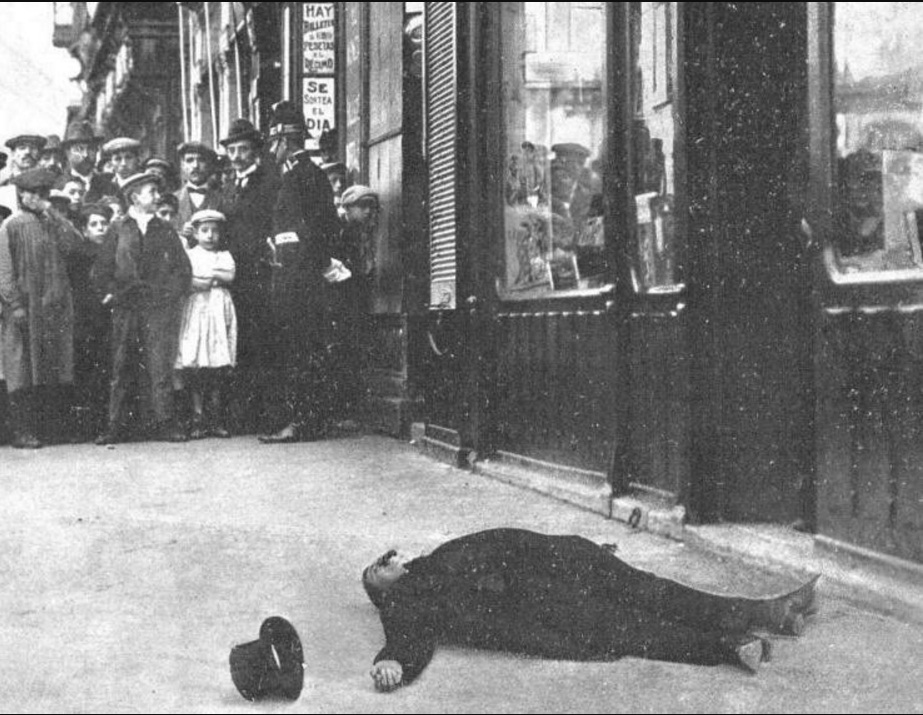
On 12 November 1912, while Canalejas was window-shopping the literary novelties of the day from a bookstore in central Madrid, he was fatally shot by anarchist Manuel Pardiñas.
Legacy
Canalejas believed in the possibility of a monarchy open to a thoroughgoing democratic policy both in economic and in civil and political matters. Salvador de Madariaga, the liberal historian, argued that the disasters Spain experienced during the 1930s could be traced to Canalejas' murder, given that this murder deprived King Alfonso of one of his few genuine statesmen.
References
References
- Until the majority age of Alfonso XIII on 17 May 1902
- Francos Rodríguez, José. (1918). "The life of Canalejas". Tip. of the "Rev. de arch., bibl. and museums".
- (30 May 1902). "Latest intelligence - Spain".
- Professor J. C J. Metford: ''The Spanish Anarchist Movement, 1908-75'', Mastermind Quiz Book, 1984
- "Biografia de José Canalejas".
This article was imported from Wikipedia and is available under the Creative Commons Attribution-ShareAlike 4.0 License. Content has been adapted to SurfDoc format. Original contributors can be found on the article history page.
Ask Mako anything about José Canalejas y Méndez — get instant answers, deeper analysis, and related topics.
Research with MakoFree with your Surf account
Create a free account to save articles, ask Mako questions, and organize your research.
Sign up freeThis content may have been generated or modified by AI. CloudSurf Software LLC is not responsible for the accuracy, completeness, or reliability of AI-generated content. Always verify important information from primary sources.
Report