From Surf Wiki (app.surf) — the open knowledge base
Gires–Tournois etalon
Optical interferometer

Optical interferometer
The complex amplitude reflectivity of a Gires–Tournois etalon is given by
:r=-\frac{r_1-e^{-i\delta}}{1-r_1 e^{-i\delta}}
where r1 is the complex amplitude reflectivity of the first surface,
:\delta=\frac{4 \pi}{\lambda} n t \cos \theta_t :n is the index of refraction of the plate :t is the thickness of the plate :θt is the angle of refraction the light makes within the plate, and :λ is the wavelength of the light in vacuum.
Nonlinear effective phase shift

Suppose that r_1 is real. Then |r| = 1, independent of \delta. This indicates that all the incident energy is reflected and intensity is uniform. However, the multiple reflection causes a nonlinear phase shift \Phi.
To show this effect, we assume r_1 is real and r_1=\sqrt{R}, where R is the intensity reflectivity of the first surface. Define the effective phase shift \Phi through
:r=e^{i\Phi}.
One obtains
:\tan\left(\frac{\Phi}{2}\right)=-\frac{1+\sqrt{R}}{1-\sqrt{R}}\tan\left(\frac{\delta}{2}\right)
For R = 0, no reflection from the first surface and the resultant nonlinear phase shift is equal to the round-trip phase change (\Phi = \delta) – linear response. However, as can be seen, when R is increased, the nonlinear phase shift \Phi gives the nonlinear response to \delta and shows step-like behavior. Gires–Tournois etalon has applications for laser pulse compression and nonlinear Michelson interferometer.
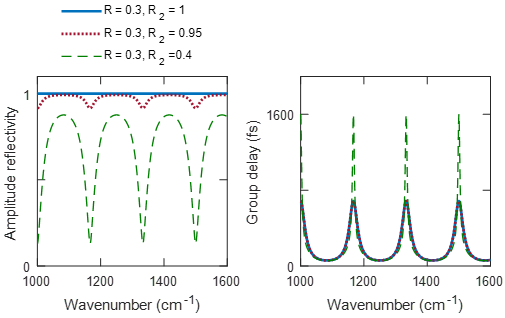
Gires–Tournois etalons are closely related to Fabry–Pérot etalons. This can be seen by examining the total reflectivity of a Gires–Tournois etalon when the reflectivity of its second surface becomes smaller than 1. In these conditions the property |r| = 1 is not observed anymore: the reflectivity starts exhibiting a resonant behavior which is characteristic of Fabry-Pérot etalons.
References
- (An interferometer useful for pulse compression of a frequency modulated light pulse.)
- Gires–Tournois Interferometer in RP Photonics Encyclopedia of Laser Physics and Technology
This article was imported from Wikipedia and is available under the Creative Commons Attribution-ShareAlike 4.0 License. Content has been adapted to SurfDoc format. Original contributors can be found on the article history page.
Ask Mako anything about Gires–Tournois etalon — get instant answers, deeper analysis, and related topics.
Research with MakoFree with your Surf account
Create a free account to save articles, ask Mako questions, and organize your research.
Sign up freeThis content may have been generated or modified by AI. CloudSurf Software LLC is not responsible for the accuracy, completeness, or reliability of AI-generated content. Always verify important information from primary sources.
Report