From Surf Wiki (app.surf) — the open knowledge base
Georgia–European Union relations

| Field | Value |
|---|---|
| title | Georgia–European Union relations |
| party1 | European Union |
| party2 | Georgia |
| map | European Union Georgia Locator 2022.svg |
| mission1 | European Union Delegation, Tbilisi |
| mission2 | Mission of Georgia, Brussels |
bilateral relations
The former European Community and Georgia established relations in 1992. After the Maastricht Treaty on creation of the European Union, Georgia deepened its ties with the EU through a Partnership and Cooperation Agreement (PCA) signed in 1996. In 2006, a five-year "Action Plan" of rapprochement was implemented in the context of the European Neighbourhood Policy (ENP). In 2009, relations between the two were further upgraded under the auspices of Eastern Partnership. In 2016, a comprehensive Association Agreement between the EU and Georgia went into force, providing Georgian citizens with visa-free travel to the EU, as well as access to some sectors of the European Single Market. Following Brexit, most of the existing EU-Georgia agreements applicable to the United Kingdom were renegotiated and agreed upon in 2019 bilaterally with the United Kingdom.
Georgia is a candidate for EU membership. A European Union Monitoring Mission in Georgia has been operating since 2009. In January 2021, Georgia was preparing to formally apply for EU membership in 2024. However, on 3 March 2022, Georgia submitted its membership application ahead of schedule, following the Russian invasion of Ukraine. In December 2023, the EU officially granted candidate status to Georgia. This made Georgia the first country in the South Caucasus region to obtain EU candidacy status.
In April 2023, a nationwide poll by the International Republican Institute found that 89 percent of Georgians support joining the EU, the highest number recorded for years.
History
Early developments
The European Community and Georgia established relations in 1992.
The European Council's Regulation (EC) No 1975/95 of 4 August 1995 provided for food aid to be sent to the people of Georgia.
Adjara crisis (2004)
In Adjara, leader Aslan Abashidze was forced to resign in May 2004 following the Rose Revolution. EU CFSP Chief Javier Solana indicated in February 2007 that the EU could send troops to Georgia alongside Russian forces.
South Ossetia crisis (2006–08)
In July 2006 the European Union referred to then-recent developments in the South Ossetia zone of conflict and to the Resolution of the Georgian Parliament on Peacekeeping Forces Stationed in the Conflict Zones, which was adopted on 18 July 2006 as follows:
After the 2008 South Ossetia war an EU cease-fire monitoring mission in Georgia (EUMM Georgia) was sent to monitor the Russian troop withdrawal from "security zones" established by Russia around South Ossetia and Abkhazia. The mission started on 1 October 2008 and was extended by the EU in July 2009 for one year while the EU expressed concern that Russia was blocking other observers from working there. A United Nations Security Council resolution aimed at extending its UN Observer Mission in Georgia was vetoed by Russia on 15 June 2009.
European Neighbourhood Policy Action Plan (2006–11)
On 2 October 2006, a joint statement on the agreed text of the Georgia-European Union Action Plan within the European Neighbourhood Policy (ENP) was issued. The Action Plan was formally approved at the EU-Georgia Cooperation Council session on 14 November 2006 in Brussels.
Association Agreement (2013–present)
.jpg)
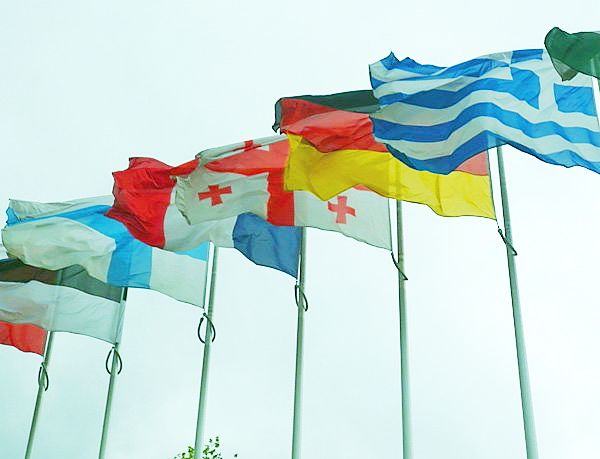
To enhance their relationship, the EU and Georgia began negotiating an Association Agreement (AA) and a Deep and Comprehensive Free Trade Agreement. In November 2012, European Commissioner for Neighbourhood and Enlargement Stefan Fule stated that the AA negotiations could be finalized by November 2013. In February 2013, Tamar Beruchachvili, the Deputy State Minister for European and Euro-Atlantic Integration of Georgia, stated that Georgia had no plans to join the Eurasian Economic Union, which Fule has warned Ukraine would be incompatible with the agreements with the EU. A ceremony on the initialling of the AA by the Georgian Foreign Minister Maia Panjikidze and EU High Representative for Foreign Affairs and Security Policy Catherine Ashton was held at the Eastern Partnership summit on 29 November 2013. It was formally signed on 27 June 2014, and had to be ratified by the EU, Euratom, their member states and Georgia. A second agreement, governing the country's involvement in EU crisis management operations, was also signed.
The Association Agreement, much of which provisionally came into force in September, has been fully ratified by Georgia and all EU member states. The agreement entered into force on 1 July 2016.
.jpg)


Ratification
The EU-Georgia Association Agreement was ratified by legislative bodies of every single EU member state. Detailed ratification timeline and vote counts are outlined in the below collapsible list (click the "show" button to expand the list):
| Walloon | |
|---|---|
| Parliament | (regional) |
| (community) |
! |- style="background:lightgreen;" ! |- style="background:lightgreen;" | 22 June 2015 | German-speaking Community ! |- style="background:lightgreen;" | 24 June 2015 | French Community ! |- style="background:lightgreen;" | 20 November 2015 | Brussels Regional Parliament ! |- style="background:lightgreen;"
| Brussels United | |
|---|---|
| Assembly | (FR language) |
| (NL language) |
! |- style="background:lightgreen;" ! |- style="background:lightgreen;"
| Flemish | |
|---|---|
| Parliament | (regional) |
| (community) |
!
|- style="background:lightgreen;"
!
|- style="background:lightgreen;"
| 24 June 2015
| COCOF Assembly
!
|- style="background:lightgreen;"
| 24 July 2014
| National Assembly
!
|- style="background:lightgreen;"
| 28 July 2014
| Presidential Assent
!
|- style="background:lightgreen;"
| 12 December 2014
| Parliament
!
|- style="background:lightgreen;"
| 18 December 2014
| Presidential Assent
!
|- style="background:lightgreen;"
| 7 May 2015
| House of Representatives
!
|- style="background:lightgreen;"
| 22 May 2015
| Presidential Assent
!
|- style="background:lightgreen;"
| 18 March 2015
| Senate
!
|- style="background:lightgreen;"
| 29 April 2015
| Chamber of Deputies
!
|- style="background:lightgreen;"
| 19 May 2015
| Presidential Assent
!
|- style="background:lightgreen;"
| 18 December 2014
| Parliament
!
|- style="background:lightgreen;"
| 4 November 2014
| Assembly
!
|- style="background:lightgreen;"
| 13 November 2014
| Presidential Assent
!
|- style="background:lightgreen;"
| 18 December 2014
| European Parliament
23 May 2016 (EU)
!
|- style="background:lightgreen;"
|
| Council of the European Union
!
|- style="background:lightgreen;"
| 10 March 2015
| Parliament
!
|- style="background:lightgreen;"
| 24 April 2015
| Presidential Assent
!
|- style="background:lightgreen;"
| 29 October 2015
| Senate
!
|- style="background:lightgreen;"
| 25 June 2015
| National Assembly
!
|- style="background:lightgreen;"
| 9 November 2015
| Presidential Assent
!
|- style="background:lightgreen;"
| 8 May 2015
| Bundesrat
!
|- style="background:lightgreen;"
| 26 March 2015
| Bundestag
!
|- style="background:lightgreen;"
| 27 May 2015
| Presidential Assent
!
|- style="background:lightgreen;"
| 18 July 2014
| Parliament
!
|- style="background:lightgreen;"
|
| Presidential Assent
!
|- style="background:lightgreen;"
| 18 November 2015
| Parliament
!
|- style="background:lightgreen;"
| 24 November 2015
| Presidential Promulgation
!
|- style="background:lightgreen;"
| 25 November 2014
| National Assembly
!
|- style="background:lightgreen;"
| 5 December 2014
| Presidential Assent
!
|- style="background:lightgreen;"
| 27 January 2015
| Dáil Éireann
!
|- style="background:lightgreen;"
| 26 November 2015
| Senate
!
|- style="background:lightgreen;"
| 29 July 2015
| Chamber of Deputies
!
|- style="background:lightgreen;"
| 7 December 2015
| Presidential Assent
!
|- style="background:lightgreen;"
| 14 July 2014
| Parliament
!
|- style="background:lightgreen;"
| 18 July 2014
| Presidential Assent
!
|- style="background:lightgreen;"
| 8 July 2014
| Parliament
!
|- style="background:lightgreen;"
| 11 July 2014
| Presidential Assent
!
|- style="background:lightgreen;"
| 18 March 2015
| Chamber of Deputies
!
|- style="background:lightgreen;"
| 12 April 2015
| Grand Ducal Promulgation
!
|- style="background:lightgreen;"
| 21 August 2014
| House of Representatives
!
|- style="background:lightgreen;"
| 7 July 2015
| Senate
!
|- style="background:lightgreen;"
| 7 April 2015
| House of Representatives
!
|- style="background:lightgreen;"
| 28 July 2015
| Royal Promulgation
!
|- style="background:lightgreen;"
| 5 March 2015
| Senate
!
|- style="background:lightgreen;"
| 6 February 2015
| Sejm
!
|- style="background:lightgreen;"
| 26 March 2015
| Presidential Assent
!
|- style="background:lightgreen;"
| 2 April 2015
| National Assembly
!
|- style="background:lightgreen;"
| 19 May 2015
| Presidential Assent
!
|- style="background:lightgreen;"
| 2 July 2014
| Chamber of Deputies
!
|- style="background:lightgreen;"
| 3 July 2014
| Senate
!
|- style="background:lightgreen;"
| 9 July 2014
| Presidential Assent
!
|- style="background:lightgreen;"
| 23 September 2014
| National Council
!
|- style="background:lightgreen;"
| 16 October 2014
| Presidential Assent
!
|- style="background:lightgreen;"
| 13 May 2015
| National Assembly
!
|- style="background:lightgreen;"
| 21 May 2015
| Presidential Assent
!
|- style="background:lightgreen;"
| 27 May 2015
| Senate
!
|- style="background:lightgreen;"
| 30 April 2015
| Congress of Deputies
!
|- style="background:lightgreen;"
|
| Royal Assent
!
|- style="background:lightgreen;"
| 26 November 2014
| Parliament
!
|- style="background:lightgreen;"
| 23 February 2015
| House of Commons
!
|- style="background:lightgreen;"
| 9 March 2015
| House of Lords
!
|- style="background:lightgreen;"
| 19 March 2015
| Royal Assent
!
|}
Accession of Georgia to the European Union
Main article: Accession of Georgia to the European Union
.jpg)

]]
On 12 January 2002, the European Parliament noted that Georgia may enter the EU in the future. The European Parliament passed a resolution in 2014 stating that "in accordance with Article 49 of the Treaty on European Union, Georgia, Moldova and Ukraine, as well as any other European country, have a European perspective and can apply for EU membership in compliance with the principles of democracy, respect for fundamental freedoms and human rights, minority rights and ensuring the rule of rights." Membership is welcomed by Georgians, with 77% of the population approving the government's goal to join the EU and only 11% opposing it.
Georgia's former President Mikheil Saakashvili has expressed a desire for Georgia to join the EU. This view has been explicitly expressed on several occasions as links to the United States, EU and NATO have been strengthened in an attempt to move away from the Russian sphere of influence. Territorial integrity issues in Ajaria were dealt with after the Rose Revolution, when leader Aslan Abashidze was forced to resign in May 2004. However, unresolved territorial integrity issues have again risen to the forefront in South Ossetia and Abkhazia as a result of the 2008 South Ossetia War. On 11 November 2010, Georgian Deputy Prime Minister Giorgi Baramidze announced that Georgia wants to cooperate with Ukraine in their attempt to join the European Union.
The European Parliament notes that in accordance with Article 49 of the Treaty with the EU, Georgia, Moldova and Ukraine, like any other European country, have a European perspective and can apply for EU membership in accordance with the principles of democracy - it said in a resolution of the European Parliament in Brussels, adopted at the last session before the elections to the European Parliament, which took place on 23–25 May 2014.
Georgian Prime Minister Irakli Garibashvili said at a press conference in Brussels on 27 June 2014 that Georgia could be a full EU member within 5–10 years. However, he stressed that Georgia had not fixed a date for bidding for EU membership.
Georgia officially applies for EU membership
On 17 January 2021, Irakli Kobakhidze was elected the chairman of the ruling Georgian Dream party. He announced plans for Georgia to officially apply for EU membership in 2024. Amid the 2022 Russo-Ukrainian War, this was expedited to 3 March 2022. On 7 March, the EU said it will formally assess Georgia's application. On 11 April, Georgia has received EU Membership Questionnaire to fill out and send it back for the review in May. According to Garibashvili, the response to the first part was submitted by May 2, remarking on his Twitter account, "I am sure of Georgia's success on in pursuit of the ultimate goal of the Georgian people", while the second and final part was submitted on 10 May 2022.
On 17 June 2022, the European Commission recommended that Georgia be given the perspective to become a member of the European Union, but deferred recommending it be given candidate status until after certain conditions were met. On 23 June 2022, the European Parliament adopted a resolution calling for the immediate granting of candidate status for membership of the European Union to Ukraine and Moldova, as well as to support the European perspective for Georgia. On 23 June 2022, the European Council expressed readiness to grant Georgia the status of a candidate for accession to the European Union after a set of recommended reforms.
The EU asked Georgia to complete economic reforms including more investment in education, renewable energy generation, and transportation. Requested political reforms included reduced political polarization, election reforms, judicial reform, stronger anti-corruption institutions, implementing "de-oligarchisation", reducing organized crime, protect journalists from government interference and criminal threats, protect vulnerable groups against criminal human rights violations, improve gender equality, reduce violence against women, increase decision-making influence of civil society, and make the Public Defender more independent.
In March 2023, the Georgian government withdrew draft legislation putting controls on "foreign agents", after condemnation from EU officials.
In September EU foreign affairs chief, Josep Borrell, advised that Georgia needed to do more to advance in its accession aims. In this/Borrell's 8 September 2023 visit to Georgia Borrell stated that nine of the 12 conditions, as stipulated by the EU in 2022, for granting Georgia its membership candidate status remained unfulfilled. Borrell also condemned Georgia's May 2023 consent to resume direct flights between Georgia and Russia, and he claimed that EU applicant countries should act in accordance with the EU policies of "isolating Russia for invading Ukraine last year". He also stated that the Georgian authorities “must ensure” a “proper environment” to depolarise the existing “tense political scene” and highlighted that the ruling party Georgian Dream announcement made early September 2023 to start an impeachment process against President of Georgia Salome Zourabichvili for an alleged unauthorized EU trip could further strengthen political polarization. Borrell also noted that it seemed that Georgia's compatibility with the EU's efforts to have a joint approach on priority issues “was not very high”, and the direction required to be improved.
On 15 September 2023 Georgian Prime Minister Irakli Garibashvili alleged that the EU would have “no reasons” to reject Georgia's candidacy in December 2023, Garibashvili claimed that “all remaining issues” related to the reform agenda outlined by the EU in 2022 for granting the status would be resolved by the end of that month (September 2023).
On 6 October 2023, Croatian Prime Minister Andrej Plenković highlighted his support for granting Georgia EU candidate status during the European Political Community Summit in Granada, Spain.
On 12 October 2023, Hungarian Prime Minister Viktor Orbán has called EU's 2022 rejection of membership candidate status for Georgia "very disappointing" and "unfair decision" in light of granting the candidacy to Moldova and Ukraine. Orban has also said that the decision contradicts the "European interests".
On 13 October 2023, the National Assembly of Bulgaria passed a resolution in favor of granting Georgia EU candidate status.
Romanian ambassador to Georgia reaffirmed Romania's support for granting Georgia the candidate status in December 2023.
On 8 November 2023, the European Commission recommended giving candidate status to Georgia. On 15 December 2023, the European Council agreed to giving candidate status to Georgia.
However, following the Georgian government's approval of legislation which would require non-governmental organizations to register as foreign agents or "organizations carrying the interests of a foreign power" and disclose the sources of their income if the funds they receive from abroad amount to more than 20% of their total revenue, which led to widespread protests in the country, the European Council stated in June 2024 that this represented "backsliding on the steps set out in the Commission’s recommendation for candidate status" and that the accession process would be de facto on hold until the government changes course. On 9 July 2024, the EU ambassador in Georgia announced that the European Union had suspended the country's accession process.
The 2024 Georgian parliamentary elections resulted in Georgian Dream retaining power, but were disputed by opposition parties which claimed that the vote was not free and fair and was subject to widespread voter fraud. The European Parliament adopted a non-binding resolution which rejected the validity of the results, and called for the vote to be repeated within a year. On 28 November 2024, Georgian Prime Minister Irakli Kobakhidze announced that Georgia's EU accession negotiations had been suspended until the end of 2028, though he insisted that his government would continue to implement the reforms required for accession and that it still planned for Georgia to join the EU by 2030.
Visa liberalization dialogue
In June 2012, the EU and Georgia began a visa liberalisation dialogue to allow for visa-free travel of Georgian citizens to the European Union. The talks aimed to have a Visa Liberalisation Action Plan in place by the end of the year. The action plan was delivered to Georgia on 25 February 2013. The new project on 'Strengthening the capacity of the Georgian Government in border management and migration regulation' which was launched in Tbilisi by the EU Delegation to Georgia, will be implemented by the International Organisation for Migration (IOM) and International Centre for Migration Policy Development (ICMPD), the EU Delegation to Georgia said in its statement on 24 January 2014. Thus, Georgia will take another step towards visa-free travel to the Schengen area through an EU-funded project which will help to increase the capacity of the Georgian authorities in the field of integrated border management and migration. In December 2015, the Commission issued a progress report that found that Georgia met all the conditions for its citizens be granted visa-free travel to the Schengen area. The European Commission formally proposed Georgia be granted visa free travel in March 2016. The Committee of Permanent Representatives gave its approval in October 2016, and it was approved by the European Parliament in February 2017. On 8 March 2017 the Official EU Journal published a legislation allowing Georgians owning biometric passports to travel to the Schengen Area visa-free. The legislation came into full effect on 28 March 2017, allowing Georgian citizens to travel for short periods to most EU member countries without a visa. In 2025 the EU warned that it might suspend visa free travel for Georgian citizens due to backsliding of rule-of-law of visa alignment comittments.
Georgia's foreign relations with EU member states
References
- Fischer, Sabine: "European Policy towards the South Caucasus after the Georgia Crisis" in the Caucasus Analytical Digest No. 1
References
- [https://neighbourhood-enlargement.ec.europa.eu/system/files/2022-06/Georgia%20opinion%20and%20Annex.pdf Commission Opinion on Georgia's application for membership of the European Union], [[European Commission]]: 17 June 2022. Quote: "The European Community established relations with Georgia in 1992. In 1996, a Partnership and Cooperation Agreement was signed (PCA), which entered into force in 1999."
- (22 April 1996). "Caucasus sign accords with EU".
- Makszimov, Vlagyiszlav. (22 January 2021). "Georgian president visits Brussels in push for 2024 EU membership application".
- "Georgia-EU Relations Within Georgia's 2024 Objective to Apply for the EU Membership".
- "Georgia, Moldova Formally Apply for EU Membership Amid Russia's Invasion of Ukraine". Radiofreeeurope/Radioliberty.
- ''[https://www.consilium.europa.eu/en/press/press-releases/2023/12/14/european-council-conclusions-on-ukraine-enlargement-and-reforms/ European Council conclusions on Ukraine, enlargement and reforms]'', [[European Council]], 14 December 2023
- James, Emilia. (2023-04-25). "IRI Georgia Poll Finds Support for EU Accession High, Weariness of Russian Presence, Lack of Faith in Political Parties".
- [[EUR-Lex]], [https://eur-lex.europa.eu/eli/reg/1995/1975/oj/eng Council Regulation (EC) No 1975/95 of 4 August 1995 on actions for the free supply of agricultural products to the peoples of Georgia, Armenia, Azerbaijan, Kyrgyzstan and Tajikistan], accessed on 18 February 2025
- [http://euobserver.com/9/23579 Solana raises prospect of EU soldiers in Georgia] EU Observer
- "Declaration by the Presidency on behalf of the European Union on recent developments in Georgia - Abkhazia and South Ossetia".
- [http://news.bbc.co.uk/2/hi/europe/7549736.stm Q&A: Conflict in Georgia], [[BBC News]] (11 November 2008)
- [http://www.rferl.org/content/Tbilisi_Must_Build_Closer_Relationship_With_EU_Former_Georgian_Envoy_Says/1294029.html Tbilisi Must Build Closer Relationship With EU, Former Georgian Envoy Says], [[Radio Free Europe/Radio Liberty]] (5 October 2008)
- [http://www.hurriyetdailynews.com/n.php?n=eu-extends-georgia-ceasefire-monitor-mission-2009-07-27 EU extends Georgia cease-fire monitor mission], [[Hürriyet Daily News and Economic Review]] (27 July 2009)
- [http://www.rferl.org/content/Russia_Vetoes_Western_Plan_For_UN_In_Georgia/1755138.html Georgia Slams Russia For Shutting Down UN Mission], [[Radio Free Europe/Radio Liberty]] (16 June 2009 )
- link. (13 August 2008 , ''Civil Georgia'', 2 October 2006.)
- (30 November 2012). "EU Commissioner: EU, Ukraine May Sign Association Agreement Next Year".
- (14 February 2013). "Georgian minister: EU remains priority despite 'Russian rapprochement'". EurActiv.
- Auyezov, Olzhas. (8 February 2013). "Reform quickly or lose deals, EU tells Ukraine". [[The Star (Malaysia).
- (29 November 2013). "Initialling of the EU-Georgia Association Agreement". [[European External Action Service]].
- (29 November 2013). "Georgia-EU association agreement initialled".
- (27 June 2014). "EU forges closer ties with Ukraine, Georgia and Moldova". [[European External Action Service]].
- (29 November 2013). "President: Georgia is ready to contribute to EU crisis management operations".
- "European Parliament ratifies EU-Georgia association deal".
- "Agreement details". [[Council of the European Union]].
- "579 d.B. (XXV. GP) - Assoziierungsabkommen zwischen der Europäischen Union und der Europäischen Atomgemeinschaft und ihren Mitgliedstaaten einerseits und Georgien andererseits".
- "La Chambre des représentants de Belgique".
- [http://www.dekamer.be/kvvcr/pdf_sections/news/0000000061/votes20150423.pdf Votes seance Pleniere du 23 Avril 2015] (in French)
- (1 July 2015). "COMPTE RENDU INTÉGRAL, Séance plénière*". Parlement.wallonie.be.
- "Ausfuhrlichter Bericht". [[Parliament of the German-speaking Community]].
- "Archived copy".
- "Recherche Projets et propositions".
- "Séance plénière vendredi 20/11/2015". Irisnet.
- "Assemblée réunie". [[Common Community Commission]].
- "Recherche Projets et propositions".
- [http://weblex.irisnet.be/data/arccc/cri/2015-16/00010/images.pdf Compte rendu intégral] C.R.I. N° 10 – Session 2015-2016
- "Verslag plenaire vergadering woensdag 17 juni 2015 19.29u - Vlaams Parlement".
- "Décret portant assentiment à l'Accord d'association entre l'Union européenne et la Communauté européenne de l'énergie atomique et leurs Etats membres, d'une part, et la Géorgie, d'autre part, fait à Bruxelles le 27 juin 2014 — Parlement de la Fédération Wallonie-Bruxelles / Communauté française".
- "100000002018075".
- "Народно събрание на Република България - Стенограми от пленарни заседания".
- "Народно събрание на Република България - Закони".
- "Hrvatski sabor".
- "Zakon o potvrđivanju Sporazuma o pridruživanju između Europske unije i Europske zajednice za atomsku energiju i njihovih država članica, s jedne strane, i Gruzije, s druge strane".
- "Parliament Of Cyprus".
- "ΝΟΜΟΘΕΣΙΑ - ΜΕΡΟΣ ΙII".
- "Sněmovní tisk 336".
- "Hlasování Poslanecké sněmovny - 27/62".
- "Aktuální tiskové zprávy".
- (9 January 2017). "Folketinget - 2014-15 (1. samling) - Svar på spørgsmål 1178842".
- (13 December 2014). link
- "Hääletustulemused / kohalolekukontroll".
- "Trip".
- "Finland ratifies EU association agreements with Ukraine, Moldova and Georgia - Ministry for Foreign Affairs of Finland: Current affairs".
- (20 May 2015). "Accord avec la Géorgie".
- "Bundesrat - Suche - Entwurf eines Gesetzes zu dem Assoziierungsabkommen vom 27. Juni 2014 zwischen der Europäischen Union und der Europäischen Atomgemeinschaft und ihren Mitgliedstaaten einerseits und Georgien andererseits".
- "DIP21 Extrakt".
- "Bundesgesetzblatt".
- "Georgia's Parliament ratifies EU-Georgia Association Agreement".
- "Αναζήτηση".
- "Προβολή ΦΕΚ A 156/2015".
- "Iromány adatai".
- "Parliamentary Debates".
- "Parlamento Italiano - Disegno di legge C. 3131 - 17ª Legislatura".
- "Settimana degli atti firmati".
- "Darba kārtība".
- "Par Asociācijas nolīgumu starp Eiropas Savienību un Eiropas Atomenerģijas kopienu un to dalībvalstīm, no vienas puses, un Gruziju, no otras puses". vestnesis.lv.
- "Lietuvos Respublikos Seimas - Svarstymo eiga".
- "Lietuvos Respublikos Seimas - Document Text".
- "6730 - Projet de loi portant approbation de l'accord d'association entre l'Union européenne et la communauté européenne de l'énergie atomique et leurs Etats membres, d'une part, et la Géorgie, d'autre part, signé à Bruxelles, le 27 juin 2014". Chamber of Deputies.
- "Mémorial A n° 69 de 2015 - Legilux".
- "Maltese Ministry for Foreign Affairs memo on the Signature of Association Agreements with the Republic of Moldova, Georgia and Ukraine". Maltese Ministry for Foreign Affairs.
- "Maltese European Union Act". Maltese Ministry for Justice, Culture and Local Government.
- "Foreign and European Affairs Committee - Twelfth Legislature (2013 - ) Sitting Number: 22 - Monday, 21 July 2014". Maltese House of Representatives.
- "Eerste Kamer der Staten-Generaal - Goedkeuring Associatieovereenkomst tussen de Europese Unie en de Europese Gemeenschap voor Atoomenergie met Georgië (34.115)".
- (6 April 2015). "Wijziging van de Wet op het primair onderwijs, de Wet op de expertisecentra, de Wet op het voortgezet onderwijs en de Wet educatie en beroepsonderwijs in verband met de invoering van het lerarenregister en het registervoorportaal".
- "Senat Rzeczyposoplitej Polskiej". Senat Rzeczyposoplitej Polskiej.
- "Druk nr 3059".
- "Głosowanie nr 9 - posiedzenie 86.". Sejm Rzeczypospolitej Polskiej.
- "Ustawy podpisane - Marzec 2015 r.". Prezydent Rzeczypospolitej Polskiej.
- "Iniciativa".
- [https://dre.pt/application/file/67282974 Decreto do Presidente da República n.º 32/2015] Diário da República, 1.ª série — N.º 99 — 22 de maio de 2015
- (2 July 2014). "Votul electronic 02.07.2014". ROMANIA Chamber of Deputies.
- (3 July 2014). "Stenograma şedinţei Senatului din 3 iulie 2014". ROMANIA Senat.
- (9 July 2014). "Decrete semnate de președintele României, domnul Traian Băsescu, miercuri, 9 iulie a.c.". ROMANIA President.
- "Národná rada Slovenskej republiky - hlasovanie poslancov".
- "Prezident Slovenskej republiky".
- "Portal DZ - Izbran zakon / akt".
- "Portal DZ - Izbrano glasovanje".
- [http://www.uradni-list.si/_pdf/2015/Mp/m2015036.pdf#!/m2015036-pdf Zakon o ratifikaciji Pridružitvenega sporazuma med Evropsko unijo in Evropsko skupnostjo za atomsko energijo in njunimi državami članicami na eni strani ter Republiko Moldavijo na drugi strani (MPSAEMD)] (Uradni list
- "Iniciativas parlamentarias - Senado de España".
- "Búsqueda de iniciativas - Congreso de los Diputados".
- Riksdagsförvaltningen. "Ärende".
- "House of Commons Hansard Debates for 23 Feb 2015 (pt 0004)". Department of the Official Report (Hansard), House of Commons, Westminster.
- "Lords Hansard text for 09 Mar 2015 (pt 0001)". Department of the Official Report (Hansard), House of Lords, Westminster.
- "The European Union (Definition of Treaties)(Association Agreement)(Georgia) Order 2015".
- "How Could America Approach the European Union?".
- (18 April 2014). "Georgia can apply for EU membership if it complies with democratic principles".
- "Public attitudes in Georgia: Results of a April 2014 survey carried out for NDI by CRRC-Georgia".
- (11 November 2010). "Georgia proposes Ukraine cooperate in bidding to join EU".
- (8 November 2011). "Saakashvili: Georgia 'should never leave path' of EU integration". EurActiv.
- "Georgia proposes Ukraine cooperate in bidding to join EU".
- (18 April 2014). "Грузия может подать заявку о членстве в ЕС при условии соблюдения принципов демократии - Европарламент".
- (28 June 2014). "Georgia can be full EU member in 5-10 years".
- (3 March 2022). "Georgia, Moldova Formally Apply For EU Membership Amid Russia's Invasion Of Ukraine".
- Barigazzi, Jacopo. (7 March 2022). "EU to officially examine Ukraine, Moldova and Georgia's bids to join the bloc".
- (11 April 2022). "Georgia Receives EU Membership Questionnaire".
- "Irakli Garibashvili submits EU questionnaire's part one to Carl Hartzell".
- Garibashvili, Irakli. (2 May 2022). "Proud to have handed the Questionnaire to the 🇪🇺 Ambassador to 🇬🇪 @CarlHartzellEU. Thus, we have stepped into the paramount stage of our country's 🇪🇺 integration path. I am sure of 🇬🇪's success on in pursuit of the ultimate goal of the Georgian people. https://t.co/HlO31tQY9L".
- "Irakli Garibashvili submits EU questionnaire's 2nd part to Carl Hartzell".
- (17 June 2022). "Єврокомісія: Молдові рекомендуємо статус кандидата в ЄС, Грузії – поки що відмовляємо".
- "The European Parliament has supported candidate status for Ukraine and Moldova".
- (23 June 2022). "Grant EU candidate status to Ukraine and Moldova without delay, MEPs demand {{!}} News {{!}} European Parliament".
- "European Council conclusions on Ukraine, the membership applications of Ukraine, the Republic of Moldova and Georgia, Western Balkans and external relations, 23 June 2022".
- "Press corner".
- (9 March 2023). "Georgia drops 'foreign agents' law after protests".
- (8 September 2023). "Georgia must do more to earn EU membership, Brussels warns".
- (September 8, 2023). "Borrell stresses "no shortcut" to accomplish EU candidacy reforms, slams anti-Western propaganda in Tbilisi visit".
- (September 15, 2023). "PM claims EU will have "no reasons" ro reject Georgia's candidacy".
- (October 6, 2023). "Croatian PM vows support for Georgia's EU candidacy, points to "key importance" of European Commission report".
- (October 12, 2023). "Hungarian PM says EU's 2022 rejection of membership candidate status for Georgia "very disappointing"".
- (October 14, 2023). "Bulgaria Adopts Declaration in Support of EU Candidate Status for Georgia as FM Visits Sofia".
- (January 25, 2023). "Romanian Ambassador reaffirms support for Georgia's candidate status".
- (8 November 2023). "European Commission Recommends EU Candidacy for Georgia".
- (2023-12-15). "European Council conclusions, 14 and 15 December 2023". [[European Council]].
- (2024-06-27). "European Council conclusions, 27 June 2024". [[European Council]].
- (2024-07-09). "EU announces Georgia's accession is 'stopped' after anti-West pivot".
- (2024-07-09). "EU halts Georgia's accession to the bloc, freezes financial aid over much-criticized law".
- (2024-11-28). "Georgia to suspend EU accession talks until 2028". [[Al Jazeera Media Network]].
- (2024-11-28). "Georgian prime minister suspends EU membership talks until end of 2028".
- Thomas Mackintosh. (29 November 2024). "Protesters clash with police after Georgia shelves EU bid". [[BBC News]].
- (3 September 2012). "EU, Georgia Making 'Good Progress' in Association Agreement, Visa Liberalization Talks". Civil Georgia.
- (25 February 2013). "Commissioner Malmström presents Action Plan on Visa Liberalisation with Georgia". Europa (web portal).
- (24 January 2014). "EU to assist Georgia in migration and border management". trend.az.
- (18 December 2015). "Commission Progress Report: Georgia meets criteria for visa liberalisation". European Commission.
- (9 March 2016). "European Commission proposes to lift visa obligations for citizens of Georgia". European Commission.
- (5 October 2016). "Visas: Council agrees its negotiating position on visa liberalisation for Georgia". [[Council of the European Union]].
- (3 February 2017). "European Parliament Approves Visa-Free Schengen Travel For Georgia". [[Radio Free Europe/Radio Liberty]].
- [http://eur-lex.europa.eu/legal-content/EN/TXT/PDF/?uri=OJ:L:2017:061:FULL&from=EN Legislation] Official Journal of the European Union
- (28 March 2017). "Jubilant Georgians Ring In Visa-Free Travel To EU". Radio Free Europe/Radio Liberty.
- (2025-12-19). "Georgia Could Lose Visa Free ‘Entirely’, EU Commission’s Visa Report Warns". Civil Georgia.
This article was imported from Wikipedia and is available under the Creative Commons Attribution-ShareAlike 4.0 License. Content has been adapted to SurfDoc format. Original contributors can be found on the article history page.
Ask Mako anything about Georgia–European Union relations — get instant answers, deeper analysis, and related topics.
Research with MakoFree with your Surf account
Create a free account to save articles, ask Mako questions, and organize your research.
Sign up freeThis content may have been generated or modified by AI. CloudSurf Software LLC is not responsible for the accuracy, completeness, or reliability of AI-generated content. Always verify important information from primary sources.
Report