From Surf Wiki (app.surf) — the open knowledge base
Forsythia × intermedia
Hybrid flowering plant in the olive family Oleaceae
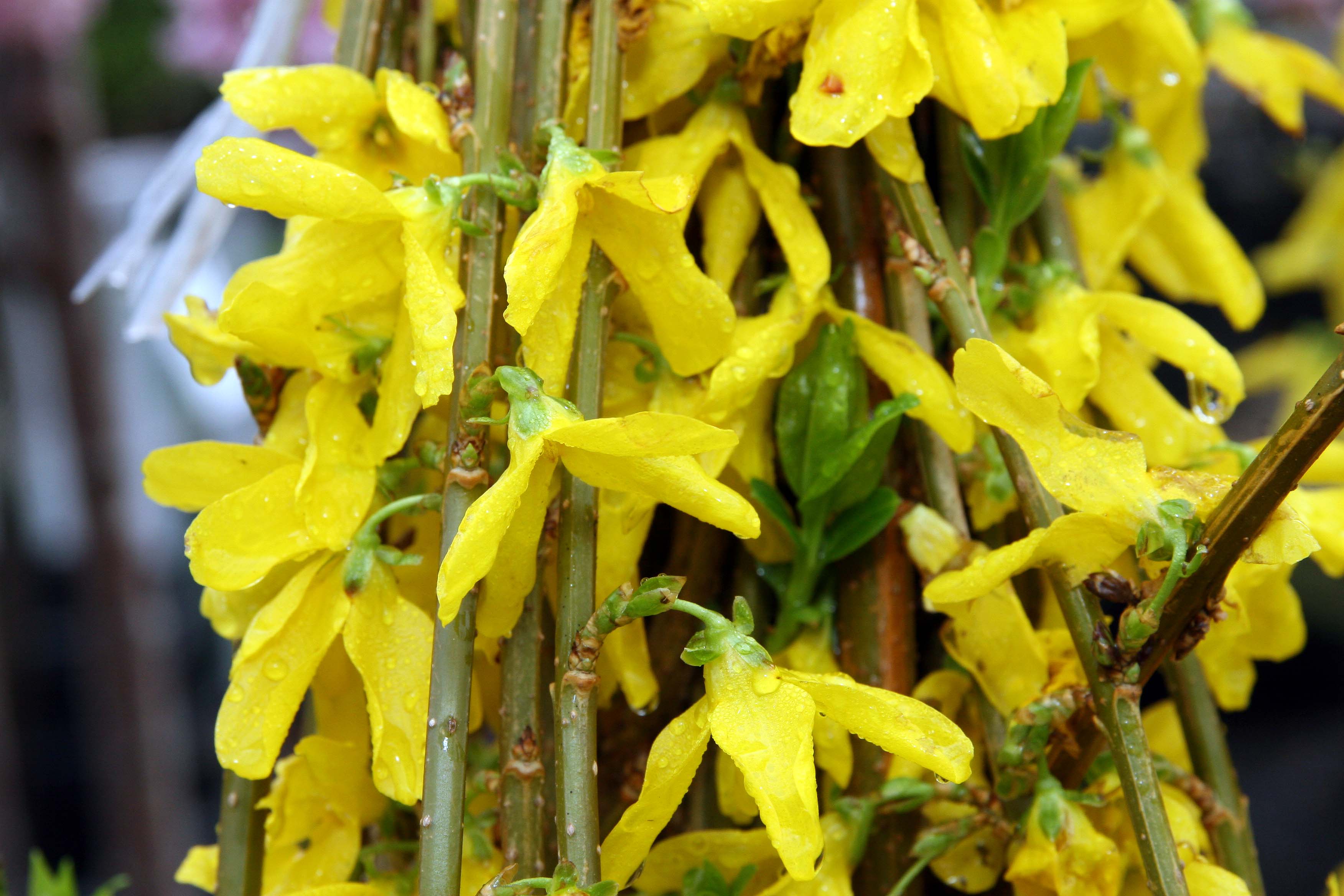
Hybrid flowering plant in the olive family Oleaceae
Forsythia × intermedia, or border forsythia, is an ornamental deciduous shrub of garden origin.
Description
The shrub has an upright habit with arching branches and grows to 3 to 4 metres high. The opposite leaves turn yellowish or occasionally purplish in the autumn before falling. The bright yellow flowers are produced on one- to two-year-old growth and may be solitary or in racemes from 2 to 6.
Origin
The hybrid is thought to be a cross between Forsythia viridissima and F. suspensa var. fortunei. Zabel formally described and named the hybrid in Gartenflora in 1885. It was introduced to the Arnold Arboretum in the United States in 1889.
Cultivation
The hybrid is best suited to a position in full sun or partial shade and is drought-tolerant. Like some other forsythias it is one of the earliest shrubs to flower. Well adapted to temperature changes, it blooms with bright yellow flowers that are noticeable even in twilight. It is one of several forsythia species that are widely cultivated in gardens and parks.
Cultivars
Cultivars include (those marked have gained the Royal Horticultural Society's Award of Garden Merit):
- 'Arnold Dwarf' – low-growing with pale yellow flowers
- 'Beatrix Farrand' – a particularly floriferous cultivar
- 'Gold Tide' ('Courtasol') – floriferous, with deep yellow autumn colour
- 'Karl Sax' – deep yellow flowers with orange lines in the throat. Introduced by the Arnold Arboretum in 1960.
- 'Lynwood' – large flowers with broad petals
- 'Lynwood Variety'{{cite web
- 'Spectabilis'
- 'Spring Glory' – purple-tinged foliage in autumn
- 'Variegata' – leaves with contrasting cream edges
- ='Courtalyn'{{cite web | url = https://www.rhs.org.uk/Plants/101339/i-Forsythia-i-×-i-intermedia-i-Font-Face-times-New-Roman-Week-End-FONT-Courtalyn-sup-(PBR)-sup/Details
Chemistry
The first dirigent protein was discovered in Forsythia intermedia. This protein has been found to direct the stereoselective biosynthesis of (+)-pinoresinol from coniferyl alcohol monomers.
-Pinoresinol_Biosynthesis.svg)
References
References
- Dirr, Michael A.. (1997). "Dirr's Hardy Trees and Shrubs - An Illustrated Encyclopedia". Timber Press.
- Rowell, Raymond J.. (1980). "Ornamental Flowering Trees in Australia". AH & AW Reed Pty Ltd..
- "''Forsythia x intermedia''". NC State University.
- "''Forsythia x intermedia''". INRA Centre d'Angers.
- {{GRIN
- (July 2017). "AGM Plants - Ornamental". Royal Horticultural Society.
- (1997). "Stereoselective bimolecular phenoxy radical coupling by an auxiliary (dirigent) protein without an active center". Science.
This article was imported from Wikipedia and is available under the Creative Commons Attribution-ShareAlike 4.0 License. Content has been adapted to SurfDoc format. Original contributors can be found on the article history page.
Ask Mako anything about Forsythia × intermedia — get instant answers, deeper analysis, and related topics.
Research with MakoFree with your Surf account
Create a free account to save articles, ask Mako questions, and organize your research.
Sign up freeThis content may have been generated or modified by AI. CloudSurf Software LLC is not responsible for the accuracy, completeness, or reliability of AI-generated content. Always verify important information from primary sources.
Report