From Surf Wiki (app.surf) — the open knowledge base
Erlenmeyer–Plöchl azlactone and amino-acid synthesis
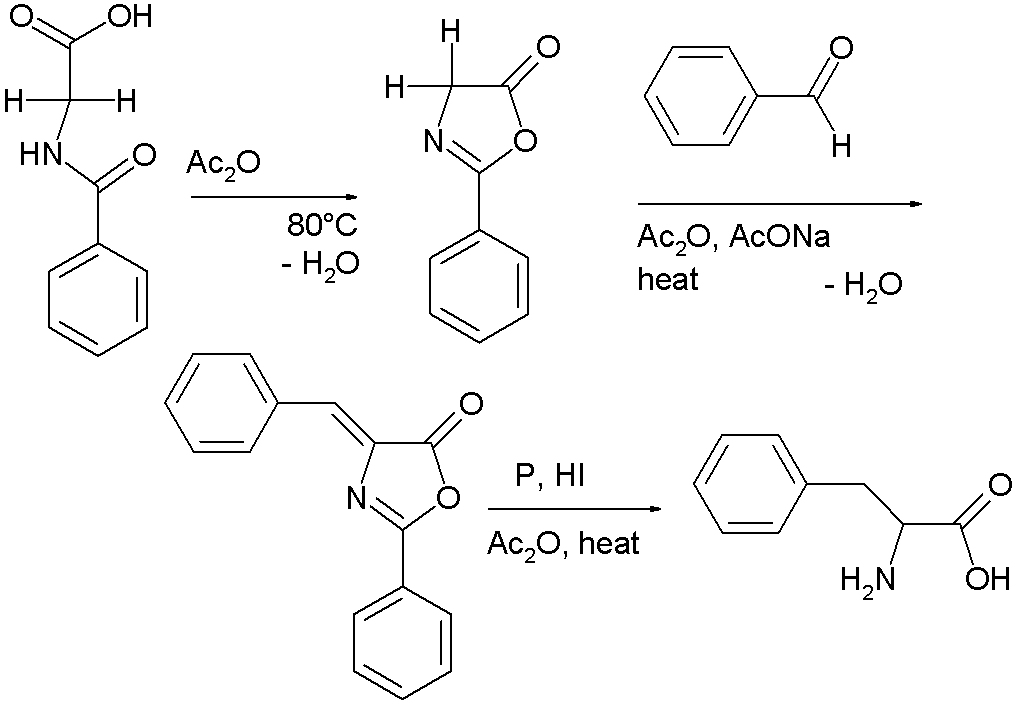
The Erlenmeyer–Plöchl azlactone and amino acid synthesis, named after Friedrich Gustav Carl Emil Erlenmeyer who partly discovered the reaction, is a series of chemical reactions which transform an N-acyl glycine to various other amino acids via an oxazolone (also known as an azlactone).{{cite journal |trans-title= On some derivatives of benzoyl-imido-cinnaminic acid |trans-title= On the condensation of hippuric acid with phthalic acid anhydride and with benzaldehyde
Hippuric acid, the benzamide derivative of glycine, cyclizes in the presence of acetic anhydride, condensing to give 2-phenyl-oxazolone. This intermediate also has two acidic protons and reacts with benzaldehyde, acetic anhydride and sodium acetate to a so-called azlactone. This compound on reduction gives access to phenylalanine.
Variations
Variants of the azlactone synthesis in which analogues of azlactones are used are sometimes advantageous. Hydantoin (in Bergmann modification), thiohydantoin and rhodanine have each been employed as the enolate-forming component of the condensation. 2,5-Diketopiperazine can be used as a methylene component as well; its condensation products with aromatic aldehydes, on reduction and hydrolysis give the corresponding amino acids.
Scope
In one study the Erlenmeyer amino acid synthesis was used in the heart of an L-m-tyrosine synthesis

References
References
- G. E. VandenBerg, J. B. Harrison, H. E. Carter, B. J. Magerlein. (1973). "2-Phenyl-2-oxazolone".
- H. B. Gillespie, H. R. Snyder. (1934). "dl-β-Phenylalanine".
- Alfred Hassner, Irishi Namboothiri. (2011). "Organic Syntheses Based on Name Reactions: A Practical Guide to 750 Transformations". Elsevier.
- Richard O.C. Norman, James M. Coxon. (1993). "Principles of Organic Synthesis". CRC Press.
- H.D. Dakin. Aromatic aldehyde derivatives of proteins, peptides and amino acids. J. Biol. Chem. 1929, 84:675-682
- Alan D. Borthwick. 2,5-Diketopiperazines: Synthesis, Reactions, Medicinal Chemistry, and Bioactive Natural Products. DrugMolDesign, 15 Temple Grove, London NW11 7UA, U.K. Chem. Rev., 2012, 112 (7), pp 3641–3716. DOI: 10.1021/cr200398y
- A. M. Asiri. New Conjugated Systems Derived from Piperazine-2,5-dione. Molecules 2000, 5, 629-636
- Cara E. Humphrey, Markus Furegati, Kurt Laumen, Luigi La Vecchia, Thomas Leutert, J. Constanze D. Müller-Hartwieg, and Markus Vögtle. (2007). "Optimized Synthesis of L-''m''-Tyrosine Suitable for Chemical Scale-Up". Organic Process Research & Development.
- The [[benzyl ether]] of [[3-hydroxybenzaldehyde]] '''1''' reacts with the N-acetyl [[amide]] of [[glycine]] '''2''', [[acetic anhydride]] and [[sodium acetate]] to the azlactone (not displayed) which is ring-opened with sodium acetate in methanol to dehydroamino acid '''3'''. [[Hydrogenation]] gives the N-acyl-m-tyrosine methyl ester '''4''' (the benzyl ether group is also cleaved). This compound is [[racemic]] and [[kinetic resolution]] is brought about by an [[enzyme]] which is able to only cleave the methyl ester of the S-enantiomer (forming (''S'')-'''5''' soluble in [[dichloromethane]]) leaving water-soluble (''R'')-'''4''' untouched. The final step is amide cleavage to (''S'')-L-''m''-tyrosine '''6'''
This article was imported from Wikipedia and is available under the Creative Commons Attribution-ShareAlike 4.0 License. Content has been adapted to SurfDoc format. Original contributors can be found on the article history page.
Ask Mako anything about Erlenmeyer–Plöchl azlactone and amino-acid synthesis — get instant answers, deeper analysis, and related topics.
Research with MakoFree with your Surf account
Create a free account to save articles, ask Mako questions, and organize your research.
Sign up freeThis content may have been generated or modified by AI. CloudSurf Software LLC is not responsible for the accuracy, completeness, or reliability of AI-generated content. Always verify important information from primary sources.
Report