From Surf Wiki (app.surf) — the open knowledge base
Du Noüy ring method
Method of measuring a liquid's surface tension
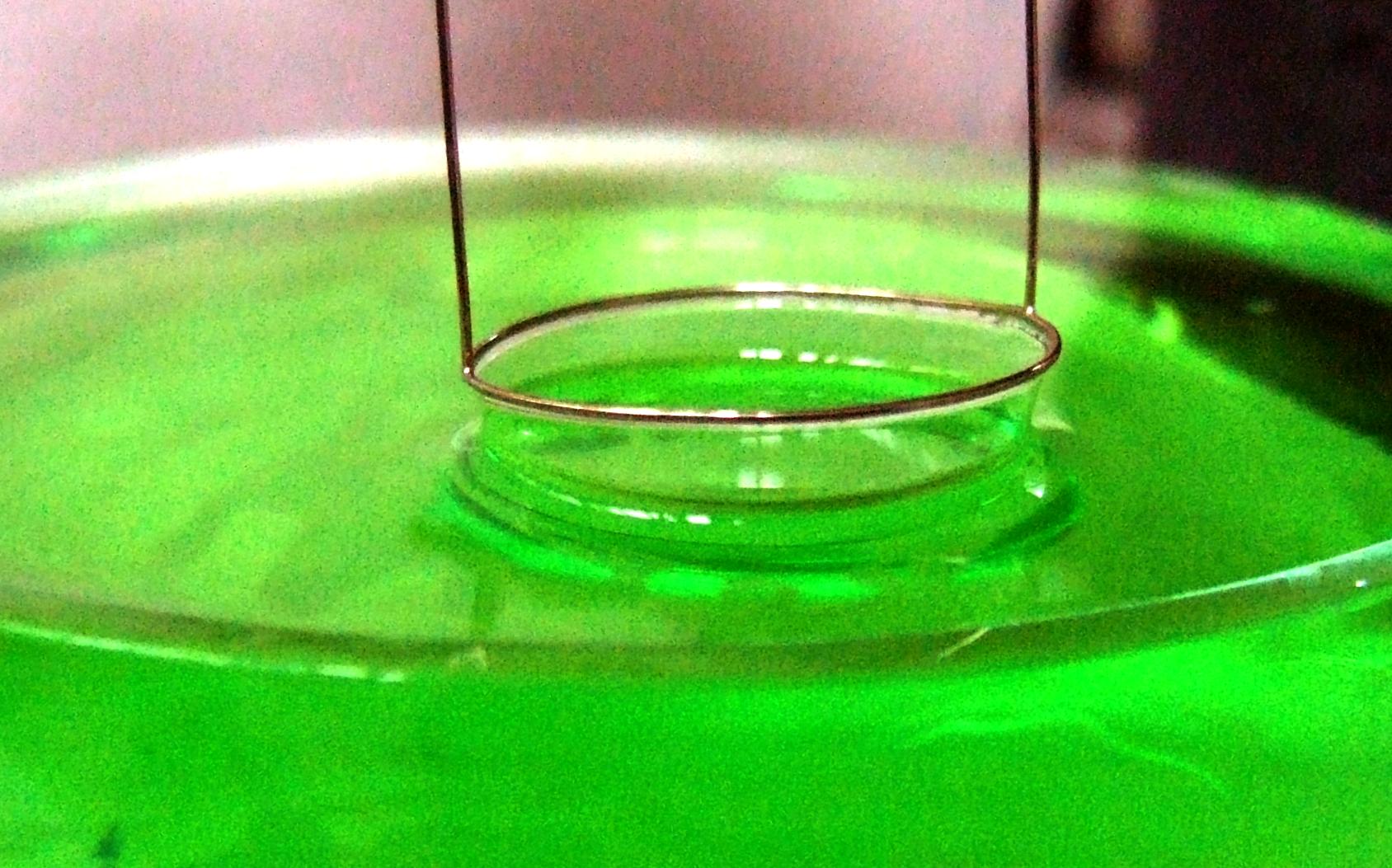
Method of measuring a liquid's surface tension
Description
The method involves slowly lifting a ring, often made of platinum, from the surface of a liquid. The force, F, required to raise the ring from the liquid's surface is measured and related to the liquid's surface tension γ:
: F = w_\text{ring} + 2\pi \cdot (r_\text{i} + r_\text{a}) \cdot \gamma,
where r is the radius of the inner ring of the liquid film pulled, and r is the radius of the outer ring of the liquid film. w is the weight of the ring minus the buoyant force due to the part of the ring below the liquid surface.
When the ring's thickness is much smaller than its diameter, this equation can be simplified to
: F = w_\text{ring} + 4\pi R \gamma,
where R is the average of the inner and outer radius of the ring, i.e. (r_\text{i} + r_\text{a})/2.
The maximum force is used for the calculations, and empirically determined correction factors are required to remove the effect caused by the finite diameter of the ring:
: F = w_\text{ring} + 4\pi R \gamma f,
with f being the correction factor.
Correction factors

The most common correction factors include Zuidema–Waters correction factors (for liquids with low interfacial tension), Huh–Mason correction factors (which cover a wider range than Zuidema–Waters), and Harkins–Jordan correction factors (more precise than Huh–Mason, while still covering the most widely used liquids).
The surface tension and correction factors are expressed by
: \gamma = \frac{F}{4 \pi R} f,
where γ is surface tension, R is the average radius of the ring, and f is correction factor.
Zuidema–Waters correction factors
H. H. Zuidema and George W. Waters introduced the following correction factor in 1961: : (f - a)^2 = \frac{4b}{\pi ^2} \frac{1}{R^2} \frac{\gamma_\text{measured}}{\rho_\text{lower} - \rho_\text{upper}} + C, where : F = maximum pull of rings [dyn/cm], : ρ = density of the lower and upper phases, : C = 0.04534 - 1.679 \frac{r}{R}, : , : [s2⋅cm−1], : r = Du Noüy wire radius, : R = Du Noüy ring radius.
Huh–Mason correction factors
C. Huh and S. G. Mason described the correction factors as a function of \tfrac{R}{r} and \tfrac{R^3}{V}. See the references.
Harkins–Jordan correction factors
William Draper Harkins and Hubert F. Jordan tabulated the correction factors as a function of R/r and R^3/V.
References
References
- du Noüy, Pierre Lecomte. (1925). "An Interfacial Tensiometer for Universal Use". The Journal of General Physiology.
- (October 2023). "Physics and Chemistry of Interfaces".
- (1941-05-01). "Ring Method for the Determination of Interfacial Tension". Industrial & Engineering Chemistry Analytical Edition.
- "Total Weight of Ring using Ring-Detachment Method Calculator {{!}} Calculate Total Weight of Ring using Ring-Detachment Method".
- Udeagbara, Stephen Gekwu. (2010-07-30). "Effect of Temperature and Impurities on Surface Tension of Crude Oil". Universal-Publishers.
- (1975-07-01). "A rigorous theory of ring tensiometry". Colloid and Polymer Science.
- (1977-05-01). "A rigorous theory of ring tensiometry: Addendum on the wall effect". Colloid and Polymer Science.
- (1930-05-01). "A Method for the Determination of Surface and Interfacial Tension from the Maximum Pull on a Ring". Journal of the American Chemical Society.
- (1930-07-18). "Surface Tension by the Ring Method". Science.
This article was imported from Wikipedia and is available under the Creative Commons Attribution-ShareAlike 4.0 License. Content has been adapted to SurfDoc format. Original contributors can be found on the article history page.
Ask Mako anything about Du Noüy ring method — get instant answers, deeper analysis, and related topics.
Research with MakoFree with your Surf account
Create a free account to save articles, ask Mako questions, and organize your research.
Sign up freeThis content may have been generated or modified by AI. CloudSurf Software LLC is not responsible for the accuracy, completeness, or reliability of AI-generated content. Always verify important information from primary sources.
Report