From Surf Wiki (app.surf) — the open knowledge base
Draghi government
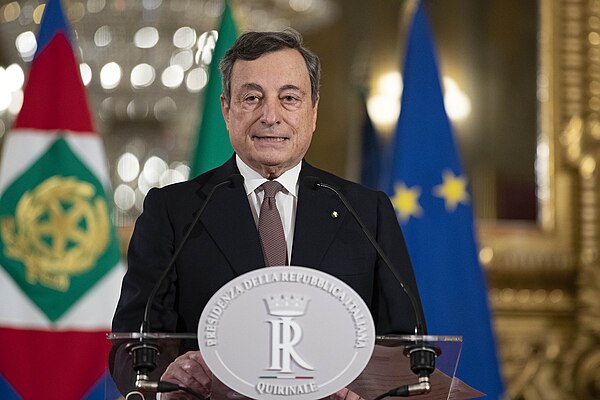
The Draghi government was the 67th government of the Italian Republic, led by former President of the European Central Bank, Mario Draghi. It was in office between 13 February 2021 and 22 October 2022.
Draghi government
The Draghi government was the 67th government of the Italian Republic, led by former President of the European Central Bank, Mario Draghi. It was in office between 13 February 2021 and 22 October 2022.
The Draghi government was the 67th government of the Italian Republic, led by former President of the European Central Bank, Mario Draghi. It was in office between 13 February 2021 and 22 October 2022.
The Draghi government was formed following the resignation of Prime Minister Giuseppe Conte in the midst of a political crisis which led to the Conte government losing its majority. After consultations with political parties, President Sergio Mattarella tasked Draghi with forming a "high-profile" government. Mattarella stated that the new government would have to face the health, economic and social crises related to the COVID-19 pandemic, as well as overseeing the EU relief fund associated with it. The Draghi government was described as a national unity government by numerous news sources. The choice by Mattarella to appoint Draghi as Prime Minister was welcomed by some international observers, with others casting doubt on the stability of a new technocratic government.
The Draghi Government was formed with both politicians and independent technocrats, and was supported by a large majority of the Italian Parliament, including the anti-establishment Five Star Movement (M5S), the right-wing League (Lega), the centre-right Forza Italia (FI), the centre-left Democratic Party (PD), the centrist Italia Viva (IV), and the leftist Article One (Art.1).
On 21 July 2022, following M5S, Lega and FI's withdrawal of their support to the government, Prime Minister Draghi submitted his resignation. The government continued to operate as a caretaker government until the next government formation following the 2022 Italian general election on 25 September.
At the time of the government formation, its ministers were part of the following parties.
| Party | Main ideology | Leader | |
|---|---|---|---|
| Five Star Movement (M5S) | Populism | Giuseppe Conte | |
| League (Lega) | Right-wing populism | Matteo Salvini | |
| Democratic Party (PD) | Social democracy | Enrico Letta | |
| Forza Italia (FI) | Liberal conservatism | Silvio Berlusconi | |
| Italia Viva (IV) | Liberalism | Matteo Renzi | |
| Article One (Art.1) | Social democracy | Roberto Speranza |
After 1 August 2022 the government was composed of the following parties.
| Party | Main ideology | Leader | |
|---|---|---|---|
| League (Lega) | Right-wing populism | Matteo Salvini | |
| Democratic Party (PD) | Social democracy | Enrico Letta | |
| Five Star Movement (M5S) | Populism | Giuseppe Conte | |
| Action (A) | Liberalism | Carlo Calenda | |
| Together for the Future (IpF) | Reformism | Luigi Di Maio | |
| Italia Viva (IV) | Liberalism | Matteo Renzi | |
| Article One (Art.1) | Social democracy | Roberto Speranza | |
| Environment 2050 (A2050) | Environmentalism | Federico D'Incà |
On 21 June 2022, Luigi Di Maio led a breakaway group outside of the M5S and formed Together for the Future, which confirmed its support for the government. Mariastella Gelmini, Renato Brunetta and Mara Carfagna left FI on 21, 22 and 26 July, respectively. On 29 July, Gelmini and Carfagna joined Action. On 30 July, Federico D'Incà left the M5S, and on 1 August he founded Environment 2050 alongside deputy Davide Crippa.
On 13 January 2021, Italia Viva (IV) withdrew its support for the second Conte government, triggering a political crisis. Conte subsequently won confidence motions in both houses of Parliament, with the abstention of IV, but could only reach a plurality in the Senate, rather than an absolute majority. In the wake of this, Conte tendered his resignation to President Mattarella, who then began a round of discussions with various parties to form a new government.
Mattarella met with delegations of political parties on 28 and 29 January to determine their views on the formation of a new government. The Five Star Movement (M5S), Democratic Party (PD), Free and Equal (LeU), For the Autonomies, Europeanists, and some members of the Mixed Group all expressed support for the reappointment of Conte as Prime Minister, but IV ruled this out. The centre-right and right-wing parties, the League (Lega), Forza Italia (FI) and the Brothers of Italy (FdI), stated that they preferred a snap election, but would be willing to join a national unity government under certain conditions. Following this deadlock, Mattarella asked Roberto Fico, the President of the Chamber of Deputies, to explore the possibility of a grand coalition government. On 2 February, Fico confirmed that there was insufficient support for the proposal.
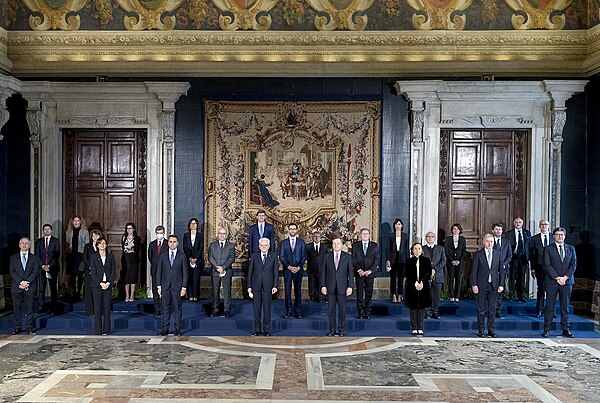
With the prospect of early elections looming, on 3 February Mattarella invited former ECB President Mario Draghi to the Quirinal Palace to charge him to forming a national unity government. Draghi accepted the offer, and began consultations with the leaders of political parties. Conte publicly endorsed him as his successor the following day, and further negotiations commenced. On 10 February, League leader Matteo Salvini and FI leader Silvio Berlusconi jointly announced their support for Draghi. Conversely, FdI leader Giorgia Meloni stated that her party would go into opposition. The PD's national board unanimously voted on 11 February to support Draghi. The same day, the M5S held an online referendum on whether to "support a technical-political government with the other political forces indicated by the appointed prime minister Mario Draghi", which was approved by 59.3%.
Having achieved sufficient support, on 12 February Draghi met with President Mattarella at the Quirinal Palace and presented his list of ministers. The Draghi government was sworn in on the following day, 13 February, at 11:00 AM UTC. The government was composed of twenty-four ministers, eight women and sixteen men, most of them from Northern Italy, largely from Lombardy and Veneto; it contained representatives from all supportive political parties, as well as numerous independent technocrats.
On 17 February 2021, the Senate approved the Draghi government with 262 votes in favour, 40 against and 2 abstentions. The following day, the Chamber of Deputies affirmed its support, with 535 votes in favour, 56 against and 5 abstentions. This was the third largest majority garnered by a government in the history of the Italian Republic after the Monti government and after the fourth Andreotti government.
| 17–18 February 2021Investiture votes for Draghi Cabinet | |||
|---|---|---|---|
| House of Parliament | Vote | Parties | Votes |
| Senate of the Republic(Voting: 302 of 321,Majority: 152) | |||
| N No | FdI (19), M5S (15), LeU / Italian Left (2), Others (4) | 40 / 302 | |
| Abstention | Aut (1), Others (1) | 2 / 321 | |
| Chamber of Deputies(Voting: 591 of 630,Majority: 296) | |||
| N No | FdI (31), M5S (16), Lega (1), LeU / Italian Left (1), Others (7) | 56 / 591 | |
| Abstention | M5S (5) | 5 / 630 |
In July 2022, the M5S did not participate to a confidence vote in the Senate on a government bill, the so-called decreto aiuti, regarding a €27 billion economic aid to counteract the energy and economy crisis. Prime Minister Draghi offered his resignation, which was rejected by President Mattarella. After a few days, on 20 July, Draghi spoke to the Senate again, seeking a confidence vote again to secure the government majority supporting his cabinet, while rejecting the proposal put forward by Lega and FI on a new government without the M5S. In that occasion, the M5S, Lega and FI, three major parties which were supporting the Draghi government, withdrew their support. Consequently, Draghi tendered his final resignation to President Mattarella, who dissolved the houses of Parliament, leading to an early election in September 2022, and asked Draghi to stay in office to handle current affairs (as is customary in Italian politics) until a new government could be formed following the upcoming general election.
| Column 1 | Column 2 |
|---|---|
| Independents | 9 |
| Five Star Movement | 4 |
| League | 3 |
| Democratic Party | 3 |
| Forza Italia | 3 |
| Italia Viva | 1 |
| Article One | 1 |
- Independents: Prime minister, 8 ministers, 3 undersecretaries
- Five Star Movement (M5S): 4 ministers, 2 deputy ministers, 9 undersecretaries
- League (Lega): 3 ministers, 1 deputy minister, 8 undersecretaries
- Democratic Party (PD): 3 ministers, 1 deputy minister, 5 undersecretaries
- Forza Italia (FI): 3 ministers, 1 deputy minister, 5 undersecretaries
- Italia Viva (IV): 1 minister, 1 deputy minister, 1 undersecretary
- Article One (Art.1): 1 minister, 1 undersecretary
- Democratic Centre (CD): 1 undersecretary
- Us with Italy (NcI): 1 undersecretary
- More Europe (+E): 1 undersecretary
| Column 1 | Column 2 |
|---|---|
| Independents | 10 |
| League | 3 |
| Democratic Party | 3 |
| Five Star Movement | 2 |
| Action | 2 |
| Together for the Future | 1 |
| Italia Viva | 1 |
| Article One | 1 |
| Environment 2050 | 1 |
- Independents: Prime minister, 9 ministers, 2 undersecretaries
- League (Lega): 3 ministers, 1 deputy minister, 8 undersecretaries
- Democratic Party (PD): 3 ministers, 1 deputy minister, 5 undersecretaries
- Five Star Movement (M5S): 2 ministers, 1 deputy minister, 5 undersecretaries
- Action (A): 2 ministers
- Together for the Future (IpF): 1 minister, 1 deputy minister, 4 undersecretaries
- Italia Viva (IV): 1 minister, 1 deputy minister, 1 undersecretary
- Article One (Art.1): 1 minister, 1 undersecretary
- Environment 2050 (A2050): 1 minister
- Forza Italia (FI): 1 deputy minister, 6 undersecretaries
- Democratic Centre (CD): 1 undersecretary
- Us with Italy (NcI): 1 undersecretary
- More Europe (+E): 1 undersecretary

- Northern Italy: 18 ministers
- Lombardy: 9 ministers
- Veneto: 4 ministers
- Emilia-Romagna: 2 ministers
- Friuli-Venezia Giulia: 1 minister
- Liguria: 1 minister
- Piedmont: 1 minister
- Central Italy: 2 ministers (including Draghi)
- Lazio: 2 ministers (including Draghi)
- Southern and Insular Italy: 4 ministers
- Basilicata: 2 ministers
- Campania: 2 ministers
The Council of Ministers is composed of the following members:
| Office | Name | Party | Term |
|---|---|---|---|
| Prime Minister | |||
| Minister of Foreign Affairs | |||
| Minister of the Interior | |||
| Minister of Justice | |||
| Minister of Defence | |||
| Minister of Economy and Finance | |||
| Minister of Economic Development | |||
| Minister of Agricultural, Food and Forestry Policies | |||
| Minister for the Ecological Transition | |||
| Minister of Sustainable Infrastructure and Mobility | |||
| Minister of Labour and Social Policies | |||
| Minister of Education | |||
| Minister of University and Research | |||
| Minister of Culture | |||
| Minister of Health | |||
| Minister of Tourism | |||
| Minister for Parliamentary Relations | |||
| Minister of Public Administration | |||
| Minister of Regional Affairs and Autonomies | |||
| Minister for the South and Territorial Cohesion | |||
| Minister for Equal Opportunities and Family | |||
| Minister for Youth Policies | |||
| Minister for Technological Innovation and Digital Transition | |||
| Minister for Disabilities | |||
| Secretary of the Council of Ministers |
| Office | Portrait | Name | Term of office | Party |
|---|---|---|---|---|
| Prime Minister | ||||
| Undersecretaries | ||||
| Vincenzo Amendola (PD) – Delegated to European Affairs | ||||
| Franco Gabrielli (Ind.) – Delegated to the Authority for the Security of the Republic | ||||
| Giuseppe Moles (FI) – Delegated to Information and Publishing | ||||
| Bruno Tabacci (CD) – Delegated to the Coordination of Economic Policy and to Space | ||||
| Valentina Vezzali (FI) – Delegated to Sport (since 16 March 2021) | ||||
| Minister of Foreign Affairs | ||||
| Deputy Minister | ||||
| Marina Sereni (PD) |
Undersecretaries Benedetto Della Vedova (+E) Manlio Di Stefano (IpF) | | | | | | Minister of the Interior | | | | | | Undersecretaries Nicola Molteni (Lega) Ivan Scalfarotto (IV) Carlo Sibilia (M5S) | | | | | | Minister of Justice | | | | | | Undersecretaries Anna Macina (IpF) Francesco Paolo Sisto (FI) | | | | | | Minister of Defence | | | | | | Undersecretaries Giorgio Mulè (FI) Stefania Pucciarelli (Lega) | | | | | | Minister of Economy and Finance | | | | | | Deputy Minister Laura Castelli (IpF)
Undersecretaries Claudio Durigon (Lega) (until 2 September 2021) Maria Cecilia Guerra (Art.1) Alessandra Sartore (PD) Federico Freni (Ind.) (from 28 September 2021) | | | | | | Minister of Economic Development | | | | | | Deputy Ministers Gilberto Pichetto Fratin (FI) Alessandra Todde (M5S)
Undersecretary Anna Ascani (PD) | | | | | | Minister of Agricultural, Food and Forestry Policies | | | | | | Undersecretaries Francesco Battistoni (FI) Gian Marco Centinaio (Lega) | | | | | | Minister for the Ecological Transition | | | | | | Undersecretaries Ilaria Fontana (M5S) Vannia Gava (Lega) | | | | | | Minister of Infrastructure and Sustainable Mobility | | | | | | Deputy Ministers Teresa Bellanova (IV) Alessandro Morelli (Lega)
Undersecretary Giancarlo Cancelleri (M5S) | | | | | | Minister of Labour and Social Policies | | | | | | Undersecretaries Rossella Accoto (M5S) Tiziana Nisini (Lega) | | | | | | Minister of Education | | | | | | Undersecretaries Barbara Floridia (M5S) Rossano Sasso (Lega) | | | | | | Minister of University and Research | | | | | | Minister of Culture | | | | | | Undersecretary Lucia Borgonzoni (Lega) | | | | | | Minister of Health | | | | | | Undersecretaries Andrea Costa (NcI) Pierpaolo Sileri (IpF) | | | | | | Minister of Tourism | | | | | | | | | | | | Minister for Parliamentary Relations(without portfolio) | | | | | | Undersecretaries Deborah Bergamini (FI) Simona Malpezzi (PD) (until 25 March 2021) Caterina Bini (PD) (since 31 March 2021) | | | | | | Minister of Public Administration(without portfolio) | | | | | | Minister of Regional Affairs and Autonomies(without portfolio) | | | | | | Minister for the South and Territorial Cohesion(without portfolio) | | | | | | Undersecretary Dalila Nesci (IpF) | | | | | | Minister for Family and Equal Opportunities(without portfolio) | | | | | | Minister for Youth Policies(without portfolio) | | | | | | Minister for Technological Innovation and Digital Transition(without portfolio) | | | | | | Undersecretary Assuntela Messina (PD) | | | | | | Minister for Disabilities(without portfolio) | | | | | | | | | | | | Secretary of the Council of Ministers | | | | |
This article is sourced from Wikipedia and is licensed under CC BY-SA 4.0. Source: https://en.wikipedia.org/wiki/Draghi_government
Ask Mako anything about Draghi government — get instant answers, deeper analysis, and related topics.
Research with MakoFree with your Surf account
Create a free account to save articles, ask Mako questions, and organize your research.
Sign up freeThis content may have been generated or modified by AI. CloudSurf Software LLC is not responsible for the accuracy, completeness, or reliability of AI-generated content. Always verify important information from primary sources.
Report