From Surf Wiki (app.surf) — the open knowledge base
Counting rods
Small bars used for calculating in ancient East Asia
Summary
Small bars used for calculating in ancient East Asia
Field
Value
t
算籌
s
算筹
p
suànchóu
mi
su̯än⁵¹ ʈ͡ʂʰoʊ̯³⁵
c2
算子
p2
suànzǐ
mi2
su̯än⁵¹ t͡sz̩²¹⁴⁻²¹⁽⁴⁾
kanji
算木 / 算籌
hiragana
さんぎ / さんちゅう
romaji
sangi / sanchū
hangul
산가지 / 산목
hanja
算가지 / 算木
rr
sangaji / sanmok
qn
que tính / toán trù
hn
𣠗併 / 算籌
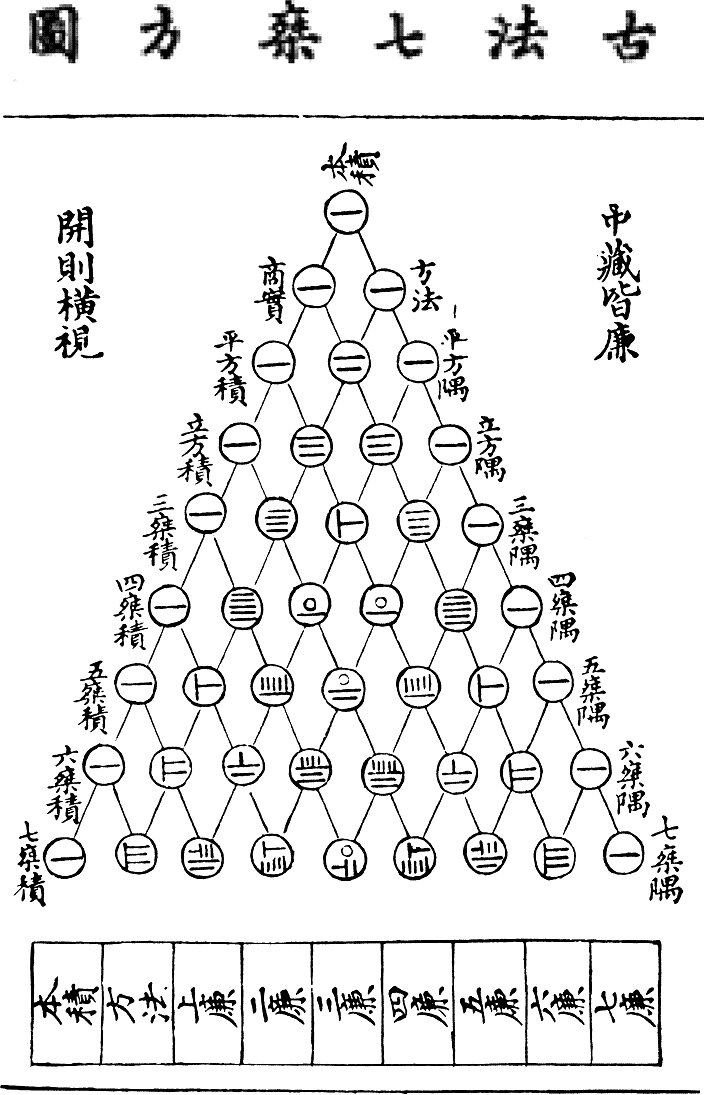
triangle]], as depicted by [[Zhu Shijie]] in 1303, using rod numerals]]'''Counting rods''' (筭) are small bars, typically 3–14 cm (1" to 6") long, that were used by mathematicians for calculation in ancient [[East Asia]]. They are placed either horizontally or vertically to represent any [[integer]] or [[rational number]].
The written forms based on them are called rod numerals. They are a true positional numeral system with digits for 1–9 and a blank for 0, from the Warring states period (circa 475 BCE) to the 16th century.
History
Chinese arithmeticians used counting rods for well over two thousand years ago.
In 1954, forty-odd counting rods of the Warring States period (5th century BCE to 221 BCE) were found in Zuǒjiāgōngshān (左家公山) Chu Grave No.15 in Changsha, Hunan.
In 1973, archeologists unearthed a number of wood scripts from a tomb in Hubei dating from the period of the Han dynasty (206 BCE to 220 CE). On one of the wooden scripts was written: "当利二月定算𝍥". This is one of the earliest examples of using counting-rod numerals in writing.
A square lacquer box, dating from c. 168 BCE, containing a square chess board with the TLV patterns, chessmen, counting rods, and other items, was excavated in 1972, from Mawangdui M3, Changsha, Hunan Province.
In 1976, a bundle of Western Han-era (202 BCE to 9 CE) counting rods made of bones was unearthed from Qianyang County in Shaanxi. The use of counting rods must predate it; Sunzi ( 544 to 496 BCE), a military strategist at the end of Spring and Autumn period of 771 BCE to 5th century BCE, mentions their use to make calculations to win wars before going into the battle; Laozi (died 531 BCE), writing in the Warring States period, said "a good calculator doesn't use counting rods". The Book of Han (finished 111 CE) recorded: "they calculate with bamboo, diameter one fen, length six cun, arranged into a hexagonal bundle of two hundred seventy one pieces".
At first, calculating rods were round in cross-section, but by the time of the Sui dynasty (581 to 618 CE) mathematicians used triangular rods to represent positive numbers and rectangular rods for negative numbers.
Toán trù 算籌 (counting rods) in a Vietnamese mathematics textbook, Cửu chương lập thành toán pháp 九章立成算法 is shown at the bottom of the page.
After the abacus flourished, counting rods were abandoned except in Japan, where rod numerals developed into a symbolic notation for algebra.
Using counting rods
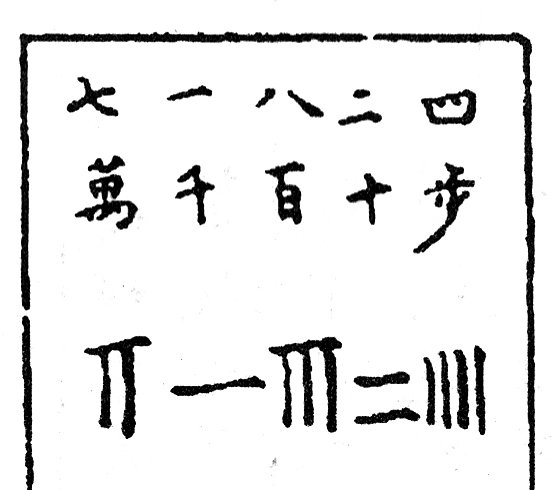
Rod numeral place value from [[Yongle Encyclopedia]]: 71,824
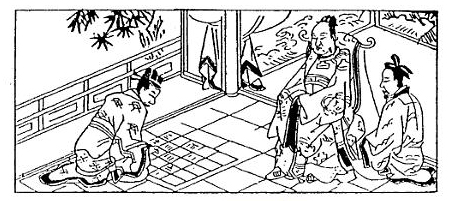
Japanese counting board with grids
A checker counting board diagram in an 18th-century Japanese mathematics textbook
Counting rod numerals in grids in a Japanese mathematic book
Counting rods represent digits by the number of rods, and the perpendicular rod represents five. To avoid confusion, vertical and horizontal forms are alternately used. Generally, vertical rod numbers are used for the position for the units, hundreds, ten thousands, etc., while horizontal rod numbers are used for the tens, thousands, hundred thousands etc. It is written in Sunzi Suanjing that "one is vertical, ten is horizontal".
Red rods represent positive numbers and black rods represent negative numbers. Ancient Chinese clearly understood negative numbers and zero (leaving a blank space for it), though they had no symbol for the latter. The Nine Chapters on the Mathematical Art, which was mainly composed in the first century CE, stated "(when using subtraction) subtract same signed numbers, add different signed numbers, subtract a positive number from zero to make a negative number, and subtract a negative number from zero to make a positive number".{{ Citation
This alternation of vertical and horizontal rod numeral form is very important to understanding written transcription of rod numerals on manuscripts correctly. For instance, in Licheng suanjin, 81 was transcribed as [[File:Counting rod h8.png]][[File:Counting rod v1.png]], and 108 was transcribed as [[File:Counting rod v1.png]][[File:Counting rod v8.png]]; it is clear that the latter clearly had a blank zero on the "counting board" (i.e., floor or mat), even though on the written transcription, there was no blank. In the same manuscript, 405 was transcribed as [[File:Counting rod v4.png]][[File:Counting rod v5.png]], with a blank space in between for obvious reasons, and could in no way be interpreted as "45"[[File:Counting rod h4.png]][[File:Counting rod v5.png]]. In other words, transcribed rod numerals may not be positional, but on the counting board, they are positional. [[File:Counting rod v4.png]][[File:Counting rod v5.png]] is an exact image of the counting rod number 405 on a table top or floor.
Place value
The value of a number depends on its physical position on the counting board. A 9 at the rightmost position on the board stands for 9. Moving the batch of rods representing 9 to the left one position (i.e., to the tens place) gives 9[] or 90. Shifting left again to the third position (to the hundreds place) gives 9[][] or 900. Each time one shifts a number one position to the left, it is multiplied by 10. Each time one shifts a number one position to the right, it is divided by 10. This applies to single-digit numbers or multiple-digit numbers.
Song dynasty mathematician Jia Xian used hand-written Chinese decimal orders 步十百千萬 as rod numeral place values, as evident from a facsimile from a page of Yongle Encyclopedia. He arranged 七萬一千八百二十四 as
This content may have been generated or modified by AI. CloudSurf Software LLC is not responsible for the accuracy, completeness, or reliability of AI-generated content. Always verify important information from primary sources.