From Surf Wiki (app.surf) — the open knowledge base
China–Russia relations

China and Russia share one of the world's most important foreign relationships. Both nations share interest in energy cooperation, military ties, and geopolitical alignment in challenging the West and the United States.
Relations between China and Russia go back to the 16th century. Though initially allies during the Cold War, China and the Soviet Union were rivals after the Sino-Soviet split in 1961. After the dissolution of the Soviet Union in 1991, China and Russia established diplomatic relations, with the relationship strengthening significantly afterwards. The two countries share a land border which was demarcated in 1991, and they signed the Treaty of Good-Neighborliness and Friendly Cooperation in 2001. Ties grew closer following international sanctions against Russia for its 2014 annexation of Crimea, which led Russia to pursue a pivot to China; in that year, China and Russia signed a 30-year gas deal worth $400 billion. Ties have continued to deepen since the start of the Russo-Ukrainian war in 2022, with Russia increasingly becoming dependent on China while it is under large-scale international sanctions. China and Russia have significant economic ties, and Russia is an important source of natural energy and oil for China. China is Russia's largest trading partner. The annual trade between China and Russia was $234 billion as of 2025.
China and Russia have enjoyed close relations militarily, economically, and politically, while supporting each other on various global issues. Commentators have debated whether the bilateral strategic partnership constitutes an alliance. Russia and China officially declared their relations "Not allies, but better than allies". The two countries cooperate through multilateral organizations and project such as the Shanghai Cooperation Organisation, BRICS and the Belt and Road Initiative. Russia recognizes Taiwan as an integral part of China, and supports Chinese unification. Russia also supports China's policies in Hong Kong, Tibet and Xinjiang. In turn, China has called for Russia's security concerns to be accounted for and has opposed the enlargement of NATO.
History
Main article: History of Sino-Russian relations, China–Soviet Union relations
The relations between China and Russia go back to the 16th century, when the Qing dynasty tried to drive Russian settlers out of Manchuria, ended by the signing of the Treaty of Nerchinsk. The Russian Empire consolidated its control over the Russian Far East in the 19th century, after the annexation of part of Chinese Manchuria (1858–1860).
After the establishment of the People's Republic of China in 1949, China and the USSR were initially allies. During the Cold War, the two countries turned into rivals after the Sino-Soviet split in 1961, competing for control of the worldwide Communist movement. There was a serious possibility of a major war between the two nations in the early 1960s; a brief border war took place in 1969. This enmity began to lessen after the death of Chairman of the Chinese Communist Party Mao Zedong in 1976, but relations were poor until the dissolution of the Soviet Union in 1991.
1990s
Russia under President Boris Yeltsin initially prioritized relations with the West, paying little attention to relations with China. During a visit to China, Russian Foreign Minister Andrei Kozyrev criticized China's human rights policies. Russia also moved to strengthen unofficial ties with Taiwan. The CCP in turn considered Yeltsin as a traitor and anti-communist, but decided to maintain pragmatic ties; a leaked Politburo meeting in January 1992 said that "Even if Yeltsin is very reactionary we can internally curse him and pray for his downfall, but we shall still have to maintain normal state relations with him".
By summer of 1992, Yeltsin started pursuing a less pro-Western foreign policy. China invited Yeltsin to visit China in March 1992. On 23 December 1992, Yeltsin made his first official visit to China, where he met with CCP general secretary Jiang Zemin and Chinese president Yang Shangkun. Former leader Deng Xiaoping refused to meet with Yeltsin. Yeltsin and Yang announced a joint declaration, which said that China and Russia were "friendly countries" and "good-neighborly and mutually beneficial". Yeltsin also noted that "the ideological barrier" had been removed. The two countries also signed twenty-five documents ranging from cooperation in technology to space exploration.
During the 1990s, cooperation between China and Russia was facilitated by the two countries' mutual desires to balance the influence of the United States and establish a multi-polar international system. Yeltsin moved Russian foreign policy towards one that balanced the East and the West, while Russian foreign policy discussions were divided on liberals that favored more alignment with the West and Eurasianists that sought closer ties with China. Tensions between Russia and NATO also contributed to Yeltsin's shift towards China. The relationship between the two countries were upgraded from "friendly countries" to a "constructive partnership" in September 1994, and was further upgraded to a "strategic partnership of equality and mutual trust for the 21st century" in April 1996.
In December 1996, at the end of Chinese Premier Li Peng's visit to Moscow, Russia and China issued a joint communique pledging to build an "equal and reliable partnership." In April 1997, the countries announced an agreement to cut down their troops along their borders, and published their first foreign policy joint statement titled the Declaration on the Trend to a Multi-polar World and the Establishment of a New International Order. Yeltsin also started to meet regularly with Chinese leader Jiang Zemin. Yeltsin visited Beijing in November 1997, while Jiang visited Moscow in 1998. Relations were further strengthened by the joint opposition to the NATO bombing of Yugoslavia.
2000s
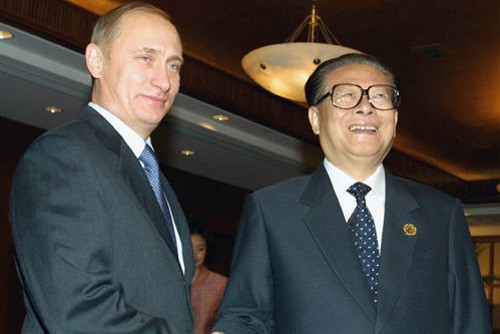
In 2000, Vladimir Putin succeeded Yeltsin as the president of Russia. In 2001, the two countries joined with junior partners Kazakhstan, Kyrgyzstan, Tajikistan, and Uzbekistan in the Shanghai Cooperation Organisation (SCO). A month later, the close relations between the two countries were formalized with the Treaty of Good-Neighborliness and Friendly Cooperation, a twenty-year strategic, economic, and security treaty. The treaty was later renewed in June 2021 for five more years.
In November 2002, Hu Jintao succeeded Jiang Zemin as the CCP General Secretary. Putin and Hu held their first meeting in December 2002. The two leaders met regularly, meeting face to face five or six times a year. Chinese Premier Wen Jiabao and his Russian counterparts also met regularly, with Wen quipping in 2007 in a meeting with Prime Minister Viktor Zubkov that "We didn’t even use prepared speeches." China backed Russia in the Second Chechen War and in regards to Russia's concerns of NATO expansion, while Russia backed China regarding the issues of Taiwan, Tibet and Xinjiang. The two countries also increasingly cooperated in the United Nations Security Council. During the 2008 Russo-Georgian war, China opposed Russia's infringement on Georgia's sovereignty. Citing principles of sovereignty, territorial integrity, and global order, China used its influence in the SCO to prevent the organization from supporting Russia. In 2009, the 1st BRIC summit was held in Russia, including China, Brazil and India.
2010s
In 2011, during a visit to Russia by Hu Jintao, the two countries agreed to upgrade their relationship to a "comprehensive strategic partnership". In November 2012, Xi Jinping succeeded Hu Jintao as the CCP General Secretary and became the top leader of China. Putin and Xi quickly established a close relationship; the pair met more than 40 times from 2013 to 2025. On the eve of a 2013 state visit to Moscow by Chinese leader Xi Jinping, Russian President Vladimir Putin remarked that the two nations were forging a special relationship. Xi visited the Operational Command Headquarters of the Russian Armed Forces, the first time a foreign leader visited the building.
When China attempted to build closer relations with Russia in 2013, the Russian government initially had reservations. However, the United States sanctions against Russia for its 2014 annexation of Crimea helped push Russia to a warmer relationship with China. Although some Chinese banks and companies refused to fully cooperate with Russia because of the concern that secondary sanctions might be applied to them, Russian-Chinese economic ties grew once China itself faced sanctions concerns. China neither denounced nor recognized the Russian annexation of Crimea. In May 2015, Xi Jinping visited Russia to attend the Moscow Victory Day Parade; the two countries signed agreements on joint assembly of a long-range passenger aircraft and the construction of a high-speed railway line from Moscow to Kazan. In 2019, during a visit to Russia by Xi, the two countries upgraded their relationship to a "comprehensive strategic partnership of coordination for a new era".[[File:Vladimir Putin and Xi Jinping (2019-06-05) 57.jpg|thumb|Chinese leader Xi Jinping presented [[Panda diplomacy|two pandas]] to [[Moscow Zoo]] at a ceremony with Vladimir Putin on 5 June 2019]]
By 2019, both nations had serious grievances with the United States. For China, the issues were control of the South China Sea, trade policies, and technology policy. For Russia, the main issue was severe economic penalties imposed by the U.S. and Europe to punish its seizure of Crimea from Ukraine. China and Russia do, however, differ on some policies. China does not recognize Russia's annexation of Crimea. Russia has officially kept neutral regarding China's claims in the South China Sea, but has criticized the involvement of "non-regional powers", indirectly referencing the United States. Nevertheless, China and Russia currently enjoy the best relations they have had since the late 1950s. Although they have no formal alliance, the two countries do have an informal agreement to coordinate diplomatic and economic moves, and build up an alliance against the United States.[[File:Xi-Putin meeting (2021-06-28) 02.jpg|thumb|right|Xi continued to meet Putin via videoconference during the [[COVID-19]] crisis]]
2020s
During the COVID-19 pandemic, some tensions arose within the Chinese-Russian relationship. For example, in October 2020, relying on the pretext of coronavirus allegedly found on the exterior of fish packaging, China greatly reduced the import of Russian seafood, causing a substantial price decrease in Russian seafood. Chinese restrictions on Russian cargo traffic at border crossings also led to tensions, including a drivers' strike.
Russo-Ukrainian war
.jpg)
Xi and Putin met on 4 February 2022, during a massive Russian build-up of force on the Ukrainian border, with the two releasing a joint statement which said the relationship between the two countries was "superior to the political and military alliances of the Cold War era" and that both nations shared "no limits" to their commitments. Russia stated that Taiwan is an inalienable part of China and expressed opposition to Taiwan independence, while the two countries called for an end to NATO enlargement and supported Russia's demand for security guarantees from the West. The two countries also voiced opposition to AUKUS, expressed concern about U.S. plans to develop missile defense and criticized attempts by "certain states" to "establish global hegemony".
During the Russian invasion of Ukraine, China stated that it respects Ukraine's sovereignty but Russia's security concerns about enlargement of NATO should also be addressed. It abstained from United Nations votes that condemned the invasion. China has also objected to international sanctions against Russia. On 25 February 2022, one day following the Russian invasion of Ukraine, Putin told Xi during a phone call that Russia is eager to engage in high-level negotiations with Ukraine, according to China's foreign ministry. In March 2022, Russia added Taiwan to the unfriendly countries and territories list that commit "unfriendly actions" against Russia. Xi Jinping assured Vladimir Putin of China's support on Russian "sovereignty and security" in June 2022. China did not recognize the Russian annexation of Donetsk, Kherson, Luhansk and Zaporizhzhia oblasts in September 2022.[[File:Putin-Xi press conference (2023).jpg|thumb|Putin welcomes Xi in Moscow during Xi's [[2023 visit by Xi Jinping to Russia|visit to Russia in March 2023]]]] In February 2023, Putin's spokesperson Dmitry Peskov rejected the Chinese peace proposal, saying that "for now, we don't see any of the conditions that are needed to bring this whole story towards peace." On 20–22 March 2023, Xi Jinping visited Russia and met with Vladimir Putin both in official and unofficial capacity, where both leaders signed the "Joint Statement on Deepening the Comprehensive Strategic Partnership of Coordination for the New Era". It was the first international meeting of Vladimir Putin since the International Criminal Court issued a warrant for his arrest. In May 2023, Russian Prime Minister Mikhail Mishustin and Deputy Prime Minister Alexander Novak visited Beijing and met Xi Jinping. On 20 July 2023, the Chinese general consulate in Odesa, Ukraine, was damaged in a Russian attack on a grain terminal in a nearby port, plus other parts of the city. China has been the largest importer of grains from Ukraine.[[File:Xi Jinping and Vladimir Putin walking past the Beijing Capital Garrison Honor Guard Battalion and children with flags (2024).jpg|thumb|Xi welcomes Putin in Beijing during Putin's [[2024 visit by Vladimir Putin to China|visit to China in May 2024]]]]In May 2025, Xi Jinping visited Russia to attend the Moscow Victory Day Parade. According to the South China Morning Post, a July 2025 meeting with European Union's High Representative for Foreign Affairs Kaja Kallas, Director of the Central Foreign Affairs Commission Office Wang Yi stated that China did not want to see Russia's loss in Ukraine, fearing the United States could focus more on Asia once the conflict in Europe is over. In September 2025, Chinese leader Xi Jinping and Russian President Vladimir Putin attended the China Victory Day Parade in Beijing.
Border
Main article: China–Russia border

On 29 May 1994, during the visit of Russian Prime Minister Viktor Chernomyrdin to Beijing, Russian and Chinese officials signed an agreement on the Sino-Russian Border Management System intended to facilitate border trade and hinder criminal activity. On 3 September of that year, a demarcation agreement was signed, fixing the boundary along a previouslydisputed 55-km stretch of the western Sino-Russian border. A further agreement was signed in November 1997, leaving only areas still in dispute the Abagaitu Islet, Yinlong (Tarabarov) Island, and Bolshoy Ussuriysky Island. After the final demarcation carried out in the early 2000s, it measures 4,209.3 km, and is the world's sixth-longest international border.
The 2004 Complementary Agreement between the People's Republic of China and the Russian Federation on the Eastern Section of the China–Russia Boundary stated that Russia agrees to transfer a part of Abagaitu Islet, all of Yinlong (Tarabarov) Island, about a half of Bolshoy Ussuriysky Island, along with some adjacent islets, to China. A border dispute between Russia and China, standing since Japanese invasion of Manchuria of 1931, was thus resolved. These Amur River islands were, until then, administered by Russia and claimed by China. The event was meant to foster feelings of reconciliation and cooperation between the two countries by their leaders. The transfer has been ratified by both the China's National People's Congress and the Russia's State Duma. The official transfer ceremony occurred on-site on 14 October 2008, concluding the border dispute between the two nations.
In the 21st century, the Chinese Communist Party's version of the Sino-Soviet border conflict, which is present on many official CCP websites, describes the 1969 Sino-Soviet border conflict as a Soviet aggression against China. Russia is the only country that still controls the territory it acquired from Qing dynasty via the unequal treaties, and teachers in China continued to teach students about the annexation.[[File:MANCHURIA-U.S.S.R BOUNDARY Ct002999.jpg|thumb|Territories that have become part of Russia under the Aigun Treaty and the Beijing Treaty of 1860]]
Economic relations
.jpg)
_10.jpg)
Currency
On 23 November 2010, at a meeting of Russian Prime Minister Vladimir Putin and the Chinese Premier Wen Jiabao, it was announced that Russia and China have decided to use their own national currencies for bilateral trade, instead of the U.S. dollar. The trading of the Chinese yuan against the Russian ruble started in the Chinese interbank market, while the yuan's trading against the ruble started on the Russian foreign exchange market in December 2010. In 2014, Beijing and Moscow signed a 150 billion yuan central bank liquidity swap line agreement to avoid and counter American sanctions.
Russia's dependence on the Chinese yuan increased heavily after its invasion of Ukraine in 2022. The share of Russian exports paid in yuan rose to 16% by December 2022, compared to 0.4% before the invasion, while share of imports paid in yuan increased to 23%, up from 4% before. Yuan's share of stock market trading in Russia increased from 3% to 33% Nearly 50 financial institutions were offering yuan saving accounts by 2023, and households were holding around $6 billion worth of yuan in Russian banks by the end of 2022. By the end of 2023, more than 90% of the trade between China and Russia was done with either the yuan or the ruble. Furthermore, Russia has been using Chinese yuan for more than 25% of its international trade with other countries than China. According to the Russian Central Bank, the Chinese yuan was in June 2024 used to settle more than a third of all Russian exports, up from 0.4% before the full-scale invasion.
In June 2024 the Bank of China had halted payments to sanctioned Russian banks because it felt compelled by current events and did not want to risk secondary sanctions. By August 2024, Russian transactions with Chinese banks (especially smaller ones) were largely closed. Due to strict secondary sanctions, Russia could not exchange money with China. As many as 98% of Chinese banks rejected direct yuan payments from Russia.
Natural resources
Russian officials have repeatedly reiterated their opposition to being merely China's natural resources storehouse. As early as 2001, Deputy Prime Minister and Finance Minister Alexei Kudrin warned that if Russia failed to become "a worthy economic partner" for Asia and the Pacific Rim, "China and the Southeast Asian countries will steamroll Siberia and the Far East." At the start of his presidency in September 2008, Dmitry Medvedev echoed similar concerns, warning a Kamchatka audience that if Russia fails to develop the Russian Far East, it could turn into a raw material base for more developed Asian countries and "unless we speed up our efforts, we can lose everything." Regional experts have pointed out that despite these increasingly vocal concerns, the local economy of the Russian Far East has become increasingly reliant on Chinese goods, services, and labor over the past decade; furthermore, local out-migration shows little sign of reversing. For all the early promises under Putin, Moscow's policy towards the Russian Far East has not seemed effective as of 2008.
In 2008, a consortium of Chinese engineering firms led by Harbin Turbine signed an agreement with Russian power producer OGK to produce coal-fired turbines in the Russian Far East, adding 41,000 megawatts of new generating capacity by 2011. Stanislav Nevynitsyn, executive director of OGK, admitted, "It is simply a necessity for us to work with the Chinese – we will not get the capacity built otherwise." Through loans to Russia's Bank for Development and Foreign Economic Affairs, Vnesheconombank (VEB), China became a major stockholder in Lukoil in 2009. In the same year, after having excluded foreign firms from bidding on the huge Udokan copper mine in Southeast Siberia, Moscow welcomed Chinese, South Korean, and Kazakh miners and refiners back into the bidding process.
After the Russian invasion of Ukraine, Russian coal exports came under particular pressure in Europe due to the combination of energy transition and sanctions over Ukraine, causing Russia to heavily increase trade on coal exports to China and other Asian countries. In April 2024, after the United States and the United Kingdom announced a ban on imports of Russian aluminum, copper, and nickel. the Russian nickel, copper and palladium mining and smelting company Norilsk Nickel planned to move some of its copper smelting to China and establish a joint venture with a Chinese company. Finished copper products would be sold as Chinese products to avoid Western sanctions. China is Norilsk Nickel's largest export market since 2023.[[File:16th BRICS Summit family photograph (2024).jpg|thumb|Vladimir Putin and Xi Jinping at the [[16th BRICS summit]] in [[Kazan]], Russia, 23 October 2024]]
Energy relations

Since the dissolution of the Soviet Union in 1991, energy relations between China and Russia have been generally marked by cooperation and regard for mutual geopolitical and strategic interests. China's fast-growing economy required increasing energy imports while Russia's economy has been largely driven by the demand for the export of natural resources. China turned from a net exporter of petroleum to a net importer for the first time in 1993. China had become the world's second-largest oil-consuming country as of 2011, and the world's largest overall energy consumer as of 2010. Given its geographical proximity to China and position as one of the world's largest oil producers and natural gas exporters, Russia has been an obvious candidate for meeting this increased demand. While energy relations have primarily related to oil, gas, and coal, there have also been partnerships with regard to nuclear and renewable (wind and water) energy technology.
The influence of Russia's regional energy trade has led to a sense of local uneasiness about foreign countries' influence in the sector. In 2000, President Putin warned a Siberian audience that unless Russia intensified the region's development, the Russian Far East would end up speaking Chinese, Japanese and Korean. Scholars and regional experts have suggested that China's rapid economic growth (especially relative to Russia's GDP growth rate) lies at the root of anxieties concerning the Russian Far East. While the Russian and Chinese economies were roughly the same size in 1993, China's grew to over 3.5 times larger than Russia's by 2008. Even since 1998, when Russia began a rapid economic recovery, China has grown at a faster rate; the gap has only widened since the 2008 financial crisis and falling energy prices of the late 2000s. China's growth has led to the creation of new productive capacity, whereas Russia's recovery has been based largely on reutilizing Soviet-era capacity that had idled in the early 1990s.
Oil and natural gas
In 1997 the China National Petroleum Corporation (CNPC) signed three contracts with the Russian oil firm Yukos where Yukos would s sell 1.5 million tons of oil to China in 1999 along the existing railway routes. Additionally, discussions were launched regarding the possibility of building a pipeline from the Yukos oilfield to Northeast China. In June 1997, CNPC reached an agreement with Sidanko, where Sidanko would export 3 to 3.5 billion cubic meters of natural gas from the Kovykta field over the next 36 years, with an eventual 20 billion cubic meters going to China and other Asian countries once the proposed pipeline was completed. Sidanko went bankrupt by 2000, however, and the Russian State Duma closed the Kovykta field to foreign investors as a "strategic asset". [[File:Russian oil exports destination.webp|thumb|Russian oil exports by destination in 2020.]] In 2001, Yukos proposed the Eastern Siberia–Pacific Ocean oil pipeline, which would link its oil refinery in Angarsk to Daqing, in northern China. At the time, rail routes were the only means of transporting oil into the growing Chinese market. In January 2003, however Japan became willing to finance a pipeline ranging the whole Russian Far East to Nakhodka. Putin expressed greater interest in the Japanese project, and the Chinese project stalled in October 2003 when Yukos chief executive Mikhail Khodorkovsky was arrested, and the Russian government launched an immediate investigation into the company. A week after Khodorkovsky's arrest, China Foreign Ministry spokeswoman Zhang Qiyue publicly announced that the Kremlin investigation would not impact the proposed China-Russia oil pipeline project. in 2003, China and Russia agreed that the new Daqing pipeline would include a spur in Skovorodino. In September 2004, Chinese premier Wen Jiabao met with Russian Prime Minister Mikhail Fradkov in Moscow, where the two heads of government signed agreements affirming Russia's promise to set the route of the pipeline from Eastern Siberia to the Pacific, with priority given to laying a pipeline spur to China, as well as increasing rail oil exports to China to 10 million tons (200,000 b/d) in 2005 and 15 million tons (300,000 b/d) in 2006.
Four days before Wen's visit, Yukos publicly announced that rail shipments of crude oil to the CNPC would end beginning on 28 September 2004. The Kremlin had begun auctioning off the troubled company's operating assets a month prior in August. In September 2005 Putin announced that the pipeline to Daqing would be built before the main pipeline was extended to the Pacific coast. Negotiations with Japan were also hindered by their insistence on regaining the Kuril Islands. In February 2009 China signed a "loans for oil" agreement under which China would pay the Russian side $25 million for the construction of the pipeline in return for Russia delivering 300 million tons of oil over the next 20 years. 10 September 2010 marked the completion of the 1,000 km Russia-China Crude Pipeline, the first pipeline ever built between China and Russia, which started pumping to China in 2011. Upon the pipeline's completion in 2010, CNPC also signed a general agreement with Transneft over the operation of the pipeline, a framework agreement with Gazprom to import natural gas to China from 2015 onwards, an agreement with Rosneft on extending oil supply to the Russia-China Crude Pipeline, and an agreement with Lukoil on expanding strategic cooperation.
In December 2003, CNPC and Sakhalin Energy signed a frame agreement on exploration and development in Russia's Sakhalin oilfield. The plan met strong opposition from Gazprom, which has a rival pipeline project and controls all Russian gas exports apart from sales through PSAs such as Sakhalin-1. In August 2006, Sakhalin-I's De-Kastri oil terminal began exporting processed petroleum to markets including China, Japan, and South Korea.
Gazprom, Soyuzneftegaz and the Chinese Embassy in Moscow all expressed interest in Yuganskneftegaz, a main arm of Yukos. The subsidiary was ultimately acquired by Russia's state-owned oil company Rosneft for roughly $9.3 billion. In February 2005, Russian Finance Minister Alexei Kudrin revealed that Chinese banks provided $6 billion in financing the Rosneft acquisition. This financing was reportedly secured by long-term oil delivery contracts between Rosneft and the CNPC. In the same month, the Chinese Foreign Ministry denied that China provided "funds" for the deal. State-owned Lukoil became China's largest Russian oil supplier when CNPC reached a strategic cooperation agreement with the company in September 2006. Construction on a direct pipeline spur to China began in March 2006, when CNPC signed an agreement providing state oil producer Transneft $400 million for constructing a pipeline from Skovorodino, about 70 km from the Chinese border. In the same month, CNPC agreed to a set of principles establishing future joint ventures with Rosneft.
In 2006 Putin said Russia would build two gas pipelines for China for a cost of $10 billion. China and Russia disputed about pricing, with Russia wanted China to pay for their gas supplies at European prices, while China wante to pay at developing country prices. In March 2006, CNPC signed a memorandum of understanding (MOU) with Gazprom for the delivery of natural gas to China, which officially began pricing negotiations between Gazprom chief executive Alexei Miller and Chen Geng, then head of the CNPC. In September 2007, the Russian Industry and Energy Ministry approved a development plan for an integrated gas production, transportation, and supply system in Eastern Siberia and the Far East, taking into account potential gas exports to China and other Asia-Pacific countries. Gazprom was appointed by the Russian Government as the Eastern Gas Program execution coordinator.
Russia's desire to diversify its export markets has been matched by China's willingness to invest in Russian energy production and infrastructure. Russian policymakers, however, have expressed reserve about increased Chinese influence in the energy sector. In 2002, CNPC attempted to bid for Russian oil firm Slavneft, but withdrew just weeks later. International news sources suggested the bid failed partly due to anti-foreign sentiment in the State Duma. In 2006, Russia denied CNPC a significant stake in OAO Rosneft. When the Russian company went public, CNPC was allowed to purchase $500 million worth of shares, one-sixth of the $3 billion it had sought. The 2008 financial crisis gave China its opportunity to invest in Russia on a grander scale through a loans for oil program. In 2009 and 2010, China's long-term energy-backed loans (EBL) extended large sums of capital to companies and entities in Russia.
In 2014, Russia and China signed a 30-year gas deal worth $400 billion, the largest in the history of the Russian gas industry. Deliveries to China started in late 2019. The Power of Siberia pipeline is designed to reduce China's dependence on coal, which is more carbon intensive and causes more pollution than natural gas. For Russia, the pipeline allows another economic partnership decoupled from western influence. In 2019, China had acquired a 30 percent and a 20 percent stake respectively in two liquefied natural gas projects in the Yamal District for a total cost of $45 billion.
Chinese imports of Russian natural gas increased significantly after the Russian invasion of Ukraine. In November 2024, China had finished building its China-Russia natural east-route gas pipeline seven months ahead of its schedule. The pipeline links Heilongjiang to Shanghai. According to China Central Television (CCTV), Russian gas would power households in Shanghai by the end of 2024. In December 2024, China completed the full pipeline for the Power of Siberia. As of 2024, crude oil from Russia accounted for almost 20% of China’s total energy imports. On 29 October 2025, Shandong Yulong Petrochemical, a major refinery in Shandong Province, increased its imports of Russian oil to a record 370,000–405,000 barrels per day. In December 2025, China became the first buyer of post-sanctions LNG from Russia’s Portovaya plant when a Gazprom tanker delivered a cargo to the Beihai terminal, marking the project’s first shipment since United States restrictions were imposed.
Nuclear energy

In September 1999, the two countries began joint construction of a nuclear power station at Lianyungang, Jiangsu Province with an installed capacity of 2 million kW, one of the first situations of mutual energy cooperation. In September 2010, President Putin reaffirmed the potential nuclear future of Russia and China's energy relations, saying "Of course, our cooperation with China is not limited to just hydrocarbons ... Russia is China's main partner in the field of peaceful use of nuclear energy, and equipment supplies here amount to billions of dollars". As of 2011, however, Russian officials have remained reluctant to transfer nuclear energy technologies and other knowledge products to Chinese partners. Industry experts have pointed out that while proprietary technology would protect Russian exports from being displaced by lower-cost Chinese products in third-party markets, such an approach may reinforce Chinese doubts about Russia's reliability as a long-term energy partner.
Central Asia
China and Russia generally cooperate with each other regarding Central Asia affairs. While they sometimes compete in Central Asia, those competitions are typically focused on economic matters and proceed in an orderly way within established norms. Where competition in Central Asia does occur between the two powers, it typically arises as a product of the circumstances rather than as an intentional effort to contain the other country.
In 1996, China, Kazakhstan, Kyrgyzstan, Russia and Tajikistan formed the Shanghai Five, a collaborative body that was renamed the Shanghai Cooperation Organisation (SCO) with the addition of Uzbekistan in 2001. As members of the SCO, China and Russia have cooperated in military exercises, such as counterterrorism drills in Kyrgyzstan in 2002 and similar exercises in Kazakhstan and China in 2003.
Russian and Chinese leaders regularly call for greater cooperation and coordination through the SCO between their two countries in the context of their broader goal of promoting multilateral diplomacy. In a joint statement issued on 23 May 2008, Russia and China asserted that "International security is comprehensive and inalienable, and some countries' security cannot be guaranteed at the cost of some others', including expanding military and political allies." Zhao Huasheng, Director of Russian and Central Asian Studies at Fudan University's Shanghai Cooperation Center, has argued that economic cooperation will ensure the long-term relevance of the SCO, as current security threats recede. While China and Russia do enjoy some bilateral energy cooperation, which experts predict will continue to grow in the future, the two countries have emerged as rivals for Central Asian oil and gas supplies. With the rising oil prices in the mid-2000s, Russia has sought to renew its influence in Central Asia, in particular the region's southern flank, to guarantee access to gas supplies for reexport to Europe and for its own domestic needs. As China's energy needs have grown and its policymakers have sought to develop its western provinces, China, too, has sought to expand its influence in Central Asia.
In 2007, at a meeting of SCO prime ministers in Tashkent, Russian Premier Viktor Zubkov reiterated Moscow's desire to forge a Central Asian energy "club" within the SCO, comprising Russia, China, Kazakhstan, Kyrgyzstan, Tajikistan and Uzbekistan. The SCO energy club could be set up as soon as 2008, Russian Deputy Industry and Energy Minister Ivan Materov announced in Tashkent. Materov insisted, however, that the club would not amount to a sort of mini-OPEC. Political and economic analysts in Moscow believe the Kremlin is keen to establish an energy club as a means to prevent a possible clash with China over Central Asia's energy resources.
Uncertainty over the Prikaspiisky route has given China an opening into the region, especially in Turkmenistan. During a brief visit to Ashgabat, Chinese Premier Wen Jiabao called for efforts "to step up bilateral trade cooperation to a new level." Berdymukhamedov, in turn, expressed interest in "working closely" with China on a natural gas pipeline project, Xinhua News Agency reported. In December 2005, Kazakhstani President Nursultan Nazarbayev inaugurated the Atasu-Alashankou pipeline to ship oil to China. The $800 million Atasu-Alashankou route still needs Russian crude oil from Western Siberia, transported via the Omsk-Pavlodar-Shymkent pipeline, to reach its full annual capacity of 20 million tons by 2010. Although China and its Central Asian partners view their expanding cooperation as a means of diversifying their energy partnerships, Russia has enjoyed success in other major energy projects. In November 2007, two Russian companies (TNK-BP and GazpromNeft) signed an agreement with KazTransOil to ship up to 5 million tons of oil annually to China via the Omsk-Pavlodar-Atasu-Alanshakou pipeline. In the first quarter of 2008, 300,000 tons of Russian crude oil were exported to China along this route. Moreover, a Russian engineering company, Stroytransgaz, won a tender to build Turkmenistan's section of the gas pipeline to China.
Military relations
China has historically been a key purchaser and licensee of Russian military equipment, some of which have been instrumental in the modernization of the People's Liberation Army. After the EU arms embargo on China imposed due to the 1989 Tiananmen Square protests and massacre, China became a reliable client for Russian military exports. From 1992 to 1994, China bought 97% of its military imports from Russia, while from 1990 to 2005, 83% of China's arms imports came from Russia. China spent $5 billion on Russian weaponry from 1993 to 1997. China's imports were a significant relief for Russia's military industry, which had struggled due to the dissolution of the Soviet Union. In 1992, China contracted to purchase a total of seventy-two Sukhoi Su-27 advanced fighter jets, while also providing the knowhow on how to build them, with the sale finalized in December 1996. In 1996, China acquired two Sovremenny-class destroyers equipped with surface-to air and anti-ship missiles, and purchased four Kilo-class submarines. China also bought up to 100 S-300 ground-to-air missiles and rocket launchers.
On 9 November 1993, Russian Defense Minister Pavel Grachev and Chinese Defense Minister Chi Haotian signed a five-year defense cooperation agreement paving the way for an increase in the number of military attachés stationed in their respective capitals. On 12 July 1994, the Russian and Chinese defense ministers signed a border security agreement designed to prevent potentially dangerous military incidents, such as unintentional radar jamming and airspace violations.

China has focused on domestic weapon designs and manufacturing, while still importing certain military products from Russia, such as jet engines. China sought to become independent in its defense sector and become competitive in global arms markets; its defense sector is rapidly developing and maturing. This has led to a decreasing dependence on Russian arms imports; from 2011 to 2021, China's arms imports from Russia fell 46% compared to the previous decade, while Russia's share shrank to 67%. Following deterioration of relations with the West in 2014, Russia became more accepting of giving military technology to China, providing China with the S-400 missile system and a squadron of twenty-four Sukhoi Su-35 fighter jets in 2015 deals worth around $5 billion.[[File:Chinese military delegation visits the Military Academy of the General Staff of the Russian Armed Forces (2023-04-17) 04.jpg|thumb|Chinese Defense Minister [[Li Shangfu]] visited the [[Military Academy of the General Staff of the Armed Forces of Russia]] on 17 April 2023]]
As early as February 2022, according to US authorities, Russia asked China for advanced military weaponry, in particular, armed drones for use in their invasion of Ukraine. China and Russia have both denied these allegations. In March 2023, Politico reported that Chinese state-owned weapons manufacturer Norinco shipped assault rifles, drone parts, and body armor to Russia between June and December 2022, with some of the shipments going through via third-countries including Turkey and the United Arab Emirates. According to the US Department of Defense, Chinese ammunition has been used on battlefields in Ukraine.
In May 2023, the European Union identified that Chinese and UAE firms were supplying weapon components to Russia. The EU banned export of dual-use goods targeting 8 Chinese firms. In July 2023, the US Office of the Director of National Intelligence published a report stating that the Chinese government is assisting Russia to evade sanctions and providing it with dual-use technology. In October 2023, the US Department of Commerce added 42 Chinese companies to the Entity List for supplying Russia with microelectronics for missile and drone guidance systems. In February 2024, the European Union proposed sanctions that would target Chinese companies aiding Russia's war effort in Ukraine. In April 2025, it was reported that the Russian military has put out recruitment videos across Chinese social media.
Military exercises and joint patrols
In August 2005, the countries held their first joint exercise, named Peace Mission, where 8,000 troops of the PLA Army, Navy and Air Force partnered with a 1,000-strong Russian naval contingent. The two sides held "military and political consultations" at the headquarters of the Russian Pacific Fleet in Khabarovsk, followed by a visit to Shandong. In August 2007 1,600 PLA troops were dispatched by train to Chelyabinsk for the first Chinese military exercise on Russian soil, joining up with 2,090 Russian soldiers. In July 2009, the two countries sent 1,300 troops each for joint counterterrorism practice in the Russian Far East and the Shenyang Military Region. From 2012 on the former biennial military exercises started taking place at least once a year. Naval manoeuvres between the two countries were held in May 2015 in the Mediterranean Sea, in July 2017 in the Baltic near Kaliningrad and in November 2019 near Cape Town in the partnership of the South African Navy.
In September 2018, Russia hosted the militaries of China and Mongolia as a part of the Vostok 2018 military exercise to improve ties between the countries, making them the first two countries outside of the former Soviet Union to join the exercise. In July 2019, Russia and China flew joint bomber patrols over the Pacific into the Sea of Japan, which was protested by South Korea and Japan. The two countries flew joint bomber patrols again in December 2020.
In September 2022, Russia hosted the military of China as a part of the military exercise. In November 2022, Russian and Chinese warplanes including the Tupolev-95 and XIAN H-6K long range strategic bombers conducted joint patrols over the Sea of Japan and East China sea. In 2024, Chinese and Russian naval fleets held their fourth joint maritime patrol in the Western and Northern Pacific Ocean. The patrol was part of an annual arrangement between the two nations and did not target any third party.
In July 2024 Russia and China dismissed a U.S. warning regarding their increasing military and economic collaboration in the Arctic, a region increasingly accessible due to climate change. Russia had enhanced its Arctic military presence by revamping Soviet-era bases, while China invested in polar exploration. Kathleen H. Hicks highlighted China's significant role in funding Russian Arctic energy projects and noted joint military exercises near Alaska. The Arctic's melting ice heightened interest in its resources and shipping routes, prompting strategic attention from Washington and NATO allies, particularly Canada. Russia and China defended their activities, emphasizing peace and stability in the region. The U.S. described the Arctic as strategically vital, noting potential increases in activity and risks due to climate change.
Partnership

China and Russia have enjoyed close relations militarily, economically, and politically, while supporting each other on various global issues. Commentators have debated whether the bilateral strategic partnership constitutes an alliance. Russia supports China's core interests; it recognizes Taiwan as an integral part of the People's Republic of China, and supports China's policies in Hong Kong, Tibet, and Xinjiang.
Russia and China officially declared their relations "Not allies, but better than allies". According to China's former vice minister of foreign affairs Fu Ying in 2016, China had no intentions to create a formal anti-U.S. or anti-Western bloc alliance. In March 2023, Russian president Vladimir Putin, in a comments briefing, assured that there is no military alliance between the two countries and stated that both Russia's and China's armed forces are "transparent". On 17 April 2023, Chinese Defense Minister Li Shangfu made his first overseas visit to Russia. During his meeting, he stated the ties between China and Russia "surpass military-political alliances of the cold war era". In November 2023, Russian defense minister Sergei Shoigu stated that the China-Russia defense ties are not aimed to target third parties. Shoigu further added that "unlike certain aggressive western countries," China and Russia "are not creating a military bloc". President Putin called China an ally in November 2024.
Leaked documents seen by the Financial Times in 2024 described a threshold for the country's use of tactical nuclear weapons that is lower than Russia had previously disclosed. The document included training scenarios for a possible invasion by China. In September 2025, a leak of documents showed that Russia had supplied China with equipment and expertise in advanced parachuting capabilities. Analysts believed that such assistance could help China with plans for an invasion of Taiwan.
Technology relations
In the 1990s, China and Russia began to cooperate on space exploration, with Russian experts helping train Chinese taikonauts, design spacesuits and to build the Shenzhou spacecraft and its booster rockets. Joint scientific projects increased in the 2000s, including in biotechnology, high-energy physics, petrochemistry to microelectronics, new materials, laser technology and nanostructures. The two countries also cooperated in Russia's Fobos-Grunt mission, which carried Chinese Mars orbiter Yinghuo-1. In March 2021 the Roscosmos and the China National Space Administration signed an agreement to set up and operate a joint research station on the Moon.
After a Pentagon report released in July 2024 that said Russia had reopened hundreds of Soviet-era military sites in the Arctic, while China was interested in the region's mineral resources and new shipping routes, Russia accused Washington of stoking Arctic tensions.
Espionage
In December 2019, Rostec officials accused China of intellectual property theft of a range of military technologies. In June 2020, Russia charged one of its Arctic scientists of passing sensitive information to China. On 30 June 2022, Russian laser scientist Dmitry Kolker was arrested on suspicion of passing information to China. In August 2022, Russian hypersonic scientist Alexandr Shiplyuk was arrested in a case of state treason. Reuters reported that Russia accused Shiplyuk for passing classified material at a scientific conference in China in 2017 as reason for the arrest.
In June 2025, The New York Times reported that a leaked internal Russian FSB memo raised concerns about China with respect to industrial espionage of sensitive Russian technologies. The FSB memo also stated that Chinese academics are laying the groundwork for territorial claims against Russia. Information on Russia's weaponry has increasingly been targeted by advanced persistent threats emanating from China.
Cultural relations
In the early 2000s, cultural ties between the two countries was lacking; Russian media paid more attention to the United States and the European Union, while Chinese preferred studying in Europe, Japan and the United States over Russia. The governments of the two countries agreed to boost cultural ties; 2006 was proclaimed the Year of Russia in China, with a Russian National Exhibition was held in Beijing and over 200 events held throughout China. 2007 was declared as the Year of China in Russia, featuring some 200 activities in what was said to be the largest display of Chinese culture ever mounted abroad. 2009 was declared as the Year of Russian Language in China, 2010 the Year of Chinese Language in Russia. 2012 was declared the Year of Russian Tourism in China, 2013 the Year of Chinese Tourism in Russia. 2016 declared was the Year of Russian Media in China, 2017 the Year of Chinese Media in Russia.
In March 2013, the Voice of Russia and the People's Daily Online signed a news sharing agreement as Xi and Putin presided. On 13 October 2014, Russia Today and the People's Daily Online signed a cooperation agreement. Since at least 2017, the Cyberspace Administration of China has cooperated with Roskomnadzor, Russia's principal internet regulator and censor. In July 2021, the Russian-Chinese Commission for Humanitarian Cooperation agreed to mass-media cooperation. Tourism, especially from China to Russia, has seen a massive spike over the years. More than 2 million Chinese tourists visited Russia in 2019, compared to 158,000 in 2009. As many as 70 per cent of tax-free receipts handed out at Russia's airports go to Chinese citizens. By 2019, Russia has become among the top 3 travel destinations for Chinese tourists. After the Russian invasion of Ukraine and the subsequent deterioration of relations with the West, China's cultural popularity in Russia has grown.
Mutual perceptions
Since 1995, Russians have consistently held positive views of China. As of September 2022, 88% of Russians surveyed by the Levada Center view China favorably, with only 5% expressing a negative opinion. According to a 2017 BBC World Service poll, 74% of the Chinese view Russia's influence positively, with 18% expressing a negative view, while 44% of Russians view China's influence positively and 23% negatively. According to a 2019 survey by the Pew Research Center, 71% of Russians have a favorable view of China, with 18% expressing an unfavorable view. A YouGov survey onducted in the same year found that 71% of the Chinese think Russia has a positive effect on world affairs, while 15% view it negatively.
During the 2022 Russian invasion of Ukraine, many social media users in China showed sympathy for Russian narratives due in part to distrust of US foreign policy. According to a Carter Center China Focus survey conducted in April 2022, approximately 75% of Chinese respondents agreed that supporting Russia in the Ukraine war was in China's best interest. Chinese company NetEase has published videos critical of Russia from Chinese in Ukraine and Ukrainians in China. According to a Genron NPO poll released in November 2022 asking about Chinese peoples' views on the Russian invasion, 39.5% of respondents said the Russian actions "are not wrong", 21.5% said "the Russian actions are a violation of the U.N. Charter and international laws, and should be opposed", and 29% said "the Russian actions are wrong, but the circumstances should be considered."
Mutual perceptions have facilitated ideological cohesion and political partnerships between the governments of Russia and China, such as through the issuing of "joint statements between the two countries [which emphasise] the alignment of their respective integration initiatives, such as the [Eurasian Economic Union] and China's Belt and Road Initiative, to enhance connectivity and cooperation in the Eurasian space."
Notes
References
References
- "Ministry of Foreign Affairs of the People's Republic of China".
- der Made, Jan van. (21 March 2023). "Territorial dispute between China and Russia risks clouding friendly future". [[Radio France Internationale]].
- Snow, Philip. (2023). "[[China and Russia".
- Chronology of principal defence and security-related agreements and initiatives involving the Russian Federation and Asian countries, 1992–99
- Xia, Yishan. (May 2000). "China-Russia Energy Cooperation: Impetus, Prospects and Impacts.". [[James A. Baker III Institute for Public Policy]].
- Turcsanyi, Richard J.. (2023). "Contemporary China: a New Superpower?". [[Routledge]].
- Parrish, Scott. (30 December 1996). "Newsline Open Media Research Institute Daily Digest".
- (28 June 2021). "Russia, China extend friendship and cooperation treaty -Kremlin".
- Lampton, David M.. (2024). "Living U.S.-China Relations: From Cold War to Cold War". [[Rowman & Littlefield]].
- "AFP: Chinese leader Xi, Putin agree key energy deals".
- Zhao, Suisheng. (2023). "The Dragon Roars Back: Transformational Leaders and Dynamics of Chinese Foreign Policy". [[Stanford University Press]].
- Sahakyan, Mher. (2023). "China and Eurasian Powers in a Multipolar World Order 2.0: Security, Diplomacy, Economy and Cyberspace". [[Routledge]].
- Hart, Brian. (5 May 2022). "What Are the Key Strengths of the China-Russia Relationship?".
- Foy, Henry. (5 June 2019). "Russia strengthens China ties in defiance of bellicose Trump". [[Financial Times]].
- Yaroslav Trofimov, "The New Beijing-Moscow Axis," [https://www.wsj.com/articles/the-new-beijing-moscow-axis-11549036661 ''Wall Street Journal'' February 2, 2019.]
- Lukonin, Sergey A.. (2023). "China and Eurasian Powers in a Multipolar World Order 2.0: Security, Diplomacy, Economy and Cyberspace". [[Routledge]].
- Chao Deng. (4 February 2022). "Putin, Xi Aim Russia-China Partnership Against U.S.". Wall Street Journal.
- (7 March 2022). "'No Wavering': After Turning to Putin, Xi Faces Hard Wartime Choices for China". [[The New York Times]].
- "Moscow-Beijing partnership has 'no limits'". Reuters.
- (25 February 2022). "China says it respects Ukraine's sovereignty and Russia's security concerns". [[Reuters]].
- Wintour, Patrick. (27 February 2022). "Ukraine: what will China do? There are signs it is uneasy about Putin's methods". [[The Observer]].
- (7 March 2022). "China and Russia's invasion of Ukraine: Initial responses and implications".
- (2 March 2022). "China will not join sanctions on Russia, banking regulator says". [[Reuters]].
- (14 April 2022). "China rejects 'pressure or coercion' over Russia relations". [[Associated Press]].
- (25 February 2022). "Putin tells Xi that Russia willing to hold high-level talks with Ukraine, China says". Reuters.
- (5 March 2022). "Measures to improve the resilience of the economy in the face of sanctions, No. 430-r". [[Government of Russia.
- "US says China's support for Russia over Ukraine puts it on 'wrong side of history'". AFP in Washington.
- (29 December 2016). "Xi Assures Putin Of China's Support For Russia". The ASEAN Post.
- [[AFP News]]. (27 February 2023). "Kremlin, on China Plan, Says No Conditions for Peace 'At the Moment' in Ukraine". [[The Moscow Times]].
- (21 March 2023). "Xi, Putin meeting highlights US tensions with China". ABC News.
- Gan, Nectar. (20 March 2023). "Xi makes 'journey of friendship' to Moscow days after Putin's war crime warrant issued". [[CNN]].
- (24 May 2023). "Russia, China sign new agreements, defying Western criticism". Al Jazeera.
- "Russian shelling in Odesa damages Chinese consulate building". [[Meduza]].
- "Ukraine: at least two dead in Russian attack on Odesa port, China consulate damaged". South China Morning Post.
- (17 May 2023). "China Won't Let Russia Starve the World".
- (20 August 2025). "China-Russia Relations Since the Start of the War in Ukraine {{!}} Asia Society".
- "Hinter verschlossener Türe legte Chinas Aussenminister die Zurückhaltung ab: Russland darf nicht verlieren!".
- Bermingham, Finbarr. (4 July 2025). "China tells EU it does not want to see Russia lose its war in Ukraine: sources".
- (1 September 2025). "China's Victory day military parade: why are Putin and Kim Jong-un there, and what is the 'axis of upheaval'?". [[The Guardian]].
- (2 September 2025). "Xi hosts 'old friend' Putin, Kim ahead of military parade in challenge to West". [[Reuters]].
- Dmochowski, Tadeusz. (2015). The Settlement of the Russian–Chinese Border Dispute. Polish Political Science Yearbook. 44. 56-74. 10.15804/ppsy2015006.
- "Russia and China tighten relations - UPI Archives".
- (7 July 2015). "Китай {{!}} Росграница".
- "Boris Yeltsin's Foreign Policy Legacy".
- "Дополнительное Соглашение Между Российской Федерацией И Китайской Народной Республикой О Российско-Китайской Государственной Границе На Ее Восточной Части (Заключено В Г. Пекине 14.10.2004)".
- Tagirova, Alsu. (5 January 2022). "From Crisis Management to Realignment of Forces: The Diplomatic "Geometry" of the 1969–1978 Sino-Soviet Border Talks". Journal of Cold War Studies.
- "View of Journal of China and International Relations - Volume 1, Number 1".
- Neville Maxwell, "How the Sino-Russian boundary conflict was finally settled: From Nerchinsk 1689 to Vladivostok 2005 via Zhenbao Island 1969." ''Critical Asian Studies'' 39.2 (2007): 229–253. [http://src-h.slav.hokudai.ac.jp/coe21/publish/no16_2_ses/02_maxwell.pdf online]
- (31 August 2023). "Where Is Bolshoy Ussuriysky? Island at heart of Russia-China border dispute".
- (21 July 2008). "China signs border demarcation pact with Russia". Reuters.
- "China, Russia sign border agreement".
- Group 3, "Complementary Agreement between the People's Republic of China and the Russian Federation," ''Russia in Global Perspective'', accessed 9 July 2025, https://russiaglobal.omeka.fas.harvard.edu/items/show/24
- Dmochowski, Tadeusz. "The Settlement of the Russian-Chinese Border Dispute".
- "Russia gives territory to China, ending border dispute".
- "Return of Heixiazi Island marks end of border dispute".
- Astashin. Nikita. (). link
- AFP. (13 January 2025). "China-Russia Trade Hit Record High in 2024".
- (14 January 2026). "China's 2025 trade with Russia posts first decline in 5 years". [[Reuters]].
- "What Are the Limits to Russia's "Yuanization"?".
- (20 May 2014). "China Has Russia Over a Barrel".
- (1 January 2018). "Russia's Turn to the East". [[Palgrave Pivot]].
- (30 June 2020). "Russia's national logistics system: main directions of development". Logforum.
- Peyrouse S. Building a New Silk Road? Central Asia in the New World Order//Origins, vol. 2, issue 10, July 2009 – http://origins.osu.edu/article/building-new-silk-road-central-asia-new-world-order/page/0/2 {{Webarchive. link. (24 December 2018)
- "Analysis {{!}} Russia becomes China's 'junior partner'". Washington Post.
- "Russia's reliance on China will outlast Vladimir Putin, says Alexander Gabuev". The Economist.
- "Russia could become China's 'economic colony,' CIA director says".
- (13 January 2023). "China's 2022 trade with Russia hit record $190 bln - customs". [[Reuters]].
- Prokopenko, Alexandra. (2 February 2023). "The Risks of Russia's Growing Dependence on the Yuan".
- (6 July 2023). "China Drives Russia Car Sales After Global Brands Quit Over War". [[Bloomberg News]].
- Sahakyan, Mher D.. (9 December 2024). "China's Digital Silk Road and the Eurasian Economic Union's Member States: Cooperation, Challenges, and Opportunities". Asian Affairs.
- Bradsher, Keith. (21 December 2023). "How China Is Profiting From Trade With Russia".
- "China, Russia quit dollar".
- "Chinese minister says China-Russia economic, trade co-op at new starting point".
- (13 October 2014). "China, Russia seek 'international justice', agree currency swap line". AFP News.
- (9 March 2023). "Russia Still Uses 'Toxic' Euro, Dollar to Sell Nearly Half of Exports". [[Bloomberg News]].
- (28 February 2023). "Russia Turns to China's Yuan in Effort to Ditch the Dollar". [[The Wall Street Journal]].
- Sor, Jennifer. (21 December 2023). "China and Russia have almost completely abandoned the US dollar in bilateral trade as the push to de-dollarize intensifies".
- (20 December 2023). "Xi Lauds Trade Boom With Russia, Vows to 'Amplify' Cooperation".
- Glover, George. (28 September 2023). "Russia is using China's yuan to settle 25% of its trade with the rest of the world, report says".
- (24 June 2024). "Bank of China Halts Payments with Sanctioned Russian Lenders – Kommersant".
- (14 August 2024). "Nearly all Chinese banks are refusing to process payments from Russia, report says". Business Insider.
- (24 June 2024). "Bank of China Halts Payments With Sanctioned Russian Lenders – Kommersant". The Moscow Times.
- (30 July 2024). "China's trade with Russia is getting so difficult that payments can take half a year and most bank transfers are returned, report says". Business Insider.
- (30 July 2024). "Analysts: China-Russia financial cooperation raises red flag". VOA News.
- Blagov, Sergei. Russia Wants to Be More than China's Source for Raw materials. [[Jamestown Foundation]], ''Eurasia Daily Monitor'', vol. 2, no. 181. 30 September 2005.
- [[Andreas Umland]]. (22 June 2015). "Towards a Greater Asia?".
- Interfax, Presidential Bulletin, FBIS SOV, 21 August 2001
- Medvedev: Far East Ignored Too Long Without Action, Russia Will Lose It, He Says. ''Analytical Department of RIA RosbusinessConsulting''. 26 September 2008
- Johnson's Russia list, 27 September 2008.
- Lo, Bobo. ''Axis of Convenience: Moscow, Beijing, and the New Geopolitics''. Washington D.C., [[Brookings Institution Press]]. 2008, p. 66.
- Kaysen, Ronda. (December 2023). "The New York Times – Breaking News, World News & Multimedia". International Herald Tribune}}{{Dead link.
- Blank, Stephen. "Russia's Failure in Asia'. UNISCI Discussion Papers 24. Oct 2010, pp 61–82.
- Helmer, John. Kremlin Extends Welcome to Foreign Miners. ''Asia Times Online''. 1 July 2009
- Interfax Russia & CIS Oil and Gas Weekly, FBIS SOV 17 June 2009
- (12 April 2024). "US, UK take action targeting Russian aluminum, copper and nickel". Reuters.
- (24 April 2024). "Nornickel moves production to China to circumvent sanctions". The Barents Observer.
- (9 July 2024). "Exclusive: Nornickel in talks with China Copper to move smelting plant to China, sources say". Reuters.
- (19 July 2024). "Nornickel weighs projects in new top market China". Mining Weekly.
- (3 May 2014). "Countries Compared by Energy > Oil > Consumption. International Statistics at".
- "Archived copy".
- (20 June 2016). "Statistical Review of World Energy | Energy economics | BP Global".
- (1 August 2023). "The Russian coal industry in an uncertain world: Finally pivoting to Asia?". Energy Research & Social Science.
- Russia: Rosneft and Transneft signed deals with China guaranteeing crude oil supplies in exchange for $25 billion in loans. ''Energy Compass''. 3 April 2009.
- Herman Pirchner Jr. (5 October 2009). "The Uncertain Future: Sino-Russian Relations in the 21st Century".
- ''BBC Monitoring'', 22 July 2000
- Blank, 2010
- Graham, Thomas. The Sources of Russia's Insecurity. ''Survival'', vol. 52, no. 1. 2010, p. 63.
- "International - Russia". [[U.S. Energy Information Administration]] (EIA).
- (29 April 2005). "Asia Times Online :: Central Asian News and current affairs, Russia, Afghanistan, Uzbekistan".
- Yukos: The Final Curtain. ''FSU Oil & Gas Monitor'', 26 July 2006, p. 5.
- Aris, Ben. Death of Yukos. ''FSU Oil & Gas Monitor'', 2 August 2006, p. 4.
- (5 November 2003). "Yukos case not to affect China-Russia oil pipeline: FM".
- China, Russia in Energy Pact. ''Oil Daily''. Washington: 27 September 2004. pg. 1.
- (October 2016)
- (27 September 2010). "Russia and China sign series of energy agreements". BBC News.
- "Russia".
- (14 July 2012). "gulfnews: Exxon's Sakhalin-1 signs China deal".
- "Energy profile of Sakhalin Island, Russia".
- "China in Line for Yuganskneftegaz - Kommersant Moscow".
- (4 June 2005). "Asia Times Online :: China News, China Business News, Taiwan and Hong Kong News and Business".
- (4 February 2005). "People's Daily Online – China did not fund Rosneft's purchase of Yuganskneftegaz".
- (22 July 2012). "Major_Events_2006".
- China, Russia Forge Three Energy Deals. ''Oil Daily''. Washington: 21 March 2006. pg. 1.
- "China Offers Transneft $400M for Oil Pipeline | the St. Petersburg Times | the leading English-language newspaper in St. Petersburg".
- "Sakhalin – Khabarovsk – Vladivostok".
- "Surprise Chinese Bid Raises Slavneft Stakes". The Moscow Times.
- Alex Frew McMillan. "CNN.com – Chinese pull out of Russian oil bid – Dec. 17, 2002".
- Lelyveld, Michael. Russia: Moscow's Oil Pipeline Plan to China Stalls, Radio Free Europe Radio Liberty (Henceforth RFERL). ''Newsline''. 10 December 2002
- Lim, Le-Min. China Sees Russian Barrier to Slavneft. ''International Herald Tribune''. 17 December 2002
- Anti-China Sentiment Plays Into Duma vote," Stratfor, Dec 16, 2002
- "Chinese Drop Plans to Bid for Slavneft. ''Rosbusiness Consulting''. 17 December 2002.
- "Inside China, Inc: China Development Bank's Cross-Border Energy Deals - Brookings Institution".
- O'Rourke, Breffni. China/Russia: CNPC Denied Intended Stake in Rosneft. ''RFE/RL''. 19 July 2006
- (19 July 2006). "CNPC invests $500M in Rosneft's IPO".
- (12 January 2022). "Russian gas boost fuels Moscow's China pivot". Deutsche Welle.
- (2 December 2019). "'Power of Siberia': Russia, China launch massive gas pipeline". [[Al Jazeera English.
- (18 November 2024). "Russian gas set to power Shanghai by end of 2024 after pipeline completed".
- (2 December 2024). "China completes full pipeline for Power-of-Siberia gas". [[Reuters]].
- Fong, Clara. (18 September 2025). "China and Russia: Exploring Ties Between Two Authoritarian Powers".
- Aizhu, Chen. (28 October 2025). "China refiner Yulong boosts Russian oil imports after sanctions, sources say". [[Reuters]].
- (8 December 2025). "Gazprom delivers first post-sanctions LNG cargo from Portovaya to China, data sho". Reuters.
- Xia, pg.4.
- Russia begins filling ESPO spur to China with oil. Anon. ''Interfax : Russia & CIS Oil & Gas Weekly''. (1 September 2010).
- (20 October 2011). "Sputnik International".
- Zhao, Huasheng. (2016). "The new great game: China and South and Central Asia in the era of reform". [[Stanford University Press]].
- "Welcome to SCO Website".
- Wishnick, 2009.
- Medvedev Pledges to Build Strategic Partnership with China. ''RIA Novosti''. 24 May 2008. [www.en.rian.ru], accessed 28 May 2008
- Reaping the Benefits of Two Glorious Years. ''Xinhua''. 7 November 2007. [Chinadaily.com.cn], accessed 19 May 2008.
- "Joint Statement between The People's Republic of China and the Russian Federation". 4 April 2007. [www.fmprc.cn], accessed 28 May 2008.
- China-Russia Joint Statement Says International Security 'Inalienable'. ''Xinhua''. 23 May 2008. [www.lexisnexis.com], accessed 28 May 2008.
- Huasheng, Zhao. The Shanghai Cooperation Organisation at 5: Achievements and Challenges Ahead. ''China and Eurasia Forum Quarterly'', Vol. 4, No. 3. 2006, p. 117-118.
- Guang, Pan. Bishkek: SCO's Success in the Hinterland of Eurasia. ''China and Eurasia Forum Quarterly'', Vol. 5, No. 4. 2007, p. 5.
- (6 November 2007). "Russia Urges Formation of Central Asian Energy Club".
- Clark, Martin. Beijing Triumphs with Inauguration of Kazakhstani Crude Pipe. ''FSU Oil & Gas Monitor''. 21 December 2005.
- KazTransOil Announces Beginning of Russian Crude Transit to China. ''Interfax''. 21 January 2008. [www.uoalberta.ca], accessed 24 July 2008.
- Gurt, Marat. Russian Company Wins Turkmen Pipeline Tender. ''Reuters''. 19 February 2008. [www.lexisnexis.com], accessed 23 July 2008.
- Richard Weitz. "Why China Snubs Russia Arms". [[The Diplomat (magazine).
- "Russia, China sign border accord - UPI Archives".
- Brown, Kerry. (2023). "China Incorporated: The Politics of a World Where China is Number One". [[Bloomsbury Academic]].
- Zhao 2004, p. 216.
- Jon Grevatt. (4 September 2015). "China's defence industry: good but could do better". CNN- Special to CNN.
- "US officials say Russia has asked China for military help in Ukraine.". Financial Times.
- Alberto Nardelli and Jennifer Jacobs. (14 March 2022). "U.S. Warns Europe That Russia Wants Armed Drones From China". [https://www.bloomberg.com/news/articles/2022-03-15/u-s-warns-europe-that-russia-wants-armed-drones-from-china Bloomberg News website] Retrieved 18 March 2022.
- "Beijing denies Russia requested military equipment for Ukraine invasion as U.S., China meet".
- (16 March 2023). "'Hunting rifles' — really? China ships assault weapons and body armor to Russia".
- (18 March 2023). "Use of Chinese ammunition in Ukraine confirmed by U.S.: sources".
- Rettman, Andrew. (9 May 2023). "The EU fears that Chinese and UAE firms could be supplying weapons components to Russia, new sanctions indicate". [[EUobserver]].
- (27 July 2023). "US intelligence report says China likely supplying tech for Russian military". [[Reuters]].
- (6 October 2023). "US restricts trade with 42 Chinese entities over Russia military support". [[Reuters]].
- (14 February 2024). "EU proposes sanctions on Chinese firms aiding Russian war effort". The Guardian.
- (10 April 2025). "'Do you want to show strength here?': Russia's ads recruiting Chinese mercenaries". [[The Guardian]].
- Johnson, Dave. (20 December 2018). "VOSTOK 2018: Ten years of Russian strategic exercises and warfare preparation".
- Boulègue, Mathieu. (29 September 2018). "What Russia's Vostok-2018 exercises mean for China and the West". [[The Hill (newspaper).
- (23 July 2019). "Joint Russian and Chinese air patrol heightens tension in Korean peninsula".
- Moscow, AP in. (22 December 2020). "Russia and China fly joint bomber patrol over the Pacific".
- (6 September 2022). "Kremlin says Putin attends military exercises with Chinese forces". Al Jazeera.
- (30 November 2022). "Russian and Chinese strategic bombers conduct joint patrols in Asia". Reuters.
- (14 July 2024). "China, Russia navies conduct joint patrol in parts of Pacific, China media says".
- (23 July 2024). "Russia and China push back against U.S. warnings over military and economic forays in the melting Arctic".
- (20 June 2020). "Weary Russia Tries to Avoid Entanglement in U.S.-China Spat". The Wall Street Journal.
- "Behind China and Russia's 'Special Relationship'". [[The Diplomat (magazine).
- "China and Russia Sign Military Cooperation Roadmap". The Diplomat.
- Stent, Angela. (24 February 2020). "Russia and China: Axis of revisionists?".
- Baev, Pavel K.. (15 June 2020). "The limits of authoritarian compatibility: Xi's China and Putin's Russia".
- Eugene Rumer. "Chinese-Russian Defense Cooperation Is More Flash Than Bang".
- "Russia, China are not creating military alliance, Putin says". Reuters.
- (17 April 2023). "China's defence minister and Putin vow to strengthen military cooperation". The Guardian.
- Wang, Amber. (17 April 2023). "Russia and China show solidarity as Chinese defence minister Li Shangfu heads to Moscow". South China Morning Post.
- (9 September 2024). "Why will China and Russia not form an alliance? The balance of beliefs in peacetime". [[International Affairs (journal).
- (8 November 2024). "Putin says China is Russia's ally, backs its stance on Taiwan".
- (28 February 2024). "FT: Leaked files reveal Russian military's criteria for nuclear strike". [[The Kyiv Independent]].
- Tom, Ball. (28 February 2024). "Russia prepared for nuclear attack on China, leaked papers reveal".
- (26 September 2025). "Russia is helping prepare China to attack Taiwan, documents suggest". [[The Washington Post]].
- Burrows, Emma. (26 September 2025). "Russia is helping China to prepare for a potential invasion of Taiwan, defense institute says".
- (24 July 2024). "Russia accuses US of stoking tensions in the Arctic".
- Simes, Dimitri. (20 December 2019). "Russia up in arms over Chinese theft of military technology". [[The Nikkei]].
- Ilyushina, Mary. (17 June 2020). "Russia accuses leading Arctic researcher of spying for China". [[CNN]].
- (3 July 2022). "Russian laser scientist dies two days after arrest for state treason". Reuters.
- (24 May 2023). "Exclusive: Russian hypersonic scientist accused of betraying secrets to China". Reuters.
- (7 June 2025). "Secret Russian Intelligence Document Shows Deep Suspicion of China". [[The New York Times]].
- Corelli, Kassie. (19 November 2025). "Pro-Kremlin Analysts Acknowledge Previously Hushed-up Problems - Jamestown".
- Rajagopalan, Megha. (19 June 2025). "China Is Hacking Russia to Steal War Secrets". [[The New York Times]].
- Bandurski, David. (11 March 2022). "China and Russia are joining forces to spread disinformation".
- (14 October 2014). "人民网与今日俄罗斯签署合作协议--时政--人民网".
- (5 April 2023). "Leaked Files Show China And Russia Sharing Tactics On Internet Control, Censorship". [[Radio Free Europe/Radio Liberty]].
- Hvistendahl, Mara. (30 December 2022). "Hacked Russian Files Reveal Propaganda Agreement With China".
- (9 August 2021). "ПРО·ТОКОЛ четырнадцатоrо заседания Подкомис·сии по сотрудничеству в области средс".
- (1 May 2021). "Year of Russian Tourism in China - Ростуризм". the Russian Federal Agency for Tourism.
- (7 January 2020). "China tourism growth lifts fortunes of Russia's airports". Financial Times.
- (30 June 2025). "Drifting From the West's Orbit, Russians Find a New Role Model in China". [[The New York Times]].
- (16 September 2022). "Attitude towards countries and their citizens". Levada.
- (30 June 2017). "BBC World Service poll". BBC.
- "People around the globe are divided in their opinions of China".
- (31 August 2019). "Superpowers and Country Reputations". YouGov.
- (11 March 2022). "What China's Social Media Is Saying About Ukraine". [[The Atlantic]].
- (20 April 2022). "Ukraine war: most Chinese believe backing Russia is in their national interest, says US think tank". [[South China Morning Post]].
- Frederik Kelter. (31 March 2023). "Russian 'invasion was wrong': Views from China on war in Ukraine". Al Jazeera.
- (27 February 2022). "乌克兰华人接到噩耗痛哭:好朋友为国牺牲,同学弟弟奔赴战场".
- (27 February 2022). "西安生活7年的乌克兰留学生发声引热议:俄没资格为乌做决定".
- (30 November 2022). "How do the Chinese view the Taiwan Strait issue and the Russian invasion of Ukraine?".
- Nobuyoshi Sakajiri. (22 December 2022). "Interview / NPO head details rare survey of Chinese views on Ukraine, Taiwan".
- "Russian-Chinese Relations: A Marriage of Expedience or a true partnership in world politics? - Danube Institute".
This article was imported from Wikipedia and is available under the Creative Commons Attribution-ShareAlike 4.0 License. Content has been adapted to SurfDoc format. Original contributors can be found on the article history page.
Ask Mako anything about China–Russia relations — get instant answers, deeper analysis, and related topics.
Research with MakoFree with your Surf account
Create a free account to save articles, ask Mako questions, and organize your research.
Sign up freeThis content may have been generated or modified by AI. CloudSurf Software LLC is not responsible for the accuracy, completeness, or reliability of AI-generated content. Always verify important information from primary sources.
Report