From Surf Wiki (app.surf) — the open knowledge base
China–North Korea border
International border
International border
| Field | Value |
|---|---|
| name | China–North Korea border |
| caption | Inscription stone marking the border between China and North Korea in Jilin |
| territory1 | |
| territory2 | |
| length | 1352 km |
| established | 9 September 1948 |
| establishedreason | Democratic People's Republic of Korea established |
| current | 20 March 1964 |
| treaties | Protocols on the Sino-Korean Border |
| image | Border stone china-corea.jpg |
The China–North Korea border is an international border separating China and North Korea, extending from Korea Bay in the west to a tripoint with Russia in the east. The total length of the border is 1,352 kilometers (840 mi). The current border was created by two secret treaties signed between China and North Korea in 1962 and 1964.
Geography
From west to east, the two countries are divided by three significant geographical features: the Yalu River, Paektu Mountain, and the Tumen River.
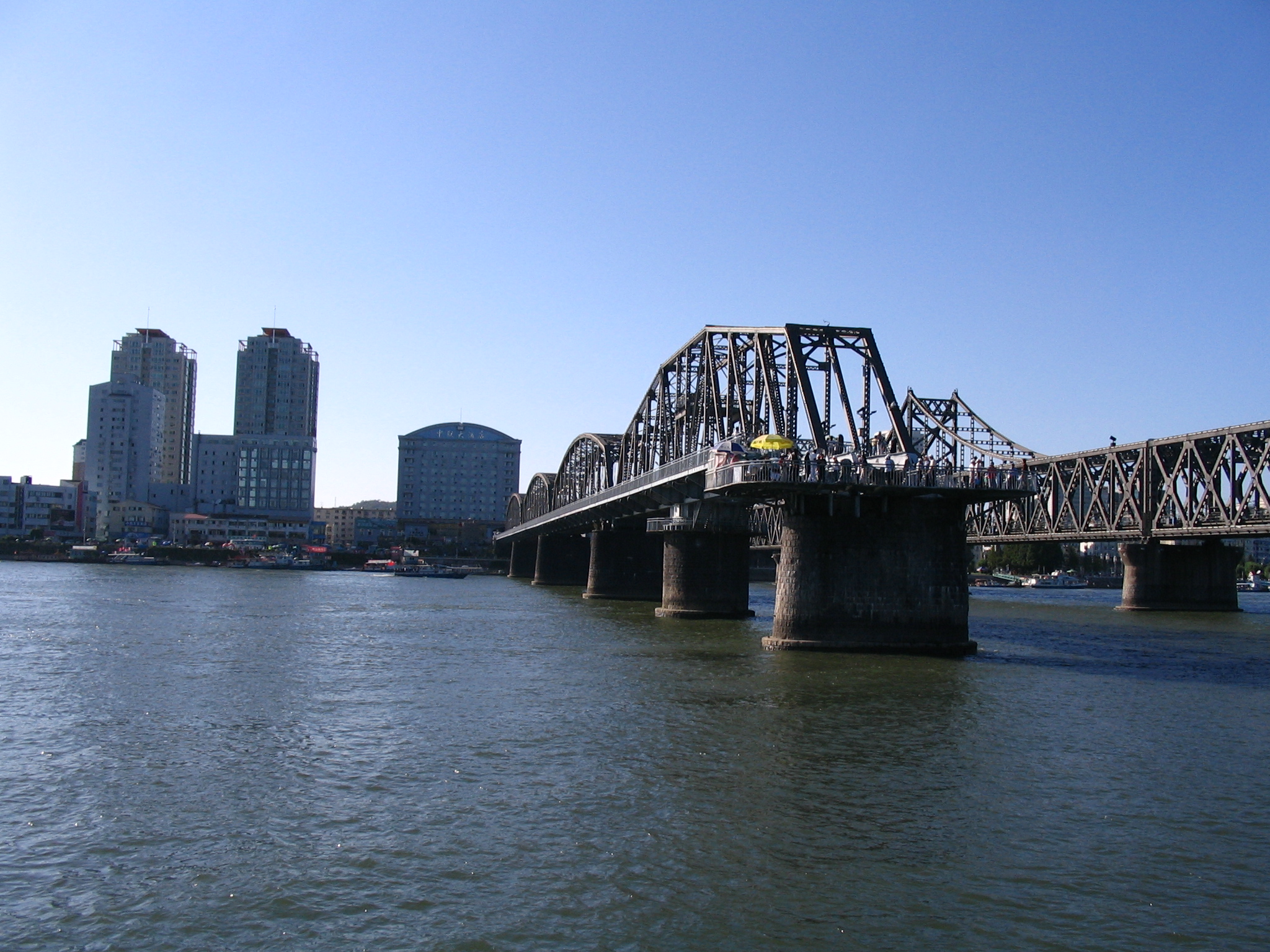
Dandong, in the Liaoning Province of China, on the Yalu River delta, is the largest city on the border. On the other side of the river is the city of Sinuiju in North Pyongan Province, North Korea. The two cities are situated on the Yalu river delta at the western end of the border, near the Yellow Sea. Their waterfronts face each other and are connected by the Sino-Korean Friendship Bridge.
There are 205 islands on the Yalu River. A 1962 border treaty between North Korea and China split the islands according to which ethnic group were living on each island. North Korea possesses 127 and China 78. Due to the division criteria, some islands such as Hwanggumpyong Island belong to North Korea even though they are on the Chinese side of the river. Both countries have navigation rights on the river, including in the delta.
History
Pre-modern
Historically the border areas have been contested by successive Chinese and Korean polities, though the current border utilising the Yalu-Tumen rivers appears to have been in place by the mid 15th century. The Manchu (Qing) dynasty of China managed to consolidate control of north-east China (Manchuria) and establish a nebulous 'tributary' rule over Joseon Korea. In 1712, the Chinese Kangxi Emperor and Joseon King Sukjong authorised a border mission to analyse the border alignment in the vicinity of the Yalu-Tumen headwaters on Mount Paektu. A pillar was erected indicating the border alignment in this section, and a demilitarised neutral zone set along the frontier. In 1875, China fearful of the Russia presence to the east, occupied its section of the neutral zone. A Chinese-Korean boundary team surveyed the Mt Paektu area in 1885–87, however there were disputes over whether the pillar had been moved, and the two sides were unable to agree precisely which of the several headwater streams should form the frontier. In 1889, the Chinese unilaterally demarcated a frontier in the area, marking it with a series of posts, however these were later destroyed by the Koreans. Korea also made periodic claims to Korean-inhabited lands (Jiandao) north of the Tumen. The Battle of Pyongyang and the Yalu River became a victory for Japan.
In the early 20th century, Korea came under the increasing influence of Japan, and by 1905, it was deemed a Japanese protectorate. In 1909, China and Japan signed the Gando Convention, whereby Korea was made to renounce any claims north of the Yalu-Tumen line in return for extensive Chinese concessions to Japan. In Mount Paektu area of 1712 pillar was confirmed as the border marker, and the Shiyi/Sogul headwater stream utilised up to the Tumen border. The following year Japan formally annexed Korea.
Current border
Main article: Sino–North Korean Border Treaty
Korea achieved its independence after the surrender of Japan in 1945 and subsequently divided into two with Kim Il-sung as its first premier in 1948 (later becoming president in 1972) and then the Eternal President of North Korea in 1994. The Soviet Union's invasion of Manchuria in August 1945 led to the Soviet occupation of northern Korea. The Soviet 25th Army was stationed in Pyongyang, and its political commissar, Colonel General Terentii Shtykov, became the de facto supreme ruler and architect of the early North Korean state until its establishment on 9 September 1948. Yakov Novichenko on the other hand with the 25th Army was at present in Pyongyang to assist the military government. Chairman Mao and the Communist Party (CPC) assumed rule over China after it won the Chinese Civil War, following the Liberation of Beijing by the PLA in 1949. Both nations emerged as communist (Marxist-Leninist) states in the post-war, leading to strong ideological alignment and early diplomatic relations between the two nations on 6 October 1949.
In 1962, North Korea and China signed a border treaty in secret which fixed the boundary line along the Yalu and Tumen rivers, with the middle overland section running across Mount Paektu and through Heaven Lake. A subsequent protocol in 1964 allocated the numerous riverine islets, granting 264 to North Korea and 187 to China. These two treaties define the modern border between the two countries.
Between March 1968 and March 1969, military skirmishes took place between the North Korean and Chinese forces.
Trade and contact

North Korea's border with China has been described as its "lifeline to the outside world." Much of the China-North Korea trade goes through the port of Dandong.
Chinese cell phone service has been known to extend as far as 10 km into Korean territory, which has led to the development of a black market for Chinese cell phones in the border regions. International calls are strictly forbidden in North Korea, and violators put themselves at considerable peril to acquire such phones.
Tourists in Dandong can take speedboat rides along the North Korean side of the Yalu River and up its tributaries.
A common wedding day event for some Chinese couples involve renting boats, putting life preservers on over their wedding clothes, and going to the North Korean border to have wedding photos taken.
Memory cards and teddy bears are reportedly among the most popular items for North Koreans shopping in Dandong.
Crossings
| China-North Korea Border Crossings | Name | Bordering | ||
|---|---|---|---|---|
| Chinese town | Bordering | |||
| Korean town | Open to | |||
| third | ||||
| country | ||||
| nationals | Railway crossing | Notes | ||
| Hwanggumpyong Island | Tangchi, | |||
| Zhenxing, Dandong | Sindo, | |||
| North Pyongan Province | No | No | Planned | |
| New Yalu River Bridge | Tangchi, | |||
| Zhenxing, Dandong | Sinuiju, | |||
| North Pyongan | Yes | No | Under construction | |
| Yalu River Broken Bridge | Tangchi, | |||
| Zhenxing, Dandong | Sinuiju, | |||
| North Pyongan | No | No | Defunct | |
| Sino-Korean Friendship Bridge | Tangchi, | |||
| Zhenxing, Dandong | Sinuiju, | |||
| North Pyongan | Yes | Yes | Opened | |
| Yalu River Broken Wooden Pontoon | Zhenzhu Subdistrict, | |||
| Zhen'an, Dandong | Sinuiju, | |||
| North Pyongan | No | Yes | Defunct | |
| Hekou Broken Bridge | Changdian, | |||
| Kuandian, Dandong | Sakchu County, | |||
| North Pyongan | No | No | Defunct | |
| Upper Hekou Railway Bridge | Changdian, | |||
| Kuandian, Dandong | Sakju, | |||
| North Pyongan | No | Yes | Opened | |
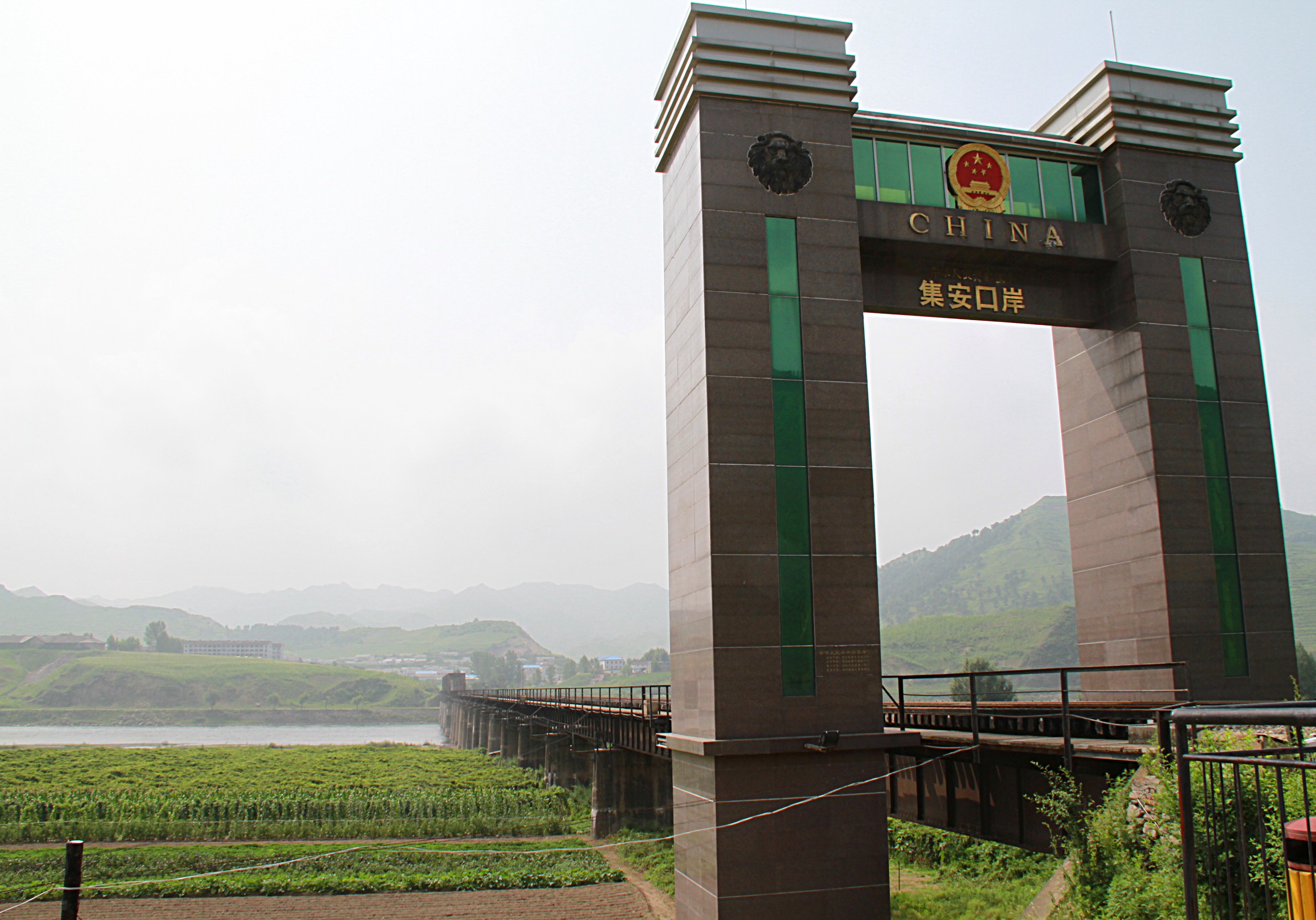
| Ji'an Railway Bridge | Ji'an City, | |||
| Tonghua | Manpo, | |||
| Chagang | No | Yes | Opened | |
| Ji'an Road Bridge | Ji'an City, | |||
| Tonghua | Manpo, | |||
| Chagang | No | No | Opened | |
| Chagang Samgang Railway Bridge | Yunfeng Lake, | |||
| Ji'an, Tonghua | Manpo, | |||
| Chagang | No | Yes | Defunct | |
| Kuunbong Railway Bridge | Yunfeng Lake, | |||
| Ji'an, Tonghua | Chasong, | |||
| Chagang | No | Yes | Defunct | |
| Linjiang Yalu River Bridge | Linjiang City, | |||
| Baishan | Chunggang, | |||
| Chagang | No | No | Opened | |
| Changbai-Hyesan Bridge | Changbai, | |||
| Baishan | Hyesan, | |||
| Ryanggang Province | No | No | Opened | |
| Karim Bridge | Ershidaogou, | |||
| Changbai, Baishan | Pochon, | |||
| Ryanggang | No | No | Defunct | |
| Samjiyon crossing | Erdaobaihe, | |||
| Antu, Yanbian | Samjiyon, | |||
| Ryanggang | No | No | Land Crossing Near Paektu Mountain | |
| Guchengli Bridge | Chongshan, | |||
| Helong, Yanbian | Taehongdan, | |||
| Ryanggang | No | No | Opened | |
| Nanping Bridge | Nanping, | |||
| Helong, Yanbian | Musan, | |||
| North Hamgyong | No | No | Opened | |
| Sanhe Bridge | Sanhe, | |||
| Longjing, Yanbian | Hoeryong, | |||
| North Hamgyong | No | No | Opened | |
| Chaokai Bridge | Kaishantun, | |||
| Longjing, Yanbian | Sambong, | |||
| Onsong, North Hamgyong | No | No | Opened | |
| Tumen Border Railway Bridge | Tumen City, | |||
| Yanbian | Namyang, | |||
| Onsong, North Hamgyong | Yes | Yes | Opened | |
| Tumen Border Road Bridge | Tumen City, | |||
| Yanbian | Namyang, | |||
| Onsong, North Hamgyong | Yes | No | Opened | |
| Liangshui Broken Bridge | Liangshui, | |||
| Tumen, Yanbian | Onsong, | |||
| North Hamgyong | No | No | Defunct | |
| Hunyung Railway Bridges | Ying'an, | |||
| Hunchun, Yanbian | Hunyung, | |||
| Kyongwon, North Hamgyong | No | Yes | Defunct | |
| Shatuozi Bridge | Sanjiazi, | |||
| Hunchun, Yanbian | Kyongwon, | |||
| North Hamgyong | No | No | Opened | |
| Quanhe-Yunting Bridge | Jingxin ({{linktext | 敬信 | 镇}}), | |
| Hunchun, Yanbian | Wonjong, | |||
| Sonbong, | ||||
| Rason | Yes | No |
Border security

In 2005, the border between North Korea and China was described as "porous".
The Chinese government transferred responsibility for managing the border to the army from the police in 2003. Chinese authorities began building wire fences "on major defection routes along the Tumen River" in 2003. Beginning in September 2006, China erected a 20 km fence on the border near Dandong, along stretches of the Yalu River delta with lower banks and narrower width. The concrete and barbed wire fence ranged in height from 8 ft to 15 ft.
In 2007 a U.S. official stated that China was building more "fences and installations at key border outposts". In the same year, it was reported that North Korea had started building a fence along a 10 km stretch of its side of the Yalu River, and had also built a road to guard the area.
In 2011 it was reported that China was building fences 4 m high near Dandong, and that 13 km of this new fencing had been built. It was also reported that China was reinforcing patrols, and that new patrol posts were being built on higher ground to give wider visibility over the area. According to a resident of the area: "It's the first time such strong border fences are being erected here. Looks like it is related to the unstable situation in North Korea." The resident also added that previously "anybody could cross if they really wanted" as the fence had only been 10 ft with no barbed wire.
In 2014, an Australian journalist who visited Dandong reported a low level of border security. In 2015, fencing was reported as the exception rather than the rule. In 2015, a photojournalist who traveled along the Chinese side of the border commented that fencing was rare and that it would be easy to cross the Yalu river when it was frozen. The same report noted friendly contact between people on opposite sides of the border. In 2018, a photojournalist drove along the border and described it as "mile after mile of nothing, guarded by no-one".

Seven people were killed in 2014 by North Korean border guards who had crossed the border in search of money, with locals reporting of North Korean soldiers of crossing the border to commit thefts and murders, especially during winter months when the Tumen River freezes over, allowing for easier access on foot. Later in 2015, a single rogue North Korean soldier killed four ethnic Korean citizens of China who lived along the border of China with North Korea.
Rumours of Chinese troop mobilizations on the border frequently circulate in times of heightened tension on the Korean peninsula. According to scholar Adam Cathcart, these rumours are hard to substantiate and hard to interpret.
A leaked China Mobile document that went viral on Chinese social media on 7 December 2017 allegedly revealed Chinese government plans to construct five "refugee settlement points" along the border to North Korea in Changbai county and Jilin province. This was apparently in preparation for a large influx of North Korean refugees if the Kim regime collapsed in a potential conflict with the United States. The Guardian quoted the document: "Due to cross-border tensions … the [Communist] party committee and government of Changbai county has proposed setting up five refugee camps in the county."
Border control was significantly strengthened in 2020 due to the COVID-19 pandemic. North Korea closed its border with China in January 2020. By August 2020, the regime had established a 1–2 kilometer buffer zone in front of the border where official permits were required to enter; trespassers would be "fired at without warning". In May 2023, newly constructed double walls and guard posts were observed along hundreds of kilometers of the border, according to satellite photos published by Reuters.
Maps
Notes
References
References
- (23 August 2023). "Korea, North".
- (2010). "China-North Korea Relations". [[Congressional Research Service]].
- Rogers, Jenny. "[http://www.goldcoast.com.au/article/2012/10/02/439048_gold-coast-business.html New group reaches out to China] {{Webarchive. link. (2012-10-06 ." ''[[Gold Coast Bulletin]]''. October 2, 2012. Retrieved on October 23, 2012.)
- (2012). "China's Impact on Korean Peninsula Unification and Questions for the Senate". [[U.S. Government Printing Office]].
- (23 April 2007). "Border Disputes between China and North Korea". China Perspectives.
- (2007). "Korea Yearbook, 2007: Politics, Economy and Society". BRILL.
- (2017). "The Journey towards "No Man's Land": Interpreting the China-Korea Borderland within Imperial and Colonial Contexts". The Journal of Asian Studies.
- Caprio, Mark. (2009). "Japanese Assimilation Policies in Colonial Korea, 1910–1945". University of Washington Press.
- Fravel, M. Taylor. (2005-10-01). "Regime Insecurity and International Cooperation: Explaining China's Compromises in Territorial Disputes". International Security.
- Gomà Pinilla, Daniel. (2004-03-01). "Border Disputes between China and North Korea". [[China Perspectives]].
- link. (2017-05-06 ." ''[[The New York Times]]''. October 22, 2006. Retrieved on October 23, 2012.)
- (10 December 2012). "North Korea: On the net in world's most secretive nation (BBC)". BBC News.
- (29 May 2015). "A trip to the North Korea-China border, in photos". [[NK News]].
- Hessler, Peter. (2006). "Oracle Bones". Harper Perennial.
- (4 December 2016). "Thanks for the memory cards; North Koreans return from China".
- "Tracing China-DPRK Border Crossings - Mansudae Korea".
- [https://archive.today/20140527173015/http://www.koreakonsult.com/transsiberian_eng.html "Trans-Siberian Railway Tours"] Accessed 2014-05-25
- (2016-09-26). "North Korea Fast-Tracks Entry Visas For Rason SEZ".
- Foley, James. “China Steps Up Security on North Korean Border”, Jane's Intelligence Review, 1 November 2003.
- Ng Gan Guan, [https://www.washingtonpost.com/wp-dyn/content/article/2006/10/16/AR2006101600289.html China Erects Fence Along N. Korea Border] {{Webarchive. link. (2018-04-28 , Associated Press (October 16, 2006).)
- (13 November 2008). "www.dailynk.com "China Troops Increase at North Korean Border"".
- [https://web.archive.org/web/20071125105433/http://www.edmontonsun.com/News/World/2007/08/27/4449708-sun.html www.edmontonsun.com "North Korea building fence on China border"]
- "Report: N. Korea building fence to keep people in". Houston Chronicle.
- Foster, Peter and agencies, Beijing. "[https://www.telegraph.co.uk/news/worldnews/asia/northkorea/8415490/China-builds-higher-fences-over-fears-of-instability-in-North-Korea.html China builds higher fences over fears of instability in North Korea] {{Webarchive. link. (2018-05-02 ." ''[[The Daily Telegraph]]''. March 30, 2011. Retrieved on October 26, 2012.)
- "[http://www.chinapost.com.tw/china/national-news/2011/03/31/296806/China-boosts.htm China boosts North Korea border fence] {{Webarchive. link. (2014-10-21 ." ''[[The China Post]]''. Thursday March 31, 2011. Retrieved on October 26, 2012.)
- (18 September 2014). "Comment: The absurdities faced by North Korean refugees in China".
- (18 September 2014). "Comment: The absurdities faced by North Korean refugees in China".
- Rob York. (25 February 2015). "The myth of a sealed China-N. Korea border". [[NK News]].
- (29 May 2015). "A trip to the North Korea-China border, in photos". [[NK News]].
- Sagolj, Damir. (15 April 2018). "A road trip on the edge of North Korea". Reuters.
- (April 30, 2015). "North Korean soldiers suspected of China killings".
- (2016-09-20). "Runaway N. Korean soldier kills four Chinese: reports".
- Cathcart, Adam. (20 October 2017). "Tigers in the Haze: Chinese Troops on the Border with North Korea in the 'April Crisis'". China Brief, Jamestown University.
- Feng[1], Liu[2], Mitchell[3], Emily[1], Xinning[2], Tom[3]. (10 December 2017). "US-North Korea tensions fuel fears on Chinese border".
- Perlez, Jane. (2017-12-11). "Fearing the Worst, China Plans Refugee Camps on North Korean Border". The New York Times.
- Phillips, Tom. (2017-12-12). "China building network of refugee camps along border with North Korea". The Guardian.
- (11 September 2020). "North Korea issues shoot-to-kill orders at Chinese border to prevent coronavirus entering: US". The Straits Times.
- (26 February 2021). "North Korea's mistranslated 'shoot-to-kill' border protection order | East Asia Forum".
- (27 May 2023). "North Korea spent the pandemic building a huge border wall". [[Reuters]].
This article was imported from Wikipedia and is available under the Creative Commons Attribution-ShareAlike 4.0 License. Content has been adapted to SurfDoc format. Original contributors can be found on the article history page.
Ask Mako anything about China–North Korea border — get instant answers, deeper analysis, and related topics.
Research with MakoFree with your Surf account
Create a free account to save articles, ask Mako questions, and organize your research.
Sign up freeThis content may have been generated or modified by AI. CloudSurf Software LLC is not responsible for the accuracy, completeness, or reliability of AI-generated content. Always verify important information from primary sources.
Report