From Surf Wiki (app.surf) — the open knowledge base
China–Japan–South Korea trilateral summit
Annual diplomatic meeting
중국총리.고이즈미일본총리와악수.jpg)
Annual diplomatic meeting
| Field | Value | |||
|---|---|---|---|---|
| other_titles | {{unbulleted list | |||
| {{native name | zh | 中日韩领导人会议 | italics | off}} |
| {{native name | ja | 日中韓首脳会談 | italics | off}} |
| {{native name | ko | 한일중 정상회의 | italics | off}} |
| image | China-Japan-Korea.svg | |||
| alt | See caption | |||
| caption | Map of East Asia indicating China (red), Taiwan (pink), Japan (green), South Korea (blue), and North Korea (light blue) | |||
| ----{{Infobox | subbox | yes | ||
| labelstyle | padding-right:1em;text-align:left | |||
| datastyle | text-align:left | |||
| label1 | China | |||
| data1 | CCP General Secretary & President Xi Jinping | |||
| Premier Li Qiang | ||||
| label2 | Japan | |||
| data2 | Prime Minister Sanae Takaichi | |||
| Emperor Naruhito | ||||
| label3 | South Korea | |||
| data3 | President Lee Jae-myung | |||
| Prime Minister Kim Min-seok | ||||
| participants | China, Japan, South Korea | |||
| founded | 2008 | |||
| keypoints |
| zh | ja | ko
Member states and key leaders: ----{{Infobox | subbox = yes Premier Li Qiang Emperor Naruhito Prime Minister Kim Min-seok
The China–Japan–South Korea trilateral summit is an annual summit meeting attended by the People's Republic of China, Japan and South Korea, three major countries in East Asia and the world's second, fourth and 12th largest economies. The first summit was held during December 2008 in Fukuoka, Japan. The talks are focused on maintaining strong trilateral relations, the regional economy and disaster relief.
The summits were first proposed by South Korea in 2004, as a meeting outside the framework of the ASEAN Plus Three, with the three major economies of East Asia having a separate community forum. In November 2007 during the ASEAN Plus Three meeting, the leaders of China, Japan, and South Korea held their eighth meeting, and decided to strengthen political dialogue and consultations between the three countries, eventually deciding on an ad hoc meeting to be held in 2008.
In September 2011, the three countries launched the Trilateral Cooperation Secretariat in Seoul. The secretary-general is appointed on a two-year rotational basis in the order of Korea, Japan, and China. Each country other than that of the secretary-general nominates a deputy secretary-general respectively.
Summits
Leader summits
| Summit | Host Country | Participants | Host City | Date | China Premier | Japan Prime Minister | South Korea President |
|---|---|---|---|---|---|---|---|
| 1st | Japan | Wen Jiabao | Tarō Asō | Lee Myung-bak | Dazaifu | 13 December 2008 | |
| 2nd | China | Wen Jiabao | Yukio Hatoyama | Lee Myung-bak | Beijing | 10 October 2009 | |
| 3rd | South Korea | Wen Jiabao | Yukio Hatoyama | Lee Myung-bak | Jeju | 29 May 2010 | |
| 4th | Japan | Wen Jiabao | Naoto Kan | Lee Myung-bak | Fukushima & Tokyo | 21–22 May 2011 | |
| 5th | China | Wen Jiabao | Yoshihiko Noda | Lee Myung-bak | Beijing | 13–14 May 2012 | |
| 6th | South Korea | Li Keqiang | Shinzō Abe | Park Geun-hye | Seoul | 1 November 2015 | |
| 7th | Japan | Li Keqiang | Shinzō Abe | Moon Jae-in | Tokyo | 9 May 2018 | |
| 8th | China | Li Keqiang | Shinzō Abe | Moon Jae-in | Chengdu | 23–25 December 2019 | |
| 9th | South Korea | Li Qiang | Fumio Kishida | Yoon Suk-yeol | Seoul | 26–27 May 2024 |
Foreign Ministers' Meetings
| Summit | Host Country | Participants | Host City | Date | China | Japan | South Korea |
|---|---|---|---|---|---|---|---|
| 1st | South Korea | Yang Jiechi | Tarō Asō | Song Min-soon | Jeju | 3 June 2007 | |
| 2nd | Japan | Yang Jiechi | Masahiko Kōmura | Yu Myung-hwan | Tokyo | 14 June 2008 | |
| 3rd | China | Yang Jiechi | Katsuya Okada | Yu Myung-hwan | Shanghai | 28 September 2009 | |
| 4th | South Korea | Yang Jiechi | Katsuya Okada | Yu Myung-hwan | Gyeongju | 15 May 2010 | |
| 5th | Japan | Yang Jiechi | Takeaki Matsumoto | Kim Sung-hwan | Kyoto | 19 March 2011 | |
| 6th | China | Yang Jiechi | Kōichirō Genba | Kim Sung-hwan | Ningbo | 8 April 2012 | |
| 7th | South Korea | Wang Yi | Fumio Kishida | Yun Byung-se | Seoul | 21 March 2015 | |
| 8th | Japan | Wang Yi | Fumio Kishida | Yun Byung-se | Kurashiki | 24 August 2016 | |
| 9th | China | Wang Yi | Tarō Kōno | Kang Kyung-wha | Beijing | 21 August 2019 | |
| Special | South Korea | Wang Yi | Toshimitsu Motegi | Kang Kyung-wha | (virtual) | 20 March 2020 | |
| 10th | South Korea | Wang Yi | Yōko Kamikawa | Park Jin | Busan | 26 November 2023 | |
| 11th | Japan | Wang Yi | Takeshi Iwaya | Cho Tae-Yul | Tokyo | 22 March 2025 |
Finance Ministers and Central Bank Governors' Meetings
| Summit | Host country | Host city | Date |
|---|---|---|---|
| 1st | Brunei | Brunei | 9 September 2000 |
| 2nd | China | Shanghai | 11 May 2002 |
| 3rd | Indonesia | Bali | 5 July 2003 |
| 4th | South Korea | Jeju | 16 May 2004 |
| 5th | Turkey | Istanbul | 4 May 2005 |
| 6th | India | Hyderabad | 4 May 2006 |
| 7th | Japan | Tokyo | 4 May 2007 |
| 8th | Spain | Madrid | 4 May 2008 |
| 9th | Indonesia | Bali | 3 May 2009 |
| 10th | Uzbekistan | Tashkent | 2 May 2010 |
| 11th | Vietnam | Hanoi | 4 May 2011 |
| 12th | Philippines | Manila | 3 May 2012 |
| 13th | Australia | Cairns | 19 September 2014 |
| 14th | Azerbaijan | Baku | 3 May 2015 |
| 15th | Peru | Lima | 8 October 2015 |
| 16th | Germany | Frankfurt | 3 May 2016 |
| 17th | Japan | Yokohama | 5 May 2017 |
| 18th | Philippines | Manila | 4 May 2018 |
| 19th | Fiji | Nadi | 2 May 2019 |
| 20th | (virtual) | 18 September 2020 | |
| 21st | 3 May 2021 | ||
| 22nd | 12 May 2022 | ||
| 23rd | South Korea | Incheon | 2 May 2023 |
| 24th | Georgia | Tbilisi | 3 May 2024 |
Economic and Trade Ministers' Meetings
| Summit | Host country | Host city | Date |
|---|---|---|---|
| 1st | Brunei | Brunei | 13 September 2002 |
| 2nd | Cambodia | Phnom Penh | 3 September 2003 |
| 3rd | Indonesia | Jakarta | 4 September 2004 |
| 4th | Philippines | Manila | 9 December 2006 |
| 5th | Singapore | Singapore | 19 November 2007 |
| 6th | Thailand | Hua Hin | 25 October 2009 |
| 7th | South Korea | Seoul | 23 May 2010 |
| 8th | Japan | Tokyo | 24 April 2011 |
| 9th | China | Beijing | 12 May 2012 |
| 10th | South Korea | Seoul | 30 October 2015 |
| 11th | Japan | Tokyo | 26 October 2016 |
| 12th | China | Beijing | 22 December 2019 |
| 13th | South Korea | Seoul | 30 March 2025 |
Health Ministers' Meetings
| Summit | Host country | Host city | Date |
|---|---|---|---|
| 1st | South Korea | Seoul | 8 April 2007 |
| 2nd | China | Beijing | 2 November 2008 |
| 3rd | Japan | Tokyo | 23 November 2009 |
| 4th | South Korea | Jeju | 21 November 2010 |
| 5th | China | Qingdao | 13 November 2011 |
| 6th | South Korea | Seoul | 24 November 2013 |
| 7th | China | Beijing | 23 November 2014 |
| 8th | Japan | Kyoto | 29 November 2015 |
| 9th | South Korea | Busan | 4 December 2016 |
| 10th | China | Jinan | 12 November 2017 |
| 11th | Japan | Kumamoto | 25 November 2018 |
| 12th | South Korea | Seoul | 15 December 2019 |
| Special | (virtual) | 15 May 2020 | |
| 13th | China | (virtual) | 11 December 2020 |
| 14th | Japan | (virtual) | 21 December 2021 |
| 15th | South Korea | (virtual) | 16 December 2022 |
| 16th | China | Beijing | 3 December 2023 |
| 17th | Japan | Tokyo | 15 December 2024 |
Environment Ministers' Meetings
| Summit | Host country | Host city | Date |
|---|---|---|---|
| 1st | South Korea | Seoul | 12 January 1999 |
| 2nd | China | Beijing | 26 February 2000 |
| 3rd | Japan | Tokyo | 7 April 2001 |
| 4th | South Korea | Seoul | 20 April 2002 |
| 5th | China | Beijing | 13 December 2003 |
| 6th | Japan | Tokyo | 4 December 2004 |
| 7th | South Korea | Seoul | 22 October 2005 |
| 8th | China | Beijing | 2 December 2006 |
| 9th | Japan | Toyama | 4 December 2007 |
| 10th | South Korea | Jeju | 1 December 2008 |
| 11th | China | Beijing | 13 June 2009 |
| 12th | Japan | Hokkaido | 22 May 2010 |
| 13th | South Korea | Busan | 28 April 2011 |
| 14th | China | Beijing | 3 May 2012 |
| 15th | Japan | Kitakyushu | 5 May 2013 |
| 16th | South Korea | Daegu | 28 April 2014 |
| 17th | China | Shanghai | 29 April 2015 |
| 18th | Japan | Shizuoka | 27 April 2016 |
| 19th | South Korea | Suwon | 25 August 2017 |
| 20th | China | Suzhou | 24 June 2018 |
| 21st | Japan | Kitakyushu | 23–24 November 2019 |
| 22nd | South Korea | (virtual) | 7 December 2021 |
| 23rd | China | (virtual) | 1 December 2022 |
| 24th | Japan | Nagoya | 4 November 2023 |
| 25th | South Korea | Jeju | 28-29 September 2024 |
Culture Ministers' Meetings
| Summit | Host country | Host city | Date |
|---|---|---|---|
| 1st | China | Nantong | 19–21 September 2007 |
| 2nd | South Korea | Jeju | 24–26 December 2008 |
| 3rd | Japan | Nara | 18–20 January 2011 |
| 4th | China | Shanghai | 5–6 May 2012 |
| 5th | South Korea | Gwangju | 27–28 September 2013 |
| 6th | Japan | Yokohama | 29–30 November 2014 |
| 7th | China | Qingdao | 19–20 December 2015 |
| 8th | South Korea | Jeju | 27–28 August 2016 |
| 9th | Japan | Kyoto | 25–26 August 2017 |
| 10th | China | Harbin | 29–31 August 2018 |
| 11th | South Korea | Incheon | 29–31 August 2019 |
| 12th | Japan | (virtual) | 30 August 2021 |
| 13th | China | (virtual) | 26 August 2022 |
| 14th | South Korea | Jeonju | 7–8 September 2023 |
| 15th | Japan | Kyoto | 12 September 2024 |
Meetings
Such a meeting was first proposed by the Republic of Korea in 2004 (another viewpoint that it should have begun in November 1999, when Zhu Rongji, the Premier of the State Council of the People's Republic of China, Keizo Obuchi, the Prime Minister of Japan, and Kim Dae-jung, the President of the Republic of Korea, held their first trilateral Leaders' Breakfast in the Philippines on the margins of the ASEAN-China Association meeting, thus setting the precedent for the trilateral Leaders to meet within the ASEAN (10+3) framework).
In November 2007, when the leaders of China, Japan and South Korea held their eighth meeting within the framework of ASEAN and China, Japan and South Korea (10+3), they decided to strengthen political dialog and consultation among the three countries and to hold occasional meetings among the leaders of the three countries, and at the meeting of the foreign ministers of the three countries held in June 2008 in Tokyo, but due to the sudden resignation of Japanese Prime Minister Yasuo Fukuda, the meeting was postponed to 13 December 2008.
1st trilateral summit (2008)
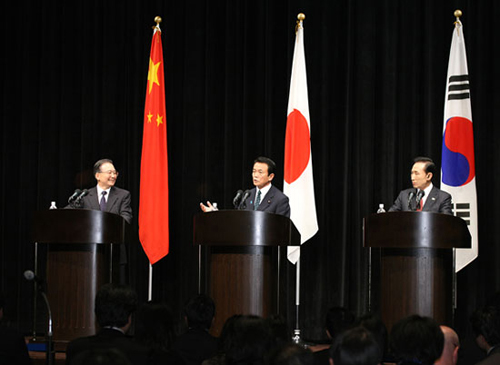
The first separate meeting of the leaders of the three countries was held in Fukuoka, Japan. During the meeting, the "Joint Statement between the three partners" was signed and issued, which identified the direction and principles behind cooperation between China, Japan and South Korea. The conference adopted the "International Financial and Economic Issues Joint Statement", "Disaster Management of the Three Countries Joint Statement" and "Action plan to promote cooperation between China, Japan and South Korea".
One of the topics discussed focused on the improvement of future relations between the three countries, from strategic and long-term perspectives. Prior talks between the three countries have been hindered specifically by various territorial and historical disputes. Chinese premier Wen Jiabao stated that "China is willing to make joint efforts with Japan to continue to develop the strategic and mutually beneficial ties in a healthy and stable manner, to benefit the peoples of the two countries and other nations in the region as well." There is also speculation of a future regional Free trade area. Such co-operation would greatly benefit the three nations, which account for two thirds of total trade, 40% of total population and three quarters of the GDP of Asia (20% of global GDP), during the ongoing economic crisis.
2nd trilateral summit (2009)

The second summit was held in the Great Hall of the People in Beijing. Despite the worries of limitations that the summit has faced in 2008, this all changed in 2009, when Japan, China and Korea were forced to coordinate and cooperate more closely to manage the regional effects of the 2008 financial crisis.
In their joint statement on the crisis, the trio identified the need to cooperate on global issues (such as financial risk) and in global institutions, including at the G20. While a reaction to global events, this cooperation began to significantly affect the management of East Asia. Over the course of 2009, the three nations resolved their long running dispute over contributions (and thus voting weight) in the Chiang Mai Initiatives, the first major 'success' of the ASEAN Plus Three process. The three nations also worked together to push through a general capital increase at the Asian Development Bank to help it fight the effects of the 2008 financial crisis, a decision mandated by the G20 but about which the US appeared ambivalent.
3rd trilateral summit (2010)
.jpg)
The third summit among these three countries was held in Jeju, Korea. The President of Korea, Lee Myung bak hosted the meeting and China's prime minister, Wen Jiabao, Japan's prime minister Yukio Hatoyama attended the meeting. One document called the 2020 Cooperation Prospect was released, which firstly emphasized that the three countries will face up to history and cooperate for the future development. Also, looking forward to the specific goals that should be achieved in the next ten years, this document stressed the importance to concentrate on the cooperation in different fields.
In the progress of institutionalizations and improvements of the partnership, the leaders decided to enhance the communication and strategic mutual trust. The leaders agreed to establish a secretariat in Korea in 2011 to confront the natural disaster, discuss the possibility to build up the 'defense dialogue mechanism', improve the policing cooperation and boost the communication among the government. In terms of sustainable development and common prosperity, the leaders said they would try to complete the survey of the Trilateral Free Trade Area before 2012; improve the trade volume; enhance trade facilitation and they restated that they would attach great importance to the customs cooperation; make efforts to the negotiation about investment agreement and offer necessary infrastructure for the improvement of the free flow of investment capital; enhance the coordination of the financial departments; improve the effectiveness of the multilateral Chiang mai initiate; reject all forms of trade protectionism; improve the cooperation in science and innovation; and strengthen the cooperation and consultation policies in the fields of industry, energy, the energy efficiency and resource.
4th trilateral summit (2011)
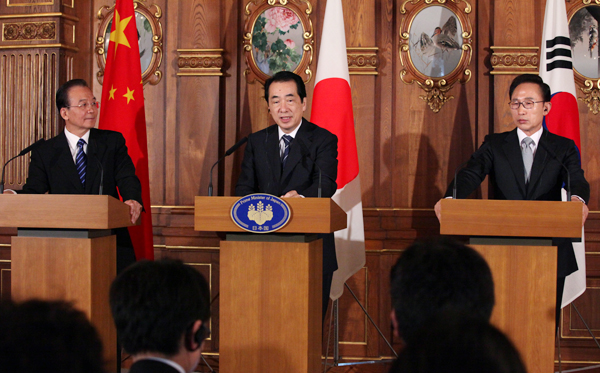
Because the previous three summit meetings covered a wide range of world issues, they did not produce any concrete outcome. There was no agreement on North Korea's nuclear development or on the March and September 2010 incidents involving North Korea. Moreover, although the leaders of the three countries had agreed to set up a permanent secretariat headquartered in Seoul to facilitate trilateral cooperation, it has still not been implemented. The three leaders had also agreed to strengthen mutual understanding and trust, expand cooperation in trade, investment, finance, and environmental protection.
The fourth meeting was held in the wake of the nuclear accident at Fukushima and the natural disaster in Japan. Prime Minister Kan Naoto proposed to hold the summit in Fukushima to convey the message to the world that Fukushima has already become a safe place. The Japanese government hoped that if the heads of the three countries gather in the crisis-stricken city, radiation fears will be mitigated. However, due to logistic problems, the meeting could not be held in Fukushima and instead was held in Tokyo.
While Japan was accused of not providing its neighbours with accurate information when radioactive materials leaked at Fukushima, the summit led to agreement to establish an emergency notification system, enhance cooperation among experts, and share information in the event of emergencies.
5th trilateral summit (2012)
.jpg)
14 May 2012, Leaders from China, Japan, and South Korea concluded the Fifth Trilateral Summit Meeting and signed the Trilateral Agreement for the Promotion, Facilitation and Protection of Investment (hereinafter referred as the Trilateral Agreement) at a summit in Beijing. The Trilateral Agreement represents a stepping stone towards a three-way free trade pact to counter global economic turbulence and to boost economic growth in Asia.
According to a joint declaration, the three nations will further enhance the "future-oriented comprehensive cooperative partnership" to unleash vitality into the economic growth of the three countries, accelerate economic integration in East Asia, and facilitate economic recovery and growth in the world.
In the joint declaration, the three nations list directions and prioritization of future cooperation, which includes enhancing mutual political trust, deepening economic and trade cooperation, promoting sustainable development, expanding social, people-to-people and cultural exchanges, and strengthening communication and coordination in regional and international affairs.
Among all these proposals, the signing of the Trilateral Agreement and the decision to endorse the recommendation from the trade ministers to launch the trilateral FTA negotiations within this year are at the top of the priority list in deepening economic and trade cooperation.
6th trilateral summit (2015)
.jpg)
The 6th trilateral summit was held on 1 November 2015 in Seoul, resuming the summit since 2012 due to varieties of disputes and issues ranging from World War II apologies to territorial disputes among the three nations. During the summit, Chinese Premier Li Keqiang, Japanese Prime Minister Shinzō Abe, and South Korean President Park Geun-hye agreed to meet annually in order to work towards deepening trade relations with the proposed trilateral free trade agreement. They also agreed to pursue the six-party talks over North Korea's nuclear weapons program.
Since 2016, relations between the People's Republic of China and South Korea have deteriorated over the deployment of the South Korean anti-missile system Terminal High Altitude Area Defense. In the same year, South Korean President Park Geun-hye was impeached and suspended from office over the Choi Soon-sil scandal. As a result, the China-Japan-South Korea Leaders' Meeting, which was originally scheduled to be held in early December 2016 in Japan, had to be postponed. The meeting was originally planned to be postponed to 2017 and still be held in Japan, but relations between China and South Korea have deteriorated sharply due to the continued festering of the Terminal High Altitude Area Defense affair. Japan's failure to satisfy the People's Republic of China on the history issue and other issues kept the meeting on the back burner, and the leaders of the three countries did not meet in 2016 or 2017.
7th trilateral summit (2018)

The 7th trilateral summit was held on 9 May 2018 in Tokyo, resuming the summit since 2015. Japanese Prime Minister Shinzo Abe, Premier of the State Council of the People's Republic of China Li Keqiang and South Korean President Moon Jae-in attended the meeting. During his visit to Japan, Li will also attend the 40th anniversary of the conclusion of the Treaty of Peace and Friendship between Japan and China and the "Sino-Japanese Governors' Forum".
8th trilateral summit (2019)

On the morning of 24 December 2019, Premier of the State Council of the People's Republic of China Li Keqiang, South Korean President Moon Jae-in, and Japanese Prime Minister Shinzo Abe attended the 8th China-Japan-South Korea Leaders' Meeting in Chengdu, Sichuan Province, exchanging views on China-Japan-South Korea cooperation, as well as on regional and international issues. In the afternoon of 24 December, Li Keqiang, along with Moon and Abe, attended the Dufu Caotang Museum in Chengdu, Sichuan Province, to mark the China-Japan-South Korea Cooperation. On 25 December, Li and Abe held talks at Mount Qingcheng before visiting the Dujiangyan Water Conservancy Project. At the meeting, the "Outlook for the Next Ten Years of China-Japan-ROK Cooperation" and other outcome documents were also released.
The leaders of the three countries did not meet from 2020 to 2023. This was due to the impact of the COVID-19 pandemic as well as strained Korean–Japanese relations due to the judgment of the Supreme Court of Korea against Japanese companies for compensation in the case of former expelled laborers, with the Japanese government strongly opposing it.
9th trilateral summit (2024)

On 26–27 May 2024, the 9th China-Japan-ROK Leaders' Meeting was held in Seoul, South Korea. Chinese Premier Li Qiang, South Korean President Yoon Suk Yeol and Japanese Prime Minister Fumio Kishida attended the meeting. The three leaders' meeting was the first trilateral talks in more than four years. It comes at a time when South Korea and Japan have been trying to repair ties damaged by historical disputes while deepening their trilateral security partnership with the United States amid heightened Sino-U.S. rivalry. Li Qiang agreed with Yoon Suk Yeol to launch a diplomatic and security dialogue and resume free trade talks, while China and Japan agreed to hold a new round of bilateral high-level economic dialogue at an appropriate time. The three leaders also agreed to designate the year 2025 and 2026 as the China-Japan-South Korea Cultural Exchange Year.
After the meeting, the three leaders joined a business summit aimed at boosting trade between the countries. Some top industry leaders attended the summit.
TCS secretaries-general
Main article: Trilateral Cooperation Secretariat
The Trilateral Cooperation Secretariat (TCS) is an international organization established with a vision to promote peace and common prosperity among China, Japan, and South Korea.
List of TCS secretaries-general:
- Shin Bong-kil South Korea (1 September 2011 – 31 August 2013)
- Rui Matsukawa Japan & Mao Ning China (Deputies)
- Shigeo Iwatani Japan (1 September 2013 – 31 August 2015)
- Chen Feng China & Lee Jong-heon South Korea (Deputies)
- Yang Houlan China (1 September 2015 – 31 August 2017)
- Lee Jong-heon South Korea & Akima Umezawa Japan (Deputies)
- Lee Jong-heon KOR (1 September 2017 – 31 August 2019)
- Yamamoto Yasushi JPN & Han Mei CHN (Deputies)
- Hisashi Michigami Japan (1 September 2019 – 31 August 2021)
- Jing Cao China & Kang Do-ho KOR (Deputies)
- Ou Boqian China (1 September 2021 – 31 August 2023)
- Bek Bum-hym KOR & Sakata Natsuko Japan (Deputies)
- Lee Hee-sup KOR (1 September 2023 – present)
- Zushi Shuji Japan & Yan Liang China (Deputies)
Countries data and comparison
| Name | China | Japan | South Korea | Official name | People's Republic of China | |||||
|---|---|---|---|---|---|---|---|---|---|---|
| (中华人民共和国) | Japan | |||||||||
| (日本) | Republic of Korea | |||||||||
| (대한민국) | ||||||||||
| Coat of arms | [[File:National Emblem of the People's Republic of China (2).svg | 50px]] | [[File:Imperial Seal of Japan.svg | 50px]] | [[File:Emblem of South Korea.svg | 50px]] | ||||
| Flag | PRC | Japan | ROK | |||||||
| Population | 1,404,237,200 | 125,930,000 | 51,780,579 | |||||||
| Area | 9,596,960 | 377,915 | 100,210 | |||||||
| Population Density | 146.3/sq mi | 333.2/sq mi | 516.7/sq mi | |||||||
| Government | Unitary communist state under a system of people's congress | Unitary parliamentary constitutional monarchy | Unitary presidential republic | |||||||
| Formation | 2070 BC (First imperial dynasty) | |||||||||
| 10 October 1911 (Republic declared) | ||||||||||
| 1 October 1949 (People's Republic proclaimed) | 11 February 660 BC (National Foundation Day) | |||||||||
| 3 May 1947 (Current state form) | 3 October 2333 BC (First Korean state) | |||||||||
| 15 August 1945 (Independence and division) | ||||||||||
| 15 August 1948 (Republic declared) | ||||||||||
| Capital | Beijing – 16,446,857 | Tokyo – 9,272,740 | Seoul – 9,904,312 | |||||||
| Largest City | Shanghai – 20,217,748 | |||||||||
| Official language | Standard Chinese (de facto) | Japanese | Korean | |||||||
| Head of State | CCP General Secretary and President Xi Jinping (Chinese Communist Party; 2012–present) | Emperor Naruhito (2019–present) | President Lee Jae-myung (Democratic Party; 2025–present) | |||||||
| Head of Government | Premier Li Qiang (Chinese Communist Party; 2023–present) | Prime Minister Sanae Takaichi (Liberal Democratic Party; 2025–present) | ||||||||
| Currency | Renmin (¥) – RMB | Japanese yen (¥) – JPY | South Korean won (₩) – KRW | |||||||
| Human Development Index | 0.788 75th | 0.920 24th | 0.929 19th |
Demographics
;Largest municipals in China, Japan, & South Korea
| Municipal | Urban population (2010 Census) |
|---|---|
| Shanghai | 20,217,748 |
| Beijing | 16,446,857 |
| Shenzhen | 10,358,381 |
| Guangzhou | 9,702,144 |
| Tianjin | 9,562,255 |
| Chongqing | 8,894,757 |
| Wuhan | 7,541,527 |
| Hong Kong | 7,336,585 |
| Dongguan | 7,271,322 |
| Foshan | 6,771,895 |
| Municipal | Population (2015 Census) |
|---|---|
| Tokyo | 13,491,000 |
| Yokohama | 3,724,844 |
| Osaka | 2,691,185 |
| Nagoya | 2,295,638 |
| Sapporo | 1,952,356 |
| Fukuoka | 1,538,681 |
| Kobe | 1,537,272 |
| Kawasaki | 1,475,213 |
| Kyoto | 1,475,183 |
| Saitama | 1,263,979 |
| Municipal | Population (2015 Census) |
|---|---|
| Seoul | 9,904,312 |
| Busan | 3,448,737 |
| Incheon | 2,890,451 |
| Daegu | 2,466,052 |
| Daejeon | 1,538,394 |
| Gwangju | 1,502,881 |
| Suwon | 1,194,313 |
| Ulsan | 1,166,615 |
| Changwon | 1,059,241 |
| Goyang | 990,073 |
Military
| Country | Active Military | Military Budget | |
|---|---|---|---|
| billions of USD | |||
| (2024) | Military Budget | ||
| % of GDP | |||
| (2024) | |||
| China | 2,183,000 | 314.0 | 1.7 |
| Japan | 247,160 | 55.3 | 1.4 |
| South Korea | 580,000 | 47.6 | 2.6 |
Economy
| Country | Currency | GDP nominal | |||||
|---|---|---|---|---|---|---|---|
| millions of USD | |||||||
| (2025) | GDP PPP | ||||||
| millions of USD | |||||||
| (2025) | GDP nominal per capita | ||||||
| USD | |||||||
| (2025) | GDP PPP per capita | ||||||
| USD | |||||||
| (2025) | Exports | ||||||
| millions of USD | |||||||
| (2024) | Imports | ||||||
| millions of USD | |||||||
| (2024) | International trade | ||||||
| millions of USD | |||||||
| (2024) | |||||||
| China | Chinese yuan | ||||||
| (CNY; 圆; ¥) | 19,398,577 | 41,015,824 | 13,806 | 29,191 | 3,792,950 | 3,219,343 | 7,220,456 |
| Japan | Japanese yen | ||||||
| (JPY; 円; ¥) | 4,279,828 | 6,758,231 | 34,713 | 54,815 | 922,447 | 981,638 | 1,924,341 |
| South Korea | South Korean won | ||||||
| (KRW; 원; ₩) | 1,858,572 | 3,363,419 | 35,962 | 65,080 | 835,148 | 752,670 | 1,616,983 |
Credit ratings
| Country | Fitch | Moody's | S&P |
|---|---|---|---|
| China | A+ | A1 | A+ |
| Japan | A | A1 | A+ |
| South Korea | AA- | Aa2 | AA |
Organization and groups
| Country | G20 | G8 | P5 | G4 | UfC | OECD | SCO | BRICS | BRI | MIKTA | MNNA | APEC | EAS | APT | UN | WTO | IMF | WBG | ISA | IPU | Interpol |
|---|---|---|---|---|---|---|---|---|---|---|---|---|---|---|---|---|---|---|---|---|---|
| China | |||||||||||||||||||||
| Japan | |||||||||||||||||||||
| South Korea |
Airport traffic
;Top busiest airports by passenger traffic (2019)
| Country | Airport | Total passengers |
|---|---|---|
| China | Beijing Capital International Airport | 100,011,000 |
| Japan | Tokyo International Airport | 85,505,054 |
| South Korea | Incheon International Airport | 71,169,516 |
;Top busiest airports by international passenger traffic (2018)
| Country | Airport | Total passengers |
|---|---|---|
| China | Hong Kong International Airport | 74,360,976 |
| South Korea | Incheon International Airport | 67,676,147 |
| Japan | Narita International Airport | 35,300,076 |
;Top busiest airports by cargo traffic (2019)
| Country | Airport | Total passengers |
|---|---|---|
| China | Hong Kong International Airport | 4,809,485 |
| South Korea | Incheon International Airport | 2,764,369 |
| Japan | Narita International Airport | 2,104,063 |
;Top busiest city airport systems by passenger traffic (2018)
| Country | Airport | Total passengers |
|---|---|---|
| Japan | Tokyo: Narita, Haneda, & Chōfu | 130,589,705 |
| China | Shanghai: Pudong & Hongqiao | 117,636,331 |
| South Korea | Seoul: Incheon & Gimpo | 92,953,372 |
Notes
References
References
- (13 December 2008). "Chinese, Japanese PMs meet for boosting bilateral ties".
- [https://web.archive.org/web/20121023081412/http://news.xinhuanet.com/english/2008-12/13/content_10499574.htm Chinese, Japanese PMs meet, pledge to boost bilateral ties]
- [http://news.xinhuanet.com/english/2008-12/09/content_10479144.htm China expects positive result at upcoming meeting with ROK, Japan ] {{webarchive. link. (11 December 2008)
- [https://www.youtube.com/watch?v=T1CiRGpo3cM CCTV-9 English News, broadcast 13 December 2008]
- [http://news.xinhuanet.com/english/2008-12/13/content_10499644.htm China, Japan, S Korea to promote co-op on disaster management ] {{webarchive. link. (11 January 2009)
- (2003). "中国周边安全环境透视". [[China Youth Publishing House]].
- (2016). "當代日本外交". 五南.
- 等许利平. (2016). "中国与周边命运共同体:构建与路径". 社會科學文獻出版社當代世界出版分社.
- [http://malaysia.news.yahoo.com/rtrs/20081211/tbs-japan-china-korea-21231dd_2.html Japan, South Korea, China: trilateral ties, tensions - Yahoo! Malaysia]
- Japanese prime minister [[Tarō Asō]] also expressed that he believed the best manner in dealing with the [[Great Recession. economic crisis of 2008]] was economic partnership.[http://news.xinhuanet.com/english/2008-12/13/content_10499616.htm China, Japan, S Korea agree to enhance systematic co-op] {{webarchive. link. (12 January 2009)
- [http://www.chinadaily.com.cn/cndy/2008-12/12/content_7296881.htm Regional summit to tackle crisis - Chinadaily]
- [http://www.southchinasea.org/docs/ASEAN-China%20Relations.pdf ASEAN-China Relations] {{webarchive. link. (4 March 2009)
- SBS World News Australia, 14 December 2008
- Joel Rathus. (15 June 2010). "China-Japan-Korea trilateral cooperation and the East Asian Community". EAST ASIA FORUM.
- Rajaram Panda and Pranamita Baruah. "Japan-China-South Korea Trilateral Summit Meet Holds Promise". Institute for defence studies and analysis.
- Xiaolei Gu. (14 May 2012). "China-Japan-South Korea Sign Trilateral Agreement and Launch FTA Talks". CHINA BRIEFING.
- (1 November 2015). "China, Japan and South Korea Pledge to Expand Trade at Joint Meeting". [[The New York Times]].
- (1 November 2015). "S Korea, Japan and China agree to push for N Korea nuclear talks". [[Financial Times]].
- (2017). "中国周边外交发展报告(2016)". [[Social Sciences Literature Press]].
- Tomohiro Osaki. [https://www.japantimes.co.jp/news/2018/05/09/national/politics-diplomacy/japan-hosts-leaders-china-south-korea-summit-north-korea/ Japan, China and South Korea are 'in sync' on North Korea, Japanese official says]. Japan Times, 9 May 2018
- (2022). "中国-东北亚国家年鉴(2019)". [[Social Sciences Literature Press]]·群学出版分社.
- (2019-12-24). "韩中日领导人纪念三国合作20周年".
- (2019-12-24). "中日韩合作未来十年展望(全文)-新华网".
- (2024-05-27). "中、日、韓週一啟動2019年以來首次三方領導人會晤".
- (2024-05-26). "中日韩领导人在中日三边会谈前会面".
- (2024-05-26). "China talks security, business with U.S.-allied South Korea, Japan". [[Reuters]].
- (2024-05-27). "China, Japan, S Korea to designate 2025-2026 as cultural exchange year". [[China Daily]].
- (2024-05-27). "South Korea, China, Japan pledge to ramp up cooperation in rare summit". [[France 24]].
- (2007). "Demographic Yearbook—Table 3: Population by sex, rate of population increase, surface area and density". UN Statistics.
- "China".
- (2012-01-29). "The world's biggest cities: How do you measure them?". [[BBC]].
This article was imported from Wikipedia and is available under the Creative Commons Attribution-ShareAlike 4.0 License. Content has been adapted to SurfDoc format. Original contributors can be found on the article history page.
Ask Mako anything about China–Japan–South Korea trilateral summit — get instant answers, deeper analysis, and related topics.
Research with MakoFree with your Surf account
Create a free account to save articles, ask Mako questions, and organize your research.
Sign up freeThis content may have been generated or modified by AI. CloudSurf Software LLC is not responsible for the accuracy, completeness, or reliability of AI-generated content. Always verify important information from primary sources.
Report