From Surf Wiki (app.surf) — the open knowledge base
China–India relations
Bilateral relations
.jpg)
Bilateral relations
China and India maintained peaceful relations for thousands of years, but their relationship has varied since the Chinese Communist Party (CCP)'s victory in the Chinese Civil War in 1949 and the annexation of Tibet by the People's Republic of China. The two nations have sought economic cooperation with each other, while frequent border disputes and economic nationalism in both countries are major points of contention.
Cultural and economic relations between China and India date back to ancient times. The Silk Road not only served as a major trade route between India and China, but is also credited for facilitating the spread of Buddhism from India to East Asia. During the 19th century, China was involved in a growing opium trade with the East India Company, which exported opium grown in India. During World War II, both British India and the Republic of China (ROC) played a crucial role in halting the progress of Imperial Japan. After India became independent in 1947, it established relations with the ROC. The modern Sino-Indian diplomatic relationship began in 1950, when India was among the first noncommunist countries to end formal relations with the Republic of China and recognise the PRC as the legitimate government of both Mainland China and Taiwan. China and India are two of the major regional powers in Asia, and are the two most populous countries and among the fastest growing major economies in the world.
Growth in diplomatic and economic influence has increased the significance of their bilateral relationship. Between 2008 and 2021, China was India's largest trading partner, and the two countries have extended their strategic and military relations. However, conflict of interest leads to hostility. India has a large trade deficit that is favoured towards China. The two countries failed to resolve their border dispute and Indian media outlets have repeatedly reported Chinese military incursions into Indian territory. And relations between contemporary China and India have been characterised by border disputes, resulting in three military conflicts – the Sino-Indian War of 1962, the border clashes in Nathu La and Cho La in 1967, and the 1987 Sumdorong Chu standoff. Since the late 1980s, both countries have successfully rebuilt diplomatic and economic ties.
Since 2013, border disputes have reemerged to take centre stage in the two countries' mutual relations. In early 2018, the two armies got engaged in a standoff at the Doklam plateau along the disputed Bhutan-China border. Since summer 2020, armed standoffs and skirmishes at multiple locations along the entire Sino-Indian border escalated. A serious clash occurred in the Galwan Valley, resulting in the death of 20 Indian soldiers and many Chinese soldiers. Both countries have steadily established military infrastructure along border areas, including amidst the 2020 China–India skirmishes. Additionally, India remains wary about China's strong strategic bilateral relations with Pakistan, and China's relations to separatist groups in Northeast India, while China has expressed concerns about Indian military and economic activities in the disputed South China Sea as well as hosting of anti-China activity from Tibetan exiles. Today, the South Asian region is the premier site of intensified great power competition between China and India.
Geopolitical overview
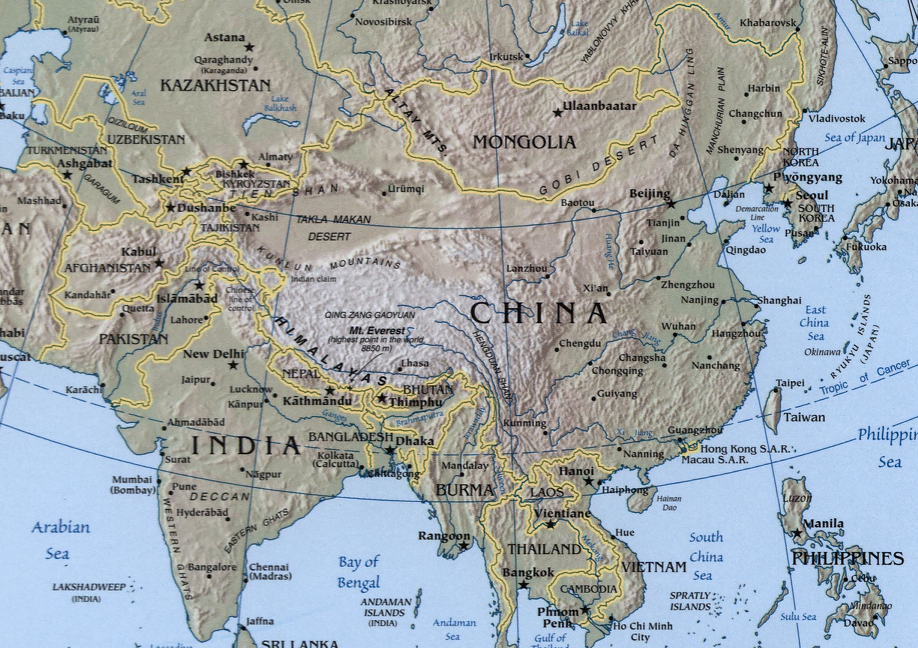
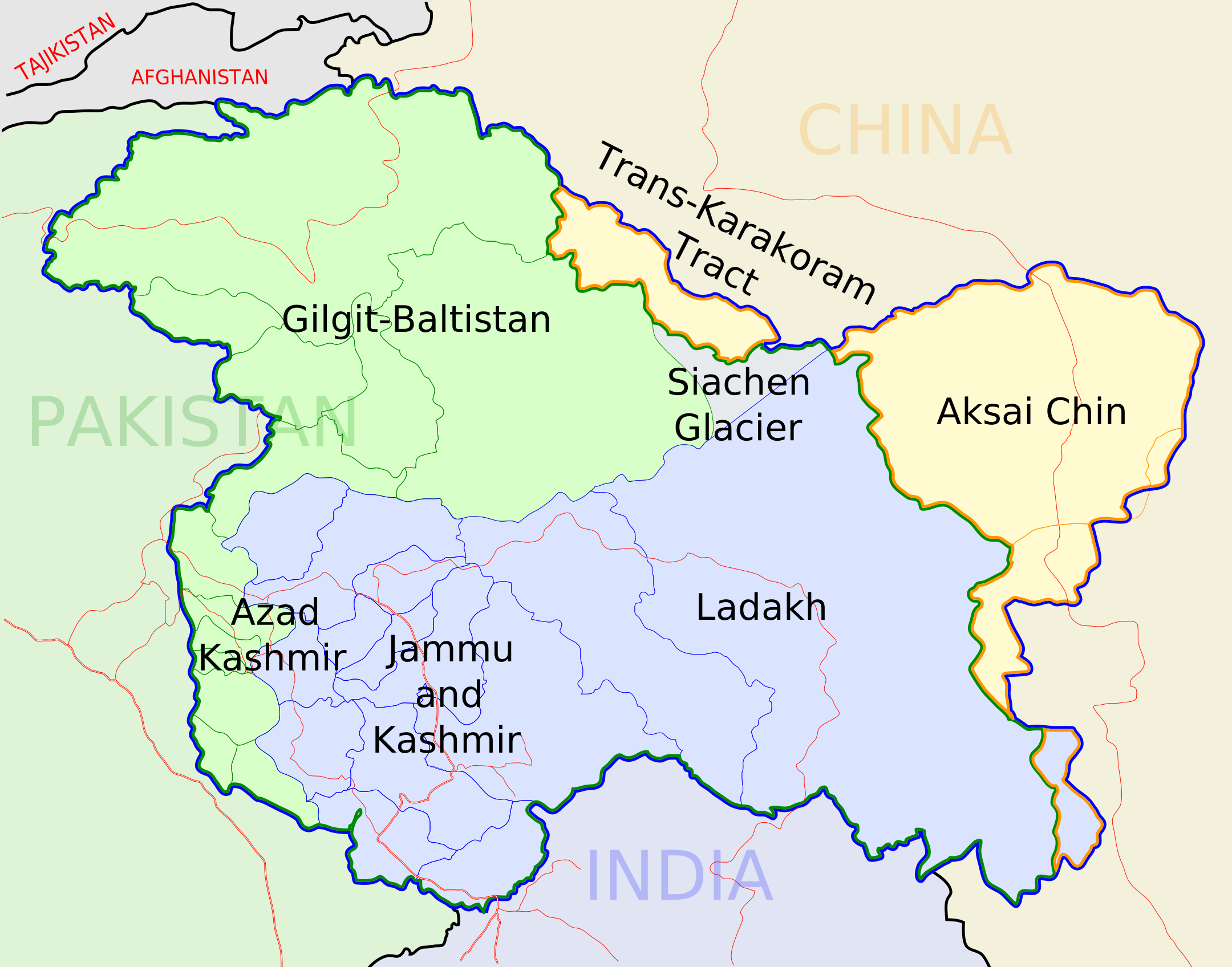
The China–India border straddles the Himalayas, with Nepal and Bhutan acting as buffer states. Parts of the disputed Kashmir region claimed by India (J&K and Ladakh) are claimed and administered by either Pakistan (Azad Kashmir and Gilgit Baltistan) or by the PRC (Aksai Chin). The Government of Pakistan, on its maps, shows the Aksai Chin area as mostly within China and labels the boundary "Frontier Undefined", while India holds that Aksai Chin is illegally occupied by the PRC. China and India also dispute most of Arunachal Pradesh.
Not only is China's India policy shaped by greater competition with the United States, but there are also real structural issues in India-China relations that exacerbate discord. These stem largely from China's attempts to keep India at arm's length in the Indo-Pacific region. There are clear differences in the regional order in Asia that the two countries desire—India seeks a multipolar order, of which India is one of the main poles, while China seeks a single pole, of which India is not a pole at all.
As India strengthens its security ties with the United States and takes a leading role in organizing the Global South, tensions with China persist. China's engagement with India's neighbors and growing military cooperation with Pakistan further strain India's geopolitical landscape. In this volatile landscape, Sino-Indian relations seek a delicate balance between pragmatic economic interests and escalating geopolitical tensions.
History
Main article: History of China–India relations
Antiquity

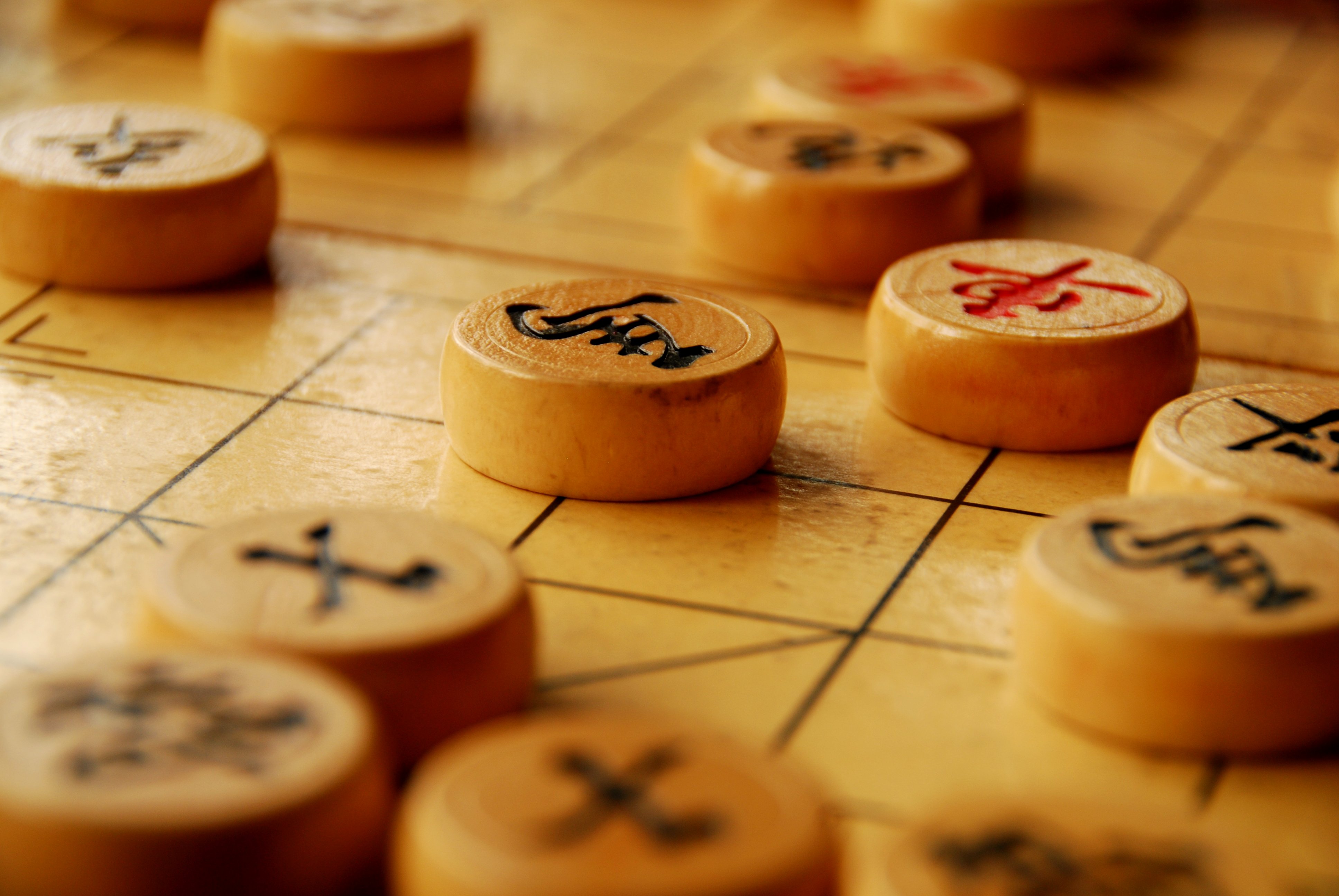
China and India have also had some contact before the transmission of Buddhism. References to a people called the Chinas, are found in ancient Indian literature. The Indian epic Mahabharata (c. 5th century BCE) contains references to "China", which may have been referring to the Qin state which later became the Qin dynasty. Chanakya (c. 350–283 BCE), the prime minister of the Maurya Empire, refers to Chinese silk as "cinamsuka" (Chinese silk dress) and "cinapatta" (Chinese silk bundle) in his Arthashastra.
Buddhism was transmitted from India to China in the 1st century CE. Trade relations via the Silk Road acted as economic contact between the two regions.
Middle Ages
_in_The_Gathering_of_Kings_(王会图)_circa_650_CE.jpg)
From the 1st century onwards, many Indian scholars and monks traveled to China, such as Batuo (fl. 464–495 CE)—first abbot of the Shaolin Monastery—and Bodhidharma—founder of Chan/Zen Buddhism—while many Chinese scholars and monks also traveled to India, such as Xuanzang (b. 604) and I Ching (635–713), both of whom were students at Nalanda University in Bihar.
Tang and Harsha dynasties
During the 7th century, Tang dynasty China gained control over large portions of the Silk Road and Central Asia. In 649, the Chinese general Wang Xuance, along with thousands of recruited Tibetan and Nepalese troops, briefly invaded North India and won the battle.
During the 8th century, the astronomical table of sines by the Indian astronomer and mathematician, Aryabhatta (476–550), were translated into the Chinese astronomical and mathematical book of the Treatise on Astrology of the Kaiyuan Era (Kaiyuan Zhanjing), compiled in 718 CE during the Tang dynasty. The Kaiyuan Zhanjing was compiled by Gautama Siddha, an astronomer and astrologer born in Chang'an, and whose family was originally from India. He was also notable for his translation of the Navagraha calendar into Chinese.
Yuan dynasty
Tamil Hindu Indian merchants traded in Quanzhou during the Yuan dynasty. Hindu statues were found in Quanzhou dating to this period.
According to Badauni and Ferishta, the Delhi Sultanate under Muhammad bin Tughluq had ambitions to invade China. There existed a direct trade relationship between China and the Delhi Sultanate. Ibn Battuta mentions that the Yuan Emperor had sent an embassy to Muhammad for reconstruction of a sacked temple at Sambhal.
Ming dynasty

Between 1405 and 1433, Ming dynasty China sponsored a series of seven naval expeditions led by Admiral Zheng He. Zheng He visited numerous Indian kingdoms and ports, including the Malabar coast, Bengal, and Ceylon, the Persian Gulf, Arabia, and later expeditions ventured down as far as Malindi in what is now Kenya. Throughout his travels, Zheng He liberally dispensed Chinese gifts of silk, porcelain, and other goods. In return, he received rich and unusual presents, including African zebras and giraffes. After the Ming treasure voyages, private Chinese traders continued operating in the eastern Indian Ocean. Chinese junks could frequently be seen in the ports of the Vijayanagara Empire, carrying silks and other products.
Qing dynasty
The Bhois of Orissa maintained minor maritime trade links with China. Many of the gosains entering Tibet from China passed through the territory of Birakisore Deva I of Khurda (1736–1793) who styled himself as Gajapati, the ruler of Utkala, when visiting the Jagannath temple at Puri.
The reign of Tipu Sultan in Mysore saw Chinese technology used for sugar production, and sandalwood was exported to China. Tipu's and Mysore's tryst with silk began in the early 1780s when he received a silk cloth from an ambassador from the Qing dynasty-ruled China at his court. Tipu was said to be enchanted by the item to such an extent that he resolved to introduce its production in his kingdom. He sent a return journey to China, which returned after twelve years.
After the Qing expansion into the Himalayas, there was increased contact with South Asia, which often manifested in the form of tributary relations. The Qing were obliged to defend their subservient state, Badakhshan, against the Afghans and Marathas, though no major clash with the Marathas ever took place. The Afghans gained the initiative and defeated the Marathas at Panipat in 1761. The battle's outcome was used by the Afghans to intimidate the Qing.

Sino-Sikh War
Main article: Sino-Sikh war
In the 18th to 19th centuries, the Sikh Empire expanded into neighbouring lands. It had annexed Ladakh into the state of Jammu in 1834. In 1841, they had some conflicts with Chinese forces; neither side wished to continue the conflict, as the Sikhs were embroiled in tensions with the British that would lead up to the First Anglo-Sikh War, while the Chinese were in the midst of the First Opium War. The Sikhs claimed victory. The two parties signed a treaty in September 1842, which stipulated no transgressions or interference in the other country's frontiers.
British Raj

Indian soldiers, known as "sepoys", who were in British service participated in the First and Second Opium Wars against Qing China. Indian sepoys were also involved in the suppression of the Boxer Rebellion in 1900, in addition to serving as guards in the British colony of Hong Kong and foreign concessions such as the Shanghai International Settlement. The Chinese slur "Yindu A San " (印度阿三 - Indian number three) was used to describe Indian soldiers in British service, with some of the popular sentiment rejecting the possibility for Sino-Indian fraternity.
Republic of China
In 1924, on his major tour of several major Chinese cities, giving lectures about using their shared Asian values and traditional spirituality to help together promote world peace, Rabindranath Tagore was invited to Canton by Sun Yat-sen, an invitation which he declined. There was considerably mixed reception to Tagore from the Chinese students and intellectuals. Hu Shih, the Chinese ambassador to the United States from 1938 to 1942, commented, albeit critically, on India's Buddhism almost completely subsuming Chinese society upon its introduction.
ASIA is one. The Himalayas divide, only to accentuate, two mighty civilizations, the Chinese with its communism of Confucius, and the Indian with its individualism of the Vedas. But not even the snowy barriers can interrupt for one moment that broad expanse of love for the Ultimate and Universal, which is the common thought-inheritance of every Asiatic race, enabling them to produce all the great religions of the world and distinguishing them from those maritime peoples of the Mediterranean and the Baltic, who love to dwell on the Particular, and to search out the means, not the end, of life.

While never having actually visited India in his lifetime, Sun Yat-sen, founder of the Republic of China, occasionally spoke and wrote of India as a fellow Asian nation that was likewise subject to harsh Western exploitation, and frequently called for a Pan-Asian united front against all unjust imperialism. Similarly, believing that then-Republican China and British India were "sister nations from the dawn of history" who needed to transform their "ancient friendship into a new camaraderie of two freedom-loving nations", Jawaharlal Nehru visited China in 1939 as an honored guest of the government. Highly praising both Chiang Kai-shek and his wife Song Meiling, Nehru referred to Chiang as "not only a great Chinese, but a great Asiatic and world figure...one of the top most leaders of the world...a successful general and captain in war", and Song as "full of vitality and charm...a star hope for the Chinese people...a symbol of China's invincibility". Chiang recorded a favorable impression of Nehru in his diary, and the Chiangs also regularly wrote Nehru during his time in prison and even after their 1942 visit to India.

Partially to enlist India's aid against both Japanese and Western imperialism in exchange for China's support for Indian independence, the Chiangs visited British India in 1942 and met with Nehru, Mahatma Gandhi, and Muhammad Ali Jinnah. The Chiangs also sought to present their nation as a potential third option for the Indian people to ally themselves with, with public sympathies at the time sharply split between the British and the Japanese, who actively tried to sway India's population with pledges to liberate Asia if they would help their efforts against the British. While the public reception to the Chiangs was mostly positive, some reacted less favorably to the Chiangs' presence in India, with Jinnah believing that Chiang Kai-shek lacked proper understanding of Indian society and feeling he was biased in favor of Nehru and Gandhi while neglecting the demands of other religious communities. For his part, Chiang apparently believed none of the major Indian leaders could help his government meaningfully. Nevertheless, the Chiangs continued to commit themselves to supporting the Indian independence movement from afar, mostly via diplomacy, with Song Meiling writing to Nehru encouragingly: "We shall leave nothing undone in assisting you to gain freedom and independence."
In 1942, a division of the Kuomintang's armies entered India as the Chinese Army in India in their struggle against Japanese expansion in Southeast Asia.
Post independence
On 15 August 1947, India gained independence from the United Kingdom. The newly independent India established diplomatic relations with the ROC. On 1 October 1949, the Chinese People's Liberation Army defeated the Kuomintang (the ROC's ruling Nationalist Party) and took over Mainland China, establishing the PRC. Soon afterwards, India became a federal, democratic republic after its constitution came into effect on 26 January 1950.
1950s
The relationship between India and a newly communist China started out on an optimistic note. Jawaharlal Nehru, the first prime minister of India, and PRC premier Zhou Enlai articulated a vision of an internationalist foreign policy governed by the ethics of the Panchsheel (Five Principles of Peaceful Coexistence). However, there was notable skepticism on the Indian side from the very beginning about Chinese intentions. For example, Bhimrao Ambedkar was surprised that Nehru took Panchsheel seriously, while Acharya Kriplani said that Panchsheel was "born in sin". Nehru himself was disappointed when it became clear that the two countries had a conflict of interest in Tibet, which had traditionally served as a buffer zone. From the Chinese side, strategists were concerned about the possibility of India continuing to spread its dominance in Asia and the Indian Ocean in the manner of British India.
China viewed Tibet as a part of its territory. The preceding government of the Republic of China under Chiang Kai-shek also claimed Tibet as Chinese territory. However, he was unable to re-assert control. Chairman of the Chinese Communist Party Mao Zedong saw Indian concern over Tibet as a manifestation of interference in the internal affairs of the PRC. The PRC reasserted control over Tibet and to end Tibetan Buddhism and feudalism, which it did by force of arms in 1950. To avoid antagonizing the PRC, Nehru informed Chinese leaders that India had no political ambitions or territorial ambitions and did not seek special privileges in Tibet, but that traditional trading rights must continue. With Indian support, Tibetan delegates signed an agreement in May 1951 recognizing PRC sovereignty but guaranteeing that the existing political and social system of Tibet would continue.
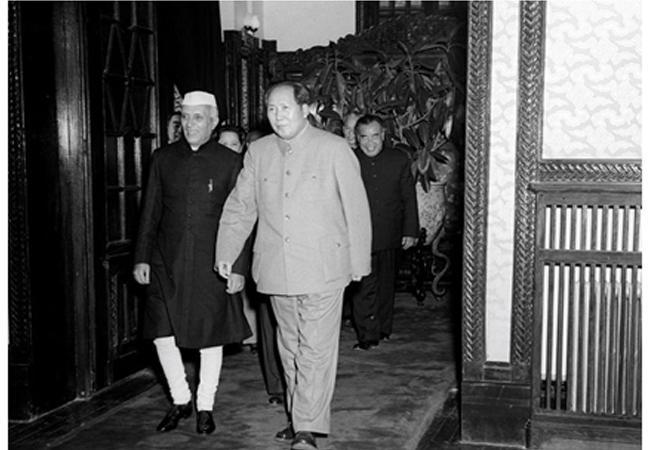
In April 1954, India and the PRC signed an eight-year agreement on Tibet that became the Five Principles of Peaceful Coexistence (or Panchsheel). Jawaharlal Nehru of India, during the latter's state visit to China, October 1954.]]In October 1954, China and India signed an agreement regarding Tibet, whereby India recognised Tibet as part of China, with China accepting the continuance of the previous trade arrangements. Observers noted the agreement heavily favored China.
It is the popular perception that the catchphrase of India's diplomacy with China in the 1950s was Hindi-Chini bhai-bhai, which means, in Hindi, "Indians and Chinese are brothers". Nehru sought to initiate a more direct dialogue between the peoples of China and India in culture and literature. Around then, the Indian artist (painter) Beohar Rammanohar Sinha, who had earlier decorated the pages of the original Constitution of India, was sent to China in 1957 on a Government of India fellowship to establish a direct cross-cultural and inter-civilization bridge. Noted Indian scholar Rahul Sankrityayan and diplomat Natwar Singh were also there, and Sarvapalli Radhakrishnan paid a visit to the PRC.
After signing the 1954 agreement, India published new maps showing defined borders, as it became apprehensive that China might make claims on Indian territory. Two major territorial disputes existed between China and India, which remained dormant until 1959. In the northeast, Indian territory included the Assam Himalayan region up to the McMahon Line, which China did not recognise as a legal boundary. In the western sector, Indian territory inherited from the British Raj included the Aksai Chin plateau, which Chinese maps started showing as Chinese territory in the 1940s, if not earlier. When India discovered that China built a road through the region, border clashes and Indian protests became more frequent. In January 1959, PRC premier Zhou Enlai wrote to Nehru, pointing out that no government in China had accepted as legal the McMahon Line, which the 1914 Simla Convention defined as the eastern section of the border between India and Tibet.
In March 1959, the Dalai Lama, spiritual and temporal head of the Tibet, sought sanctuary in Dharmsala, Himachal Pradesh, where he established the Tibetan government-in-exile. Thousands of Tibetan refugees settled in northwestern India. Relations between India and China deteriorated after India provided the Dalai Lama sanctuary.
1960s
Main article: Sino-Indian War, 1967 Nathu La and Cho La clashes, 1987 Sino-Indian skirmish
Nathu La incident[[File:India disputed areas map.svg|thumb|[[List of disputed territories of India|Disputed territories of India]]]] Border disputes resulted in a short border war between the People's Republic of China and India on 20 October 1962. The border clash resulted in an overall defeat of India as the PRC pushed the Indian forces to within 48 km of the Assam plains in the northeast. It also occupied strategic points in the Aksai Chin and Demchok regions of Ladakh, before declaring a unilateral ceasefire on 21 November. It claimed that it withdrew to 20 km behind its contended line of control. India disagreed with the claim.
During the Sino-Indian border conflict, India's Communist Party was accused by the Indian government of being pro-PRC, and many of its political leaders were jailed. Subsequently, the Communist Party of India (CPI) split with the leftist section, forming the Communist Party of India (Marxist) in 1964.
Relations between the PRC and India deteriorated during the rest of the 1960s and the early 1970s, while China–Pakistan relations improved and Sino-Soviet relations worsened. The PRC backed Pakistan in its 1965 war with India, and issued "ultimatums" threatening military action at its own border. The threats only served to damage Pakistan's relations with the western powers. In late 1967, there were two more conflicts between Indian and Chinese forces at their contested border, in Sikkim, known as the Nathu La and Cho La clashes. Both sides suffered heavy casualties, but India came out in a better position than the PRC.[[File:1967-09 1967年 北京举行抗议印度的示威游行.jpg|thumb|right|300px|Chinese demonstrations against Indian "[[reactionary]] factions" in Beijing in 1967.]]The PRC continued an active propaganda campaign against India and supplied ideological, financial, and other assistance to dissident groups, especially to tribes in northeastern India. The PRC accused India of assisting the Khampa rebels in Tibet. Sri Lanka played the role of chief negotiator for the withdrawal of Chinese troops from the Indian territory. Both countries agreed to Colombo's proposals.
1970s
In August 1971, India signed a Treaty of Peace, Friendship, and Co-operation with the Soviet Union. The PRC sided with Pakistan in its December 1971 war with India. Although China strongly condemned India, it did not carry out its veiled threat to intervene on Pakistan's behalf. By this time, the PRC had replaced the Republic of China in the UN, where its representatives denounced India as being a "tool of Soviet expansionism."
India and the PRC renewed efforts to improve relations after Indian Prime Minister Indira Gandhi's Congress party lost the 1977 elections to Morarji Desai's Janata Party. In 1978, the Indian Minister of External Affairs Atal Bihari Vajpayee made a landmark visit to Beijing, an impetus to both countries to officially re-establish diplomatic relations in 1979. The PRC modified its pro-Pakistan stand on Kashmir and appeared willing to remain silent on India's absorption of Sikkim and its special advisory relationship with Bhutan. The PRC's leaders agreed to discuss the boundary issue, India's priority, as the first step to a broadening of relations. The two countries hosted each other's news agencies, and Mount Kailash and Mansarowar Lake in Tibet, the home of the Hindu pantheon, were opened to annual pilgrimages.
1980s
In 1981, the Minister of Foreign Affairs of the People's Republic of China, Huang Hua, made a landmark visit to New Delhi. PRC Premier Zhao Ziyang concurrently toured Pakistan, Nepal, and Bangladesh.
In 1980, Indian Prime Minister Indira Gandhi approved a plan to upgrade the deployment of forces around the Line of Actual Control. India also undertook infrastructural development in disputed areas. In 1984, squads of Indian soldiers began actively patrolling the Sumdorong Chu Valley in Arunachal Pradesh. In the winter of 1986, the Chinese deployed their troops to the Sumdorong Chu before the Indian team could arrive and built a helipad at Wandung. Surprised by the Chinese occupation, India's then Chief of Army Staff, General K.Sundarji, airlifted a brigade to the region. Chinese troops could not move any further into the valley and were forced to move away from the valley. By 1987, Beijing's reaction was similar to that in 1962 and this prompted many Western diplomats to predict war. However, Indian foreign minister N.D. Tiwari and Prime Minister Rajiv Gandhi travelled to Beijing to negotiate a mutual de-escalation.
India and the PRC held eight rounds of border negotiations between December 1981 and November 1987. In 1985, the PRC insisted on mutual concessions without defining the exact terms of its "package proposal" or where the actual line of control lay. In 1986 and 1987, the negotiations achieved nothing, given the charges exchanged between the two countries of military encroachment in the Sumdorung Chu Valley. China's construction of a military post and helicopter pad in the area in 1986 and India's grant of statehood to Arunachal Pradesh (formerly the North-East Frontier Agency) in February 1987 caused both sides to deploy troops to the area. The PRC relayed warnings that it would "teach India a lesson" if it did not cease "nibbling" at Chinese territory. By the summer of 1987, however, both sides had backed away from conflict and denied military clashes had taken place.
A warming trend in relations was facilitated by Rajiv Gandhi's visit to China in December 1988. The two sides issued a joint communiqué that stressed the need to restore friendly relations on the basis of the Panchsheel. India and the People's Republic of China agreed to achieve a "fair and reasonable settlement while seeking a mutually acceptable solution" to the border dispute. The communiqué also expressed China's concern about agitation by Tibetan separatists in India and reiterated that anti-China political activities by expatriate Tibetans would not be tolerated. Rajiv Gandhi signed bilateral agreements on science and technology co-operation, established direct air links, and on cultural exchanges. The two sides also agreed to hold annual diplomatic consultations between foreign ministers, set up a joint committee on economic and scientific co-operation, and a joint working group on the boundary issue. The latter group was to be led by the Indian foreign secretary and the Chinese vice minister of foreign affairs.
1990s
Top-level dialogue continued with the December 1991 visit of PRC premier Li Peng to India and the May 1992 visit to China of Indian president R. Venkataraman. Six rounds of talks of the Indian-Chinese Joint Working Group on the Border Issue were held between December 1988 and June 1993. Progress was also made in reducing tensions on the border via mutual troop reductions, regular meetings of local military commanders, and advance notification about military exercises. In July 1992, Sharad Pawar visited Beijing, the first Indian Minister of Defence to do so. Consulates reopened in Bombay (Mumbai) and Shanghai in December 1992.
In 1993, the sixth-round of the joint working group talks was held in New Delhi but resulted in only minor developments. Prime Minister Narasimha Rao and Premier Li Peng signed a border agreement dealing with cross-border trade, cooperation on environmental issues (e.g. Pollution, Animal extinction, Global warming, etc.), and radio and television broadcasting. A senior-level Chinese military delegation made a goodwill visit to India in December 1993 aimed at "fostering confidence-building measures between the defence forces of the two countries." The visit, however, came at a time when China was providing greater military support to Burma. The presence of Chinese radar technicians in Burma's Coco Islands, which border India's Andaman and Nicobar Islands, caused concern in India.
In January 1994, Beijing announced that it not only favored a negotiated solution on Kashmir, but also opposed any form of independence for the region. Talks were held in New Delhi in February aimed at confirming established "confidence-building measures", discussing clarification of the "line of actual control", reduction of armed forces along the line, and prior information about forthcoming military exercises. China's hope for settlement of the boundary issue was reiterated.
In 1995, talks by the India-China Expert Group led to an agreement to set up two additional points of contact along the 4,000 km border to facilitate meetings between military personnel. The two sides were reportedly "seriously engaged" in defining the McMahon Line and the line of actual control vis-à-vis military exercises and prevention of air intrusion. Talks were held in Beijing in July and in New Delhi in August to improve border security, combat cross-border crimes, and on additional troop withdrawals from the border. These talks further reduced tensions. Lin Liangguang Ye Zhengjia and Han Hua, Contemporary China's Relations with South Asia Countries, Beijing: Social Sciences Documentation Publishing House 2001.
There was little notice taken in Beijing of the April 1995 announcement of the opening of the Taipei Economic and Cultural Centre in New Delhi. The centre serves as the representative office of the Republic of China (Taiwan) and is the counterpart of the India-Taipei Association located in Taiwan. Both institutions share the goal of improving India-ROC relations, which have been strained since New Delhi's recognition of Beijing in 1950.
China-Indian relations hit a low point in 1998 following India's nuclear tests. Indian Defence Minister George Fernandes declared that "“in my perception of national security, China is enemy No 1....and any person who is concerned about India's security must agree with that fact", hinting that India developed nuclear weapons in defence against China's nuclear arsenal. During the 1999 Kargil War, China voiced support for Pakistan, but also counseled Pakistan to withdraw its forces.
2000s

In a major embarrassment for China, the 17th Karmapa, Urgyen Trinley Dorje, who was proclaimed by China, made a dramatic escape from Tibet to the Rumtek Monastery in Sikkim. Chinese officials were in a quandary on this issue as any protest to India on the issue would mean an explicit endorsement on India's governance of Sikkim, which the Chinese still hadn't recognised. In 2003, China officially recognised Indian sovereignty over Sikkim as the two countries moved towards resolving their border disputes.
In 2004, the two countries proposed opening up the Nathula and Jelepla Passes in Sikkim. 2004 was a milestone in China-Indian bilateral trade, surpassing the US$10 billion mark for the first time. In April 2005, Chinese Premier Wen Jiabao visited Bangalore to push for increased China-Indian cooperation in high-tech industries. Wen stated that the 21st century will be "the Asian century of the IT industry." Regarding the issue of India gaining a permanent seat on the UN Security Council, Wen Jiabao initially seemed to support the idea, but had returned to a neutral position.
In the South Asian Association for Regional Cooperation (SAARC) Summit in 2005, China was granted observer status. While other countries in the region are ready to consider China for permanent membership in the SAARC, India seemed reluctant.
In 2005, China and India signed the 'Strategic and Cooperative Partnership for Peace and Prosperity'. However, there has been very little, if any, strategic convergence between the two countries.
Issues surrounding energy have risen in significance. Both countries have growing energy demand to support economic growth. Both countries signed an agreement in 2006 to envisage ONGC Videsh Ltd (OVL) and the China National Petroleum Corporation (CNPC) placing joint bids for promising projects.
In 2006, China and India re-opened the Nathula pass for trading; Nathula had been closed for 44 years prior to 2006. The re-opening of border trade helps to ease the economic isolation of the region. In November 2006, China and India had a verbal spat over the claim of the north-east Indian state of Arunachal Pradesh. India claimed that China was occupying 38,000 square kilometres of its territory in Kashmir, while China claimed the whole of Arunachal Pradesh as its own.
In 2007, China denied the application for visa from an Indian Administrative Service officer in Arunachal Pradesh. According to China, since Arunachal Pradesh is a territory of China, he would not need a visa to visit his own country. Later in December 2007, China reversed its policy by granting a visa to Marpe Sora, an Arunachal-born professor in computer science. In January 2008, Prime Minister Manmohan Singh visited China to discuss trade, commerce, defence, military, and various other issues.

Until 2008, the British Government's position remained the same as it had been since the Simla Accord of 1913: that China held suzerainty over Tibet but not sovereignty. Britain revised this view on 29 October 2008, when it recognized Chinese sovereignty over Tibet through its website. The Economist stated that although the British Foreign Office's website does not use the word sovereignty, officials at the Foreign Office said "it means that, as far as Britain is concerned, 'Tibet is part of China. Full stop.'" This change in Britain's position affects India's claim to its North Eastern territories, which rely on the same Simla Accord that Britain's prior position on Tibet's sovereignty was based upon.
In October 2009, the Asian Development Bank formally acknowledged Arunachal Pradesh as part of India and approved a loan to India for a development project there. Earlier, China had exercised pressure on the bank to cease the loan. However, India succeeded in securing the loan with the help of the United States and Japan. China expressed displeasure at the ADB.
2010s
Chinese Premier Wen Jiabao paid an official visit to India from 15 to 17 December 2010, at the invitation of Prime Minister Manmohan Singh. He was accompanied by 400 Chinese business leaders, who wished to sign business deals with Indian companies. During this visit, Premier Wen Jiabao said "India and China are two very populous countries with ancient civilisations, friendship between the two countries has a time-honoured history, which can be dated back 2,000 years".
In April 2011, during the BRICS summit in Sanya, Hainan, China, the two countries agreed to restore defence cooperation and China had hinted that it may reverse its policy of administering stapled visas to residents of Jammu and Kashmir. This practice was later stopped, and as a result, defence ties were resumed between the two countries and joint military drills were expected.
In the March 2012 BRICS summit in New Delhi, CCP General Secretary and Chinese leader Hu Jintao told Indian Prime Minister Manmohan Singh that "it is China's unswerving policy to develop China-Indian friendship, deepen strategic cooperation, and seek common development". Other topics were discussed, including border dispute problems and a unified BRICS central bank. In April 2012, in response to India's test of an Agni-V missile capable of carrying a nuclear warhead to Beijing, the PRC called for the two countries to "cherish the hard-earned momentum of co-operation".
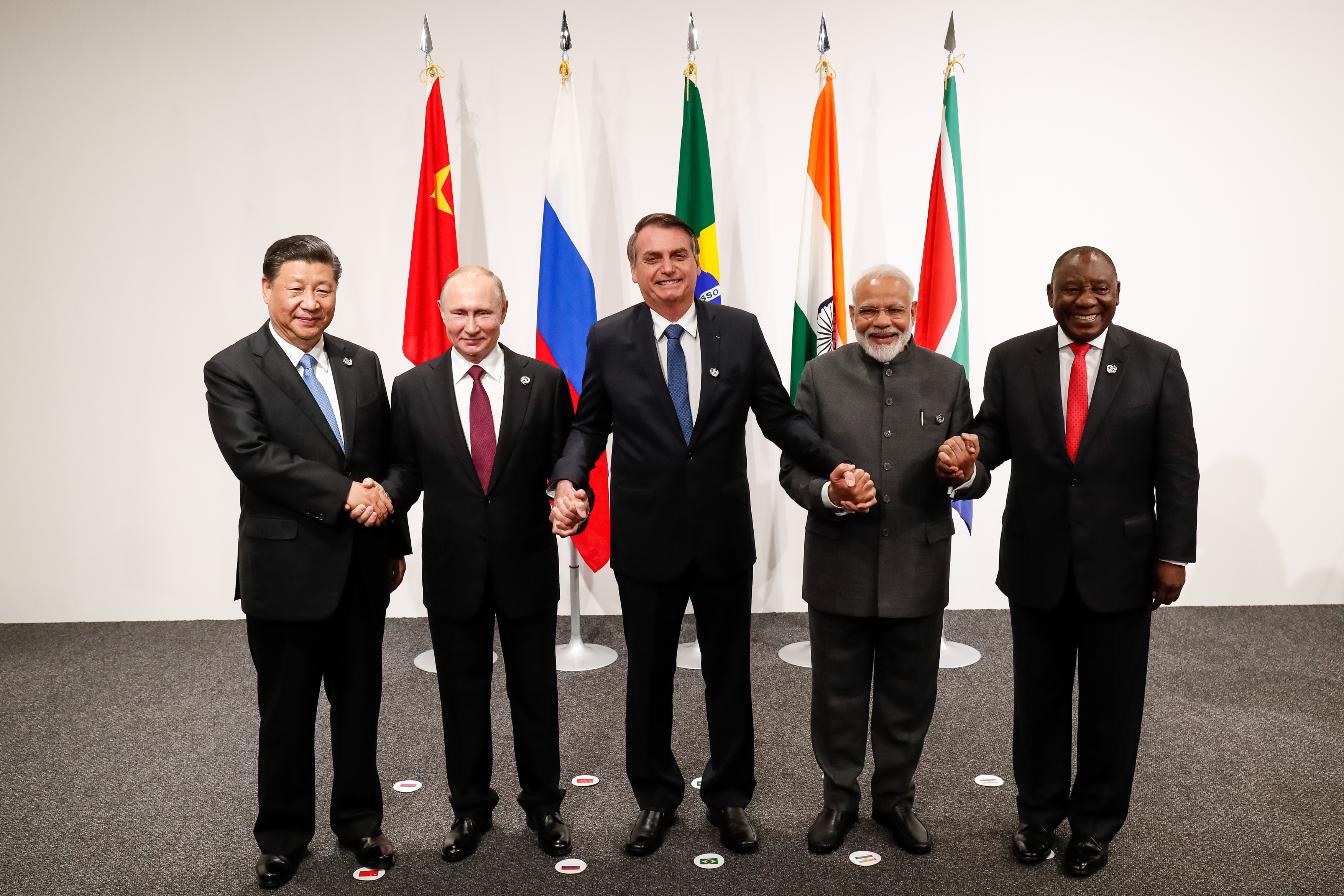
General Secretary of the Chinese Communist Party Xi Jinping was one of the top world leaders to visit New Delhi after Narendra Modi took over as Prime Minister of India in 2014. India's insistence to raise the South China Sea in various multilateral forums subsequently did not help that beginning once again, the relationship facing suspicion from Indian administration and media alike. In September 2014, the relationship took a sting as troops of the People's Liberation Army reportedly entered two kilometres inside the Line of Actual Control in the Chumar sector. The next month, V. K. Singh said that China and India had come to a "convergence of views" on the threat of terrorism emanating from Pakistan.

China and India have been working together to produce films together, such as Kung Fu Yoga starring Jackie Chan. However, disruptions have risen again due to China building trade routes, the China–Pakistan Economic Corridor, with Pakistan on disputed Kashmir territory. On 16 June 2017, Chinese troops with construction vehicles and road-building equipment began extending an existing road southward in Doklam, a territory which is claimed by both China as well as India's ally Bhutan. On 18 June 2017, around 270 Indian troops, with weapons and two bulldozers, entered Doklam to stop the Chinese troops from constructing the road. Among other charges, China accused India of illegal intrusion into its territory—what it called the mutually agreed China-India boundary, and violation of its territorial sovereignty and UN Charter. India accused China of changing the status quo in violation of a 2012 understanding between the two governments regarding the tri-junction boundary points and causing "security concerns", which were widely understood as its concerns with the strategic Siliguri Corridor. India media reported that on 28 June, Bhutan issued a demarche, demanding that China cease road-building in Doklam and leave the area as is. The Minister of External Affairs of India at the time, Sushma Swaraj, asserted that if China unilaterally altered the status-quo of the tri-junction point between China-India and Bhutan, the nation would be posing a challenge to India's security. China repeatedly stated that India's withdrawal was a prerequisite for meaningful dialogue. On 21 July 2017, the Minister of External Affairs of India Sushma Swaraj said that for dialogue, both India and China must withdraw their troops. On 2 August 2017, the Ministry of Foreign Affairs of China published a document claiming that Indian border forces had illegally crossed the border between China and India and detailed China's position on the matter. The document said that China notified India regarding its plan to construct a road in advance, "in full reflection of China's goodwill". The Indian Foreign Ministry replied by referring towards their earlier press release on this matter, as opposed to a point-by-point rebuttal. On 28 August 2017, China and India reached a consensus to end the border stand-off.
In May 2018, the two countries agreed to coordinate their development programmes in Afghanistan in the areas of health, education, and food security. In 2019, India reiterated that it would not join China's Belt and Road Initiative, stating that it cannot accept a project that ignores concerns about its territorial integrity. On 11 October 2019, Chinese leader Xi Jinping met with Indian Prime Minister Narendra Modi at Mahabalipuram, Tamil Nadu, India, for a second informal meeting between India and China. Modi and Xi Jinping met 18 times between 2014 and 2019.
China offered public health and economic assistance to India in response to the COVID-19 pandemic, although India refused per the United States' request.
2020s
Main article: 2020–2021 China–India skirmishes, 2022 Yangtse clash
On 10 May 2020, Chinese and Indian troops clashed in Nathu La, Sikkim, leaving 11 soldiers injured. Following the skirmishes in Sikkim, tensions between the two countries grew in Ladakh, with a buildup of troops at multiple locations. There were 20 Indian soldiers and an unknown number of PLA soldiers killed on the night of 15/16 June. China reinforced troops near the Indian border with Tibet, Chinese state media reported. Bilateral agreements between India and China prevent the use of guns along the line of actual control. However, these skirmishes saw the first shots, warning shots, being fired in decades.
Following the deaths, Prime Minister Modi addressed the nation about the incident, saying that "the sacrifice made by our soldiers will not go in vain", while the Indian foreign minister told the Chinese foreign minister that Chinese actions in Galwan were "pre-meditated". Following the Galwan Valley clash on 15 June 2020, there were renewed calls across India to boycott Chinese goods. However, numerous Indian government officials said that border tensions would have little impact on trade.
On 29 June 2020, the Indian government banned 59 widely used Chinese mobile phone and desktop applications in response to rising tensions and escalating diplomatic dispute between the two nations. On 19 August, The Times of India reported that the ministry of external affairs of India has been told that visas for Chinese businessmen, academics, industry experts, and advocacy groups will need prior security clearance, and the measures are similar to those that have long been employed with Pakistan. On 19 September, India police arrested a freelance journalist for passing sensitive information to Chinese intelligence].
On 27 October 2020, the United States and India signed the Basic Exchange and Cooperation Agreement, enabling greater information-sharing and further defense cooperation, to counter China's growing military power in the region.
.jpg)
After the 2022 visit by Nancy Pelosi to Taiwan, the Ministry of Foreign Affairs of India responded, "Like many other countries, India, too, is concerned at recent developments. We urge the exercise of restraint, avoidance of unilateral actions to change status quo, de-escalation of tensions, and efforts to maintain peace and stability in the region." India stopped reiterating the so-called "One China" policy as early as 2010.
In September 2022, India and China pulled back soldiers from a friction point along the line of actual control. However, according to India's Ministry for External Affairs, the situation on the Line of Actual Control is "still not normal". The Diplomat has reported that normalcy around the border between the countries seems unlikely and may not develop further.
On 6 October 2022, India abstained on a draft resolution in the UNHRC on "holding a debate on the situation of human rights in the Xinjiang Autonomous Region of China"
In June 2023, China placed a technical hold on a proposal moved by the U.S. and co-designated by India to sanction accused Pakistani terrorist Sajid Mir under the 12/67 Al Qaeda Sanctions Committee of the UN Security Council. Mir had previously orchestrated bombings in Mumbai, killing some 175 people. India heavily criticized the Chinese decision.
_01.jpg)
On 25 August 2023 during the 15th BRICS summit in Johannesburg, South Africa, Modi and Xi spoke on the summit's sidelines where they agreed to deescalate tensions at the border. The Ministry of Foreign Affairs of China said both leaders "had a candid and in-depth exchange of views on current China-India relations” and Xi stated that "improving China-India relations serves the common interests of the two countries and peoples”, while the Ministry of External Affairs of India stated that during the meeting Modi "underlined that the maintenance of peace and tranquility in the border areas, and observing and respecting the LAC are essential for the normalization of the India-China relationship." The meeting was seen as a step toward mending the bilateral relations between the two countries.
In October 2024, India announced that it had reached an agreement over patrolling arrangements along the Line of Actual Control (LAC) in the border area, which would lead to disengagement and resolution of the long-running conflict that began in 2020.
In January 2025, China and India agreed to resume direct flights between the two countries after nearly 5 years.
In April 2025, India launched its biggest-ever joint naval exercise with African nations as part of a push to boost its influence on the continent. The military exercises were perceived as a show of force to China, whose influence in Africa is significant. India also announced the resumption of the Kailash Mansarovar Yatra in April 2025, after a period of five years, in a bid to normalise relations between the two nations.
On 26 June 2025, Indian Defence Minister Rajnath Singh met his Chinese counterpart Dong Jun on the sidelines of the SCO defence ministers’ meeting in Qingdao, where he called for a permanent resolution to the border dispute through a “structured roadmap of permanent engagement and de-escalation.” Singh emphasised the need to “rejuvenate the established mechanism” for border demarcation and urged both sides to maintain “positive momentum” while avoiding new complications. He also stressed the importance of “bridging the trust deficit” created after the 2020 standoff by “taking action on ground.” Additionally, Singh briefed the Chinese side on 22 April Pahalgam attack and India's Operation Sindoor, launched to dismantle cross-border terrorist networks. On 22 July 2025, India announced that it would resume issuing tourist visas for Chinese citizens, ending a five-year suspension imposed following the 2020 border skirmishes.

In a sign of growing diplomatic engagement and economic cooperation, China has reportedly agreed to address India's concerns over export curbs on key commodities such as fertilisers, rare earth magnets and minerals, and tunnel boring machines. The understanding followed high-level discussions between China's Director of the Office of the Central Foreign Affairs Commission Wang Yi and Indian External Affairs Minister S.Jaishankar during Wang's two-day visit to India in July 2025. According to Reports, Chinese authorities have begun responding to India's requests on these critical goods. The move is viewed as part of broader efforts to improve bilateral ties, reflecting the two nations’ long-shared history and mutual interest in regional stability.
In September 2025, Prime Minister of India Narendra Modi met General Secretary of the Chinese Communist Party Xi Jinping in Tianjin, calling for India and China to act as partners rather than rivals. They agreed to resume direct flights, tourist visas, and the Kailash Mansarovar Yatra, suspended during the COVID-19 pandemic, and emphasized strategic autonomy while expanding cooperation on regional and global issues.
Triangular relations
The United States and Russia (previously Soviet Union) have been a consistent part of developments in Chinese and Indian relations.
As a major power, Japan has also been part of China–India relations, with initiatives such as the Quadrilateral Security Dialogue. Pakistan and China share warm relations that drive Chinese infrastructure projects in the disputed territory of northern Kashmir. The Middle East, Latin America, and Africa are places where both India and China engage and compete. The Middle East is important to both countries in terms of their energy security. In Africa, China and India seem most engaged across a wide variety of issues, from development to peacekeeping. In South Asia and South-East Asia, a power balance struggle between China and India is seen in triangular relations.
Nepal
Nepal's geostrategic situation during periods of heightened tensions between China and India, such as during the 1962 war, resulted in varying shades of cautionary neutrality when making statements. Nepal's Permanent Representative stated, "we do not want to pass judgement on the merits of Sino-Indian border dispute. As a country friendly to both...". Tulsi Giri, then the Nepalese foreign minister, stated, "Nepal's relations with India will remain close [...] Yet, Nepal has a 600-mile boundary with China, China has now emerged as a great power. Friendly relations with our northern neighbour (China) should be the natural aim of the country's foreign policy." During the time Tibet was independent, Nepal played the role as an important buffer state and was central to influence between the regions.
The China-Nepal-India Economic Corridor (CNIEC) was proposed by China in April 2018. It is an extension of the agreed upon China-Nepal Trans-Himalayan Multi-dimensional Connectivity Network into India. While China and Nepal have shown favourable reactions towards CNIEC, India is "indifferent". This indifference is postulated to stem from CNIEC being a part of BRI, China's growing influence over Nepal, and an end to "India's monopoly over Nepal's transit points and Nepal's attempt to end its dependency on India".
United States
On 11 November 1950, Sri Aurobindo wrote in Mother India, On 28 March 1963, Sudhir Ghosh recorded the President of the United States John F Kennedy's reaction on reading Sri Aurobindo's words, "One great Indian, Nehru, showed you the path of non-alignment between China and America, and another great Indian Aurobindo, showed you another way of survival. The choice is up to the people of India." Earlier in the meeting, Ghosh recorded Kennedy's reaction to a letter from Nehru, "He indignantly said that only a few months earlier when Mr Nehru was overwhelmed by the power of Communist China, he made desperate appeal to him for air protection, and non-alignment or no non-alignment, the President had to respond. He added sarcastically that Mr Nehru's conversion lasted only a few days".
Unlike the left-wing diplomatic leanings of the Indian Congress Party, the BJP administration has strengthened its strategic partnership with the United States. China faces combined challenges to its influence with its neighbors, and because it sees a growing threat from India and the United States' cooperation, it has exaggerated the discord between the two countries to divide and conquer its rivals.
India participated in the restart of Quadrilateral Security Dialogue, and has strengthened the military, diplomatic, and economic cooperation with the United States, Japan, and Australia. More recently, after the deadly Chinese-initiated clash at Galwan Valley in June 2020, preceded by the 2017 Doklam standoff, the U.S.-based think tank, the Center for Foreign Relations, explained that there was a significant ramp-up in QUAD activity. The group cites how, since 2020, the group has looked beyond regional cooperation and have focused on checking Chinese regional behavior, with the four navies performing their first joint exercise in over a decade in November 2020. This was specifically initiated by India in response to the border skirmishes.
Africa
In July 2025, during an address to the Parliament of Ghana, Indian Prime Minister Narendra Modi made a tacit critique of China's lending practices in Africa, contrasting them with India's approach to development cooperation. Without directly naming China, Modi emphasized that India's partnerships in Africa are demand-driven, aimed at building local capacities and self-sustaining ecosystems, rather than creating debt burdens. He highlighted India's support for Africa's Agenda 2063 and underscored the importance of growing together as equals.
Indo-Pacific
Pakistan, and more importantly, Myanmar, other than India itself, are potential land routes into the Indian Ocean. Pan Qi, Vice Minister for Communications, wrote in 1985 that China would need to find an outlet for its landlocked provinces. At the time, he suggested routes to the Indian Ocean through Myanmar.
In the same vein of invigorating relationships with geopolitical allies, India has also strengthened their Look East Policy, transforming it into the Act East Policy under the Modi administration. The rebranded Act East Policy has an increased focus on infrastructure projects, such as the Agartala-Akhaura Rail Project and the Asian Trilateral Highway. Such geopolitical connectivity measures improved India's alliances with the Philippines, Malaysia, and Vietnam to check Chinese dominance. These soft power measures also enhance Indian border security.
Western Indian Ocean
The Western Indian Ocean has been characterised as an emerging "geopolitical theatre" marked by interstate conflict between India, China and the US. The regions holds key geostrategic importance to all three states. Roughly 40 percent of world trade passes through the region as well as two thirds of global oil and gas supplies. It is a main gateway for global energy supply and two of the world's most important maritime chokepoints, the Bab-el Mandeb and Hormuz strait, are both located in the Western Indian Ocean region. India and China are both dependent on access and free passage in the Western Indian Ocean as it is crucial to secure the increasing energy demand by the two growing economies/ The US is also dependent on the free passage of oil from the Middle East to the trans-Atlantic world through the region.
India and China are both motivated by defensive interests in securing their supplies of energy and trade in the region. Beyond this both states are attempting to increase their relative power positions, economically as well as militarily and naval. This is commonly understood through the terms String of Pearls regarding China and India's Act East Policy. This could potentially align the two countries against the US, but this does not seem to be the case. India and China continue to strive for similar power positions and power rivalry between the two states continue.
Beijing is refusing to see India as a regional power and from an Indian perspective the Indian Ocean is largely seen as “India’s Ocean”. Any Chinese encroachment on India's sphere of interest is seen as a potential threat. To counter increased Chinese naval and economic presence India has joined the Quad-alliance between the US, Japan and Australia and is carrying out naval missions with the US, China's core strategic rival. As such Sino-Indian relations in the Western Indian Ocean can be understood in terms of a triangular relationship of continuous counterbalancing between the three states.
Both India and China have interests in containing the influence of the other, yet none of them has the capacity to fully do this. India's aspirations to become a great regional power are constrained for several reasons. New Delhi's focus has traditionally been directed towards the continent and its naval development is lagging behind both China and the US. Scholars also point towards the lack of a coherent maritime strategy despite increased political attention to the issue, for example through its Act East policy. Political protectionist tendencies have allowed China to increase its relative economic influence overtaking India's position as main trading partner in various countries in the region. In 2005 China surpassed India and became Bangladesh's main trading partner. Despite these constraints China does not have the capacity to fully contain India. India continues to hold a special position in the region due to its dominating geographical position, history and interstate relations. Furthermore, it is in US interests to counterbalance China's increased naval strength through cooperation with India.
As such geopolitical rivalry and strategic counterbalancing remains unsettled in the Western Indian Ocean and intensified rivalry between India and China seems to be the most likely trajectory some time to come. This has substantial security implications as the increased militarisation decreases trust between the states and thus complicates cooperation over persisting security problems such as piracy. A potential risk of militarisation at sea is that offence-defence tactics are often difficult to distinguish. Even if India and China followed solely defensive strategies, as it has been claimed, it might be perceived as offensive tactics within the maritime domain. Furthermore, both states are deploying military and naval means beyond what is commonly seen as necessary to defend global shipping routes. This includes nuclear-powered submarines send by China to fight piracy in the region.
Military relations
Border clashes
Since the 1950s, during the term of India's first prime minister Jawaharlal Nehru, India and China have repeatedly encountered border disputes at the Line of Actual Control, delineating the border between the two nations. The first Sino-India border war broke out in 1962 at the Aksai Chin region, escalating into a month-long military conflict. Initiating the conflict, China took advantage of global concern about the ongoing Cuban missile crisis to time their regional invasion in hopes of building a military road in India's Ladakh region.
During the Narendra Modi administration, bloody clashes erupted again on the Sino-Indian border. The strategic alliance between China and Pakistan, and the vigorous arming of the Pakistani forces, make India face the threat of a two-front war. Indian officials said the huge differences between the two sides on the border issue "eroded the entire basis" of their relationship.
Maritime concerns
According to Center for Strategic and International Studies (CSIS), since 2020, Chinese research vessels with dual-use capabilities have expanded operations in the Indian Ocean Region, raising concerns. While framed as scientific missions, these surveys—conducted by ships linked to state and military institutions—collect oceanographic data critical for submarine operations and undersea warfare. Vessels such as Xiang Yang Hong 06 and Shiyan 06 have mapped the seafloor, deployed sensors, and operated near Indian waters, sometimes while concealing their presence by disabling identification systems. Despite the evidence presented in a 2024 study conducted by the CSIS, Chinese state-media Global Times dismissed the concerns as a "China Threat Narrative".
Chinese vessels have operated near sensitive maritime zones and within the EEZs of regional countries, prompting India to increase naval surveillance and diplomatic engagement. In early 2024, Sri Lanka, imposed a temporary moratorium on Chinese research vessels docking at its ports, reflecting growing regional resistance to Beijing's opaque maritime activities.
In July 2025, a Chinese research vessel was caught operating covertly in the Bay of Bengal near Indian waters, according to a French maritime intelligence firm. The ship had switched off its Automatic Identification System (AIS) but was tracked via radio frequency signals. It was likely conducting strategic activities such as seafloor mapping, acoustic analysis, and identifying submarine transit routes—operations linked to surveillance and anti-submarine warfare.
Military exercises
_escorting_PLA_Navy_Ship_Weifang_off_Visakhapatnam,_India_in_May_2014.jpg)
China and India conduct a joint military exercise called 'Exercise Hand–in–Hand'. The exercise began in 2007, with the second edition taking place in 2008. The third, fifth, and seventh editions of Hand-in-Hand were conducted in China in 2013, 2015, and 2018, respectively, while the fourth edition and sixth editions were held in India in 2014 and 2016. The eighth edition was held in India in 2019. While bilateral military exercises between India and China have ceased over the past few years, India is still accepting invitations from Russia for multilateral armed forces exercises that also happen to host Chinese soldiers.
Water sharing and hydro–politics
A total of seven rivers that start in Tibet flow through India — Indus, Satlej, Karnali (Ghaghara), Subansiri, Brahmaputra, and Lohit (and its tributary Dulai).
Brahma Chellaney has written that "India's formal recognition of Chinese sovereignty over Tibet constitutes the single biggest security blunder with lasting consequences for Indian territorial and river-water interests".
India has concern with China's water–diversion, dam–building, and inter–river plans. More so, in a conflict, India fears that China can use the rivers as leverage. China has already constructed ten dams on the Bhramaputra and its tributaries, such as the Zangmu Dam, and there has been talk of China building a mega–dam at the "great bend" called the Motuo Dam. India's concerns also stem from the fact that China does not cooperate with regard to timely sharing of information related to projects which would impact water sharing, nor does China allow Indian experts to visit dam sites. There are a number of memoranda of understanding on hydrological data sharing between the two countries with regard to the Brahmaputra, including emergency management.
An alternate view is also presented in relation to "misinformation spread by some (Indian) newspapers" and the waters of Brahmaputra — "80 percent of the waters of the Brahmaputra emanate from the north side of the Himalayas in China and that that country cannot be the sole arbiter of its international waters. This is not right. Eighty percent of the waters of the mighty Brahmaputra are picked up after it enters India" and that Chinese activities have helped India by reducing annual flood intensity in the north-east.
India formally “registered its concern with China” in December 2024 over construction of Medog Dam, also known as the Motuo Hydropower Station, the country's external affairs minister told lawmakers in March 2025, adding that the project figured prominently in talks between the nations in January 2025.
In 2025, while India expressed significant concerns over China's construction of the Motuo Hydropower Station on the Yarlung Tsangpo River in Tibet, citing potential threats to water security, environmental stability, and regional livelihoods, Indian officials and experts warned that the project could enable China to control or divert river flows into India, affecting the Siang and Brahmaputra rivers, which are vital for millions in the northeastern states. Arunachal Pradesh Chief Minister Pema Khandu described the dam as an "existential threat" to indigenous communities such as the Adi tribe, highlighting risks of water scarcity or catastrophic flooding due to sudden water releases. The Indian government formally urged China to ensure transparency, consult downstream countries, and safeguard the interests of riparian states, framing the issue as a matter of regional cooperation and stability. Some experts, observers, and individuals from journalistic fraternity from India have also expressed concerns. Dr. Jogendranath Sharma, an eminent geologist and retired professor from Dibrugarh University, cautioned that China's proposed 60,000 MW Medog Hydropower Project, located in a seismically active and ecologically sensitive region, could trigger severe natural disasters in downstream Assam. He cited potential risks including erosion from “hungry water,” disruption of groundwater systems, altered monsoon patterns, and threats to biodiversity and livelihoods, and advocated for a joint Indo-China environmental impact assessment.
On 19 July 2025, the Yarlung Zangbo hydropower project of China officially commenced construction. India and Bangladesh have raised concerns about the impact in their countries when the dam becomes operational after 2030.
In August 2025, India reiterated its concerns over China's Medog Hydropower Station, citing risks to regional water security, ecology, and downstream livelihoods. The Ministry of External Affairs stated that the project was being closely monitored and that India had repeatedly urged Beijing to ensure transparency and consult downstream countries. External Affairs Minister S. Jaishankar raised the issue during his July 2025 visit to China for the Shanghai Cooperation Organisation Foreign Ministers’ Meeting, also calling for the resumption of suspended hydrological data sharing.
Indian observers have raised concerns about the legality of China's unilateral actions in asserting upstream control over transboundary rivers. Aravind Yelery, associate professor at Jawaharlal Nehru University, described China's approach as neglecting its responsibility to preserve river flows, suggesting it is driven by geopolitical ambitions and poses environmental and diplomatic risks. He noted similar patterns in China's management of the Mekong River, where multiple dams have been built without formal riparian agreements. Atul Kumar, a fellow at the Observer Research Foundation, highlighted that China has not entered into water-sharing treaties with its neighbors and often withholds hydrological data during periods of strained relations.
Economic relations
India-China economic relations have been institutionalized through the Joint Economic Group and Business Council, as well as more focused efforts such as the "Agreement on the Avoidance of Double Taxation".
China and India have developed their own complementary skills following a period in which they had cut themselves off from each other. By 2007, while China excelled at cost-effective manufacturing, India was skilled in cost effective designing and development. In 2007, Tarun Khanna wrote in Harvard Business Review that "The simplest, and most powerful, way of combining China and India is to focus on hardware in China and on software in India." In the 2009 book "Getting China and India Right", the authors suggest a China plus India strategy so as to strategically benefit from both India's and China's scale, complementary strengths, and reducing the risk of being unilaterally present.
There are cases when Indian companies have gone to China and done well, such as Mahindra and Mahindra, while Chinese companies such as Huawei have done well in India. Huawei set up its Indian unit in 1999 and by 2007, had 1500 engineers. Huawei's Bangalore unit, already one of Huawei's most important research and development centres, was Capability Maturity Model Level 5 certified in 2003.
In the oil sector, there is competition and engagement — China's Sinopec and China National Petroleum Corporation and India's Oil and Natural Gas Corporation fight over oil assets in some regions, while winning bids as joint ventures in others such as Syria, Colombia, Angola, and Venezuela.
Since the deterioration of relations between the two countries in the 2010s, India has banned a large number of Chinese technology companies and software, including Huawei, TikTok, WeChat, etc., from entering the Indian market. In order to reduce Western countries' previous dependence on Chinese products, India plays an integral role in boosting supply chain resilience through friendshoring.
On 18 January 2024, at the World Economic Forum 2024 in Davos, Switzerland, top Indian industrial policy bureaucrat Rajesh Kumar Singh told Reuters that due to easing of border tensions between India and China in 2023, India could reduce its heightened scrutiny of Chinese investments in India although timeframe for it was not given.
In July 2025, China reportedly recalled over 300 engineers from Foxconn's iPhone plant in India. India responded by partnering with Taiwan, the US, South Korea, and Japan to secure engineers and critical manufacturing equipment. In December 2025, India imposed anti-dumping duties on rolled Chinese steel.
Bilateral trade
China is India's second largest trading partner. In June 2012, China asserted that "Sino-Indian ties" could be the most "important bilateral partnership of the century", seemingly substantiated by current Prime Minister Narendra Modi's historic visit to China in May 2015. At that pivotal visit, Wen Jiabao, the Premier of China, and Manmohan Singh, the Prime Minister of India set a goal to increase Indo-Chinese bilateral trade to US$100 billion by 2015. At the India-China Business Forum in Shanghai, Modi claimed that China and India would pool together their manufacturing capabilities, citing initiative examples, such as building “50 million houses by 2022”, "develop[ing] smart cities and mega industrial corridors”, and refining FDI policy and modernizing railway systems together.

Following that conference, bilateral trade between China and India touched US$89.6 billion in 2017–18, with the trade deficit widening to US$62.9 billion in China's favor. In 2017, the volume of bilateral trade between India & China stood at US$84.5 billion. This figure excludes bilateral trade between India and Hong Kong, which stands at another US$34 billion. Chinese imports from India amounted to $16.4 billion, or 0.8% of its overall imports, and 4.2% of India's overall exports in 2014. Major commodities exported from India to China were: cotton; gems, precious metals, coins; copper; ores, slag, ash; organic chemicals; salt, sulphur, stone, cement; machines, engines, and pumps. Chinese exports to India amounted to $58.4 billion or 2.3% of its overall exports, which made up approximately 12.6% of India's overall imports in 2014. Major commodities exported from China to India were: electronic equipment; machines, engines, pumps; organic chemicals; fertilizers; iron and steel; plastics; iron or steel products; gems, precious metals, coins; ships, boats; medical, and technical equipment.
In 2018, a Standing Committee on Commerce chaired by Naresh Gujral submitted a report on the 'Impact of Chinese Goods on Indian Industry.' The report pointed out insufficient implementation of existing anti-dumping laws, reliance on Chinese raw materials in sectors such as pharmaceuticals, reliance on Chinese imports in India's National Solar Mission, Goods and Services Tax on certain products resulting in increased imports from China, and Indian smart city administrations preferring Chinese bicycles over Indian ones. India imported $65.3 billion worth of goods from China in the fiscal year ended March 2020, and exported $16.6 billion, according to the commerce ministry.
In 2020, in a departure from the previous pledges of collaboration, Modi instituted bans on Chinese products, including both intangible apps (TikTok) and tangible goods (toys and furniture). Furthermore, the Modi administration created the Phased Manufacturing Program to encourage India-based cellphone assembly and manufacturing. Under guidance from this legislation and the accompanying task force to reduce import dependence, India raised import duties on electronic items produced in China, as well as a laundry list of ancillary goods.
According to a 2021 survey published in ThePrint, 43% of Indians did not buy ‘Made in China’ products since the Galwan clash the previous year. Modi also took notice of Swadeshi Jagran Manch's (SJM) campaigns, launching or reviving 220 out of 370 anti-dumping suits against Chinese items ranging from steels, pharmaceuticals, and chemicals.
Due to the international sanctions against Russia following the 2022 Russian invasion of Ukraine, Indian oil refiners started using Chinese yuan for payments of Russian oil imports as an alternative to the US dollar. The Indian government also does not welcome the use of yuan for payments by its companies. Indian automakers have faced shortages due to export restrictions of China's rare earth metals.
Due to rising trade tensions with the US such as the imposition of 50% tariffs over India's trade with Russia on the majority of Indian goods by President Donald Trump, which took effect in August 2025, India had a diplomatic shift strengthening its ties with China. By September 2025, visa issuances have resumed, and India had begun considering Chinese firms to hold 20% to 25% stakes in its manufacturing, renewable energy, and auto parts sectors. In December 2025, China filed a case against India with the World Trade Organization over tariffs.
The author argues that expectations of India emerging as a global power comparable to China have faded over the past decade. Despite early optimism after economic liberalisation, India did not industrialise or grow at a pace similar to China and remains relatively poor on a per-capita basis. As a result, India is no longer seen internationally as China’s peer, and domestic political ambition has shifted toward regional rather than global competition. A second shift, the author says, is the erosion of India’s democratic character. While elections remain largely competitive, civil liberties have declined, affecting free expression, religion, academia, civil society, and the rule of law. International assessments have downgraded India from a full democracy to a flawed or partly free system. The author concludes that both diminished economic ambition and democratic backsliding have become widely accepted realities in India.https://www.heraldgoa.in/edit/why-india-no-longer-competes-with-china/461479/
Cultural relations
A famous quote from Hu Shih regarding ancient Sino-Indian ties, albeit in a critical context, was "India conquered and dominated China culturally for 20 centuries without ever having to send a single soldier across her border".
Cuisine
Public opinion
According to a 2014 BBC World Service Poll, 23% of Indians viewed China positively, with 47% expressing a negative view, whereas 27% of Chinese people viewed India positively, with 35% expressing a negative view. A 2014 survey conducted by Pew Research Center had 39% of Indian respondents holding an unfavourable view of China compared to 31% holding a favourable view; 72% of the respondents were concerned that territorial disputes between China and neighbouring countries could lead to a military conflict.
An Observer Research Foundation survey released in August 2021 of Indian youth found that 77% of respondents distrusted China, which was higher than any other country, including Pakistan. 86% also supported the government's decision to ban Chinese mobile apps. An August 2023 survey by Pew Research Center found that 67% of Indian respondents had an unfavorable view of China.
A 2008 poll from the Pew Research Center found that in China, views about India were mixed – 25% said India was a partner, while 24% said it was an enemy. In 2011, Vikas Bajaj of The New York Times found Chinese media rarely reported about India and general populace lacks awareness and expertise on Indian matters. A 2023 Tsinghua University survey found that 8% of Chinese respondents had a favorable view of India, 50.6% had an unfavorable view, and 41.5% had a neutral view.
References
References
- Backus, Maria. (September 2002). "Ancient China". Lorenz Educational Press, 2002.
- Janin, Hunt. (January 1999). "The India-japan opium trade in the two century". McFarland, 1999.
- Tansen Sen. (January 2003). "Buddhism, Diplomacy, and Trade: The Realignment of Sino-Indian Relations, 600-1400". University of Hawaii Press.
- Williams, Barbara. (2005). "World War Two". Twenty-First Century Books, 2004.
- Lancaster, John. (12 April 2005). "India, China Hoping to 'Reshape the World Order' Together". The Washington Post.
- (7 July 2010). "Why Indo-China ties will be more favourable than Sino-Pak". Theworldreporter.com.
- [http://www.thehindu.com/news/international/indiachina-trade-surpasses-target/article1129785.ece India-China trade surpasses target] {{Webarchive. link. (10 May 2013 , ''The Hindu'', 2 January 2010.)
- (29 May 2022). "US Becomes India's Biggest Trading Partner, Surpasses China". [[NDTV]].
- Jeff M. Smith today's Wall Street Journal Asia. (24 June 2009). "The China-India Border Brawl". The Wall Street Journal.
- [http://www.apcss.org/core/BIOS/malik/India-China_Relations.pdf]{{dead link. (September 2017)
- Joshi, Manoj. (2017). "Doklam: To start at the very beginning". Observer Research Foundation.
- (17 June 2020). "Galwan Valley: China and India clash on freezing and inhospitable battlefield". BBC News.
- [http://www.dnaindia.com/india/report_ak-antony-admits-china-incursion_1592435 AK Antony admits China incursion] {{webarchive. link. (30 September 2011 , DNA, 28 September 2011.)
- (27 November 2009). "China-Pakistan military links upset India". Financial Times.
- Lintner, Bertil. (30 October 2020). "Behind China's threat to support insurgency in India". [[Asia Times]].
- [http://www.thehindu.com/news/international/article2455647.ece China warns India on South China Sea exploration projects] {{webarchive. link. (24 September 2011 , ''The Hindu'', 15 September 2011.)
- [[Aamir Peerzada]]. (16 October 2020). "The Tibetans serving in 'secretive' Indian force". [[BBC News]].
- Geeta Mohan. (1 January 2022). "China protests Indian MPs' attending Tibetan reception, Tibet govt-in-exile fires back".
- "Major Power Rivalry in South Asia".
- (8 April 2023). "Analysing China's threat perception of India-United States relations".
- "India and China: Trading With the Enemy".
- Chanhudaro, Ernest J. Mackay, American Oriental Society, 2090
- Zhao, Deyun. (2014). "Study on the etched carnelian beads unearthed in China". Chinese Archaeology.
- Henry Davidson, ''A Short History of Chess'', p. 6.
- Colless, Brian. (December 1980). "Han and Shen-tu China's Ancient Relations with South Asia". East and West.
- link. (21 August 2013)
- [[Joseph Needham]], Volume 3, p. 109
- Ananth Krishnan. (19 July 2013). "Behind China's Hindu temples, a forgotten history". The Hindu.
- (18 July 2013). "China's Hindu temples: A forgotten history". [[The Hindu]].
- "Multimedia".
- "What to do in Quanzhou: China's forgotten historic port – CNN Travel".
- Chatterjee, Garga. (14 May 2017). "OBOR: As Mamata seeks Chinese investment for Bengal, why is Delhi bent on playing spoilsport?". Scroll Media.
- (2020). "Indian Mendicants in Ming and Qing China: A Preliminary Study by Matthew W. Mosca in ''India-China: Intersecting Universalities''". Collège de France.
- Kamath (2001), p235-236
- Kamath (2001), p236-237
- (18 November 2015). "A sultan's silken dreams".
- Mosca, Matthew W.. (31 July 2015). "From frontier policy to foreign policy : the question of India and the transformation of geopolitics in Qing China". Stanford University Press.
- The Sino-Indian Border Disputes, by Alfred P. Rubin, The International and Comparative Law Quarterly, Vol. 9, No. 1. (January 1960), pp. 96–125.
- (15 September 2020). "When Indian, Chinese soldiers fought together".
- Choudhuri, Atonu. (29 January 2008). "Monumental neglect of war graves – Discovered in 1997, Jairampur cemetery gets entangled in red tape".
- (1 November 2020). "Beyond Pan-Asianism: Connecting China and India, 1840s–1960s". Oxford University Press.
- Hogel, Bernhard. (2005). "India and China in the Colonial World". Berghahn Books.
- "Religion in Chinese Life".
- Okakura, Tenshin (1904) ''[http://www.sacred-texts.com/shi/ioe Ideal of the East] {{Webarchive. link. (10 August 2022 '')
- [[wikisource:Sun Yat-sen's speech on Pan-Asianism. Sun Yat-sen's speech on Pan-Asianism]]
- "In the Footsteps of Xuanzang: Tan Yun-Shan and India".
- "Transforming India-Taiwan Relations".
- [https://www.globalasia.org/v12no3/feature/playing-with-fire-taiwan-and-indias-long-courtship_james-baron Playing with Fire: Taiwan and India's Long Courtship] {{Webarchive. link. (8 April 2023 ''[[Global Asia]]'')
- Deepak, B. R.. (2005). "India and Taiwan: From Benign Neglect to Pragmatism". VIJ Books (India) PVT Limited.
- Pakula, Hannah. (2009). "The Last Empress Madame Chiang Kai-shek and the Birth of Modern China". Simon and Schuster.
- [https://www.bbc.com/news/world-asia-india-22599356 Why is India's Dr Kotnis revered in China?] {{Webarchive. link. (1 September 2022 [[BBC]])
- "蒋介石曾以"元首身份"访印度 与甘地谈6小时".
- Mohanty, Sachidananda. (August 2020). "The Chinese Betrayal, Early Warnings Unheeded: Lessons from Sardar Patel and Sri Aurobindo".
- (1 April 2020). "Xi to Kovind: China-India relations are at a new starting point".
- (22 February 2006). "Asia Times Online :: China News, China Business News, Taiwan and Hong Kong News and Business.".
- "Agreement on Trade and Intercourse with Tibet Region".
- LL Mehrotra (2000). [https://tibet.net/wp-content/uploads/2017/05/Inidas-Tibet-Policy.pdf India's Tibet Policy: An Appraisal And Options] {{Webarchive. link. (8 April 2023 . pp 25, 26. Tibetan Parliamentary and Policy Research Centre. Third edition. New Delhi.)
- (16 December 2008). "GMF – The New Great Game: Why the Bush administration has embraced India".
- (9 July 2020). "China, quid without a quo: 1954 India-China trade agreement was one-sided affair".
- "Don't believe in Hindi-Chini bhai-bhai, Nehru told envoy". The Indian Express.
- Raghavan, Srinath. (2010). "War and Peace in Modern India". Palgrave Macmillan.
- Hudson, G. F.. (1963). "Far Eastern Affairs". Chatto & Windus.
- Fingar, Thomas. (2016). "The new great game : China and South and Central Asia in the era of reform". [[Stanford University Press]].
- (3 July 2020). "The MAN In Sam Manekshaw". Parzor Foundation.
- Bajwa, Farooq Naseem.. (30 September 2013). "From Kutch to Tashkent : the Indo-Pakistan war of 1965".
- The Foreign Policy of Sirimavo Bandaranaike – The Colombo and the Sino-Indian War of 1962
- (2004). "Rapprochement Across the Himalayas: Emerging India-China Relations Post Cold War Period (1947–2003)". Gyan Publishing House.
- Ananth Krishnan. (25 November 2010). "Huang Hua, diplomat who helped thaw ties with India, passes away". The Hindu.
- "Military common sense".
- "indiatodaygroup.com".
- [http://www.deccanherald.com/deccanherald/apr172005/spotlight942292005416.asp India's Land of the Rising Sun] {{webarchive. link. (31 December 2005 ''Deccan Herald'')
- "Obituary: Warrior as Scholar: Gen (retd) K Sundarji (1928–1999)".
- "Need to strengthen border with China". Deccan Herald.
- (25 July 2017). "Why is China alienating half a billion young Indians?".
- (12 April 2005). "China, India agree on "strategic partnership"".
- (24 February 2017). "The reality of the India-China strategic dialogue".
- [http://news.bbc.co.uk/2/hi/south_asia/5093712.stm "India-China trade link to reopen"] {{webarchive. link. (21 June 2006 , BBC News, 19 June 2006. Retrieved 31 January 2007.)
- [http://news.bbc.co.uk/2/hi/south_asia/6145866.stm "India and China row over border"] {{webarchive. link. (15 February 2008 , BBC News, 14 November 2006. Retrieved 31 January 2007.)
- (25 May 2007). "China denies visa to IAS officer". CNN-IBN.
- (7 December 2007). "South Asia – Chinese 'border gesture' to India".
- (9 December 2007). "A thaw? China lets Arunachalee visit". [[The Times of India]].
- link. (2 December 2008 '', Foreign Office website. Retrieved 25 November 2008.'')
- Richard Spencer, ''[https://www.telegraph.co.uk/news/worldnews/asia/tibet/3385803/UK-recognises-Chinas-direct-rule-over-Tibet.html UK recognises China's direct rule over Tibet] {{webarchive. link. (3 November 2010 '', [[The Daily Telegraph]], 5 November 2008)
- link. (5 August 2017 '', [[The Wall Street Journal]], 1 November 2008)
- link. (10 December 2008 '', [[The Economist]], 6 November 2008)
- link. (5 January 2015 '', [[The New York Times]], 24 November 2008)
- (11 September 2008). "Project Records | Asian Development Bank". Adb.org.
- (9 July 2009). "China objected to ADB loan to India". The New Indian Express.
- (9 July 2009). "China objected to ADB loan to India for Arunachal project: Krishna (Lead) – Thaindian News". Thaindian.com.
- (17 December 2010). "Chinese premier urges closer cultural, youth links with India – People's Daily Online". People's Daily.
- (15 December 2010). "Chinese PM Wen Jiabao begins bumper Indian trade trip". BBC News.
- "The Tribune, Chandigarh, India – Main News". The Tribune.
- (11 April 2011). "Indian PM Manmohan Singh heads to China for talks". BBC News.
- (13 April 2011). "Nri". The Times of India.
- (13 April 2011). "India, China to restore defence co-operation : Neighbours, News". India Today.
- (23 December 2011). "2011: India, China solve stapled visa issue; put off border talks". The Times of India.
- (30 March 2012). "China wants to deepen strategic cooperation with India: Hu Jintao". The Times of India.
- Nelson, Dean. [https://www.telegraph.co.uk/news/worldnews/asia/china/9216554/China-warns-India-of-arrogance-over-missile-launch.html "China warns India of arrogance over missile launch."] {{webarchive. link. (20 April 2012 ''The Telegraph''. 20 April 2012.)
- (6 May 2013). "India says China agrees retreat to de facto border in faceoff deal".
- link. (24 July 2013 . ''Defence News''. 8 May 2013. Retrieved 11 May 2013.)
- "Chinese premier visits India".
- (20 May 2013). "Joint Statement on the State Visit of Chinese Premier Li Keqiang to India". [[Ministry of External Affairs (India)]].
- "China's Arunachal Pradesh Fixation". The Diplomat.
- (30 November 2013). "China reiterates claim on Arunachal Pradesh through mouthpiece".
- Goswami, Ranjit. (13 May 2015). "Make China India's natural ally for development". Observer Research Foundation.
- Goswami, Ranjit. (11 May 2015). "Can Modi Make China India's Natural Ally for Development?". HuffPost.
- (23 September 2014). "Chinese troops said to be 2 km inside LAC, build-up on the rise". The Indian Express.
- (31 October 2014). "Delhi, Kabul warn China: Pak maybe your ally but it exports terror". Living Media India Limited.
- Patrick Frater. (4 November 2015). "AFM: Golden Network Kicks Off With Jackie Chan Movie Pair". [[Variety (magazine).
- "India to boycott China summit amid Kashmir concerns". Channel NewsAsia.
- "Press Release – Ministry of Foreign Affairs".
- (26 July 2017). "How India and China Have Come to the Brink Over a Remote Mountain Pass". The New York Times.
- (3 July 2017). "China says India violates 1890 agreement in border stand-off". Reuters.
- Safi, Michael. (5 July 2017). "Chinese and Indian troops face off in Bhutan border dispute". The Guardian.
- (24 July 2017). "Doklam standoff: China sends a warning to India over border dispute". Los Angeles Times.
- Heydarian, Richard. (24 June 2019). "Beijing's Inchoate Hegemony: The Brewing Backlash in Asia to China's Resurgence".
- Safi, Michael. (5 July 2017). "Chinese and Indian troops face off in Bhutan border dispute". The Guardian.
- "China warns Indian troops to get out of contested region". AccessWDUN.
- China Foreign Ministry. (2 August 2017). "The Facts and China's Position Concerning the Indian Border Troops' Crossing of the China-India Boundary in the Sikkim Sector into the Chinese Territory (2017-08-02)".
- "Recent Developments in Doklam Area".
- Panda, Ankit. "What's Driving the India-China Standoff at Doklam?". The Diplomat.
- (28 June 2017). "Bhutan issues demarche to China over its army's road construction".
- (20 July 2017). "If China unilaterally changes status-quo in Doklam, it's a challenge to our security: Sushma Swaraj".
- (10 July 2017). "Doklam stand-off: China wants India to retreat for meaningful dialogue". Business Standard.
- (20 July 2017). "China said India's withdrawal a prerequisite for meaningful dialogue".
- Chaudhury, Dipanjan Roy. (21 July 2017). "For dialogue, both India and China must withdraw troops, says Sushma Swaraj". The Economic Times.
- "印度边防部队在中印边界锡金段越界 进入中国领土的事实和中国的立场".
- (2 August 2017). "The Facts and China's Position Concerning the Indian Border Troops' Crossing of the China-India Boundary in the Sikkim Sector into the Chinese Territory (2017-08-02)".
- "China issues position document on Indian border troop trespass – Xinhua | English.news.cn".
- (4 August 2017). "China says India building up troops amid border stand-off".
- Ministry of External Affairs, India. (4 August 2017). "Weekly Media Briefing by Official Spokesperson (August 4, 2017)".
- (2 August 2017). "With the Release of an Official Document, China Ups the Ante Again on Doklam". The Wire.
- Chaudhury, Dipanjan Roy. (29 August 2017). "Doklam: There won't be a war at Doklam as India and China agree to disengage". The Economic Times.
- [https://economictimes.indiatimes.com/news/politics-and-nation/india-china-likely-to-jointly-undertake-projects-in-afghanistan/articleshow/64057491.cms India, China likely to jointly undertake projects in Afghanistan] {{Webarchive. link. (7 May 2018, ''The Economic Times'', 7 May 2018.)
- (4 October 2019). "India won't join BRI, its concept won't apply to us: Jaishankar". [[Asian News International]].
- Mehta, Ashok K.. (10 October 2020). "PM Modi, Xi Jinping Spend "Quality Time", Talk Trade, Terror: 10 Points".
- Mehta, Ashok K.. (10 October 2020). "Where Does the India-China Border Dispute Stand Now, and What Can We Expect?".
- Korolev, Alexander S.. (2023). "China and Eurasian Powers in a Multipolar World Order 2.0: Security, Diplomacy, Economy and Cyberspace". [[Routledge]].
- Janjua, Haroon. (10 May 2020). "Chinese and Indian troops injured in border brawl". [[The Times]].
- (11 May 2020). "Indian and Chinese soldiers injured in cross-border fistfight, says Delhi". [[The Guardian]].
- (11 May 2020). "Chinese and Indian soldiers engage in 'aggressive' cross-border skirmish". [[CNN]].
- Sushant Singh, [https://indianexpress.com/article/india/m-m-naravane-army-chief-line-of-actual-control-lac-chinese-transgressions-6424478/ Chinese intrusions at 3 places in Ladakh, Army chief takes stock] {{Webarchive. link. (30 May 2020 , The Indian Express, 24 May 2020.)
- Pubby, Manu. (17 June 2020). "Over 20 soldiers, including Commanding Officer killed at Galwan border clash with China". The Economic Times.
- (28 June 2020). "China sent martial artists to LAC before deadly clash: Report". Aljazeera.
- (28 June 2020). "China deployed martial art trainers along Tibet during border tension with India: Reports". Hindustan Times.
- Singh, Vijaita. (11 September 2020). "LAC standoff {{!}} Officials confirm two incidents of firing at south bank of Pangong Tso". The Hindu.
- (18 June 2020). "India warns China of serious impact on ties, Modi talks of 'befitting' reply".
- (17 June 2020). "Is This Hindi-Chini Bye Bye on Trade Front? Maybe Not: No immediate impact likely on business relations, say govt officials". The Economic Times.
- (16 June 2020). "Traders' body calls for boycott of 3,000 Chinese products over 'continued' border clashes".
- (29 June 2020). "Tik Tok ban in India: Centre bans 59 mobile apps including Tik Tok. This action was taken by the Indian government after a border conflict with China that left over twenty Indian soldiers dead. UC Browser, others". The Times of India.
- (21 August 2020). "India slaps new curbs on visas, schools to stem China's influence". The Times of India.
- "Chinese spy ring busted in Delhi, 3 held".
- (27 October 2020). "India signs defensive agreement with US following Himalayan standoff with China".
- Laskar, Rezaul H. (12 August 2022). "In 1st remarks on Nancy Pelosi's Taiwan trip, India doesn't mention 'one-China' policy". [[Hindustan Times]].
- (4 August 2022). "Explained: The 'One China' policy on Taiwan and India's stance on it".
- "India-China Situation "Still Not Normal", Says Government". NDTV.
- "China-India Relations in a State of Limbo". Diplomat Media.
- "India Abstains on Xinjiang Resolution at UNHRC".
- (21 June 2023). "India slams China at UN for blocking move to designate 2611 accused Sajid Mir as 'global terrorist'". The Hindu.
- (25 August 2023). "India's Modi and China's Xi agree to 'intensify efforts' to deescalate border issue following rare meeting". CNN.
- Sen, Amiti. (21 October 2024). "LAC breakthrough: India, China agree on patrolling arrangements in border area".
- (27 January 2025). "India and China agree to resume air travel after nearly five years". Reuters.
- (13 April 2025). "India launches biggest-ever joint naval exercises in Africa". Financial Times.
- (27 April 2025). "India, China move to normalise ties, Kailash Mansarovar Yatra to resume in June after 5 years".
- "India calls for 'permanent solution' in China border dispute – DW – 06/27/2025".
- "Raksha Mantri meets his Chinese counterpart on the sidelines of SCO Defence Ministers' meeting in Qingdao".
- "India seeks 'permanent solution' to border dispute with China".
- (24 July 2025). "Indian and Chinese travelers hail end of visa freeze between world's two most populous nations as diplomatic tensions thaw". CNN.
- "India gets relief as China moves to lift curbs on rare earths, fertilisers".
- "PM, Xi Boost India-China Ties with Direct Flights, Trade, Optics: 10 Points". NDTV.
- (25 February 2020). "Routledge Handbook of China–India Relations". Routledge.
- (1987). "Nonaligned States and India's International Conflicts (Thesis submitted for the degree of Doctor of Philosophy of the Jawaharlal Nehru University thesis)". Centre For International Politics Organization And Disarmament School Of International Studies New Delhi.
- Upadhya, Sanjay. (27 February 2012). "Nepal and the Geo-Strategic Rivalry between China and India". Routledge.
- PTI. (18 April 2018). "India China Nepal economic corridor: China moots India-Nepal-China economic corridor through Himalayas".
- (4 March 2021). "The China–Nepal–India Economic Corridor: wishful thinking or regional aspiration beyond rhetoric?". [[The Round Table (journal).
- Mohanty, Sachidananda. (August 2020). "The Chinese Betrayal, Early Warnings Unheeded: Lessons from Sardar Patel and Sri Aurobindo".
- Šumit, Ganguly. (2022). "Obama, Trump and Indian foreign policy under Modi". Nature Public Health Emergency Collection.
- Smith, Sheila. "The Quad in the Indo-Pacific: What to Know".
- (17 June 2020). "Galwan Valley: China and India clash on freezing and inhospitable battlefield". BBC News.
- Karackattu, Joe Thomas. (26 May 2020). "The Corrosive Compromise of the Sino-Indian Border Management Framework: From Doklam to Galwan". Asian Affairs.
- "Geopolitics Africa: Modi Critiques China's Debt-Trap, Highlights India's Empowerment Model".
- Lintner, Bertil. (15 April 2019). "The Costliest Pearl: China's Struggle for India's Ocean". Oxford University Press.
- Banerjee, Anamitra. (25 April 2022). "Comparing India's Look East and Act East Policies".
- (25 April 2022). "Comparing India's Look East and Act East Policies".
- Jha, Prem Shankar. (May 2017). "China–India Relations under Modi: Playing with Fire". China Report.
- (1 February 2022). "Introduction: Narendra Modi and India's foreign policy". International Politics.
- (3 April 2022). "Maritime security and the Western Indian Ocean's militarisation dilemma". African Security Review.
- Lieberherr, Boas. (May 2021). "Geostrategic Storm in the Indian Ocean". CSS Analyses in Security Policy.
- Bo, Hu. (2020). "China in a multipolar world". Routledge.
- Gurjar, Sankalp. (3 September 2019). "Geopolitics of Western Indian Ocean: Unravelling China's Multi-dimensional Presence". Strategic Analysis.
- Hornat, Jan. (2 April 2016). "The power triangle in the Indian Ocean: China, India and the United States". Cambridge Review of International Affairs.
- Pant, Harsh V.. "India and China Slug It Out in South Asia".
- (2 January 2020). "Shaping the regional and maritime battlefield? The Sino-Indian strategic competition in South Asia and adjoining waters". Maritime Affairs: Journal of the National Maritime Foundation of India.
- Brewster, David. (2020). "China–India and maritime security: A contest for power and influence in the Indian Ocean". Routledge.
- "Economics of Influence: China and India in South Asia".
- Gill, Don McLain. (4 May 2021). "Between the Elephant and the Dragon: examining the Sino-Indian competition in the Indian Ocean". Journal of the Indian Ocean Region.
- (7 August 2020). "Cruising for a Bruising: Maritime Competition in an Anti-Access Age". Security Studies.
- Zhu, Cuiping. (12 August 2017). "India's Ocean: Can China and India Coexist?". Springer.
- "Sino-Indian War {{!}} Causes, Summary, & Casualties".
- G, C.. (19 April 2021). "The Challenge of a Two-Front War: India's China-Pakistan Dilemma • Stimson Center".
- (28 April 2023). "Indian anger and Chinese indifference quash hopes of border resolution". The Guardian.
- Powers-Riggs, Matthew P. Funaiole, Brian Hart, Aidan. "Surveying the Seas: China's Dual-Use Research Operations in the Indian Ocean".
- Torode, Greg. (12 January 2024). "China media warns against taking China's Indian Ocean research as threats". Reuters.
- (5 January 2024). "Sri Lanka declares moratorium on research ships for a year amid Indian concerns over Chinese vessels".
- (11 July 2025). "Chinese ship caught hiding presence in Bay of Bengal: Report cites French maritime intel".
- Pubby, Manu. (10 July 2025). "'Hidden' Chinese research vessel in Bay of Bengal". The Economic Times.
- (4 March 2020). "Military Exercises". PIB.
- (27 December 2019). "Hand-in-Hand 2019: Indian and Chinese Armies Come Together for Joint Military Exercise". The Diplomat.
- Kishore Kumar Khera (2017). [https://idsa.in/system/files/jds/jds_11_3_2017_international-military-exercises.pdf International Military Exercises: An Indian Perspective] {{Webarchive. link. (24 December 2020 , Journal of Defence Studies, Vol. 11, No. 3 July–September 2017, pp. 17–40)
- (2 December 2019). "Exercise Hand-in-Hand 2019: Troops from India, China to conduct joint drill this week". The Financial Express.
- "Does China-Russia Cooperation Hurt India's National Interests?".
- Bhattacharji, Romesh. (4 December 2009). "Where is the dam?". Frontline.
- Chellaney, Brahma. (2011). "Water: Asia's New Battleground". Georgetown University Press.
- Ho, Selina. (3 September 2018). "The China-India Rivalry in the Globalization Era". Georgetown University Press.
- (22 July 2025). "More power than Britain: China kick-starts mega dam to bolster economy".
- (21 July 2025). "China starts building world's largest dam, fuelling fears in India".
- (30 June 2025). "Mega dam threat: Expert warns of catastrophic impact on Assam from China's Medog Project". Hubnews.
- 刘小卓. "Premier announces construction of Yarlung Zangbo hydropower project".
- Amy Stockdale with Reuters. (21 July 2025). "China begins construction on world's largest dam in Tibet". [https://www.dw.com/en/china-begins-construction-on-worlds-largest-dam-in-tibet/a-73349445 DW website] Retrieved 21 July 2025.
- (11 August 2025). "India voices concern over China's mega dam project on Yarlung Tsangpo in Tibet".
- (10 August 2025). "India seeks transparency from China over construction of mega dam on River Brahmaputra". The Times of India.
- "Should India worry about China's massive dam? – DW – 07/30/2025".
- (2005). "Report of the India-China Joint Study Group on Comprehensive Trade and Economic Cooperation".
- (December 2007). "China + India: The Power of Two". Harvard Business Review.
- (30 March 2009). "Getting China and India Right: Strategies for Leveraging the World's Fastest Growing Economies for Global Advantage". John Wiley & Sons.
- (30 June 2020). "Ban on Chinese apps, including TikTok, surprises India content makers". BBC.
- (17 July 2023). "India plays an integral role in boosting supply chain resilience through friendshoring: Yellen". The Economic Times.
- (18 January 2024). "Exclusive: India could ease China investment curbs if border stays calm". Reuters.
- Bhattacharjee, Yudhijit. (27 June 2024). "Why Do India and China Keep Fighting Over This Desolate Terrain?". The New York Times.
- (14 July 2025). "China pushback on India's GVC ascent".
- (18 December 2025). "India imposes anti-dumping duty on some steel imports from China". [[Reuters]].
- (19 May 2013). "India Gripes Over Border, Trade Woes on Li's First Foreign Trip".
- (9 February 2012). "India to reach US$100 billion dollar trade with China by 2015". The Economic Times.
- "Trademap".
- (31 May 2013). "US, China woo India for control over Asia-Pacific". The Times of India.
- (22 June 2012). "India-China bilateral trade set to hit $100 billion by 2015". The Times of India.
- "Full Text of Prime Minister Narendra Modi's Speech at the India-China Business Forum in Shanghai".
- "With US trade under a cloud, China opens to Indian pharma". ''[[The Times of India]]''. Archived from the original on 2 August 2018. Retrieved 13 July 2018.
- Sen, Amiti (12 July 2018). "India tells China: $63-b trade deficit untenable". ''@businessline''.
- "India-China bilateral trade hits historic high of USD 84.44 bln in 2017". ''The Economic Times''. 7 March 2018. Archived from the original on 3 May 2018. Retrieved 2 May 2018.
- "Top China Imports". Archived from the original on 16 May 2016. Retrieved 16 May 2016.
- "Top China Exports". Archived from the original on 21 May 2016. Retrieved 16 May 2016.
- "Top India Imports". Archived from the original on 3 May 2016. Retrieved 16 May 2016.
- "Impact of Chinese Goods on Indian Industry". ''PRS Legislative Research''. Retrieved 20 October 2020.
- "Trade Statistics, India Department of Commerce". Mcommerce.
- Aiyar, Swaminathan. "India's New Protectionism Threatens Gains from Economic Reform.".
- (8 August 2021). "Economic distress amidst political success: India's economic policy under Modi, 2014-2019". India Review.
- Krishnankutty, Pia. (15 June 2021). "43% Indians did not buy 'Made in China' products since Galwan clash last year, survey says".
- (19 February 2020). "PM Modi backtracks on free-trade vow with import curbs in India". The Times of India.
- Sharma, Rakesh. (3 July 2023). "India State Refiners Consider Paying in Yuan for Russian Crude". Bloomberg.
- (16 October 2023). "As India frowns on paying for Russian oil with yuan, some payments held up".
- (6 June 2025). "China Rare Earth Curbs Choke India Automakers, Add to Tensions". [[Bloomberg News]].
- (27 August 2025). "Donald Trump's 50% tariff on India kicks in as PM Modi urges self-reliance".
- (11 September 2025). "India has narrow path to victory in US-China trade war". Reuters.
- (19 December 2025). "China files WTO case against Indian tariffs, subsidies". [[Reuters]].
- (2026-01-21). "Why India no longer competes with China – 21 January 2026 {{!}} O Heraldo".
- Sheel, Kamal. (1 August 2014). "Hu Shih and 'The Indianisation of China': Some Comments on Modern Chinese Discourses on India". China Report.
- [http://downloads.bbc.co.uk/mediacentre/country-rating-poll.pdf 2014 World Service Poll] {{webarchive. link. (10 April 2016 [[BBC]])
- (14 July 2014). "Chapter 2: China's Image".
- (14 July 2014). "Chapter 4: How Asians View Each Other". [[Pew Research Center]].
- (15 August 2021). "China most distrusted nation, says a survey of Indian youth". [[The Times of India]].
- (29 August 2023). "Indians' views of other countries".
- ''The 2008 Pew Global Attitudes Survey in China'' (22 July 2008) p 5. [https://www.pewresearch.org/global/wp-content/uploads/sites/2/2008/07/2008-Pew-Global-Attitudes-Report-2-July-22-2pm.pdf online] {{Webarchive. link. (29 September 2019)
- Bajaj, Vikas. (31 August 2011). "India Measures Itself Against a China That Doesn't Notice".
- Brar, Aadil. (29 May 2023). "More Chinese now regard India as a security threat. Only 8% consider it favourable".
- Olander, Eric. (1 June 2023). "Only 8% of Chinese Have a Favorable View of India, Says New Tsinghua University Poll".

This article was imported from Wikipedia and is available under the Creative Commons Attribution-ShareAlike 4.0 License. Content has been adapted to SurfDoc format. Original contributors can be found on the article history page.
Ask Mako anything about China–India relations — get instant answers, deeper analysis, and related topics.
Research with MakoFree with your Surf account
Create a free account to save articles, ask Mako questions, and organize your research.
Sign up freeThis content may have been generated or modified by AI. CloudSurf Software LLC is not responsible for the accuracy, completeness, or reliability of AI-generated content. Always verify important information from primary sources.
Report